On this page
What Are Cable Lugs?
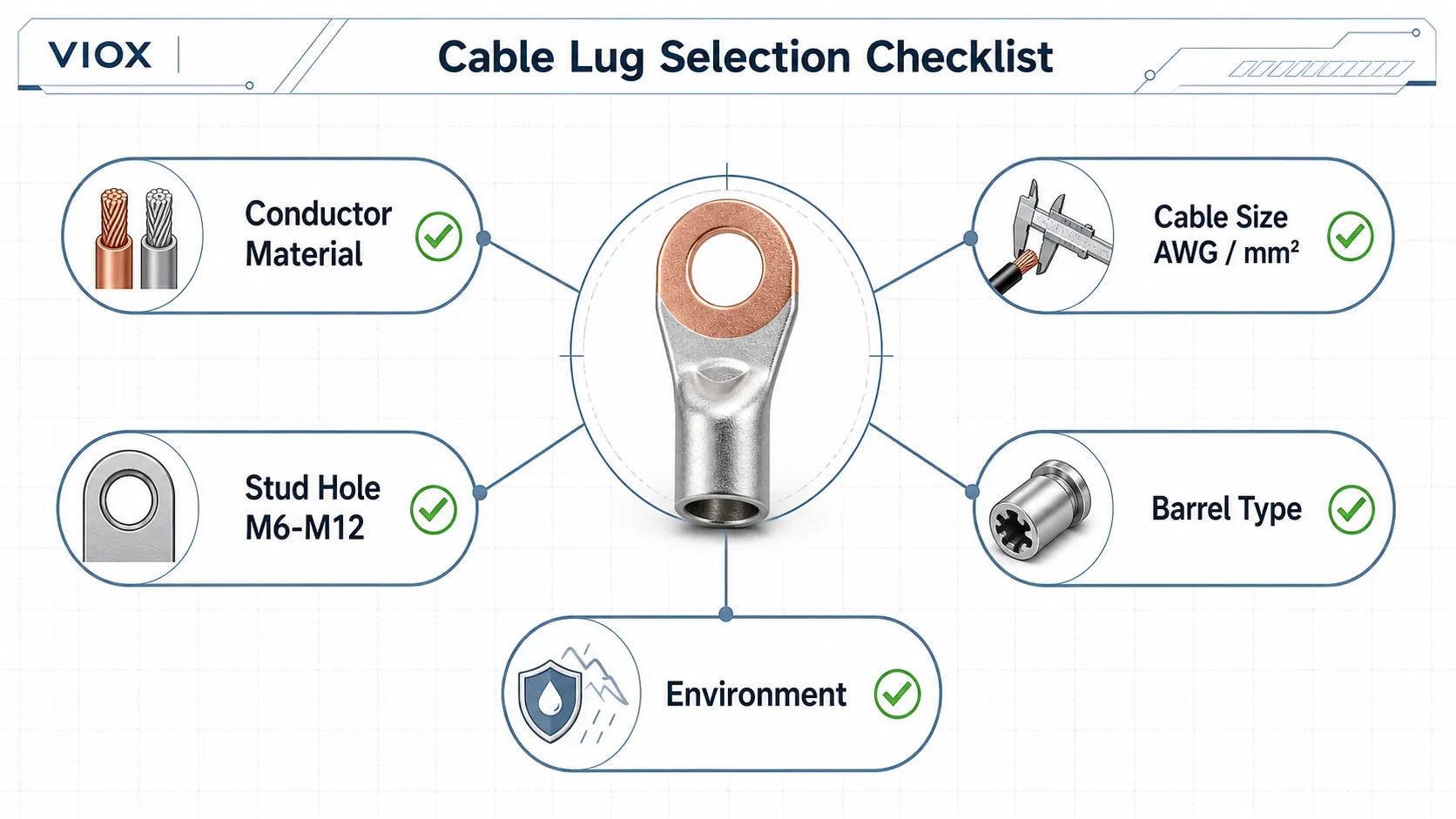
Cable lugs are conductive terminals used to connect cables to busbars, circuit breakers, batteries, switchgear, terminal blocks, grounding points, and power distribution equipment. To choose the right cable lug, match the conductor material, cable size, stud hole, lug material, barrel type, crimping method, installation environment, and applicable standard.
In practical electrical work, a cable lug is not just a metal end fitting. It is a controlled electrical and mechanical connection. If the lug is too large, too small, poorly crimped, made from the wrong material, or installed on the wrong stud size, the connection can loosen, overheat, corrode, or fail under load.
For buyers and panel builders, this guide explains how to select cable lugs more reliably. For direct product evaluation, see the VIOX cable lug product range.
Cable Lug Selection at a Glance
| Selection factor | What to check | Why it matters |
|---|---|---|
| Conductor material | Copper, aluminum, or aluminum-to-copper transition | Prevents galvanic corrosion and poor conductivity |
| Cable size | AWG or mm² conductor cross-section | Lug barrel must match the conductor |
| Stud hole | M6, M8, M10, M12, or other bolt/stud size | Ensures secure bolted contact area |
| Lug material | Copper, tinned copper, aluminum, or bimetallic | Affects conductivity, corrosion resistance, and compatibility |
| Barrel type | Standard, long barrel, short barrel, flared barrel, inspection window | Affects crimp area, insertion, and inspection |
| Termination method | Compression, mechanical, solder, or shear-bolt type | Determines tool requirement and installation quality |
| Environment | Indoor, outdoor, marine, industrial, corrosive, high-vibration | Influences plating, sealing, insulation, and maintenance needs |
| Standard or approval | UL, IEC, DIN, project specification, or utility requirement | Determines acceptance in the target market |
Main Types of Cable Lugs
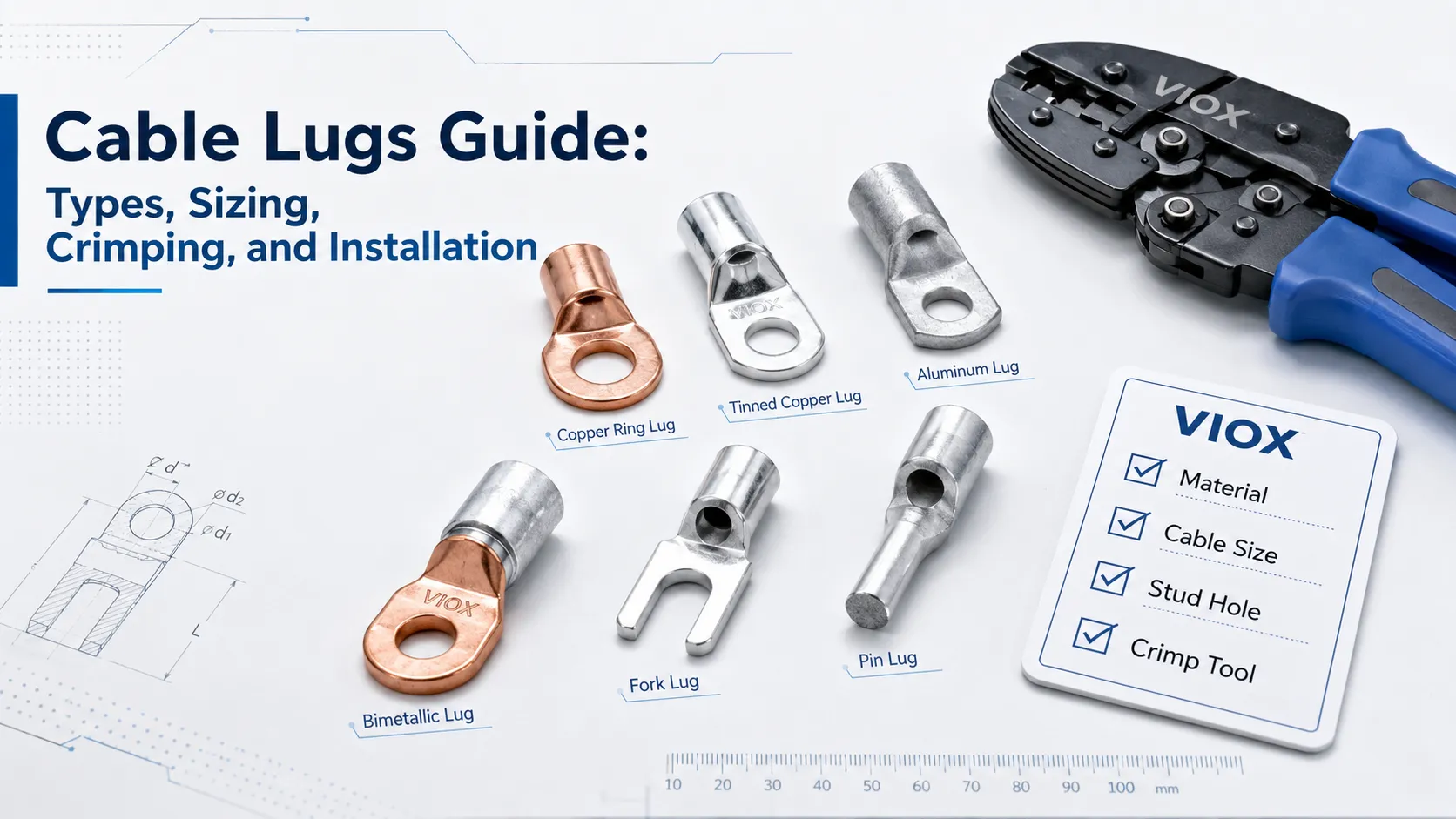
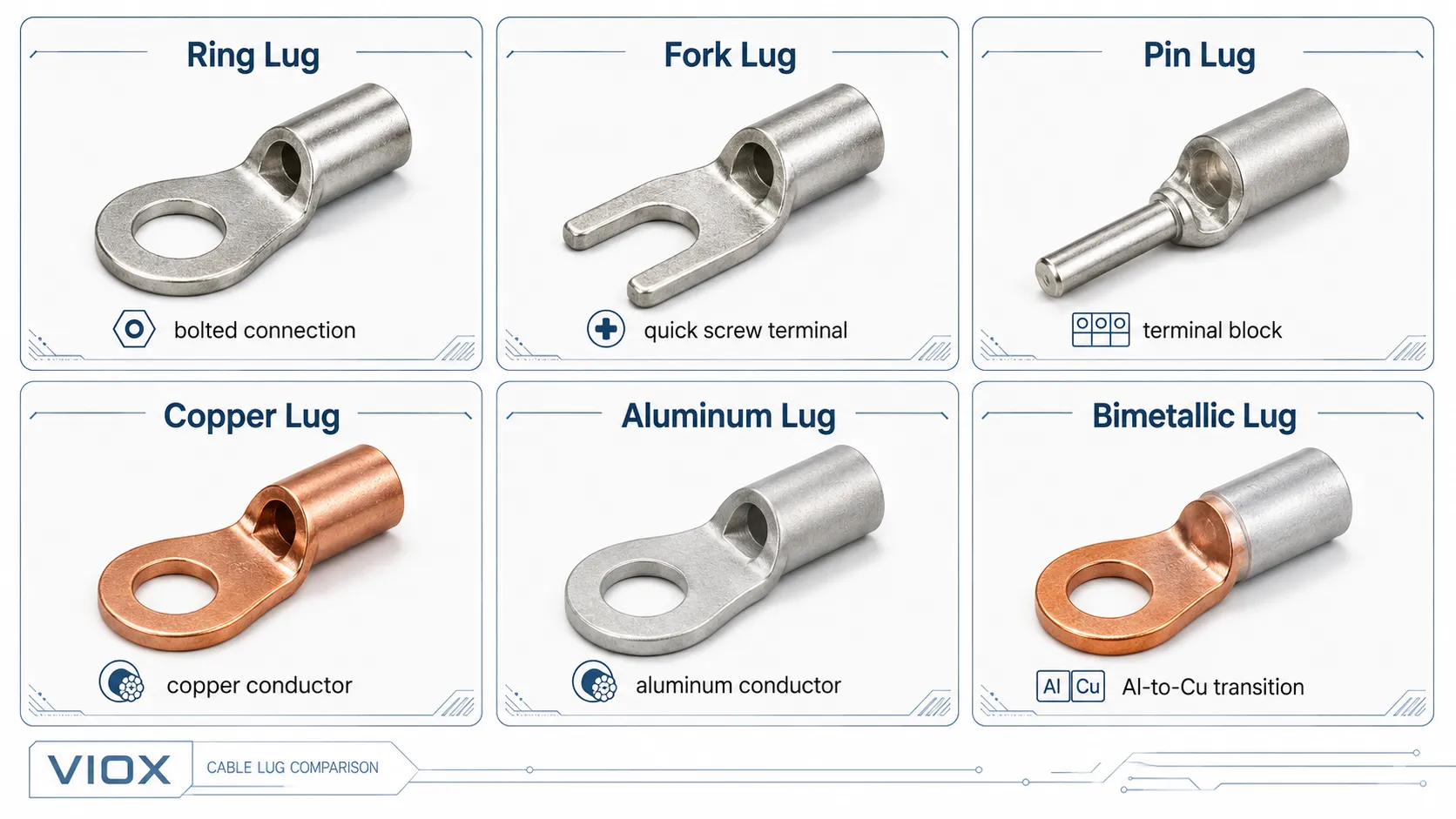
Cable lug names often describe either the shape of the connection end or the material used. The right choice depends on the equipment terminal, cable type, and installation conditions.
| Lug type | Best use | Key selection check |
|---|---|---|
| Ring lug | Secure bolted connections in panels, batteries, switchgear, and grounding | Stud hole must match the bolt size |
| Fork or spade lug | Connections where the screw can be loosened without full removal | Use only where the terminal design permits fork lugs |
| Pin lug | Terminal blocks and compact control wiring | Pin size must match terminal clamp geometry |
| Copper lug | Copper conductors and low-resistance power connections | Match cable size and plating requirement |
| Tinned copper lug | Copper conductors in environments needing better surface corrosion resistance | Check plating quality and compatibility |
| Aluminum lug | Aluminum conductors | Requires correct compound, surface preparation, and compatible equipment |
| Bimetallic lug | Aluminum cable to copper busbar or copper equipment terminal | Prevents direct aluminum-copper interface problems |
| Mechanical lug | Field termination without compression tooling in some applications | Torque and conductor range must follow manufacturer instructions |
| Compression lug | Permanent crimped power connection | Requires correct die, tool, and crimp sequence |
How to Choose the Right Cable Lug
The safest selection method is to start with the conductor and the equipment terminal, not with the lug photo.
1. Match the Conductor Material
Copper cable should normally use copper or tinned copper lugs. Aluminum cable should use aluminum lugs or approved bimetallic lugs when connecting to copper busbars or copper equipment terminals.
Directly mixing copper and aluminum without the correct transition component can create galvanic corrosion, oxide buildup, higher contact resistance, and heating. In field work, this is one of the easiest ways to create a connection that looks acceptable on installation day but fails later under load.
For deeper copper-lug selection, see VIOX’s guide on how to choose the right copper lug.
2. Match Cable Size to Lug Barrel Size
The cable conductor must fit the lug barrel correctly. A barrel that is too large can leave voids after crimping. A barrel that is too small can damage strands or prevent full conductor insertion.
Check the lug marking and datasheet for:
- cable cross-section in
mm²or AWG - conductor class compatibility, such as solid, stranded, or flexible cable
- maximum insulation diameter if using insulated lugs
- barrel length and crimp location
- whether the lug is designed for fine-stranded cable
Do not select a lug only by “it fits physically.” Electrical contact quality depends on controlled deformation during crimping or clamping.
3. Match the Stud Hole to the Equipment
The lug palm hole should match the equipment stud or bolt. If the hole is too small, installers may drill it out, damaging plating and reducing contact quality. If the hole is too large, the connection may have poor contact area, poor centering, and higher risk of loosening.
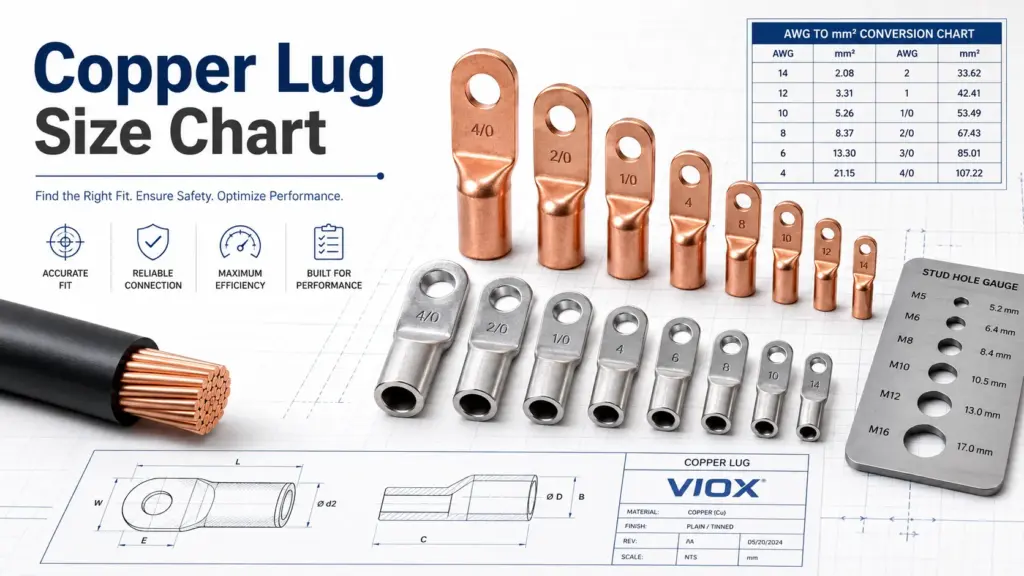
Common stud holes include metric sizes such as M6, M8, M10, and M12, but the correct value must come from the equipment terminal design.
4. Choose the Right Lug Material and Plating
Copper offers high conductivity and is widely used for power connections. Tin plating is often used to improve surface corrosion resistance and solderability, especially where oxidation is a concern. Aluminum reduces weight and material cost but requires careful connection design. Bimetallic lugs are used when aluminum conductors must terminate onto copper equipment.
For material property background, the VIOX article on conductivity, resistivity, and %IACS explains why material choice affects voltage drop, heating, and contact reliability.
5. Check the Installation Environment
The same cable lug may perform differently in a dry control cabinet, a battery room, a marine enclosure, or an outdoor distribution box. Consider:
- moisture and condensation
- salt fog or corrosive atmosphere
- vibration
- thermal cycling
- UV exposure if the termination is exposed
- chemical contamination
- enclosure temperature rise
In harsh environments, tinned copper, sealed insulation, heat-shrink tubing, corrosion inhibitor, or bimetallic transition designs may be needed depending on the conductor and installation.
Copper vs Aluminum vs Bimetallic Cable Lugs
| Lug material | Typical conductor match | Strength | Risk if misused |
|---|---|---|---|
| Copper lug | Copper conductor | High conductivity, strong power connection | Not suitable for direct aluminum transition unless approved |
| Tinned copper lug | Copper conductor, corrosion-prone environments | Better surface corrosion resistance than bare copper | Plating damage can reduce long-term surface protection |
| Aluminum lug | Aluminum conductor | Compatible with aluminum cable | Oxide film and thermal expansion require correct preparation |
| Bimetallic lug | Aluminum conductor to copper busbar or terminal | Controlled aluminum-copper transition | Wrong orientation or poor installation defeats the purpose |
Compression vs Mechanical vs Solder Cable Lugs
Compression Cable Lugs
Compression lugs are installed using a crimping tool and die. When properly matched, the crimp compresses the conductor and barrel into a low-resistance mechanical and electrical joint.
They are common in switchgear, batteries, grounding systems, power distribution panels, renewable energy systems, and industrial electrical assemblies.
The key requirement is tool compatibility. A good lug can still fail if it is crimped with the wrong die, wrong tool force, wrong crimp count, or wrong crimp location.
Mechanical Cable Lugs
Mechanical lugs use screws, bolts, or clamp mechanisms to secure the conductor. They are useful in field installations where compression tooling may not be available or where equipment terminals are designed for mechanical termination.
The installer must follow the exact manufacturer instructions for conductor preparation, torque, conductor range, and re-use limitations. Do not apply one generic torque value to every mechanical lug.
Solder Cable Lugs
Solder lugs are less common in heavy power distribution than compression or mechanical lugs. They may be used in some electronics, light-duty, or specialty applications, but soldered power connections can be sensitive to heat, vibration, and workmanship. Use them only where the application and manufacturer instructions support that method.
How to Crimp Cable Lugs Correctly
Cable lug crimping quality determines whether the connection is simply “attached” or actually reliable.
Field Crimping Checklist
| Step | What to verify | Common failure if skipped |
|---|---|---|
| Identify conductor | Material, size, strand class, insulation diameter | Wrong lug selected |
| Select lug | Correct material, barrel, stud hole, standard, and environment fit | Loose joint or corrosion |
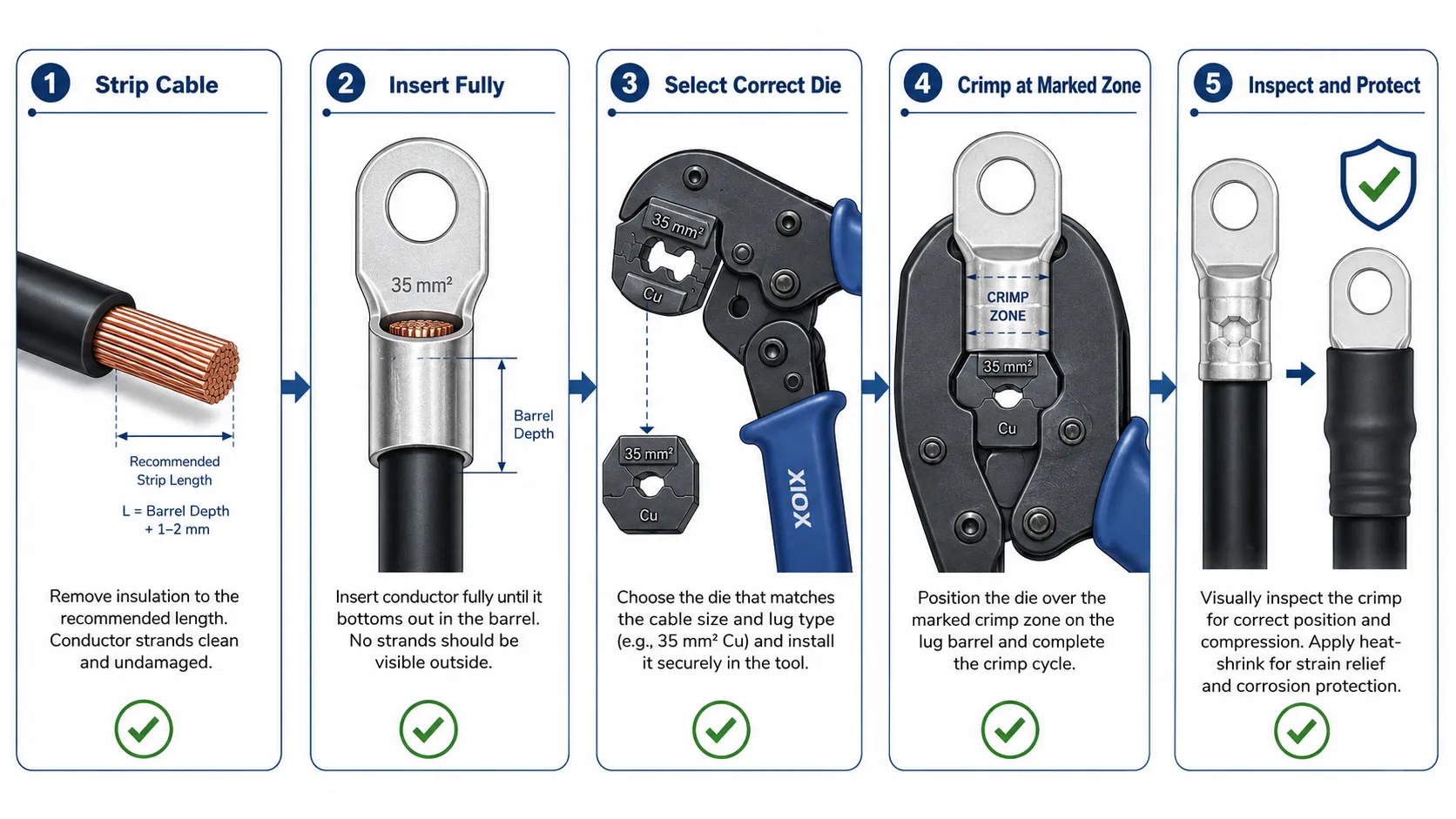
| Strip cable | Correct strip length without cutting strands | Reduced conductor area |
| Insert conductor | Full insertion into barrel | Weak pull-out strength and hot joint |
| Select die/tool | Lug and tool manufacturer compatibility | Poor compression and high resistance |
| Crimp at marked zone | Correct crimp position and sequence | Barrel deformation or incomplete crimp |
| Inspect crimp | No cracks, missing strands, poor insertion, or loose barrel | Early failure under load |
| Protect termination | Heat-shrink, insulation boot, inhibitor, or enclosure protection as needed | Corrosion, tracking, or accidental contact |
What a Good Crimp Should Achieve
A correct crimp should create:
- low electrical resistance
- strong mechanical retention
- stable contact pressure
- minimal voids inside the barrel
- no cut strands
- no cracked barrel
- no loose conductor movement
If the crimp looks crushed, split, under-compressed, off-center, or only partially filled, do not treat it as acceptable just because the conductor does not immediately fall out.
Common Cable Lug Installation Mistakes
| Mistake | Risk |
|---|---|
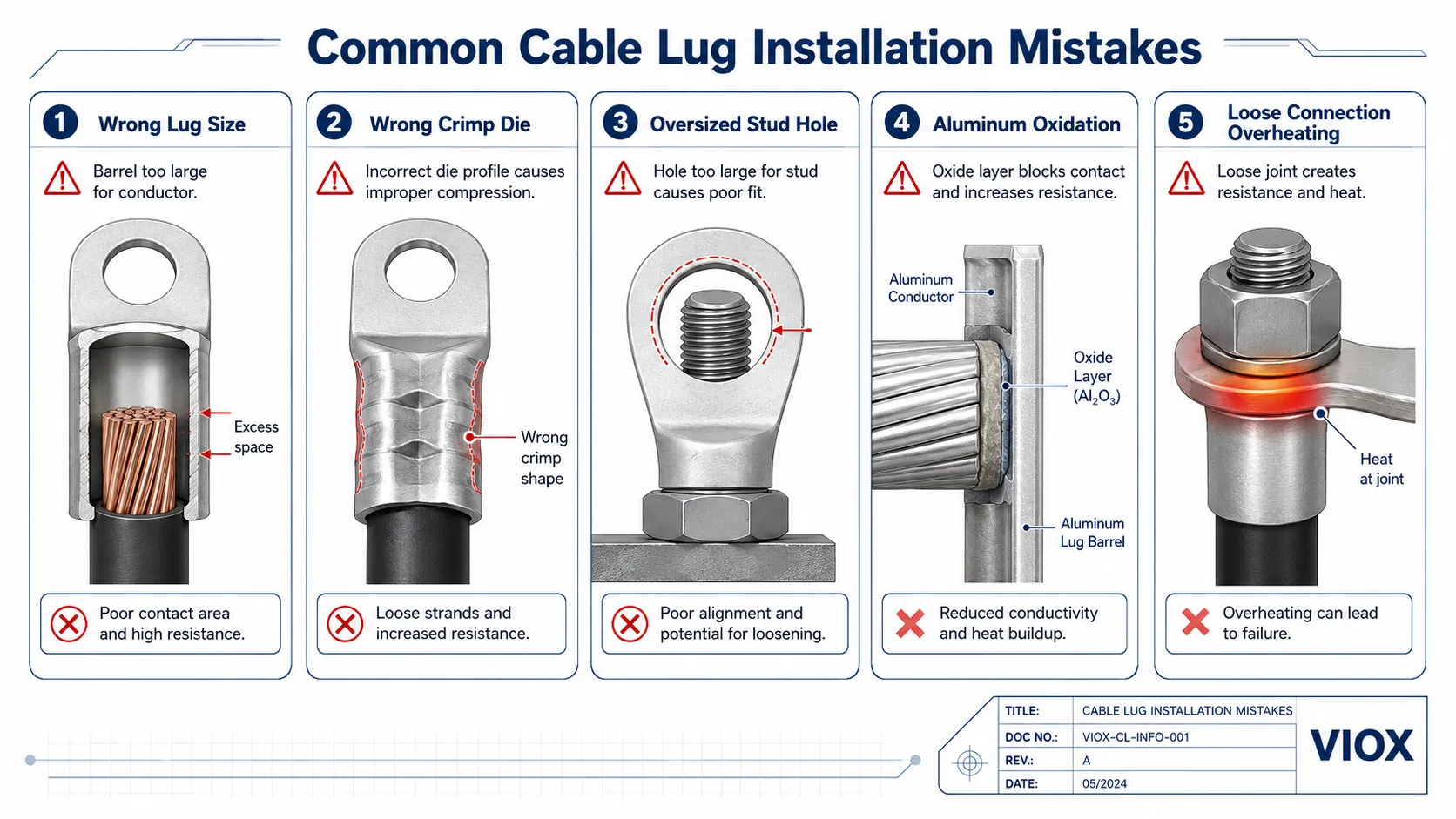
| Wrong cable size | Loose joint, overheating, pull-out, or poor crimp fill |
| Wrong crimp die | High resistance, poor mechanical strength, cracked barrel |
| Copper lug on aluminum cable | Galvanic corrosion and heating risk unless specifically approved |
| Aluminum cable without proper preparation | Oxide buildup and unstable contact resistance |
| Wrong stud hole | Poor contact area or mechanical looseness |
| Under-tightened mechanical lug | Hot spot, vibration loosening, intermittent failure |
| Over-tightened mechanical lug | Damaged conductor, stripped thread, or deformed lug |
| Missing heat-shrink or insulation where required | Accidental contact, tracking, or corrosion |
| Reusing a compression lug | Uncontrolled connection quality |
| Drilling or modifying lug palm | Damaged plating and reduced contact area |
Why Cable Lug Connections Overheat
Most cable lug overheating problems trace back to contact resistance. Even a small increase in resistance can create heat because power loss follows:
P = I²RThat means heating rises with the square of the current. A slightly loose or poorly crimped lug may not show a problem at low load but become a serious hotspot at operating current.
Common causes include:
- poor crimp compression
- wrong lug size
- conductor strands cut during stripping
- aluminum oxidation
- incompatible metals
- loose bolted joint
- contaminated contact surface
- overloaded conductor
- poor enclosure heat dissipation
For a wider field-diagnosis approach, the VIOX article on terminal block overheating in control panels explains how contact resistance, load current, torque, and environment create hot connections.
Cable Lug Standards and Specifications
Cable lug requirements depend on market, cable type, voltage class, equipment application, and project specification. Do not assume one approval covers every installation.
| Standard or specification area | Typical relevance | Practical note |
|---|---|---|
| UL 486A-486B | Wire connectors and soldering lugs for North American contexts | Check whether the lug and conductor combination is covered |
| IEC 61238-1 | Compression and mechanical connectors for power cables up to specified voltage classes | Often relevant for power cable connector performance |
| DIN 46235 | Compression cable lugs for copper conductors in DIN-based contexts | Common reference for metric copper compression lugs |
| Manufacturer datasheet | Exact conductor range, tool, die, stud hole, and crimp method | The most important document for actual installation |
| Project or utility specification | Acceptance requirements for site work | May be stricter than general catalog guidance |
This section is a selection map, not a certification claim for any specific VIOX model. Always verify the exact cable lug series, conductor size, tool, and market requirement before purchase or installation.
Where Cable Lugs Are Used
Cable lugs are used anywhere a cable must be connected securely to an electrical device, busbar, terminal, or grounding point.
Common applications include:
- low-voltage switchgear
- distribution boxes
- control panels
- circuit breakers
- busbars
- batteries and energy storage systems
- solar and DC power systems
- grounding and bonding points
- transformers
- motors and drives
- power distribution blocks
- terminal blocks and marshalling panels
When the design involves compact panel distribution, VIOX power distribution blocks and terminal blocks may also be relevant alongside cable lugs.
Cable Lug Inspection and Maintenance
Cable lug inspection should focus on both electrical and mechanical symptoms.
Look for:
- discoloration around the lug or insulation
- melted insulation or heat-shrink
- loose bolts or terminals
- corrosion or white oxide on aluminum connections
- cracked barrel or palm
- cable movement at the barrel
- abnormal heating compared with similar connections under similar load
- signs of arcing or pitting
Thermal inspection can help identify hotspots, but temperature readings must be interpreted with load current, ambient temperature, emissivity, and comparison to similar nearby connections. Do not judge a connection from one isolated thermal image without context.
How VIOX Fits Into Cable Lug Selection
VIOX supplies cable lugs for electrical connection applications where conductor compatibility, material selection, barrel size, stud hole, and installation quality matter. If you are selecting cable lugs for distribution boxes, switchgear, power distribution blocks, grounding connections, or control panels, start with the conductor size and equipment terminal, then confirm the product datasheet.
For manufacturing and quality-control background, see how cable lug manufacturing works. If your task is supplier comparison rather than product selection, the top cable lug manufacturers page fits that search intent better.
FAQ
What is a cable lug used for?
A cable lug is used to terminate a cable and connect it to equipment such as a busbar, circuit breaker, battery, terminal block, grounding point, or power distribution device.
How do I choose the right cable lug size?
Match the lug barrel to the conductor size in AWG or mm², then match the palm hole to the equipment stud size. Also check conductor material, strand class, crimping tool, and installation environment.
Can I use a copper lug on aluminum cable?
Do not assume this is acceptable. Aluminum conductors usually require aluminum-compatible lugs or bimetallic lugs when connecting to copper equipment. Direct copper-aluminum contact can create corrosion and heating risk unless the product is specifically designed and approved for that use.
What is a bimetallic cable lug?
A bimetallic cable lug is designed to connect an aluminum conductor to a copper busbar or copper equipment terminal. It provides a controlled transition between dissimilar metals.
What happens if I use the wrong crimp die?
The crimp may be under-compressed, over-compressed, off-center, or mechanically weak. This can increase resistance, reduce pull-out strength, damage the barrel, and create overheating under load.
Are solder lugs better than crimp lugs?
Not generally for heavy power connections. Compression lugs are widely used because a correct crimp provides controlled mechanical and electrical performance. Solder lugs should be used only where the application and manufacturer instructions support solder termination.
Why do cable lug connections overheat?
They usually overheat because of high contact resistance, overload, loose bolted joints, poor crimping, incompatible materials, oxidation, or poor conductor preparation.
Should cable lugs be tinned?
Tinned copper lugs are useful where surface corrosion resistance is important. Whether they are required depends on the conductor, environment, equipment terminal, and project specification.
What standards apply to cable lugs?
Common references include UL 486A-486B, IEC 61238-1, DIN 46235, manufacturer datasheets, and project or utility specifications. The correct standard depends on the market and application.
Can a cable lug be reused after crimping?
Compression lugs should generally not be reused after crimping because the barrel has already been permanently deformed. Use a new lug and follow the correct crimping procedure.
Conclusion
Cable lug selection should not be reduced to appearance or nominal current. A reliable termination depends on conductor material, conductor size, lug barrel, stud hole, material compatibility, crimping method, installation environment, and documentation.
If the connection is part of a power distribution system, switchgear assembly, battery system, grounding point, or control panel, the cable lug is a small component with large consequences. Select it like a critical connection component, not a generic accessory.