

On this page
High-quality cable ties match the specified part, perform as required, and arrive with evidence that supports their claimed ratings. Check the strap and locking head for defects, then verify the material, loop tensile strength, environmental ratings, including ultraviolet (UV) resistance, and documentation for the exact product. A glossy finish, black color or strong hand pull cannot establish all of these properties.
This checklist focuses on nylon cable ties received for electrical installations and panel assembly. If the specification has not yet been chosen, start with the cable tie selection guide. Inspection should verify an agreed requirement, not create one after the shipment arrives.
Cable Tie Quality Checklist: What Each Check Can Establish
Separate three evidence levels: physical screening, product documentation, and method-matched testing. Each answers a different question.
| Check | Useful evidence | Limit of the check |
|---|---|---|
| Product identity | Part number, supplier, lot identifier and approved specification | An unidentified sample cannot establish compliance of a delivered lot |
| Visible condition | Strap, head, teeth and edges inspected against agreed defect criteria | Good appearance does not establish polymer formulation or environmental performance |
| Locking function | Correct threading and engagement on designated samples | A manual check does not measure rated loop tensile strength |
| Mechanical performance | Relevant test report with identified samples, conditions and acceptance criteria | An unexplained force reading is insufficient for a standard-compliance claim |
| Environmental suitability | Exact-part UV, installation-temperature and operating-temperature declarations with supporting evidence | Color and material family are insufficient substitutes |
| Certification claim | Applicable product record and markings matched to the delivered part | A resin certificate or another model’s record does not verify this tie |
Use screening to find obvious problems quickly. Use documentation and testing to resolve properties that cannot be seen.
1. Record the Specified Part and Delivered Lot
Before opening the packaging, photograph its label and record the purchase-order line, manufacturer or supplier, part number, dimensions, material designation and available lot code. Compare these with the approved sample or drawing revision.
The receiving specification should identify which requirements matter: strap dimensions, usable bundle diameter, declared loop strength, environmental suitability and any required product certification. If traceability or a particular test report is required, make that part of the order rather than an informal request after delivery.
Agree on the sampling method, defect categories, test method and release criteria with the supplier or quality team. There is no universal rule that ten random ties, a fixed dimensional tolerance or a particular percentage of strength variation will qualify every shipment.
Keep samples from different lots separate. Record any mixed packaging, changed part number or unexplained substitution before testing. Otherwise, a passing sample can become detached from the shipment it is supposed to represent.
2. Inspect the Strap, Head and Locking Function
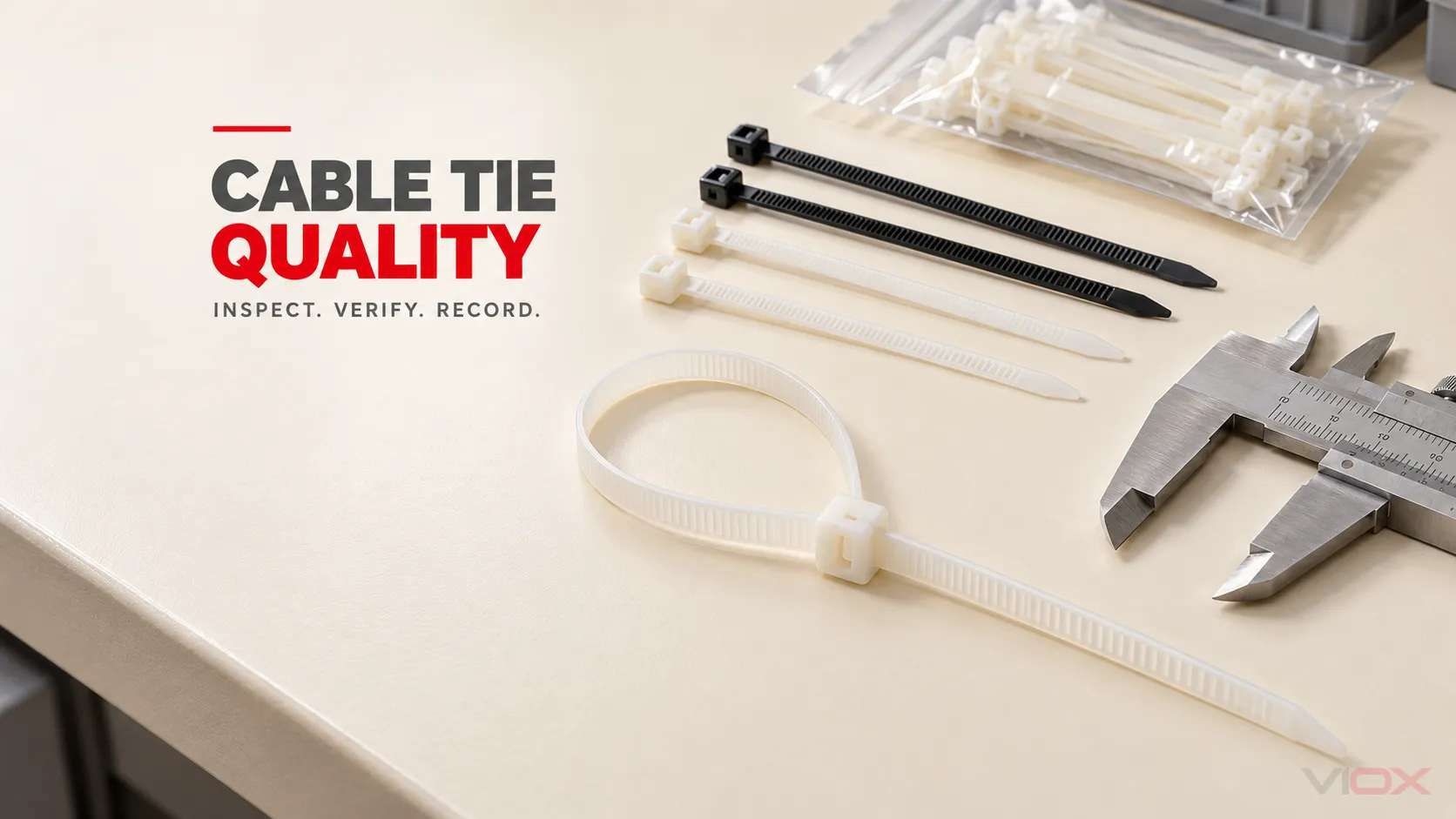
Under adequate light, inspect designated samples for cracks, incompletely formed areas, damaged teeth, foreign particles and burrs that could affect installation or retention. Pay particular attention to the head opening, the transition between the head and strap, and both strap edges.
Compare dimensions with the drawing or agreed tolerances, measuring at defined locations. A nominal width in a catalog is not automatically the tolerance for every point on the strap. For an initial size cross-check, use the cable tie size chart, then verify the exact manufacturer’s dimensions.
Thread the strap in the intended direction and check that it engages as instructed. Use a representative bundle or designated fixture within the declared bundle range. Unexpected slipping, cracking or inability to thread calls for investigation; the severity and lot disposition should follow the agreed inspection plan.
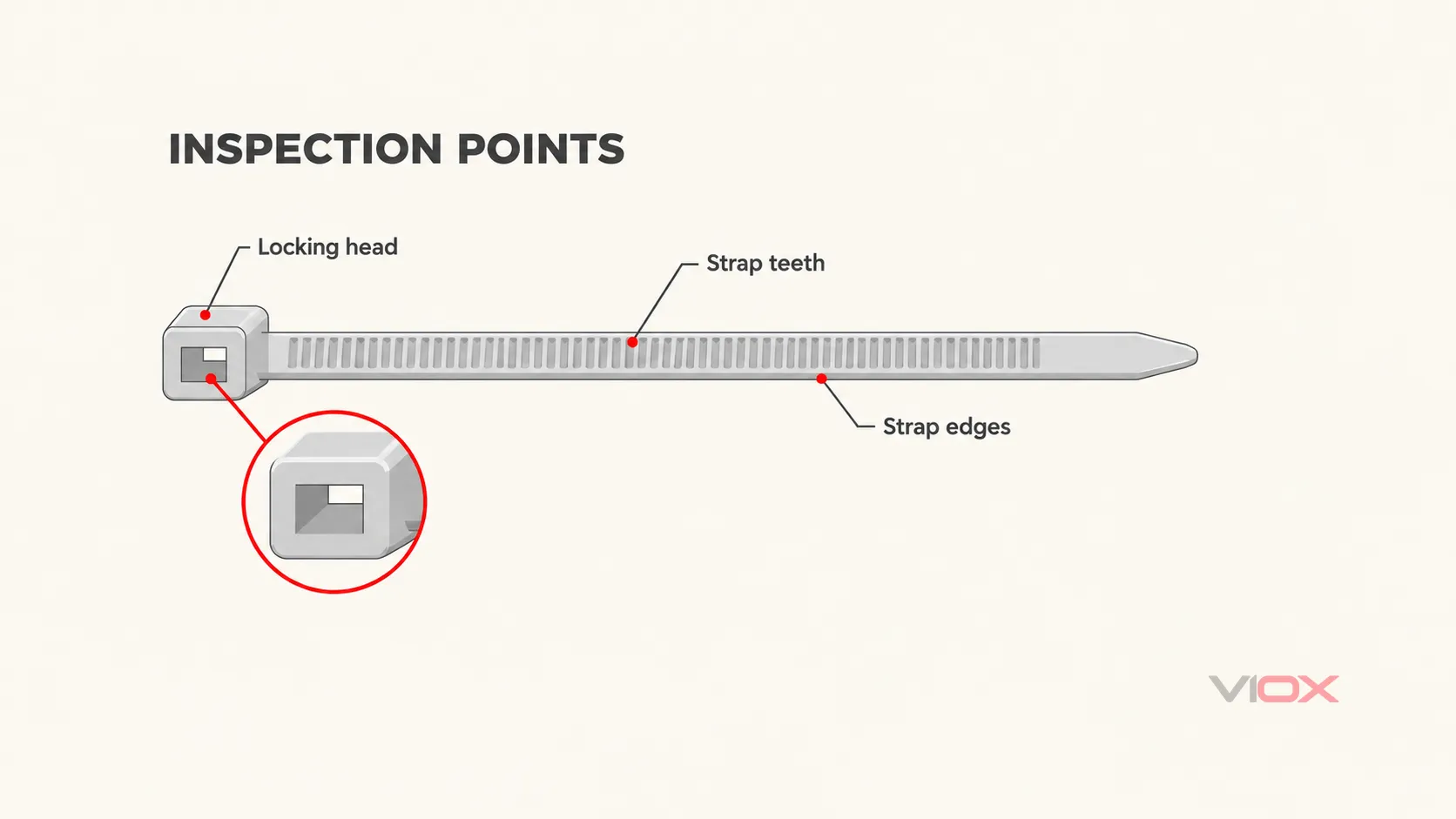
Do not pull harder until a sample breaks and call the result a strength test. Keep inspection samples out of the installation if they have been overstressed or damaged. Surface gloss, uniform color and a crisp locking sound may help describe a sample, but they do not certify quality.
3. Verify Material and Environmental Claims
PA66 Is a Material Designation, Not a Complete Rating
A label stating PA66 identifies polyamide 66, also called nylon 66. It does not, by itself, prove the delivered formulation, UV suitability or finished-product strength. Ask for the material declaration and its connection to the supplied part or production lot.
If virgin resin, recycled content or a specified formulation is a contractual requirement, request evidence appropriate to that claim. Appearance, weight and hand bending cannot quantify recycled content. Where material identity is disputed, a qualified laboratory can advise on methods such as infrared analysis, differential scanning calorimetry or thermogravimetric analysis. These are among the methods described in UL’s plastics testing program; their ability to resolve a particular dispute depends on the formulation and available reference material.
Do not burn cable ties or judge smoke and odor to identify nylon. Such an improvised test creates an avoidable exposure and does not produce defensible material-identification evidence.
Verify UV Resistance and Temperature Separately
For outdoor ties, check the exact product’s UV-resistance declaration and supporting record. Black color alone is insufficient. Also distinguish the minimum installation temperature, when the tie is wrapped and tightened, from its operating-temperature range after installation. A cold-service rating does not automatically authorize installation at the same temperature. UL’s cable tie application guide treats these as separate characteristics.
Ask whether the supplied color and material variant are included in the evidence. An indoor natural-color part and an outdoor-rated black variant can share dimensions without sharing all ratings.
For nylon, packaging and storage conditions also deserve attention because moisture affects material behavior. Follow the manufacturer’s storage instructions rather than assuming a brittle sample proves inferior resin. The same UL application guide discusses moisture and storage. Do not invent a soaking, oven or freezer procedure to make a shipment pass.
UV testing or a temperature declaration should not be converted into an unsupported number of outdoor service years. Ask for the conditions and limitations behind any lifespan claim.
4. Review Loop Tensile Strength Evidence Correctly
Cable tie loop tensile strength concerns a closed tie with the locking mechanism engaged: the strap and lock are loaded together. It is different from the polymer’s material tensile strength and does not establish long-term static load capacity. UL’s cable tie guidance explains this distinction.
Check the units. Force is normally expressed in newtons or pound-force; material tensile stress is expressed in units such as megapascals. For example, 50 lbf is approximately 222 N. That conversion is not permission to suspend a 50 lb object from the tie. For load interpretation, see zip tie tensile strength versus safe load.
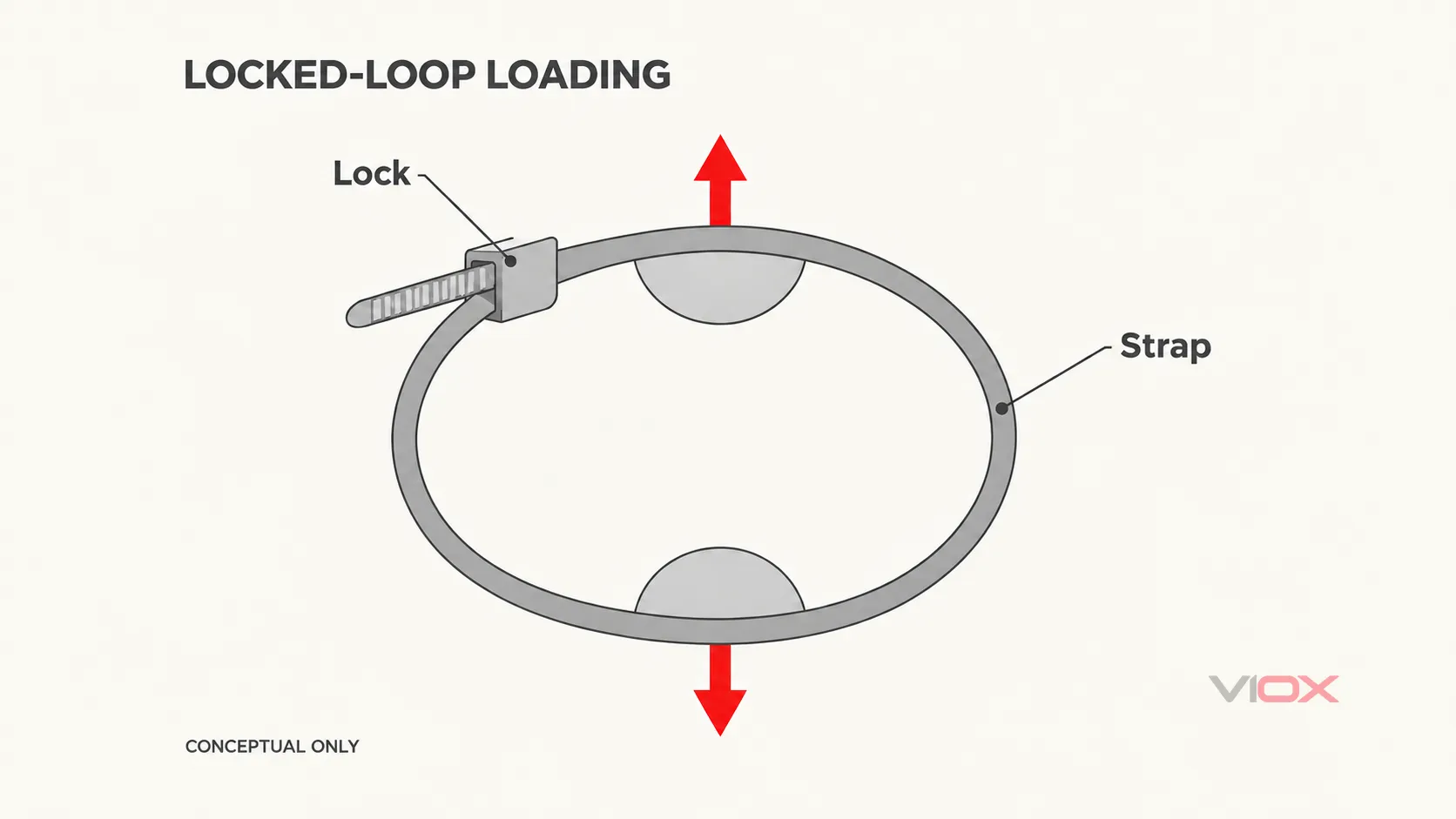
Before accepting a report, check that it identifies:
- The tested part, material/color variant, sample identifiers and relationship to the delivered lot.
- The standard and edition or agreed method, including the declared product classification where relevant.
- Sample preparation and conditioning, fixture arrangement, loading method and test conditions.
- The declared acceptance requirement, individual results and observations, rather than only an unexplained average.
- The laboratory or responsible tester, test date and relevant equipment/calibration information.
The investigation can depend on the declared Type; do not assume every classification uses the same break-to-failure test. UL describes Type-dependent methods in its cable tie guidance. A failure at the lock is useful information to investigate, but a universal rule that a good tie must always break in the strap is unjustified.
A hand pull or spring-scale demonstration can reveal gross weakness. It does not become a compliant test merely because its reading exceeds a catalog number. Formal verification needs the specified method, suitable equipment and a controlled setup. Use designated samples, guarding and qualified personnel; never conduct destructive testing on an installed cable bundle.
5. Match Certification and Other Documents to the Product
IEC 62275:2022 covers cable ties and fixing devices for managing and securing wiring systems. Citing the standard is not the same as supplying a certificate or test report. The official IEC scope also notes that support applications may require additional considerations.
Where a UL claim matters, check the applicable record in UL Product iQ. Match the company, product family, part or covered series, ratings and limitations with the supplied packaging and documentation. If the exact part is unclear, request clarification before releasing it on the strength of the claim.
Distinguish UL Listed products from UL Recognized components and their applicable conditions. A mark copied onto a sales sheet is insufficient; UL’s cable tie guidance explains the different certification contexts. Do not assume every electrical cable tie must carry the same certification in every market.
Other documents answer different questions:
- A resin-level UL 94 rating does not establish certification of the finished tie or its suitability for every installation. UL describes the material tests and their scope in its plastics fire testing guidance.
- Restriction of Hazardous Substances (RoHS) documentation concerns restricted substances, not loop strength or UV performance. Check its relevance to the supplied product and destination; the European Commission’s RoHS overview describes that regulatory scope.
- A company management-system certificate does not replace exact-product evidence or lot inspection.
Do not accept a folder of unrelated certificates as a substitute for a traceable answer about the delivered part.
6. Decide: Accept, Hold or Reject
The following is a receiving-decision framework, not a standardized sampling plan. Apply it with your agreed defect definitions and release authority.
| Finding | Disposition | Required next action |
|---|---|---|
| Identity, sampled condition and required evidence meet the agreed criteria | Accept through the authorized quality process | Record the evidence and release decision |
| Samples appear usable, but a required UV, strength or certification claim is not traceable | Hold | Obtain the missing exact-part evidence or resolve the requirement |
| Cracking or locking defects are found, or a method-matched test fails the agreed criterion | Segregate and reject or investigate under the quality procedure | Record the nonconformity and determine its lot-level consequence |
| Packaging or part identity differs from the approved order | Hold as a suspected substitution | Confirm identity; do not release against the original specification without approval |
For example, two black ties may look identical. If an outdoor-rated tie was specified, an indoor tie with an undocumented claim remains a mismatch, even if it feels strong. The release decision should follow the specification and evidence, not a visual preference.
Keep a Reusable Inspection Record
Use one record per lot or other defined inspection unit:
Purchase order / approved specification revision:
Supplier / manufacturer / delivered part number:
Lot or batch identifier / quantity / receipt date:
Required dimensions, material and environmental ratings:
Sampling plan / sample identifiers:
Visual and locking observations / photographs:
Required documents / report IDs / covered part variants:
Test method, conditions and results, if applicable:
Nonconformities / missing evidence / supplier response:
Accept, hold or reject / responsible approver / date:
This record makes a quality decision repeatable and gives the supplier a specific issue to resolve. When evaluating VIOX cable ties, send the required dimensions, bundle range, material, environment and documentation requirements to [email protected]. Request the evidence for the proposed part before treating a general catalog claim as project approval.
Sources and Standards
- IEC 62275:2022: Cable management systems – Cable ties for electrical installations.
- UL Solutions: Cable Ties for Cable Management.
- UL Solutions: Cable Tie Application Guide.
- UL Solutions: Plastics Testing and Plastics Fire Testing.
- UL Product iQ certification database.
- European Commission: RoHS Directive.