

On this page
Quick Answer: Best Busbar Manufacturers for Electrical Panels
For electrical panels, circuit breaker systems, load centers, and low-voltage distribution boards, the strongest busbar manufacturers are not all the same type of company.
Some are global switchgear manufacturers, such as Schneider Electric, Siemens, ABB, Eaton, and Legrand. Some are specialist busbar or power-interconnection suppliers, such as Mersen, Rogers, EAE, and Altech. Others, such as VIOX Electric, focus more directly on low-voltage panel accessories, MCB busbars, pin-type busbars, fork-type busbars, and circuit breaker connection systems.
If you are sourcing busbars for a panel project, do not choose only by brand name. Check the actual busbar type, copper or aluminum grade, plating, pitch, current rating, short-circuit withstand, insulation, breaker compatibility, and documentation.
Key Takeaways
- “Busbar manufacturer” is a broad search term. It can mean MCB comb busbars, panelboard busbars, busbar trunking, laminated busbars, copper busbars, or load center busbars.
- Circuit breaker busbars need exact compatibility. Tooth pitch, terminal type, phase configuration, and breaker series must match.
- Load center busbar quality depends on contact pressure, plating, heat rise, and breaker fit. A famous brand is not enough if the busbar and breaker interface are mismatched.
- IEC and UL projects require different documentation. IEC 61439, UL 67, UL 857, UL 508A, and product-specific listings may matter depending on market and application.
- VIOX is most relevant for MCB busbars and low-voltage panel accessories. For large busway or busbar trunking systems, global switchgear brands may be stronger.
How We Selected These Busbar Manufacturers
This list is not a financial ranking. It compares busbar manufacturers from a buyer’s perspective, especially for electrical panels, circuit breaker distribution, MCB busbars, load centers, low-voltage switchgear, and OEM panel assembly.
| Selection Factor | Why It Matters |
|---|---|
| Product scope | Separates MCB comb busbars, busbar trunking, laminated busbars, and custom copper busbars |
| Electrical rating | Current rating, voltage rating, and short-circuit withstand must match the panel design |
| Breaker compatibility | Circuit breaker busbars must fit the exact terminal style and spacing |
| Material quality | Copper grade, aluminum grade, plating, and insulation affect heat rise and service life |
| Standards support | IEC/UL documentation reduces project approval risk |
| Customization | OEMs often need special length, pitch, pole count, phase arrangement, or packaging |
| Global supply | Distributors and panel builders need stable sourcing and replacement availability |
| Technical support | Correct selection prevents overheating, loose contact, and failed inspection |
Busbar Manufacturer Comparison Table
| Manufacturer | Main Busbar Strength | Best For | Buyer Note |
|---|---|---|---|
| Schneider Electric | Low-voltage distribution systems, panel infrastructure, busbar trunking | Large commercial and industrial projects | Strong system integration; verify product family and local availability |
| Siemens | Switchgear, panelboard, and busbar trunking systems | Industrial distribution and infrastructure | Strong for engineered systems; less focused on generic MCB comb busbars |
| ABB | Electrification products, low-voltage distribution, breaker systems | Global panel and switchgear projects | Good fit when busbar and breaker are purchased as a system |
| Eaton | Load centers, switchboards, panelboards, busway | North American and global distribution projects | Strong where UL ecosystem and panel compatibility matter |
| Legrand | Busbar trunking, panel distribution, building electrical infrastructure | Commercial buildings and structured distribution | Good for building distribution systems and standardized projects |
| Mersen | Laminated busbars, power electronics, fuses, protection systems | EV, power electronics, renewable energy, high-performance assemblies | Strong for engineered interconnection, not just breaker comb busbars |
| Rogers | Laminated busbar technology for high-power electronics | EV, inverter, traction, battery, and power conversion systems | Best for laminated busbar engineering rather than standard panel busbars |
| EAE Elektrik | Busbar trunking and power distribution systems | Industrial plants, data centers, commercial buildings | Good for busway and large power distribution projects |
| Altech Corp | DIN rail and control-panel busbar systems | North American panel builders and machine builders | Useful for modular control panels and UL-oriented sourcing |
| VIOX Electric | MCB busbars, pin/fork busbars, panel accessories, low-voltage distribution parts | OEMs, distributors, electrical panel builders, MCB distribution boards | Strong option for flexible sourcing, comb busbars, and low-voltage accessories |
Top 10 Busbar Manufacturers
1. Schneider Electric
Schneider Electric is strongest when the buyer is not sourcing loose copper bars, but a complete low-voltage distribution architecture: busbar trunking, panelboard systems, switchgear integration, and coordinated protection devices.
Best for: commercial buildings, industrial distribution, data centers, and standardized low-voltage distribution systems.
What to verify: product family, local standard, current rating, short-circuit rating, panel compatibility, and whether the project needs busbar trunking or internal panel busbars.
2. Siemens
Siemens is usually evaluated for engineered distribution systems rather than commodity panel accessories. Its value is strongest where busbars, switchgear, protection devices, and project documentation need to work as one coordinated package.
Best for: industrial facilities, infrastructure projects, large switchboards, and engineered distribution systems.
What to verify: whether the required busbar product is a switchgear busbar, panelboard busbar, busbar trunking system, or breaker accessory.
3. ABB
ABB is most suitable where busbar quality is evaluated as part of a complete breaker and panel system. For buyers, the key question is less “does ABB make busbars?” and more “which ABB distribution platform is this busbar designed to support?”
Best for: switchgear projects, electrical distribution systems, and global industrial applications.
What to verify: breaker compatibility, installation system, regional approvals, and whether the busbar is supplied as part of a complete ABB distribution platform.
4. Eaton
Eaton is especially relevant for buyers searching for load center brands, panelboard quality, and long-term busbar reliability. In North American projects, Eaton’s strength is its broad ecosystem of load centers, panelboards, breakers, switchboards, and busway products.
Best for: load centers, panelboards, commercial distribution, and UL-oriented projects.
What to verify: breaker series compatibility, busbar plating, panelboard rating, available fault current, and replacement breaker support.
5. Legrand
Legrand is a strong global brand in building electrical infrastructure, panel distribution, wiring devices, and busbar trunking systems. It is often evaluated in commercial and institutional building projects where distribution, modularity, and installation efficiency matter.
Best for: building distribution, commercial electrical systems, and structured power distribution.
What to verify: system family, regional catalog, rated current, enclosure integration, and whether the project needs busbar trunking or panel accessories.
6. Mersen
Mersen belongs in this list because many busbar projects are no longer simple panel distribution. In power electronics, renewable energy, and battery systems, the busbar is part of the thermal, dielectric, and protection design.
Best for: renewable energy, EV, battery systems, inverters, high-current assemblies, and laminated busbar projects.
What to verify: insulation system, thermal performance, dielectric strength, mechanical design, and coordination with fuses or protection devices.
7. Rogers Corporation
Rogers is widely associated with advanced engineered materials and laminated busbar technology. It is more relevant for high-power electronics and compact power conversion than for ordinary MCB comb busbars.
Best for: EV drivetrains, inverters, converters, energy storage, traction, and high-power electronics.
What to verify: laminated busbar stack design, insulation material, partial discharge requirements, thermal interface, and mechanical integration.
8. EAE Elektrik
EAE is a significant manufacturer of busbar trunking and electrical distribution systems. It is a strong candidate for projects involving large power distribution routes, commercial buildings, industrial facilities, and data center infrastructure.
Best for: busbar trunking, large building distribution, industrial plants, and infrastructure.
What to verify: busway type, rated current, IP rating, short-circuit withstand, fire performance, installation environment, and local support.
9. Altech Corp
Altech is relevant for control-panel builders and North American buyers who need modular power distribution, DIN rail components, and busbar systems for industrial control panels.
Best for: machine control panels, DIN rail distribution, control cabinets, and UL-oriented panel accessories.
What to verify: UL listing, finger-safe covers, spacing, adapter compatibility, conductor size, and breaker or fuse holder fit.
10. VIOX Electric
VIOX Electric is a practical option for buyers sourcing MCB busbars, pin-type busbars, fork-type busbars, miniature circuit breakers, low-voltage distribution accessories, and circuit breaker connection components. This is a different lane from giant busbar trunking systems: VIOX is strongest where distributors and panel builders need flexible, repeatable low-voltage accessories rather than a full switchgear platform.
Best for: MCB distribution boards, comb busbars, pin/fork busbars, low-voltage panel accessories, distributor sourcing, and OEM supply.
What to verify: pole count, tooth pitch, conductor material, plating, rated current, insulation, packaging, and compatibility with the target MCB terminal design.
For product evaluation, see VIOX’s MCB busbar product page and MCB product page. For related technical selection, see VIOX’s guides on circuit breaker busbars, pin type busbar vs fork type busbar, and busbar insulator selection.
Circuit Breaker Busbar vs Busbar Trunking vs Laminated Busbar
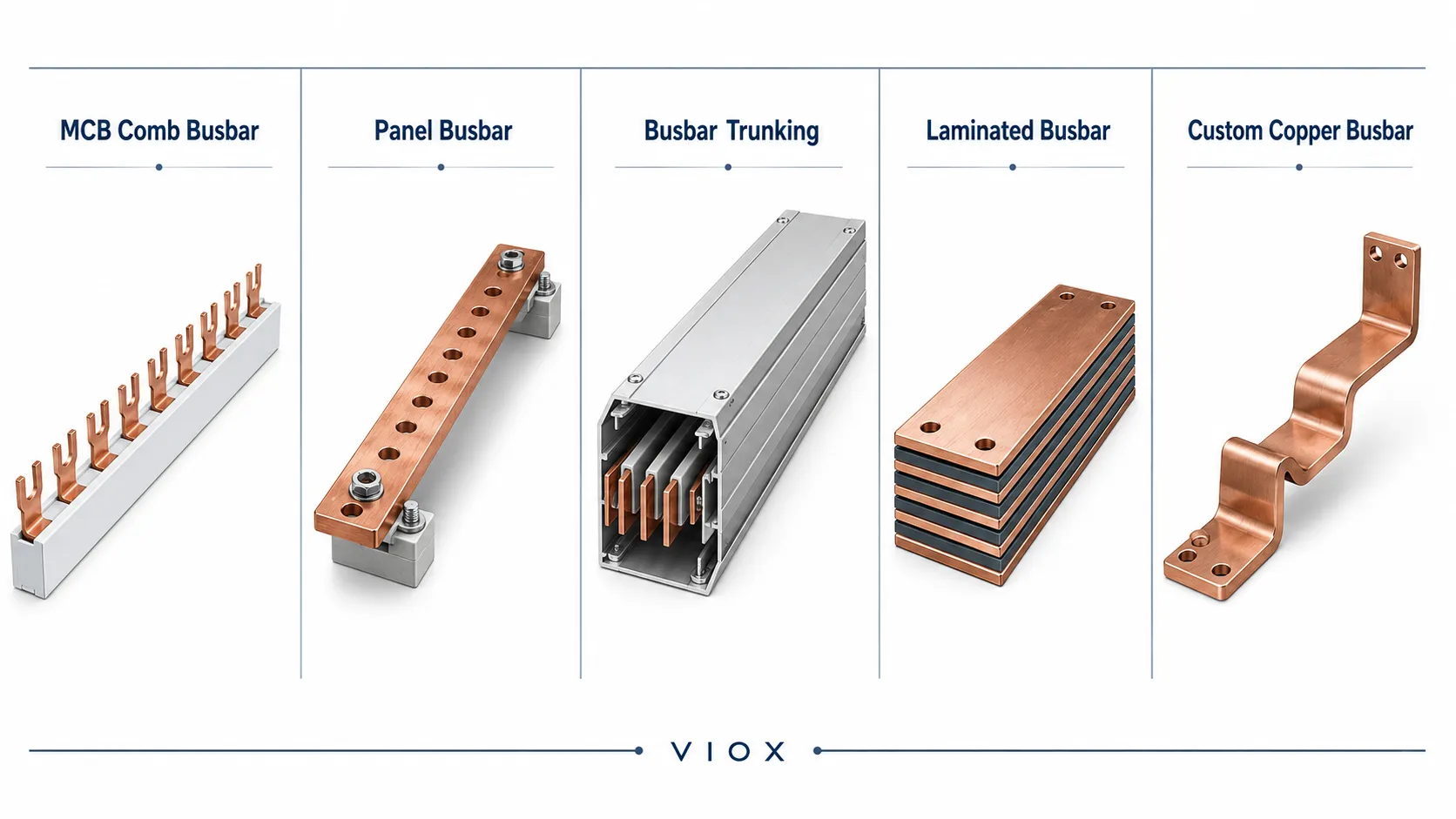
Many buyers search for “busbar manufacturers” but need different products. These terms should not be mixed.
| Busbar Type | What It Means | Typical Application | Typical Supplier Type |
|---|---|---|---|
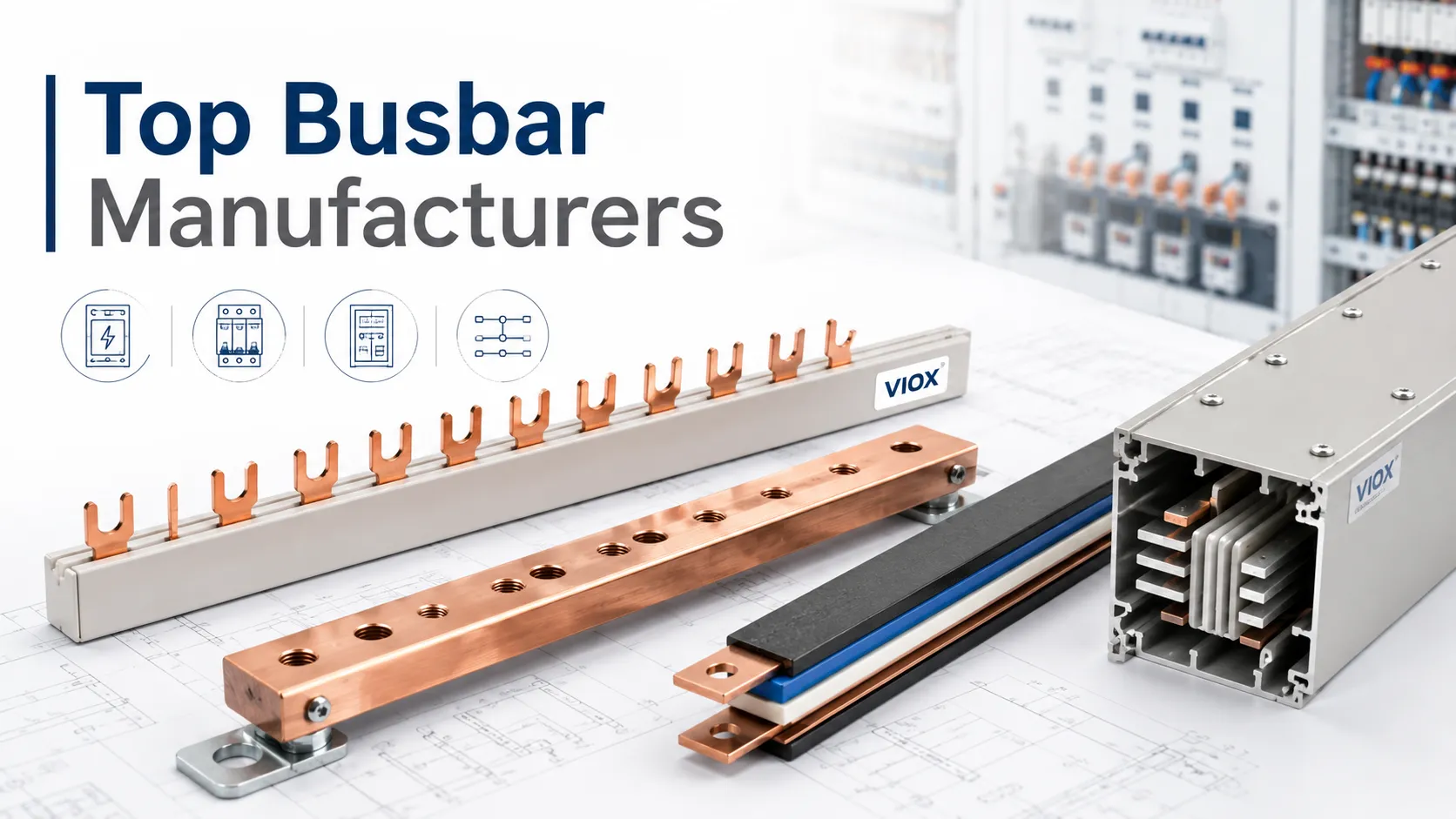
| MCB comb busbar | Pin or fork busbar linking modular breakers | Consumer units, distribution boards, small panels | Low-voltage accessory manufacturers |
| Circuit breaker busbar | Busbar connecting breakers inside a panel or load center | Panelboards, load centers, switchboards | Breaker/panel manufacturers |
| Busbar trunking / busway | Enclosed busbar distribution system | Buildings, factories, data centers | Large electrical distribution manufacturers |
| Laminated busbar | Layered insulated busbar assembly | EV, battery, inverter, power electronics | Engineered interconnect specialists |
| Custom copper busbar | Fabricated copper or aluminum bar | Switchgear, battery systems, OEM equipment | Metal fabrication or busbar specialists |
If your project is an MCB panel, you probably need a pin or fork busbar manufacturer. If your project is a factory power riser, you probably need busbar trunking. If your project is an EV inverter or battery pack, you may need laminated busbar engineering.
What Makes a Reliable Circuit Breaker Busbar?
Circuit breaker busbars fail when electrical, mechanical, and thermal details are treated as secondary details. A reliable busbar must maintain low contact resistance over time.
| Factor | Why It Matters |
|---|---|
| Copper or aluminum grade | High-conductivity copper such as T2 / C11000 is commonly specified where low resistance and stable temperature rise matter |
| Cross-sectional area | Affects current capacity and temperature rise |
| Tin, nickel, or silver plating | Improves corrosion resistance and contact stability; tin plating is often specified in the 3-5 micrometer range, but final thickness depends on project requirements |
| Tooth pitch | Must match breaker terminal spacing |
| Pin or fork profile | Must match MCB terminal type |
| Insulation material | Affects temperature resistance, touch safety, and flame resistance |
| Short-circuit withstand | Important during fault conditions |
| Contact pressure | Poor contact causes heating and arcing |
| Creepage and clearance | Critical for safety and standard compliance |
| Labeling and packaging | Reduces installation errors in distributor supply |
For MCB busbars, pitch and terminal geometry are often more important than buyers expect. A busbar that is “almost compatible” can create uneven contact pressure, heating, and unreliable operation.
Engineering Parameters Worth Asking For
Hard data separates a serious busbar supplier from a catalog reseller. For formal panel projects, ask for values such as:
| Parameter | Practical Reference Point |
|---|---|
| Copper grade | T2 / C11000 copper or equivalent high-conductivity copper, often specified above 99.9% purity |
| Plating | Tin plating, nickel plating, or silver plating depending on environment and contact requirements |
| Typical tin thickness | Often 3-5 micrometers for general low-voltage busbar contact protection; confirm by datasheet |
| Insulation flame rating | UL94 V-0 is commonly requested for flame-retardant plastic insulation parts |
| Glow-wire performance | Important for IEC-style distribution boards and consumer unit accessories |
| Temperature rise | Must be verified under rated current, enclosure temperature, grouping, and installation conditions |
| Short-circuit withstand | Must match the panel’s prospective fault current and protective device coordination |
| Creepage and clearance | Must match voltage, pollution degree, and applicable standard framework |
Do not treat these numbers as universal approval limits. The final acceptance criteria depend on product standard, panel design, enclosure temperature, protective device, and regional certification route.
Load Center Busbar Quality: What Buyers Should Check
Load center reliability depends heavily on the breaker-to-busbar interface. When buyers compare load center brands or models, the busbar system should be part of the evaluation, not an afterthought.
When evaluating load center busbar quality, check:
- breaker fit and contact pressure
- busbar plating and corrosion resistance
- thermal performance under continuous load
- manufacturer-approved breaker series
- short-circuit current rating
- availability of replacement breakers
- neutral and ground bar layout
- panel labeling and circuit directory quality
- compatibility with AFCI, GFCI, or dual-function breakers
The weak point is not always the busbar metal itself. It may be the spring contact, breaker stab, plating, torque, breaker compatibility, or heat rise inside a crowded panel.
MCB Busbar Selection Checklist
Use this checklist when buying MCB busbars for distribution boards or modular electrical panels.
| Check Item | What to Confirm |
|---|---|
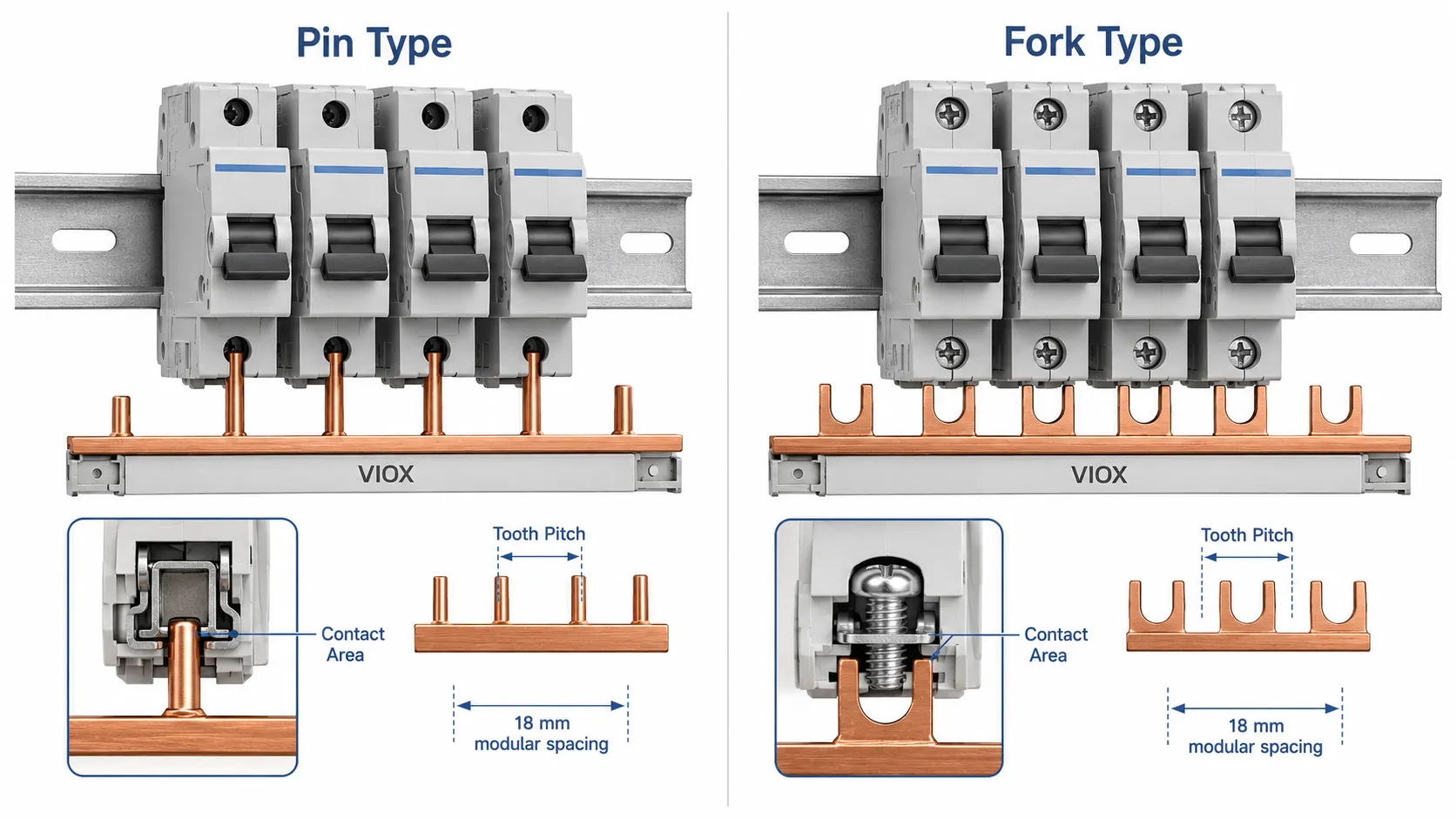
| Busbar type | Pin, fork, or special terminal design |
| Number of poles | 1P, 2P, 3P, 4P, 1P+N, 3P+N |
| Phase arrangement | Single-phase, three-phase, neutral arrangement |
| Tooth pitch | Commonly 18mm module spacing, but verify breaker series |
| Rated current | Match panel design and derating |
| Insulation | Flame resistance, touch safety, temperature rating, and where required UL94 V-0 or glow-wire performance |
| Cut length | Can be cut safely without exposing dangerous edges |
| End caps | Required for touch protection |
| MCB compatibility | Terminal design must match breaker family |
| Certification documents | Needed for formal panel or distributor projects |
For detailed compatibility, see Pin Type Busbar vs Fork Type Busbar.
Common Red Flags When Choosing a Busbar Supplier
Avoid suppliers that:
- cannot specify copper grade or plating
- give current rating without temperature-rise context
- cannot confirm tooth pitch and breaker compatibility
- provide no insulation or end-cap details
- cannot provide drawings or datasheets
- treat pin and fork busbars as interchangeable
- have no packaging control for export distribution
- cannot support consistent batch quality
- claim universal compatibility with all circuit breakers
For circuit breaker busbars, “universal” is often a warning sign. Breaker terminal geometry differs between brands and series. A good supplier should ask what breaker family, pole count, pitch, current rating, and panel design you are using.
Circuit Breaker Brands vs Busbar Manufacturers
Circuit breaker manufacturers and busbar manufacturers often overlap, but the search intent is not identical. A company may produce excellent breakers but source certain busbar accessories from another supplier. Another company may specialize in MCB busbars, laminated busbars, or busbar trunking without being a major circuit breaker brand.
If your priority is breaker brand comparison, use a dedicated circuit breaker manufacturer guide such as VIOX’s Top Circuit Breaker Manufacturers in China. If your priority is heat rise, contact reliability, comb busbar compatibility, or load center busbar quality, stay focused on busbar suppliers and busbar system design.
FAQ
Who are the top busbar manufacturers?
Leading busbar manufacturers include global electrical distribution companies such as Schneider Electric, Siemens, ABB, Eaton, and Legrand, as well as specialist busbar suppliers such as Mersen, Rogers, EAE, Altech, and VIOX Electric for different application areas.
What is the difference between a busbar manufacturer and a busbar system manufacturer?
A busbar manufacturer may produce copper bars, MCB comb busbars, laminated busbars, or custom busbars. A busbar system manufacturer usually supplies a complete distribution system, such as busbar trunking, busway, adapters, holders, tap-off units, and installation accessories.
What makes a good circuit breaker busbar?
A good circuit breaker busbar has the correct material, plating, current rating, tooth pitch, insulation, breaker-terminal fit, and short-circuit withstand. The contact area must remain stable under load and temperature cycling.
Are pin type and fork type busbars interchangeable?
No. Pin type and fork type busbars fit different breaker terminal designs. Using the wrong type can cause poor clamping, overheating, or unsafe contact. Always match the busbar to the breaker terminal structure.
Which busbar is best for MCB distribution boards?
For MCB distribution boards, the best busbar is usually a properly rated insulated comb busbar with the correct pole configuration, module pitch, pin or fork style, and end caps. Brand choice matters less than correct compatibility and documentation.
What should I check for load center busbar quality?
Check the breaker-to-busbar contact design, plating, heat rise, panel listing, approved breaker series, short-circuit rating, and availability of replacement breakers. Long-term reliability depends on the whole breaker-busbar interface, not only the busbar metal.
Is VIOX a busbar manufacturer?
VIOX Electric supplies low-voltage busbar products and panel accessories, especially MCB busbars, pin and fork busbars, and circuit breaker connection accessories. It is best suited for distributors, OEMs, and electrical panel builders sourcing modular low-voltage components.
Conclusion
The best busbar manufacturer depends on the busbar type you need.
For large switchgear and busbar trunking, global electrical manufacturers such as Schneider Electric, Siemens, ABB, Eaton, and Legrand are strong options. For laminated busbars and power electronics, companies such as Mersen and Rogers are more relevant. For MCB busbars, comb busbars, and low-voltage distribution board accessories, VIOX and other specialized panel accessory suppliers may be the more practical choice.
Do not buy a busbar only by brand name. Check the application, breaker compatibility, current rating, heat rise, plating, insulation, short-circuit requirement, and documentation before choosing a supplier.