

On this page
Quick Answer
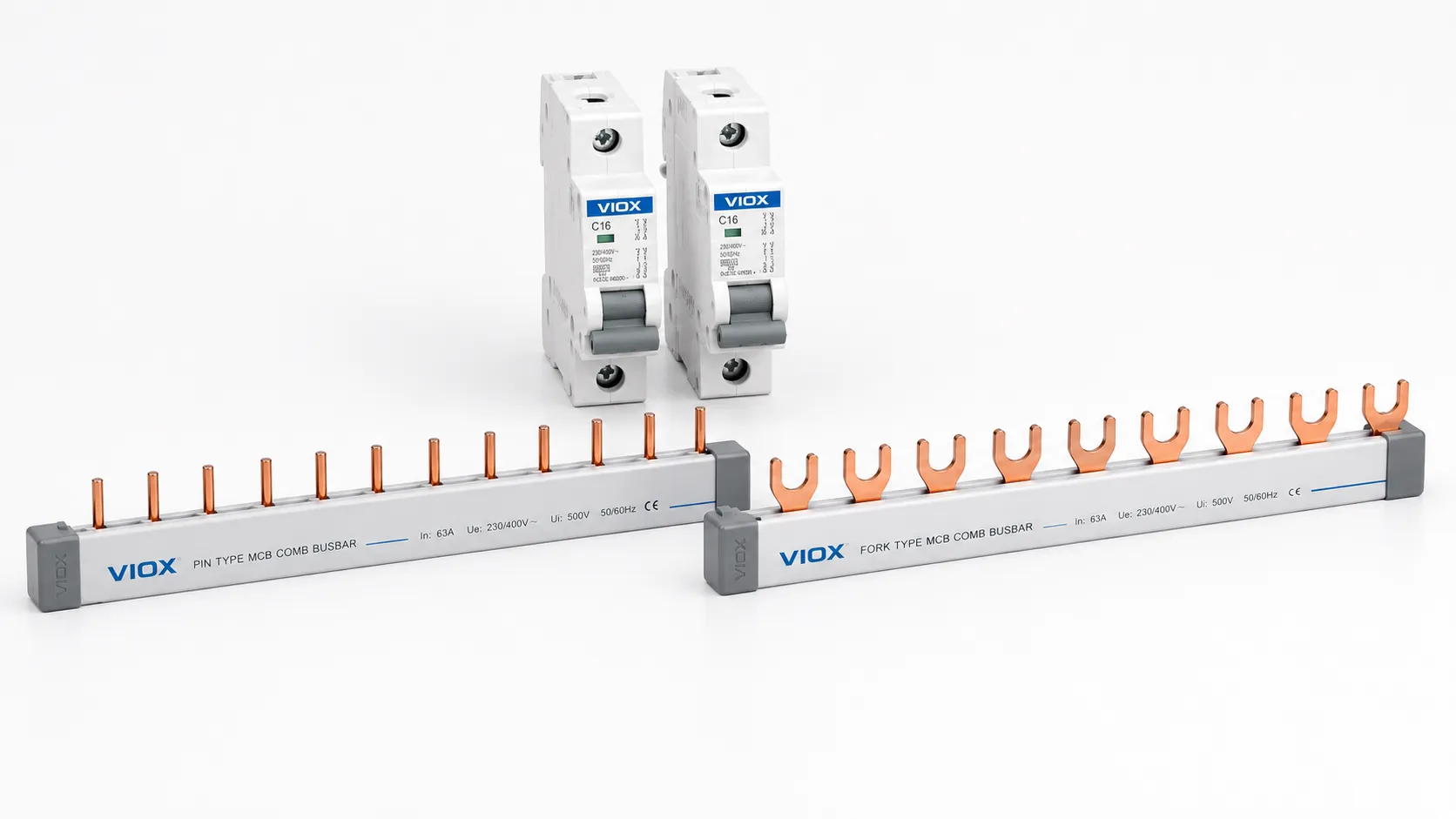
A pin type busbar uses straight copper pins that insert into compatible circuit breaker terminals. A fork type busbar uses fork-shaped copper teeth that fit under or around a compatible screw-clamp terminal area.
The most important rule is this: pin and fork busbars are not interchangeable unless the breaker manufacturer specifically allows both connection types. The correct choice depends on the terminal design of the miniature circuit breaker (MCB), residual current circuit breaker (RCCB), residual current breaker with overcurrent protection (RCBO), or other modular device being installed.
If the busbar shape does not match the breaker terminal, the connection may look acceptable from the outside but have poor contact pressure inside the terminal. That can cause heating, insulation damage, nuisance tripping, or arcing at the breaker connection.
Pin Type vs Fork Type Busbar at a Glance
| Item | Pin Type Busbar | Fork Type Busbar |
|---|---|---|
| Conductor shape | Straight pins | Fork-shaped teeth |
| Common name | Pin busbar, comb pin busbar | Fork busbar, fork comb busbar |
| Terminal fit | Breaker terminals designed for pin insertion | Compatible screw-clamp terminals |
| Installation method | Pins insert into terminal openings | Forks sit under or around the terminal clamp area |
| Main advantage | Compact and common for modular breaker rows | Strong seating when matched to compatible clamps |
| Main risk | Pin not fully inserted or misaligned | Fork not seated correctly under the clamp |
| Interchangeable? | No, unless approved by the breaker manufacturer | No, unless approved by the breaker manufacturer |
For buyers comparing modular distribution accessories, VIOX provides MCB busbar options for circuit breaker rows and distribution board assemblies.
What Is a Pin Type Busbar?
A pin type busbar is a comb-style busbar with straight conductive pins. These pins are inserted into the terminal openings of compatible modular breakers. The terminal clamp then secures the pin together with the breaker connection system.
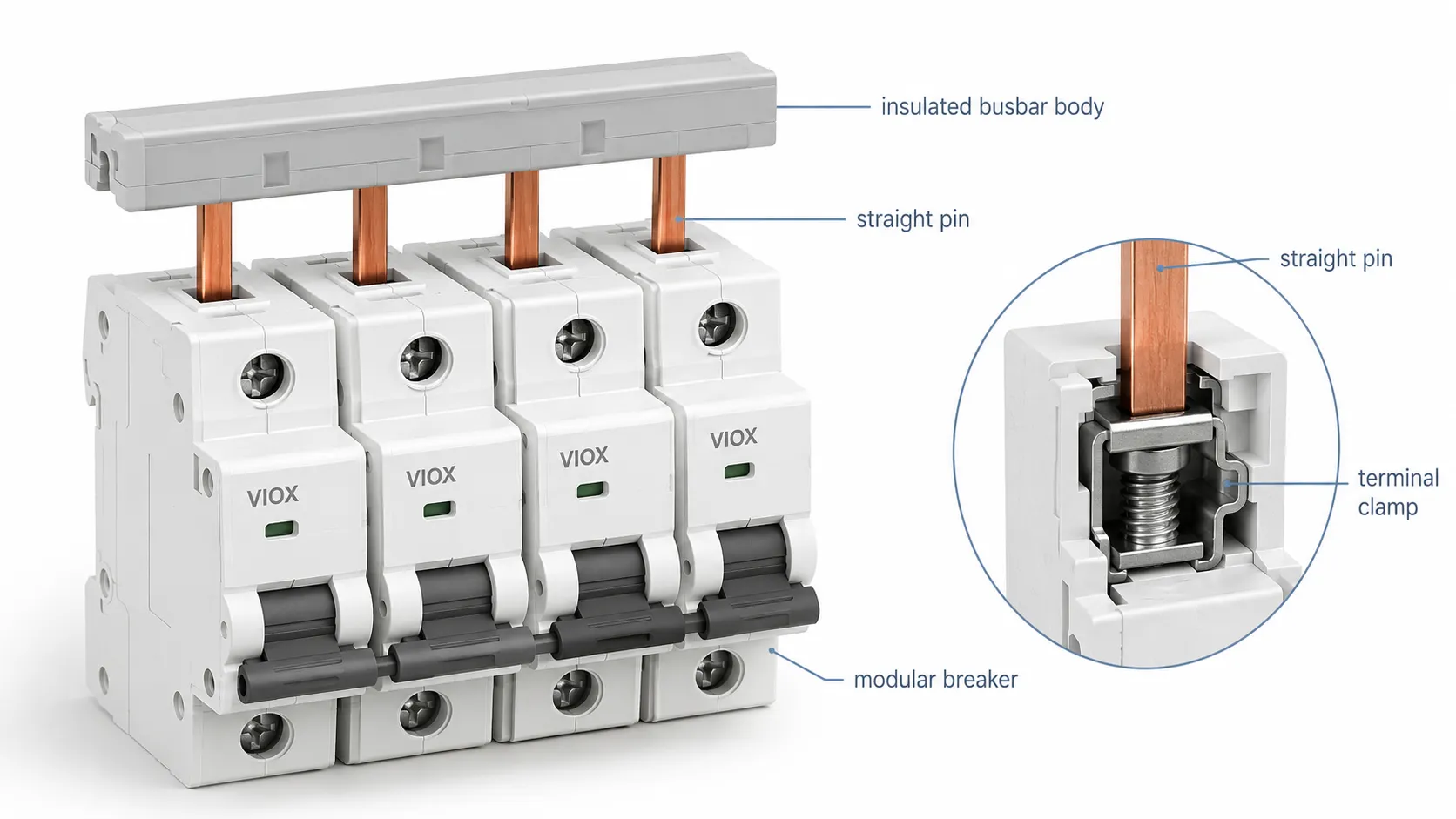
Pin type busbars are widely used in distribution boards because they are compact, easy to align, and suitable for many DIN rail MCB layouts. They are commonly available in 1P, 2P, 3P, and 4P arrangements depending on the system.
A pin design is usually appropriate when:
- the breaker terminal is designed for pin entry
- the busbar pitch matches the modular breaker spacing
- the panel uses a standard row of compatible MCBs
- the manufacturer allows the pin busbar connection
- the installation requires a clean and compact distribution row
The pin must be fully inserted and correctly clamped. A partially inserted pin can create high contact resistance even when the terminal screw feels tight.
What Is a Fork Type Busbar?
A fork type busbar has fork-shaped conductive teeth instead of straight pins. The fork is designed to fit into a compatible terminal clamp area, often under a screw-clamp mechanism depending on the breaker design.
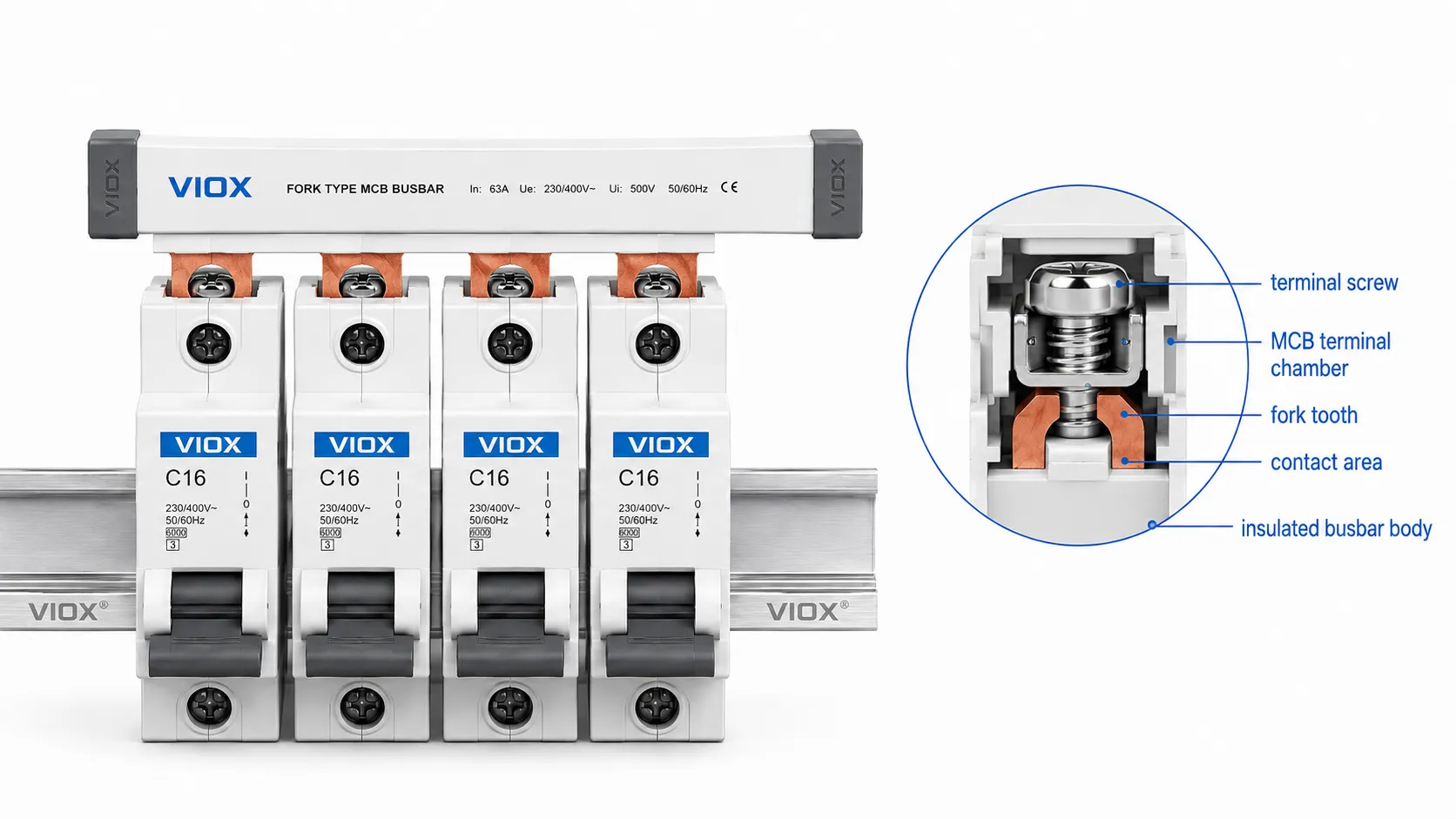
Fork type busbars can provide a secure contact when the terminal is designed for them. They are useful in breaker systems where the terminal clamp geometry supports a fork-style conductor.
A fork design is usually appropriate when:
- the breaker terminal is designed for fork busbar teeth
- the screw-clamp area allows proper fork seating
- the fork width matches the terminal opening
- the manufacturer approves fork busbar use
- the busbar sits flat and evenly across all breaker terminals
Do not force a fork busbar into a terminal intended only for pin entry. The fork may not sit correctly, and the terminal may clamp only part of the conductor.
Structural Difference: Pin vs Fork
The difference is mechanical before it is electrical. Both busbars distribute current, but the terminal interface is different.
| Feature | Pin Type | Fork Type |
|---|---|---|
| Contact geometry | Straight conductor enters the terminal | Fork wraps or sits around the clamping area |
| Alignment sensitivity | Pin depth and straight insertion matter | Fork seating and screw clamp position matter |
| Visual inspection | Check that each pin is fully inserted | Check that each fork is flat and fully captured |
| Typical failure mode | Pin only partly clamped | Fork edge or one side clamped poorly |
| Best inspection point | Terminal entry and busbar alignment | Fork seating under the terminal clamp |
This is why a busbar should never be selected by current rating alone. The contact geometry must match the breaker.
MCB Compatibility: The Most Important Selection Rule
MCB busbar compatibility depends on the complete breaker terminal design, not just the pole width. Two breakers may both be 18 mm modular devices, but their terminal openings, clamp depth, screw position, and busbar seating area may be different.
Before selecting a pin or fork busbar, confirm:
- breaker brand and product series
- terminal type accepted by the breaker
- busbar pitch and pole spacing
- 1P, 2P, 3P, or 4P arrangement
- rated current and voltage
- busbar insulation and touch protection
- whether end caps are required after cutting
- whether the same busbar can feed MCBs, RCCBs, or RCBOs in the row
The most common mistake is assuming that if the busbar physically enters the terminal, it is compatible. Physical fit is not the same as approved electrical contact.
Standards and Datasheet Checks
For a modular distribution board, the busbar should be evaluated as part of the complete breaker and enclosure system, not as a loose copper accessory. Depending on the market and panel type, relevant references may include IEC 60898-1 for miniature circuit breakers used in household and similar installations, IEC 61439 series requirements for low-voltage switchgear and controlgear assemblies, and local installation rules.
Do not read those standards as a shortcut for selecting a busbar. The practical selection still comes from the breaker manufacturer’s accessory list and the busbar datasheet.
| Technical Check | What to Verify | Why It Matters |
|---|---|---|
| Conductor material | Copper grade, plated copper, or other declared material | Affects conductivity, oxidation behavior, and temperature rise |
| Cross-section | Copper section in mm² or equivalent datasheet value | Determines current-carrying ability together with insulation and installation conditions |
| Rated current | Busbar current rating for the intended pole arrangement | Prevents overheating in continuous operation |
| Rated voltage | Insulation and creepage/clearance suitability | Must match the distribution system |
| Short-circuit withstand | Assembly-level fault condition and upstream protection | A busbar must survive the fault energy expected in the panel |
| Terminal torque | Breaker terminal tightening torque from the breaker datasheet | Too little torque causes heat; too much can damage the clamp or busbar tooth |
| Temperature rise | Manufacturer test data or assembly verification | Confirms the busbar performs inside the real enclosure |
| End cap system | Insulated end caps after cutting | Prevents exposed live copper |
For published product pages, this is where actual VIOX model data should be added: copper material, busbar cross-section, rated current, rated voltage, compatible breaker series, and required terminal torque. Those numbers should come from the product drawing or datasheet, not from a generic industry assumption.
Can You Replace a Pin Busbar With a Fork Busbar?
Usually, no. You should not replace a pin busbar with a fork busbar unless the breaker manufacturer confirms that the terminal accepts both styles.
The reason is contact pressure. A terminal designed for a straight pin may not clamp a fork tooth evenly. A terminal designed for a fork may not correctly capture a straight pin. Either mistake can create a small contact area, and small contact area means more heat under load.
If you are replacing an old busbar, match:
- original busbar type
- breaker series
- pole count
- pitch
- current rating
- insulation style
- end cap system
If the old busbar is damaged or unavailable, do not guess. Use the breaker manufacturer’s accessory guide or select a confirmed compatible replacement.


Busbar Connector Types
In modular panels, users often use different names for similar parts. The main connector styles include:
| Busbar Connector Type | Description | Typical Use |
|---|---|---|
| Pin busbar | Comb busbar with straight pins | Modular MCB rows |
| Fork busbar | Comb busbar with fork-shaped teeth | Compatible screw-clamp breaker terminals |
| Comb busbar | General term for a busbar with repeated teeth | Distribution boards |
| Link bar | Short connection bar between devices | Small breaker groups or special layouts |
| Phase busbar | Multi-phase busbar arrangement | Three-phase MCB distribution |
The correct connector type is determined by the device terminal design and panel layout. Do not choose by name alone.
Selection Guide
| Question | What to Check | Why It Matters |
|---|---|---|
| What breaker series are you using? | Brand and model compatibility | Terminal design differs by series |
| Pin or fork? | Accepted busbar shape | Prevents poor contact |
| How many poles? | 1P, 2P, 3P, 4P | Matches circuit arrangement |
| What current rating? | Busbar rated current | Prevents overheating |
| What system voltage? | Rated insulation voltage | Matches electrical system |
| Can it be cut? | Manufacturer cutting rules | Cut ends must be insulated |
| Does the row include RCCB or RCBO? | Neutral and terminal alignment | Prevents wiring and tripping problems |
| Is touch protection required? | Covers and end caps | Improves installation safety |
For a broader explanation of circuit breaker busbar layouts, see VIOX’s guide to circuit breaker busbars and MCB busbar selection.
What to Send When Requesting a Busbar Quotation
For pin and fork busbars, a vague request such as “I need a 63A busbar” is not enough. The supplier must know the breaker terminal structure and panel arrangement before confirming the correct busbar type.
| Information to Send | Why It Helps |
|---|---|
| Breaker brand and model | Confirms terminal compatibility |
| Terminal photo or drawing | Shows whether pin or fork connection is suitable |
| Pin or fork preference, if known | Reduces back-and-forth during quotation |
| Pole configuration | 1P, 2P, 3P, 4P, 1P+N, or 3P+N |
| Number of ways or total length | Determines busbar length and cutting requirement |
| Rated current and voltage | Confirms electrical suitability |
| Panel layout | Helps verify phase sequence and device spacing |
| Required insulation color or cover style | Supports standardization and market requirements |
| Quantity and packaging needs | Important for distributor and OEM orders |
If the exact breaker model is unknown, send a clear terminal photo from the front and side. For busbars, terminal geometry is often more useful than a general product name.
Field Note: The Contact Area Matters More Than the Shape Name
In panel inspection, the dangerous busbar connection is often not the one that looks obviously wrong. It is the one that is barely misaligned: one pin is slightly shallow, one fork tooth is clamped only at the edge, or one breaker from a different series sits a few millimeters out of line. The panel may energize normally, but the small contact area becomes a hot spot under load.
That is why experienced panel builders check the busbar from three angles before closing the dead front: mechanical seating, terminal torque, and insulation coverage. Pin and fork are only shape names. The real engineering question is whether the terminal clamp creates full, stable contact pressure on every pole.
Common Installation Mistakes
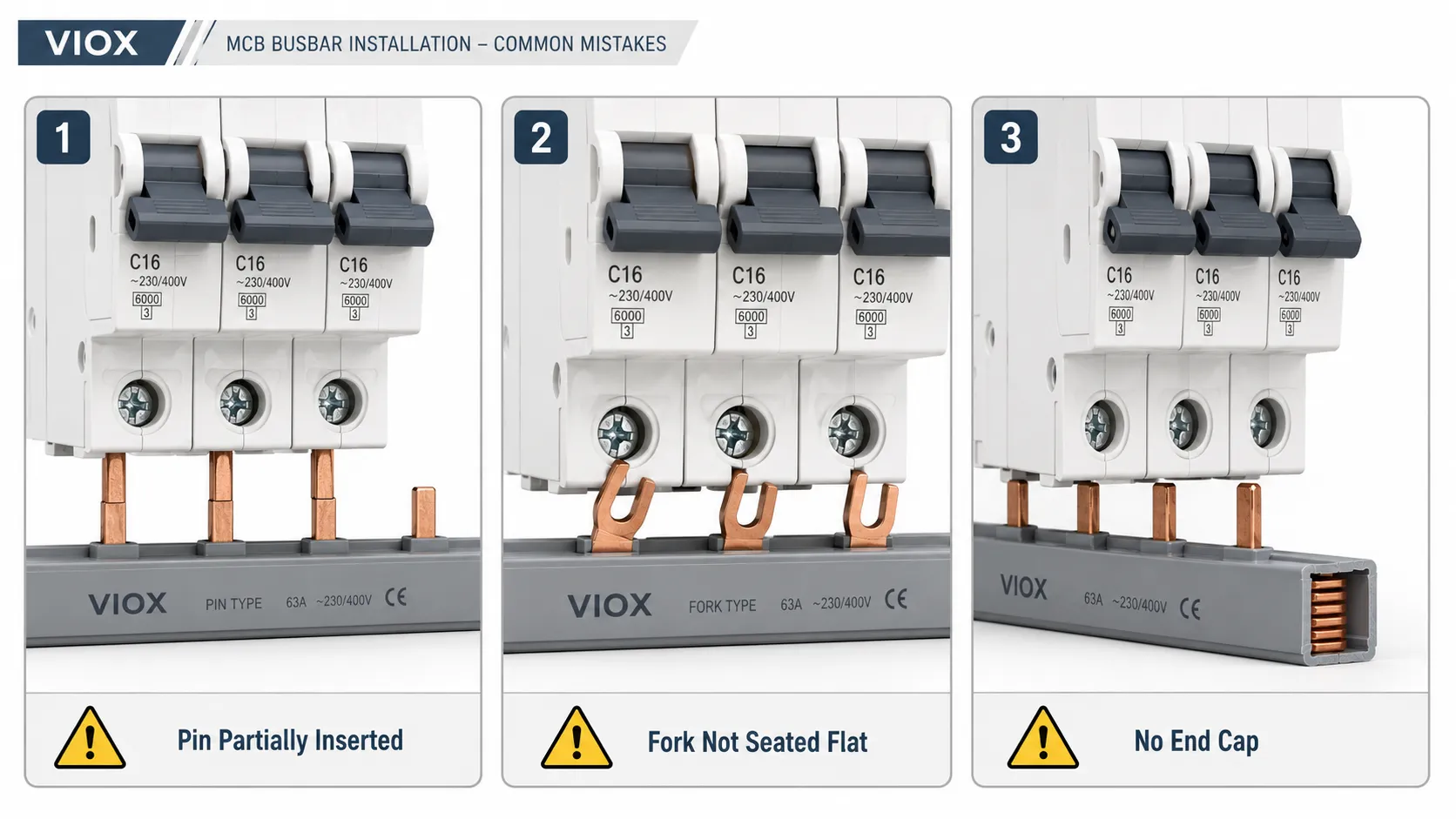
Mistake 1: Choosing by Current Rating Only
A 63A busbar is not correct simply because the current rating is high enough. If the pin or fork shape does not match the breaker terminal, the connection can still fail.
Mistake 2: Cutting the Busbar and Leaving Copper Exposed
Many comb busbars can be cut to length, but the exposed end must be protected with the correct end cap or insulation cover. Exposed copper at the end of a busbar is a shock and short-circuit hazard.
Mistake 3: Mixing Different Breaker Series in One Row
Different breakers may not align perfectly even if they have the same modular width. A busbar may sit straight on one device and poorly on another.
Mistake 4: Tightening the Terminal Without Checking Seating
The terminal screw may feel tight even when the busbar tooth is not fully seated. Always inspect alignment before final tightening.
Mistake 5: Ignoring RCCB or RCBO Neutral Arrangement
When the row includes RCCBs or RCBOs, neutral position and terminal direction matter. A busbar that works for an MCB row may not automatically work for a mixed protection row.
Practical Recommendation
A pin busbar is the safer choice when the modular breaker terminal is designed for pin insertion and the panel needs a compact, standard distribution row.
A fork busbar is the safer choice when the breaker terminal is designed for fork-style seating under a compatible clamp.
Do not treat pin and fork busbars as universal accessories. Treat them as part of a breaker system. The safest selection is the busbar type recommended for the exact breaker series, pole arrangement, and distribution board design.
FAQ
What is the difference between pin type and fork type busbar?
A pin type busbar uses straight pins that insert into compatible breaker terminals. A fork type busbar uses fork-shaped teeth that fit under or around a compatible terminal clamp area.
Is a pin busbar better than a fork busbar?
Neither is always better. The correct choice depends on the breaker terminal design. A correctly matched fork busbar is better than a mismatched pin busbar, and a correctly matched pin busbar is better than a mismatched fork busbar.
Can I use a fork busbar on an MCB?
Only if the MCB terminal is designed or approved for fork busbars. Some MCBs accept fork busbars, while others require pin busbars or a specific accessory system.
Can I use a pin busbar on an RCCB or RCBO?
Sometimes, but only when the RCCB or RCBO terminal arrangement matches the busbar design. Neutral position and line/load orientation must be checked carefully.
Why does a busbar connection overheat?
Common causes include wrong busbar type, partial insertion, loose terminal clamping, incompatible breaker series, overload, or exposed/damaged conductive parts.
What does busbar connector type mean?
Busbar connector type refers to the shape and connection method of the busbar interface, such as pin, fork, comb, link bar, or phase busbar. The correct type depends on the breaker terminal design.
What information should I provide when buying a pin or fork busbar?
Send the breaker brand and model, terminal photo or drawing, pole configuration, number of ways, rated current, rated voltage, required length, quantity, and any insulation color or packaging requirements. The terminal photo is especially important because it helps confirm whether the breaker accepts a pin busbar or a fork busbar.
Can MCB busbars be customized?
Yes. Depending on the manufacturer, MCB busbars may be customized by length, pole arrangement, number of ways, insulation color, conductor style, labeling, and packaging. Customization still depends on breaker terminal compatibility and electrical rating requirements.
Why is terminal torque important for a fork busbar?
The terminal screw must clamp the fork tooth with enough contact pressure to avoid heating, but excessive torque can damage the terminal or busbar tooth. Always use the tightening torque specified by the breaker manufacturer, not a generic value.
Conclusion
Pin type and fork type busbars perform the same general job: distributing power across multiple modular circuit breakers. The difference is how they connect to the breaker terminals.
Pin busbars use straight pins. Fork busbars use fork-shaped teeth. The right choice is not based on preference; it is based on terminal compatibility, pole arrangement, current rating, voltage rating, insulation, and panel layout.
If the breaker and busbar are matched correctly, the panel becomes cleaner, faster to assemble, and easier to inspect. If they are mismatched, the busbar can become a hidden heating point inside the distribution board.