

On this page
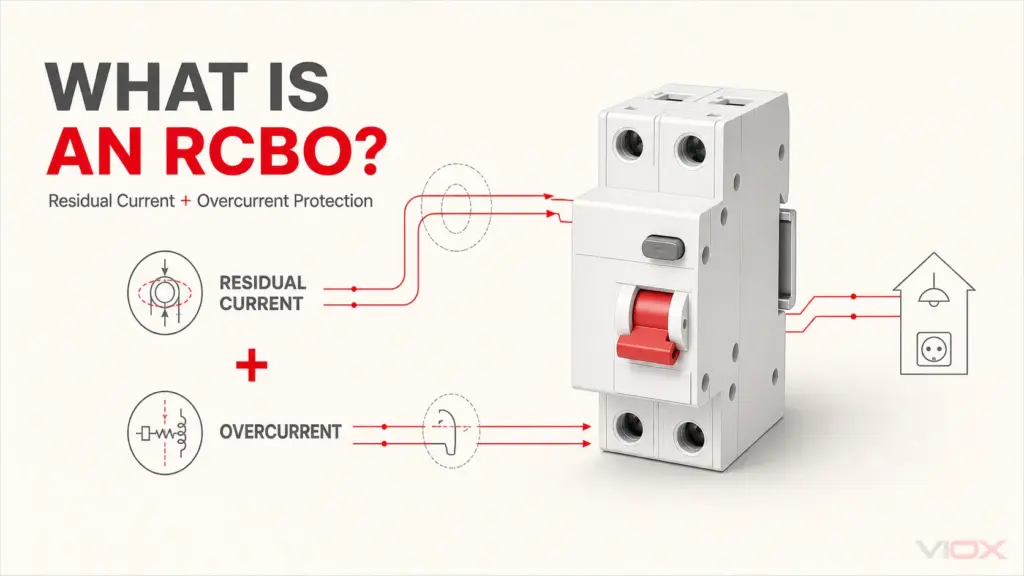
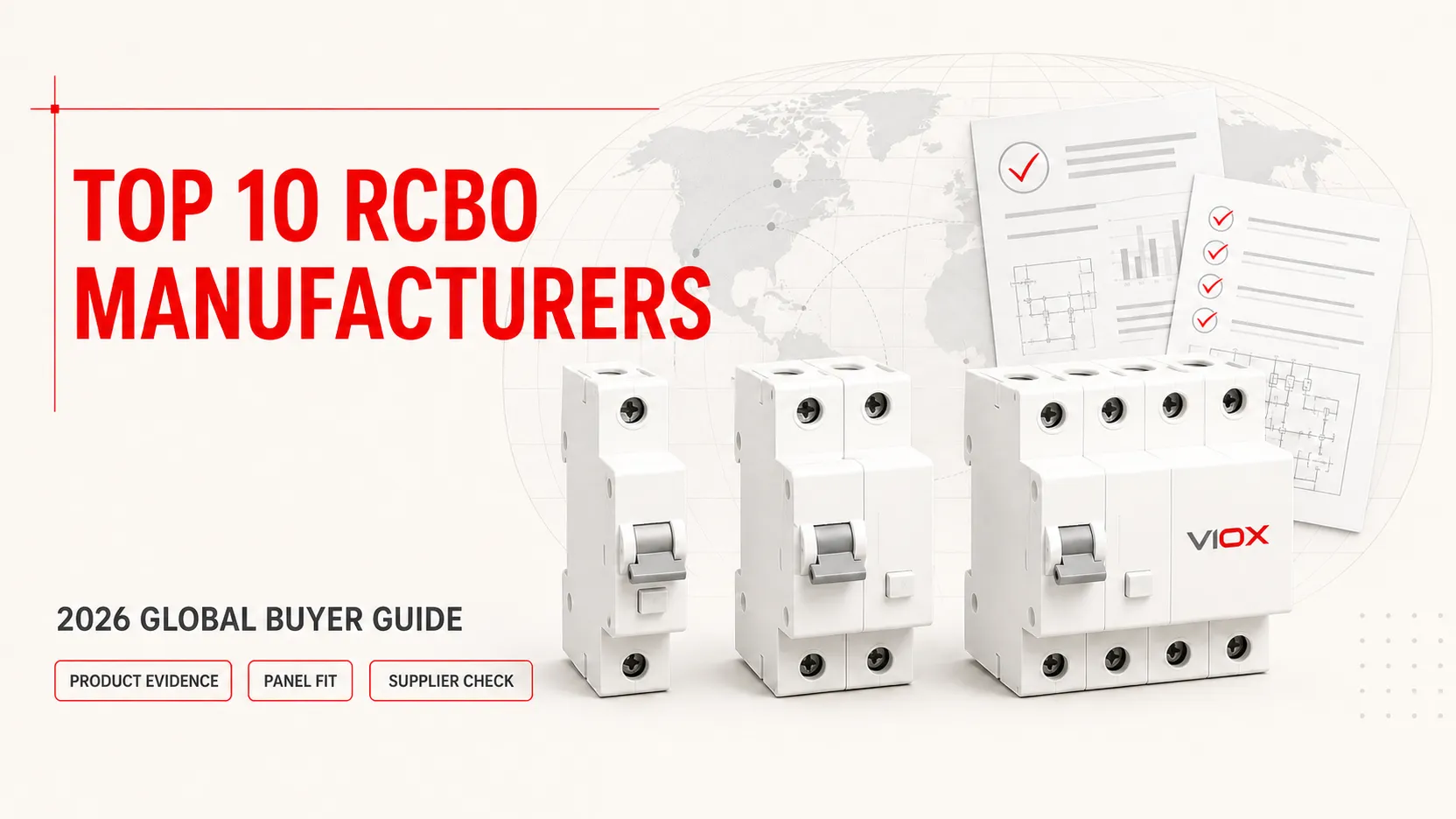
Leading RCBO manufacturers worth evaluating in 2026 include Schneider Electric, ABB, Siemens, Eaton, Legrand, Hager, Fuji Electric, LS Electric, CHINT, and VIOX Electric. This is an editorial buyer guide, not a market-share, sales, or laboratory-performance ranking. Inclusion is based on public RCBO product evidence, documentation, product-system fit, regional relevance, and sourcing options. The sequence does not imply that one brand is technically superior to the next.
There is no universal “best RCBO brand.” A suitable manufacturer must offer an exact Residual Current Circuit Breaker with Overcurrent Protection (RCBO) model that matches the circuit, distribution board, destination-market requirements, and procurement model. The brand name cannot replace verification of the model number, residual-current type, rated residual operating current, trip curve, short-circuit rating, pole arrangement, or certification documents.
This page covers combined residual-current and overcurrent protection. Buyers comparing residual-current devices without integral overcurrent protection should use the separate global RCCB manufacturer guide.
RCBO Manufacturers at a Glance
| Manufacturer | Verified RCBO family or product | Publicly visible distinction | Typical buyer fit |
|---|---|---|---|
| Schneider Electric | Acti9 iC60 RCBO | 2P, 3P, and 4P options within the Acti9 system | Multinational projects, OEM panels, system-standardized installations |
| ABB | DS201 / DSE201 | Detailed RCBO technical documentation and System pro M compact integration | Specification-led commercial and industrial projects |
| Siemens | SENTRON 5SU1 | Two-, three-, and four-pole RCBO solutions within SENTRON | Siemens-standardized panels and industrial infrastructure |
| Eaton | xEffect FRBdM and xPole ranges | Conventional and digitally indicated RCBO options | Building distribution and projects using Eaton assemblies |
| Legrand | DX³ RCBO | Broad modular protection range for residential and commercial panels | Building projects and Legrand distribution systems |
| Hager | ADC bidirectional RCBO series | Compact 1P+N models with documented bidirectional operation | Modular boards requiring an exact, documented bidirectional SKU |
| Fuji Electric | BCL RCBO | Regional RCBO range introduced for Southeast Asian markets | Regional distributors and projects using Fuji low-voltage equipment |
| LS Electric | Beyond X L-Series RCBO | 1P+N through multipole configurations shown in current product resources | Asian industrial, commercial, and distribution projects |
| CHINT | NB1L / NXBLE series | Final-circuit and higher-current products with different standards boundaries | International distribution and value-focused project sourcing |
| VIOX Electric | VIOX RCBO portfolio | Published 1P+N, 2P, 3P+N, and 4P coverage plus OEM/ODM support | Importers, distributors, panel builders, and electrical brands |
The table identifies publicly documented product families reviewed in August 2026; it does not imply that every configuration is available or approved in every market. Always verify the quoted SKU in the country where it will be installed.
How We Evaluated the Manufacturers
The list uses a repeatable evaluation framework rather than an unsupported claim about company size or product quality.
1. Public evidence of an RCBO product
Each manufacturer must publish an official RCBO product page, datasheet, catalogue, or comparable technical resource. A general claim that a company makes circuit breakers is not enough.
2. Product-range relevance
We considered visible options such as pole configuration, rated current, residual-current type, trip curve, breaking capacity, and modular width. These characteristics are compared only where the manufacturer publishes them; one sample model does not define the entire range.
3. Documentation and verification path
Professional buyers need more than a catalogue image. Useful evidence can include model-specific datasheets, declarations of conformity, CB certificates, installation instructions, dimensional drawings, and accessory references.
4. Distribution-board and accessory fit
DIN-rail mounting alone does not make devices interchangeable. Busbars, terminals, neutral arrangements, enclosure approvals, auxiliaries, and manufacturer instructions can create system-specific compatibility requirements.
5. Regional and sourcing fit
Some brands are strongest when specified as part of a complete distribution ecosystem. Others are relevant to regional channels, competitive tenders, or OEM/private-label sourcing. The appropriate shortlist depends on how the buyer intends to purchase and support the product.
6. Standard boundary
IEC 61009-1:2024 covers RCBOs for household and similar uses within the standard’s stated voltage, current, frequency, and short-circuit-capacity limits. That scope is not a global approval passport. Local rules can require national deviations, additional certification, or a different product standard. Higher-current devices may also be declared under a different standard, so the applicable standard must be checked on the exact model.
Ten RCBO Manufacturer Profiles
The profiles below follow the same editorial order as the opening table. They are not positions in a performance league table.
Schneider Electric
Schneider Electric is a strong candidate for projects already built around the Acti9 modular protection ecosystem. Its official Acti9 iC60 RCBO range includes two-, three-, and four-pole devices in corresponding module widths.
The practical advantage is system continuity: engineers can evaluate the RCBO together with compatible modular devices, accessories, documentation, and distribution equipment. That makes Schneider especially relevant where one global product platform is being used across multiple panels or project locations.
Best suited for: multinational specifications, commercial infrastructure, OEM panels, and projects standardized on Schneider Electric equipment.
Verify before specifying: the regional Acti9 family, whether neutral is switched or solid for the selected model, residual-current type, breaking capacity, busbar compatibility, and the approvals required in the destination country.
ABB
ABB provides one of the clearer public documentation paths in this comparison. The current DS201 product page identifies 1P+N construction, multiple residual-current response types, several tripping characteristics, and model-dependent breaking capacities. ABB also publishes DSE201 electronic RCBO resources and variants for specific applications and markets.
The DS201 belongs to ABB’s System pro M compact family. This matters to buyers who need an RCBO to fit into a wider modular-device and accessory architecture rather than treating the breaker as an isolated component.
Best suited for: engineering-led commercial and industrial projects, panel builders using ABB modular equipment, and buyers who prioritize accessible technical documentation.
Verify before specifying: the DS201, DS201 M, DSE201, or other exact family; voltage dependence; type A, AC, APR, or F response; trip curve; accessory compatibility; and model-specific IEC or regional certification.
Siemens
Siemens positions RCBOs within its SENTRON residual-current protection portfolio. The official SENTRON RCBO information identifies the 5SU1 as a combined residual-current and overcurrent protective device available in two-, three-, and four-pole versions.
Siemens is most relevant when the RCBO is part of a broader SENTRON specification. For panel builders, using one coordinated product ecosystem can simplify accessory selection, documentation control, replacement planning, and purchasing. It still does not remove the need to check whether the chosen device fits the particular enclosure and busbar assembly.
Best suited for: industrial infrastructure, commercial distribution, machine or panel projects using Siemens low-voltage equipment, and specifications requiring multipole options.
Verify before specifying: the exact 5SU1 order number, pole and neutral arrangement, residual-current type, voltage and frequency, breaking capacity, upstream coordination, accessory support, and current regional availability.
Eaton
Eaton offers conventional RCBO ranges as well as products with additional status indication. Its official xEffect FRBdM RCBO page describes 1+N and two-pole devices with LED indication of residual-current status, B/C/D tripping characteristics, and busbar-compatible terminals.
This gives Eaton a distinct buyer proposition: a project can remain within Eaton’s modular distribution ecosystem while choosing between straightforward protection and enhanced indication where the appropriate product is available. Digital indication should be treated as a maintenance aid, not as a substitute for testing or protective-device coordination.
Best suited for: commercial building distribution, maintenance-conscious installations, and panels standardized on Eaton or xPole equipment.
Verify before specifying: whether the device is voltage-dependent, the operating behavior if supply voltage is lost, residual-current response type, current and breaking capacity, accessory compatibility, and the standard or national approval stated for the exact SKU.
Legrand
Legrand’s DX³ range covers modular protection for residential, commercial, and selected industrial distribution systems. Legrand’s UK protection overview lists DX³ RCBOs across single-pole, 1P+N, and multipole options, while a current DX³ 6000 product sheet documents a compact 1P+N Type A RCBO conforming to IEC 61009-1.
Legrand deserves consideration where the distribution board, busbars, auxiliary devices, and protection components are being selected as one building-system package. Product formats and catalogues differ by country, so a model shown on an international catalogue should not automatically be specified for a national consumer unit.
Best suited for: residential and commercial buildings, Legrand panel ecosystems, and distributors serving modular building-protection markets.
Verify before specifying: national catalogue availability, board and busbar compatibility, module width, neutral location, curve and sensitivity, auxiliary options, and exact conformity documents.
Hager
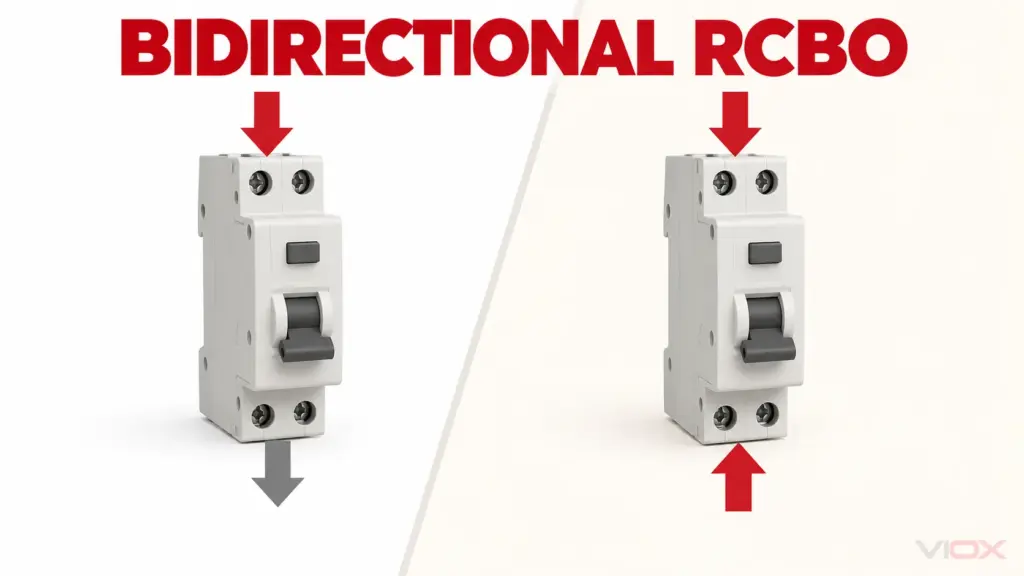
Hager is closely associated with modular building distribution and publishes detailed model-level data for its RCBOs. The ADC916R, for example, is documented as a one-module, 1P+N, Type A bidirectional RCBO with line/load reversible wiring.
Bidirectional operation is particularly relevant when current may legitimately flow in either direction, but the word “bidirectional” must appear in the manufacturer documentation for the exact device. It should never be inferred from terminal position or from another model in the same brand.
Best suited for: residential and light-commercial distribution, compact consumer units, and applications where the exact specification requires a documented bidirectional AC RCBO.
Verify before specifying: bidirectional status, the permitted supply and load orientation, board generation, busbar fit, residual-current type, breaking capacity, temperature derating, and country-specific declarations.
Fuji Electric
Fuji Electric adds a Japanese manufacturer with an explicitly regional RCBO offer. Its official BCL series launch documentation states that RCBOs and RCCBs were included alongside miniature circuit breakers for Southeast Asian markets, with 6 kA and 10 kA interrupting-capacity options and B, C, and D curves across the wider series.
Fuji Electric is therefore a useful candidate when the procurement route or installed equipment base is tied to Southeast Asia. Because the cited launch document is regional and dates from 2022, buyers should request the current country catalogue and live order codes before treating a listed configuration as available.
Best suited for: Southeast Asian distributors, regional building projects, and buyers already using Fuji Electric low-voltage products.
Verify before specifying: current BCL RCBO order codes, country availability, pole configuration, residual-current type and sensitivity, current rating, certificates, local service channel, and lead time.
LS Electric
LS Electric publishes current RCBO resources for its Beyond X L-Series and related product families. Its official L-Series product page identifies 1P+N, 2P, 3P+N, and 4P configurations, with ratings and residual-current characteristics varying by model. The company’s MCB and circuit-protection resource page also lists RCBO CAD data and product documentation.
This breadth makes LS Electric relevant to buyers who need both single-phase and multipole protection from a South Korean supplier, especially in Asian industrial and commercial channels. Some certifications and product variants are region-specific, so an English catalogue alone should not be treated as final approval evidence.
Best suited for: Asian industrial and commercial projects, LS-standardized panels, and distributors that need single-phase and multipole RCBO options.
Verify before specifying: the exact current series and order code; electronic or electromagnetic residual-current operation; pole arrangement; residual-current type; IEC versus Korean standard marking; and current certification files.
CHINT
CHINT has a broad RCBO portfolio spanning compact final-circuit devices and higher-current products. The NB1L family provides a conventional final-distribution reference, while the official NXBLE-125 product page lists 1P+N, 2P, 3P, 3P+N, and 4P configurations up to 125 A.
The NXBLE-125 example also demonstrates why buyers must check the standard boundary carefully: CHINT declares that family to IEC/EN 60947-2 rather than presenting it as an IEC 61009-1 household RCBO. A buyer searching only for the word “RCBO” could otherwise compare products governed by different scopes and test requirements.
Best suited for: international distributors, price-sensitive tenders, and projects that need a broad catalogue across final and higher-current low-voltage distribution.
Verify before specifying: whether the chosen series is NB1L, NXBLE-40, NXBLE-125, or another family; applicable product standard; residual-current type; Icn or Icu/Ics terminology; exact certificate-to-model match; and authorized regional supply.
VIOX Electric
VIOX Electric manufactures low-voltage components for distributors, panel builders, importers, and electrical brands. The VIOX RCBO range publishes 1P+N, 2P, and 4P model examples, while VIOX’s RCBO technical resources cover 1P+N, 2P, 3P+N, and 4P configurations. The buyer proposition differs from the large system brands: VIOX is particularly relevant when the project requires direct factory communication, OEM/ODM coordination, packaging, documentation control, or export-oriented supply.
For OEM work, catalogue breadth is only the first filter. Buyers should establish a controlled relationship between the order code, label, technical file, certificate, sample, and production unit. Private-label artwork must not obscure the product identity or create a certification claim that the underlying model does not support.
Best suited for: wholesalers, importers, private-label electrical brands, and panel builders seeking a direct RCBO manufacturing partner.
Verify before specifying: the exact series and configuration, destination-market certification package, residual-current type, sensitivity, trip curve, breaking capacity, pole and neutral operation, sample approval, traceability markings, packaging, production lead time, and change-control process.
Which RCBO Manufacturer Fits Your Buying Model?
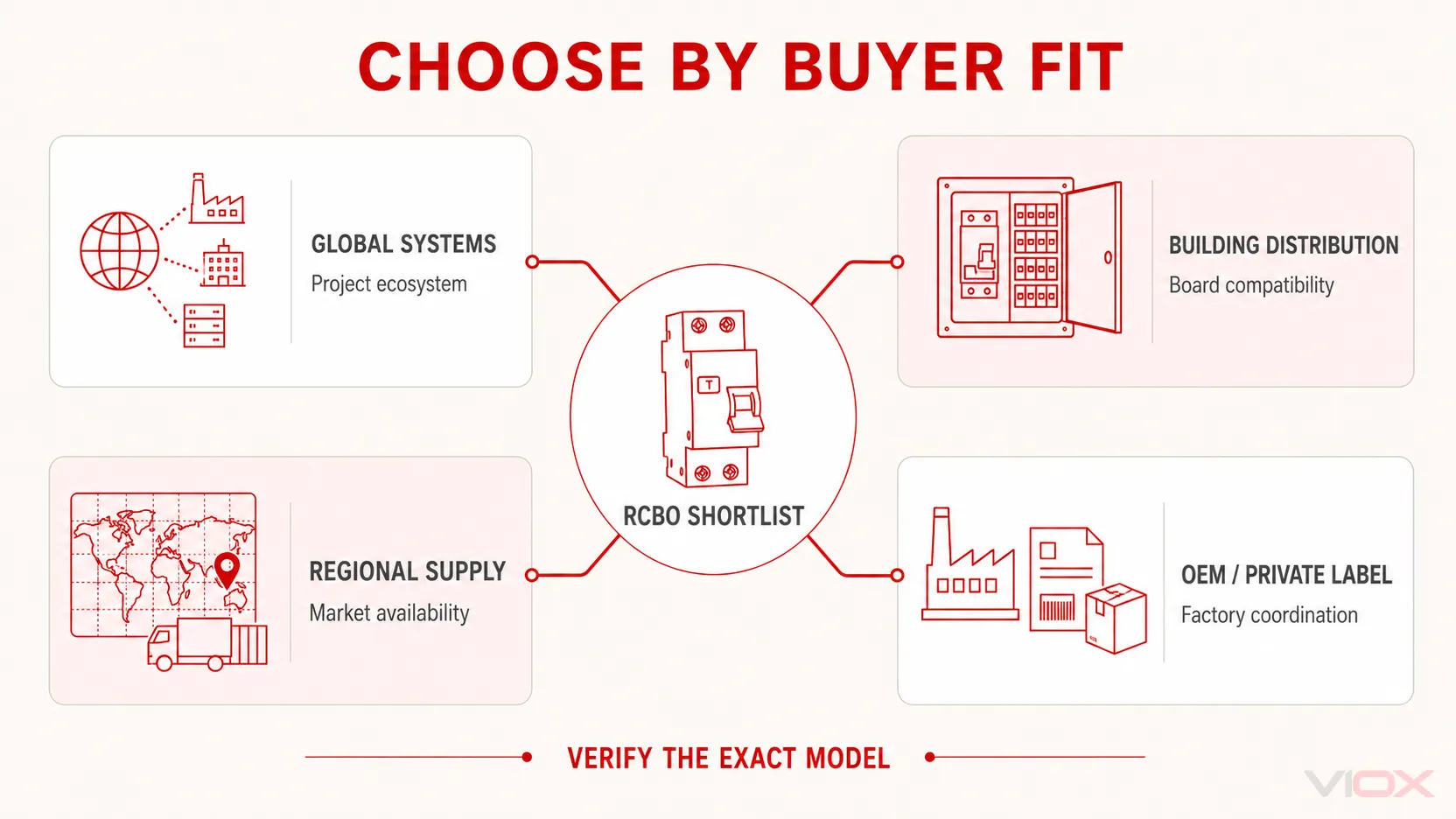
The ten brands become more useful when they are filtered by purchasing context rather than reduced to a single winner.
| Buyer context | Manufacturers to examine first | Why they enter the shortlist | Main verification priority |
|---|---|---|---|
| Multinational specification or one-system project | Schneider Electric, ABB, Siemens, Eaton | Broad low-voltage ecosystems and established documentation paths | Regional SKU equivalence and panel-system compatibility |
| Residential and commercial modular distribution | Hager, Legrand, Schneider Electric, ABB | Strong focus on modular protection and building distribution | Consumer-unit or distribution-board approval, busbars, neutral layout |
| Southeast or East Asian project channel | Fuji Electric, LS Electric, CHINT | Regional catalogues and distribution relevance | Current local availability and certificate scope |
| Multipole RCBO requirement | Siemens, Schneider Electric, LS Electric, CHINT, VIOX | Publicly visible multipole families or manufacturing coverage | Exact 3P/3P+N/4P switching and protected-pole arrangement |
| Bidirectional application | Hager and any other brand with an explicitly documented bidirectional SKU | Suitability cannot be inferred from a standard RCBO | Exact model marking, wiring orientation, application instructions |
| OEM or private-label sourcing | VIOX Electric | Direct manufacturing and customization route | Certificate ownership, model traceability, approved sample, change control |
Use the table to create a first shortlist, then evaluate exact products. A familiar brand with the wrong residual-current response or panel fit is not a safer choice than a less familiar supplier with a fully verified model.
RCBO Supplier Verification Checklist
Before approving a manufacturer or placing a production order, request a model-specific evidence pack.
| Verification item | What to request | Why it matters |
|---|---|---|
| Exact product identity | Full order code, product label drawing, and datasheet revision | Prevents evidence from one model being applied to another |
| Applicable standard | Declaration and certificate naming the exact standard and model | Separates IEC 61009-1 devices from products evaluated under other scopes |
| Residual-current response | Type AC, A, F, B, or manufacturer-specific delayed/high-immunity designation | Connected electronic equipment can change the required residual-current detection capability |
| Sensitivity | Rated residual operating current, IΔn | Must match the protection objective and local installation rules |
| Overcurrent behavior | Rated current and B/C/D or other stated trip characteristic | Must coordinate with conductor capacity, load, and inrush current |
| Short-circuit capability | Icn, or Icu/Ics where the applicable standard uses those terms | Must be adequate for the prospective fault current at the installation point |
| Pole and neutral arrangement | Protected poles, switched poles, neutral position, and disconnection behavior | Labels such as 1P+N, 2P, 3P+N, and 4P are not always used identically across catalogues |
| Voltage dependence | Operating principle and behavior if line or neutral voltage is lost | Can affect the protection concept and permitted application |
| Direction of power flow | Explicit bidirectional statement or permitted line/load wiring | Important for circuits with generation, storage, or reverse power flow |
| Panel compatibility | Approved enclosure, busbar, terminals, auxiliaries, and installation instructions | DIN-rail dimensions alone do not establish system compatibility |
| Market authorization | Current national approval, importer details, and authorized channel | IEC conformity does not automatically satisfy every national market |
| Production control | Approved sample, batch records, label and packaging approval, and change notification | Keeps delivered production aligned with the evaluated model |
For the electrical parameters behind this checklist, use the VIOX RCBO selection guide. For the distinction between product-standard scope and market approval, see IEC 61009-1 explained. Installation personnel should follow the exact manufacturer diagram; the RCBO wiring diagram guide explains the main 1P+N, 2P, 3P+N, and 4P arrangements without replacing model-specific instructions.
A Practical Three-Step Shortlisting Process
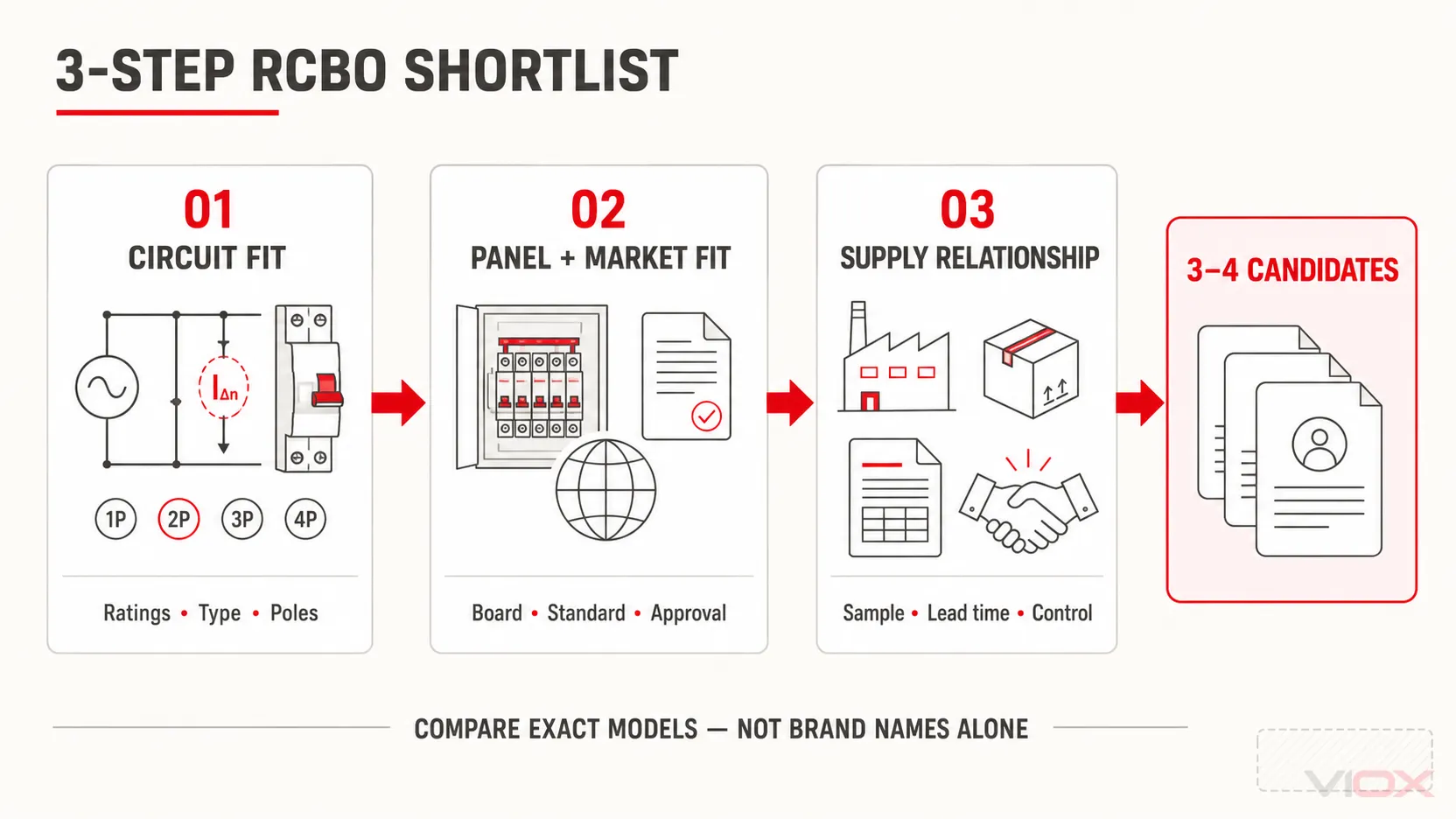
Step 1: Eliminate products that do not fit the circuit
Define the circuit voltage, frequency, conductor and load requirements, prospective fault current, residual-current type, IΔn, trip curve, pole arrangement, power-flow direction, and applicable installation rules. Remove any candidate that cannot document the required combination.
Step 2: Eliminate products that do not fit the panel or market
Check the actual distribution board, busbar, terminals, neutral arrangement, accessories, and enclosure instructions. Then confirm that the model—not merely the brand or series—has the documentation required in the destination country.
Step 3: Compare the supply relationship
For project brands, compare channel availability, technical support, approved substitutions, and replacement continuity. For OEM procurement, compare minimum order quantity, samples, documentation control, labeling, packaging, inspection terms, lead time, and engineering-change notification.
The result should be a shortlist of three or four model-level candidates. Only then do price, delivery, and commercial terms become meaningful comparisons.
Manufacturer Disclosure
This article is published by VIOX Electric, which manufactures and supplies RCBOs and is included in the list. Inclusion and editorial order do not represent audited market share, sales volume, or an independent laboratory ranking. Competing manufacturers are described using publicly available official product information, while VIOX portfolio information includes first-party product data.
Buyers should independently verify every quoted model, certificate, rating, and compatibility requirement before specification or purchase. If your sourcing project requires 1P+N, 2P, 3P+N, or 4P RCBOs, you can review the VIOX RCBO product range and submit the destination market, required ratings, annual volume, and branding requirements for a model-level proposal.
Official Product Sources Reviewed
- IEC 61009-1:2024 scope
- Schneider Electric Acti9 iC60 RCBO
- ABB DS201 RCBO product page
- Siemens SENTRON residual-current protective devices
- Eaton xEffect FRBdM RCBO
- Legrand DX³ 6000 RCBO product sheet
- Hager ADC916R bidirectional RCBO
- Fuji Electric BCL series launch documentation
- LS Electric Beyond X L-Series RCBO
- LS Electric MCB and circuit-protection resources
- CHINT NXBLE-125 RCBO
- VIOX RCBO product range