On this page
Quick Answer: How Do You Test If a Circuit Breaker Is Bad?
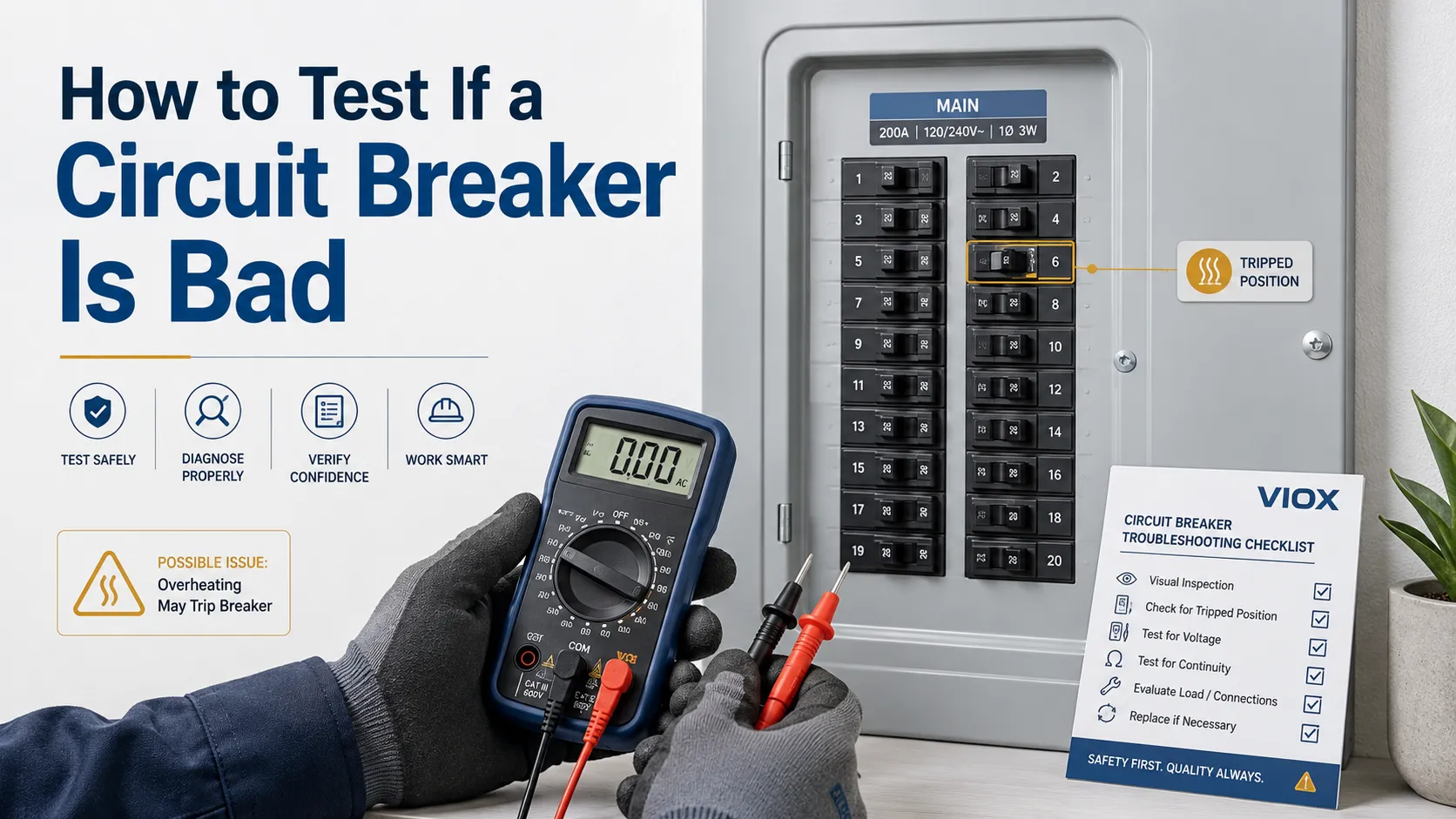
To test if a circuit breaker is bad, first look for visible and operating symptoms: the breaker will not reset, feels hot, smells burnt, trips with normal load, has scorch marks, or leaves the circuit without power even when the handle is ON. A qualified person can then use a multimeter to check whether voltage is present at the breaker output when the breaker is ON and whether the breaker passes power correctly.
The most important rule is this:
Do not assume the breaker is bad just because it trips. A breaker may be doing its job because the circuit has an overload, short circuit, ground fault, arc fault, loose connection, or damaged appliance.
If there is burning smell, buzzing, heat, melted plastic, visible arcing, water damage, or a main breaker problem, stop testing and call a licensed electrician.
Safety First: What You Can and Cannot Test
Circuit breaker testing can involve live voltage inside an electrical panel. That is hazardous. Homeowners can safely observe symptoms and reset a breaker once when conditions are normal, but they should not remove panel covers, touch busbars, probe live service equipment, or perform tests they are not trained to do.
| Situation | Safe Action |
|---|---|
| Breaker trips once after an obvious overload | Turn off loads, reset once, reduce load |
| Breaker trips repeatedly | Stop resetting and diagnose the circuit |
| Breaker feels hot or smells burnt | Turn off if safe and call an electrician |
| Panel has scorch marks or buzzing | Do not touch; call an electrician |
| Main breaker problem | Call an electrician |
| You need live voltage testing inside the panel | Use a qualified person |
Never replace a breaker with a higher amp rating to stop nuisance tripping. The breaker protects the wire. Upsizing without verifying conductor size and circuit design can create a fire hazard.
Bad Breaker Symptoms Checklist
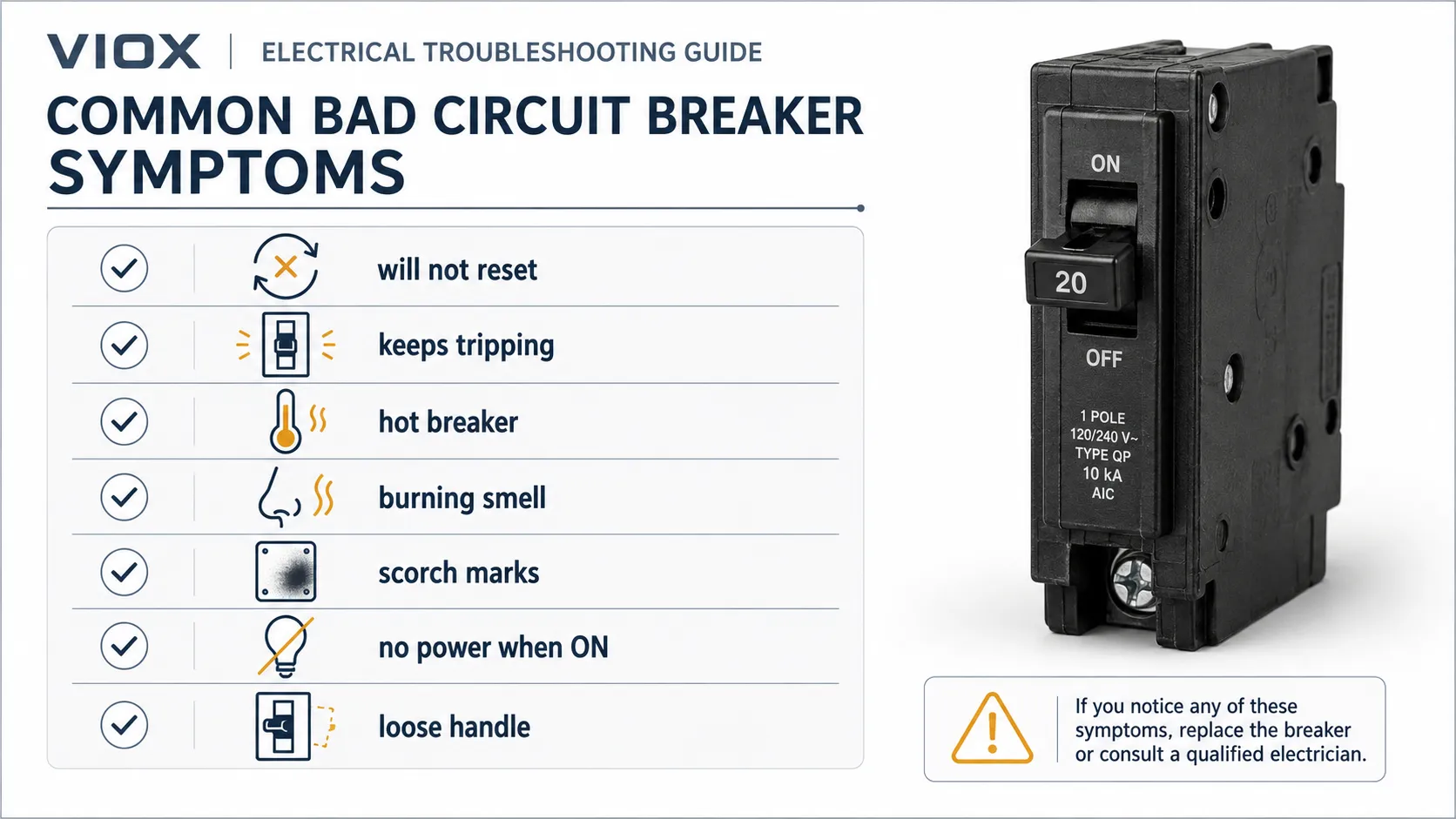
| Symptom | Possible Meaning | What to Do |
|---|---|---|
| Breaker will not reset | Fault on circuit, damaged breaker, worn latch | Turn off loads; do not force it |
| Breaker trips immediately | Short circuit, ground fault, arc fault, failed breaker | Stop resetting and troubleshoot |
| Breaker trips under normal load | Weak breaker, overload, loose terminal, faulty appliance | Compare load and circuit condition |
| Breaker feels hot | Loose connection, overload, poor contact, internal damage | Call an electrician |
| Burning smell | Arcing, overheating, insulation damage | Shut off power if safe |
| Scorch marks or melted case | Severe overheating or arcing | Replace and inspect panel |
| No power but handle is ON | Failed internal contact, loose connection, circuit issue | Voltage test by qualified person |
| Handle feels loose or will not latch | Mechanical wear or breaker damage | Replace after diagnosis |
| Breaker hums or buzzes | Loose connection, overload, failing device | Have panel inspected |
One symptom alone does not always prove the breaker is bad. A good diagnosis separates breaker failure from wiring and load problems.
How to Test If a Circuit Breaker Is Bad With a Multimeter
Live testing should be done only by a qualified person using a properly rated meter and safe electrical work procedures.
In the field, a breaker diagnosis usually starts with a simple question: is the breaker failing to pass power, or is it correctly reacting to a fault downstream? That difference matters. Replacing a breaker that is correctly tripping from a short, ground fault, or overloaded appliance only resets the clock on the real problem.
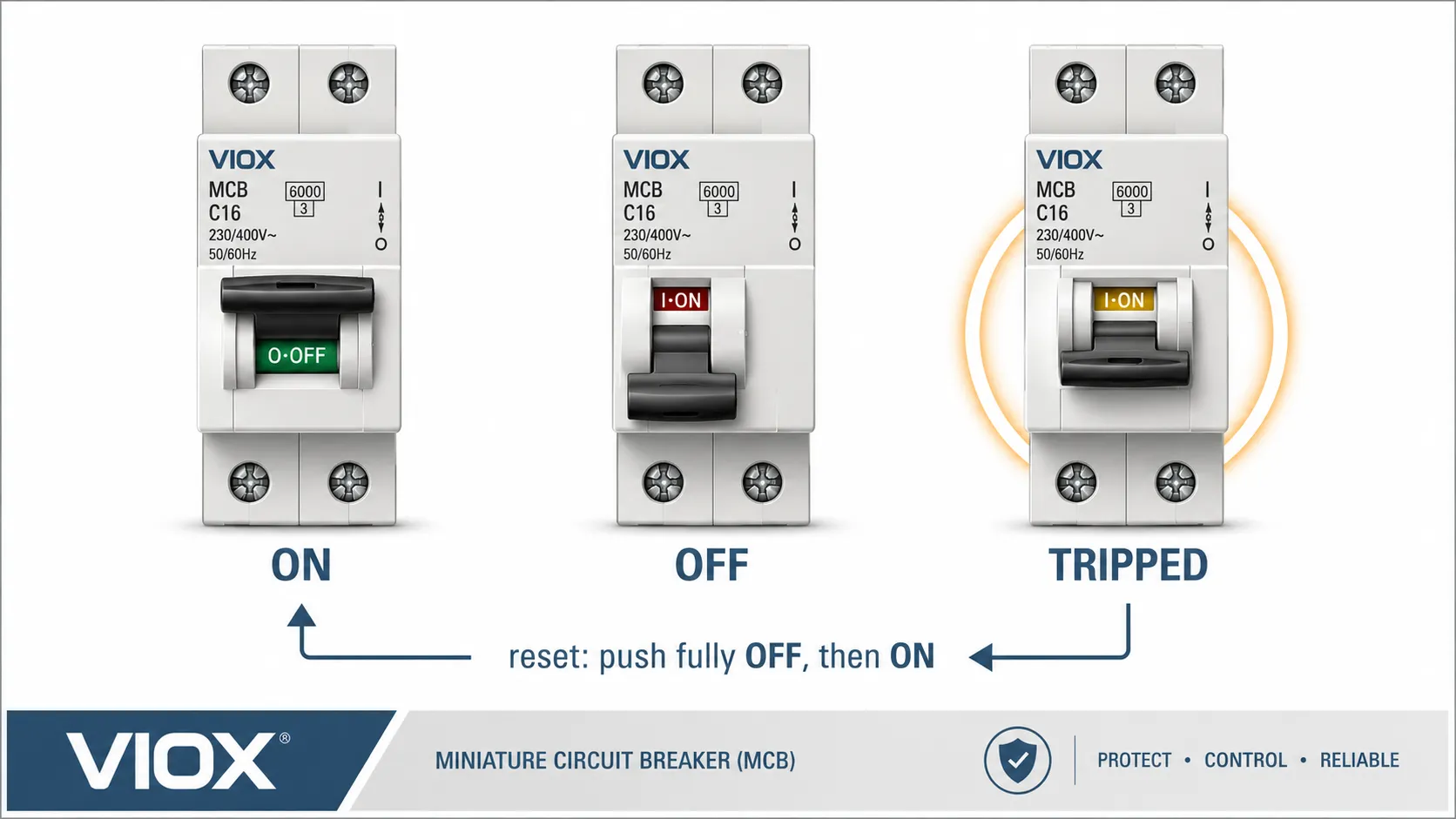
1. Confirm the Breaker Is Fully ON
Many breakers trip to a middle position. To reset correctly, the handle usually must be pushed fully OFF first, then back ON. If the handle will not latch or feels mechanically loose, the breaker may be damaged or the circuit may still have a fault.
2. Test Voltage at the Breaker Output
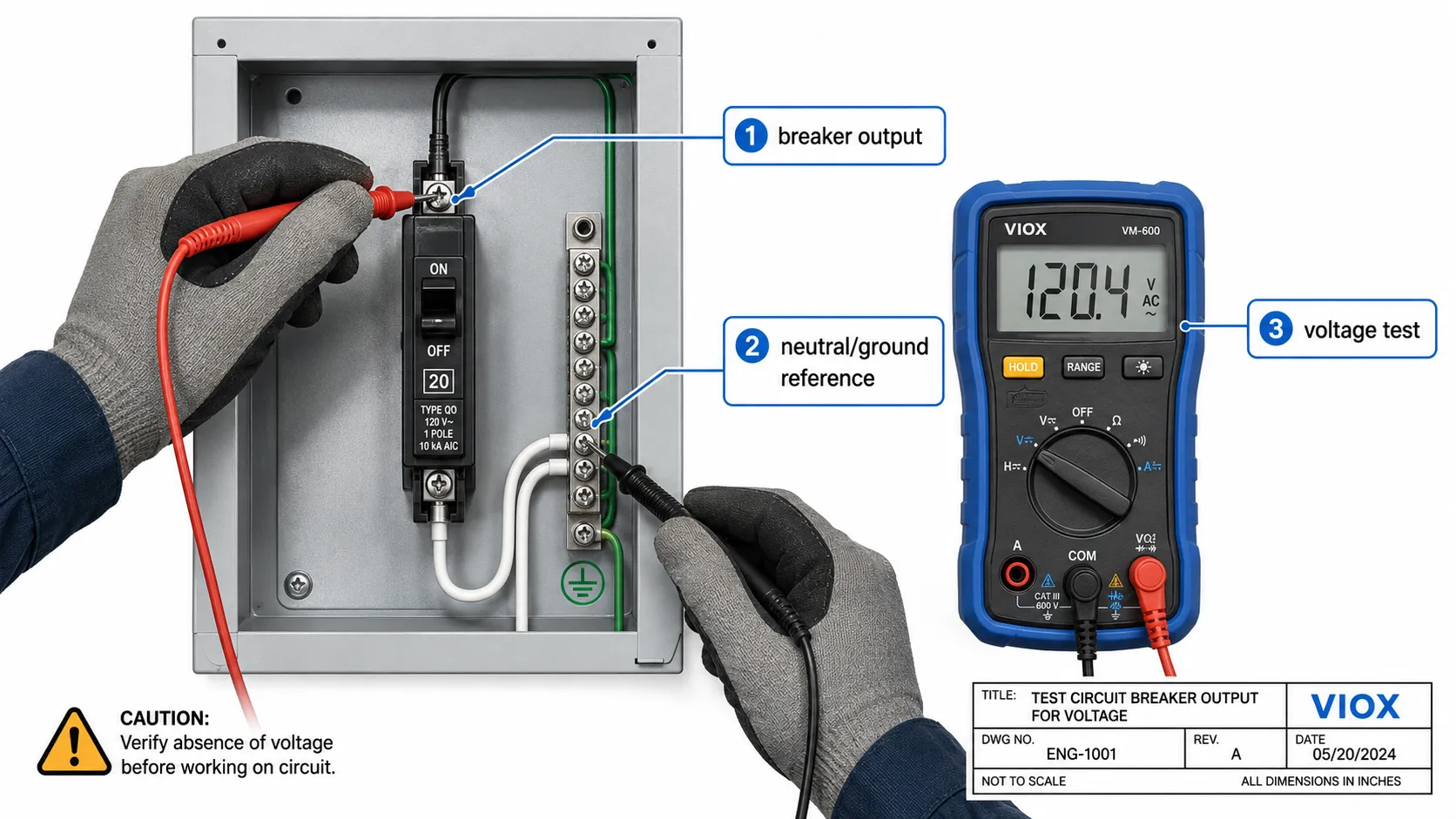
With the breaker ON, a qualified person can measure voltage from the breaker load terminal to neutral or ground, depending on the circuit and system.
| Expected Result | Possible Meaning |
|---|---|
| Correct voltage at breaker output | Breaker may be passing power; problem may be downstream |
| No voltage at breaker output while breaker is ON | Breaker may have failed internally or bus connection may be bad |
| Unstable voltage | Loose connection, damaged breaker, damaged conductor, or panel issue |
This test must be interpreted with the system type. A 120 V, 240 V, single-pole, double-pole, GFCI, AFCI, RCBO, or MCB circuit may require different test points.
For documentation-heavy environments such as factories, machine panels, and data-center support rooms, technicians often record the panel ID, circuit number, measured voltage, connected load, and trip history before replacing a breaker. That record helps prevent the same circuit from being repaired twice for two different assumed causes.
3. Test Continuity Only When De-Energized
Continuity testing should only be done on a de-energized breaker that has been safely isolated. A continuity test can show whether the breaker contacts close when the handle is ON and open when OFF.
| Breaker Position | Expected Continuity |
|---|---|
| ON | Continuity through the breaker |
| OFF | No continuity |
| TRIPPED | No continuity |
Do not use the continuity or resistance setting on a live circuit. That can damage the meter and create a serious shock or arc hazard.
4. Understand the Limit of a Normal Multimeter
A closed breaker should have very low contact resistance. However, accurate contact-resistance testing usually requires a low-resistance ohmmeter or micro-ohmmeter and a de-energized test setup.
A normal handheld multimeter is not a reliable tool for judging subtle breaker contact wear. It may show near-zero resistance even when the breaker has heat-damaged contacts under load.
How to Check a Breaker Without a Multimeter
Without a multimeter, you can still check for warning signs, but you cannot prove the electrical condition of the breaker.
Safe visual and operating checks include:
- Does the breaker reset normally?
- Does it trip again immediately?
- Does the handle feel loose, gritty, or weak?
- Is the breaker hot compared with neighboring breakers?
- Is there a burning smell?
- Are there scorch marks, discoloration, or melted plastic?
- Does the problem happen only with one appliance?
- Does the circuit lose power even when the breaker appears ON?
These checks help decide whether to stop and call an electrician. They do not replace electrical testing.
Can a Breaker Fail Without Tripping?
Yes. A circuit breaker can fail without visibly tripping.
Possible examples include:
- internal contacts fail open, causing no power even when the handle is ON
- contact surfaces become burned or pitted, causing heat under load
- mechanical latch weakens and trips too easily
- trip mechanism becomes unreliable
- breaker-to-busbar contact becomes loose or overheated
- terminal screw connection overheats
The most dangerous failure is not always nuisance tripping. A breaker that cannot interrupt a fault correctly, overheats at the terminal, or makes poor busbar contact can create a fire or arc hazard.
Bad Breaker vs Bad Circuit: How to Tell the Difference
| Situation | More Likely Breaker | More Likely Circuit or Load |
|---|---|---|
| Trips only when one appliance starts | Less likely | Appliance inrush, overload, motor fault |
| Trips with all loads unplugged | Possible | Hidden wiring fault also possible |
| Breaker handle will not latch | More likely | Circuit fault may also prevent reset |
| No power but breaker is ON | Possible | Loose wire or downstream fault also possible |
| Breaker is visibly burned | Very likely breaker/panel issue | Circuit may have caused overheating |
| New correct breaker also trips | Less likely | Circuit or load problem |
| Original breaker feels loose on busbar | Breaker or panel issue | Not a load problem |
Replacing a breaker without diagnosing the circuit can hide the real problem. If the new breaker trips, the old breaker may not have been the cause.
Circuit Breaker Failure Modes
Circuit breakers can fail electrically, mechanically, or thermally.
| Failure Mode | What Happens | Common Clue |
|---|---|---|
| Worn spring mechanism | Breaker becomes weak or inconsistent | Nuisance trips or loose handle |
| Burned contacts | Contacts overheat or fail to carry load cleanly | Heat, smell, voltage drop |
| Pitted contacts | Repeated switching or fault stress damages surface | Heat under load |
| Loose terminal | Conductor connection overheats | Discoloration, buzzing, melted insulation |
| Busbar clip damage | Breaker does not grip panel bus correctly | Heat at breaker back, unstable power |
| Thermal element aging | Thermal trip behavior changes | Trips at lower-than-expected load |
| Magnetic trip failure | Fault interruption behavior may be compromised | Requires professional testing |
| Case damage | Insulation and mechanical integrity compromised | Cracks, melting, burn marks |
Most field diagnosis starts with visible symptoms, voltage testing, load behavior, and thermal signs. Detailed trip testing is usually not practical for homeowners.
Circuit Breaker Resistance and Contact Resistance
Breaker resistance is usually discussed when technicians suspect that the breaker contacts are not carrying current cleanly. The concept is valid, but the test is often misunderstood.
When a breaker is closed, its contact resistance should be very low. The problem is that a cheap or normal handheld multimeter cannot accurately measure very low contact resistance under real load conditions. It also cannot reproduce heat rise, contact pressure, or fault-clearing behavior.
For professional maintenance, contact resistance may be evaluated with specialized low-resistance test equipment under controlled conditions. For residential or small commercial troubleshooting, heat, voltage drop, visible damage, nuisance tripping, and proper voltage testing are usually more practical indicators.
In an industrial panel, a thermographic scan can also reveal a suspect breaker connection before a complete failure occurs. A hot breaker terminal does not automatically prove the breaker itself is bad; it may point to a loose conductor, damaged busbar contact, poor crimp, overloaded circuit, or internal contact wear. The useful clue is the temperature difference compared with similar breakers under similar load.
Field Example: When the Breaker Was Not the First Cause
A common maintenance trap is replacing the breaker first because it is the visible device that trips. In one workshop-style fault pattern, a small motor circuit trips intermittently after running for several minutes. The breaker feels warm, so the first assumption is a weak breaker. After checking the load, however, the real issue is a loose terminal causing heat at the breaker output. The breaker is reacting to a bad connection, not creating the fault by itself.
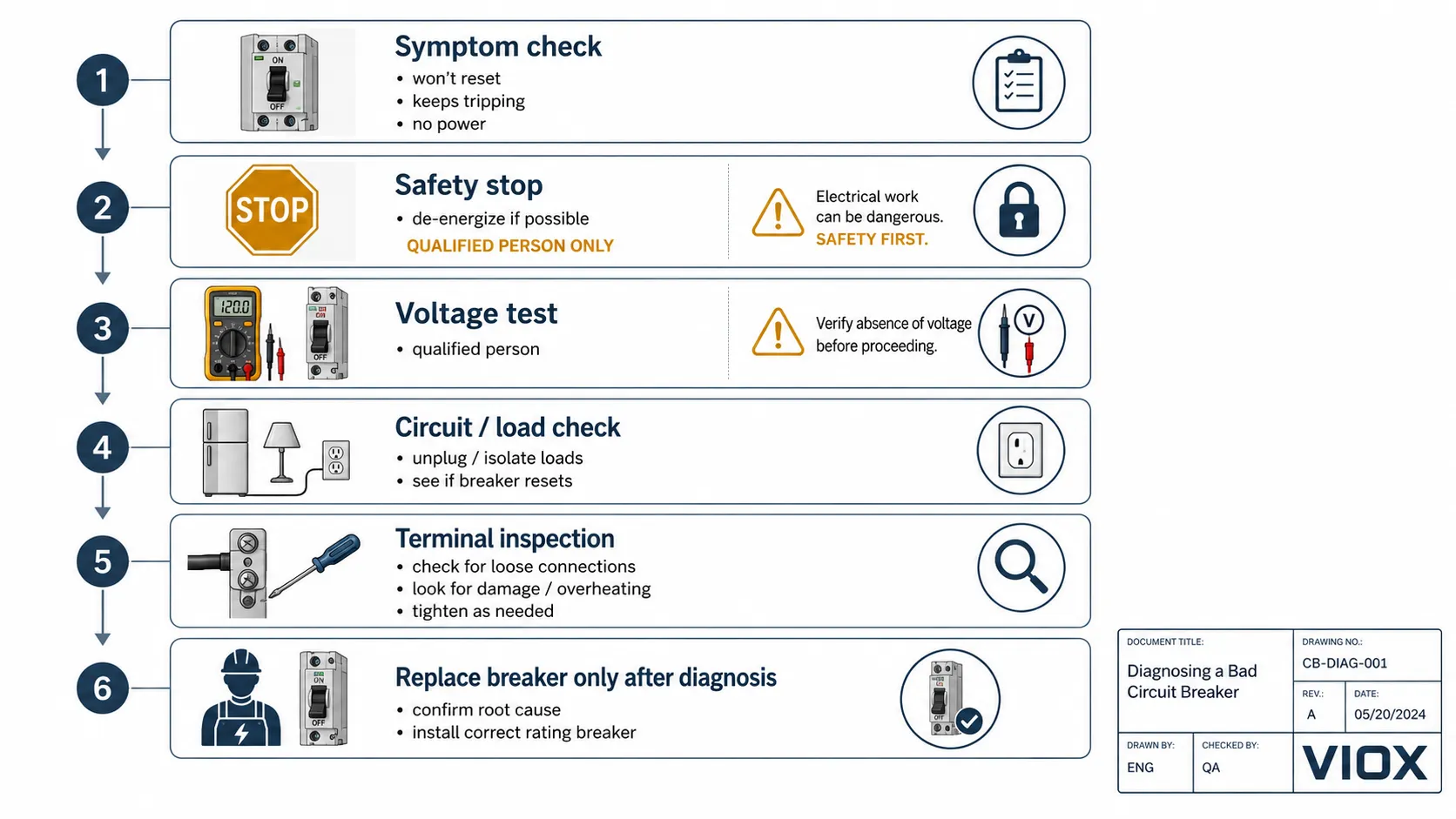
This is why breaker diagnosis should follow a sequence:
- Check visible damage and heat.
- Confirm the load and trip pattern.
- Test voltage safely.
- Inspect terminals and conductor condition.
- Only then decide whether the breaker should be replaced.
Skipping directly to replacement can leave the dangerous connection in place.
Weak Breaker Symptoms
A weak breaker is a breaker that trips too easily, fails to latch reliably, or no longer behaves consistently under normal conditions.
Common weak breaker symptoms include:
- trips with a load that previously worked normally
- handle feels loose or soft
- trips more often after warming up
- resets temporarily but trips again without a clear overload
- neighboring similar circuits work normally under comparable load
- breaker has a history of repeated trips or overheating
Even then, confirm the circuit condition. Motors, compressors, heaters, and power tools may draw high inrush current that looks like a weak breaker problem.
How Electricians Load Test a Circuit Breaker
A load test checks how the breaker and circuit behave under controlled current. This is not the same as randomly plugging in appliances until the breaker trips.
An electrician may review:
- actual circuit load
- conductor size
- breaker rating
- terminal condition
- voltage drop
- temperature rise
- trip history
- load type and inrush current
- panel condition
For molded case circuit breakers, industrial breakers, or critical equipment, professional testing may include insulation testing, contact resistance testing, primary injection testing, or manufacturer-specific maintenance procedures.
When to Replace a Circuit Breaker
Replacement is usually justified when:
- breaker is physically damaged
- breaker has scorch marks or melting
- breaker will not reset after circuit faults are cleared
- breaker overheats at normal load
- breaker has failed voltage or continuity testing
- breaker trips inconsistently after the circuit is verified
- breaker does not fit tightly in the panel
- breaker is obsolete, recalled, or not approved for the panel
The replacement breaker must match the panel and circuit requirements. Same amperage alone is not enough. Check brand compatibility, breaker series, voltage, pole count, interrupting rating, wire size, and panel labeling.
When to Call an Electrician Immediately
Call an electrician immediately if you notice:
- burning smell
- smoke
- buzzing or crackling from the panel
- melted breaker or wire insulation
- scorch marks
- hot panel cover
- main breaker issue
- water near the panel
- breaker repeatedly trips after reset
- lights flicker across multiple circuits
- breaker feels loose on the busbar
These signs can indicate arcing, overheating, loose connections, or panel damage.
FAQ
How do I know if a breaker is bad?
A breaker may be bad if it will not reset, trips under normal load after the circuit is verified, feels hot, smells burnt, has scorch marks, or does not pass voltage when ON. However, many breaker trips are caused by circuit or load problems, not a bad breaker.
How do you test if a circuit breaker is bad with a multimeter?
A qualified person can test voltage at the breaker output when the breaker is ON. Continuity testing can be done only when the breaker is de-energized and isolated. Do not use resistance or continuity mode on a live circuit.
Can a breaker fail without tripping?
Yes. A breaker can fail open, overheat internally, develop poor contact, loosen on the busbar, or fail to carry load properly without showing a normal trip position.
Can I test a circuit breaker without a multimeter?
You can check symptoms such as heat, smell, visible damage, loose handle, repeated trips, or failure to reset. But without a meter or professional testing, you cannot confirm the electrical condition of the breaker.
What are weak breaker symptoms?
Weak breaker symptoms include nuisance tripping, loose handle feel, failure to latch, tripping under normal load, and inconsistent behavior after the circuit and load have been verified.
What is circuit breaker contact resistance?
Contact resistance is the resistance across the breaker contacts when closed. It should be very low, but accurate measurement requires proper low-resistance test equipment. A normal multimeter is not reliable for detailed breaker contact diagnosis.
Should I replace a breaker that keeps tripping?
Not immediately. First identify whether the trip is caused by overload, short circuit, ground fault, arc fault, loose wiring, or appliance failure. Replace the breaker only after the circuit condition is checked.
Can I replace a breaker with a higher amp breaker?
No. A higher amp breaker can overload the wire and create a fire hazard unless the entire circuit is designed and approved for that rating.
Conclusion
The best way to test if a circuit breaker is bad is to combine symptom checks, safe electrical testing, and circuit diagnosis. A bad breaker can cause no power, overheating, nuisance trips, weak reset action, or visible damage. But a breaker that trips repeatedly may also be responding correctly to an unsafe circuit condition.
If the issue involves heat, burning smell, scorch marks, repeated trips, main breaker problems, or live panel testing, stop guessing and call a qualified electrician. The goal is not just to replace a breaker. The goal is to find whether the real problem is the breaker, the load, the wiring, or the panel connection.