

On this page
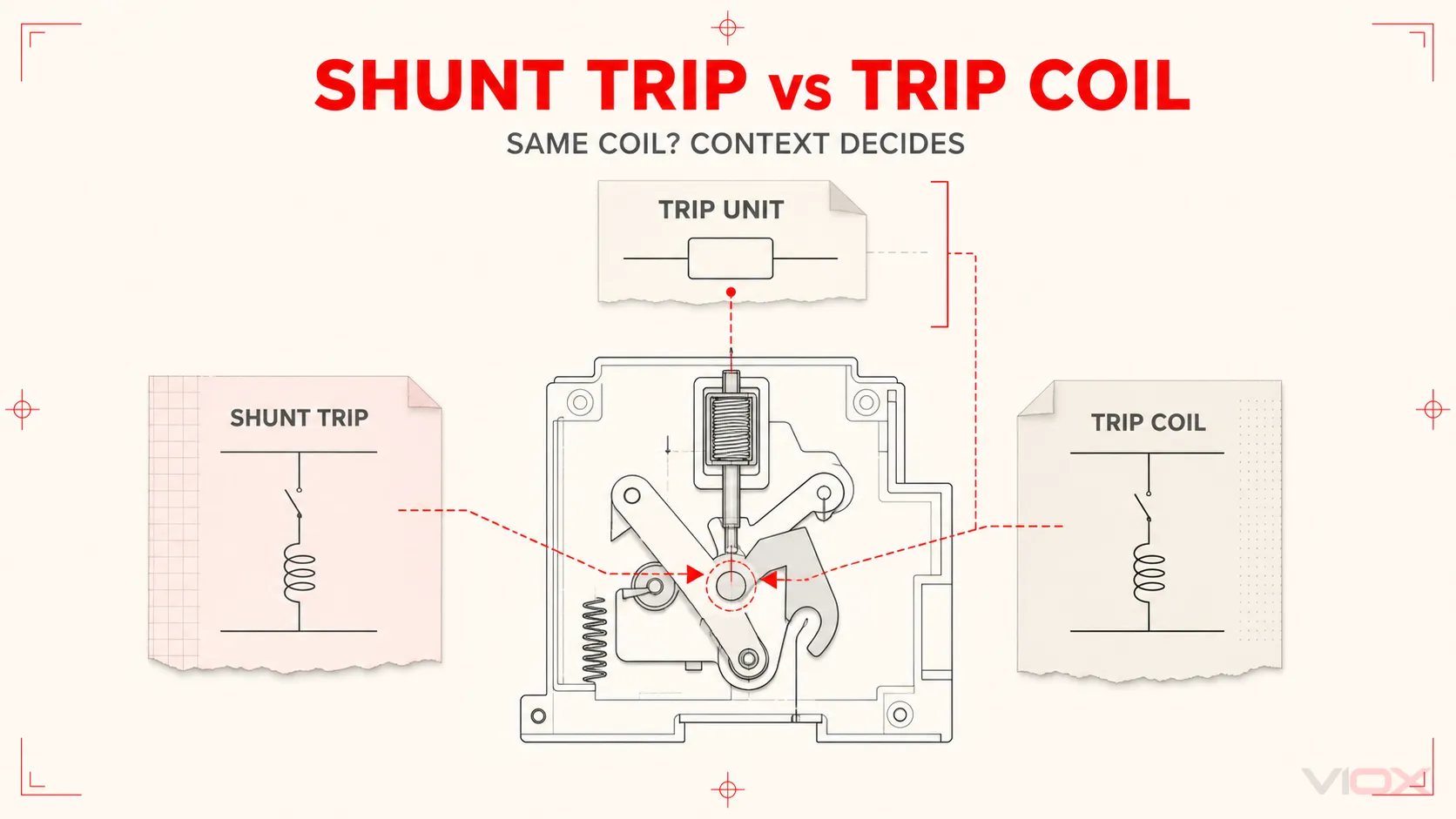
A shunt trip is a specific energize-to-open release. Trip coil is a broader, context-dependent term: it may mean the coil inside that shunt release, or it may identify another electrically operated breaker-opening coil in a relay-controlled breaker. The two terms are therefore not universal opposites.
The practical rule is simple: do not select or substitute either item from the generic name alone. Confirm what initiates the trip, which device makes the trip decision, which coil or release opens the breaker, and how the exact manufacturer identifies that component.
Shunt Trip vs Trip Coil at a Glance
| Term | Most defensible general meaning | What energizes or commands it? | Important boundary |
|---|---|---|---|
| Shunt trip / shunt release / shunt opening release | A voltage-operated release that opens a breaker when a valid external command is applied | Push button, relay contact, fire-alarm interface, programmable controller, or another control circuit | Usually an exact breaker-family accessory; applying the name does not establish voltage, duty, timing, or compatibility |
| Shunt trip coil | The electromagnetic operating element of a shunt-trip function, or shorthand for the complete accessory | The shunt-trip control circuit | In many manufacturer documents, this is itself a trip coil |
| Trip coil / opening coil | A broad term for an electrically operated element that releases a breaker’s opening mechanism | May be a shunt command, protection-relay output, breaker control circuit, or another documented source | Its meaning changes with breaker type and manufacturer terminology |
| Trip unit | The protection element that detects or evaluates an abnormal electrical condition and decides whether tripping is required | Current sensors, thermal-magnetic elements, electronic sensing, and configured protection logic | A trip unit is not simply another name for a shunt-trip coil |
| Undervoltage release | A release intended to open or prevent closing when its control voltage falls below the product’s operating condition | Loss or reduction of the monitored control voltage | Its operating logic differs from an energize-to-trip shunt release |
Schneider Electric describes a shunt trip as an optional breaker accessory that trips when external power is applied to its terminals. The same manufacturer also uses the expression shunt trip coil for its MX and iMX releases. Eaton likewise sells products explicitly described as shunt-trip coils. These examples show why “shunt trip” and “trip coil” cannot be treated as two globally separate categories.
The Four Layers Behind a Breaker Trip
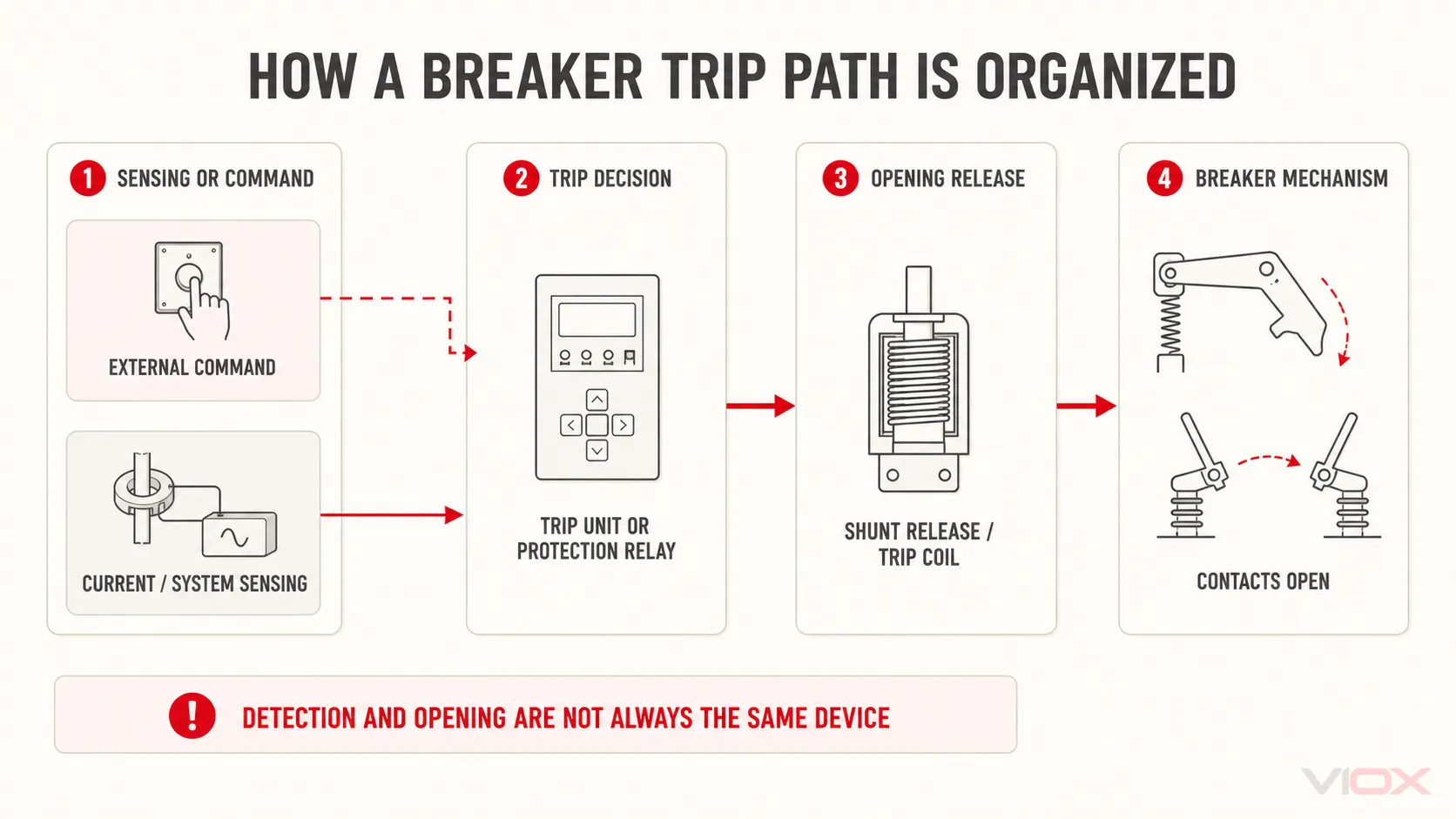
Most terminology confusion disappears when the trip path is divided into four functional layers:
- Sensing or command source — current sensors, a protective relay, an emergency-stop contact, a fire-alarm interface, or another external command source.
- Trip decision — a thermal-magnetic trip unit, electronic trip unit, protection relay, safety controller, or direct manual command determines that the breaker should open.
- Opening actuator or release — a shunt opening release, trip coil, flux-transfer device, magnetic latch, or another manufacturer-defined actuator releases the mechanism.
- Breaker mechanism — stored mechanical energy opens the main contacts and the breaker moves to its open or tripped state.
The same words do not always label the same layer. A low-voltage molded case circuit breaker (MCCB) may have an optional shunt-trip accessory alongside a separate thermal-magnetic or electronic trip unit. A larger air or medium-voltage breaker may use a protection relay and a separately powered opening coil that its documentation calls the trip coil, shunt opening release, or another model-specific designation.
That distinction matters because the detector and the opening actuator are not necessarily the same device. A shunt release can open a breaker after receiving a signal, but it does not by itself measure overload current, calculate a protection curve, or decide that a fault exists.
When Shunt Trip and Trip Coil Mean the Same Thing
The terms can refer to the same functional hardware when:
- a manufacturer labels the accessory “shunt trip coil”;
- a breaker diagram calls its voltage-operated opening release the trip coil;
- a protection relay energizes the breaker’s shunt opening release to execute a trip;
- a parts catalog uses “trip coil” as shorthand for the replacement coil inside the shunt-trip assembly.
For example, Schneider documentation for QO and QOB breakers describes remote tripping by a tripping coil energized from a separate circuit and labels the internal element “Shunt Trip Coil.” The correct interpretation is not that a shunt trip and a trip coil are competing devices; the coil is part of the shunt-trip function in that product architecture.
This does not make generic part numbers interchangeable. Two accessories can perform the same broad energize-to-open function and still differ in mounting, connector arrangement, rated control voltage, AC or DC suitability, operating range, duty, power consumption, clearing-contact arrangement, and breaker-frame compatibility.
When “Trip Coil” Has a Broader Meaning
In switchgear and relay-protection documentation, trip coil often means the electrically operated opening coil of the breaker mechanism. A protective relay may monitor current, voltage, frequency, differential current, or other system quantities and close an output contact when its configured protection logic operates. That output then energizes the breaker’s opening circuit.
ABB documentation for certain medium-voltage breakers uses shunt opening release for a remotely controlled opening device and discusses control-coil continuity and trip-circuit supervision. Siemens air-circuit-breaker documentation uses defined shunt-trip designations alongside closing coils and undervoltage releases. These examples reinforce the context rule: the equipment manual—not a generic glossary—defines the actual coil, terminals, permissible duty, and control architecture.
The phrase may also appear in maintenance discussions such as trip-circuit supervision. In that context, the engineering concern is not merely whether a remote button exists. It may include continuity of the control supply, wiring, auxiliary contacts, relay output, and opening coil so that a hidden open circuit does not prevent breaker operation.
Do Not Confuse a Trip Coil with a Trip Unit
The old version of this page treated the trip coil as the breaker’s internal fault-protection system. That is too broad.
An MCCB trip unit provides the protection decision. Depending on the design, it may use thermal-magnetic elements or electronic sensing and logic. The actuator that releases the latch may be integrated into that assembly, but it should not automatically be specified as a replaceable “trip coil.” If you need a deeper explanation of the protection device itself, see What Is an MCCB?.
A shunt trip solves a different problem: it provides an electrical path for an external command to operate the breaker mechanism. The shunt release may receive a command from a protection relay, but that does not make the release the sensing or protection element.
Breaker Context Changes the Correct Answer
| Breaker context | Likely terminology | Correct engineering question |
|---|---|---|
| MCB or MCCB with a remote-opening accessory | Shunt trip, shunt release, shunt opening release, MX, SHT, or shunt trip coil | Is this exact accessory approved for the breaker family, frame, control supply, and intended command duty? |
| MCCB with thermal-magnetic or electronic protection | Trip unit plus an optional shunt release | Which function detects the fault, and which accessory executes an external trip command? |
| Low-voltage air circuit breaker | First or second shunt trip, opening release, trip coil, or product-specific designation | Which installed release is connected to the intended control or protection circuit? |
| Medium-voltage breaker operated by protection relays | Trip coil, opening coil, shunt opening release, or breaker-specific code | What are the DC or AC control requirements, supervision method, and exact terminal logic in the breaker manual? |
This is why a purchasing statement such as “breaker with trip coil” is incomplete. It does not establish the breaker family, protection architecture, remote-command requirement, control voltage, coil duty, number of opening releases, or need for trip-circuit supervision.
Specify the Function Before Naming the Coil
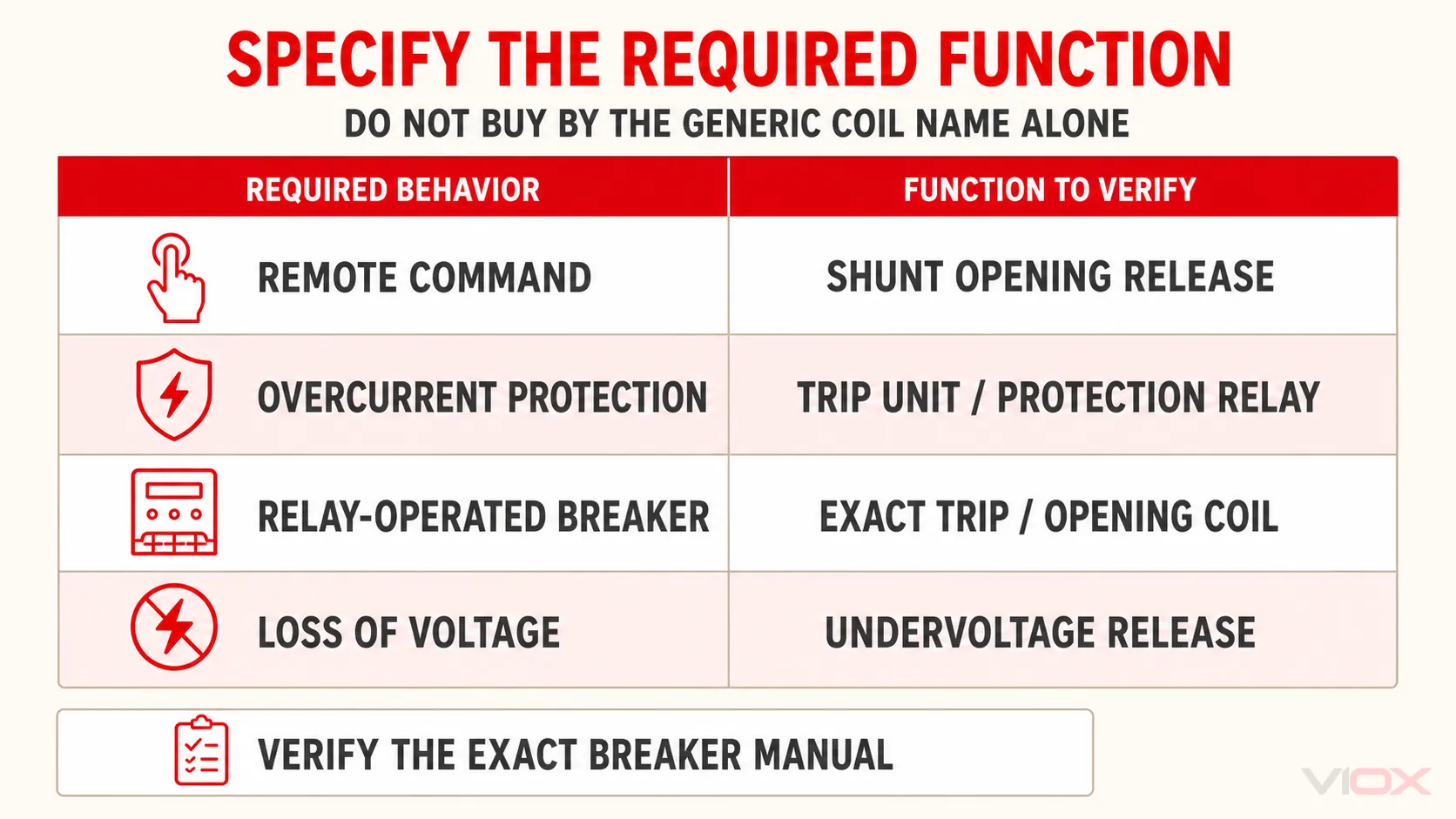
Use the required system behavior to choose the correct specification path.
| Required behavior | What to specify | What not to assume |
|---|---|---|
| Open the breaker from an external push button, controller, interlock, or safety system | Exact compatible shunt opening release and its documented control-circuit requirements | That every “trip coil” listing is a compatible add-on accessory |
| Trip after an MCCB detects overload, short circuit, or another supported protection condition | Correct trip-unit type, ratings, settings, and coordination; add a shunt release only when an external command is also required | That the shunt coil performs overcurrent sensing |
| Open a relay-controlled air or medium-voltage breaker | Exact breaker opening or trip coil, control supply, relay interface, auxiliary contacts, and supervision requirements | That low-voltage accessory terminology or wiring can be transferred to the larger breaker |
| Open or prevent closing after loss of control voltage | Exact compatible undervoltage release and its documented pickup, dropout, and reset behavior | That an ordinary energize-to-trip shunt release is fail-safe on control-power loss |
If the real requirement is MCCB accessory wiring, commissioning, or fault diagnosis, use the dedicated MCCB shunt-trip coil guide. This comparison page intentionally stops at terminology, architecture, and specification boundaries.
Exact-Model Verification Checklist
Before approving a breaker schedule, replacement, or accessory order, obtain the manufacturer documentation for the exact breaker and release. Verify:
- breaker series, frame size, pole configuration, and accessory mounting position;
- manufacturer name for the function and its catalog or ordering code;
- rated control voltage and permitted operating-voltage range;
- AC or DC suitability and frequency where applicable;
- command duration and whether momentary or maintained energization is permitted;
- inrush and holding burden where the control source or relay contact must be sized;
- internal coil-clearing contact or required external cutoff arrangement;
- terminal identification, polarity where relevant, and the authoritative wiring diagram;
- number of opening releases and any mutual-exclusion rules with other accessories;
- auxiliary contacts, trip indication, interlocks, and trip-circuit supervision requirements;
- environmental, installation, and certification documents required for the destination market;
- functional test and reset procedure stated by the manufacturer.
Do not infer these fields from a similar frame or another manufacturer’s accessory. Even when two releases share a voltage label and general function, their electrical burden, mechanism interface, and permitted duty may differ.
For a VIOX MCCB application, review the VIOX MCCB range and provide the exact breaker family, frame, required control voltage, command source, and destination market when requesting accessory documentation.
Frequently Asked Questions
Is a shunt trip coil the same as a trip coil?
Sometimes. A shunt-trip coil is one type of electrically operated trip or opening coil, and some manufacturers use the terms together. “Trip coil” can also be a broader breaker-control term, so the product manual must confirm what it means.
Does a trip coil detect an overload or short circuit?
Not necessarily. A coil may only execute the opening action. The detection and trip decision can come from a thermal-magnetic trip unit, electronic trip unit, or external protection relay.
Will a shunt trip open the breaker if control power is lost?
An ordinary shunt release is generally an energize-to-trip function, so loss of its control supply does not by itself create the trip command. If loss-of-voltage behavior is required, evaluate an undervoltage release or another engineered fail-safe architecture using exact product documentation.
Can a shunt-trip coil remain energized continuously?
Only when the selected product documentation permits it. Some designs use a coil-clearing contact after the breaker trips; others may be rated for maintained energization. Do not generalize the duty of one accessory family to another.
Can I replace a shunt release with another brand’s trip coil?
Not from the generic description alone. Compatibility depends on the breaker mechanism, mounting, electrical ratings, connector or terminal arrangement, accessory rules, and product approvals for the exact combination.
Sources
- Schneider Electric: How a shunt trip works
- Schneider Electric: What a Shunt Trip MX is used for
- Schneider Electric QO and QOB circuit breaker catalog — shunt-trip terminology and diagram
- Eaton: Shunt trip coil replacement kit
- ABB: Shunt opening release and control-coil continuity
- Siemens: 3WT1 air circuit breaker manual