

On this page
Direct Answer: What Is an MCCB?
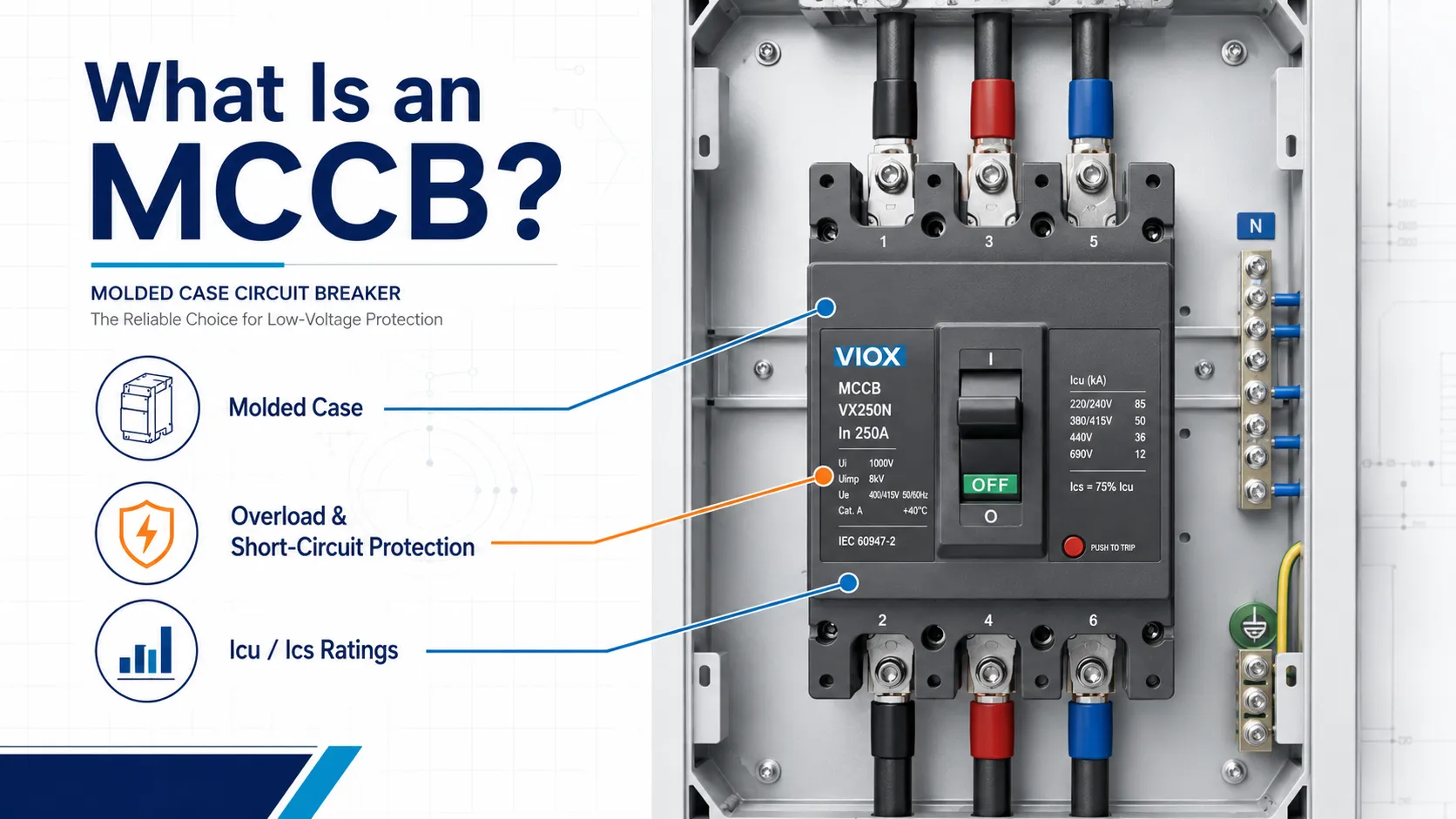
An MCCB, or molded case circuit breaker, is a low-voltage circuit breaker used to protect feeders, motors, distribution panels, generators, and industrial equipment from overloads and short circuits. Compared with an MCB, an MCCB usually supports higher current ratings, higher breaking capacity, adjustable trip settings, and more accessories for commercial and industrial power distribution.
The word molded case refers to the insulated molded housing that contains the contacts, trip unit, operating mechanism, terminals, and arc-extinguishing structure. The housing makes the breaker compact, enclosed, and suitable for panel and switchboard installation.
If you need the product range rather than the educational explanation, see the VIOX MCCB product page.
Key Takeaways
- MCCB means molded case circuit breaker.
- MCCBs protect low-voltage circuits against overload and short-circuit current.
- MCCBs are commonly used where an MCB is too small for the current rating, fault level, or trip-setting requirement.
- Key MCCB ratings include rated current
In, rated operational voltageUe, breaking capacityIcuandIcs, pole count, and trip-unit type. - MCCB internal parts are important, but this page only summarizes them. For a full diagram and parts explanation, see the VIOX MCCB internal parts and structure guide.
MCCB Meaning and Full Form
MCCB stands for Molded Case Circuit Breaker.
| Term | Meaning |
|---|---|
| M | Molded |
| C | Case |
| C | Circuit |
| B | Breaker |
The term is used globally, although spelling differs by region:
- Molded case circuit breaker is common in American English.
- Moulded case circuit breaker is common in British English and some IEC-market documentation.
Both terms refer to the same general product category.
If the user only needs the acronym explanation, the shorter page MCCB Full Form: Molded Case Circuit Breaker can support that intent. This page focuses on meaning, operation, ratings, and application.
MCCB vs MCB: Main Difference
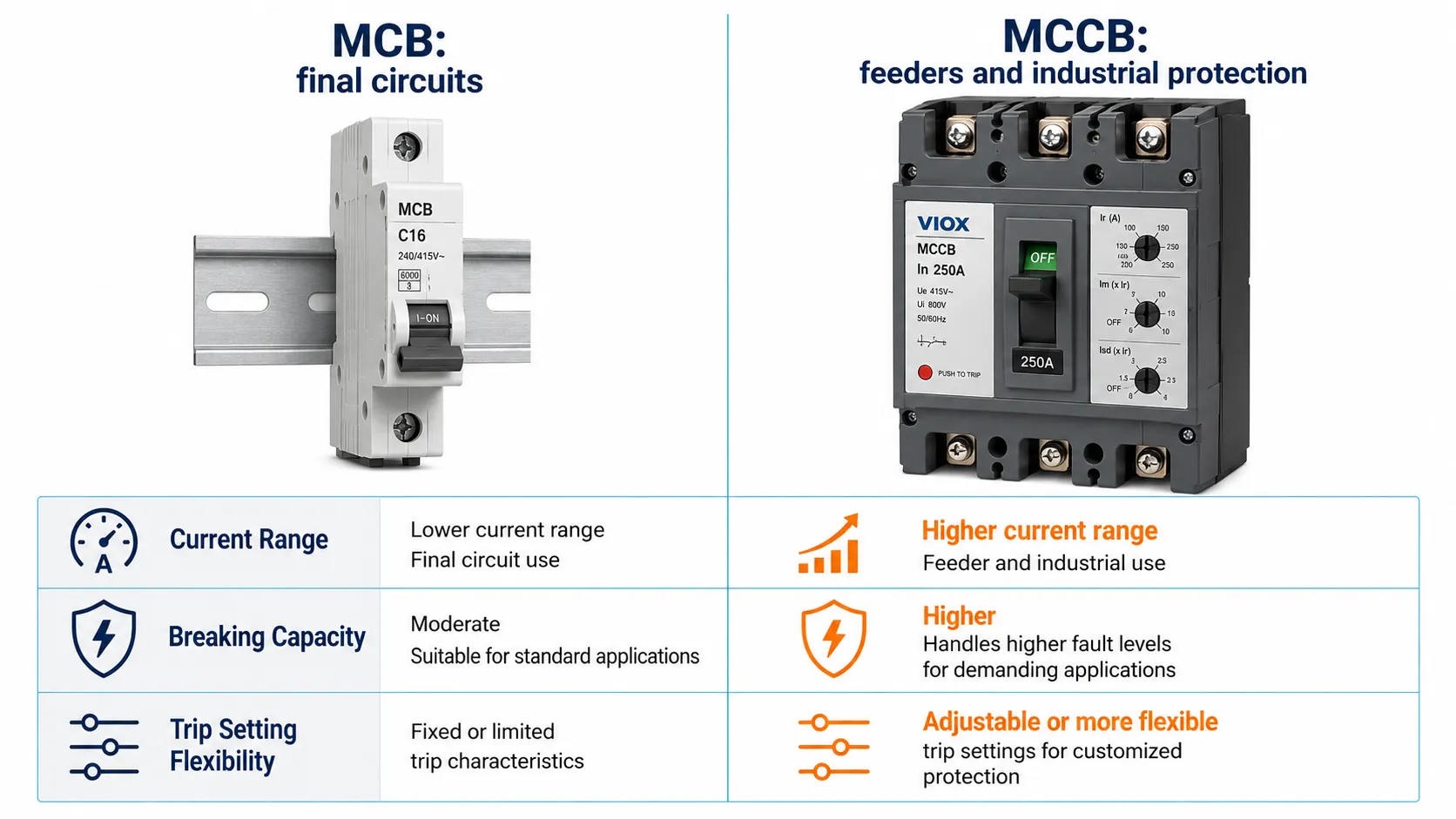
MCCBs and MCBs are both circuit breakers, but they are not used for the same duty level.
| Feature | MCCB | MCB |
|---|---|---|
| Full name | Molded case circuit breaker | Miniature circuit breaker |
| Typical role | Feeder, larger branch, motor, and industrial protection | Final circuits and smaller branch circuits |
| Current range | Usually higher | Usually lower |
| Breaking capacity | Usually higher | Usually lower |
| Trip settings | Fixed or adjustable depending on model | Usually simpler and less adjustable |
| Accessories | Often supports shunt trip, auxiliary contact, undervoltage release, motor operator | More limited depending on series |
| Typical installation | Distribution panels, switchboards, machinery panels | DIN rail boards and final distribution |
The practical difference is simple: use an MCB for smaller final circuits; use an MCCB when the circuit needs higher current capacity, higher short-circuit capability, adjustable trip behavior, or accessory integration.
For a dedicated comparison, see VIOX’s MCCB vs MCB guide.
How Does an MCCB Work?
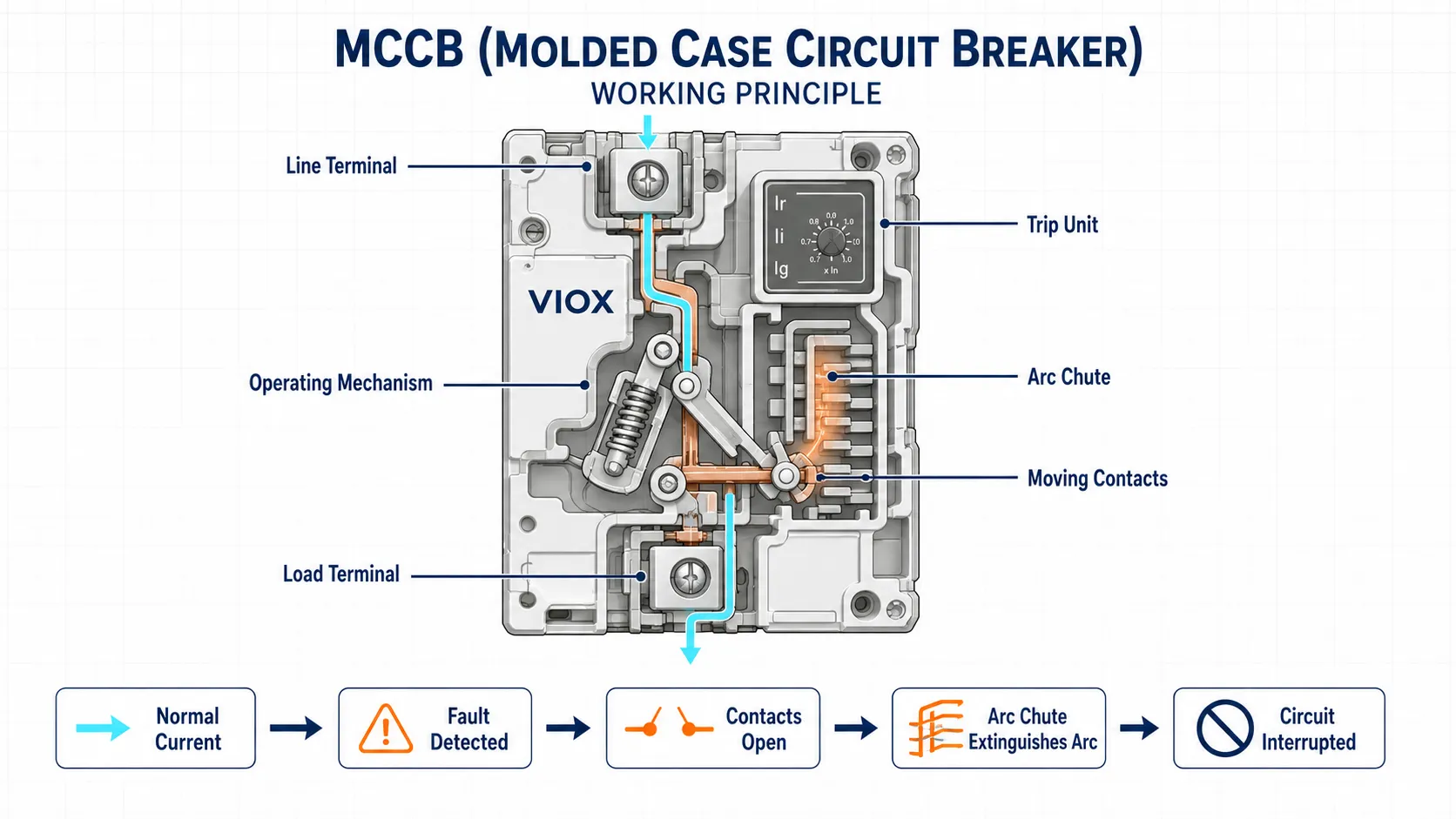
An MCCB carries normal load current continuously within its rated conditions. When current exceeds the allowed limit, the breaker trips and opens the circuit.
The operating sequence is:
Normal current flows → overload or short circuit occurs → trip unit detects fault → mechanism releases → contacts open → arc chute extinguishes arc → circuit is interruptedMost MCCBs use one of two trip technologies:
| Trip Technology | How It Works | Typical Advantage |
|---|---|---|
| Thermal-magnetic MCCB | Thermal element responds to overload; magnetic element responds to short circuit | Simple, robust, cost-effective |
| Electronic trip MCCB | Sensors and electronic logic measure current and control trip functions | More adjustable settings, better coordination options, possible metering or communication |
For the deeper technology comparison, see VIOX’s Electronic vs Thermal-Magnetic MCCB guide.
MCCB Working Principle
The working principle of an MCCB depends on the fault type.
Overload Protection
During overload, current is higher than normal but not as severe as a short circuit. In a thermal-magnetic MCCB, a bimetal element heats and bends until it releases the trip mechanism. This provides time-delay behavior so the breaker does not trip instantly for every short inrush event.
Short-Circuit Protection
During short circuit, current rises rapidly. The magnetic element or electronic trip unit responds much faster and releases the mechanism. The moving contacts separate, an arc forms, and the arc chute splits and cools the arc until current is interrupted.
Arc Extinction
Arc extinction is one reason an MCCB is more than a simple switch. When contacts open under fault current, the device must safely manage the arc inside its rated breaking capacity. The molded case, contact system, arc runners, and arc chute all contribute to this interruption process.
Key MCCB Ratings and Specifications
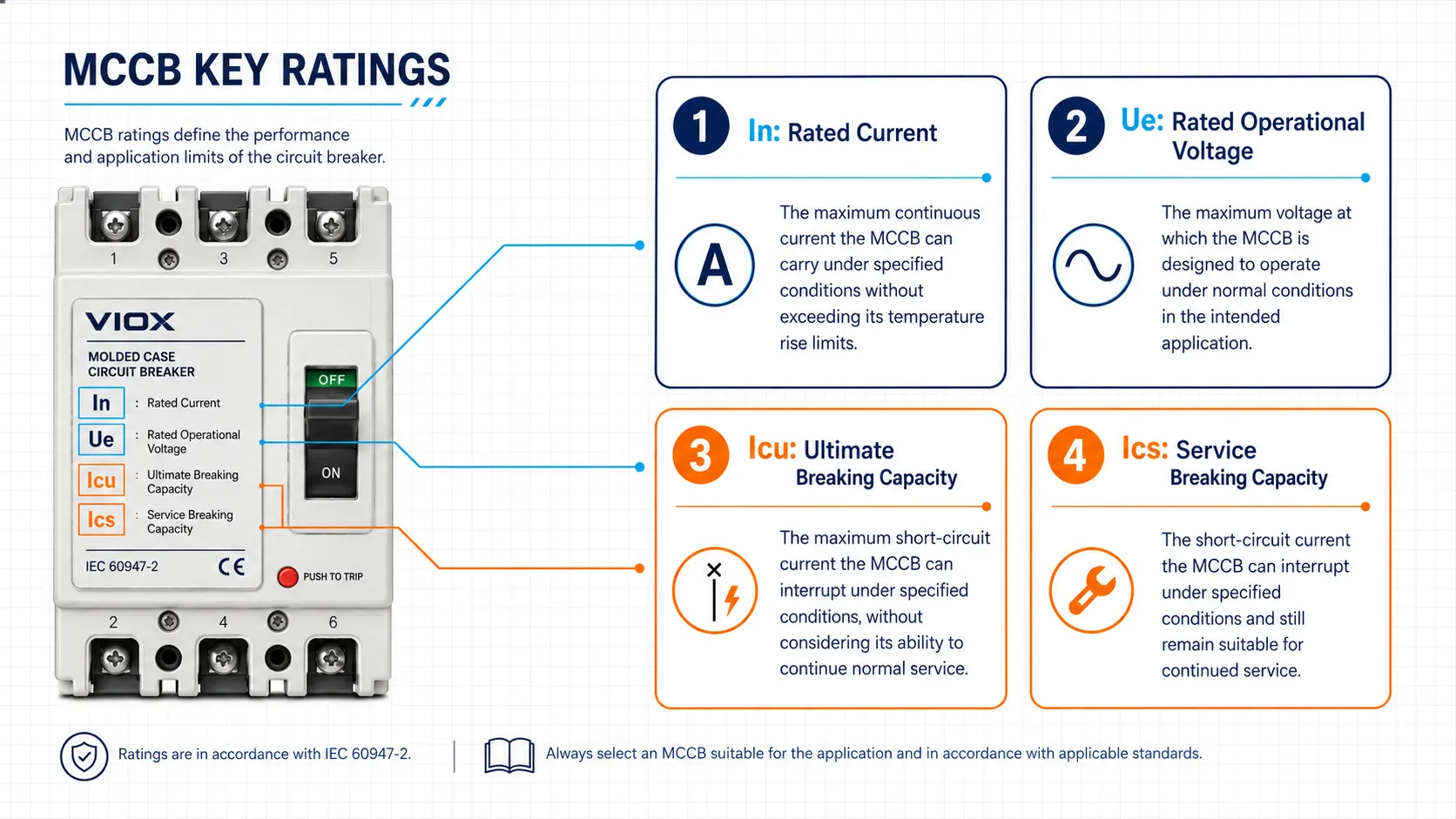
MCCB selection is not only about amperes. Buyers and engineers should check the main ratings on the datasheet or nameplate.
| MCCB Rating | Meaning | Why It Matters |
|---|---|---|
Rated current In |
Current the breaker is designed to carry under defined conditions | Must match load and cable protection requirements |
Rated operational voltage Ue |
System voltage the breaker can operate at | Must match AC or DC system voltage |
Ultimate breaking capacity Icu |
Maximum short-circuit current the breaker can interrupt under defined test conditions | Must exceed available fault current |
Service breaking capacity Ics |
Short-circuit rating related to continued service after interruption | Important for industrial continuity and reliability |
| Number of poles | 2P, 3P, 4P, or other configurations depending on system | Must match wiring system and neutral treatment |
| Trip unit type | Thermal-magnetic or electronic | Affects adjustability, coordination, and features |
| Frame size | Physical and current-frame platform | Affects installation and available trip range |
| Accessories | Shunt trip, auxiliary contact, alarm contact, undervoltage release, motor operator | Needed for control, signaling, and automation |
For a detailed nameplate explanation, see VIOX’s MCCB nameplate reading guide. For short-circuit ratings, see the guide to Icu, Ics, Icw, and Icm.
Why Icu Alone Is Not Enough
One common MCCB selection mistake is choosing a breaker only by Icu. Icu is the ultimate short-circuit breaking capacity under defined test conditions. It tells you the maximum fault current the breaker can interrupt. But for industrial panels, Ics is often just as important because it relates to service breaking capacity and continued usability after a short-circuit event.
In panel reviews, a typical problem looks like this: the MCCB has an impressive Icu value, so it appears suitable for the available fault current. After a serious short circuit, the breaker interrupts the fault, but the maintenance team cannot assume the device remains suitable for continued service if the required Ics level was ignored. The result can be unexpected replacement, downtime, and a failed project review even though the breaker “had enough kA” on paper.
For general building circuits, a buyer may focus on current and voltage first. For production lines, data centers, OEM machinery, and critical distribution boards, the better question is: what breaking capacity is required, and what level of post-fault service continuity does the project expect?
Temperature and Altitude Derating
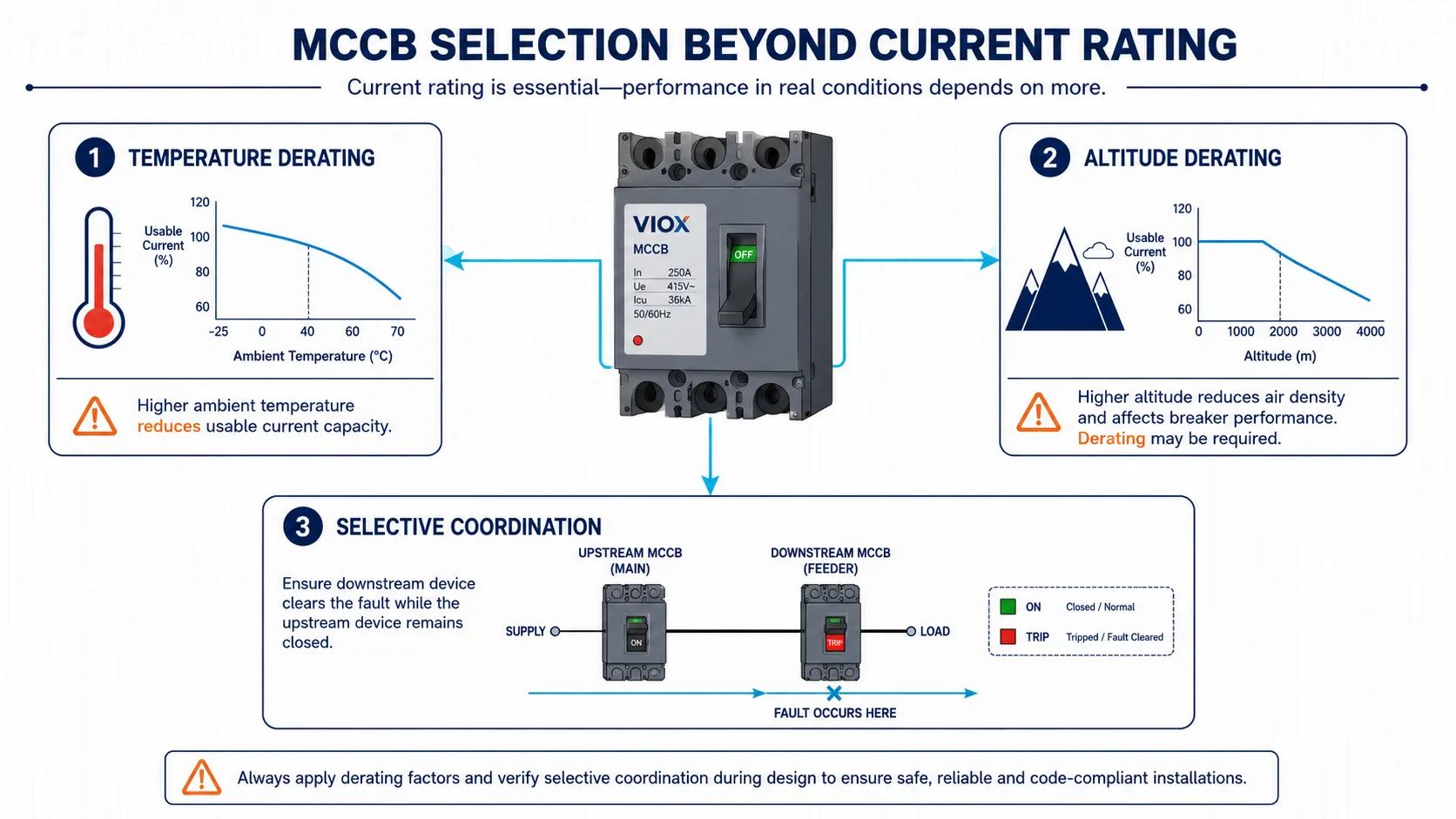
MCCB ratings are tested under defined conditions. Real panels are not always installed under ideal conditions. Ambient temperature, cabinet temperature rise, grouping, ventilation, and altitude can all affect breaker performance.
| Condition | Why It Matters | What to Check |
|---|---|---|
| High ambient temperature | Can affect thermal trip behavior and continuous current carrying ability | Manufacturer derating table |
| Hot enclosure or poor ventilation | Raises internal temperature around the breaker | Panel layout, spacing, heat sources |
| Multiple breakers grouped together | Can increase local heat buildup | Grouping factor or installation guidance |
| High altitude | Can reduce air insulation and cooling performance | Altitude correction data from manufacturer |
| Large cable or busbar terminations | Heat at terminals can affect reliability | Torque, lug fit, conductor size, ventilation |
Do not treat the printed current rating as a guarantee in every enclosure. In a hot control cabinet, a breaker that is acceptable on paper may need derating, a larger frame, better ventilation, or a different installation layout. Always check the manufacturer’s derating data for high temperature or high-altitude installations.
Selective Coordination: Avoid Tripping the Wrong Breaker
MCCB selection is not only about protecting one cable. In a real distribution system, the MCCB must coordinate with upstream and downstream protection devices. Selective coordination means the device closest to the fault should trip first, while upstream breakers remain closed when possible.
Poor coordination can cause a small downstream fault to trip a main feeder breaker, shutting down a much larger part of the facility. This is especially important in:
- production lines
- data centers
- hospitals and critical buildings
- generator-backed systems
- transfer-switch distribution
- large motor control panels
Electronic trip MCCBs are often selected when more adjustable long-time, short-time, instantaneous, or ground-fault settings are needed for coordination studies. Thermal-magnetic MCCBs can still be effective, but their setting flexibility is usually more limited. For trip-unit comparison, see VIOX’s Electronic vs Thermal-Magnetic MCCB guide.
Types of MCCB
MCCBs can be classified in several ways.
By Trip Unit
- Thermal-magnetic MCCB
- Electronic trip MCCB
This is one of the most important classifications because it affects coordination, adjustability, accuracy, and advanced protection functions.
By Pole Count
- 2-pole MCCB
- 3-pole MCCB
- 4-pole MCCB
Pole count depends on system wiring, load type, and whether the neutral must be switched or protected.
By Application
- Feeder protection MCCB
- Motor circuit MCCB
- Generator MCCB
- Distribution panel MCCB
- DC-rated MCCB where the product is specifically designed and rated for DC use
Do not assume an AC MCCB can be used in a DC circuit. DC interruption requires appropriate product design and ratings.
Where Are MCCBs Used?
MCCBs are widely used in low-voltage power distribution. Typical applications include:
- industrial distribution panels
- commercial main and sub-main feeders
- motor control centers
- HVAC equipment
- generator output protection
- transfer-switch and backup-power systems
- machinery panels
- larger branch circuits
- solar, battery, or DC systems when a correctly rated DC MCCB is specified
In many panels, the MCCB is the bridge between smaller branch protection and larger switchgear-level protection.
How to Choose an MCCB
For basic selection, start with these questions:
| Selection Question | What to Check |
|---|---|
| What is the load current? | Choose rated current and frame size correctly |
| What is the system voltage? | Match Ue and AC/DC rating |
| What is the available short-circuit current? | Select adequate Icu and Ics |
| What is the load type? | Feeder, motor, transformer, generator, DC circuit |
| Is coordination required? | Check upstream and downstream trip curves |
| What is the installation environment? | Check temperature, enclosure heat rise, grouping, and altitude derating |
| Is adjustable protection needed? | Consider electronic trip MCCB |
| Are accessories required? | Check shunt trip, auxiliary contact, UV release, motor operator |
| What enclosure or panel is used? | Check mounting, terminals, spacing, and heat dissipation |
For detailed sizing, use the VIOX MCCB panel selection guide.
Common MCCB Selection Mistakes
| Mistake | Risk |
|---|---|
| Selecting only by current rating | Breaker may not match fault level, voltage, or coordination needs |
Looking only at Icu and ignoring Ics |
Breaker may interrupt the fault but not meet the required service-continuity expectation |
| Ignoring temperature or altitude derating | Breaker may nuisance trip or run hotter than expected in the real enclosure |
| Ignoring selective coordination | A downstream fault may trip an upstream feeder and shut down more equipment than necessary |
| Treating MCCB and MCB as interchangeable | Installation may lack current capacity, fault rating, or adjustability |
| Ignoring trip-unit type | Thermal-magnetic and electronic MCCBs behave differently |
| Using AC-rated MCCB in DC circuit without approval | DC arc interruption may be unsafe |
| Forgetting accessories | Control, signaling, remote trip, or interlock functions may be missing |
| Oversizing the breaker | Cable and equipment protection may be weakened |
MCCB FAQ
What is MCCB?
MCCB stands for molded case circuit breaker. It is a low-voltage circuit breaker used for feeder, machinery, motor, and industrial distribution protection.
What is the difference between MCCB and MCB?
An MCB is usually used for smaller final circuits. An MCCB is used for higher current, higher breaking capacity, adjustable trip settings, and more demanding commercial or industrial protection.
What is inside an MCCB?
An MCCB contains a molded case, fixed and moving contacts, operating mechanism, trip unit, arc chute, terminals, and optional accessories. For a detailed diagram, see the MCCB internal parts guide.
What are the main MCCB ratings?
The main ratings include rated current In, rated voltage Ue, breaking capacity Icu and Ics, pole count, frame size, and trip-unit type.
Where is an MCCB used?
MCCBs are used in distribution panels, switchboards, motor circuits, generator feeders, HVAC equipment, machinery panels, and larger commercial or industrial circuits.
Is an MCCB suitable for DC?
Only if the specific MCCB is rated and approved for DC voltage and interruption duty. Do not use an AC-only MCCB in a DC system without manufacturer documentation.
Conclusion
An MCCB is a molded case circuit breaker used when a circuit needs more current capacity, breaking capacity, trip flexibility, or accessory support than a typical MCB can provide. It protects low-voltage feeders, industrial panels, motors, generators, and larger distribution circuits from overloads and short circuits.
For a basic definition, remember this: an MCCB is the heavier-duty low-voltage breaker used between small MCB branch protection and larger switchgear-level protection. For real selection, always check current, voltage, Icu, Ics, trip-unit type, pole count, accessories, and coordination requirements.