

On this page
A junction box encloses conductor joints or connection points. A terminal box organizes conductors at defined terminals. A distribution box, in the power-distribution sense used here, divides an incoming supply among outgoing circuits with specified protection and switching. Classify the completed electrical function, not the enclosure’s position, material or appearance.
The names can overlap. A junction box may contain terminal blocks, and a terminal enclosure may distribute a common supply. Neither description alone establishes that the equipment is a protected distribution board.
Quick Comparison: Function, Hardware and Protection
| Comparison point | Junction box | Terminal box | Distribution box or board |
|---|---|---|---|
| Main job | Contain and protect joints, splices or connection points | Provide an organized interface at defined terminals | Allocate power among specified outgoing circuits |
| Typical hardware | Suitable connectors, joints or terminal devices | Terminal blocks or studs, markers, supports and cable entries | Protective devices, switching, busbars and connection hardware appropriate to the design |
| Circuit relationship | Continues or branches conductors | Maps conductors to terminals; may also distribute a common potential | Establishes an incoming/outgoing circuit arrangement with a defined protection scheme |
| Automatic fault interruption | Not provided by the enclosure or an ordinary connector | Not provided by an ordinary feed-through terminal | Provided by the specified protective devices, within their ratings and coordination |
| Main document to examine | Connection arrangement and enclosure suitability | Terminal schedule, device data and interface requirements | Circuit schedule, assembly ratings, protection arrangement and verification evidence |
| Typical application | Lighting connections, cable joints or field connection points | Machine terminals, instrument wiring or field-cable interfaces | Building, machine or local power distribution |
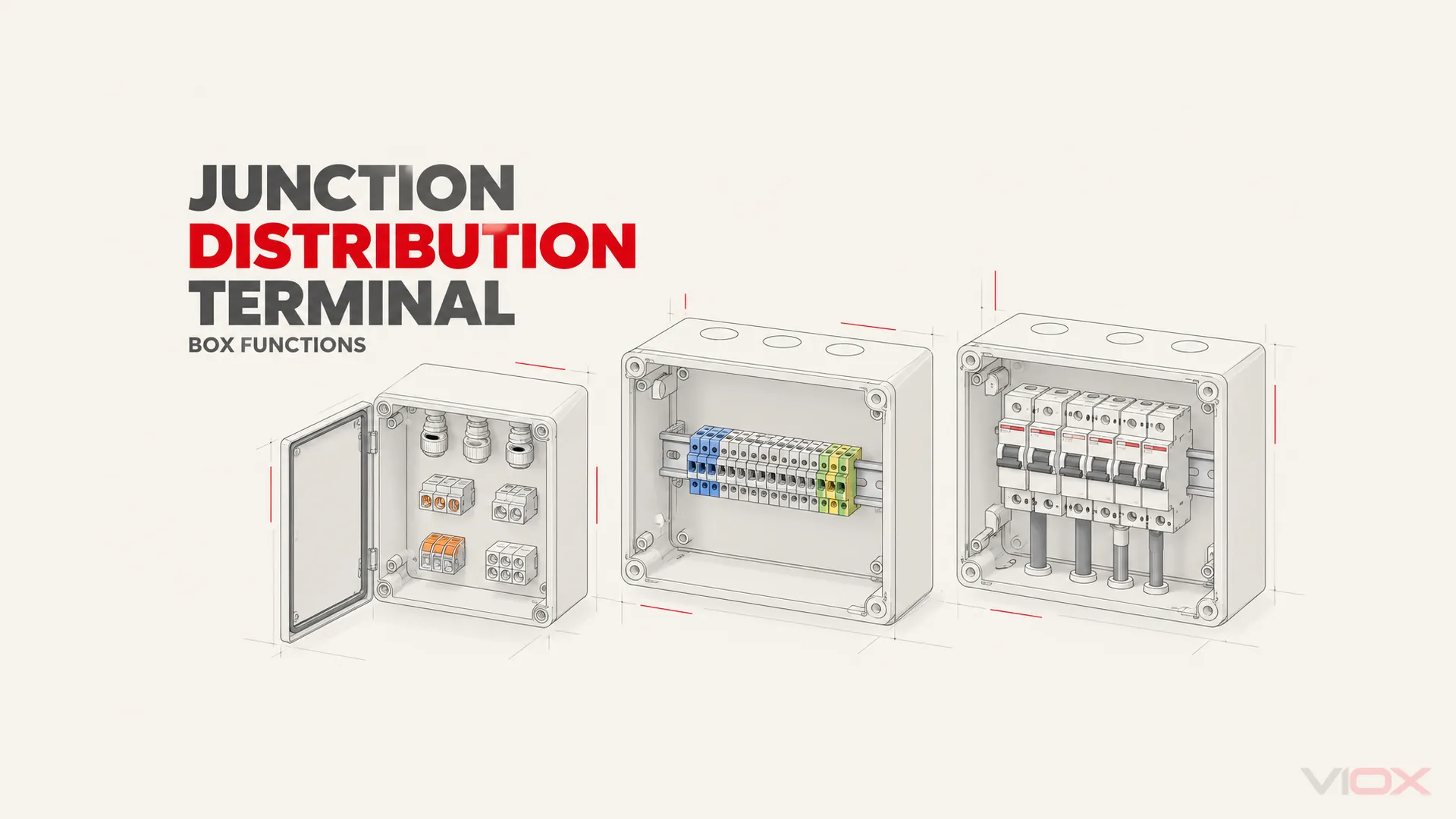
These are functional descriptions, not three globally exclusive product categories. Ask whether the box joins conductors, organizes an interface, or distributes protected circuits. Then inspect the actual design.
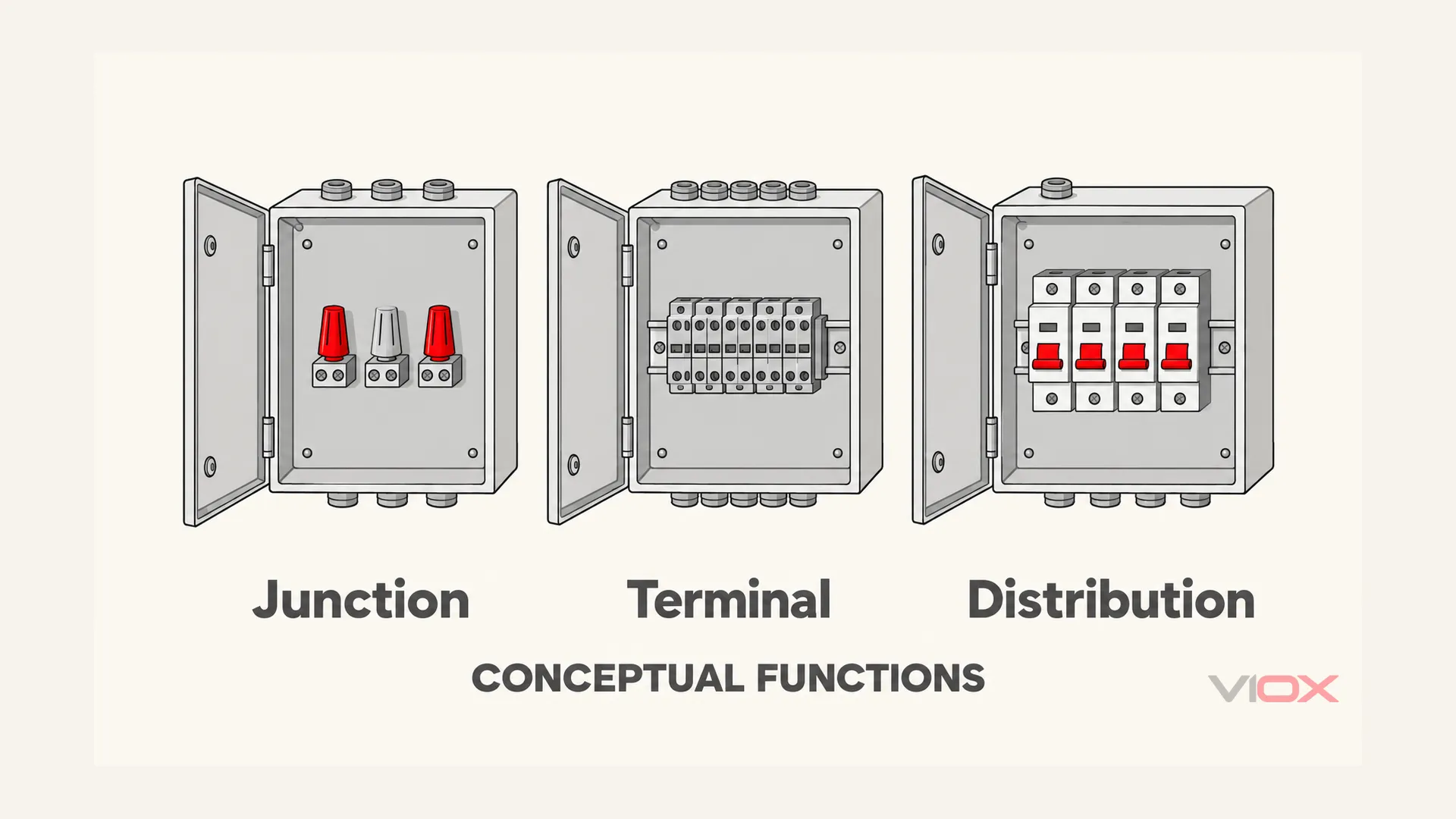
The equipment is generic. The drawing distinguishes functions; it is not an approved installation layout, terminal connection schedule or statement of product certification.
What Makes Each Box Different?
Junction Box: A Protected Connection Location
A junction box provides an enclosure for conductor connections. Suitable joints or connectors make the electrical connection; the enclosure contains them and protects against access or environmental conditions according to its design.
There is no general rule that a junction box must contain loose splice connectors rather than fixed terminals. Its enclosure function remains relevant when terminals are fitted. The International Electrotechnical Commission’s IEC 60670-22:2024, for household and similar fixed electrical installations, covers connecting boxes and enclosures, including junction and tapping connecting boxes within its scope. It is not a universal standard for every industrial enclosure.
For the wider enclosure landscape and functional parts, see the junction box introduction.
Terminal Box: A Defined Wiring Interface
A terminal box emphasizes the termination arrangement: each conductor connects at an assigned terminal or stud. Identification and a terminal schedule make the interface traceable. The box might be mounted on a motor, on a machine frame or on a wall between field devices and a control panel.
The terminal hardware may be screw-clamp, spring-clamp or another supported design. IEC 60947-7-1:2025 addresses specified terminal blocks for copper conductors, primarily for industrial or similar use. Compliance evidence for a terminal component does not automatically establish the capability of its enclosure or the complete installation.
Where the decision is specifically organized terminations versus another connection arrangement, the terminal box vs junction box comparison is the deeper resource. The presence of a terminal block does not make the words “junction box” incorrect.
Distribution Box: A Defined Power-Distribution Assembly
For this comparison, a distribution box or board receives power and supplies multiple outgoing circuits through the specified protection and switching arrangement. Its identity comes from the circuit architecture and assembly capability, not simply from having a mounting rail or a large incoming cable.
However, suppliers also use “distribution box” for enclosures containing distribution terminals without local protective devices. Clarify which meaning is intended before ordering. A power distribution block divides a common electrical potential; an ordinary block does not automatically trip on overload or interrupt a fault like a breaker or fuse. Protection must be established elsewhere in the circuit design if it is not included locally.
A power-distribution assembly needs more than a list of individual component ratings. Loading, temperature rise, short-circuit capability, insulation and protective arrangements must be verified for the assembled equipment as applicable. IEC 61439-1:2020 supplies general rules together with the relevant assembly part; Part 1 alone is not the entire conformity basis.
The distribution-box selection guide owns detailed choices such as circuit ways, protection, loading and enclosure configuration.
Why “Start, Middle, End” Is Not a Reliable Rule
The phrase can describe one simple feeder route, but it fails as a definition or specification:
- A subdistribution board can be well downstream of the main board, not at the building’s electrical starting point.
- A wall-mounted terminal box can sit between sensors and a controller, not at the end of a power circuit.
- A junction box can connect conductors close to a load or within a permitted equipment arrangement.
- Distribution, terminal and junction functions may coexist in one suitably designed assembly.
Nor can the category be established from metal versus plastic, a hinged versus removable cover, or how frequently someone expects to open it. Those choices affect suitability and maintenance; they do not replace the electrical function.
An empty enclosure does not become a verified distribution board merely because breakers fit inside. Likewise, adding terminals may organize connections without proving the completed assembly’s current, fault or environmental capability.
Which Box Should You Specify? Three Illustrative Scenarios
Connecting Lighting Conductors
If the task is to enclose permitted conductor joints along a lighting circuit, specify a suitable junction connection enclosure and its connection hardware. Establish the conductor arrangement, space, entry system and location requirements. Branching inside that enclosure is not, by itself, the same task as creating a new protected-circuit distribution board.
Do not choose dimensions from the category name. The junction box sizing guide separates applicable box-fill and pull-box calculations rather than treating one formula as universal.
Terminating Several Field Cables
If cables from instruments or machine devices must terminate at identified positions before continuing to a controller, specify a terminal enclosure with an appropriate terminal schedule. Conductor type and size, circuit voltage, separation requirements, marking, spare positions and entry layout affect the design.
This arrangement can still be called a field junction box. The requirement is a documented terminal interface, not a different outer shell. Use the terminal-block guide for the hardware selection paths.
Supplying Several Local Circuits
If one feeder must supply several outgoing circuits with defined local protective devices, specify a power-distribution assembly. Establish the incoming supply, outgoing circuit duties, protective devices, fault conditions, loading and applicable assembly requirements.
If the task is only to divide an already protected feeder at distribution terminals, describe that narrower arrangement explicitly. It may be a connection or tap enclosure rather than a distribution board. The tap box, junction box and pull box guide addresses those different functions and U.S. sizing contexts.
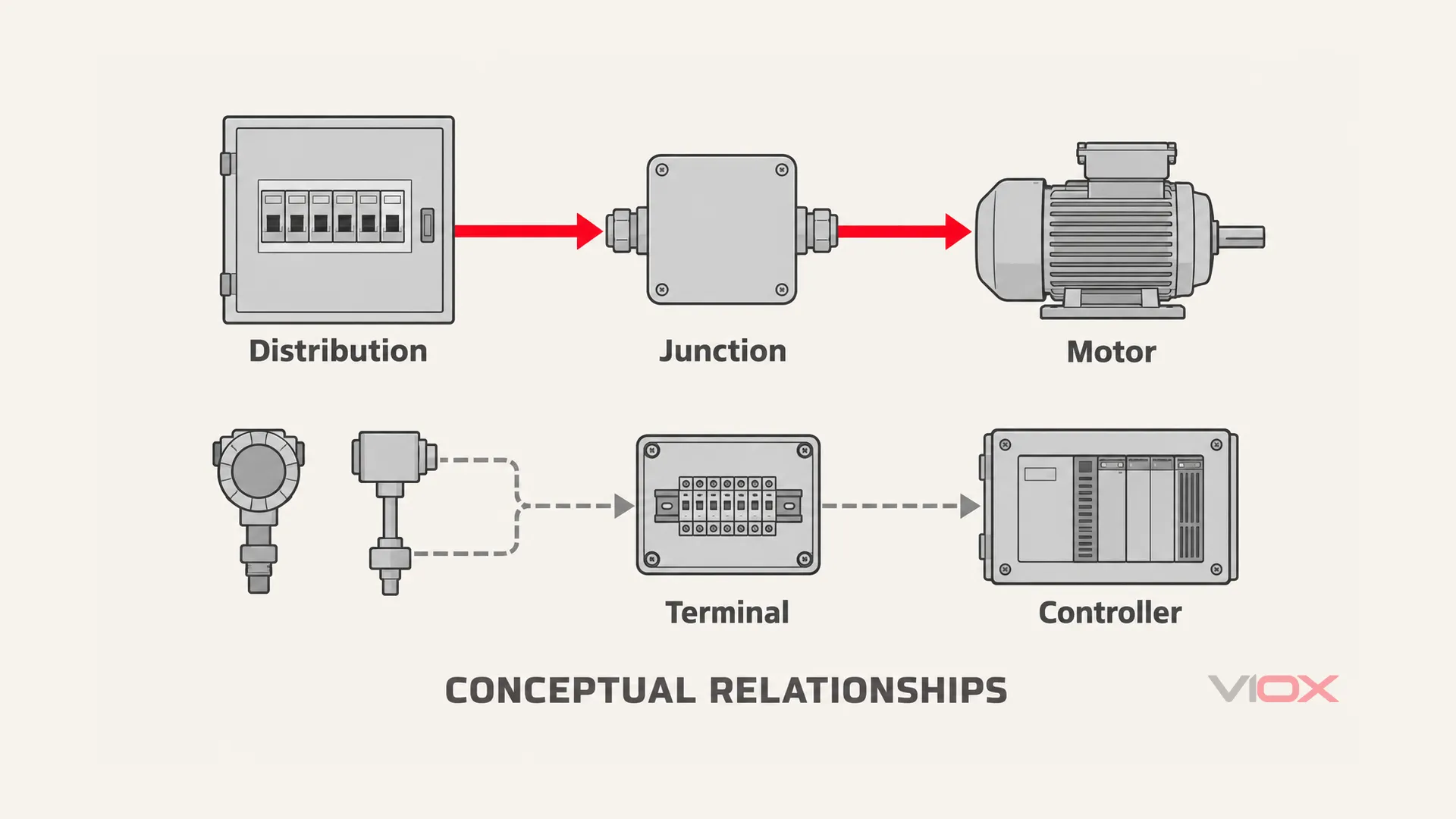
Solid arrows show power-system relationships; dashed arrows show a separate signal relationship. This is deliberately not a mandatory distribution-to-junction-to-terminal sequence. Neutral, protective-earth, device terminals and installation wiring are omitted.
Enclosure Protection Is Not Electrical Protection
Three different questions must be answered before substituting one product for another:
- Will the enclosure suit the location? Check the required ingress protection (IP) rating, material, temperature, entry accessories and installed configuration. IEC 60529 classifies enclosure IP protection. An IP designation is not an ampere rating or proof of branch-circuit protection.
- Will the connections suit the conductors and duty? Check the actual terminals, connectors and their instructions, including conductor compatibility and permitted terminations. Do not infer connection capability from spare physical space.
- Will the assembled equipment suit the circuit? Determine the applicable assembly, installation and protection requirements. Component certification and enclosure suitability address different evidence from verification of the finished assembly.
For example, IEC 61439-3:2024 addresses distribution boards intended to be operated by ordinary persons within its specified scope. It does not apply merely because a supplier calls an enclosure a “DB box.” Select the applicable assembly part and local installation requirements for the actual equipment.
In applicable U.S. workplace installations, the Occupational Safety and Health Administration’s OSHA 1910.305 includes requirements for covers, closed unused openings, conductor-entry protection and suitable enclosures; bonding provisions also matter where applicable. Those obligations are not removed by choosing the label “terminal box” instead of “junction box.” They do not establish that every region uses the same installation rules.
Work on installed equipment requires qualified personnel, appropriate isolation and verification under the applicable procedures. This comparison is not permission to open energized equipment or improvise a distribution assembly.
Describe the Function Before Requesting a Quote
Instead of requesting only a “junction,” “terminal” or “distribution” box, write the intended function and include the corresponding documentation.
| If you need… | Describe the required equipment this way | Include these inputs |
|---|---|---|
| Enclosed conductor connections | Connection enclosure for the specified joints or branches | Conductors, connectors, entry layout, available space and environment |
| An organized wiring interface | Terminal enclosure with a defined terminal schedule | Circuit duties, conductor details, terminal types, markings and spare positions |
| Protected outgoing circuits | Power-distribution assembly with specified incoming and outgoing circuits | Supply details, load schedule, fault conditions, protection, assembly framework and environment |
For an illustrative terminal-enclosure enquiry, a clearer description is: “Wall-mounted field terminal enclosure for the attached terminal schedule; provide the terminal-device data, entry arrangement, available wiring space and evidence for the specified environment.” It identifies the task without inventing dimensions, current ratings or compliance marks.
For product evaluation, start with the relevant VIOX junction-box family or distribution-box family, then confirm the exact model and whether the quotation covers an empty enclosure, fitted connection hardware or a verified complete assembly.