

On this page
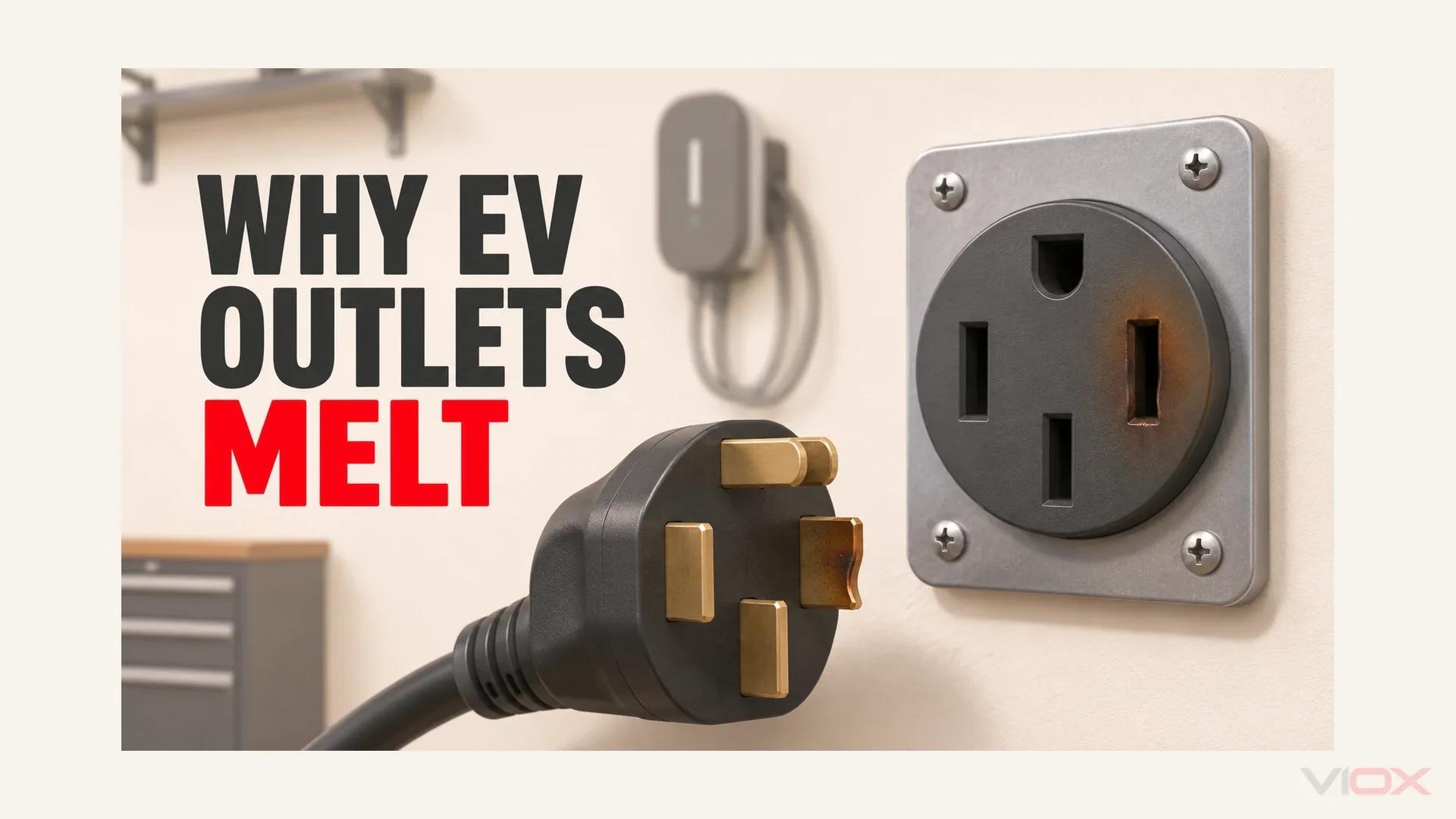
A NEMA 14-50 outlet can melt during EV charging because a loose blade contact or poorly terminated conductor concentrates heat at one connection. The charging current can remain below the branch breaker’s trip level while the receptacle, plug or wiring insulation overheats. A breaker that stays on does not prove the connection is sound. If you notice abnormal heat, discoloration, looseness, melting or a burning smell, stop charging and have the circuit isolated and inspected by a licensed electrician.
The repair depends on where the damage began and whether the complete installation suits EV use. A replacement receptacle alone may leave a damaged plug or termination in service. Hardwiring removes the plug/receptacle interface, but it still requires correctly installed terminals and all applicable circuit protection.
1. What Happened in October 2026
An October 26, 2026 Lucid Owners discussion described a plug and receptacle melting together, with damage to the box and conductor insulation. The owner said the breaker eventually tripped. Another participant reported a similar failure within a year of use. These are owner reports, not independently verified failure investigations or a measure of how often receptacles fail.
Earlier that month, Design News reported on October 14 about Legrand’s EV-use receptacle and concerns about appliance-oriented outlets under prolonged charging. That date identifies the news article; it does not establish the product’s launch date. Neither account proves that every ordinary 14-50 is defective.
The useful question is more specific: does the exact receptacle have the required EV-use evidence, and are its mating contacts and wiring terminations still sound? A circuit that worked for months can develop contact damage later. Its previous operation is useful history, but it is not an acceptance test after overheating appears.
2. Why a 50A Receptacle Is Not a 50A EV Charger
The number on the receptacle identifies its device rating. It does not authorize an EVSE to draw that current continuously from an ordinary branch circuit. Mike Holt’s 2023 NEC Article 625 explanation identifies EV charging as a continuous load under 625.42 and explains the minimum overcurrent-protection sizing under 625.41.
For the typical residential arrangement discussed here:
| Charging arrangement | Branch circuit | Connection consequence |
|---|---|---|
| Up to 40A continuous charging through a NEMA 14-50 | Properly designed 50A circuit | Plug-in may be permitted when the exact equipment, receptacle, instructions and adopted code allow it |
| Full 48A continuous charging | Properly designed 60A circuit | Do not use a 50A NEMA 14-50; use the manufacturer’s approved connection, commonly hardwired |
| Damaged or overheating plug/receptacle | Any rating | Stop use; a lower setting does not make damaged hardware acceptable |
The 40A result reflects the usual 80% continuous-load relationship, not a claim that a 50A receptacle is inherently a noncontinuous-only device. For the full calculation, use the EV charger circuit breaker sizing guide.
The manufacturer boundary is equally important. ChargePoint’s Home Flex installation FAQ allows its specified plug-in models at 32A or 40A charging and requires hardwiring for the 48A setting. This is a verified model example, not permission to modify another EVSE.
Qmerit’s amperage guide reports that 70% of its installations use 48A chargers and describes those installations as hardwired. That is Qmerit’s own installation mix, not national market share. The connection rule comes from the installation requirements, not the popularity figure.
3. Why It Melts: Four Failure Points
A. The Receptacle’s Actual Suitability for EV Charging
NEMA 14-50 identifies a connection configuration. Devices sharing that configuration can differ in construction, permitted applications and certification evidence. Extended charging exposes weaknesses in contact pressure, terminal retention and housing performance that a brief functional check will not reveal.
Do not decide suitability from the phrases “heavy duty” or “EV-grade” alone. Check the exact model’s EV-use listing, instructions, conductor compatibility and installation conditions. Legrand’s official 3894WREV datasheet, for example, describes an EV-use 50A receptacle rated 125/250V. Leviton’s 1450W product page identifies another model specifically intended for EV charging. These examples establish model-specific documentation, not immunity from incorrect installation.
There is also an edition boundary. Mike Holt’s 2026 code-change review reproduces 625.44(B)(3)(b): the relevant 125/250V, single-phase, three-pole, four-wire receptacles in that provision must be listed for EVSE and WPTE use. Confirm the edition and amendments adopted locally with the authority having jurisdiction; publication of a new NEC does not automatically change every existing installation’s legal status.
UL Solutions’ identification guidance explains the EV-specific markings and Product iQ verification route. A green EV graphic by itself is insufficient evidence. Checking markings that require wallplate removal belongs to the electrician’s isolated inspection.
Look for: an unidentified model, missing instructions, uncertain EV-use evidence or deterioration around a blade opening. Missing records call for verification, not a declaration that the device is counterfeit or necessarily defective.
B. Blade Contact Wear and Mechanical Loading
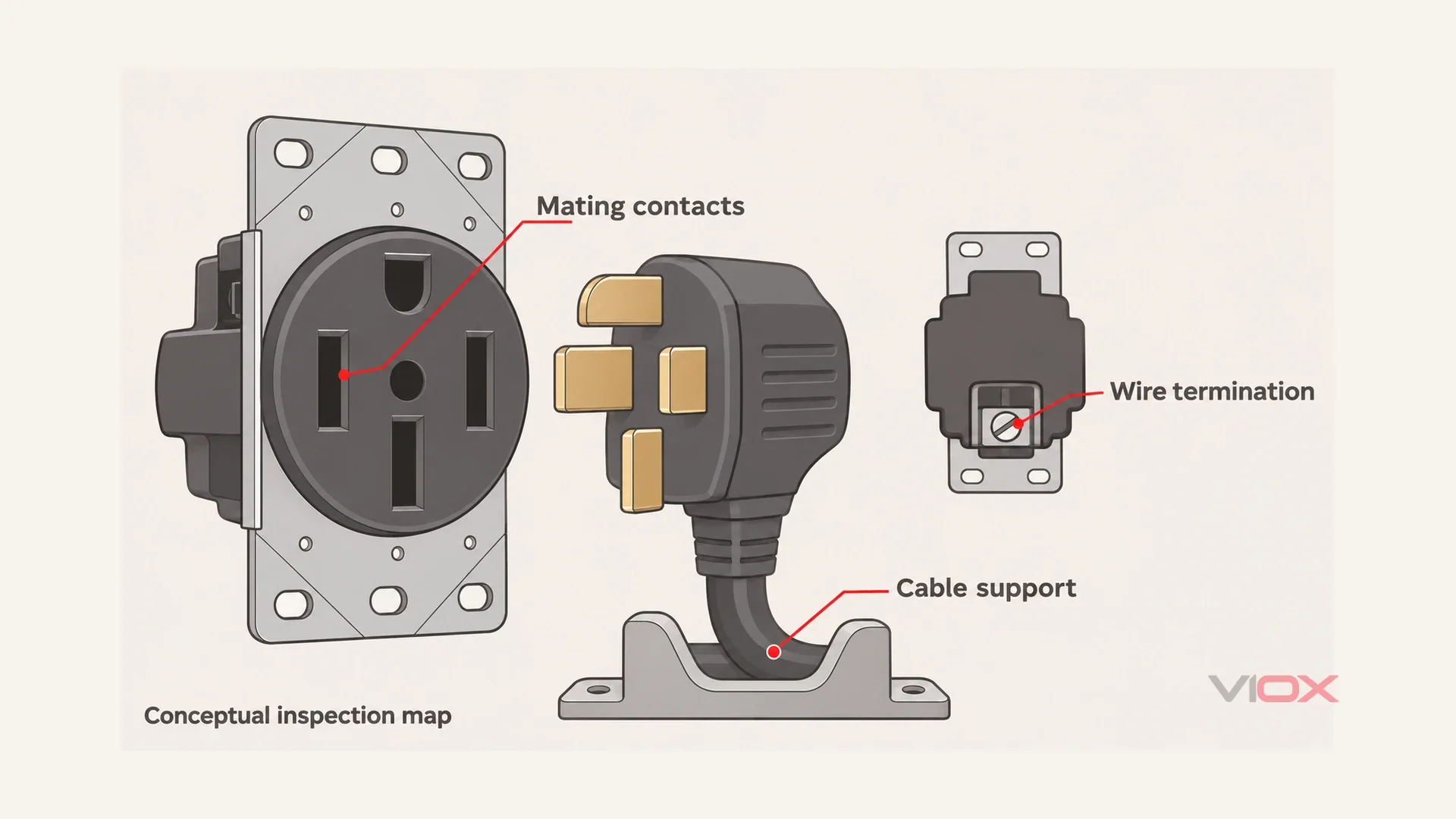
The receptacle’s contacts must hold the plug blades firmly. Repeated insertion, a loose mounting arrangement or cable weight pulling sideways can disturb the mating interface. A worn connection can concentrate heating near one blade even when the charger operates at its intended current.
The local heating follows I²R: increased resistance at the interface produces more heat at the same current. This is a connection problem, so an overcurrent breaker may have no reason to trip. For the related mechanism in a different component, see why a fuse holder can melt while the fuse remains intact.
Look for: loss of secure engagement, darkened blades, distortion near one slot or a plug that no longer seats correctly. Do not wiggle or partly withdraw a plug under load to investigate. A supported cable and sound mounting help avoid mechanical strain; they cannot restore worn contacts.
C. Terminal Torque and Conductor Compatibility
The rear wire termination is a separate potential hot spot. An unsuitable conductor, incomplete seating, damaged strands or incorrect tightening can create a poor connection behind a face that initially looks normal. Tightening by feel is not a substitute for the device instructions.
Mike Holt’s explanation of NEC 110.14(D) describes using an approved means to achieve the indicated terminal torque. The electrician should use the exact receptacle instructions and an appropriate torque tool or other approved method. There is no universal 14-50 tightening value.
The terminal must also accept the conductor material and size. Aluminum connections require terminals approved for that conductor and the preparation specified by their manufacturer. Oxide inhibitor is not a universal cure or an automatic requirement for every terminal.
Look for: heat concentrated behind the receptacle, discolored insulation at a termination or damaged conductor strands. Conductor sizing and terminal suitability need verification; this article does not provide a substitute wire-size table.
D. A Mismatched Circuit or Charging Arrangement
A 60A breaker does not upgrade a 50A receptacle. An extension cord adds connections and can introduce loading or compatibility problems. An installation completed without proper electrical verification may hide errors even when the plug fits and charging starts.
The U.S. Fire Administration’s EV charging guidance recommends a qualified electrician, appropriate dedicated supply and following the charging equipment instructions; it warns against extension cords. These are installation checks, not reasons to assume every owner-reported incident has the same cause.
Look for: a breaker/receptacle mismatch, adapters or extensions, an unsupported charger cable, or no record of the installed model and commissioned current setting. Have the electrician verify the arrangement rather than simply fitting a larger breaker.
4. Hardwired vs Plug-In: Which Connection Should You Keep?
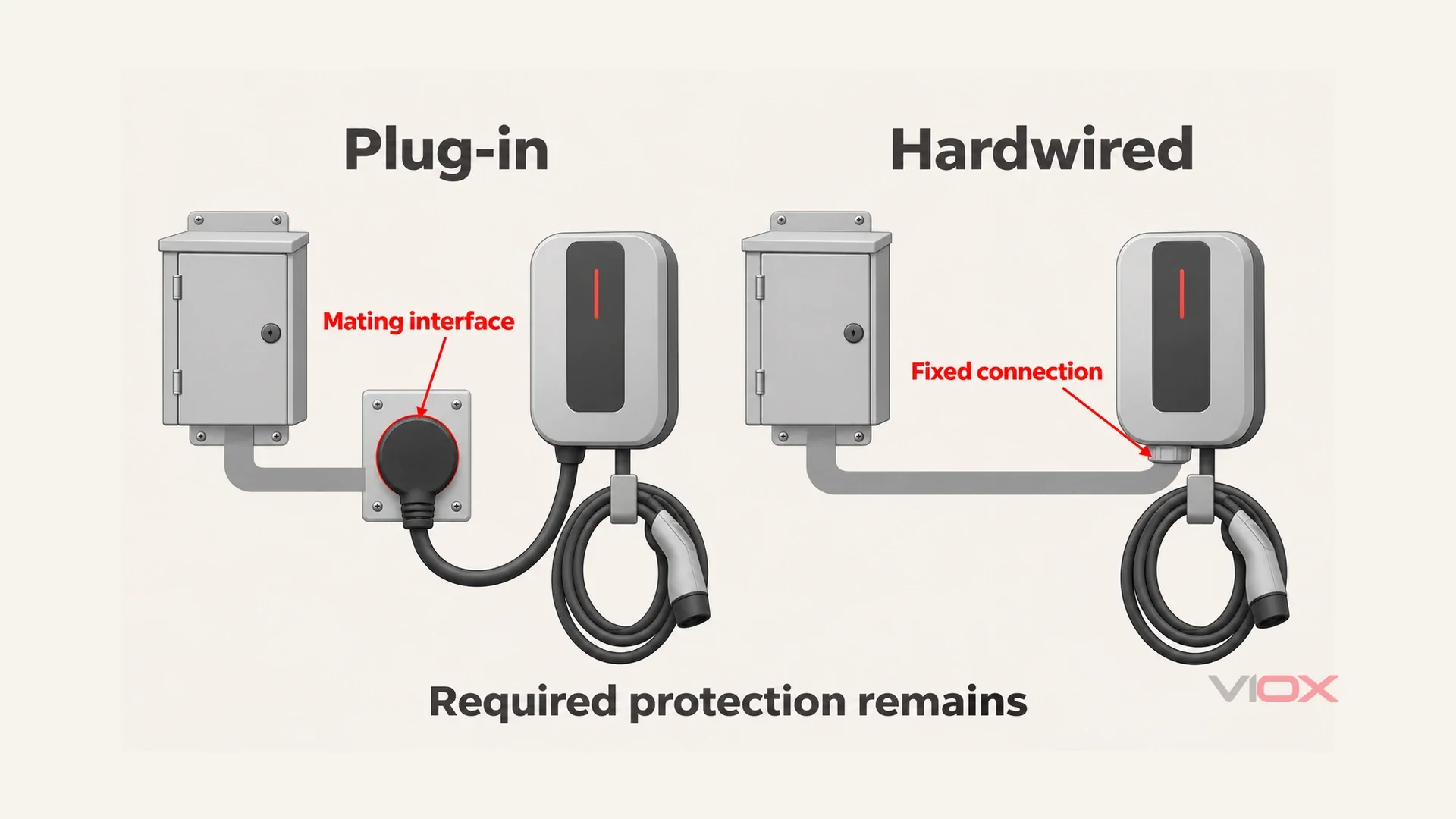
Hardwiring removes the receptacle contacts and plug blades from the supply path. It leaves fixed terminations that still need correct conductor preparation, tightening and inspection. A badly installed hardwired unit can also overheat.
| Your situation | Appropriate direction | Evidence needed before returning to service |
|---|---|---|
| Sound installation, charging at 40A or less through a 14-50 | Plug-in can remain an option | Exact EVSE permission, suitable receptacle, correct circuit, secure mounting and required protection |
| Frequent unplugging or cable strain at the receptacle | Consider approved hardwiring or correct the physical arrangement | Manufacturer-permitted conversion and a location that avoids recurring mechanical loading |
| Full 48A operation using the verified Home Flex example | Hardwire on the required 60A circuit | Exact model instructions and complete circuit verification |
| Melted, loose, discolored or otherwise suspect connection | Isolate and repair first | Assessment of both mating parts, conductors, terminals and the cause of damage |
Daily charging favors a durable, properly installed connection; it does not create a universal rule that every daily-use EVSE must be hardwired. Some equipment is not field-convertible. Never cut off a molded plug simply because another model permits conversion.
Hardwiring also does not authorize removal of required ground-fault protection. Follow the separate EV charger GFCI and CCID decision guide for that question. For broader installation acceptance, use the residential EV charger installation requirements.
5. How to Tell Yours Is Already at Risk
Use symptoms to decide whether to stop, not to justify another charging session. Do not touch exposed parts, remove covers on an energized circuit or deliberately continue charging to see how hot the plug becomes.
| Observed symptom | What the electrician should establish | Immediate action |
|---|---|---|
| Discoloration, deformation or burning smell | Extent of damage at plug, receptacle, box and conductors | Stop use and arrange isolation and inspection |
| Loose fit or a plug that will not seat normally | Contact retention, mounting and cable strain | Do not reseat repeatedly or continue charging |
| Abnormal heating previously noticed during charging | Location and cause, using an appropriate professional assessment | Stop charging; do not use a hand-touch threshold |
| Breaker terminal heating or damaged supply insulation | Condition of the upstream termination and circuit | Have the electrician inspect beyond the receptacle |
| Protective device trips but no visible damage | Which protective function operated and whether a connection fault also exists | Diagnose the trip; do not assume it is harmless nuisance tripping |
A trip is a protective action; melting is physical damage. They can occur together, or the connection can overheat without an overcurrent trip. Repeatedly resetting a breaker does not repair either problem.
Give the electrician the model details, installation date if known, charging setting, photographs taken without opening equipment, and the circumstances of any interruption or smell. After isolation and verification that the circuit is dead, the inspection can establish whether damage began at a blade interface or wire terminal. Do not pull apart fused components yourself.
6. What to Do Instead
Repair options increase in scope, but the stop-use decision comes first. Choose the least extensive option that actually corrects the defect and satisfies the equipment instructions and applicable code.
On an inspected, undamaged installation, consider a lower permitted charging setting. A setting such as 24A or 32A can reduce the demand when the equipment and commissioning method permit it. This is an operating choice for sound equipment, never an emergency workaround for a burned or loose outlet. For supply-capacity constraints, see whether a 100A panel can handle an EV charger.
Replace damaged mating components and repair affected wiring. A licensed electrician should assess the plug or EVSE input cord as well as the receptacle. A heat-damaged blade can compromise a new socket. Replace damaged parts using approved replacements; assess insulation and conductor damage, box condition, mounting and cable support. Reusing scorched parts or merely tightening a damaged terminal leaves the original risk unresolved.
Consider a manufacturer-approved hardwire conversion. This is particularly relevant when the desired full output cannot use a 14-50, or the site keeps imposing strain on a plug connection. It requires a verified circuit and permitted equipment configuration. It does not automatically require a larger service: capacity and load-management decisions belong in the linked 100A-panel guide.
Before accepting the repair, ask for a record of the installed model, applicable EV-use evidence, permitted current setting, conductor/terminal compatibility, tightening instructions followed and corrected cause. The electrician should verify operation under the intended load and assess the repaired connection using appropriate methods and manufacturer limits. No single generic surface-temperature number proves a repair successful.
VIOX does not supply the EVSE or NEMA 14-50 receptacles discussed here. This guide addresses the supply connection and protective-device boundary; it makes no claim that VIOX tested these reported incidents or certifies a particular receptacle installation.
7. Frequently Asked Questions
Can a NEMA 14-50 outlet handle a 48A EV charger?
Not at a continuous 48A draw through that 50A connection. The typical 14-50 arrangement supports up to 40A continuous charging on a properly designed 50A circuit. Full 48A requires the appropriate 60A circuit and the connection permitted by the exact EVSE instructions, commonly hardwired.
Why did my 14-50 outlet melt if the breaker never tripped?
A poor blade contact or wire termination can produce concentrated heat while current remains below the breaker’s overcurrent trip level. The breaker does not measure every receptacle contact’s temperature. Stop using the damaged connection and have its cause and full damage extent investigated.
Is a stove outlet the same as an EV charging outlet?
The plug configuration can be identical, but the exact device’s construction, listed use and instructions may differ. Verify EV-use evidence and the applicable adopted code; neither appearance nor a generic marketing label establishes suitability. Correct installation remains essential even for an EV-use model.
Should I hardwire my EV charger or keep the plug?
Keep plug-in only where the installation is sound and its current, receptacle, instructions and code permit it. Consider approved hardwiring to remove the mating interface or obtain output unavailable through a 14-50. Damaged equipment needs repair before either option is acceptable.
My 14-50 plug feels warm — is that normal?
Some warming can occur under load, but touch cannot establish compliance or distinguish a safe connection from a failing contact. Abnormal or increasing heat, odor, discoloration, deformation or looseness means stop use and obtain inspection. Do not open energized equipment or continue charging to test it.