

On this page
A hardwired EV charger does not have one universal GFCI-breaker answer. The adopted electrical code, location, branch-circuit rating, and exact equipment instructions determine the permitted installation. Built-in charging-circuit protection does not automatically waive an upstream GFCI requirement. If the code requires external protection but the instructions prohibit that arrangement, stop and resolve the conflict with the manufacturer and authority having jurisdiction (AHJ) before energizing.
The practical trap is calling every charging interruption a “false trip.” An upstream device may be correctly detecting current below the charger’s internal operating threshold. Compatibility can also be a problem, but the cause must be established rather than assumed.
This guide addresses US AC electric vehicle supply equipment (EVSE). Its numerical code comparison is limited to the 2020 and 2023 National Electrical Code (NEC). For another adopted edition, obtain its actual text, applicable issued amendments, and local interpretation before applying this decision table.
The Conflict: Electrical Code vs the Charger Instructions
An installer can encounter a genuine conflict: the adopted outdoor-outlet rule calls for GFCI protection, while the selected hardwired charger’s instructions call for a non-GFCI supply. That is an equipment-and-installation compatibility question, not permission to choose whichever document produces fewer callbacks.
What 210.8(F) actually covers
The 2020 NEC introduced 210.8(F) for dwelling outdoor outlets supplied by single-phase branch circuits rated 150 volts to ground or less and 50 amperes or less. “Outlet” is broader than a plug-in receptacle; permanently connected equipment can be supplied at an outlet. A line-to-line voltage label alone does not establish the voltage to ground.
The 2023 wording retains those electrical limits and expressly lists garages with floors at or below grade, accessory buildings, and boathouses. Its “outdoor outlets” scope and location wording must be read together; do not use a generic “indoors means exempt” shortcut where classification is disputed. NFPA’s issued amendments for the 2020 and 2023 editions, PDF pages 5-6, provide the relevant text. Their HVAC exception is not an EVSE exception.
Separately, 625.54 addresses receptacles installed for EV charging. Mike Holt’s signed 2020 NEC EV-equipment explanation confirms their GFCI requirement. Internal charger protection does not protect every upstream plug, receptacle, or wiring segment.
What the manufacturers actually say
The following documents illustrate why the exact model and revision matter:
| Equipment and verified document | External-GFCI guidance | Installation implication |
|---|---|---|
| Ford Connected Charge Station, revised installation-specification sheet | Contains the warning quoted below; circuit rating depends on the configured working current | Apply that sheet to its identified equipment, not every Ford charging product |
| ChargePoint Home Flex, CPH50 installation FAQ | Does not recommend an external GFCI because integrated CCID protection can create compatibility issues; its answer also says installation on GFCI is possible | A recommendation and a categorical prohibition are different instructions |
| Emporia Classic and Pro, official installation help article | Directs hardwired installations to a standard non-GFCI breaker and warns about redundant protection; acknowledges local plug-in requirements | Resolve the actual project’s code requirement before accepting this configuration |
Ford’s revised Connected Charge Station sheet says: “Do NOT use GFCI breaker since internal GFCI is included and false tripping will occur.” The same sheet tells installers to follow local and national codes. It is not a national exemption.
ChargePoint’s Home Flex installation FAQ warns about nuisance tripping in certain circumstances. Emporia’s Classic/Pro installation guidance is more categorical. Neither statement establishes the cause of a particular trip or authorizes ignoring an adopted requirement.
Which document wins?
The installation must satisfy the adopted code and the applicable listed-equipment instructions. A manufacturer’s warning does not repeal a code provision. Equally, installing equipment contrary to its listing instructions is not an acceptable workaround merely because external protection is required.
Give the AHJ the exact manual, supply arrangement, and applicable local provision. Request a documented interpretation and an installation arrangement that meets both requirements. A different listed product, approved configuration, or location may be necessary. A support email about compatibility is not, by itself, an amendment to the code or product listing.
For the remaining project checks, use the residential EV charger installation requirements.
CCID20 vs Class A GFCI: Different Protection Boundaries
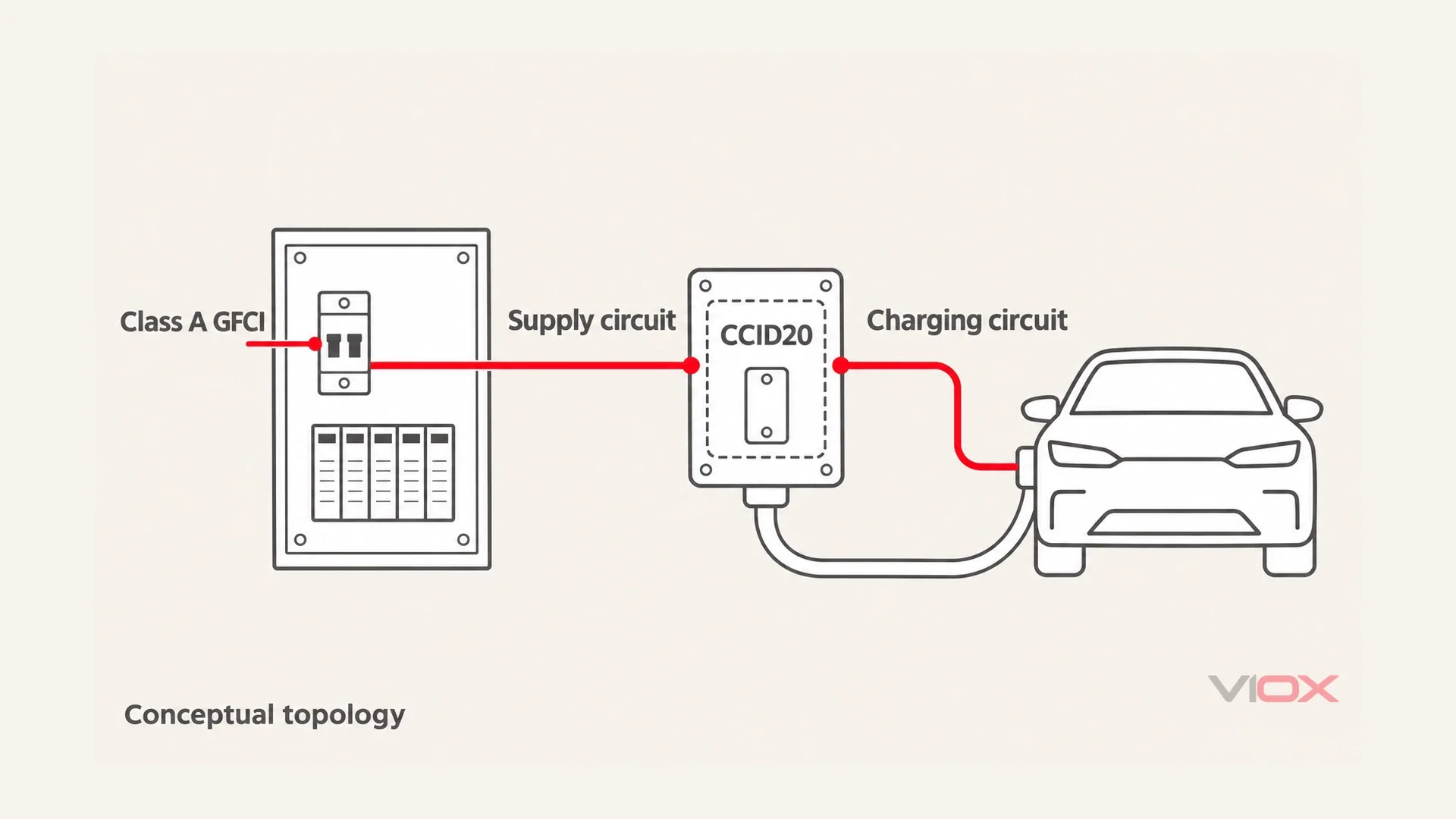
CCID means charging circuit interrupting device. A CCID20 is part of an EV supply personnel-protection system evaluated under the UL 2231 framework. It should not be described merely as protection for the charger hardware.
A Class A ground-fault circuit interrupter (GFCI), associated with UL 943, provides personnel protection for its defined circuit boundary. Installing two devices does not make their protection scopes interchangeable.
| Question | EVSE CCID20 system | Upstream Class A GFCI |
|---|---|---|
| Relevant framework | UL 2231 EV supply personnel protection | UL 943 GFCI personnel protection |
| Threshold shorthand | 20mA in the cited UL 2231-2 component test description | 4-6mA Class A range |
| Where protection is evaluated | Inside the identified EVSE system and its protected charging path | Downstream of the installed GFCI’s sensing and disconnecting point |
| Does it automatically cover the upstream receptacle? | No; establish the actual boundary | Can protect a receptacle and its downstream circuit when correctly applied |
| Does its presence settle installation-code compliance? | No | No; correct device, placement, compatibility, and installation still matter |
Intertek’s UL 2231-2 standards update, C5.2, identifies a 20mA threshold for CCID20 sensing tests. That shorthand is not a complete specification for every waveform, response time, or internal architecture. UL’s ground-fault protection guide identifies the Class A 4-6mA range; its historical installation examples should not be treated as current code coverage.
Why the threshold difference matters
Charging equipment and the vehicle contain electronics. Filter capacitance can provide a leakage path to protective earth without a metallic short circuit. The applicable product evaluation accounts for the charging system’s operating characteristics; a higher CCID threshold does not prove that a particular charger actually leaks that amount.
An upstream Class A device can respond before a CCID20 system does. The charger’s lack of an internal fault indication therefore cannot prove that the upstream trip was incorrect. Nor does it establish that the upstream device is defective.
Do not confuse UL Class A GFCI with IEC Type A RCD. They are different classifications. For an IEC project, use the separate EV charging RCD selection guide; its Type A/B/F and RDC-DD decisions do not replace this US review.
Why the Combination Can False-Trip
Two protective devices do not “fight” simply because they are in series. They respond to what their sensing circuits detect. The investigation must identify the current path, the device that opened, and the operating event that coincided with it.
Self-test current: establish the actual path
An EVSE self-check can exercise its fault-detection function. If a particular design creates an imbalance visible to the upstream GFCI, that upstream device can respond. A test confined to an internal sensing circuit, however, does not automatically create the same upstream residual current.
This distinction prevents an unsupported diagnosis: “The charger tests itself, so the breaker must trip.” Ask the manufacturer whether the exact hardware and firmware create an upstream-visible test signal, when that test occurs, and which supply protection arrangements were evaluated. Do not infer a test-current magnitude or recurring interval from an online anecdote.
Emporia’s Classic/Pro guidance warns about redundant protection without specifying an upstream test-current amplitude or routine schedule. An installer investigating these models should request those details from support. Startup or scheduled-event timing is a useful clue, not proof that a trip is harmless.
Operating leakage and a legitimate upstream response
Leakage contributions from the connected charging system may combine at the upstream sensing point. If the residual current reaches that device’s operating region, it can disconnect while the EVSE’s internal protection remains below its own threshold. Adding nameplate load currents does not calculate this residual current.
The electrician must distinguish normal operating contributions from moisture, damaged insulation, or an installation defect. A recurring pattern alone cannot make that distinction. Manufacturer compatibility warnings justify investigating the pairing; they do not justify declaring every observed trip false.
For general circuit-fault isolation beyond this EV-specific compatibility question, see AFCI and GFCI nuisance-tripping troubleshooting.
The Decision Tree: Hardwired vs Plug-In
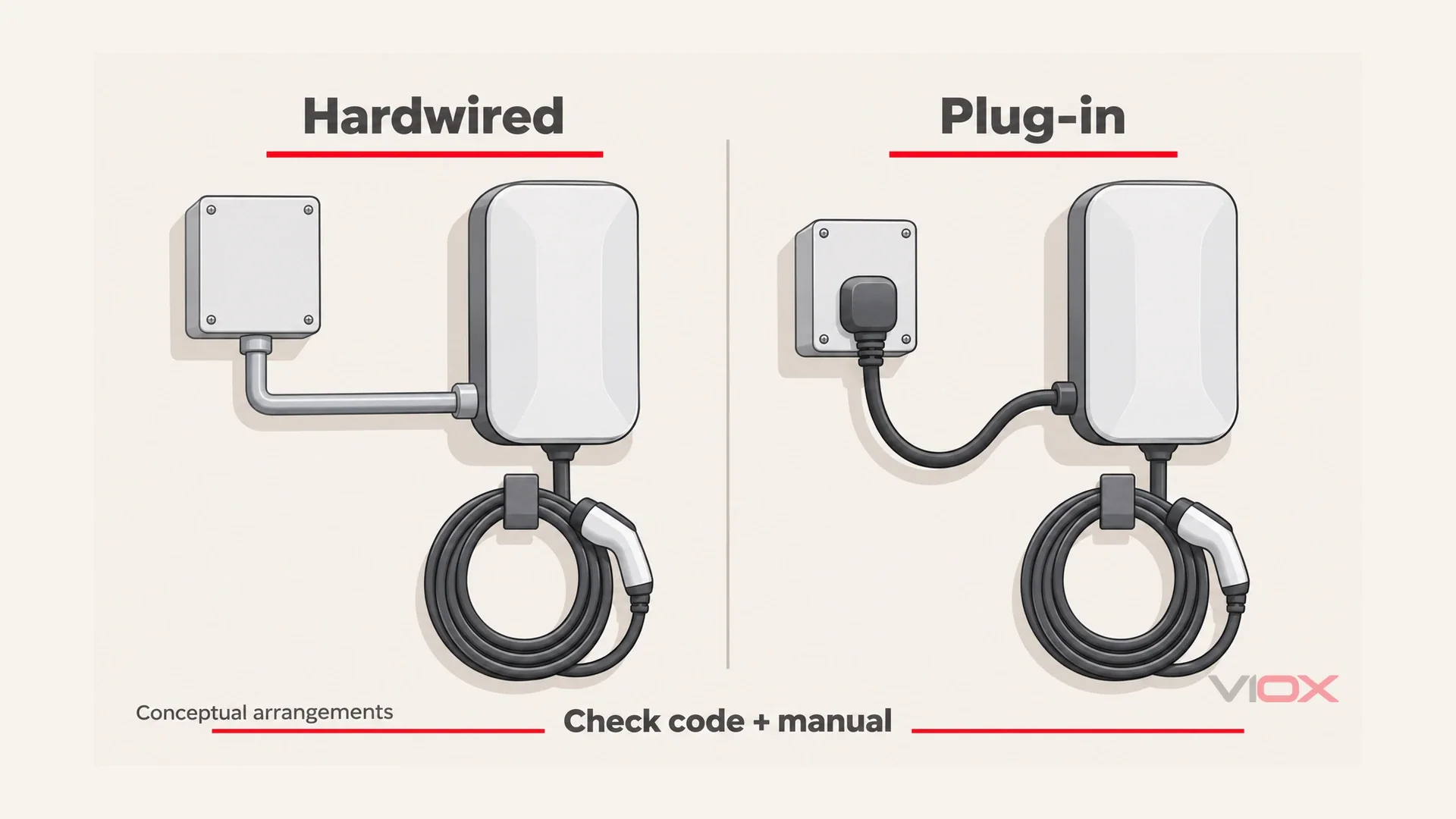
Start with the exact installation manual, then test its permitted arrangement against the adopted rules. Homeowners can assemble documents and observations; the licensed installer must determine circuit compliance. A protection requirement may be satisfied by an appropriate listed arrangement, not necessarily only by a panel breaker in every application.
| Installation input | Required decision | Safe next action |
|---|---|---|
| EVSE supplied through a receptacle | Apply the EV-charging receptacle GFCI provision and other applicable location rules | Keep required protection; select compatible equipment and a compliant listed arrangement |
| Hardwired at a dwelling outdoor outlet within 210.8(F)’s electrical scope | Check the adopted outdoor-outlet requirement | Built-in CCID is not an automatic exemption; resolve any instruction conflict |
| Hardwired, with location or supply outside that provision’s scope | Check other applicable provisions and exact instructions | A non-GFCI arrangement may be acceptable only after the full review |
| Garage, accessory-building, or disputed indoor/outdoor classification | Read the adopted edition’s location wording and amendments | Obtain the AHJ’s interpretation rather than applying a blanket exemption |
| Manual says non-GFCI; adopted requirement says GFCI | There is no established compliant combination yet | Pause commissioning; resolve configuration or equipment with the AHJ and manufacturer |
| Different code edition or uncertain local amendment | This guide’s edition comparison is insufficient | Obtain the governing text before selecting or changing protection |
Record the decision before changing hardware
The installer should retain the adopted edition and amendments; dwelling or other occupancy classification; outlet location; supply voltage to ground; branch-circuit rating; EVSE model and configuration; manual revision; and relevant AHJ determination.
Compare a rule’s branch-circuit limit with the branch-circuit rating, not the charger’s present output setting. A software setting is not a substitute for identifying the installed circuit. Equally, a manufacturer’s instructions for one supply arrangement cannot automatically be transferred to another connection method or a later product revision.
Then confirm the proposed breaker is permitted in that panel and that its protection function matches the requirement. A physically fitting breaker, an IEC RCD label, or an unfamiliar higher-threshold ground-fault device does not establish suitability for this US application.
Before the permit review, put the conflict in one sentence: “This adopted provision appears to require external GFCI protection, while this model’s instruction identifies a different arrangement.” Attach the actual pages rather than a screenshot of a search result. Record the resolution against that project, including any approved change of equipment. That gives the commissioning electrician and the future maintenance contractor a traceable reason for the final configuration.
Do not increase circuit rating merely to move outside a rule’s scope. Any redesigned circuit must independently satisfy equipment, conductor, panel, and permitted-load requirements. Use the EV charger circuit-breaker sizing guide for that separate task.
What to Do When It Already Trips
Do not repeatedly reset a recurring fault. Stop charging if there is heat damage, moisture intrusion, damaged insulation, or another unsafe condition. Opening equipment, testing circuits, and changing protection belong to a qualified electrician using isolation and verification procedures.
1. Identify what actually opened
Record whether the panel breaker moved to its trip position, the EVSE reported an internal fault, or charging stopped with the supply still energized. Use the exact device’s diagnostic instructions. A charging-app message is not a measurement of the panel breaker’s trip cause.
A GFCI breaker also performs overcurrent protection. Its presence does not establish that its ground-fault function caused this interruption. Avoid replacing a correctly operating device before identifying the indication.
2. Compare event timing with documented self-check behavior
Keep a short log: energization, vehicle connection, charging start, EVSE-reported self-check, and interruption. Ask support to confirm the actual test behavior for that model and firmware. Match confirmed events rather than inventing a universal daily or periodic test schedule.
Provide support with the breaker model, EVSE model, manual revision, connection method, and observed indication. A useful support response identifies whether that pairing is permitted and what verification is needed; “remove the GFCI” without an installation-code review is incomplete.
3. Review protection before authorizing replacement
Establish whether the Class A GFCI was required, permitted, or inconsistent with the specified equipment arrangement. Check the code/manual decision with the AHJ before a protection change. If external GFCI remains required, investigate a manufacturer-supported compatible solution or different equipment rather than bypassing it.
After correction, commissioning must verify the approved configuration and protective functions according to the applicable instructions. The handover record should explain what changed and why the installation satisfies both the adopted requirements and the equipment instructions. Successful charging alone is not that verification.
Frequently Asked Questions
Do EV chargers have built-in GFCI protection?
Many listed EVSE products include internal personnel-protection functions, but the exact architecture and documentation matter. A CCID20 system is not automatically a UL 943 Class A GFCI, and its presence does not settle upstream protection requirements.
Does the NEC require a GFCI breaker for a hardwired EV charger?
It depends on the adopted edition, local amendments, location, supply, and circuit scope. Under the 2020/2023 provisions discussed here, a relevant outdoor-outlet requirement can apply to hardwired equipment. Hardwiring alone is not a universal exemption.
Why does my EV charger keep tripping the GFCI breaker?
Possible causes include a real fault or equipment/protection incompatibility. First identify the tripping function. Compare event timing with manufacturer-confirmed self-check behavior, and have the circuit inspected before deciding the trip is false.
Can I replace the GFCI breaker with a standard breaker?
Only after a qualified installer confirms that the revised arrangement meets adopted requirements, panel compatibility, and the EVSE’s applicable instructions. Obtain AHJ clarification where necessary. Do not remove required GFCI protection to stop interruptions.
Does a plug-in EV charger need GFCI protection too?
The EV-charging receptacle provision requires GFCI protection in the code framework addressed here. Built-in EVSE protection does not automatically replace it. Confirm the adopted edition and a compliant, compatible installation arrangement.