On this page
Type AC, Type A, Type F, and Type B describe the residual-current waveforms an RCBO is designed to detect and respond to. They do not describe the device’s overcurrent trip curve. In simplified terms, Type AC covers sinusoidal AC residual current; Type A adds pulsating DC; Type F adds specified composite residual currents associated with certain single-phase frequency-converter loads; and Type B adds smooth DC plus a broader defined frequency range.
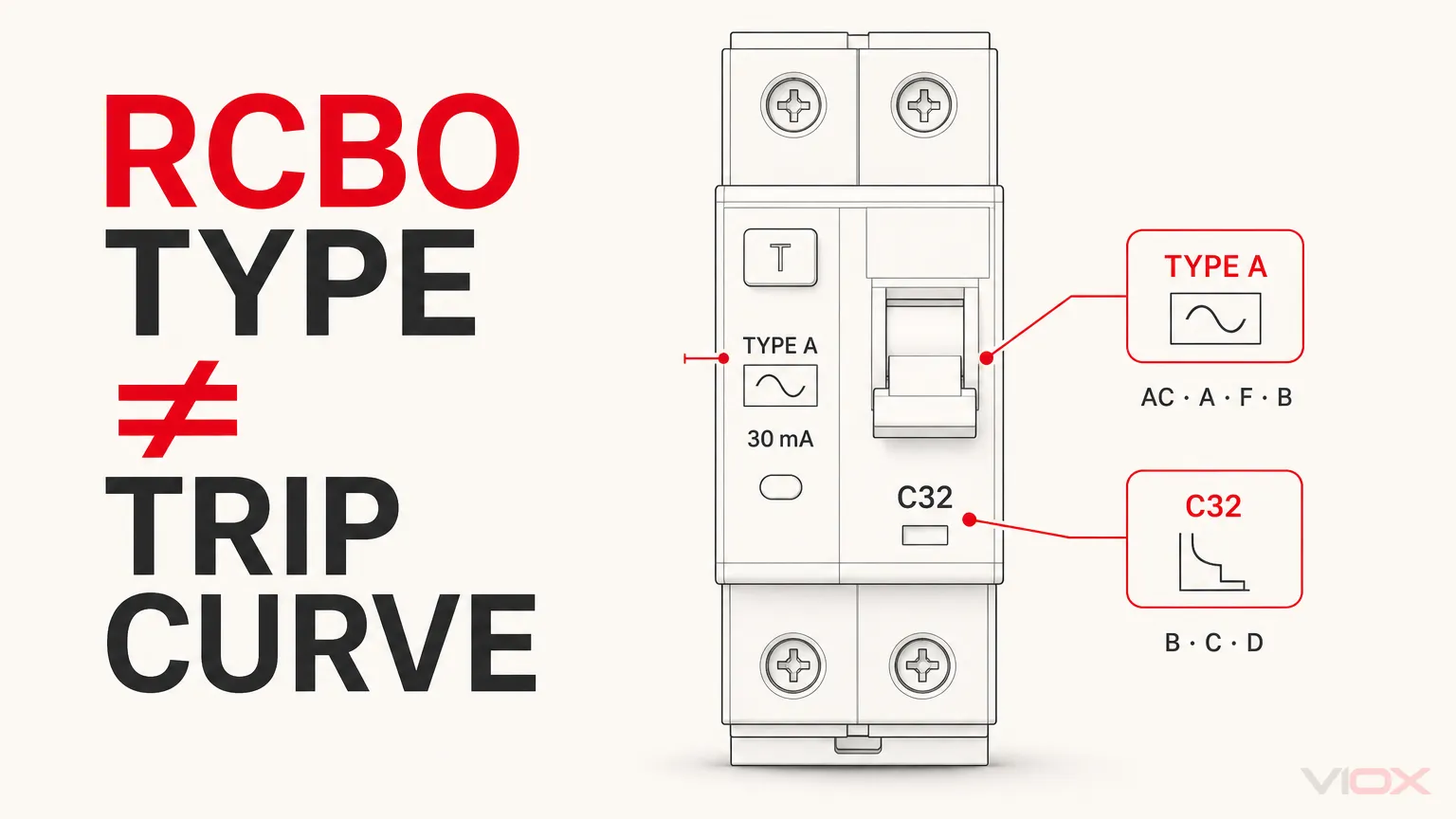
The practical rule is to choose the residual-current type from the connected equipment’s possible fault-current waveform, then verify the RCBO’s overcurrent curve, rated current, residual operating current, poles, and breaking capacity as separate fields. Never select Type B merely because the front of an RCBO says B16: that marking normally identifies a B overcurrent curve at 16 A, not a Type B residual-current device.
| RCBO residual-current type | Capability, simplified | Load condition that may point to it | Stop and verify when |
|---|---|---|---|
| Type AC | Sinusoidal alternating residual current | A genuinely simple AC load, where Type AC is permitted | Electronic conversion is present or unknown, or local rules restrict Type AC |
| Type A | Type AC capability plus pulsating DC residual current | Many single-phase electronic loads with rectifier or phase-control stages | Composite-frequency or smooth DC residual current may occur |
| Type F | Type A capability plus specified composite residual currents from certain single-phase frequency converters | Some single-phase variable-speed appliances, pumps, heat pumps, and air-conditioning equipment | The topology is three-phase, smooth DC may occur, or the manufacturer does not support Type F |
| Type B | Sinusoidal AC, pulsating DC, defined frequency components, and smooth DC within the product-standard scope | Some three-phase converters, variable-frequency drives, photovoltaic inverters, uninterruptible power supplies, and EV-charging architectures | The choice is based only on an application label instead of exact equipment and system documents |
This table is a screening tool, not an installation rule. The final choice must follow the equipment manufacturer’s instructions, the exact RCBO documentation, the protection architecture, and the requirements that apply in the destination market.
One RCBO, Two Different Type Decisions
An RCBO combines residual-current protection with overload and short-circuit protection. That creates two independent classification axes on one device:
| Field | Example | What it controls | What it does not tell you |
|---|---|---|---|
| Residual-current type | Type A | Which residual-current waveforms the device is designed to detect | Inrush tolerance or rated current |
| Overcurrent trip curve | C curve | The instantaneous overcurrent operating characteristic | Whether smooth DC residual current is detected |
Rated current In |
32 A | Continuous-current rating under the stated product conditions | Residual-current sensitivity |
Rated residual operating current IΔn |
30 mA | Residual-current operating threshold | Overload protection or breaking capacity |
A specification written as Type A, C32, 30 mA therefore contains three different decisions: Type A for residual-current waveform capability, C curve and 32 A for the overcurrent function, and 30 mA for rated residual operating current. Marking layouts and symbols vary, so confirm each field in the manufacturer’s datasheet rather than decoding a product from one letter alone.
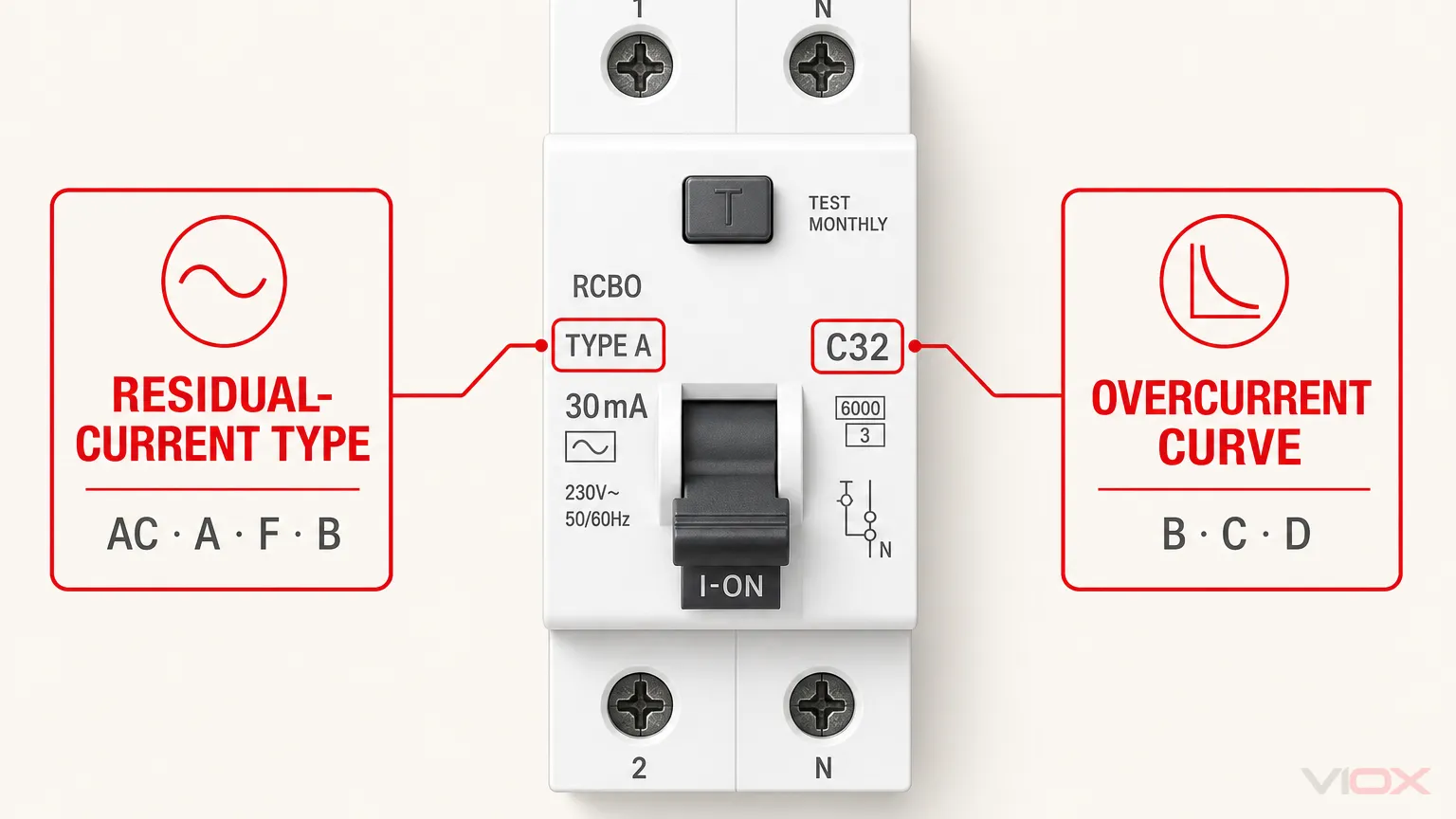
If the task is to choose all ratings—not only the residual-current type—use the complete RCBO selection guide.
The RCBO Residual-Current Capability Ladder
The four types can be understood as a progressively broader capability ladder, but “broader” does not automatically mean “correct for every circuit”:
Type AC → sinusoidal AC residual current
Type A  → Type AC capability + pulsating DC
Type F  → Type A capability + specified composite residual currents
Type B  → broader defined frequency capability + smooth DC
IEC 61009-1:2024 gives general requirements and tests for residual-current operated circuit-breakers with integral overcurrent protection for household and similar uses within its stated voltage, frequency, current, and short-circuit-capacity limits. IEC 62423 adds requirements and tests for Type F and Type B RCDs and is used with the relevant base RCCB or RCBO standard.
The type letter answers only the waveform question. It does not replace verification of In, IΔn, trip curve, poles, voltage, frequency, breaking capacity, supply dependence, selectivity, or national installation requirements. The IEC 61009-1 RCBO guide explains the product-standard boundary in more detail.
Type AC RCBO vs Type A RCBO
Type AC RCBOs are intended to respond to sinusoidal alternating residual current. Type A RCBOs add response to pulsating DC residual current, which can arise from single-phase electronic equipment containing rectifiers or phase-control circuits.
The decision is not “old device versus new device” or “cheap versus premium device.” It is whether the connected load and its fault paths can produce a residual-current waveform outside Type AC capability.
Investigate Type A when the circuit supplies electronic equipment with diode bridges, switched-mode power supplies, electronic controls, or similar conversion stages. Do not assume Type A is sufficient when the manufacturer identifies composite-frequency or smooth-DC conditions.
Consider Type AC only when all of the following can be verified:
- the load topology does not introduce pulsating DC, composite-frequency, or smooth-DC residual current;
- the equipment instructions do not require another residual-current type;
- the destination-market installation rules permit Type AC for that circuit; and
- the exact RCBO documentation supports the intended installation.
If the load topology is unknown, the type decision is unresolved. An appliance category such as “lighting,” “heating,” or “socket circuit” is not enough evidence by itself.
Type A RCBO vs Type F RCBO
Type F extends the Type A capability for specified composite residual currents associated with certain single-phase frequency-converter loads. IEC 62423 describes Type F devices for installations where a frequency inverter is supplied between phase and neutral, or between phase and an earthed middle conductor, and composite residual currents may occur.
That makes Type F relevant to some single-phase variable-speed appliances, pumps, heat pumps, air conditioners, and washing machines. These product names are screening clues, not prescriptions: two devices sold as “heat pumps” can use different converter topologies and require different protection.
Move from a Type A candidate to a Type F investigation when:
- the equipment uses a relevant single-phase frequency-converter topology;
- composite-frequency residual current is possible;
- the equipment manufacturer specifies or supports Type F; and
- the applicable installation rules and exact RCBO documentation allow the arrangement.
Do not select Type F solely to cure unexplained tripping. Unwanted tripping can also result from accumulated normal leakage, mixed neutrals, insulation faults, transients, or an unsuitable circuit architecture. The residual-current type must first match the possible fault-current waveform.
Type F RCBO vs Type B RCBO
The decisive boundary is smooth DC residual current. Type B covers smooth DC in addition to sinusoidal AC, pulsating DC, and defined frequency components within its product scope. Type F should not be described as having the same smooth-DC residual-current capability.
Potential Type B contexts include three-phase frequency converters, variable-frequency drives, PV inverters, UPS systems, EV charging, and other power-electronic equipment. However, a category label does not reveal the complete topology. One inverter may explicitly require Type B; another may include monitoring or protective functions that permit a different documented arrangement.
Before specifying Type B, verify:
- whether the exact equipment can produce smooth DC residual current;
- whether separate DC detection is built into the equipment;
- what the equipment manufacturer requires for the external RCD or RCBO;
- how DC leakage may affect upstream residual-current devices;
- whether upstream and downstream devices require coordination; and
- whether the proposed Type B RCBO has the correct voltage, frequency, poles, time characteristic, and other ratings.
Type B has broader waveform capability, but it is not a universal upgrade. Broader detection does not automatically establish selectivity, compatibility, or compliance for a particular system.
Load Topology to RCBO Type Decision Matrix
Start from the power-conversion topology, not the appliance name.
| Load or conversion topology | Possible residual-current behavior | RCBO type to investigate first | Required evidence | Stop condition |
|---|---|---|---|---|
| Simple AC load without electronic conversion | Sinusoidal AC | Type AC, where permitted | Equipment circuit information and installation rules | Any rectifier, electronic control, or non-sinusoidal fault path is present or unknown |
| Single-phase load with rectifier or phase control | Sinusoidal AC plus pulsating DC | Type A | Equipment manual and residual-current requirement | Composite frequencies or smooth DC are possible |
| Certain single-phase inverter supplied phase-to-neutral | Pulsating DC plus specified composite frequencies | Type F | Converter topology and manufacturer-specified RCD type | Three-phase conversion, smooth DC, or unsupported Type F application |
| Conversion stage that can produce smooth DC | Smooth DC may occur | Type B or another explicitly documented protection architecture | Exact protective-device instructions and system diagram | DC protection or upstream-device behavior is undocumented |
| Three-phase rectifier or frequency converter | Smooth DC and frequency components may occur | Type B | Converter manual, circuit diagram, and coordination data | Selection is based only on “VFD” or motor nameplate wording |
| EV charger with a documented 6 mA RDC-DD | A defined function addresses the specified DC condition | Type A or Type F may be possible when instructed and permitted | Exact EVSE/RDC-DD documentation and external-device requirement | “6 mA protection” is only a marketing statement or its function is unclear |
| EV charger without suitable documented DC detection | Smooth DC condition remains for external protection | Type B strategy to evaluate | EVSE manual, installation rules, and exact Type B RCBO data | Circuit architecture or manufacturer requirement is unresolved |
“Investigate first” is deliberate wording. This matrix narrows the candidate; it does not authorize a final model selection without the required evidence.
EV Charging: Type B or Type A Plus RDC-DD?
An EV-charging circuit does not automatically require the same external arrangement in every installation. Two common architectures to evaluate are:
- a suitable Type B RCD or RCBO strategy; or
- a Type A or Type F device used with a documented Residual Direct Current Detecting Device (RDC-DD), when the equipment instructions and applicable rules permit that combination.
IEC 62955:2018 applies to RDC-DDs for permanently connected Mode 3 AC electric-vehicle charging stations within its stated scope. A vague “6 mA DC protection” claim is not enough: verify that the charging equipment’s function, product documentation, installation instructions, and external protection requirements form a complete architecture.
For the application-specific decision, use the dedicated EV charger residual-current protection guide rather than treating EV charging as one row in a generic household table.
Evidence-First RCBO Type Selection Workflow
1. Identify the exact equipment and supply topology
Record whether the load is single-phase or three-phase, whether it contains a rectifier or inverter, how the converter is supplied, and whether the manufacturer provides an RCD-type requirement. “Electronic load” is too broad to complete this step.
2. Identify the possible residual-current waveform
Use the equipment manual, converter documentation, and applicable design information to determine whether sinusoidal AC, pulsating DC, composite-frequency, or smooth-DC residual current can occur. If the evidence is missing, record the type as unresolved rather than guessing.
3. Select the residual-current type
Match the possible waveform to Type AC, A, F, or B using the fixed comparison basis above. Verify the type and its symbol or marking in the exact RCBO datasheet.
4. Select the overcurrent curve separately
After the residual-current type is fixed, choose the B, C, D, or other available trip characteristic from load inrush, fault-current, and disconnection requirements. Do not infer the residual-current type from a marking such as B16 or C32.
5. Complete the remaining RCBO specification
Confirm rated current, IΔn, poles, voltage and frequency, breaking capacity, terminal arrangement, supply dependence, selectivity, and required product or market documentation. These are separate selection tasks covered by the complete RCBO selection guide.
The final decision record should contain:
Connected equipment and exact model:
Supply and converter topology:
Possible residual-current waveform:
Manufacturer-required RCD/RCBO type:
Selected residual-current type: AC / A / F / B
Selected overcurrent curve:
Rated current In:
Rated residual operating current IΔn:
Poles, voltage and frequency:
Breaking capacity:
Separate DC-detection function, if any:
Upstream/downstream coordination requirement:
Applicable installation rules:
Unresolved evidence that prevents final selection: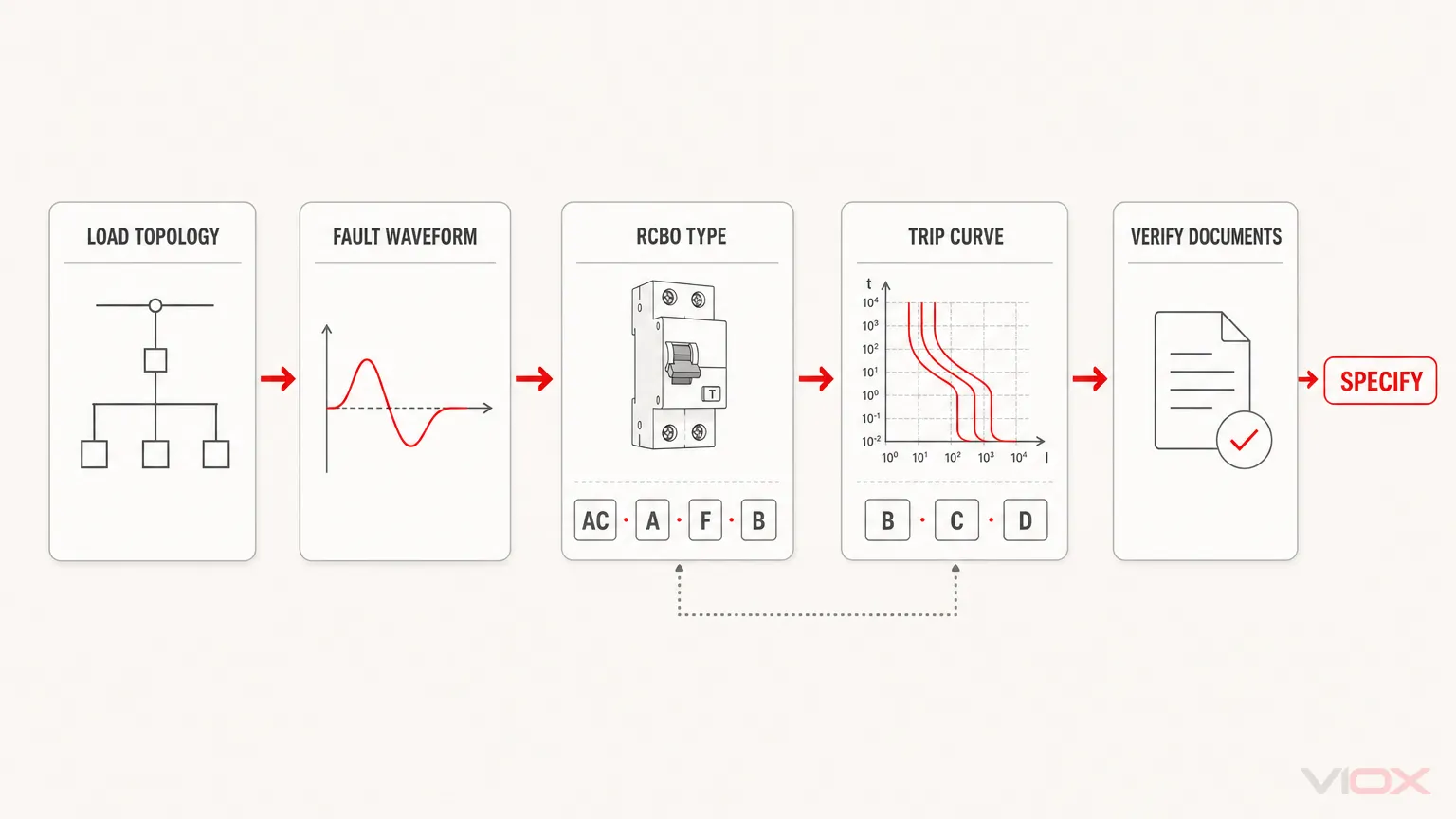
RCBO Type vs RCCB Type
Type AC, A, F, and B describe residual-current response for both RCBOs and Residual Current Circuit Breakers without integral overcurrent protection (RCCBs) within the relevant product-standard scope. The underlying waveform comparison is therefore related, but the device decision is not identical.
An RCBO integrates overcurrent protection, so the reader must avoid confusing its residual-current type with its B/C/D trip curve and must specify both axes. An RCCB does not contain the same integral overcurrent function and needs an associated overcurrent-protection arrangement. Use the separate RCCB Type AC, A, F, and B comparison when the selected device is an RCCB.
Focused RCBO Type Questions
Is a Type B RCBO the same as a B-curve RCBO?
No. Type B describes residual-current waveform capability, including smooth DC within the device’s applicable scope. B curve describes the instantaneous overcurrent operating characteristic. An RCBO can therefore be Type A on the residual-current side and B curve on the overcurrent side.
Is Type A RCBO better than Type AC?
Type A has broader residual-current waveform capability because it adds pulsating DC response. That does not make it universally correct. Select it when the load behavior, product documents, equipment instructions, and applicable rules support Type A; investigate Type F or B when composite-frequency or smooth-DC conditions may occur.
When should a Type F RCBO be considered?
Consider Type F for certain single-phase frequency-converter loads that can produce the composite residual currents addressed by Type F requirements. Verify the actual converter topology and manufacturer instruction rather than selecting it from an appliance name alone.
Do EV chargers always need a Type B RCBO?
No universal answer applies. A suitable Type B strategy may be required, while some documented systems permit Type A or Type F with a suitable 6 mA RDC-DD. The EVSE manual, RDC-DD documentation, circuit architecture, applicable rules, and exact external-device requirement must agree.
Can a Type B RCBO replace Type A or Type F?
Type B has broader waveform capability, but replacement is not decided by waveform breadth alone. Verify voltage, frequency, current rating, IΔn, poles, trip curve, breaking capacity, supply dependence, coordination, equipment instructions, and installation rules before substituting any RCBO.
Sources Reviewed
- IEC 61009-1:2024 — RCBOs with integral overcurrent protection
- IEC 62423:2009 — Type F and Type B RCD requirements
- IEC 62955:2018 — RDC-DDs for Mode 3 EV charging
- ABB — Selection of residual-current devices for EV charging infrastructure
- Schneider Electric Electrical Installation Guide — Types of RCDs
After documenting the residual-current type and the other independent RCBO fields, compare the VIOX RCBO product range and request the exact model datasheet and destination-market documents from [email protected].