

On this page
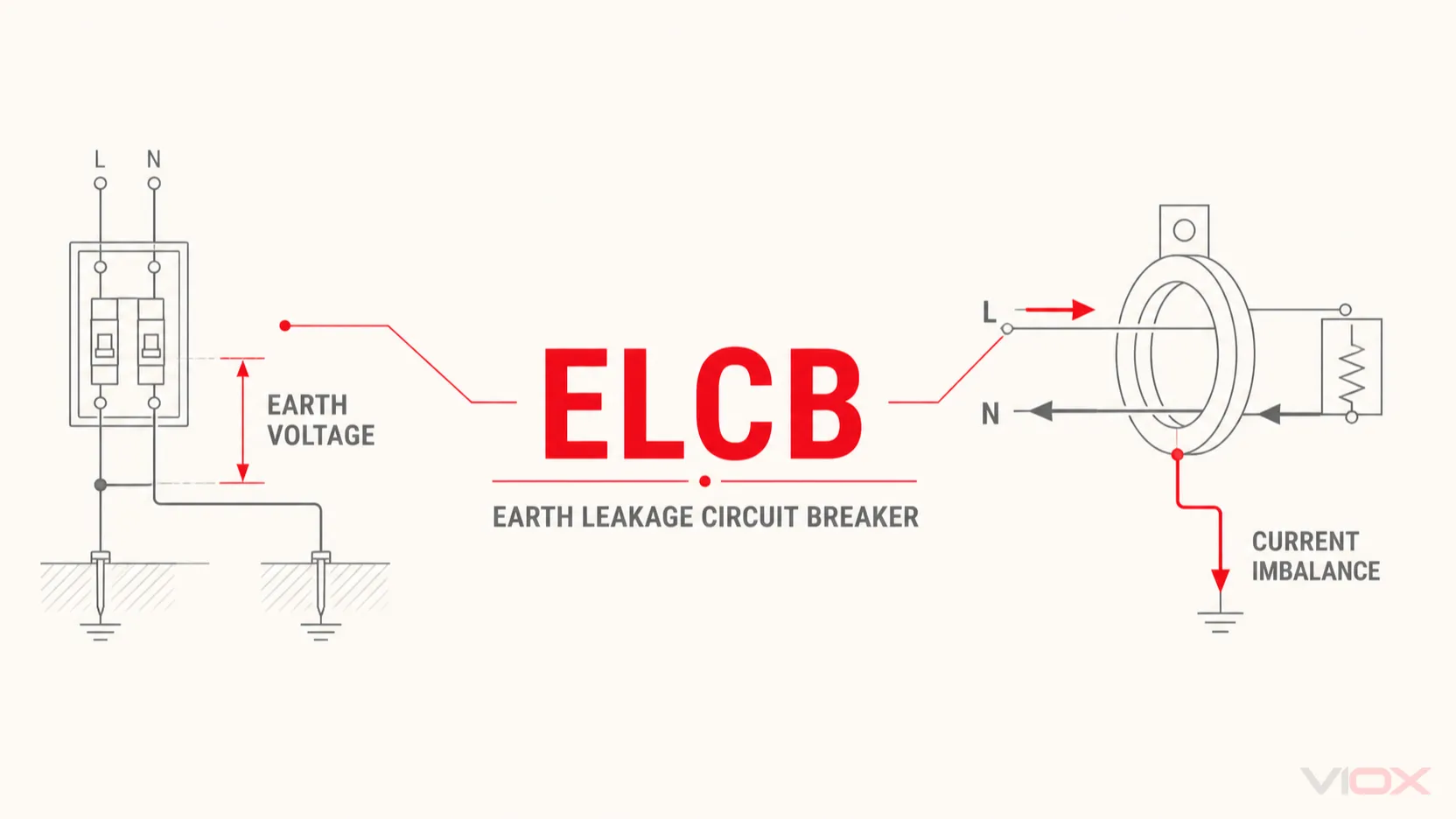
ELCB stands for Earth Leakage Circuit Breaker. The name can describe two different ideas: a legacy voltage-operated earth-leakage device, or—in informal and regional usage—a current-operated device now more precisely called an RCD or RCCB. If overcurrent protection is built in, the modern device term is usually RCBO.
That distinction matters. Reading “ELCB” on a label or quotation does not, by itself, tell you the sensing principle or whether the device protects against overload and short circuit.
ELCB Full Form: Letter-by-Letter Meaning
| Letter | Meaning | What it indicates |
|---|---|---|
| E | Earth | The fault current or voltage is associated with earth |
| L | Leakage | Current has left its intended circuit path |
| C | Circuit | The protected electrical circuit or installation |
| B | Breaker | The device opens its contacts to disconnect the supply |
The expanded name is therefore Earth Leakage Circuit Breaker. The acronym explains the purpose, but not the exact detection method.
What Does “ELCB” Mean on an Actual Device?
Use two questions to identify what the term means:
- What does the device sense—earth voltage or residual-current imbalance?
- Does it also provide overcurrent protection?
| Wording or clue | Most likely meaning | Correct modern description |
|---|---|---|
| Old installation; device has two separate earthing terminals | Voltage-operated ELCB | Legacy voltage-operated earth-leakage circuit-breaker |
| “ELCB” in a catalogue, with residual-current sensitivity marked as IΔn | Current-operated earth-leakage device | Usually an RCD or RCCB; verify the standard and datasheet |
| Residual-current function plus overload and short-circuit ratings | Combined protective device | RCBO, if the applicable product standard and markings confirm it |
| North American personnel ground-fault terminology | Region-specific protective device | GFCI; do not assume every ELCB is an exact one-to-one equivalent |
This decoder is more reliable than choosing a device from the acronym alone.
Traditional ELCB: A Voltage-Operated Device
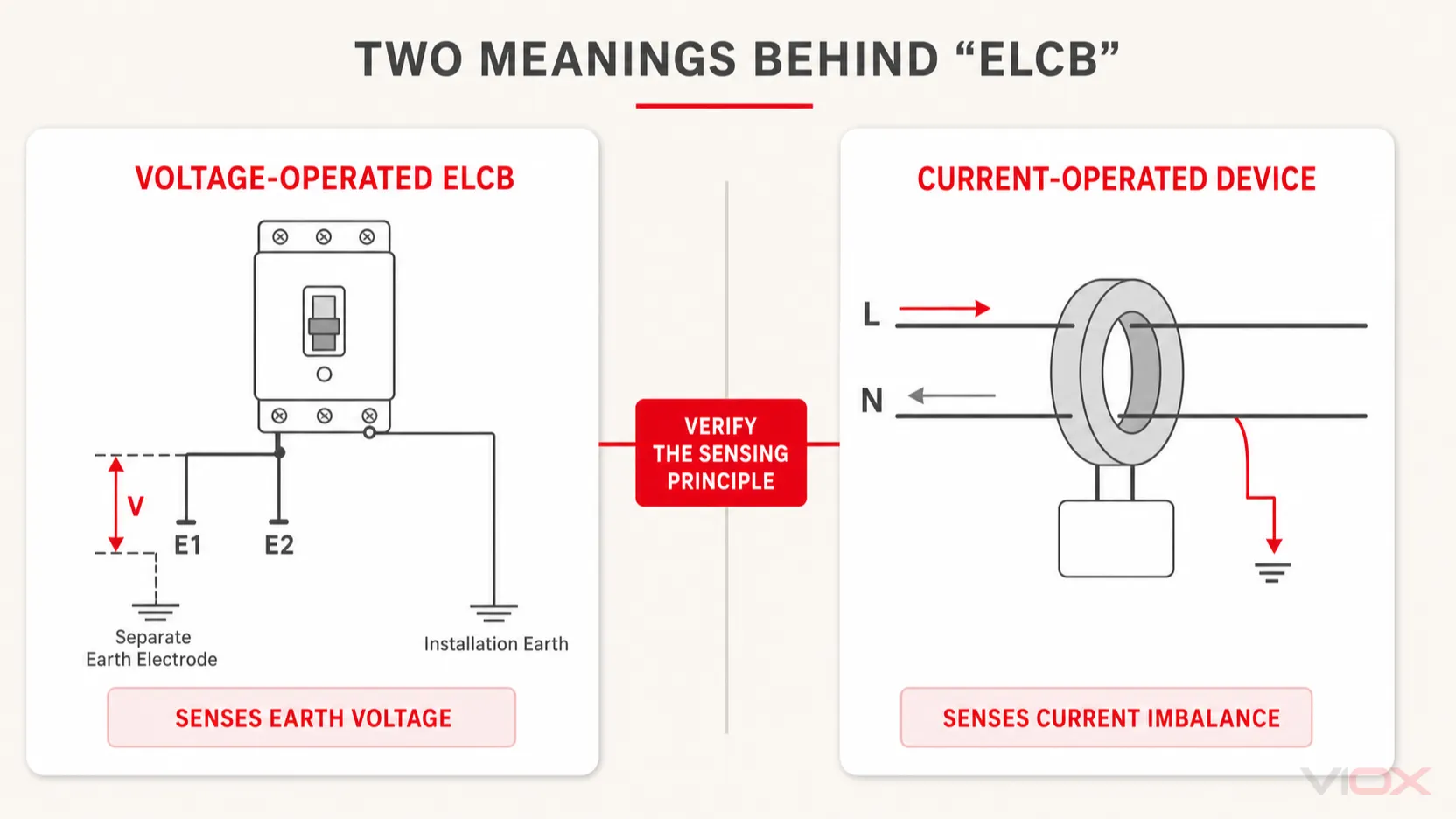
Historically, ELCB could refer to a voltage-operated device. It monitored the voltage between the installation’s earthing system and a reference earth connection. When that voltage reached the operating condition, the device disconnected the supply.
The IET notes that older regulations recognized both voltage-operated and current-operated ELCBs. In the UK context, the voltage-operated type ceased to be recognized in 1981. It can often be identified by two separate earthing terminals: one connected to the installation earthing conductor and the other to the means of earthing.
This design depends on the monitored earth path. A parallel earth path can bypass the sensing route, which is one reason the old voltage-operated principle should not be confused with a modern residual-current device.
Current-Operated “ELCB”: Usually an RCD or RCCB
A current-operated device compares current flowing through the live conductors. In a single-phase circuit, current leaving through line should return through neutral. If some current flows through an unintended path, the resulting imbalance is residual current. The device trips when its specified operating conditions are met.
RCD is the generic term for this residual-current protection function. An RCCB is a residual current operated circuit-breaker without integral overcurrent protection. The current edition of IEC 61008-1:2024 covers RCCBs for household and similar uses within the standard’s stated scope.
For a fuller treatment of the two detection principles, use the dedicated RCCB vs ELCB comparison. For the adjacent acronym, see RCCB full form and meaning.
ELCB, RCCB, RCBO, and GFCI: Protection Boundaries
| Term | Main detection or function | Integral overcurrent protection? | Practical terminology note |
|---|---|---|---|
| Voltage-operated ELCB | Voltage on the monitored earthing path | Not established by the name | Legacy device; inspect and identify rather than assume |
| RCD | Residual-current operation | Depends on the device type | Generic family term |
| RCCB | Residual-current operation | No | Requires appropriate overcurrent protection elsewhere |
| RCBO | Residual current plus overcurrent | Yes | Combined residual-current and circuit overcurrent protection |
| GFCI | North American ground-fault personnel-protection category | Product form and scope vary | Use the applicable North American product standard and local code terminology |
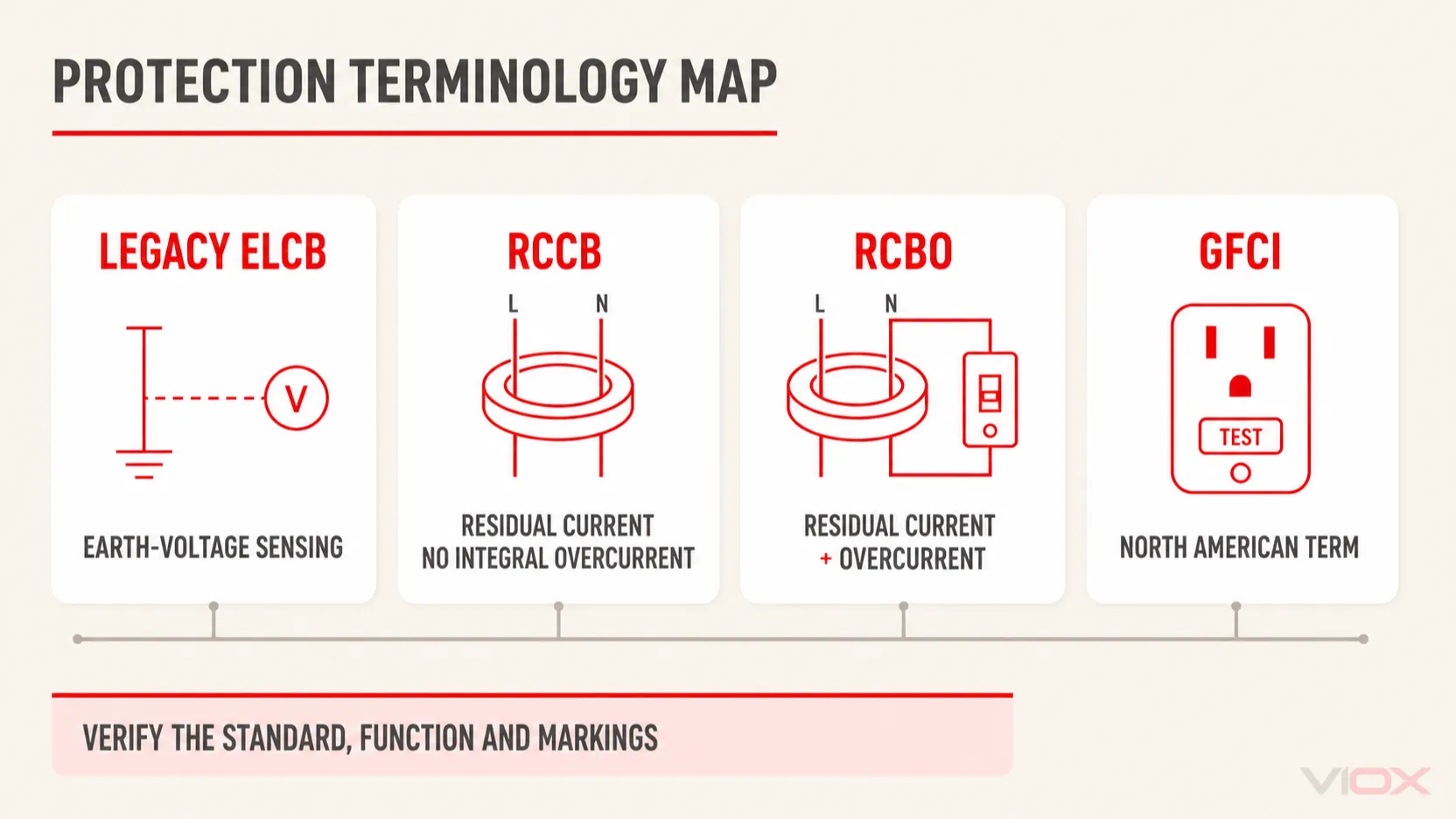
IEC 61009-1:2024 defines the household and similar-use scope for RCBOs with integral overcurrent protection. This is the essential difference between an RCCB and an RCBO: an RCCB does not replace the fuse or circuit-breaker needed for overcurrent protection, while an RCBO combines both functions within its stated ratings and standard scope.
In North America, GFCI is the familiar term for personnel ground-fault protection. UL’s GFCI certification information references UL 943 and CSA C22.2 No. 144.1 for Class A GFCIs. GFCI and ELCB are related in purpose, but they should not be treated as universally interchangeable specification terms.
How to Read an ELCB Label or Specification
If a drawing, panel, or seller uses “ELCB,” verify these items before deciding what the device is:
- Product standard: this is stronger evidence than the marketing name.
- Sensing description: look for voltage-operated or residual-current/current-balance language.
- Residual operating current, IΔn: this supports identification of a residual-current device but does not prove overcurrent protection.
- Overcurrent markings: a current rating alone is not enough. Confirm whether overload and short-circuit protection are integral and which product standard applies.
- Terminals and diagram: two dedicated earth terminals can indicate a legacy voltage-operated ELCB; modern residual-current devices normally monitor all live conductors of the protected circuit.
- Manufacturer instructions: use the exact model documentation when inspecting, replacing, or specifying equipment.
Do not infer suitability from the word “ELCB” alone. Device type, electrical ratings, residual-current characteristics, application, earthing arrangement, and local installation rules must be evaluated together by a qualified person.
How Should ELCB Be Written on a Drawing or RFQ?
Avoid specifying only “ELCB.” The term is too ambiguous for a modern drawing, bill of materials, or request for quotation.
Instead, state the required standardized device category and function, for example:
- RCCB without integral overcurrent protection, with the applicable standard and project-specific ratings; or
- RCBO with integral overcurrent protection, with the applicable standard and project-specific ratings.
Then add the poles, rated current, rated residual operating current, residual-current type, short-circuit data where applicable, voltage, frequency, and required certification for the target market. Those values must come from the circuit design and local rules, not from the acronym.
Readers moving from terminology to product evaluation can review the VIOX RCCB range or RCBO range, while selection decisions should be confirmed against the relevant application and compliance requirements.
Frequently Asked Questions
Is ELCB the same as RCCB?
Not strictly. A traditional ELCB is voltage-operated, while an RCCB detects residual-current imbalance. However, “ELCB” is still used informally in some markets for devices that are technically RCCBs. Always verify the standard and operating principle.
Is ELCB obsolete?
The voltage-operated ELCB is a legacy device in many installations. The name itself is not absent from the market, but modern documentation should identify a current-operated device more precisely as an RCD, RCCB, or RCBO.
Does an ELCB protect against overload or short circuit?
The name alone does not guarantee either function. An RCCB provides residual-current protection without integral overcurrent protection. An RCBO includes overcurrent protection. A legacy voltage-operated ELCB must be identified from its model and documentation.
What is ELCB called in the USA?
GFCI is the common North American term associated with personnel ground-fault protection. It is safer to specify the applicable GFCI category and standard than to translate “ELCB” as an exact equivalent.
What is the difference between ELCB and MCB?
ELCB terminology concerns earth-leakage or residual-current protection. An MCB responds to overcurrent conditions such as overload and short circuit within its ratings. One does not automatically replace the other.