

On this page
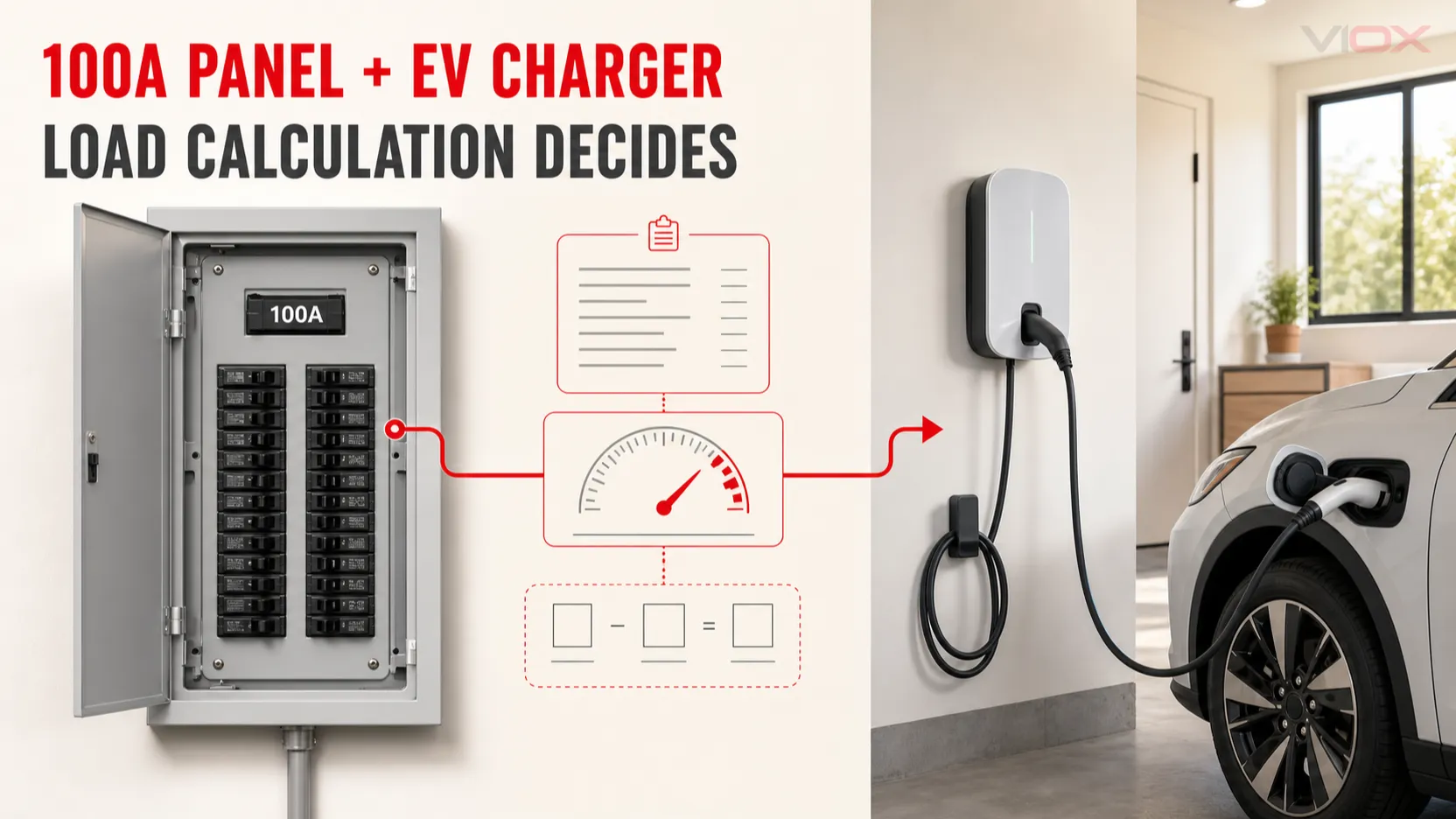
Yes, a 100 amp panel can often support a Level 2 electric vehicle charger, but the service rating alone cannot answer the question. The decision depends on the home’s calculated or measured demand, the charger’s maximum current setting, the panel and service equipment ratings, available breaker space, and any approved energy management system.
A 200 amp upgrade is therefore not automatic. The U.S. Environmental Protection Agency notes that even 100 amp service is often sufficient, depending on the home’s other electrical loads, and identifies lower-power charging and load management as possible alternatives to a service upgrade.
Safety and code boundary: This guide is a planning reference for North American 120/240 V residential systems. The locally adopted edition of the National Electrical Code (NEC), the authority having jurisdiction (AHJ), utility requirements, EV supply equipment (EVSE) instructions, and a qualified electrician’s assessment control the final installation.
Key Takeaways
- A 100 amp label does not prove that a Level 2 charger will or will not fit. Run a residential load calculation or use permitted demand data.
- Do not add all breaker-handle ratings to estimate panel load. Connected load, calculated demand, and breaker ratings are different quantities.
- EVSE branch circuits are sized for continuous duty. A 32A EVSE commonly requires a 40A circuit; 40A requires 50A; and 48A requires 60A.
- Charging at a lower current can avoid an unnecessary service upgrade when it still replaces the vehicle’s daily energy use during the available charging window.
- Approved energy management can limit or pause EV charging as other household loads rise.
- Empty breaker spaces solve only the physical-space question. They do not prove that the service, feeder, bus, or conductors have electrical capacity.
Quick Answer: EV Charger Current and Circuit Size
For a 240 V residential Level 2 EVSE, use the equipment’s maximum continuous output setting, not the marketing name of the charger. NEC-style branch-circuit planning uses a minimum circuit rating of 125% of the EVSE maximum load.
| EVSE maximum output | Approximate power at 240 V | Minimum circuit rating at 125% | Common standard breaker size |
|---|---|---|---|
| 16A | 3.84 kW | 20A | 20A |
| 24A | 5.76 kW | 30A | 30A |
| 32A | 7.68 kW | 40A | 40A |
| 40A | 9.60 kW | 50A | 50A |
| 48A | 11.52 kW | 60A | 60A |
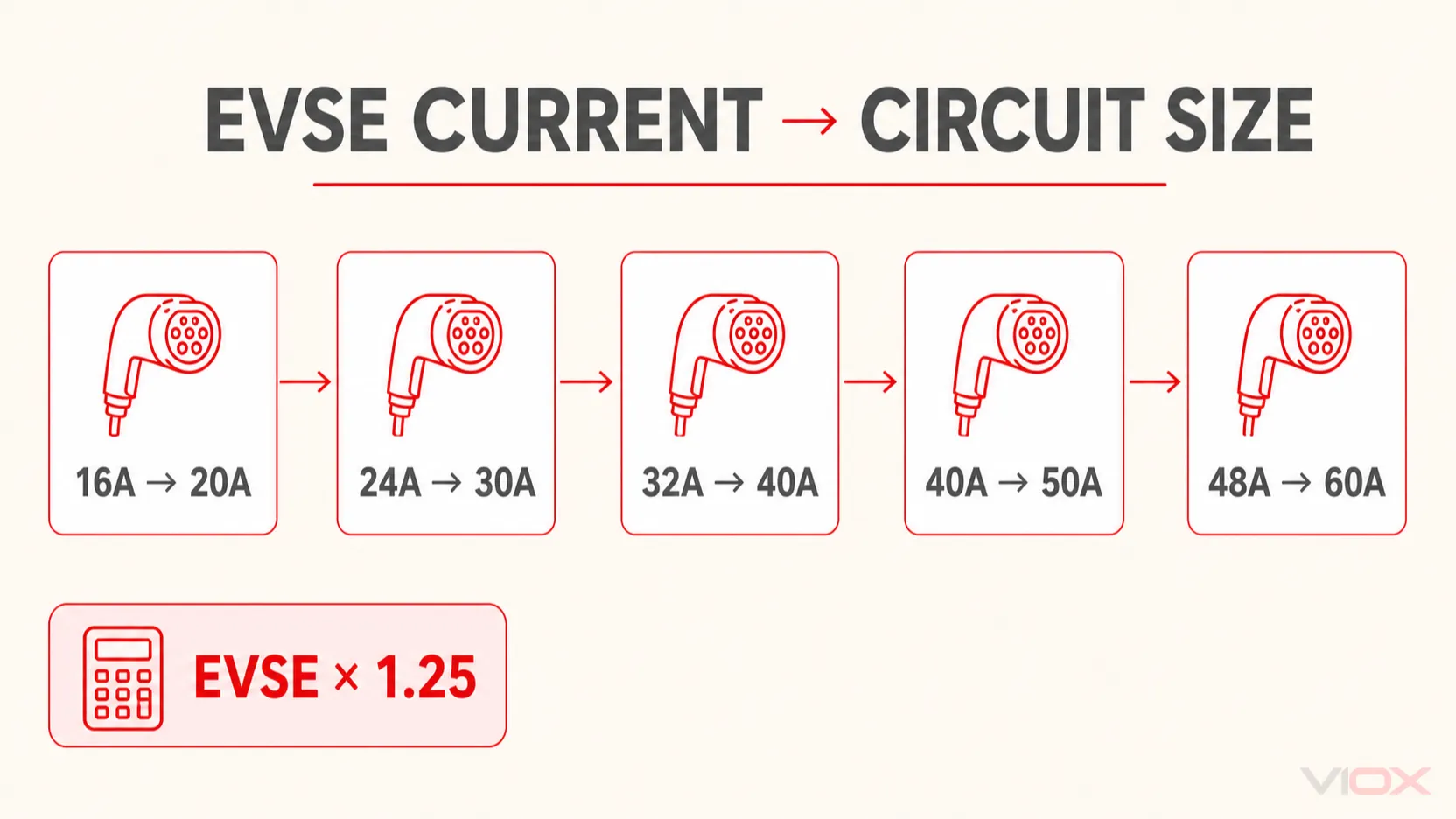
The calculation is:
Minimum circuit rating = EVSE maximum current × 1.25
Example for a 32A EVSE:
32A × 1.25 = 40A circuit
This table addresses the dedicated EVSE branch circuit. It does not prove that the existing 100 amp service can accept the new load. Conductor ampacity, terminal ratings, wiring method, ambient conditions, voltage drop, and the EVSE installation instructions must also be checked.
For a deeper branch-circuit explanation, see the VIOX EV charger circuit breaker sizing guide.
Use the VIOX EV Charger Load Calculator
Use the calculator to translate EVSE power and supply voltage into operating current. Treat the result as an input to the residential service-load assessment, not as an installation approval.
First Confirm What the 100 Amp Rating Describes
Homeowners often use “100 amp panel” and “100 amp service” as if they mean the same thing. They may not.
An electrician should verify:
- Service rating: The permitted capacity of the utility service and service equipment.
- Main breaker rating: The rating of the service or feeder overcurrent device.
- Panel bus rating: The load center may have a bus rating different from the installed main breaker.
- Service and feeder conductors: Their material, size, insulation, and terminal limitations must support the rating.
- Meter base and disconnect ratings: A panel swap alone does not upgrade upstream equipment.
- Panel type and condition: Obsolete, damaged, corroded, or unsupported equipment may need replacement even if the load calculation passes.
- Breaker spaces: A typical 240 V Level 2 circuit requires two adjacent pole positions, but physical space is separate from electrical capacity.
Installing a larger panel or a subpanel can create more circuit spaces, but it does not increase a 100 amp service’s capacity. Increasing service capacity may also involve the main disconnect, meter equipment, service conductors, utility connection, grounding and bonding, permits, and inspection.
How to Determine Whether the Charger Fits
The correct workflow has three separate checks.
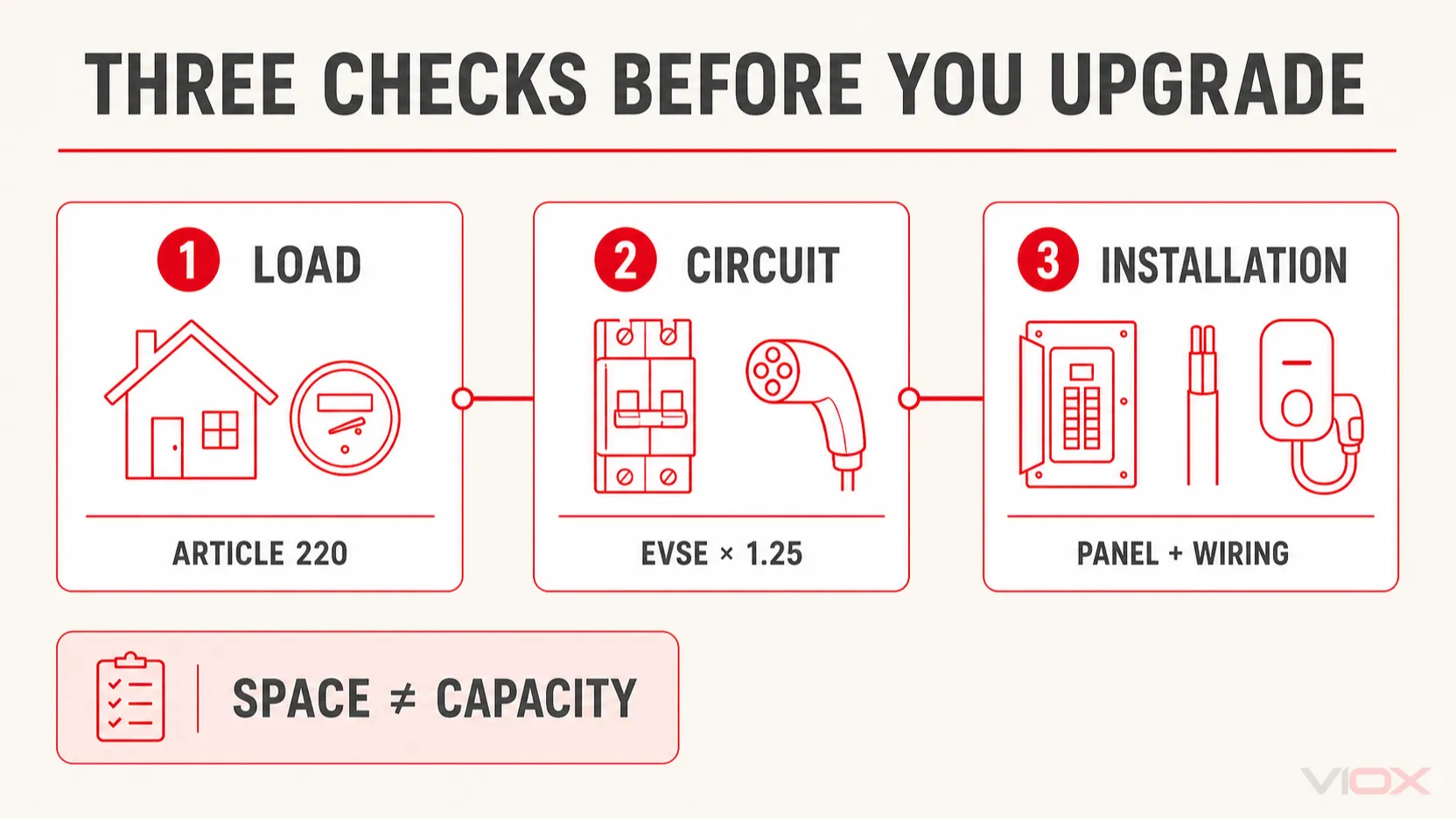
Check 1: Establish the Existing Residential Load
For a U.S. dwelling, a qualified person may calculate the feeder or service load using the method allowed by the locally adopted NEC Article 220. Depending on the method and code edition, inputs can include:
- floor area and general lighting/receptacle load;
- required small-appliance and laundry circuits;
- electric cooking equipment and clothes dryers;
- water heating;
- heating and air-conditioning equipment;
- other fixed appliances and motors;
- existing EVSE, energy storage, or other significant loads;
- code-permitted demand factors.
The correct input is not the sum of all breaker ratings. Breakers describe circuit protection; they do not show how much load operates simultaneously.
VIOX’s home electrical load calculation guide explains connected load, demand load, and service capacity in more detail.
Check 2: Add the Proposed EVSE Using the Applicable Method
NEC Article 625 addresses electric vehicle power transfer equipment. In the 2023 NEC framework, Section 625.41 requires EVSE feeder and branch-circuit overcurrent protection to be sized for continuous duty at not less than 125% of the equipment’s maximum load. Section 625.42 addresses the rating of the service, feeder, and branch circuit and recognizes controlled limits under qualifying energy management arrangements.
Keep two calculations separate:
- Branch-circuit sizing: Determines the breaker and minimum circuit capacity for the EVSE.
- Service-load calculation: Determines whether the dwelling service and feeders can carry the resulting load under the adopted Article 220 method.
Do not automatically add the new breaker’s handle rating to the sum of existing breaker ratings. Have the EVSE incorporated into the same approved load-calculation method used for the dwelling.
Check 3: Verify the Physical Installation
Even when the service-load result passes, verify:
- compatible two-pole breaker space;
- breaker type approved for the panel;
- conductor ampacity and terminal temperature ratings;
- route length and voltage drop;
- garage subpanel or feeder capacity, if applicable;
- grounding, bonding, and required personnel protection;
- whether the EVSE is hardwired or receptacle-connected;
- EVSE maximum input setting and vehicle onboard-charger limit;
- outdoor or wet-location rating where applicable;
- permit, inspection, and utility requirements.
Worked Example 1: A 32A EVSE May Fit Without an Upgrade
Assume a qualified electrician completes the applicable residential calculation and determines that the existing dwelling load is 58A at 240 V before the EVSE is added.
The homeowner wants 32A charging:
EVSE output = 32A
Branch-circuit planning value = 32A × 1.25 = 40A
Conservative capacity screen = 58A + 40A = 98A
The conservative screen remains below the 100 amp service rating. This does not by itself approve the installation, but it shows why a 100 amp service should not be rejected solely because the charger is Level 2. The electrician can complete the adopted load method and verify the panel, service equipment, conductor, and EVSE requirements.
At 240 V, 32A charging supplies approximately:
240V × 32A = 7.68 kW
That charging rate is sufficient for many overnight home-charging schedules, subject to the vehicle’s onboard charger and the energy that must be replaced.
Worked Example 2: Reduce Charging Current Before Upgrading Service
Assume the validated pre-EV dwelling load is 74A. A 32A EVSE produces this conservative screen:
74A + 40A branch-circuit planning value = 114A
That candidate does not pass the screen for a 100 amp service. Now test a 16A EVSE setting:
16A × 1.25 = 20A circuit
74A + 20A = 94A
The lower setting may allow the project to proceed without a service upgrade if:
- the EVSE supports a listed, restricted, or otherwise code-accepted maximum-current setting;
- the installer configures it according to the manufacturer’s instructions;
- the local AHJ accepts the method;
- 3.84 kW charging meets the driver’s daily energy requirement;
- all other installation checks pass.
These are transparent engineering examples, not customer case histories. Actual Article 220 worksheets may produce different results depending on the dwelling loads, calculation method, code edition, and local interpretation.
Calculated Load vs. Measured Demand
For an existing installation, measured demand can sometimes provide a more representative basis than reconstructing every appliance load. NEC provisions for determining existing loads have historically allowed maximum demand data over a one-year period and, under specified conditions, a shorter recording period when one-year data is unavailable.
Do not use a monthly utility bill’s total kilowatt-hours as though it were peak demand. Energy consumption in kWh and maximum demand in kW or A answer different questions. Where a measured-demand method is permitted, the data interval, seasonal loads, measurement period, calculation factor, and added load must meet the adopted code and AHJ requirements.
The U.S. Department of Energy’s EV infrastructure guidance also treats metered peak load as the preferred input when assessing existing panel capacity.
When a 100 Amp Service Often Works
A Level 2 installation is more likely to fit when:
- the dwelling has gas or other non-electric space heating, water heating, or cooking;
- the validated existing demand leaves sufficient capacity;
- the selected EVSE current is based on actual daily driving needs rather than the charger’s highest possible setting;
- the panel and service equipment are in suitable condition;
- a compliant current limit or energy management system is available;
- future electrification loads are modest or separately planned.
The EPA specifically identifies lower-powered Level 2 charging and load management or circuit-sharing systems as alternatives that can maximize existing electrical capacity.
When to Consider a 200 Amp Service Upgrade
An upgrade becomes the stronger option when one or more of these conditions apply:
- the approved load calculation fails at the minimum charging current that meets the user’s needs;
- the home is already heavily electrified with electric resistance heat, large HVAC loads, electric water heating, cooking, drying, a hot tub, or other substantial loads;
- the owner plans a second EV, heat pump conversion, induction range, accessory dwelling unit, workshop, or other major additions;
- the existing panel or service equipment is obsolete, damaged, undersized, or incompatible with the required work;
- the utility or AHJ requires an upgrade based on service conditions;
- variable or reduced charging is operationally unacceptable;
- an approved energy management solution is unavailable or unsuitable.
A 200 amp service provides more capacity, but it is not a substitute for a load calculation. A heavily electrified 200 amp home can also require load management or further capacity planning.
Can Dynamic Load Management Avoid a Panel Upgrade?
Often, yes. A qualifying energy management system can monitor service or feeder current and reduce or pause EV charging before the controlled limit is exceeded.
The system does not create additional utility capacity. It makes EV charging a controllable load that uses available capacity when other loads are lower. For example, the charger may operate at a higher current overnight, reduce output when an electric range or dryer is operating, and resume automatically when capacity becomes available.
Verify all of the following:
- the system is listed or otherwise accepted for the intended energy-management function;
- the controlled current limit is configured and protected against unauthorized changes where required;
- current sensors are installed at the correct service or feeder location;
- loss of communications or control produces the required safe response;
- the EVSE, controller, panel, and installation method are compatible;
- the AHJ and utility accept the design;
- the minimum available charging rate still meets the driver’s needs.
The current NEC edition and local amendments matter. Do not assume that any Wi-Fi charger, scheduling app, or consumer energy monitor qualifies as a code-recognized energy management system.
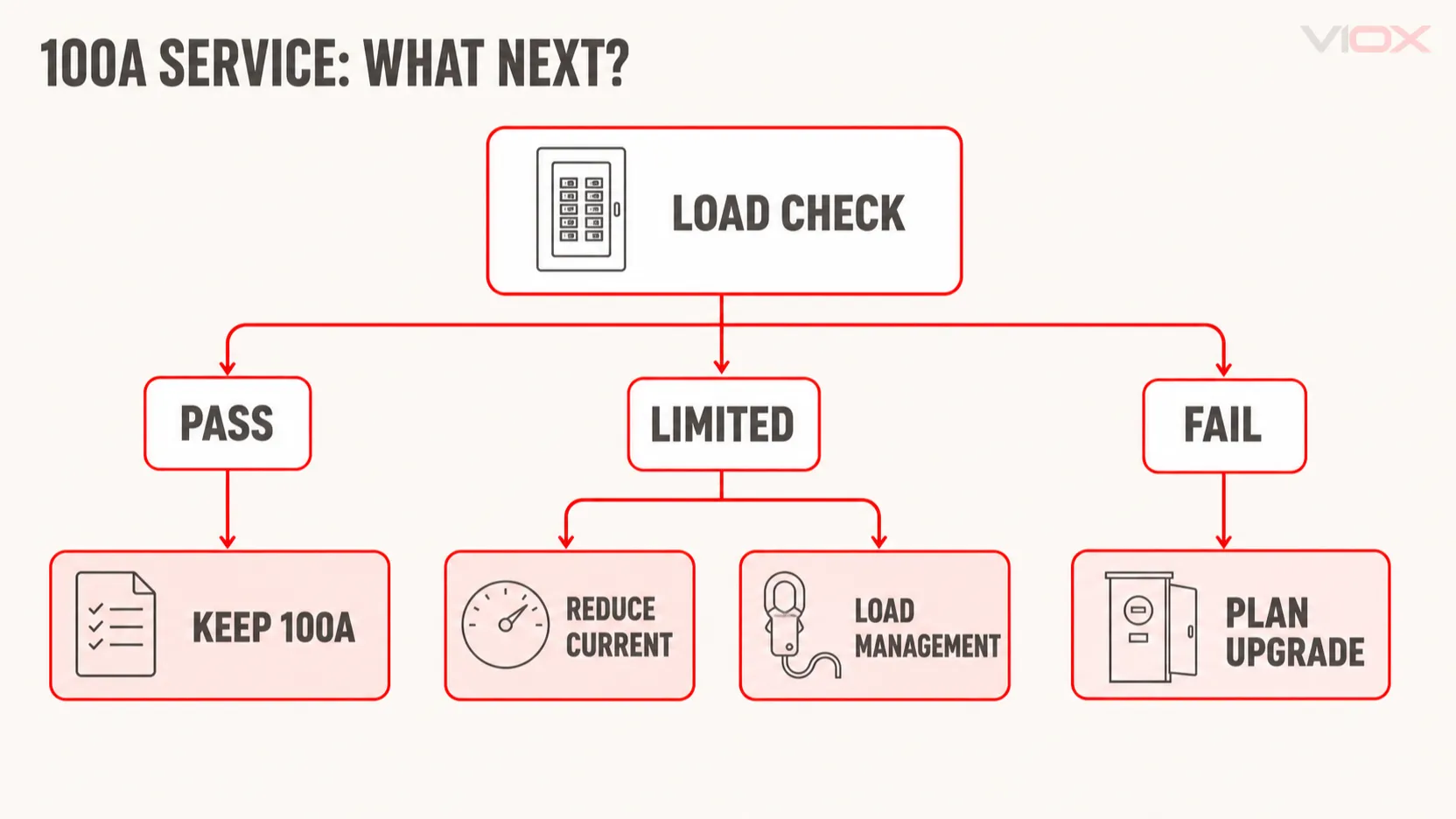
Decision Table: Upgrade, Reduce Current, or Add Load Management?
| Assessment result | Most appropriate next step | Why |
|---|---|---|
| Load calculation passes at desired EVSE current | Keep 100A service and complete circuit design | No service upgrade is indicated by capacity alone |
| Desired current fails, but a lower setting meets driving needs | Reduce and lock the EVSE maximum current using an accepted method | Preserves existing service while providing predictable charging |
| Static calculation fails, but household peak loads are intermittent | Evaluate a qualifying energy management system | EV charging can use capacity when other loads are low |
| Physical breaker space is missing but service capacity passes | Evaluate a listed compatible panel solution or subpanel | Adds spaces without claiming to increase service capacity |
| Existing service equipment is unsuitable or future loads are substantial | Plan a service and panel upgrade with the utility and AHJ | Addresses capacity, equipment condition, and future expansion together |
| Result is uncertain or documentation is incomplete | Obtain a formal load calculation or permitted demand measurement | Replaces assumptions with a reviewable basis |
Common Mistakes to Avoid
Assuming Every 100 Amp Home Needs 200 Amp Service
This can lead to unnecessary work. The load calculation and charging requirement decide the result, not the service label alone.
Assuming Empty Breaker Slots Mean Spare Capacity
Physical space and electrical capacity are different. A panel can have empty spaces while the service-load calculation is already near its limit.
Adding Every Breaker Rating
The sum of breaker handles normally exceeds the main rating because circuits do not all operate at their maximum simultaneously. Use an approved demand calculation or permitted measurement method.
Treating a Subpanel as a Capacity Upgrade
A subpanel redistributes circuits and adds spaces. It remains limited by its feeder and the upstream service.
Specifying 48A Charging Because the EVSE Supports It
The vehicle may accept less current, and the driver may need far less power to replace daily mileage. Start with the required energy and available charging window.
Using an App Schedule as Load Management
Time-of-use scheduling can reduce coincidence, but it may not qualify as a code-recognized energy management control. The system must limit load in the manner required by the adopted code and accepted design.
Reusing an Existing Dryer Circuit Without a Complete Review
Receptacle type, circuit rating, conductor, continuous-load limit, equipment instructions, switching or sharing device, GFCI requirements, and simultaneous-use prevention must all be verified. A convenient outlet is not automatic approval for EV charging.
Practical Checklist for the Electrician or Installer
Before quoting a 200 amp upgrade, document:
- adopted NEC edition and local amendments;
- service, main breaker, bus, meter, and conductor ratings;
- panel manufacturer, model, condition, and compatible breaker type;
- validated Article 220 calculation or permitted demand data;
- desired EVSE maximum current and vehicle AC charging limit;
- daily energy requirement and charging window;
- 125% branch-circuit sizing calculation;
- conductor ampacity, terminals, wiring method, and voltage drop;
- required breaker spaces and garage feeder capacity;
- hardwired or receptacle-connected installation requirements;
- energy management equipment and fail-safe behavior, if used;
- permit, inspection, and utility coordination requirements;
- future electrification loads that should influence the design.
Frequently Asked Questions
Can I install a 40 amp EV charger on a 100 amp panel?
Possibly. A 40A EVSE commonly requires a 50A dedicated circuit, but the 100 amp service must also pass the applicable residential load calculation or permitted measured-demand method. A qualifying energy management system or a lower current setting may be needed.
What breaker size does a 32 amp EV charger need?
A 32A EVSE commonly requires a 40A circuit because 32A × 1.25 = 40A. Verify the EVSE instructions, conductor ampacity, terminals, and adopted code.
What breaker size does a 48 amp EV charger need?
A 48A EVSE commonly requires a 60A circuit because 48A × 1.25 = 60A. This circuit has a large impact on a 100 amp service assessment, so lower-current charging or energy management should also be evaluated.
Do I need 200 amp service for a Level 2 charger?
Not automatically. The EPA states that 100 amp service is often sufficient depending on other household loads. The correct answer comes from the selected charging current, load assessment, equipment condition, and local approval requirements.
Can I add a subpanel for the EV charger?
A subpanel may solve circuit-space or routing problems if the upstream feeder and service have capacity. It does not increase a 100 amp service rating.
Can load management keep the house below 100 amps?
A qualifying system can reduce or pause EV charging to keep controlled load within an approved limit. Confirm listing, configuration, sensor placement, fail-safe operation, EVSE compatibility, and AHJ acceptance.
Does the charger need a dedicated circuit?
Residential EVSE is generally supplied by a dedicated branch circuit under NEC Article 625 and the equipment instructions. Approved load-sharing or energy-management arrangements must be specifically designed and accepted for that function.
Is a 16 amp Level 2 charger worth installing?
At 240 V, 16A provides about 3.84 kW. Whether that is sufficient depends on daily driving energy, vehicle efficiency, onboard-charger limits, and the overnight charging window. Lower-power Level 2 charging can be a practical way to retain a 100 amp service.
Final Decision
A 100 amp panel can handle an EV charger when the validated dwelling load, chosen EVSE current, service equipment, branch circuit, and physical installation all pass review. The correct sequence is:
- determine the existing load;
- select the charging current actually needed;
- size the EVSE circuit for continuous duty;
- evaluate fixed-current, managed-load, and upgrade options;
- verify the complete installation with the AHJ, utility, equipment instructions, and qualified installer.
Start with a load calculation, not an automatic 200 amp upgrade. Use the VIOX EV Charger Load Calculator to estimate charger current, then have the service and circuit design verified for the actual home.
Technical References
- U.S. EPA: Getting Started with Home EV Charging
- U.S. EPA: Plug-In Electric Vehicle Charging—The Details
- U.S. Department of Energy Alternative Fuels Data Center: Charging Electric Vehicles at Home
- U.S. Department of Energy Alternative Fuels Data Center: Electric Vehicle Charging Stations
- NFPA 70, National Electrical Code