

On this page
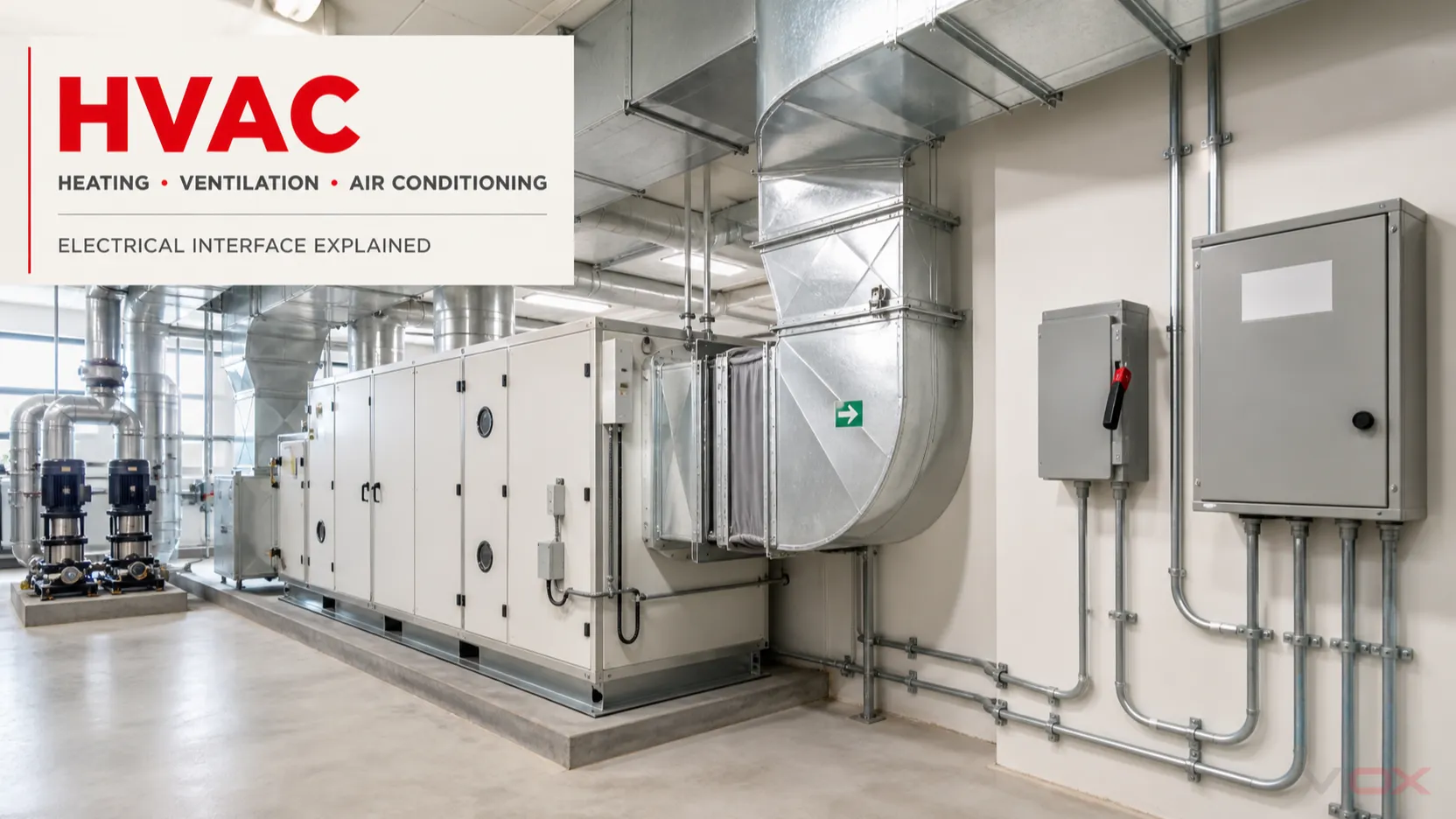
HVAC stands for Heating, Ventilation, and Air Conditioning. On electrical drawings or panel schedules, HVAC normally labels the building equipment or circuits serving heating, ventilation, and cooling loads; it is not a type of circuit breaker. Within HVAC, AC means Air Conditioning, not alternating current.
The acronym identifies a building service. To understand its electrical requirements, you must still identify the connected equipment, its power circuit, its control circuit, and the ratings given in the applicable schedule, nameplate, and manufacturer instructions.
HVAC Full Form in Electrical
The accepted HVAC full form is Heating, Ventilation, and Air Conditioning. ASHRAE also commonly uses the grammatical form “heating, ventilating, and air-conditioning” when describing the field. Both refer to systems that manage indoor thermal conditions and air movement.
The U.S. Department of Energy describes HVAC as systems and technologies used to control indoor temperature, humidity, and air quality. This definition is important for electrical readers: HVAC is the served building system, while breakers, disconnects, contactors, drives, relays, transformers, controllers, motors, and heaters form its electrical interfaces.
HVAC Letter-by-Letter Meaning
| Part | Full term | What it represents | Typical electrical interface |
|---|---|---|---|
| H | Heating | Equipment that adds heat to a space or process | Heater elements, heat-pump compressors, pumps, fans, ignition and control circuits |
| V | Ventilation | Equipment that supplies, circulates, or removes air | Supply and exhaust fans, air-handling units, damper actuators, sensors and controls |
| AC | Air Conditioning | Equipment that cools and often dehumidifies indoor air | Compressors, condenser and evaporator fans, pumps, drives, contactors and controls |
Not every heating source is electric, but fuel-fired or hydronic equipment can still require electrical power for blowers, pumps, valves, ignition, monitoring, and control. The acronym therefore does not tell you which loads are present or how much electrical capacity they require.
What HVAC Means on Electrical Drawings and Panel Schedules
The label HVAC can appear in several places, and its meaning changes with the document:
| Where HVAC appears | What it usually identifies | What it does not tell you by itself |
|---|---|---|
| Panel schedule | A branch circuit, feeder, or grouped mechanical load | Voltage, phase, conductor size, or breaker rating unless separately stated |
| Single-line diagram | A downstream HVAC panel, motor-control assembly, disconnect, or equipment group | Internal controls or every connected motor |
| Equipment schedule | A named air handler, condensing unit, chiller, heat pump, fan, or pump | Final field wiring unless coordinated with electrical documents |
| Control schematic | The system or sequence controlled by thermostats, sensors, relays, interlocks, or a building controller | The complete power distribution path |
| Breaker-panel directory | The load served by a protective device | The exact fault, trip cause, or suitability of the installed breaker |
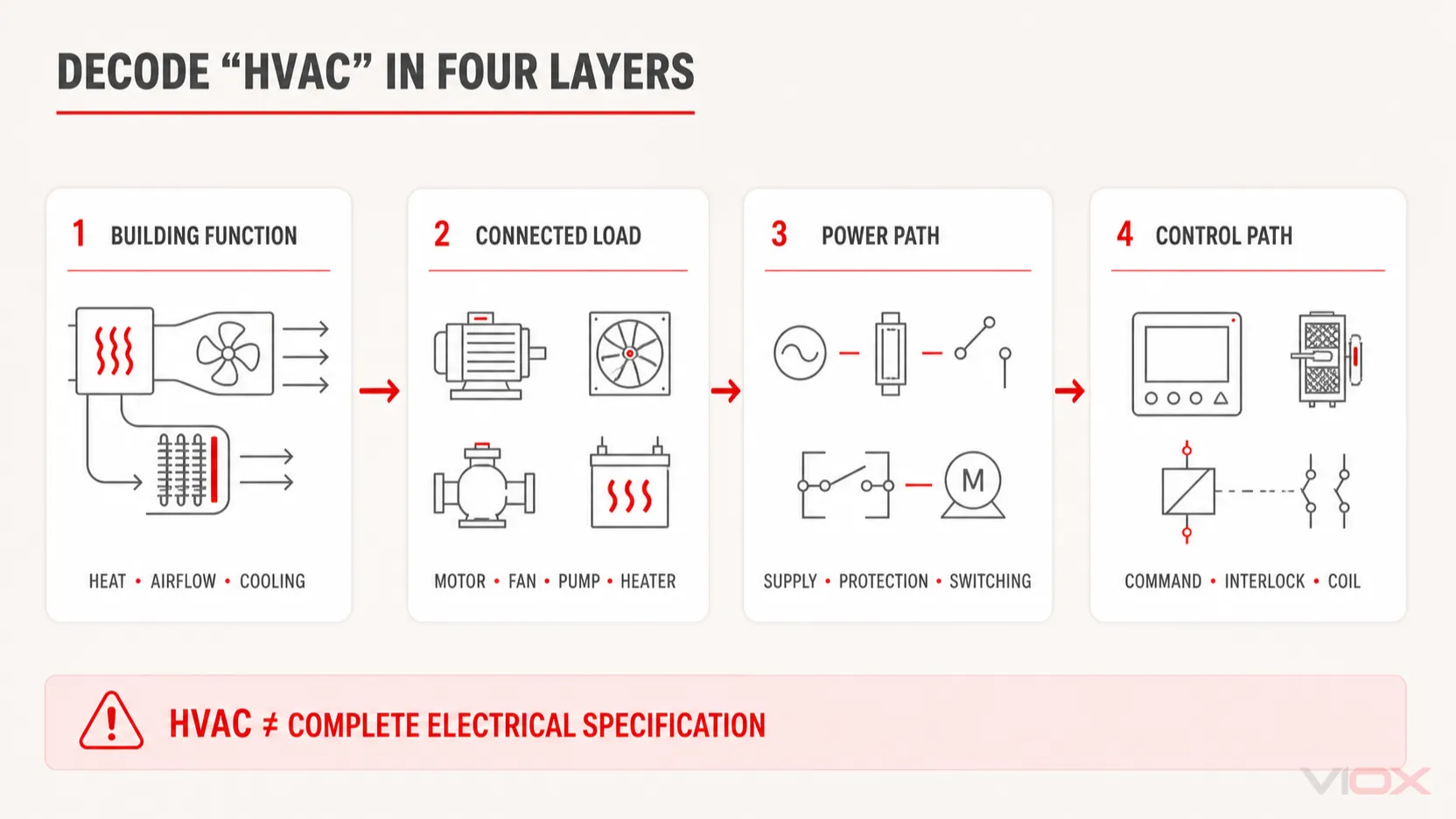
A useful way to decode the label is to separate four layers:
- Building function: heating, ventilation, or cooling.
- Connected load: the actual compressor, motor, fan, pump, heater, air handler, or packaged unit.
- Power path: how electrical energy reaches and is interrupted for that load.
- Control path: how the load receives operating commands and safety permissions.
This four-layer check prevents a common error: treating “HVAC” as though it were a complete electrical specification.
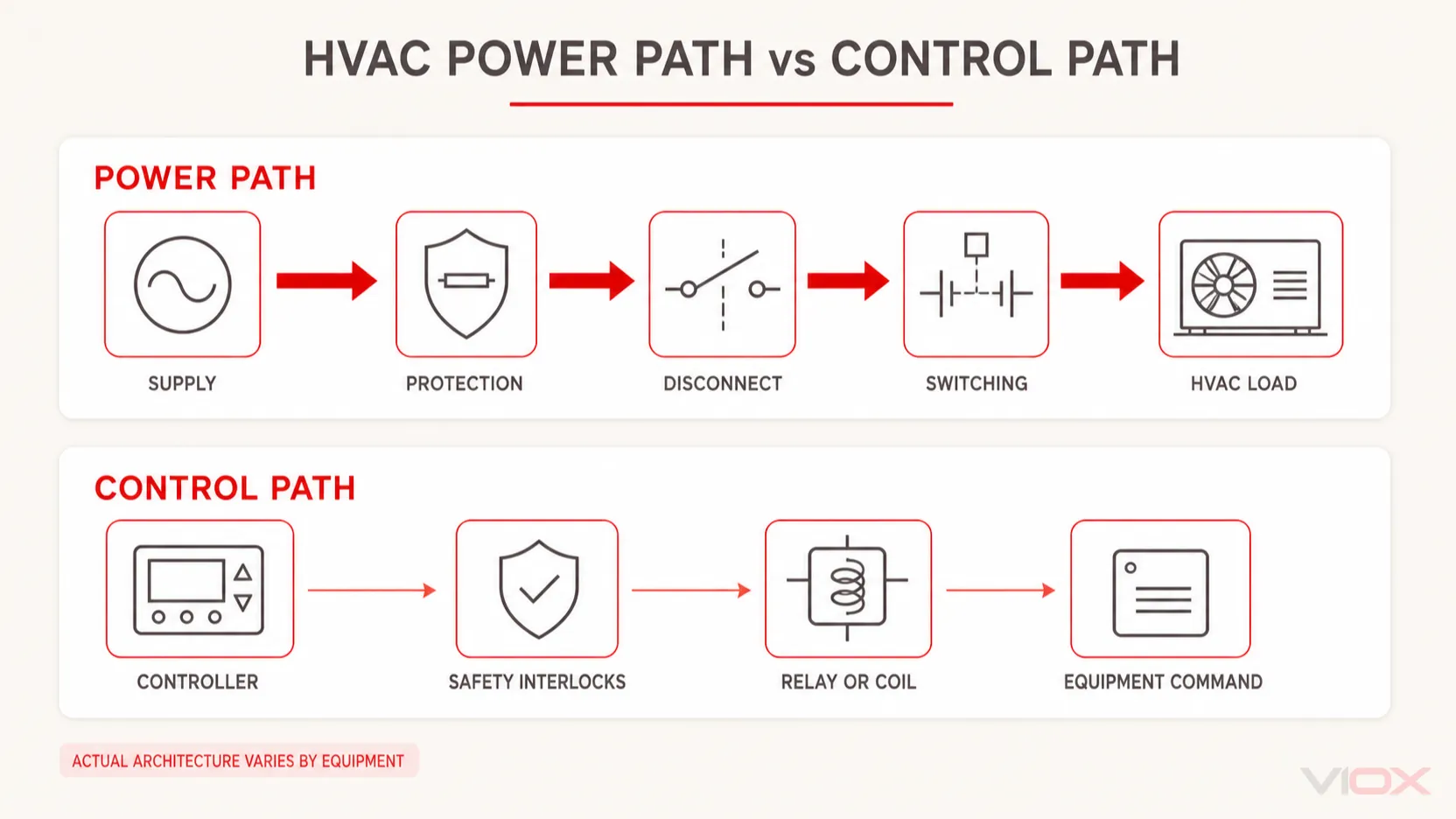
The HVAC Electrical Interface: Power Path vs Control Path
An HVAC system normally has a power path and a control path. They are related, but they perform different jobs.
Power path
A simplified power path may be represented as:
Supply → overcurrent protection → disconnecting means → switching or motor-control device → HVAC load
The exact sequence and equipment depend on the unit design, ratings, local rules, and whether components are factory-installed or field-installed. A breaker or fuse provides specified overcurrent protection; a disconnect or isolating means provides the required means of disconnection within its defined capability. These functions should not be treated as interchangeable. The VIOX guide to circuit breakers versus isolator switches explains that boundary in more detail.
Control path
A simplified control path may be represented as:
Thermostat or controller → permissives and safety interlocks → relay/contactor coil or drive command → equipment response
The control circuit may operate at a different voltage from the power circuit. A thermostat or building controller requests operation; safety devices determine whether the request is permitted; and a relay, contactor, or variable-frequency drive switches or modulates the load.
| Electrical component | Role in the HVAC interface | Important boundary |
|---|---|---|
| Breaker or fuse | Protects the circuit against specified overcurrent conditions | Does not replace the required disconnecting or motor-control function in every design |
| Disconnect or isolating means | Provides a defined means to disconnect equipment | Not automatically an overcurrent protective device |
| Contactor | Electrically switches a power load using a control signal | Requires correct contact, coil, utilization, and coordination data |
| Overload protection | Protects a motor against specified overload conditions | Does not by itself provide complete short-circuit protection |
| Time-delay relay | Adds a deliberate operating delay | Function and timing must match the control sequence |
| Controller or thermostat | Issues operating commands from temperature, pressure, schedule, or logic inputs | Does not normally switch a large power load directly |
For adjacent detail, see what an electrical contactor does, how thermal overload relays protect motors, and the separate guide to an HVAC time-delay relay for compressor protection.
AC in HVAC vs AC in Electrical
The letters AC are context-dependent. This is the most important terminology trap in the phrase “HVAC full form in electrical.”
| Example | Meaning of AC | How to recognize it |
|---|---|---|
| HVAC | Air Conditioning | AC is part of the building-system acronym |
| AC supply | Alternating Current | The term describes the electrical supply waveform |
| AC contactor coil | Alternating Current | AC describes the coil supply type |
| AC unit | Usually Air-Conditioning unit | The phrase identifies cooling equipment, but verify the equipment schedule |
Read the complete phrase, units, drawing legend, and adjacent symbols. Do not expand an abbreviation from the letters alone when it appears on a multidisciplinary drawing.
You may also encounter HVACR or HVAC&R. The added R stands for Refrigeration. ASHRAE’s terminology resource uses HVAC&R as a broad field covering heating, ventilating, air conditioning, and refrigeration.
How to Read an HVAC Electrical Nameplate or Schedule
The word HVAC supplies no circuit rating. Before making an electrical design, purchasing, or replacement decision, use the exact equipment documentation to verify the applicable fields.
| Field to verify | Why it matters |
|---|---|
| Equipment identity and model | Connects the drawing or schedule to the correct manufacturer data |
| Rated voltage | Establishes the intended supply voltage and any published tolerance |
| Phase and frequency | Confirms supply-system compatibility |
| Rated input or motor/heater data | Defines the electrical characteristics of the actual connected loads |
| MCA, if provided | Gives the manufacturer’s stated minimum circuit ampacity basis within the applicable market and documentation |
| MOCP or MOP, if provided | States the manufacturer’s maximum permitted overcurrent-protection value within the applicable equipment listing and rules |
| Control supply | Identifies the voltage and source for controllers, coils, relays, sensors, and interlocks |
| Wiring diagram and terminal designations | Separates incoming power, outputs, communications, and external safety/control connections |
| Applicable certification and instructions | Defines the evidence and installation conditions that apply to that specific equipment |
Manufacturer data demonstrates why generic advice is unsafe. For example, published Carrier commercial equipment data lists different voltage, phase, frequency, current, MCA, and MOCP values for different models and supply configurations. Those model-specific values are evidence for those products—not universal HVAC ratings.
Circuit design and installation must follow the applicable equipment instructions, project documents, and local electrical rules. A qualified designer or installer should resolve any conflict between a panel schedule, mechanical schedule, nameplate, and manufacturer documentation.
Frequently Asked Questions
What is the full form of HVAC in electrical engineering?
HVAC stands for Heating, Ventilation, and Air Conditioning. In electrical engineering documents, it normally identifies the building equipment or electrical loads serving those functions.
Is HVAC electrical or mechanical?
HVAC is generally a mechanical or building-services discipline with substantial electrical power and control interfaces. Motors, compressors, fans, heaters, pumps, contactors, drives, sensors, and controllers require electrical coordination, but HVAC is not itself one electrical device type.
Does AC in HVAC mean alternating current?
No. In the acronym HVAC, AC means Air Conditioning. In phrases such as “AC supply” or “AC coil,” AC means Alternating Current. Context determines the expansion.
What does HVAC mean on a breaker panel?
It identifies the heating, ventilation, or air-conditioning load served by that circuit. The directory label alone does not prove the correct breaker rating or explain why a breaker operated.
Is HVAC the same as air conditioning?
No. Air conditioning is only the AC portion. HVAC also includes heating and ventilation functions, although a specific installation may combine several functions in one packaged system.
What does HVACR mean?
HVACR means Heating, Ventilation, Air Conditioning, and Refrigeration. The form HVAC&R is also used.