On this page
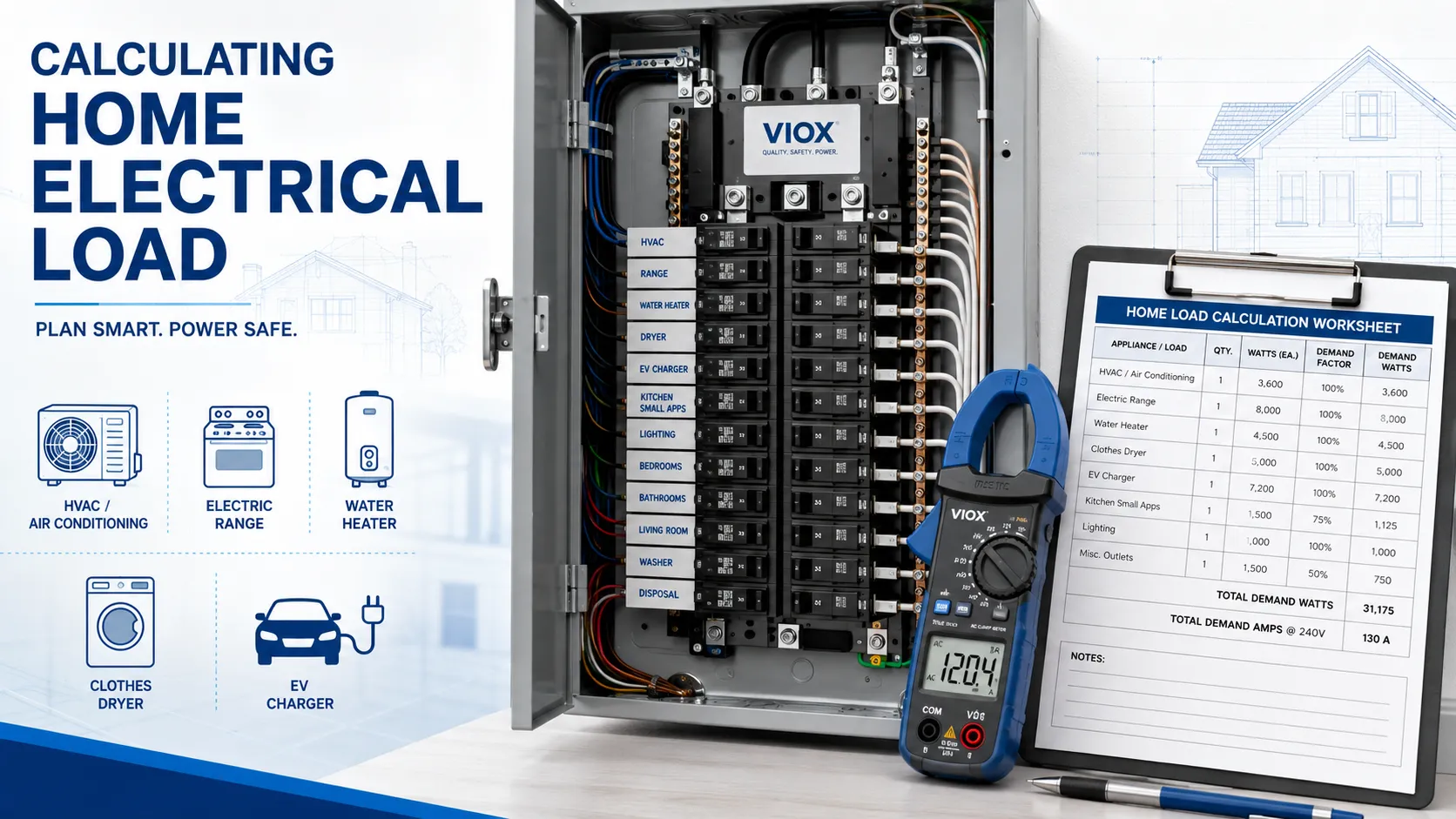
You calculate your home electrical load by listing the major appliances and circuits, converting watts to amps, estimating connected load, applying demand or diversity rules where allowed by the local electrical code, and comparing the result with your electrical panel or service rating.
For a quick estimate, use this basic formula:
Amps = Watts / Volts
For example, a 4,800W load on a 240V circuit draws about 20A:
4,800W / 240V = 20A
That simple formula is useful for estimating load, but it is not a substitute for a professional residential load calculation. If you are adding an EV charger, heat pump, electric range, workshop, solar system, battery system, or a new subpanel, a licensed electrician should verify the load calculation according to your local code. In the United States, residential calculations may reference NEC Article 220. In other markets, follow the applicable local wiring rules.
Quick Answer: Home Electrical Load Calculation
| Step | What to Do | Why It Matters |
|---|---|---|
| 1 | List major loads | HVAC, water heater, range, dryer, EV charger, pumps, and large appliances drive service size |
| 2 | Convert watts to amps | Makes loads comparable with breaker and panel ratings |
| 3 | Separate 120V and 240V loads | Current is different at different voltages |
| 4 | Create a panel schedule | Shows which circuits serve which loads |
| 5 | Estimate demand load | Not every connected load runs at full power at the same time |
| 6 | Compare with panel/service rating | Helps decide if the existing service has enough capacity |
What Is Electrical Load in a House?
Electrical load is the power demand placed on your home electrical system by lights, receptacles, appliances, heating/cooling equipment, and connected devices.
There are three related terms:
| Term | Meaning |
|---|---|
| Connected load | Total rating of installed equipment if everything operated at once |
| Demand load | More realistic maximum load after applying code-permitted demand factors or usage diversity |
| Circuit load | Load connected to one branch circuit or breaker |
The key point: adding up every breaker rating in the panel does not tell you the real load. A panel may contain many 15A and 20A breakers, but those circuits do not all run at full load simultaneously.
Home Electrical Load Formula
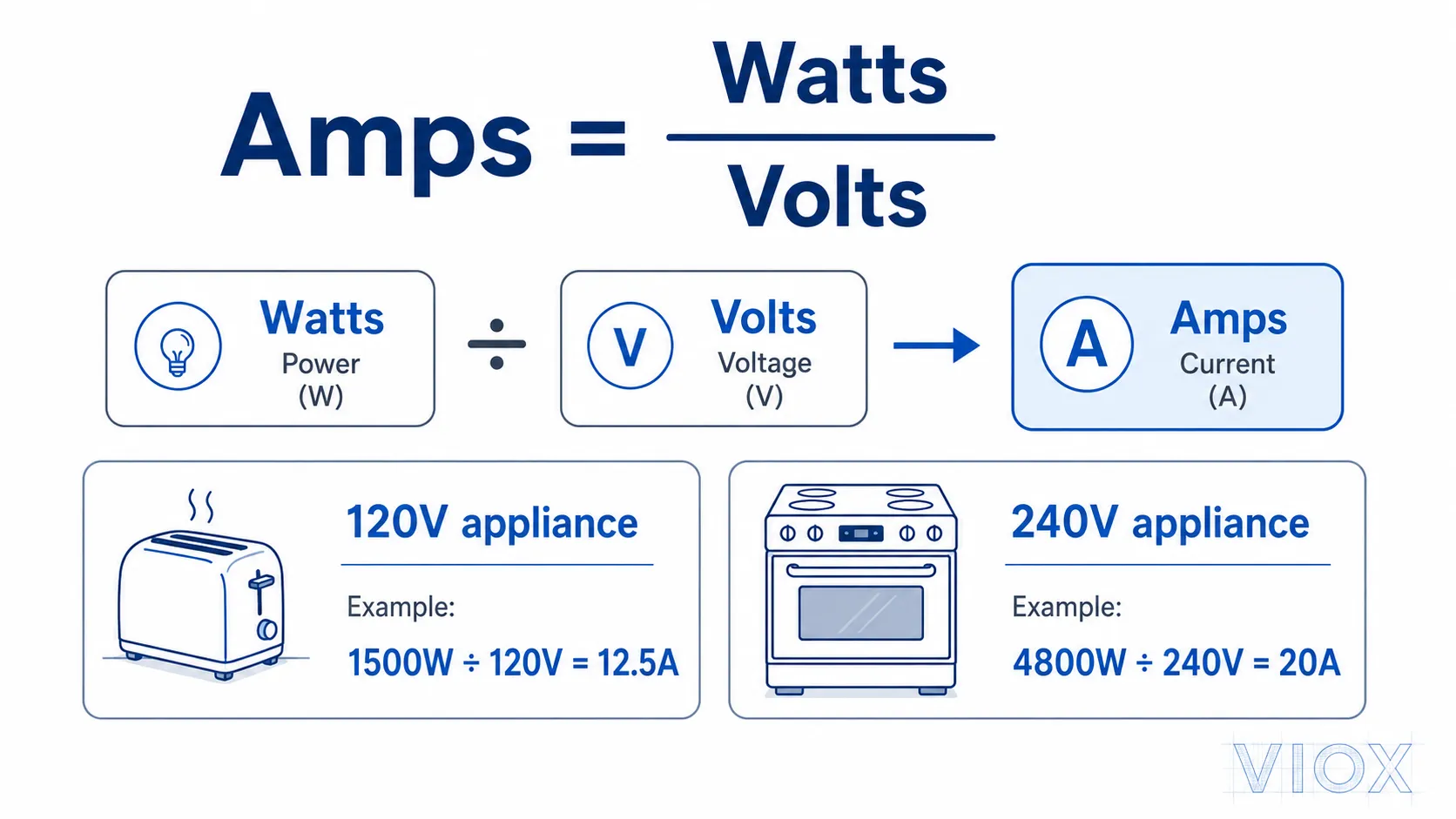
Amps = Watts / Volts
Watts = Volts × Amps
kW = Watts / 1000
Example: 4,800W / 240V = 20A
Use these formulas for a basic worksheet:
| Calculation | Formula |
|---|---|
| Single-phase power | Watts = Volts x Amps |
| Current from watts | Amps = Watts / Volts |
| 240V load current | Amps = Watts / 240 |
| 120V load current | Amps = Watts / 120 |
| Approximate kW | kW = Watts / 1000 |
Example:
| Load | Power | Voltage | Approx. Current |
|---|---|---|---|
| Electric water heater | 4,500W | 240V | 18.75A |
| Microwave | 1,200W | 120V | 10A |
| EV charger | 7,680W | 240V | 32A |
For continuous loads, local electrical rules may require additional sizing margin. For example, many North American designs apply the 125% rule to continuous loads. For a dedicated explanation, see NEC 125% Rule for Continuous Loads.
Home Electrical Load Calculator Worksheet
Use this worksheet to collect data before discussing service size with an electrician.
| Load or Circuit | Watts | Voltage | Amps | Notes |
|---|---|---|---|---|
| HVAC / heat pump | 240V | Check nameplate or equipment data | ||
| Electric water heater | 240V | Often one of the largest continuous-style loads | ||
| Electric range / oven | 240V | Use nameplate rating | ||
| Electric dryer | 240V | Check nameplate | ||
| EV charger | 240V | Use configured charging current, not only charger maximum | ||
| Refrigerator | 120V | Running current and starting current differ | ||
| Dishwasher | 120V | May include heating element load | ||
| Microwave | 120V | High short-duration load | ||
| Lighting | 120V | LED lighting has low running watts but may have driver inrush | ||
| General receptacles | 120V | Estimate by circuit use and code method |
This table is not a permit calculation. It is a planning worksheet. A professional load calculation may use code-specific demand factors, appliance categories, heating/cooling comparisons, and service calculation rules.
Major Appliance Load Table
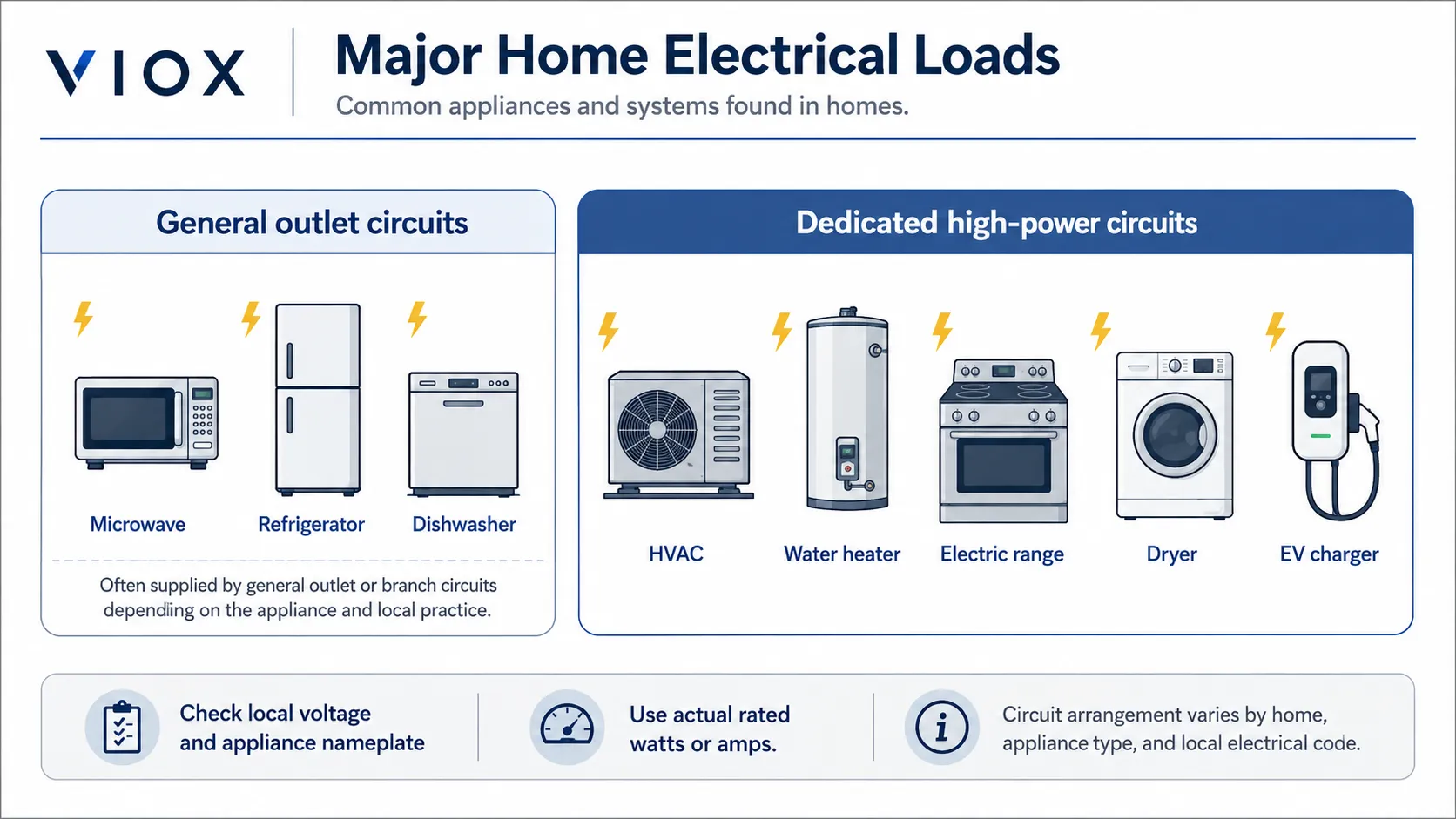
Typical values vary by product, country, and nameplate rating. Use the actual appliance nameplate whenever possible.
| Appliance | Typical Power Range | Common Voltage | Approx. Current |
|---|---|---|---|
| Electric range | 8,000-12,000W | 240V | 33-50A |
| Electric dryer | 5,000-7,200W | 240V | 21-30A |
| Electric water heater | 3,500-5,500W | 240V | 15-23A |
| Central air conditioner / heat pump | Varies widely | 240V | Check nameplate |
| EV charger | 3,800-11,500W+ | 240V | 16-48A+ depending on setting |
| Microwave | 1,000-1,500W | 120V | 8-13A |
| Dishwasher | 1,200-1,800W | 120V | 10-15A |
| Refrigerator | 300-800W running | 120V | 2.5-7A running |
Do not size a service upgrade from a generic appliance table alone. HVAC equipment, EV chargers, electric heating, pool equipment, and workshops can change the result significantly.
How to Estimate Load from Your Electrical Panel
Your panel gives useful clues, but it does not automatically provide the full load calculation.
Start with:
- Main breaker rating.
- Service voltage.
- Number and size of branch breakers.
- Labels on each circuit.
- Large dedicated loads such as range, dryer, HVAC, water heater, EV charger, pump, or subpanel.
- Any signs of overheating, nuisance tripping, or outdated equipment.
Common residential service sizes include 100A, 150A, 200A, and larger services. A 200A panel does not mean the home is using 200A continuously. It means the service equipment is rated for that level under the applicable installation conditions.
If your question is whether a 15A or 20A circuit is enough for a specific load, see How Do I Know If I Need a 15 or 20 Amp Breaker?.
Panel Schedule: What to Record
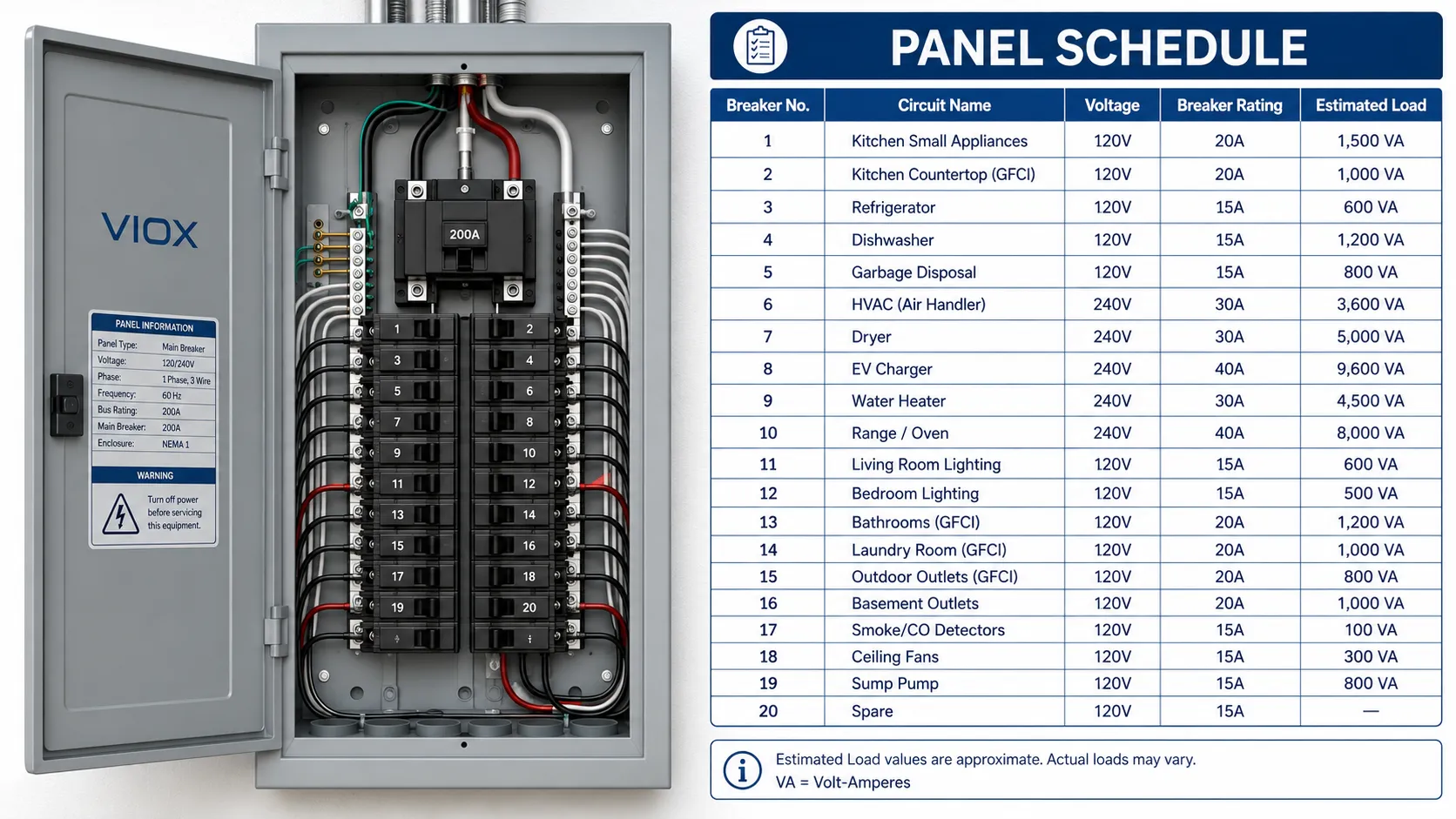
A panel schedule is a list of circuits, breaker sizes, loads, and locations. It helps identify where power is used and which circuits are overloaded or unclear.
| Panel Schedule Item | Example |
|---|---|
| Breaker number | 1, 3, 5, etc. |
| Breaker rating | 15A, 20A, 30A, 40A |
| Circuit description | Kitchen receptacles, dryer, HVAC, garage |
| Voltage | 120V or 240V |
| Load type | Lighting, receptacles, motor, heating, EV charger |
| Estimated watts or amps | Nameplate or measured value |
| Notes | Trips, warm breaker, shared neutral, subpanel feed |
Do not assume a circuit is safe just because the breaker does not trip. A loose terminal, overloaded extension cord, poor connection, or undersized wiring can still create heat.
Connected Load vs Demand Load
Connected load is the sum of installed load ratings. Demand load is the expected maximum load after considering realistic usage and code rules.
Example:
| Item | Connected Current |
|---|---|
| Electric range | 40A |
| Dryer | 25A |
| Water heater | 19A |
| EV charger | 32A |
| Other estimated loads | 35A |
| Total connected load | 151A |
That does not automatically mean the home needs more than 151A of service capacity. A formal residential load calculation may apply demand factors depending on the load type and local code. However, high continuous or high-duty loads such as EV charging, electric heating, and some HVAC equipment need careful treatment.
How to Monitor Power Load Per Circuit
There are three practical ways to understand real usage:
| Method | What It Shows | Limitations |
|---|---|---|
| Utility bill review | Monthly energy consumption in kWh | Does not show peak demand or circuit-level load |
| Whole-home energy monitor | Real-time or historical home load | Installation may require qualified help |
| Circuit-level monitoring | Load per branch circuit | More complex and may require panel work |
Utility bills show energy consumption, not instantaneous load capacity. A home can have a modest monthly kWh total but still experience high peak demand when the dryer, range, water heater, HVAC, and EV charger run together.
When Your Home May Need a Service Upgrade
Ask for a professional load calculation before adding:
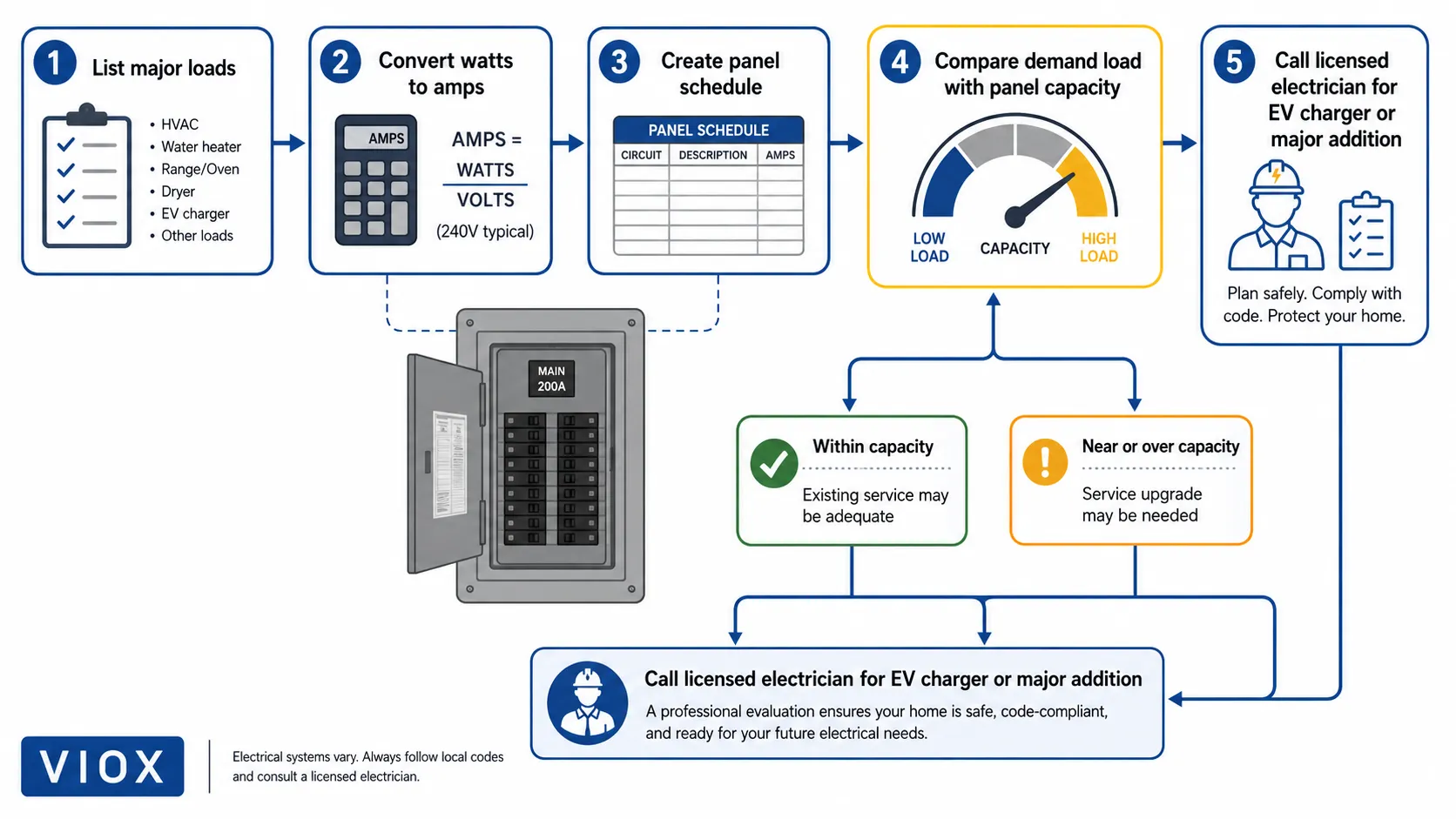
- EV charger;
- electric heat pump or central air upgrade;
- electric range or induction cooktop;
- electric water heater;
- workshop or welder;
- pool equipment;
- hot tub;
- solar inverter or battery system;
- subpanel for garage, ADU, or addition.
Warning signs that the system needs review include frequent breaker trips, dimming lights when large loads start, warm outlets or panel surfaces, burning smell, buzzing equipment, or a panel with unclear circuit labels.
If your concern is repeated tripping, see What Is Circuit Overload?.
Common Load Calculation Mistakes
| Mistake | Why It Matters |
|---|---|
| Adding breaker ratings together | Breaker totals are not the same as actual load |
| Ignoring 240V loads | Large appliances often dominate demand |
| Using utility kWh as peak load | kWh is energy over time, not peak current |
| Forgetting continuous loads | Continuous loads may need additional sizing margin |
| Ignoring EV charger settings | Charger current can often be configured lower than maximum |
| Not checking panel condition | Old or damaged equipment can be unsafe even if load appears acceptable |
| Treating DIY estimates as permit calculations | Service upgrades and additions usually need professional calculation |
FAQ
How do I calculate electrical load in a house?
List major appliances and circuits, convert watts to amps using Amps = Watts / Volts, estimate connected load, apply demand factors where allowed by local code, and compare the result with your panel or service rating.
What is a house amperage calculator?
A house amperage calculator estimates current demand from appliance wattage, voltage, and usage assumptions. It is useful for planning, but professional calculations are needed for permits, service upgrades, and high-load additions.
Can I calculate load from my electric bill?
Only roughly. A utility bill shows energy use in kilowatt-hours, not peak current. It can help show average consumption, but it cannot replace a load calculation for panel capacity.
What appliances use the most electricity at home?
The largest loads are usually HVAC equipment, electric water heating, electric ranges, dryers, EV chargers, pumps, and electric heating systems.
How do I determine electrical service size?
Check the main breaker and service equipment rating, then compare it with a proper load calculation. Do not rely only on the number of breakers installed in the panel.
When should I call an electrician?
Call a licensed electrician before adding major loads, upgrading service, opening a panel, installing monitoring clamps, adding circuits, or investigating burning smell, heat, buzzing, or frequent tripping.
Conclusion
The best way to determine your home’s electrical load is to combine three pieces of information: appliance nameplate data, a panel schedule, and real usage patterns. A simple worksheet can help you estimate the load, but major upgrades require a professional calculation based on local electrical code.
For homeowners, the practical goal is not to use every amp of panel capacity. The goal is to understand whether the existing service can safely support the loads you actually use today and the loads you plan to add next.