

On this page
Quick Answer: What Is an HRC Fuse?
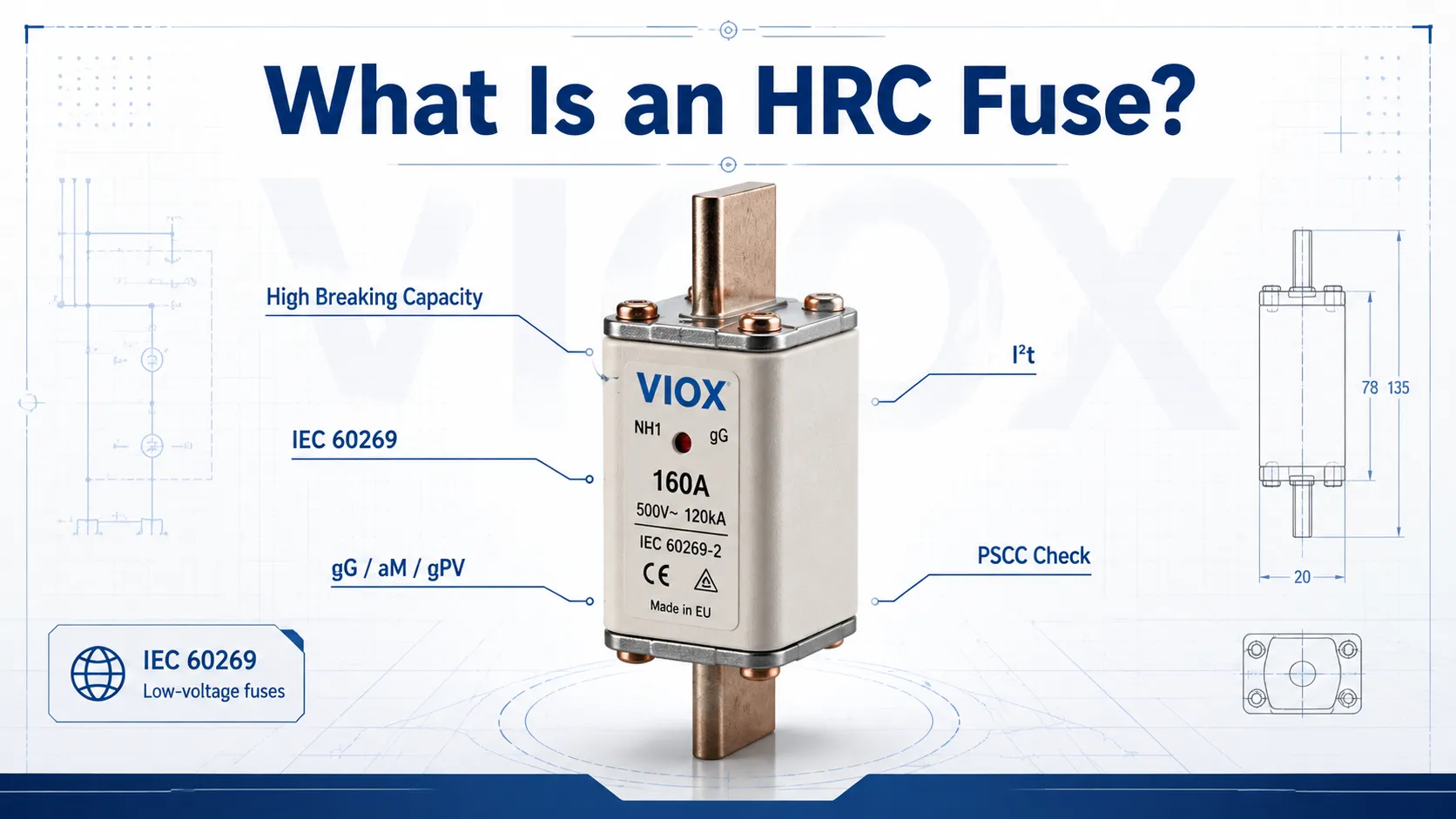
An HRC fuse, or High Rupturing Capacity fuse, is a current-limiting fuse designed to safely interrupt high prospective short-circuit current without rupturing its body or allowing a sustained arc. It is commonly used in low-voltage industrial panels, distribution boards, motor circuits, transformer feeders, semiconductor protection, solar PV systems, and battery-related DC applications.
In practical selection, an HRC fuse is not chosen only by ampere rating. You must check:
- rated current
- rated voltage, including AC or DC rating
- breaking capacity against the prospective short-circuit current
- utilization category such as gG, aM, aR, gR, or gPV
- I2t let-through energy
- time-current curve
- fuse size and holder compatibility
- coordination with upstream and downstream protection
If you need the broader fuse family background first, see Electrical Fuses: Types, Working Principle, and Selection Guide. This article focuses specifically on HRC fuse construction, ratings, standards, and selection.
HRC vs HBC Fuse: Are They the Same?
In many markets, HRC fuse and HBC fuse are used almost interchangeably.
| Term | Meaning | Common usage |
|---|---|---|
| HRC fuse | High Rupturing Capacity fuse | Common in UK, India, and many IEC-oriented markets |
| HBC fuse | High Breaking Capacity fuse | Common in technical datasheets and some European/industrial contexts |
| High interrupting fuse | Fuse with high fault-current interruption capability | Common North American wording |
The wording is slightly different, but the engineering idea is the same: the fuse must be able to interrupt a high fault current safely under its rated conditions.
For a focused terminology comparison, see HRC vs HBC Fuses: Technical Difference Guide.
Why “High Rupturing Capacity” Matters
Every fuse has a breaking capacity, also called interrupting capacity. This is the maximum fault current the fuse can safely interrupt at its rated voltage and specified test conditions.
The key rule is:
Fuse breaking capacity >= prospective short-circuit current at the installation pointIf the available fault current is higher than the fuse breaking capacity, the fuse may fail violently, continue arcing, or damage surrounding equipment.
This is why defining HRC only by a small minimum interrupting-current number is not useful for industrial panels. The relevant value is the actual prospective short-circuit current (PSCC) at the installation point, which may be several kA, tens of kA, or higher depending on transformer size, cable impedance, and system layout.
For a related breaker-side explanation, see How to Calculate Short Circuit Current for MCB and 6kA vs 10kA MCB Breaking Capacity Guide.
How an HRC Fuse Works
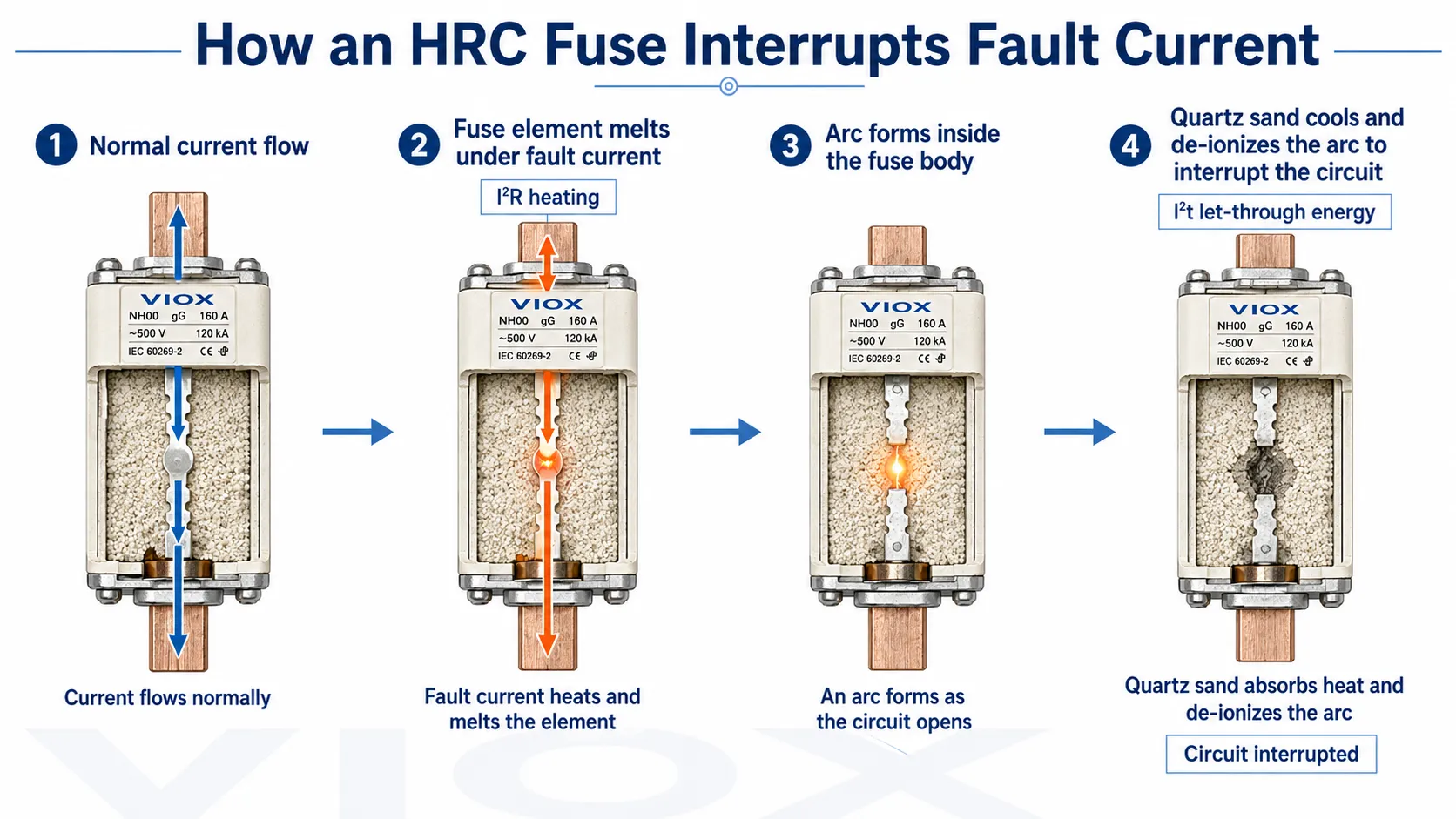
An HRC fuse operates by melting a calibrated fuse element when current exceeds the fuse’s time-current characteristic. Under heavy fault current, the fuse does more than simply “burn open.” It must interrupt an arc safely.
The operating process is usually:
- Fault current rises rapidly.
- The fuse element heats according to
I2Renergy. - One or more element sections melt.
- Arcs form inside the fuse body.
- Quartz sand or similar filler absorbs heat and helps divide, cool, and de-ionize the arc.
- Arc voltage rises and the current is forced to zero.
- The circuit is permanently opened and the fuse link must be replaced.
The current-limiting behavior is one of the major advantages of HRC fuses. In a high fault, a properly selected HRC fuse can limit the peak let-through current and reduce the thermal and mechanical stress imposed on downstream equipment.
HRC Fuse Construction
Most industrial HRC fuse links use a robust cartridge construction.
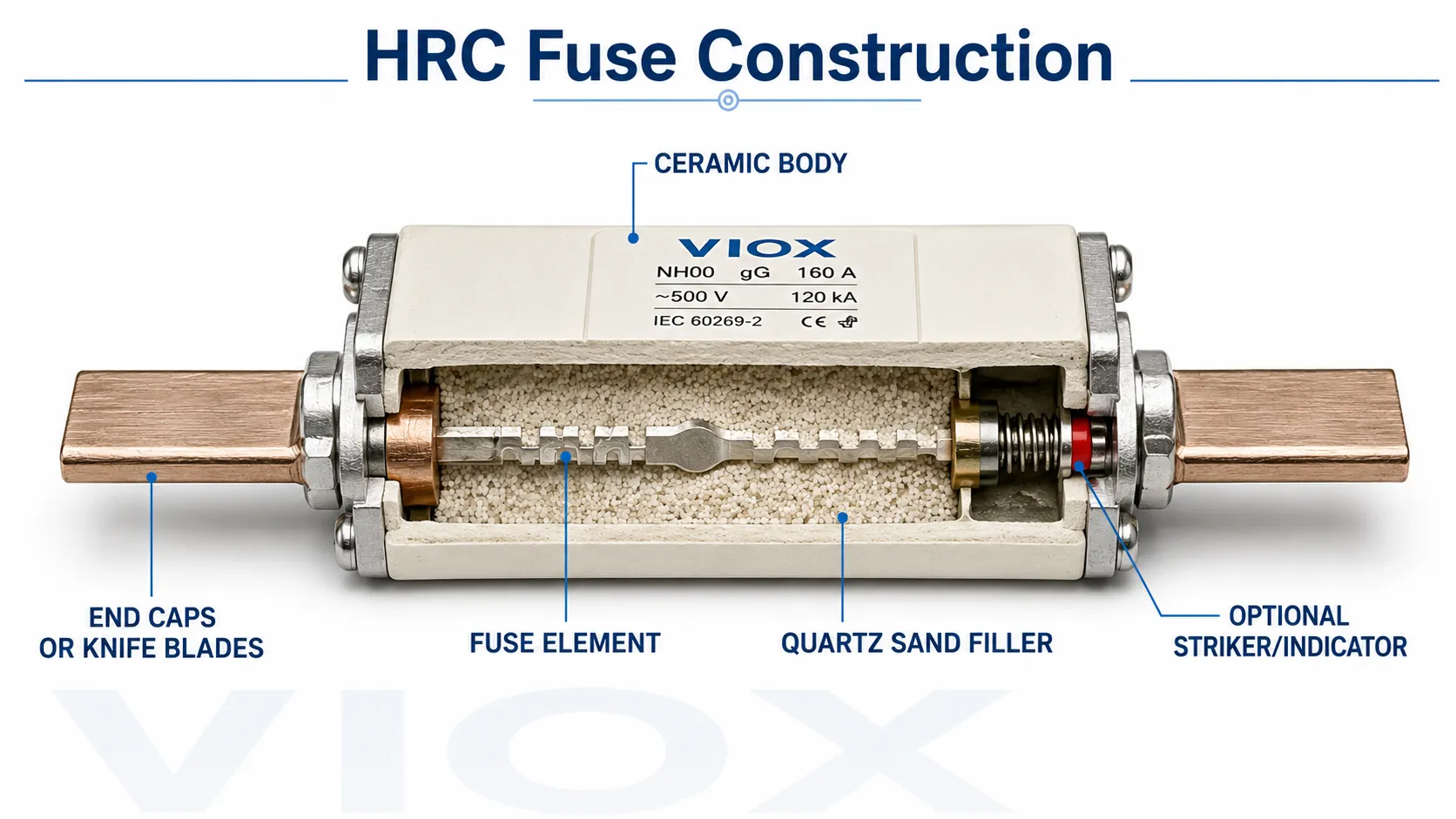
| Component | Function |
|---|---|
| Ceramic or porcelain body | Withstands high temperature, pressure, and arc energy during fault interruption |
| Fuse element | Calibrated conductive element, commonly silver or copper-based depending on design |
| Quartz sand filler | Absorbs heat, cools the arc, and helps form a high-resistance arc path |
| End caps or knife blades | Provide electrical connection to the holder, base, or fuse switch disconnector |
| Indicator or striker, if fitted | Gives visual indication or actuates a microswitch/trigger mechanism after operation |
Not every HRC fuse has the same internal element design. Some use notches, parallel element sections, M-effect features, striker pins, or special semiconductor-speed elements. That is why two fuses with the same ampere rating can behave very differently if their utilization category and time-current curve are different.
Key HRC Fuse Ratings Explained
| Parameter | What it means | Why it matters |
|---|---|---|
| Rated current (In) | Current the fuse can carry under specified conditions | Must match the protected cable, load, and utilization category |
| Rated voltage | Maximum circuit voltage for safe operation | AC and DC ratings must be checked separately |
| Breaking capacity | Maximum fault current the fuse can interrupt safely | Must exceed PSCC at the installation point |
| Utilization category | Fuse operating behavior, such as gG, aM, aR, gPV | Determines whether the fuse protects cables, motors, semiconductors, PV strings, etc. |
| Time-current curve | Relationship between current magnitude and operating time | Required for selectivity, motor starting, and coordination |
| I2t | Energy let through during melting and clearing | Critical for semiconductor protection and thermal damage limitation |
| Power dissipation | Heat produced by the fuse at rated current | Affects enclosure temperature and fuse holder selection |
| Fuse size and format | NH, cylindrical, D/D0, semiconductor style, PV fuse, etc. | Must match the physical holder and disconnector |
IEC 60269 Fuse Categories: gG, aM, aR, gPV, and More
IEC 60269 is the major international standard family for low-voltage fuses. In IEC terminology, the replaceable part is often called a fuse-link, while the complete assembly may include the fuse-link and fuse holder or fuse base.
The utilization category tells you what the fuse is designed to protect.
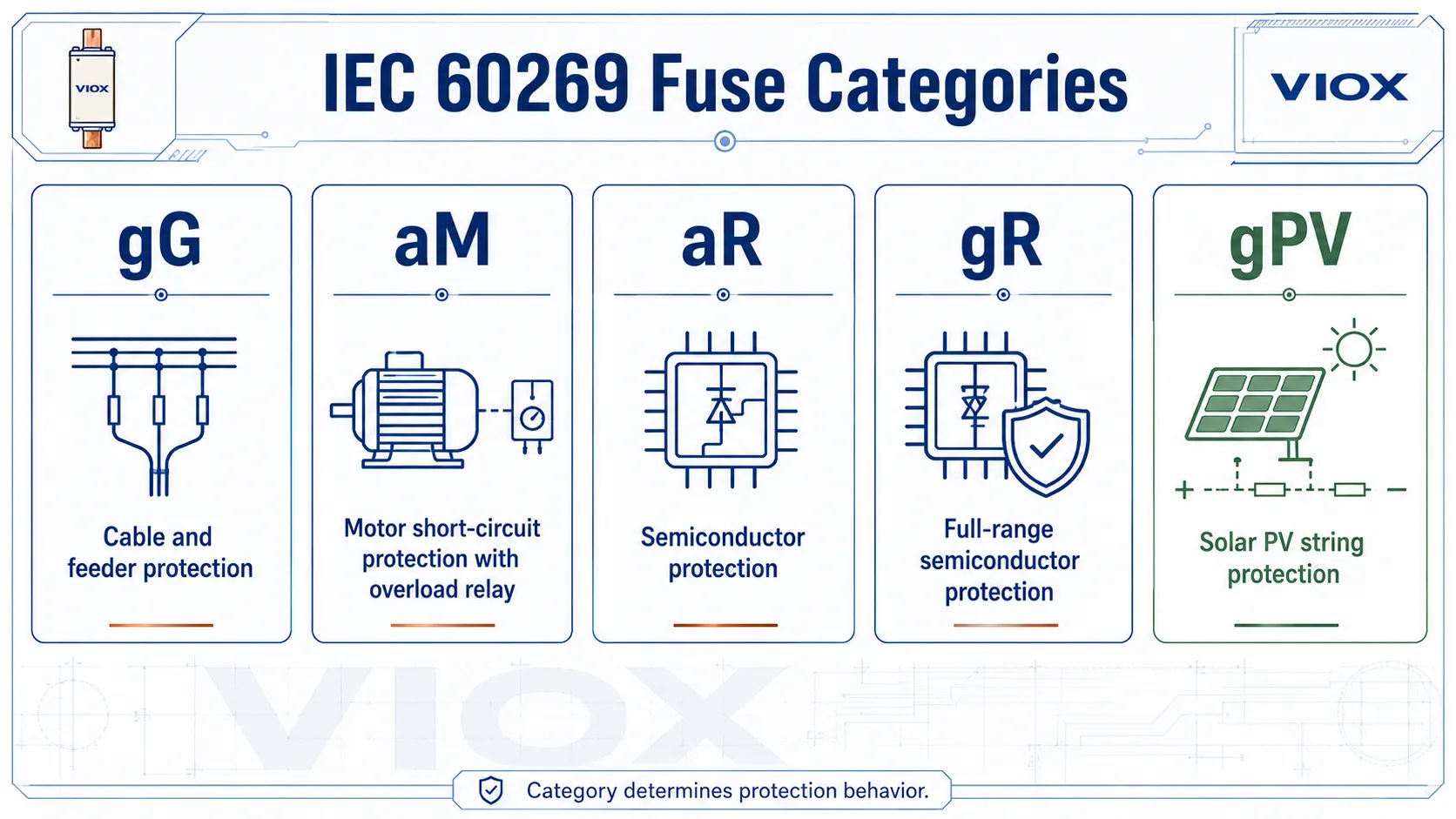
| Category | Main function | Typical use | Selection warning |
|---|---|---|---|
| gG | Full-range general-purpose protection | Cables, lines, general distribution circuits | Common choice for cable and feeder protection |
| aM | Partial-range motor short-circuit protection | Motor circuits with separate overload relay | Does not provide full overload protection by itself |
| aR | Partial-range semiconductor protection | Rectifiers, drives, power electronics | Very fast, but must be coordinated with the semiconductor device |
| gR | Full-range semiconductor protection | Semiconductor and converter protection | Check manufacturer curves and I2t data carefully |
| gPV | Photovoltaic string protection | Solar PV combiner boxes and DC arrays | Requires DC voltage and PV-specific rating |
| Battery-related categories | Battery and energy storage protection | BESS and DC battery circuits | Must be selected from the exact fuse standard, datasheet, and system fault profile |
The first letter matters:
ggenerally indicates full-range breaking capability, covering overload and short-circuit conditions within the fuse’s defined range.agenerally indicates partial-range protection, typically for short-circuit protection only; another device must provide overload protection.
This is a major selection point. For example, an aM motor fuse is not a direct replacement for a gG cable protection fuse unless the protection scheme is designed for it.
For deeper IEC 60269 selection guidance, see IEC 60269 Low Voltage Fuse Selection Guide: gG, aM, and NH Fuses.
Main Types of HRC Fuses
NH HRC Fuses
NH fuses are widely used in industrial low-voltage distribution. They normally have a rectangular ceramic body and knife-blade contacts. They are commonly used with NH fuse bases, fuse switch disconnectors, or switch-fuse combinations.
Typical applications include:
- main distribution boards
- feeder circuits
- transformer secondary protection
- motor feeders
- industrial control panels
- utility and building distribution
NH fuse selection must include the fuse size, rated current, voltage, breaking capacity, utilization category, and matching holder or fuse switch disconnector.
Cylindrical HRC Fuses
Cylindrical HRC fuses are compact cartridge fuses used in control panels, small distribution circuits, control transformers, instrumentation, and some power circuits.
They are not automatically interchangeable just because the diameter and length match. Voltage, current, breaking capacity, utilization category, and holder rating still matter.
D and D0 Type Fuses
DIAZED and NEOZED-style fuses are used in some European-style distribution systems. They are usually associated with screw-type fuse bases and gauge rings that help prevent installing a fuse above the intended rating.
These are not the same as NH fuses, and they should not be treated as interchangeable.
Semiconductor Fuses
Semiconductor fuses are designed for very fast energy limitation. They protect:
- rectifiers
- inverters
- drives
- UPS systems
- solid-state devices
- power converters
The critical data is not just current rating. I2t, peak let-through current, voltage rating, and coordination with the semiconductor device are essential.
PV and DC HRC Fuses
Solar PV and battery systems require DC-rated fuses. DC arcs do not naturally extinguish at a current zero the way AC arcs do, so the fuse must be tested and rated for the actual DC voltage and fault conditions.
For PV systems, use PV-rated fuses such as gPV where required. For DC fuse fault duties, see DC Fuse Breaking Capacity for PV Systems and How to Properly Fuse a Solar Photovoltaic System.
HRC Fuse vs Fuse Link vs Fuse Holder
These terms are often mixed together, but they are not the same.
| Item | Meaning | Why it matters |
|---|---|---|
| Fuse link | Replaceable cartridge or blade component that melts during a fault | Must match current, voltage, class, size, and curve |
| Fuse holder/base | Mechanical and electrical support for the fuse link | Must match heat, current, voltage, and short-circuit conditions |
| Fuse switch disconnector | Switching device that includes fuse links and isolation/switching function | Must be rated for switching duty and safe operation |
| Fuse assembly | Complete protective arrangement | Performance depends on all matched parts |
Do not select the fuse link alone and ignore the holder. Poor contact pressure, wrong size, low-quality terminals, or mismatched fuse bases can cause overheating even when the fuse link rating is correct.
For the terminology split, see Fuse vs Fuse Link Difference Guide. For installation hardware, see Fuse Holder vs Fuse Switch Disconnector.
HRC Fuse vs MCB and MCCB
HRC fuses and circuit breakers both protect electrical circuits, but they do it differently.
| Feature | HRC fuse | MCB / MCCB |
|---|---|---|
| Operation after fault | Single-use, replace fuse link | Resettable after trip, subject to inspection |
| Fault interruption | Very high and fast current-limiting capability possible | Depends on breaking capacity and trip unit design |
| Overload adjustment | Fixed by fuse type and curve | MCCBs may offer adjustable settings |
| Indication | Some fuses have indicators or strikers | Breakers show trip/open/closed state more directly |
| Remote control | Not normally | Possible with accessories on some breakers |
| Selectivity | Strong when coordinated with fuse curves | Strong when coordinated with breaker settings |
| Maintenance focus | Holder condition, contact pressure, correct replacement | Mechanism, contacts, trip unit, accessories |
Use an HRC fuse when high fault-current limitation, compact protection, and simple replacement are priorities. Use a breaker when resettable operation, switching function, adjustable protection, or monitoring are required.
For a more detailed comparison, see Fuse vs MCB Response Time and What Is the Difference Between Fuse and Circuit Breaker?.
How to Select an HRC Fuse
Use this sequence instead of choosing only by ampere rating.
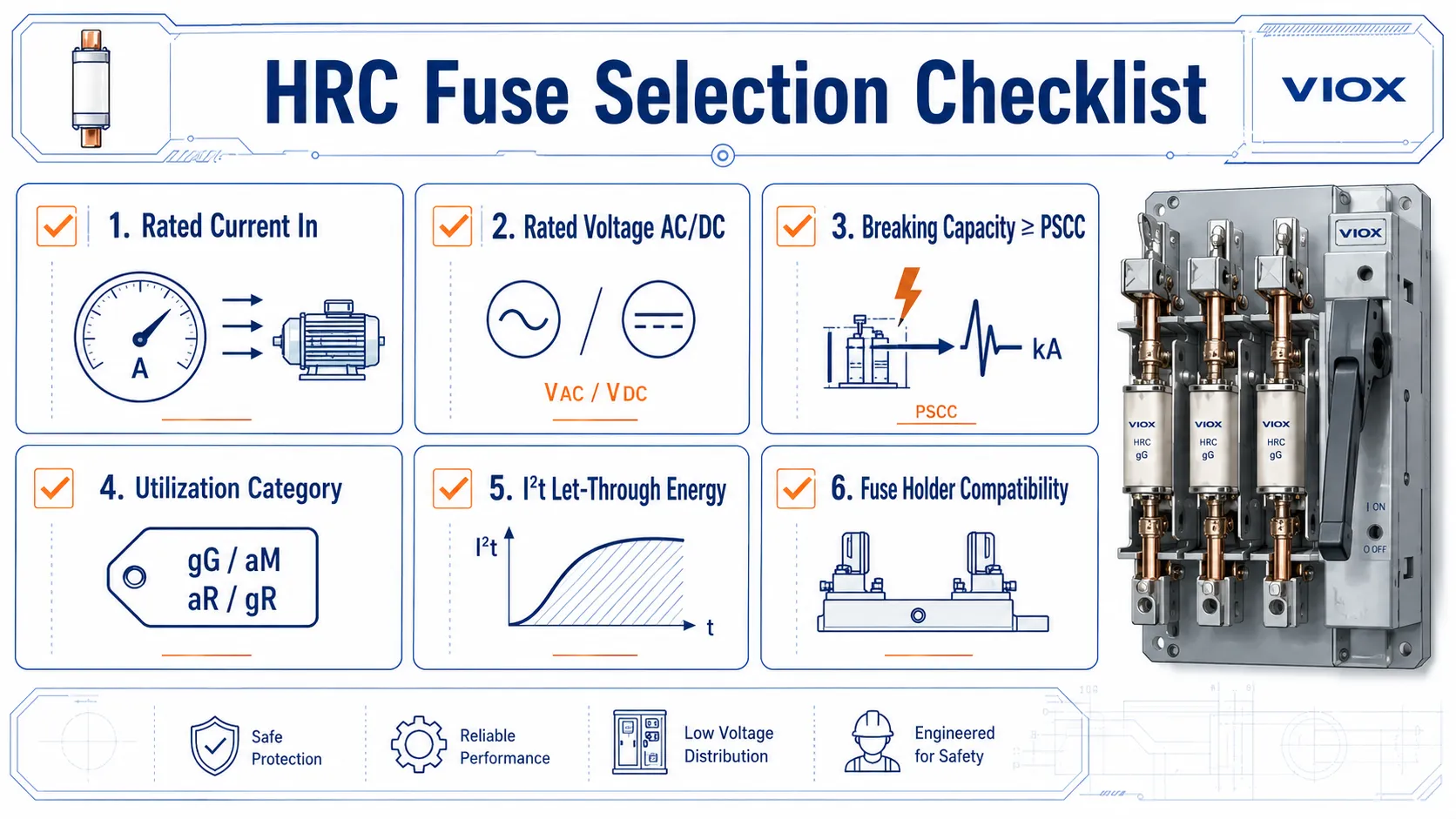
Step 1: Identify the circuit application
Ask what the fuse is protecting:
- cable or feeder
- motor circuit
- transformer
- capacitor bank
- semiconductor device
- PV string
- battery circuit
- control transformer
- general distribution
Different applications require different fuse categories and curves.
Step 2: Match the rated voltage
The fuse voltage rating must be equal to or higher than the system voltage. AC and DC ratings are not interchangeable.
For DC systems, confirm:
- maximum DC voltage
- polarity requirements, if any
- DC breaking capacity
- PV or battery-specific standard and category
- manufacturer wiring and installation instructions
Step 3: Match the rated current
Rated current must protect the cable and load correctly. Do not oversize the fuse just to avoid nuisance operation.
For motor circuits, consider starting current and starting time. A motor circuit may require an aM fuse with an overload relay or motor protection device. For cable feeders, a gG fuse may be more appropriate.
Step 4: Check breaking capacity against PSCC
Calculate or obtain the prospective short-circuit current at the installation point. Then confirm:
Fuse breaking capacity >= PSCCIf the fuse is installed near a transformer or main busbar, PSCC may be much higher than at a downstream final circuit.
Step 5: Check utilization category
Do not replace:
- gG with aM without reviewing overload protection
- semiconductor fuse with general-purpose fuse
- PV fuse with ordinary AC fuse
- DC battery fuse with an AC-only fuse
The utilization category is a functional rating, not a marketing label.
Step 6: Review I2t and selectivity
For coordination, compare melting I2t and clearing I2t with downstream and upstream devices. In semiconductor circuits, I2t is often one of the most critical parameters because the fuse must limit energy before the protected device is damaged.
Step 7: Confirm fuse holder and disconnector compatibility
Check:
- physical size
- rated current of holder
- voltage rating
- heat dissipation
- contact pressure
- terminal capacity
- mounting style
- fuse switch disconnector rating, if used
An HRC fuse link is only as good as the holder and connection system around it.
Common HRC Fuse Selection Mistakes
Mistake 1: Treating HRC as one universal fuse type
HRC describes high breaking capacity, but it does not define the application category. gG, aM, aR, gR, gPV, and other categories behave differently.
Mistake 2: Using AC voltage data for DC circuits
DC interruption is more demanding because there is no natural current zero. Always check the DC voltage and DC breaking capacity.
Mistake 3: Oversizing the fuse to avoid nuisance blowing
Oversizing may stop nuisance operation, but it can leave cables or equipment under-protected.
Mistake 4: Ignoring I2t
For semiconductor, drive, UPS, rectifier, and power electronics protection, I2t can be more important than the ampere rating alone.
Mistake 5: Replacing only the fuse link without checking the holder
Overheated fuse holders, weak contact pressure, corrosion, and wrong base size can cause failures even with a correct fuse link.
Mistake 6: Using ordinary fuses in PV or battery systems
PV strings and battery systems have DC fault behavior that requires suitable DC-rated fuse links and correct coordination.
Mistake 7: Removing a fuse under load without the right device
A fuse holder is not automatically a load-break switch. If switching is required, use a properly rated fuse switch disconnector or switch-fuse device.
FAQ
What does HRC fuse mean?
HRC fuse means High Rupturing Capacity fuse. It is designed to safely interrupt high fault current without the fuse body rupturing or allowing a sustained arc.
Is HRC the same as HBC?
In most practical industrial discussions, HRC and HBC describe the same concept: a fuse with high fault-current breaking capability. HRC means High Rupturing Capacity, while HBC means High Breaking Capacity.
What is the difference between gG and aM fuses?
A gG fuse is a full-range general-purpose fuse often used for cable and feeder protection. An aM fuse is a partial-range motor fuse intended mainly for short-circuit protection and normally requires separate overload protection.
What is I2t in an HRC fuse?
I2t describes energy let-through during fuse operation. It is used for protection coordination and is especially important when protecting semiconductors, drives, rectifiers, and other sensitive power electronics.
Can an HRC fuse be reused after it blows?
No. The fuse link is a single-use protective device. After operation, replace it with the correct type, current rating, voltage rating, utilization category, and size.
Can I replace an HRC fuse with an MCB?
Not automatically. An MCB must have suitable rated current, trip curve, breaking capacity, voltage rating, and coordination for the circuit. HRC fuses and MCBs behave differently, especially under high fault current.
Can HRC fuses be used in DC circuits?
Yes, but only if the fuse is specifically rated for the DC voltage, breaking capacity, and application. Do not assume an AC HRC fuse is suitable for DC, PV, or battery systems.
Why did my HRC fuse not blow during motor starting?
That may be normal if the fuse and motor circuit were selected correctly. Motor starting current is temporary. Motor circuits often use a fuse type and overload protection arrangement that allows starting current while still protecting against short circuits.
What should I check when an HRC fuse holder is hot?
Check load current, fuse rating, terminal torque according to manufacturer instructions, contact pressure, corrosion, fuse holder rating, cable size, and whether the fuse link is correctly seated. Heat often comes from contact resistance, not only from fuse current rating.
Which standard applies to HRC fuses?
For IEC markets, low-voltage fuses are commonly specified under the IEC 60269 series. North American applications may involve UL 248 fuse standards. The correct standard depends on product type, market, voltage, and application.
Summary
An HRC fuse is a high breaking capacity protective device used where fault current can be severe and fast, reliable interruption is required. Its strength comes from a carefully designed fuse element, ceramic body, arc-quenching filler, and tested breaking capacity.
The correct selection is not simply “choose the same ampere rating.” Engineers and panel builders must check rated voltage, AC/DC duty, breaking capacity, utilization category, I2t, time-current curve, fuse holder compatibility, and coordination with the rest of the system.
For VIOX fuse-related guidance, start with the Fuse product category, then review the supporting guides on IEC 60269 fuse selection, fuse holder vs fuse switch disconnector, and DC fuse breaking capacity for PV systems.