

On this page
Quick Answer: Can Solar Panels Cause Fires?
Yes. Solar photovoltaic (PV) systems can cause fires when installation defects, damaged connections or failed components create localized heating or electrical arcs. A Fraunhofer ISE release from 2013 reported that 0.006% of Germany’s then-installed systems had caused fires resulting in large damage; that historical figure is not a current annual or worldwide fire probability. Investigations identify installation errors and DC-side equipment, especially isolators and connectors, as important areas for prevention and professional inspection.
The useful question is where a fault can develop, what evidence reveals it, and when to stop using the system. A panel exposed to sunshine is not the same thing as a damaged connection generating concentrated heat beneath it.
Understanding Solar Panel Fire Risk: The Real Statistics
Different reports measure different events. A fire involving a building with PV, a fire started by PV equipment and a fire causing major building damage are not interchangeable categories.
Germany: historical large-damage fires. In its 2013 fire-protection release, Fraunhofer ISE described Germany’s then-installed base of 1.3 million PV systems and experience over approximately the preceding two decades. It reported that 0.006% of systems had caused a fire resulting in large damage. This supports a narrowly defined historical finding, not a prediction for an individual roof or a measure of every overheating event.
United Kingdom: reported fires involving solar panels. The Fire Protection Association’s account of The Independent’s freedom-of-information investigation reported 66 fires involving solar panels from the beginning of 2023 through July, compared with 63 during the whole of 2019. These are reported incident counts, not a proven count of fires ignited by PV equipment or a comparable annual failure rate. Differences in reporting, deployment and observation periods matter.
United Kingdom: investigated causes. The government-commissioned BRE National Solar Centre investigation examined 80 potential PV-related incidents. Its conclusion attributed approximately 36% of the incidents caused by PV systems to poor installation practices. That percentage applies to the PV-caused subset, not to the entire database; many underlying causes remained unknown.
These findings justify attention to installation quality and component condition. They do not justify assigning every PV fire to poor workmanship or concluding that rising incident counts prove an aging-related increase in individual-system risk.
Main Causes of Solar Panel Fires
Poor Installation Practices
Installation defects can leave an otherwise suitable component operating outside its intended conditions. Loose terminations, poor connector sealing, damaged insulation, unsuitable cable routing and incorrect component selection can create faults that remain hidden after commissioning.
A connection can still carry current while developing abnormal resistance and localized heat. A successful startup therefore does not prove that every connection will remain sound through weather exposure and repeated thermal cycling.
Prevention means following the exact equipment instructions, using compatible connections and appropriate tools, and documenting commissioning checks. Grounding, cable protection and enclosure entry arrangements must match the installation requirements. Covering a suspect connection with tape or repeatedly resetting a fault indication does not establish that it is safe.
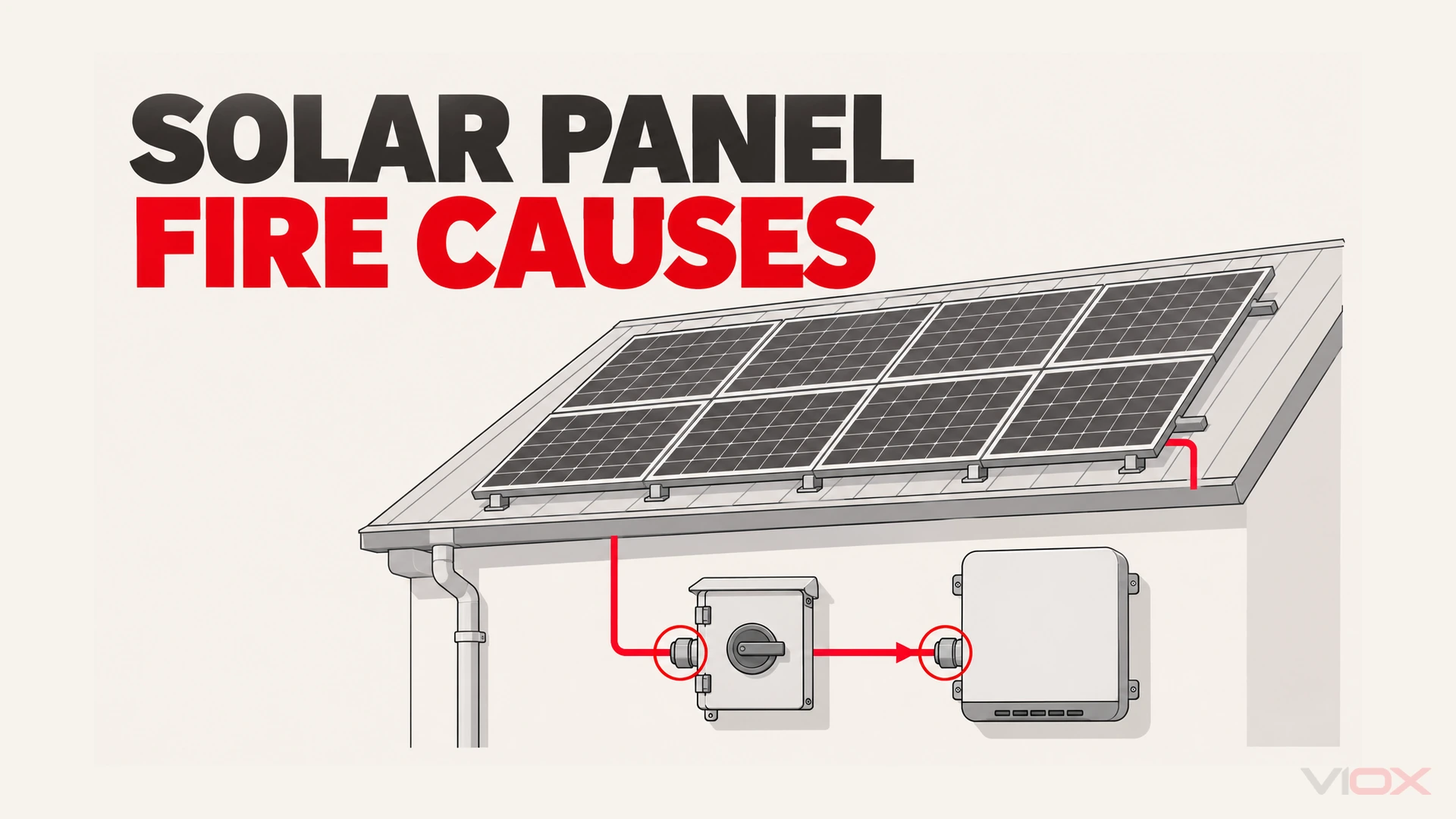
DC Isolators and DC Connectors: Important PV Fire Starting Points
In BRE’s investigation database of 80 incidents, DC isolators were recorded as the probable origin in 26 cases. The report separately classified possible component involvement. Isolators were the most frequently implicated single component in that sample; this is not a worldwide ranking or proof that every damaged isolator started the fire.
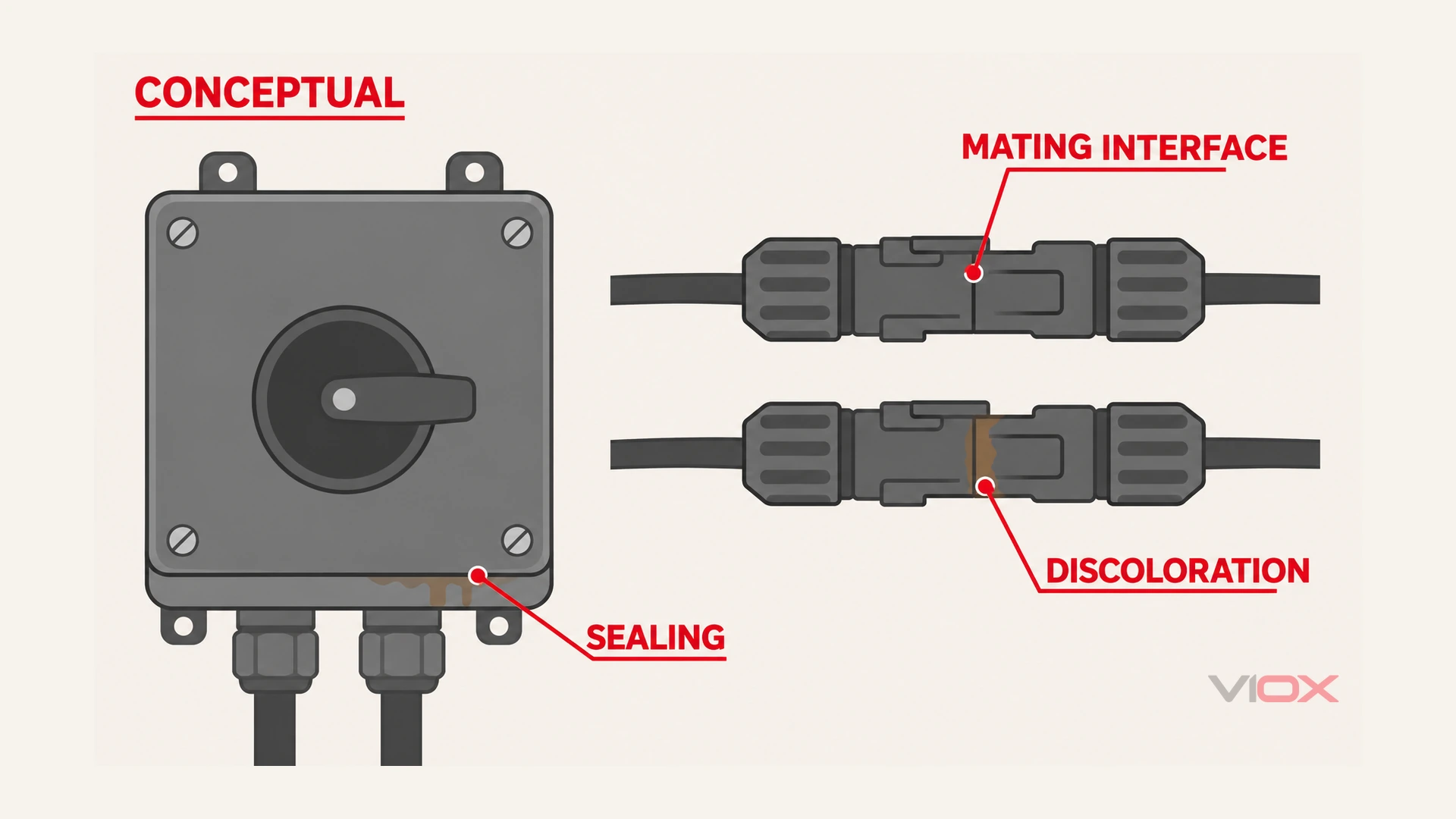
An outdoor isolator depends on suitable switching duty, secure connections and intact weather sealing. Moisture ingress, corrosion or poor terminations can lead to heating and arcing. Connectors can develop similar faults through poor crimping, incomplete mating, incompatible parts or environmental degradation. Sandia National Laboratories’ connector research identifies degraded connectors as a source of failures that can include fire.
Warning signs include discoloration, deformation, burnt odor, damaged seals or recurring weather-related faults. Keep away from suspect equipment rather than opening it or unplugging connectors under load. The deeper diagnostic boundaries are explained in why solar DC isolator switches overheat and burn. For equipment inside a combiner, use the separate solar combiner box fault troubleshooting guide.
Electrical Faults and Arc Faults
Electrical arcing can occur across a damaged or separating connection. Contamination and insulation deterioration can also create unintended current paths. Heat at a fault can damage surrounding insulation and ignite nearby combustible material.
DC arcs are difficult to interrupt because direct current lacks the natural recurring current-zero crossings of AC. This does not mean every DC fault becomes a sustained arc; it explains why switching and protective equipment must be suitable for the actual PV application.
Ground faults, damaged cables and inverter failures require professional investigation. An inverter alarm can identify a condition needing attention, but it does not by itself locate the ignition source. Resetting an alarm without identifying the fault can leave the underlying defect in place.
Hot Spots from Shading and Debris
Partial shading, contamination, cell damage or mismatch can create uneven operating conditions within a module. A shaded cell in a current-carrying string can become reverse-biased and dissipate energy as heat, creating a localized hot spot rather than useful output.
Not every shaded panel is a fire hazard. Persistent abnormal heating, damaged module materials or a developing electrical defect is the concern. A qualified inspection can distinguish a thermal anomaly from an ordinary temperature difference and relate it to the module’s condition.
Keep vegetation and debris management within the system’s maintenance plan. Do not climb onto a roof or wash a cracked or burnt module to investigate a suspected hot spot. Thermal imaging needs operating context and competent interpretation, not an invented universal temperature cutoff.
Component Defects and Equipment Failure
Module junction boxes, inverter components, insulation and bypass diodes can fail. NREL’s bypass-diode research explains their role in protecting against reverse-bias hot spots. Bypass diodes provide an alternative current path around affected cell groups; they are not simply devices that block reverse current. Damage or failure can compromise that function.
The Scheuten Multisol case illustrates a specific product defect. PV Tech reported a Dutch authority warning covering as many as 650,000 potentially affected modules with an alleged junction-box design flaw. That is the number potentially affected by the warning, not the number that caught fire.
Check applicable safety notices against the exact installed module or component identity. A system producing electricity normally does not establish that it is unaffected by a known defect. Preserve equipment records so an installer can identify the relevant model and corrective guidance.
Environmental Factors
Heat, moisture, wind and lightning can worsen an existing weakness or damage equipment. Water can enter an unsuitable enclosure arrangement; wind can strain cables or mounting; a surge can damage electrical components. A nearby building or vegetation fire can also spread to an array without the array being the original cause.
Extreme ambient heat and electrical hot spots should not be confused. Hot weather can increase thermal stress and accelerate deterioration, especially where ventilation is poor or equipment is outside its specified conditions. It does not by itself establish why a particular panel burned.
For the surge-protection part of prevention, see how to choose the right SPD for a solar power system. A surge protective device addresses transient overvoltage; it does not repair a loose connection, prevent every arc or replace correct installation.
Aging Systems and Lack of Maintenance
Exposure and service conditions can degrade seals, insulation, connections and mechanical support. Minor damage may go unnoticed until corrosion, movement or heating makes it more serious. The relevant question is equipment condition and maintenance history, not a universal age at which panels become unsafe.
Rising fire-report totals alone cannot separate aging from growth in installed systems or changes in reporting. There is no justified fixed percentage increase in failure probability to assign to an unmaintained system here.
Review earlier inspection findings, unresolved alarms, storm damage and any change in performance. Have a competent PV professional assess deterioration and replace damaged components through the correct system isolation and verification process.
How to Prevent Solar Panel Fires
Choose Professional Installation
Use a qualified installer working to the applicable local requirements and the equipment instructions. MCS is a UK scheme, not a worldwide installer requirement. Ask who is responsible for electrical verification and how commissioning results, component identities and shutdown instructions will be handed over.
Documentation matters after the original installer leaves. It allows a later technician to identify suitable replacement parts and understand which equipment belongs to each circuit without guessing.
Invest in Suitable, Compatible Components
Check that devices are intended for their location and electrical duty. A connector that physically fits another connector is not necessarily an approved mating pair. Enclosure sealing, cable entries, strain relief and conductor preparation are part of the installed system’s reliability.
Arc-fault detection and other protective functions can reduce particular hazards where applicable. They cannot compensate for an incorrectly assembled connection or guarantee that every failure will be detected.
Implement Regular Maintenance
Owners can review monitoring information and report visible changes from a safe location. Electrical checks, opening enclosures, testing insulation and handling rooftop connections belong to qualified personnel using the documented isolation procedure.
Ask the maintenance provider to connect findings to corrective action: what is damaged, what needs replacement and what verification is required before return to service. Cleaning should follow module instructions and safe access arrangements; it is not a remedy for an electrical defect.
Ensure Proper System Design
Design should account for equipment conditions, cable routing, weather exposure, ventilation and maintenance access. Faults can spread beyond the component where they begin if hot equipment or arcing is close to combustible material.
For system context, what a solar combiner box does explains its role. A combiner’s presence alone does not prove that connections, protection and environmental sealing are correct.
Warning Signs to Watch For
| Observation from a safe location | Appropriate next action |
|---|---|
| Smoke, active arcing or a strong burning smell | Keep away, evacuate and call emergency services as appropriate. Do not investigate the enclosure. |
| Burn marks, discoloration, melting or deformation | Stop using the affected equipment through the safe documented process and arrange professional inspection. |
| Damaged cable, exposed wiring or displaced equipment | Prevent access; do not touch or attempt a temporary repair. |
| Repeated inverter faults or unexplained performance changes | Record the messages and conditions for the installer. Do not repeatedly reset without diagnosis. |
Low output alone does not prove a fire hazard, and normal output does not clear a burnt connection. Treat visible damage and electrical symptoms as evidence to investigate, not something to dismiss because the system still generates power.
What to Do If Your Solar Panel Catches Fire
Evacuate and call emergency services. Keep people away from the roof, damaged wiring and electrical equipment. Do not attempt to extinguish an electrical fire yourself or spray water onto energized equipment.
Operate a system shutdown or disconnect only if it is safely accessible, unaffected by the fire and doing so will not delay escape. Follow the documented emergency procedure; do not approach smoke or open an enclosure to find a switch.
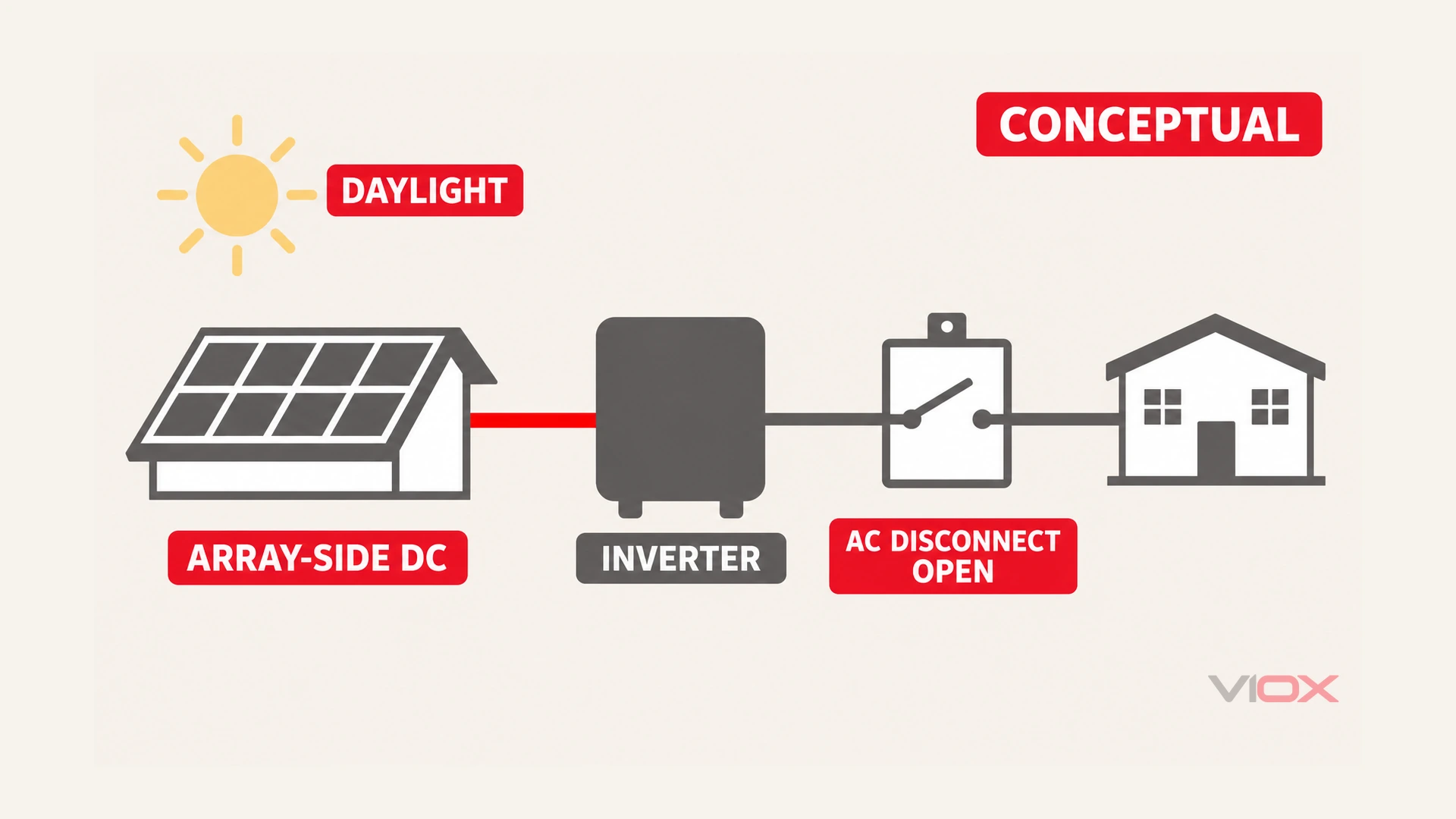
Tell firefighters that the property has PV, where labeled shutdown points are and whether battery storage is also present. Opening the AC disconnect does not make the array-side DC equipment safe in daylight. Modules can continue generating when illuminated, even after the building supply has been disconnected.
The US Department of Energy’s solar fire-safety guidance explains the electrical hazards and the importance of clear system labeling and trained responders. Firefighting techniques are for those responders, not homeowner instructions. Do not restart fire-damaged equipment until the responsible professionals have cleared it.
The Future of Solar Panel Fire Safety
Improved fault detection, shutdown functions and component design can help manage specific hazards. Their scope depends on the actual equipment and installation. No protective feature justifies ignoring damaged connectors, water ingress or recurring alarms.
For an existing system, accurate records, resolved defects and verified maintenance are more useful than assuming a newer label makes every part of the installation safe.
Frequently Asked Questions
How likely is a solar panel fire?
The often-quoted 0.006% comes from Fraunhofer ISE’s historical German assessment published in 2013 and concerns systems causing fires with large damage. It is not an annual worldwide probability. Individual risk depends on the installed system and its condition.
What part of a solar system starts the most fires?
DC isolators were the most frequently implicated single component in the BRE investigation sample. Connectors were also implicated. This does not establish a universal ranking; the suspected origin of a particular fire requires investigation.
Can solar panels catch fire in extreme heat?
Heat can worsen component stress and deterioration, but ordinary solar heating and localized fault heating are different. A damaged connection, insulation defect or hot spot needs investigation. Do not treat normal generation in hot weather as proof of a fault, or ignore burnt equipment because the weather is hot.
Conclusion: Solar Panels Are Safe When Done Right
Solar fires can occur, and the cause may lie in the equipment and connections around the modules. Professional installation, suitable components and maintenance reduce avoidable risks; none is a guarantee against every failure.
Key Takeaways:
- Historical large-damage fires were uncommon in the German assessment; do not turn that finding into a current universal probability.
- Installation errors were the largest identified root-cause category in BRE’s PV-caused subset, while DC isolators were its most frequently implicated single component.
- Prevent faults through correct installation and condition-based maintenance, and escalate damage promptly rather than relying on continued output as proof of safety.