

On this page
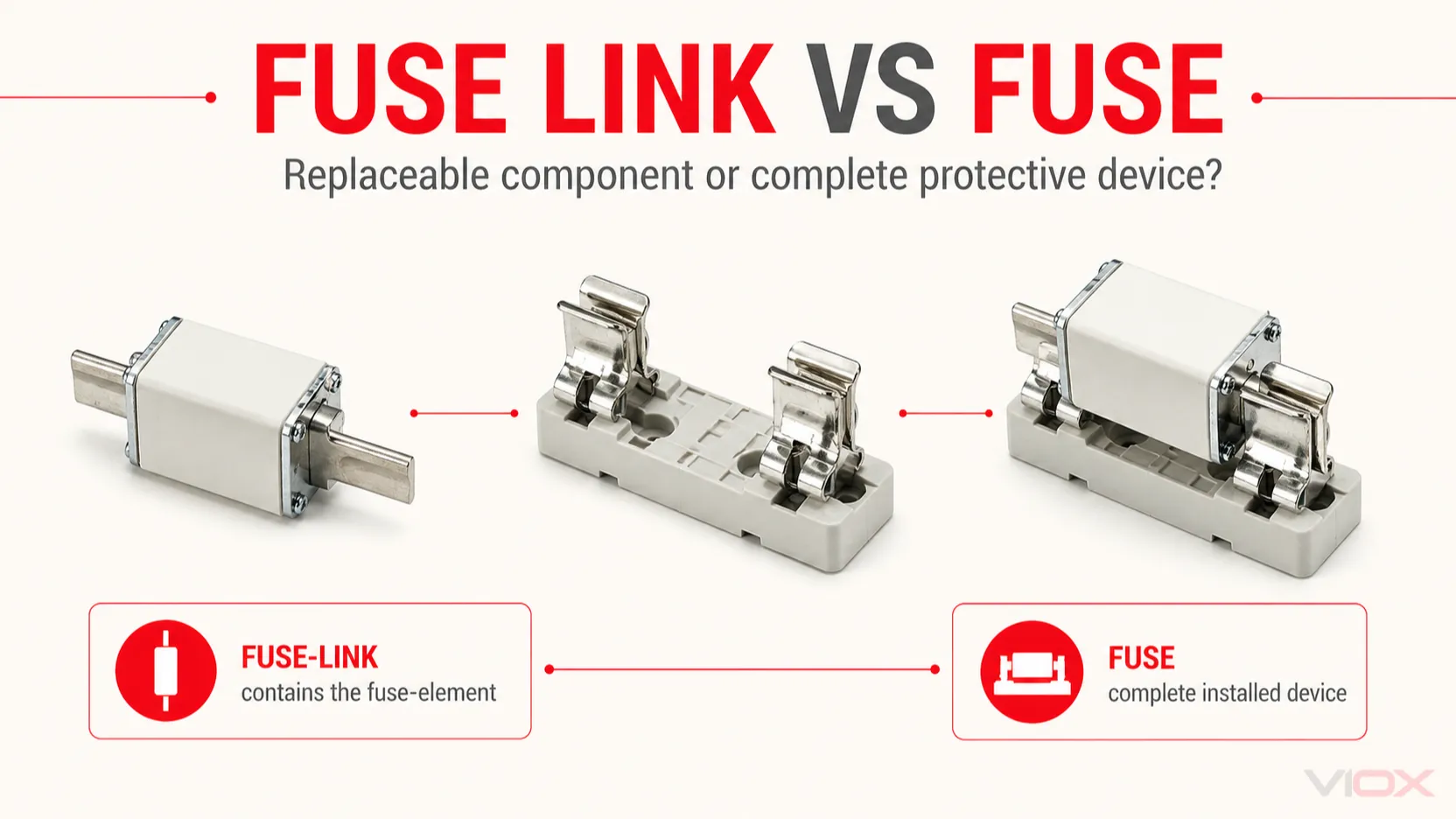
A fuse-link is the replaceable part of a fuse that contains the calibrated fuse-element. When excessive current produces enough heat, that element melts and the fuse-link interrupts the circuit. In IEC low-voltage terminology, the fuse is the complete protective device; depending on its construction, it may include the fuse-link, fuse-base, fuse-carrier, and other parts needed for installation and operation.
In everyday trade and catalog language, however, people often call the replaceable fuse-link simply a “fuse.” Neither usage should be trusted on a purchase order by itself. State whether you need the replaceable link or the complete installed assembly, then identify the ratings and physical system.
Fuse vs Fuse-Link: Quick Comparison
| Question | Fuse | Fuse-link |
|---|---|---|
| What is it? | The complete overcurrent protective device in IEC terminology | The replaceable part that contains the fuse-element |
| What happens during a fault? | The installed device clears the circuit through operation of its fuse-link | Its calibrated element melts; the link must then be replaced |
| Does it include mounting hardware? | It may include a base, holder, carrier, or other system parts | Normally no; it must match the relevant base or holder |
| What do you order for routine replacement? | Not usually the whole system unless the mounting equipment is damaged or being changed | A compatible fuse-link with the required ratings and dimensions |
| What do you order for a new panel? | The complete compatible system, with the required links | Links are specified as part of that system and as maintenance spares |
| Can the terms be used interchangeably? | They often are in informal usage | Not safely in a BOM, RFQ, or maintenance instruction |
The practical rule is simple: replace an operated fuse-link with a verified compatible fuse-link; specify a complete fuse system when the base, holder, switching function, or mounting arrangement is also required.
How a Fuse-Link Works
The fuse-link carries normal current through one or more conductive fuse-elements. When current exceeds the intended time-current characteristic, resistive heating raises the element temperature until it melts. The opening arc is then controlled and extinguished by the link’s construction, which may include an enclosed ceramic body and arc-quenching filler.
This operation is intentionally non-resettable. After the circuit has been isolated and the cause of the overcurrent has been corrected, the operated link is replaced with one having the correct:
- rated current;
- rated voltage and AC or DC suitability;
- utilization category or operating characteristic;
- rated breaking capacity;
- physical size and contact form;
- standard and product-system compatibility.
There is no safe universal statement such as “a fuse-link opens at five times rated current in two seconds.” Operating time depends on the fuse-link family, rated current, utilization category, preloading, ambient conditions, and the manufacturer’s time-current curve. Use the curve and data for the exact series being specified.
The Parts of an IEC Low-Voltage Fuse System
The words surrounding a fuse-link describe different functions. Confusing them can result in an unusable replacement or an unsafe operating assumption.
| Component | Function | Typical procurement situation |
|---|---|---|
| Fuse-link | Contains the fuse-element and performs the one-time interruption | Replacement after operation; maintenance spares |
| Fuse-base | Provides stationary contacts and mounting for the link or carrier | New installation or replacement of damaged fixed hardware |
| Fuse-carrier | Holds and supports the fuse-link in designs that use a removable carrier | New system, damaged carrier, or system-specific spare |
| Fuse-holder | General term for the parts intended to carry and connect the fuse-link | Panel design or replacement where the complete holder is required |
| Fuse | Complete protective device in IEC terminology | System-level specification |
| Fuse switch-disconnector | Combines fuse-link accommodation with a defined switching and isolation function | Circuits that require protection plus a verified load-switching or isolation function |
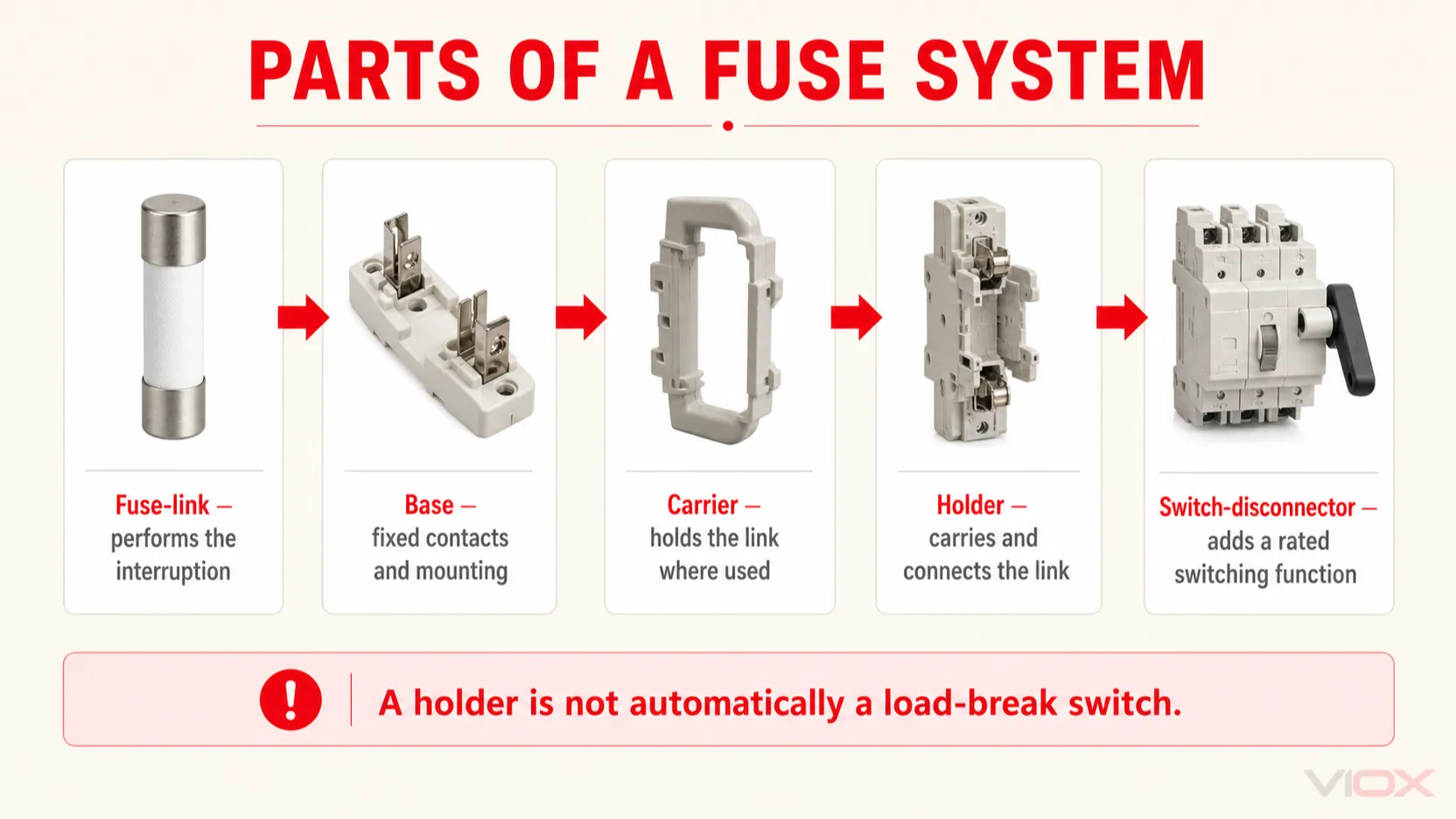
A fuse-holder is not automatically a load-break switch. If an operator must open a circuit under load, use equipment with the required switching function and rating. The distinction is covered separately in Fuse Holder vs Fuse Switch Disconnector.
NH and Cylindrical Fuse-Link Examples
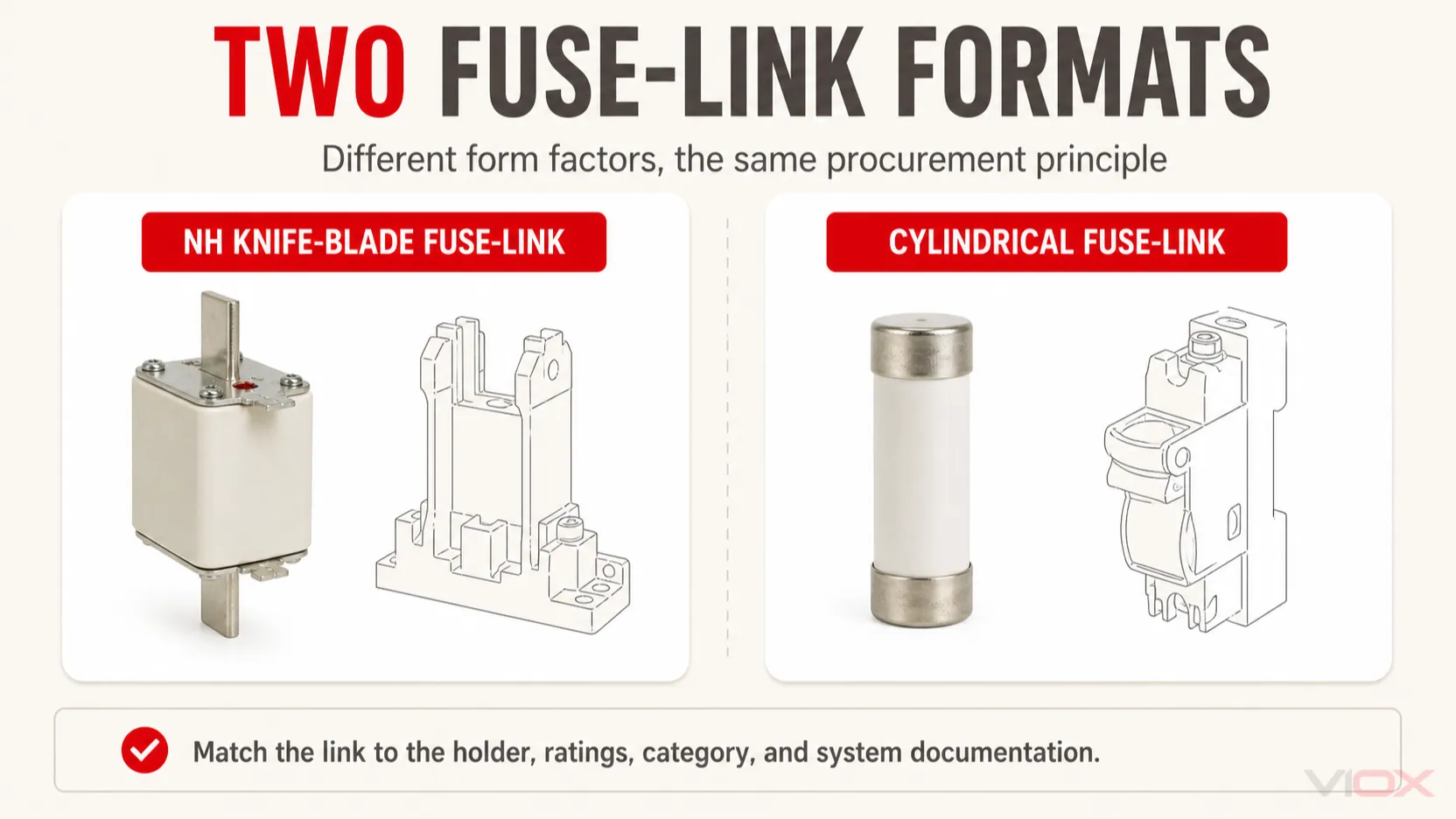
NH knife-blade system
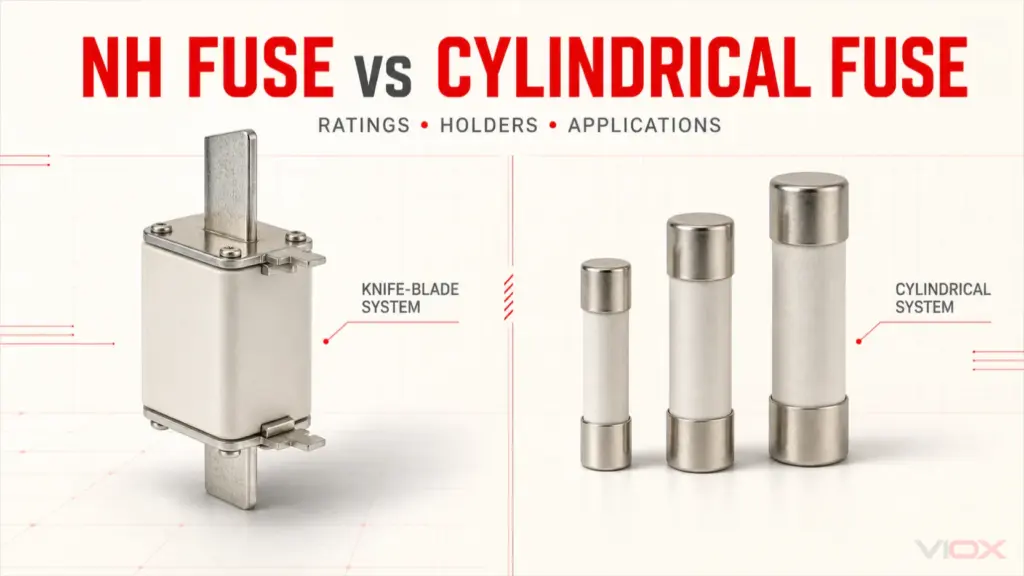
In an NH system, the ceramic component with blade contacts is the NH fuse-link. It fits a compatible NH base, fuse rail, or fuse switch-disconnector. The link’s size designation, contact arrangement, current rating, utilization category, and voltage rating must match the intended system.
Do not infer compatibility from current alone. Two links marked with the same amperage can differ in physical size, utilization category, voltage capability, indication features, and manufacturer-approved application. For a focused comparison of physical formats, see NH Fuse vs Cylindrical Fuse.
Cylindrical fuse system
In a cylindrical system, the ceramic cartridge with metal end caps is the cylindrical fuse-link. Common dimensional families include 10 x 38 mm, 14 x 51 mm, and 22 x 58 mm, but the dimensions alone do not establish the electrical rating. The holder and link must be coordinated for voltage, current, breaking capacity, utilization category, and permitted conductor or installation conditions.
The installed holder provides contact pressure, mounting, and electrical connection. It does not replace the protective function of the link. Conversely, a loose fuse-link is not an installed protective system until it is used in compatible equipment.
When to Order a Fuse-Link and When to Order the Complete Fuse
| Situation | What to specify | Why |
|---|---|---|
| An existing link operated and the base passed inspection | Compatible replacement fuse-link | Only the consumable protective element needs replacement |
| A new distribution panel is being built | Complete fuse system plus correctly rated links | The mounting, contacts, link, and any operating function must work as one system |
| The holder is heat-damaged, loose, cracked, or corroded | Replacement holder/base or complete system, subject to inspection | Replacing only the link does not repair damaged contact hardware |
| The circuit must be manually switched or isolated | Appropriately rated fuse switch-disconnector or other switching device | A basic holder may not have load-break or isolation capability |
| The utilization category is changing | Recheck protection coordination and select a suitable link | Equal current ratings do not imply equal time-current behavior |
| The original series is obsolete | Obtain a documented replacement or redesign the complete system | Similar dimensions do not prove interchangeability |
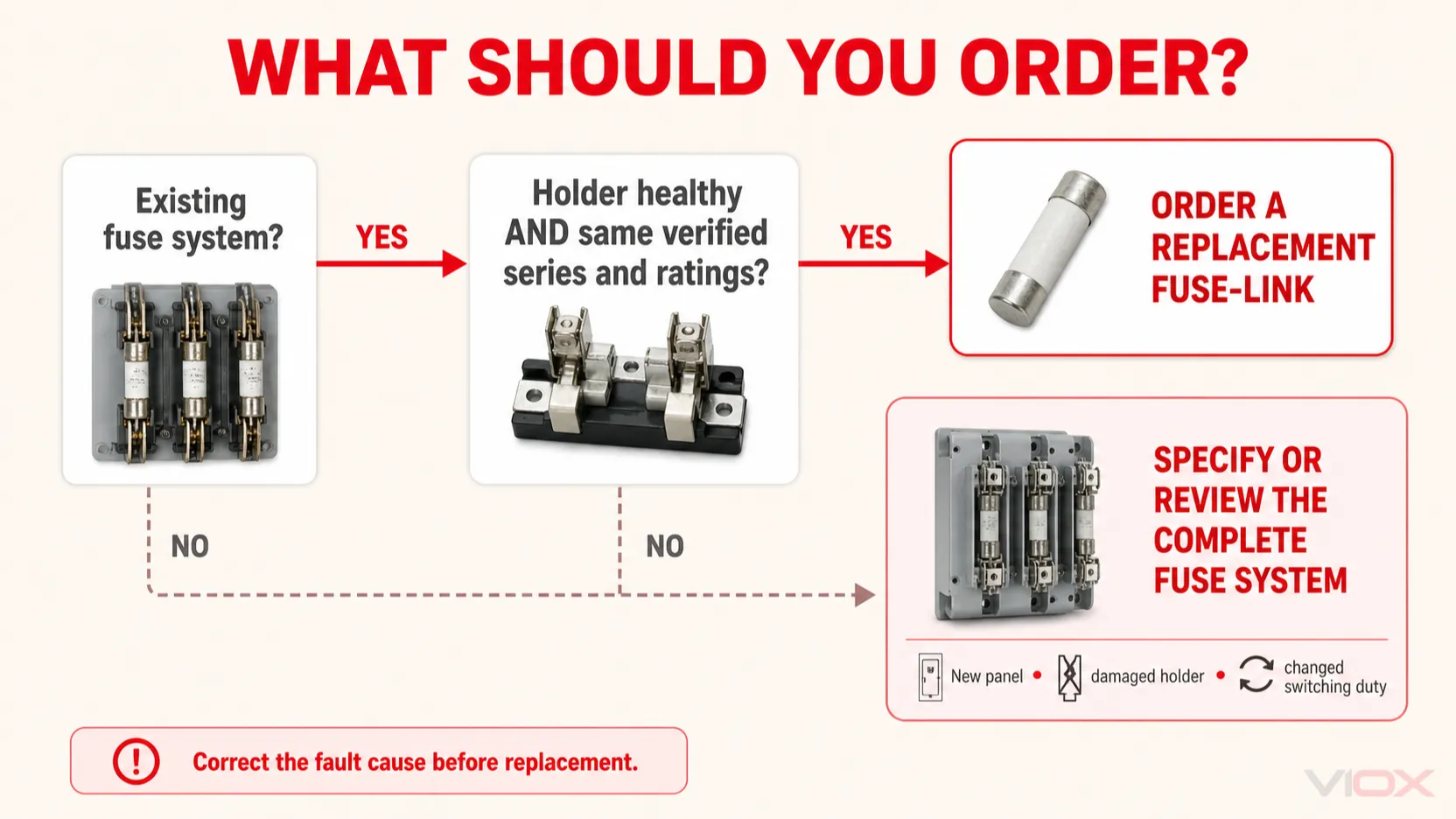
For maintenance, record the manufacturer, series, physical size, and full marking before removing the old link. A photograph is useful, but the product documentation and equipment schedule should remain the controlling evidence.
How to Read and Specify Fuse-Link Ratings
An industrial fuse-link specification should include more than amperes.
1. Rated current
Rated current identifies the link, but it is not by itself a complete protection setting. Cable protection, motor starting, transformer inrush, load profile, ambient conditions, and coordination with upstream and downstream devices can all affect selection.
2. Rated voltage and current type
The link’s rated voltage must be suitable for the circuit, and AC and DC interruption must not be assumed equivalent. DC applications require explicit DC ratings because the arc does not benefit from natural AC current zero crossings.
3. Utilization category
IEC fuse-link markings such as gG, aM, gPV, or aR identify different protection duties. For example, an aM fuse-link provides partial-range protection for motor circuits and requires separate overload protection. Do not replace one utilization category with another merely because the current and dimensions match. Use the IEC 60269 Fuse Selection Guide for the category-level decision.
4. Rated breaking capacity
The fuse-link must be able to interrupt the prospective fault current at its installation point under the stated rating conditions. A high breaking-capacity marking is not a substitute for checking the exact voltage, current type, standard, and series data. For the underlying concept, see What Is an HRC Fuse?.
5. Physical system and contact form
Record the standardized size, body dimensions where relevant, contact arrangement, indicator or striker requirement, and the compatible holder or switch-disconnector. Never create a universal NH dimension table from mixed catalogs; use the applicable IEC fuse-system requirements and the exact manufacturer’s datasheet.
6. Time-current and let-through data
Protection coordination requires the model’s time-current curves and, where relevant, pre-arcing and total I²t data. These values determine how the link behaves with cables, motors, semiconductor devices, and other protective devices. They cannot be derived reliably from the product’s rated current alone.
“Fuse-Link” Means Something Different in Other Industries
This page uses the IEC low-voltage industrial meaning because that is the relevant context for panel builders and electrical equipment buyers. Two other uses explain why search results can be confusing.
Utility cutout fuse-link
In overhead distribution, a cutout fuse-link is the replaceable element installed in a fuse cutout. Its construction and operating classes belong to utility protection practice, not to an NH or cylindrical low-voltage system. A utility link must be selected under its applicable cutout and protection standard; it is not interchangeable with a low-voltage fuse-link.
Automotive fusible link
In automotive terminology, a fusible link is commonly a short, specially designed section of insulated conductor used to protect a high-current wiring circuit. It is not the same product as an IEC cartridge fuse-link. Replacement must follow the vehicle or equipment manufacturer’s specification; ordinary wire must not be substituted.
These contexts should not be combined on one RFQ. State the industry, system voltage, product form, and governing specification before using the term “fuse-link.”
Fuse-Link Replacement and Procurement Checklist
Before approving a replacement or sending an RFQ, verify:
For new equipment or an uncertain legacy system, provide photographs, markings, circuit voltage, load type, prospective fault-current information, and the existing holder details when requesting model support through the VIOX low-voltage fuse and fuse-holder range.
Frequently Asked Questions
Is a fuse-link the same as a fuse?
In casual usage, the words are often treated as synonyms. In IEC terminology, the fuse-link is the replaceable part containing the fuse-element, while the fuse is the complete protective device. A technical specification should identify which component is required.
What is inside a fuse-link?
An enclosed fuse-link typically contains one or more calibrated fuse-elements connected to its terminals. Depending on the design, it may also contain arc-quenching filler and an indicator or striker mechanism. Construction varies by fuse family and application.
Can I replace a fuse-link with another brand?
Only when dimensional, electrical, utilization-category, and holder compatibility are documented. Equal current and voltage markings alone do not prove that the replacement has the same time-current behavior, contact arrangement, power dissipation, or approved system fit.
Is a fuse-link holder a switch?
Not necessarily. A holder carries and connects the fuse-link, but load switching and isolation require explicitly rated equipment. Do not operate a holder under load unless its manufacturer documentation permits that operation.
Why does a fuse-link keep operating?
Repeated operation indicates that the circuit conditions or protection selection require investigation. Possible causes include overload, short circuit, inrush or starting conditions, unsuitable utilization category, poor contact heating, or an incorrect replacement. Never increase the current rating simply to stop repeated operation.