On this page
Direct Answer: Is a Fuse Faster Than an MCB?
In high short-circuit conditions, a current-limiting fuse can usually clear faster than a miniature circuit breaker (MCB) because the fuse element melts and limits the fault current before the prospective short-circuit current reaches its full peak. This is why fuses are often used where limiting let-through energy is more important than reset convenience.
But a fuse is not automatically faster in every fault condition. Fuse clearing time and MCB trip time both depend on fault current, device type, time-current curve, voltage rating, breaking capacity, and coordination with upstream and downstream protection.
For practical selection, do not ask only “which device is faster?” Ask a better question: “Which device limits damage better for this fault level, cable size, load type, and protection objective?”
Key Takeaways
- Current-limiting fuses are usually faster than MCBs under high short-circuit current conditions.
- For overloads, the result depends on the fuse curve and MCB trip curve.
- Fuse clearing time includes melting time plus arcing time.
- MCB trip time includes detection, mechanical unlatching, contact opening, and arc extinction.
- I²t, or ampere-squared seconds, is used to compare let-through thermal energy during fault interruption.
- MCBs are resettable and convenient; fuses can provide very strong current limitation when correctly selected.
Fuse vs MCB Response Time at a Glance
| Question | Fuse | MCB |
|---|---|---|
| Can it respond very fast to high short-circuit current? | Yes, especially current-limiting fuses | Yes, but usually with more mechanical opening delay |
| Is it resettable? | No, it must be replaced after operation | Yes, it can be reset after the fault is corrected |
| Best strength | Fast current limitation and low let-through energy | Convenient branch protection and easy restoration |
| Key curve | Fuse time-current curve | MCB B, C, D, K, or Z trip curve |
| Important energy value | Melting I²t and clearing I²t | Let-through energy depends on breaker design and fault level |
| Main selection risk | Replacing with wrong fuse type or rating | Choosing wrong trip curve or breaking capacity |
| Typical use | Semiconductor protection, motor circuits, short-circuit energy limitation, high SCCR panels | Residential, commercial, control panels, branch circuits, DIN rail distribution |
If the application is a standard branch circuit, an MCB is often preferred for reset convenience. If the application needs strong short-circuit energy limitation, an HRC or current-limiting fuse may be the better protection device.
Are Current-Limiting Fuses Faster Than MCBs?
Yes, under high short-circuit current conditions, current-limiting fuses can have a much faster response time than MCBs.
This is the answer behind the common training question:
Current limiting fuses have a much faster response time to short circuit currents. True or false?
The correct answer is usually true, but the engineering condition matters. It is true when the fuse is a properly selected current-limiting fuse and the fault current is high enough to drive the fuse into its current-limiting region. In that region, the fuse can melt and interrupt the fault before the first full current peak develops.
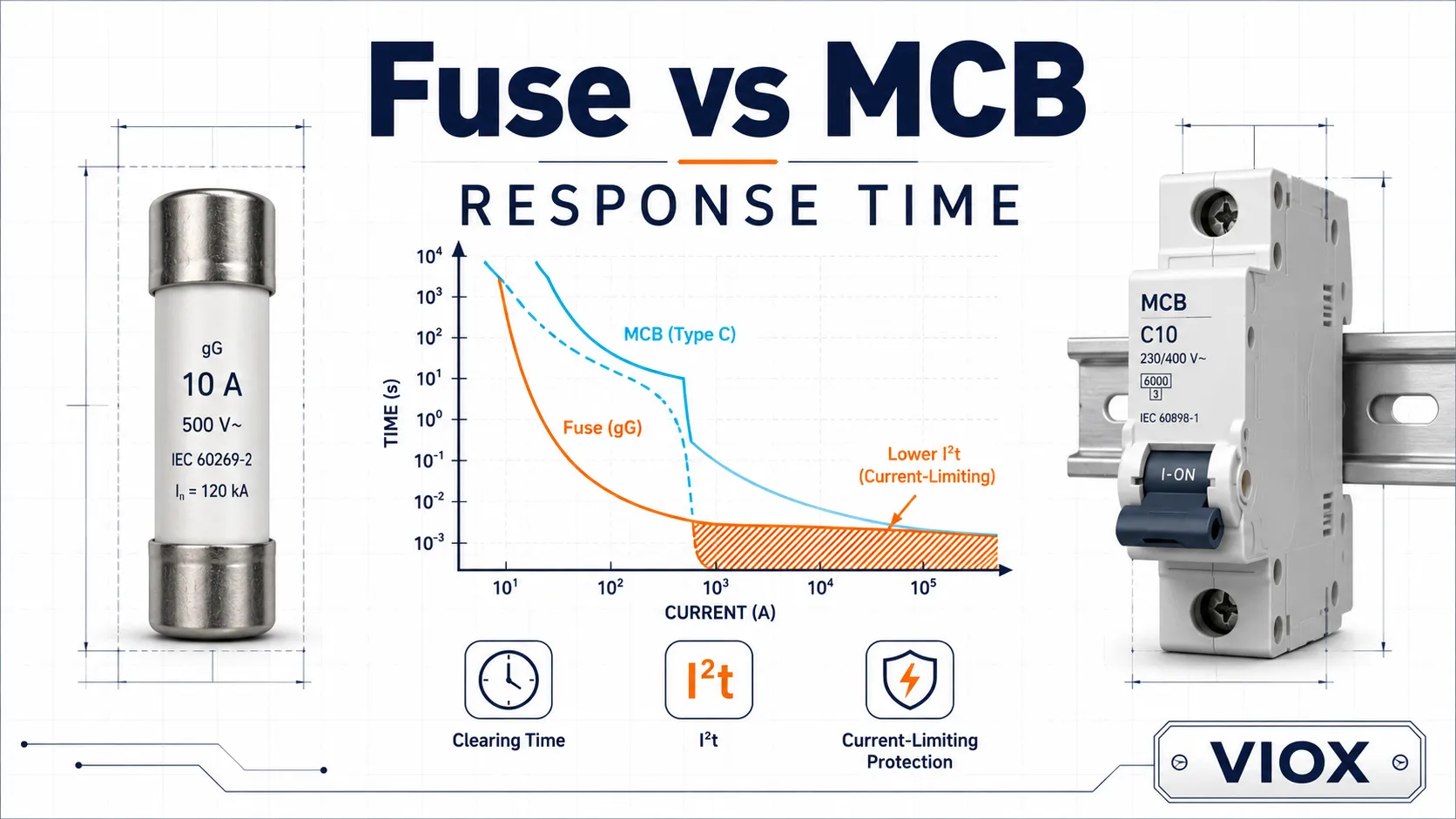
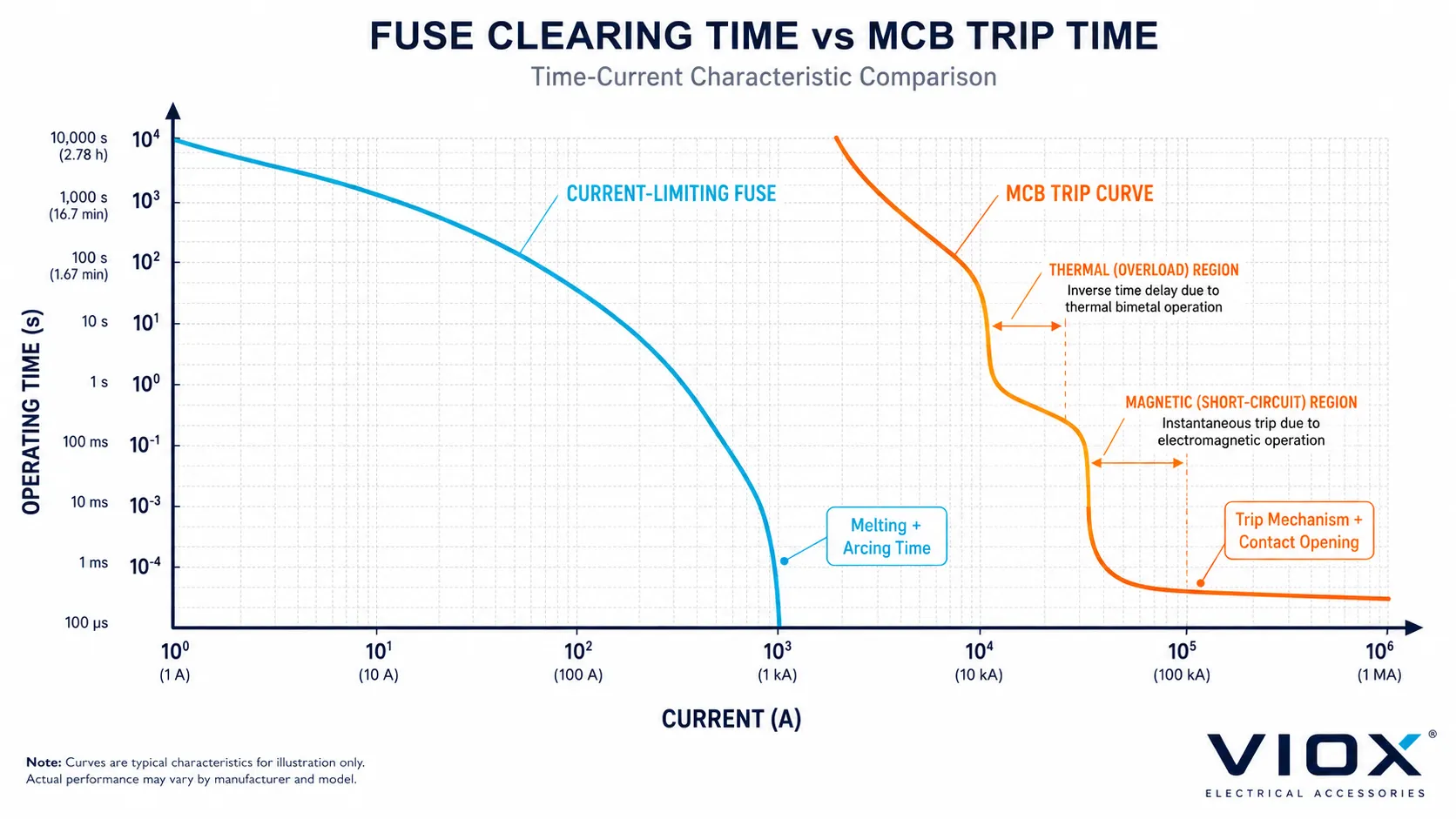
In many short-circuit protection comparisons, a high-speed or current-limiting fuse may clear a severe fault in only a few milliseconds, such as roughly 2-4 ms in some manufacturer curve examples. A standard MCB may require tens of milliseconds, such as 20-100 ms, because its magnetic trip still has to release a mechanical latch, open contacts, and extinguish the arc. These numbers should be treated as typical engineering ranges, not universal ratings; the actual value must come from the device time-current curve and fault-current level.
For low-level overloads, the answer is not that simple. A fuse and an MCB can both take seconds, minutes, or longer to operate depending on the overload multiple and their time-current characteristics.
What Is Fuse Clearing Time?
Fuse clearing time is the total time required for a fuse to interrupt a fault current. It is made of two parts:
| Fuse Time Term | Meaning | Why It Matters |
|---|---|---|
| Melting time / pre-arcing time | Time from fault current starting until the fuse element melts | Determines how quickly the fuse starts interrupting |
| Arcing time | Time from element melting until the arc is extinguished | Determines final interruption performance |
| Total clearing time | Melting time plus arcing time | The value engineers use when checking protection coordination |
In a current-limiting fuse, total clearing time can be very short during high short-circuit faults. The fuse does not simply “wait and open.” It physically melts, creates arc voltage, and limits the current that would otherwise flow through cables, busbars, semiconductors, or downstream devices.
For HRC fuse selection, see VIOX’s High Rupturing Capacity Fuse guide.
What Is MCB Trip Time?
MCB trip time is the time it takes for a miniature circuit breaker to detect overcurrent, release its internal mechanism, open the contacts, and extinguish the arc.
An MCB normally uses two protection mechanisms:
| MCB Protection Mechanism | Fault Type | How It Works |
|---|---|---|
| Thermal trip | Overload | A bimetal strip heats and bends until the breaker trips |
| Magnetic trip | Short circuit | A magnetic coil trips the mechanism rapidly at high current |
The magnetic trip responds much faster than the thermal trip, but the breaker still has mechanical movement and contact opening time. This is one reason why a properly selected current-limiting fuse can limit peak current and let-through energy more effectively in severe short-circuit conditions.
For more on MCB curves, see VIOX’s MCB types and trip characteristics guide.
I²t Explained: Ampere-Squared Seconds and Let-Through Energy
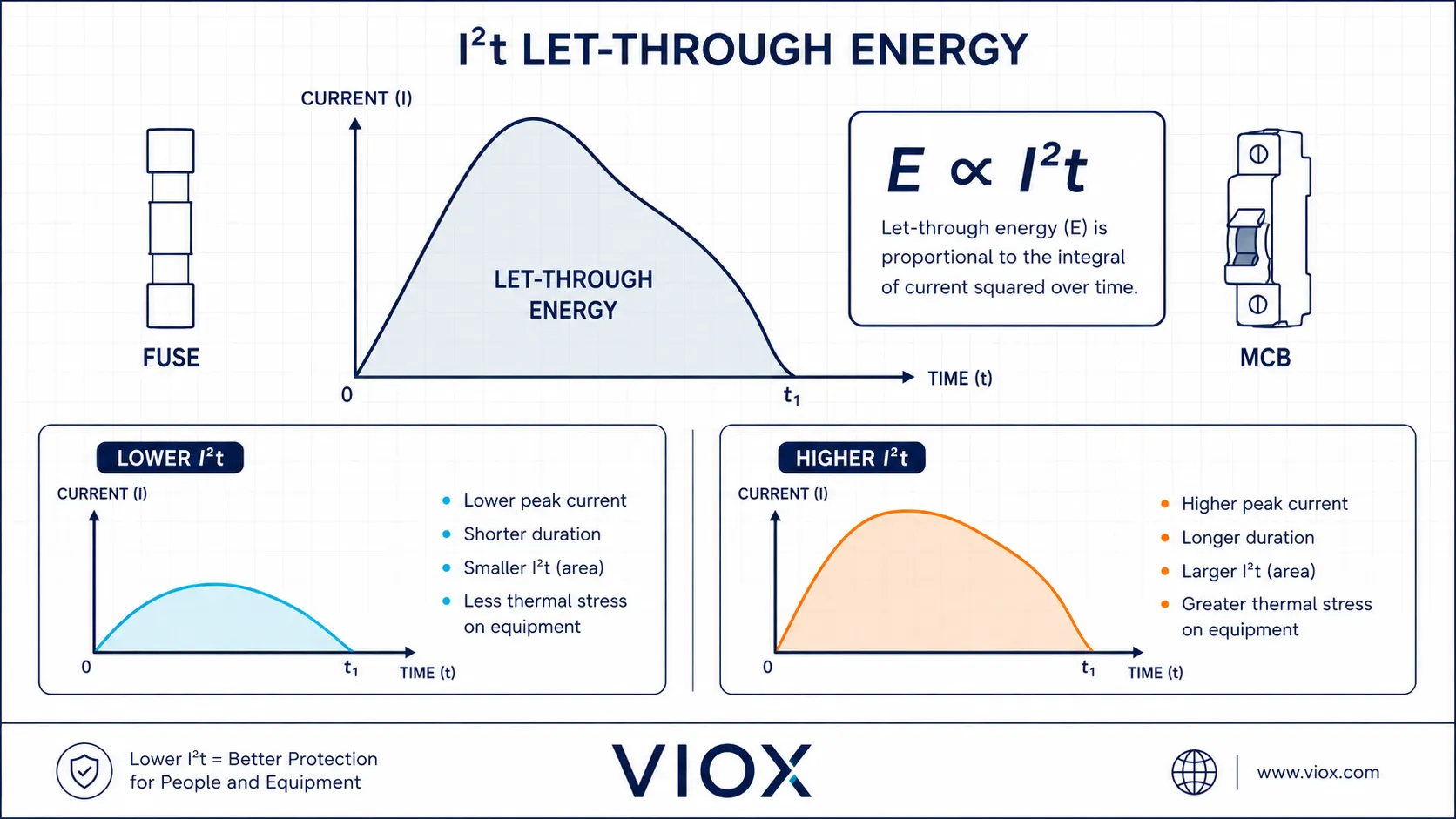
I²t, pronounced “I squared t,” means ampere-squared seconds. It is a way to describe the thermal energy let through by a protective device during a fault.
The basic relationship is: thermal energy is proportional to current squared multiplied by time, or E ∝ I²t.
E ∝ I²tWhere:
Iis currenttis time- higher current greatly increases heating because current is squared
This matters because short-circuit damage is not determined only by current. It is determined by how much current flows and how long it flows.
| Lower I²t Means | Higher I²t Means |
|---|---|
| Less thermal stress on cables and conductors | More heating during the fault |
| Better protection for sensitive components | Higher risk of contact welding or insulation damage |
| Lower let-through energy | More energy reaching downstream equipment |
| Better semiconductor protection when correctly coordinated | Greater stress on power electronics |
Fuse datasheets may list melting I²t and clearing I²t. For semiconductor fuses, rectifiers, drives, UPS systems, and power electronics, I²t can be more important than ampere rating alone.
Real-World Example: Why Milliseconds Matter
In one panel review involving a variable frequency drive (VFD) feeder, the original design used semiconductor fuses to limit short-circuit energy before it reached the drive input stage. During a later maintenance change, the protection was replaced with a resettable breaker selected mainly by ampere rating. On paper, both devices looked similar because the current rating matched. In the fault event, they did not behave the same way.
The breaker eventually opened, but the let-through energy was high enough to damage the drive power section before the circuit was fully interrupted. The expensive part of the failure was not only the protective device; it was the drive module, downtime, troubleshooting labor, and recommissioning delay. This is the practical reason engineers compare clearing I²t and time-current curves instead of choosing protection only by rated current.
The lesson is simple: when protecting semiconductors, VFDs, rectifiers, UPS systems, and other power electronics, milliseconds and I²t are not academic details. They decide whether the protective device clears the fault before the protected equipment is damaged.
Time-Current Curve: The Term Behind Fuse and MCB Opening Time
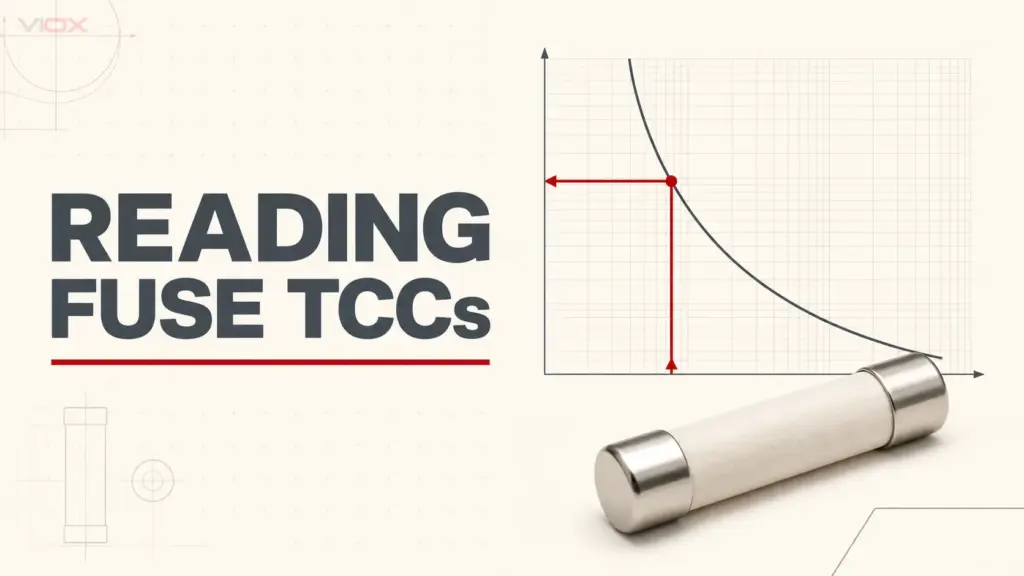
The term that describes how long a fuse or circuit breaker takes to open at different current values is the time-current characteristic or time-current curve.
This curve is essential because no fuse or MCB has one fixed response time. A 2× overload, 5× overload, and 20× short circuit can produce very different operating times.
| Current Condition | Fuse Behavior | MCB Behavior |
|---|---|---|
| Slight overload | May operate slowly depending on fuse class | Thermal trip operates slowly |
| Moderate overload | Time depends strongly on fuse curve | Thermal trip or magnetic threshold may be involved |
| High short circuit | Current-limiting fuse may clear very fast | Magnetic trip operates, then contacts open and arc is extinguished |
| Very high fault current | Fuse may strongly limit peak current and I²t | Breaker must have adequate breaking capacity and let-through performance |
This is why engineers compare curves, not just rated amperes.
Why Fuses Can Protect Faster in Short Circuits
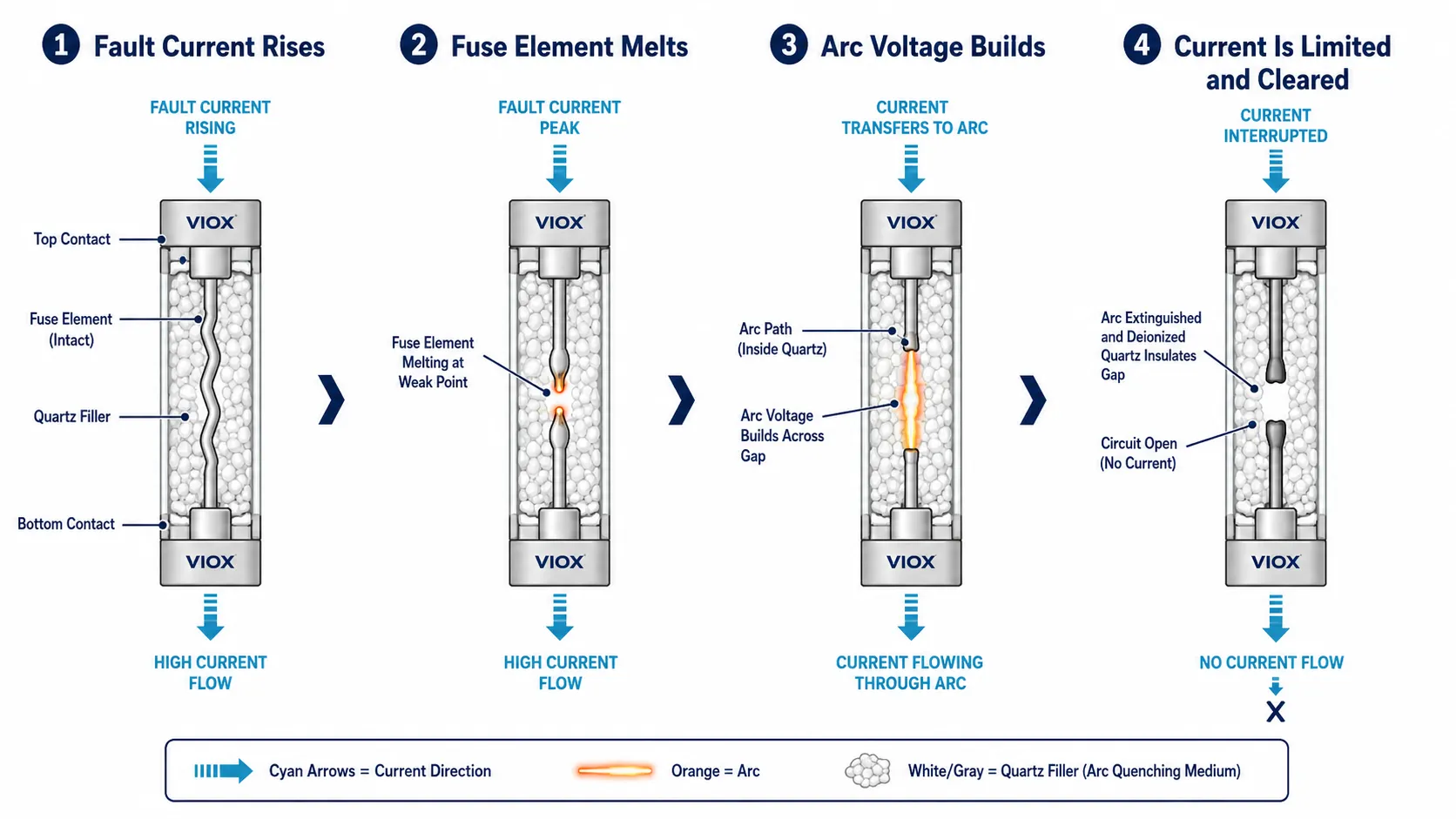
A current-limiting fuse can protect faster in short-circuit conditions because it has no latch, handle, spring mechanism, or reset system to move. The fuse element itself is the sensing and interrupting element.
When fault current rises rapidly:
- The fuse element heats according to I²t.
- The element melts at designed weak points.
- The fuse creates arc voltage inside the cartridge.
- The arc is quenched by the fuse body and filler material.
- The current is limited before the full prospective peak is reached.
This is especially useful for:
- semiconductor protection
- drives and rectifiers
- UPS and power electronics
- control panels needing higher short-circuit current rating (SCCR)
- compact equipment where reducing let-through energy matters
- circuits where downstream contact welding must be avoided
Why MCBs Are Still Better in Many Circuits
MCBs are widely used because they are resettable, compact, easy to operate, and convenient for branch-circuit protection.
An MCB is often the better practical choice when:
- the circuit needs frequent maintenance switching
- the user needs quick reset after fault correction
- the installation is a residential or commercial distribution board
- visual ON/OFF/TRIP indication is useful
- standardized DIN rail modular protection is preferred
- the fault level is within the MCB breaking capacity
- coordination with downstream loads is not extremely energy-sensitive
This is why the answer to “is MCB better than fuse?” is not universal. An MCB is better for convenience and resettable protection. A fuse may be better for fast energy limitation.
Fuse vs MCB for Overload and Short Circuit
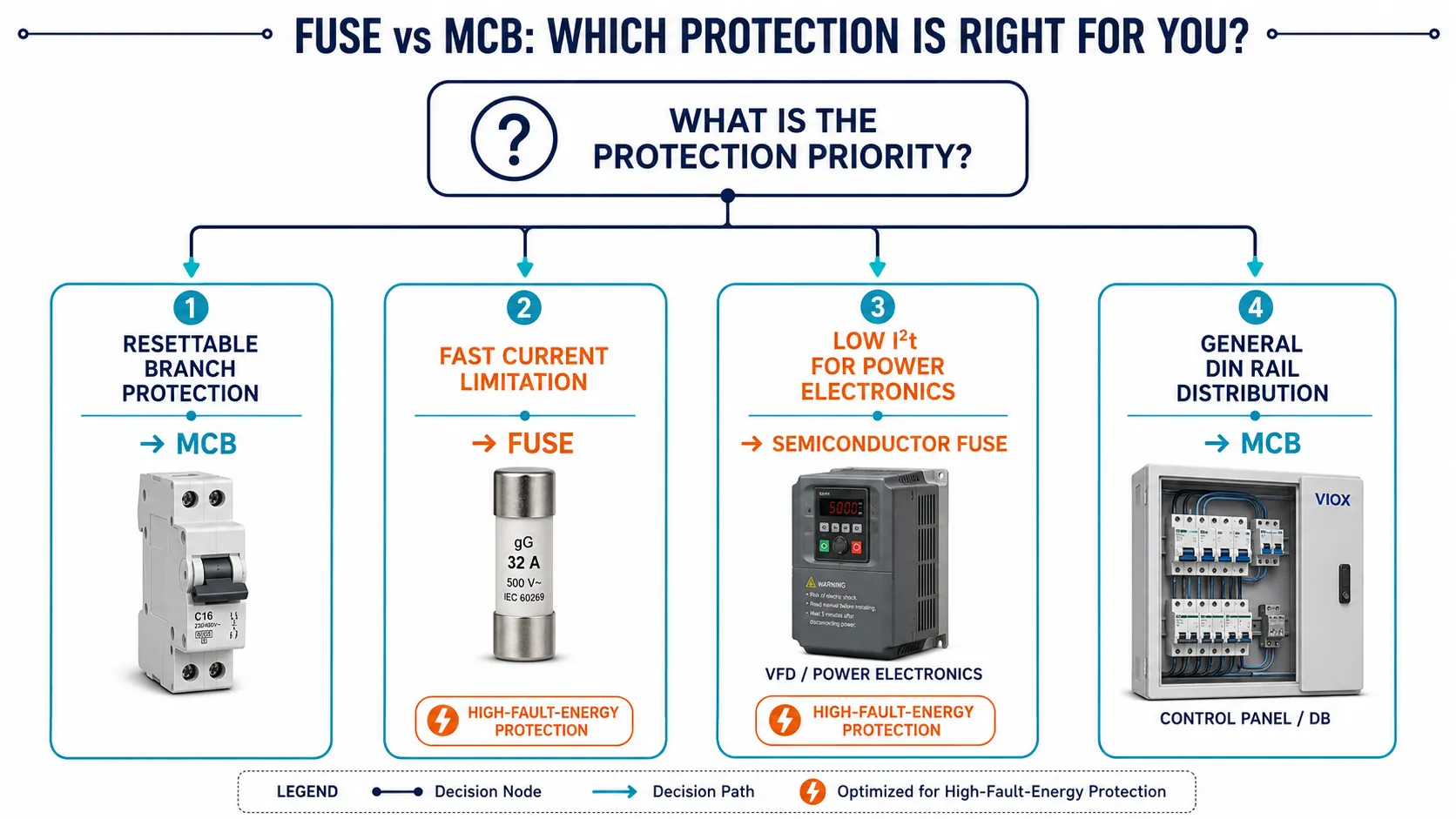
| Protection Requirement | Better Fit | Reason |
|---|---|---|
| Fast high short-circuit current limitation | Current-limiting fuse | Lower peak let-through current and I²t when properly selected |
| Reset after fault | MCB | No replacement fuse needed |
| Standard branch circuit protection | MCB | Convenient operation and familiar installation |
| Semiconductor protection | Semiconductor fuse / ultra-fast fuse | Better I²t coordination with power electronic devices |
| Motor branch circuit short-circuit protection | Fuse or breaker, depending on design | Must coordinate with contactor, overload relay, and motor starter design |
| High SCCR control panel | Often fuse-based protection helps | Current limitation can improve panel short-circuit rating when correctly documented |
| Frequent nuisance operation risk | Depends on curve | Wrong fuse or wrong MCB curve can both cause problems |
For motor-panel retrofit decisions, see VIOX’s fuse-to-breaker retrofit guide.
MCB Trip Curves vs Fuse Curves
MCBs are often selected by trip curve. Common IEC-style MCB trip curves include:
| MCB Curve | Typical Magnetic Trip Range | Common Use |
|---|---|---|
| B curve | 3-5 × rated current | Resistive loads, low inrush circuits |
| C curve | 5-10 × rated current | General commercial and light industrial loads |
| D curve | 10-20 × rated current | High inrush loads, transformers, motors |
| K curve | Higher inrush industrial loads | Motors and inductive loads depending on manufacturer |
| Z curve | Low magnetic threshold | Sensitive electronic circuits depending on application |
Fuses are selected by fuse class and curve, such as gG/gL for general cable protection, aM for motor short-circuit protection, and gR/aR for semiconductor protection. These curves are not interchangeable.
The mistake is assuming “same ampere rating = same protection.” A 32A fuse and a 32A MCB can behave very differently during overload and short-circuit faults.
Standards and Datasheet Terms to Check
Fuse vs MCB response time should be checked from datasheets and time-current curves, not from a generic rule. The applicable standard depends on the device type and market.
| Device or Topic | Common Standard Context | What to Check in the Datasheet |
|---|---|---|
| Low-voltage fuse | IEC 60269 series or relevant UL fuse standard | Rated voltage, utilization category, breaking capacity, time-current curve, melting I²t, clearing I²t |
| Household and similar MCB | IEC 60898-1 or regional equivalent | Rated current, B/C/D curve, rated short-circuit capacity, voltage rating |
| Industrial circuit breaker | IEC 60947-2 or relevant UL/NEMA framework | Icu, Ics, trip unit type, instantaneous setting, let-through data if provided |
| Semiconductor fuse | Manufacturer fuse class and device data | Pre-arcing I²t, total clearing I²t, peak let-through current, voltage rating |
| Panel coordination | Project specification and local code | SCCR, selectivity, backup protection, upstream/downstream coordination |
This is also where buyer mistakes happen. A catalog headline such as “10 kA breaker” or “high breaking capacity fuse” does not tell the full response-time story. For response time and energy limitation, the curve and I²t data matter more than the product name.
Simple Difference Between Fuse and MCB
For a quick classroom or buyer-level answer, the difference is simple:
| Item | Fuse | MCB |
|---|---|---|
| Full meaning | Protective device with a melting element | Miniature circuit breaker |
| Operation | Fuse element melts during overcurrent | Internal trip mechanism opens contacts |
| After operation | Must be replaced | Can be reset after fault correction |
| Short-circuit speed | Can be very fast if current-limiting type | Fast magnetic trip, but mechanical opening is involved |
| Best feature | Low let-through energy in high faults | Convenience and resettable protection |
| Main limitation | Replacement required | May not limit energy as strongly as a current-limiting fuse |
So, an MCB is not simply a “modern fuse.” It is a different protection device with a different operating principle, response curve, and maintenance behavior.
When to Use a Fuse
Use a fuse when the design priority is:
- current limitation
- low I²t let-through energy
- semiconductor protection
- high short-circuit fault capability
- compact high-energy protection
- backup protection for switching devices
- improving SCCR through documented protection coordination
Fuses are also useful when a non-resettable protective action is preferred because the fault must be inspected before the circuit is restored.
When to Use an MCB
Use an MCB when the design priority is:
- resettable circuit protection
- branch circuit convenience
- clear manual switching
- DIN rail modular installation
- residential or commercial distribution
- easy maintenance and troubleshooting
- common B/C/D curve selection
For many low-voltage boards, the MCB is not chosen because it is always faster. It is chosen because it provides practical, resettable protection with predictable installation behavior.
When to Use Both a Fuse and an MCB
In some systems, fuses and breakers are used together. This is not duplication when each device has a different job.
Examples include:
- upstream fuse for high fault current limitation, downstream MCB for branch protection
- fuse backup protection for switch-disconnectors or contactors
- semiconductor fuse protecting a drive, with breaker providing feeder switching
- fuse protecting high-energy short circuits while MCB protects smaller downstream circuits
The important point is coordination. The upstream and downstream devices must be selected so that the correct device operates first under the intended fault condition.
Common Fuse vs MCB Selection Mistakes
| Mistake | Why It Is a Problem |
|---|---|
| Assuming fuses are always faster | Fuses are faster mainly in high fault current and current-limiting conditions |
| Assuming MCBs are always better because they are resettable | Reset convenience does not mean lower let-through energy |
| Matching only ampere rating | Time-current curve, voltage rating, breaking capacity, and I²t also matter |
| Replacing a semiconductor fuse with an MCB | The MCB may not protect the semiconductor before damage occurs |
| Ignoring breaking capacity | The device must safely interrupt the available fault current |
| Using the wrong MCB curve | Wrong curve can cause nuisance trips or delayed short-circuit protection |
| Ignoring coordination | Upstream and downstream devices may not operate in the intended order |
Fuse vs MCB: Quick Selection Checklist
Before choosing between a fuse and an MCB, check:
- system voltage: AC or DC
- rated current
- available short-circuit current
- required breaking capacity
- load type: cable, motor, transformer, semiconductor, heater, power supply
- inrush current
- required reset behavior
- time-current curve
- I²t or let-through energy
- SCCR requirement
- upstream and downstream coordination
- applicable standard and project specification
FAQ
Is a fuse faster than an MCB?
A current-limiting fuse is usually faster than an MCB during high short-circuit current conditions. For overloads or low-level faults, the answer depends on the fuse curve, MCB trip curve, and fault current level.
What is fuse clearing time?
Fuse clearing time is the total time required for a fuse to interrupt a fault. It includes melting time, also called pre-arcing time, plus arcing time.
What is MCB trip time?
MCB trip time is the time required for the breaker to detect overcurrent, release the trip mechanism, open the contacts, and extinguish the arc.
What does I²t mean in a fuse?
I²t means ampere-squared seconds. It describes thermal energy let through during fuse operation and is especially important for semiconductor, drive, UPS, and high-fault-energy circuits.
Are current-limiting fuses faster than circuit breakers?
In high short-circuit faults, current-limiting fuses can be faster and can reduce peak let-through current more effectively. But device curves and fault level must be checked.
Is an MCB better than a fuse?
An MCB is better when resettable protection and user convenience matter. A fuse can be better when fast current limitation, low I²t, or semiconductor protection is required.
Can I replace a fuse with an MCB?
Not automatically. Check voltage rating, current rating, breaking capacity, trip curve, I²t, SCCR, and coordination. A fuse and an MCB with the same ampere rating may not provide the same protection.
What is the term for how long a fuse or breaker takes to open at different current values?
The term is time-current characteristic or time-current curve. It shows operating time at different multiples of rated current.
Why are fuses still used if MCBs can be reset?
Fuses are still used because they can provide strong current limitation, high interrupting capacity, low let-through energy, and excellent protection for power electronics when correctly selected.
Conclusion
Fuse vs MCB response time is not a single fixed number. A current-limiting fuse can clear severe short-circuit faults faster and with lower I²t let-through energy than many MCBs. An MCB, however, is resettable, convenient, and well suited for many branch circuits.
For engineering selection, compare time-current curves, breaking capacity, load type, and coordination requirements. The fastest device is not always the best device; the best device is the one that interrupts the fault safely while protecting the cable, equipment, and downstream components.