On this page
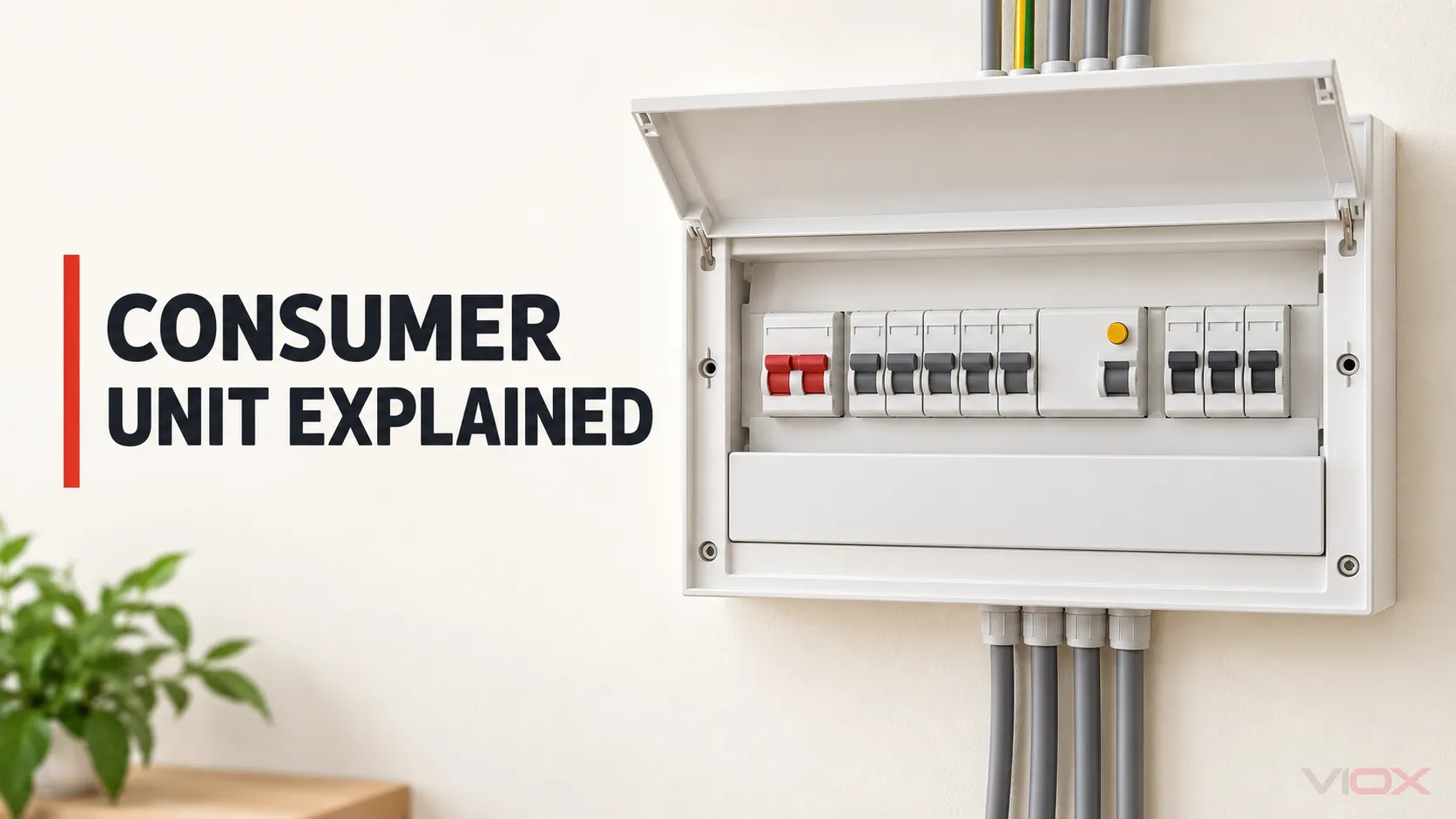
A consumer unit is a low-voltage distribution board that receives an incoming electrical supply and divides it into protected outgoing circuits. It provides a common enclosure for the main switching device, distribution system, terminals, and protective devices serving circuits such as lighting, socket outlets, heating, cooking equipment, or dedicated loads.
The term is used mainly in the United Kingdom and related markets. Elsewhere, similar equipment may be called a distribution board, breaker panel, panelboard, load centre, or fuse box. These names are not always technically interchangeable because product standards, supply systems, device formats, and installation rules differ by market.
The consumer unit itself is not one universal protective device. Its protection depends on the components installed inside the verified assembly.
Where the Consumer Unit Sits in the Electrical System
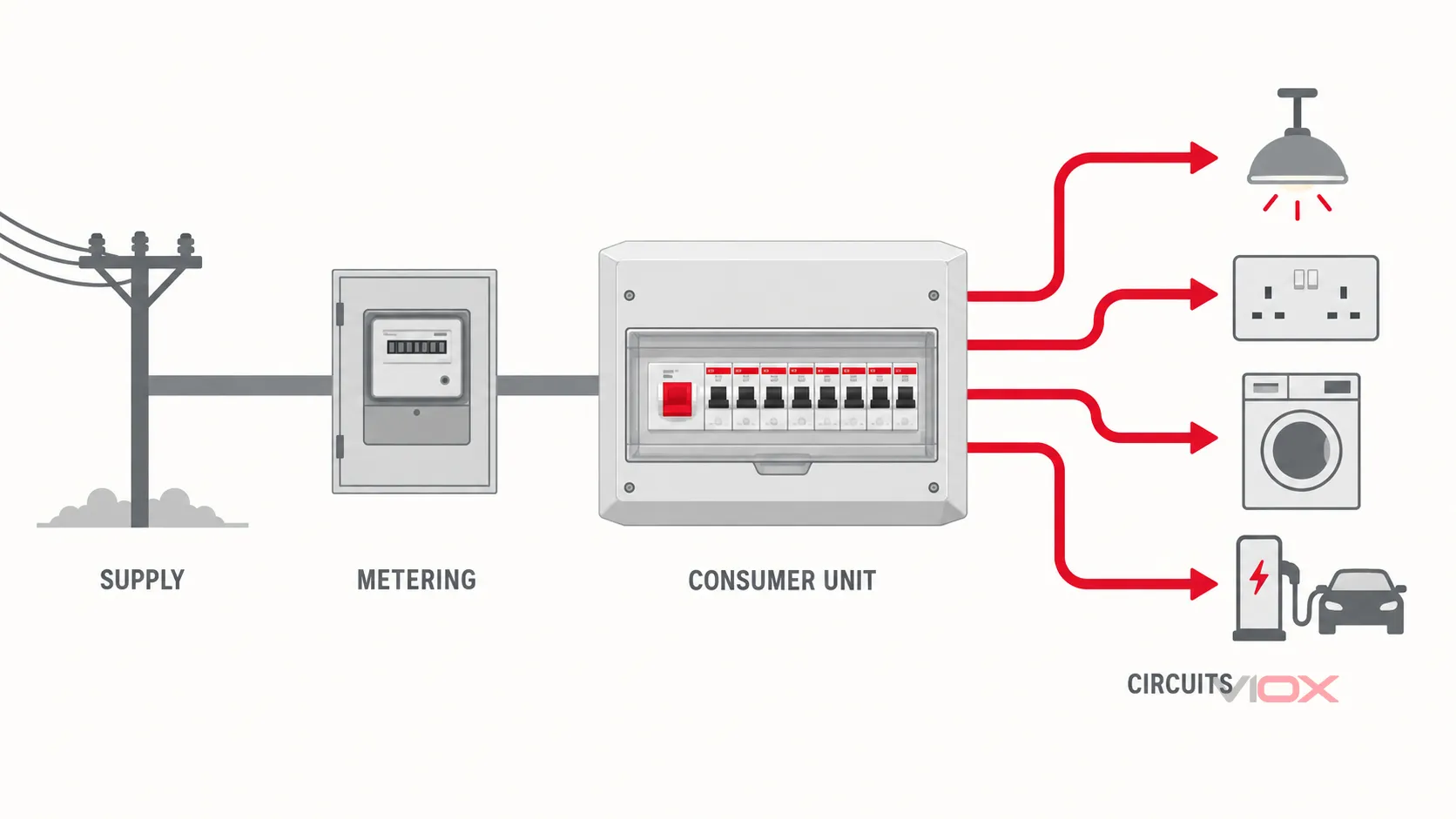
In a typical installation, electrical energy passes through the supply and metering equipment before reaching the consumer unit. The consumer unit then distributes that supply to separate final circuits.
Supply → metering and service equipment → consumer unit → outgoing circuits → connected loads
The exact ownership and isolation boundaries vary by country and utility. Supply-company equipment, meters, service fuses, isolators, and the consumer’s installation must not be treated as one interchangeable system.
For assemblies within its scope, IEC 61439-3:2024 defines specific requirements for distribution boards intended to be operated by ordinary persons. National product standards and installation rules may add or modify requirements, so a generic consumer-unit label does not prove suitability for a particular country or project.
Main Consumer Unit Components
| Component | Primary function | Important boundary |
|---|---|---|
| Enclosure and internal supports | Houses and supports the assembly components | Material alone does not prove assembly verification or correct thermal performance |
| Main switch or incomer | Provides the specified incoming switching or isolation function | It is not automatically an overcurrent or residual-current protective device |
| Busbar or distribution system | Distributes supply to outgoing protective devices | Compatibility depends on the documented assembly system, not DIN-rail fit alone |
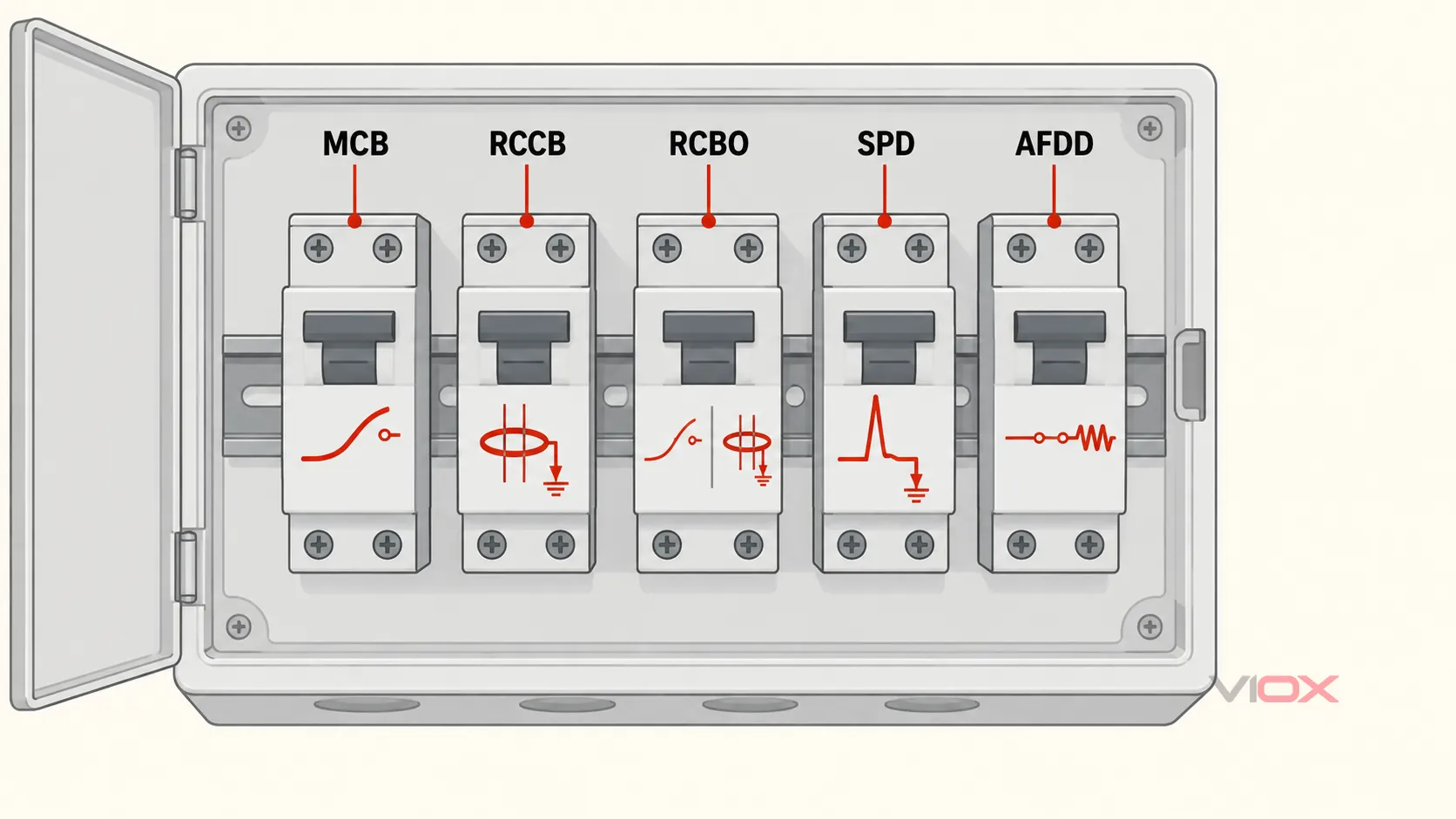
| MCB | Protects an outgoing circuit against overload and short circuit within its declared conditions | It does not provide residual-current protection |
| RCCB/RCD | Provides residual-current protection to one or more circuits | It normally requires separate overcurrent protection |
| RCBO | Combines residual-current and overcurrent protection for one circuit | Type, sensitivity, curve, current, poles and breaking capacity still require selection |
| SPD | Limits specified transient overvoltages within a coordinated protection design | It does not replace circuit overcurrent or residual-current protection |
| AFDD | Detects specified arc-fault signatures under its product scope | It does not replace every other protective function |
| Neutral and protective-conductor terminals | Provide defined termination points for circuit conductors | Neutral routing must match the residual-current architecture |
| Blanks, labels and barriers | Close unused openings and identify circuits or functions | Missing or unsuitable parts can compromise the completed assembly |
Not every consumer unit contains every component. The applicable installation rules, circuit schedule, project risk assessment, and verified assembly determine the final configuration.
What Does a Consumer Unit Protect Against?
The enclosure provides a location for protective and switching devices, but the installed devices determine which conditions are addressed.
| Electrical condition | Device that may provide the function | What must still be verified |
|---|---|---|
| Circuit overload | MCB, RCBO, fuse, or another suitable overcurrent device | Load current, conductor capacity, device characteristic, and installation rules |
| Short circuit | MCB, RCBO, fuse, or another suitable short-circuit device | Prospective fault current, breaking capacity, disconnection time, and coordination |
| Residual current | RCCB/RCD or RCBO of the required type and sensitivity | Waveform, IΔn, earthing arrangement, leakage budget, and circuit scope |
| Transient overvoltage | Coordinated SPD arrangement | Supply system, exposure, SPD type, backup protection, installation and local rules |
| Specified arc-fault conditions | AFDD where required and correctly applied | Circuit type, product scope, installation requirements, and coordination |
| Manual isolation | Main switch or other suitable switching device | Which conductors are switched and whether the device is suitable for the intended function |
A consumer unit does not automatically protect against every shock, fire, overvoltage, power-quality, wiring, or equipment hazard. Earthing, bonding, conductor selection, circuit division, equipment protection, inspection, testing, and maintenance remain part of the complete installation.
Common Consumer Unit Architectures
The following descriptions are orientation-level summaries. The permitted design depends on the market and project.
Main Switch with Individual Overcurrent Devices
In this arrangement, a main switch feeds individual MCBs or fuses. Residual-current protection may be absent, provided elsewhere, or added only to defined circuits. This architecture can be encountered in older installations or systems governed by different requirements.
Its presence does not by itself prove that the installation is unsafe or requires immediate replacement. Condition, circuit use, earthing, test results, alterations, and current requirements determine the assessment.
Split-Load or Dual-RCD Consumer Unit
Circuits are divided into groups. Each group is protected by an RCCB/RCD, while individual MCBs provide overcurrent protection. A residual-current fault on one circuit can disconnect the other circuits supplied through the same RCD.
This arrangement can be cost-effective, but circuit division, standing leakage, selectivity, neutral routing, and the consequences of losing a group of circuits require consideration.
RCBO Consumer Unit
Each outgoing circuit uses an individual RCBO, combining residual-current and overcurrent protection at circuit level. This normally improves fault separation because one circuit’s residual-current operation does not depend on a shared RCD protecting several unrelated circuits.
The complete choice involves much more than fitting RCBOs. The incomer, ways, SPD, optional AFDDs, fault rating, thermal limits, busbar, terminals, approvals, circuit schedule, and documentation must form a verified assembly. Use the dedicated RCBO consumer unit selection guide for the board-level workflow.
Mixed or High-Integrity Arrangements
Some boards combine shared RCD groups, individual RCBOs, main-switch ways, SPDs, AFDDs, or special-purpose devices. A mixed arrangement can serve a defined circuit-division strategy, but the configuration should be read from its actual schedule and diagrams rather than inferred from a marketing label.
Ratings and Markings to Recognize
Before evaluating a consumer unit, distinguish these fields:
- rated voltage and frequency: the supply conditions for which the assembly and devices are declared;
- rated current: the current capability of the incomer, assembly, busbar, terminals, and protective devices under their respective conditions;
- number of ways and modules: circuit positions and physical device space, which are not necessarily the same;
- short-circuit rating: the declared fault-current capability of devices or the complete assembly under stated conditions;
- RCBO/RCD sensitivity
IΔn: the rated residual operating current; - residual-current type: AC, A, F, or B waveform capability where applicable;
- trip curve: the overcurrent characteristic, such as B, C, or D for relevant devices;
- pole and neutral arrangement: conductors monitored, protected, switched, and terminated;
- IP rating and environmental limits: enclosure protection and permitted installation conditions; and
- standards and approvals: the product, assembly, national, and project documents that apply.
Do not treat a 100 A main switch, 30 mA RCBO, 10 kA breaker, and 12-way enclosure as interchangeable ratings. Each describes a different part of the design.
When Does a Consumer Unit Need Professional Assessment?
Arrange an assessment when there is visible damage, overheating, burning odor, water ingress, missing covers, exposed accessible parts, repeated unexplained tripping, inadequate labels, known alterations, insufficient capacity for proposed work, or uncertainty about residual-current protection.
Age, a plastic enclosure, or the presence of rewireable fuses does not by itself establish the complete condition of the installation. An inspection and appropriate testing are needed before deciding whether to retain, repair, alter, or replace the board. The VIOX guide on how to tell if an old consumer unit needs upgrading separates observable warning signs from the evidence required for a replacement decision.
Where replacement is planned, existing circuits should be assessed before the new board is selected. Electrical Safety First’s Best Practice Guides include guidance on replacing consumer units in domestic premises. In England, Approved Document P explains the building-regulation framework for electrical work in dwellings.
Consumer Unit Knowledge Map
Use the page that matches the task you need to complete:
| Reader question | VIOX resource |
|---|---|
| What does an RCBO do and what faults does it cover? | What Is an RCBO? |
| How do I specify a complete board using individual RCBOs? | RCBO Consumer Unit Guide |
| How do I choose the ratings for one RCBO circuit? | How to Select the Right RCBO |
| Should the board use individual RCBOs or a shared RCCB plus MCBs? | RCBO vs RCCB Plus MCB |
| Does an old board need replacement? | Old Consumer Unit Assessment Guide |
| What is involved in an old fuse-box-to-RCBO upgrade? | Old Fuse Box to RCBO Consumer Unit |
| How do 1P+N, 2P, 3P+N, and 4P RCBO arrangements differ? | RCBO Wiring Diagrams |
Technical References
- IEC 61439-3:2024 — Distribution boards intended to be operated by ordinary persons
- Electrical Safety First — Best Practice Guides
- GOV.UK — Approved Document P: Electrical safety in dwellings
For component-level procurement, review the documented VIOX RCBO range only after the circuit and assembly requirements are known. The exact protective device must match the board system, circuit schedule, destination-market approvals, and manufacturer documentation.