

On this page
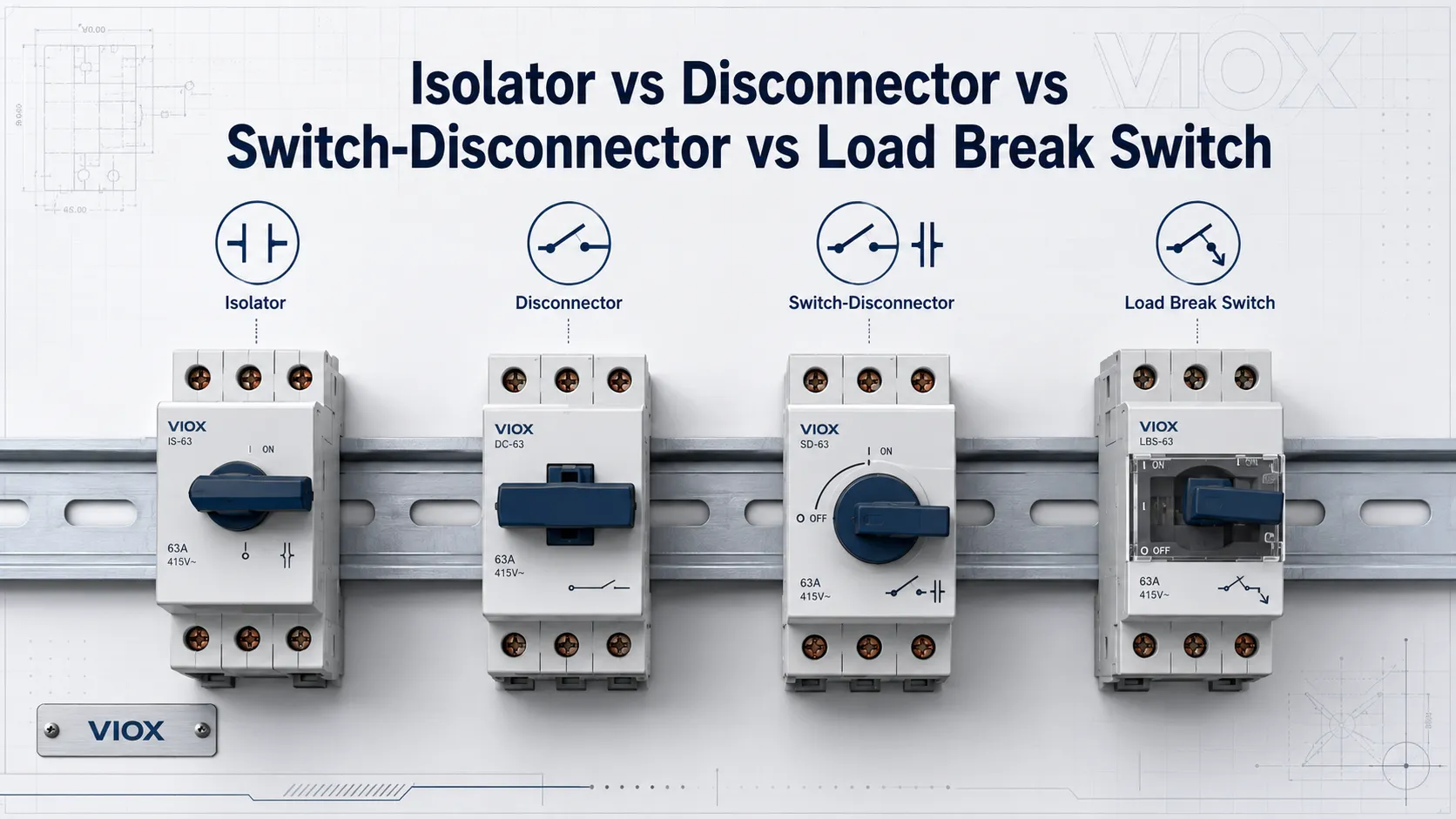
An isolator or disconnector primarily provides safe electrical isolation when open; a switch-disconnector provides both isolation and rated load switching; a load break switch is designed to make and break normal load current; and a disconnect switch is a broad term, especially common in North American wording, for a device used to disconnect power.
The confusing part is that these terms are often used loosely in catalogs, drawings, and site discussions. In engineering selection, however, the name alone is not enough. You must check the device’s rated voltage, rated operational current, utilization category, isolation function, short-circuit coordination, and whether it is approved for AC or DC use.
Scope note: This article focuses mainly on low-voltage switchgear and controlgear, especially IEC 60947-3 style terminology used for switches, disconnectors, switch-disconnectors, and fuse-combination units. Medium-voltage and high-voltage equipment may use related words, but the applicable standards, test duties, construction, and safety procedures are different, such as the IEC 62271 series for high-voltage switchgear.
Quick Comparison Table
| Term | Simplified circuit-symbol idea | Core meaning | Can break load current? | Main purpose | Typical use |
|---|---|---|---|---|---|
| Isolator | Open contact with isolation gap marker | General term for a device used to isolate a circuit | Depends on design and rating | Safe maintenance isolation | Distribution boards, machinery, PV systems |
| Disconnector | IEC-style open contact / isolation function symbol | Device that provides isolation in the open position | Usually no, unless rated otherwise | Off-load isolation | Switchgear, panels, maintenance isolation |
| Switch-disconnector | Switch symbol plus isolation function marker | Device combining switching function and isolation function | Yes, within rated duty | Load switching plus safe isolation | LV panels, main switches, industrial equipment |
| Load break switch | Switch symbol emphasizing load switching | Switch designed to make and break normal load current | Yes | Switching normal load current | Feeders, transformer circuits, distribution systems |
| Disconnect switch | Varies by regional drawing practice | Broad North American/general term for disconnecting power | Depends on type | Disconnecting means for service or safety | HVAC, machines, panels, solar systems |
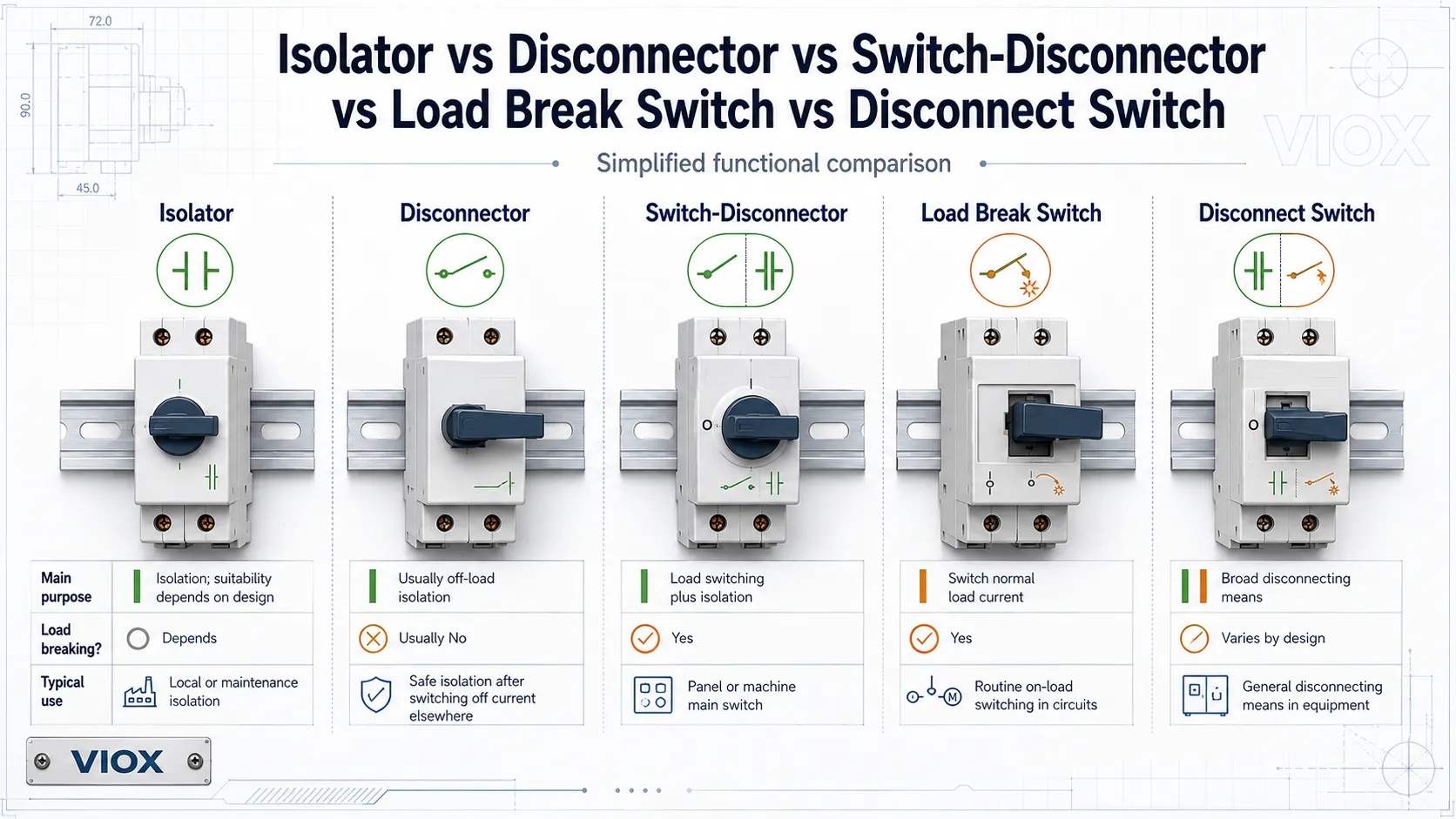
If you are comparing these devices with overcurrent protection, see Circuit Breaker vs Isolator Switch. A circuit breaker and an isolating switch do not perform the same job.
Circuit Symbols: Why Drawings Can Be Clearer Than Words
In electrical drawings, the symbol often communicates the function more clearly than the product nickname. Exact symbols vary by drawing standard and company convention, but the functional idea is usually consistent:
| Function shown on drawing | What the symbol is trying to tell you | Selection implication |
|---|---|---|
| Disconnector / isolating function | The open position provides a defined isolation gap | Suitable for isolation only if the product is marked/rated for isolation |
| Switching function | The device is intended to make or break a circuit under stated conditions | Check rated operational current and utilization category |
| Switch-disconnector | The device combines switching and isolation functions | Check both load switching duty and isolation suitability |
| Fuse-switch-disconnector | Switching/isolation function combined with fuse protection | Check fuse class, coordination, and load-breaking rating |
| Circuit breaker | Protective switching device with automatic tripping | Check breaking capacity, trip unit, and isolation marking if used as isolator |
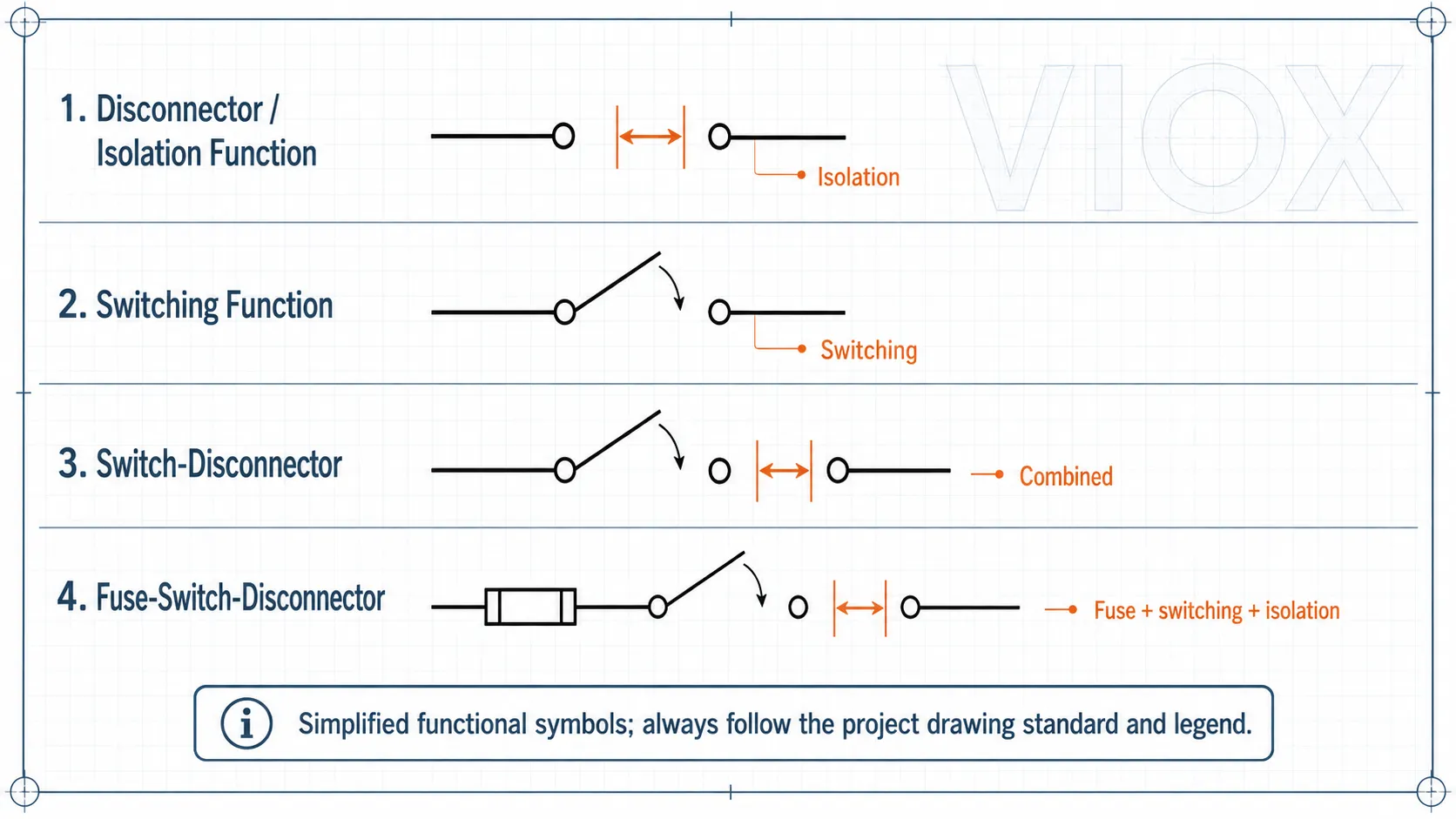
This is also why a symbol legend matters on international projects. A drawing that uses “disconnect switch” wording may still need the procurement team to confirm whether the actual device is a disconnector, switch-disconnector, fused disconnect, or circuit breaker.
Why These Terms Are Often Confused
The confusion comes from three sources.
First, different regions use different words. IEC documents and many international catalogs often use disconnector and switch-disconnector. North American documentation often uses disconnect switch, safety switch, or disconnecting means. Many installers use isolator as a practical field term.
Second, manufacturers often sell devices that combine functions. A product may be marketed as an isolator switch, but its datasheet may show that it is actually a switch-disconnector capable of load switching under a specified utilization category.
Third, the same enclosure style can hide very different capabilities. Two rotary handles may look similar from outside a cabinet, but one may be an off-load disconnector while another may be a load-break switch-disconnector.
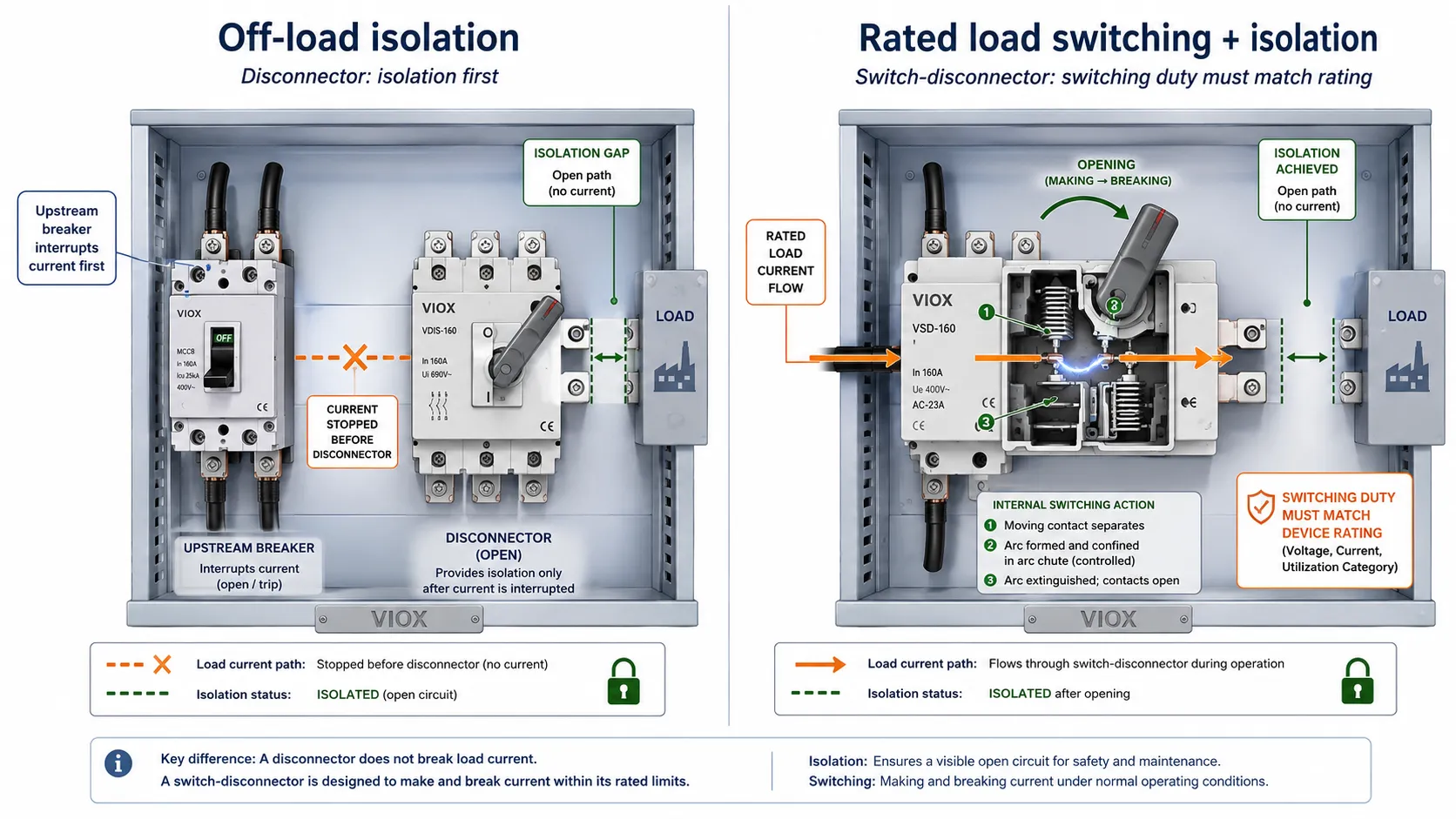
That is why the correct question is not only “What is it called?” The correct question is:
What current, voltage, load type, and switching duty is this device rated to perform?
What Is an Isolator?
An isolator is a device used to isolate a circuit or item of equipment from the power source so maintenance can be performed more safely. In practice, the term is broad. It may refer to a simple off-load isolating device, a rotary isolator switch, a DC isolator for solar PV, or a switch-disconnector used as a main switch.
The key point is that isolation is about the open position. A proper isolating device must provide a defined separation between supply and load when open, and it should be lockable or otherwise secured where maintenance safety requires it.
However, not every device called an isolator is suitable for switching current under load. Some isolators must be operated only after the circuit current has already been interrupted by another device, such as a circuit breaker, contactor, or fuse-switch arrangement.
For DC applications, the selection boundary is even stricter. A DC isolator must be rated for the actual DC voltage, current, pole arrangement, and utilization category. DC arcs do not benefit from AC zero crossing, so an AC isolator should not be assumed suitable for PV, battery, or DC distribution duty. For a deeper DC/AC comparison, see DC Isolator vs AC Isolator Switch.
What Is a Disconnector?
A disconnector is the more formal IEC-style term for a device that provides isolation in the open position. Its primary role is to create a safe separation point after the circuit has been de-energized.
In strict usage, a disconnector is normally an off-load device. It is not intended to interrupt normal load current or fault current unless the datasheet specifically states a suitable making and breaking rating.
This distinction matters in switchgear and maintenance procedures. Opening a pure disconnector while current is flowing can create dangerous arcing, contact damage, and equipment failure. In many systems, the correct sequence is:
- Use the circuit breaker, contactor, or load-break device to interrupt current.
- Open the disconnector to provide isolation.
- Apply locking, verification, and grounding procedures as required by the installation.
The term disconnector is sometimes used interchangeably with isolator, but in engineering documents it is better to read it as: isolation function first, switching function only if rated.
What Is a Switch-Disconnector?
A switch-disconnector combines two functions:
- switching function: it can make and break current under specified rated conditions
- disconnector function: it provides isolation when open
This is the device many panel builders actually need when they want a main switch for a low-voltage control cabinet or distribution board. It can be used to switch a circuit during normal operation and provide an isolation point for maintenance, provided the selected model matches the load duty.
The important phrase is under specified rated conditions. A switch-disconnector is not automatically suitable for every load. Its datasheet should be checked for:
- rated operational voltage
- rated operational current
- utilization category, such as AC-21, AC-22, AC-23, DC-21, DC-22, or DC-23
- short-circuit making capacity where relevant
- conditional short-circuit current rating with upstream fuse or breaker
- number of poles and neutral switching arrangement
- suitability for isolation
For low-voltage panels, this is often the most practical distinction: a disconnector isolates; a switch-disconnector switches and isolates.
What Is a Load Break Switch?
A load break switch is a switch designed to make and break normal load current. The phrase is common in both low-voltage and medium-voltage power distribution, but the voltage class must not be blurred. In low-voltage panels, selection is commonly discussed around IEC 60947-3 style duties. In medium-voltage systems, load-break switches and disconnectors belong to a different equipment family with different insulation media, interlocking, earthing, and test requirements.
The focus of a load break switch is the ability to interrupt normal operating current. It is not the same as a circuit breaker. A load break switch does not usually provide automatic overload or short-circuit protection unless it is part of a fused or protected assembly.
Typical use cases include:
- feeder switching
- transformer switching
- main incoming switching
- manual load transfer arrangements
- distribution circuits where normal load current must be switched
In IEC low-voltage selection, load switching capability is commonly tied to utilization categories. For example, AC-21 is associated with resistive loads, AC-22 with mixed resistive and inductive loads, and AC-23 with motor or highly inductive load switching. The exact rating must come from the product datasheet.
What Is a Disconnect Switch?
A disconnect switch is a broad term used especially in North American and general international language. It usually means a device that disconnects power for service, maintenance, emergency access, or local isolation.
But the term does not tell you enough by itself. A disconnect switch may be:
- non-fused or fused
- load-break or non-load-break
- AC-only or DC-rated
- enclosed or open type
- manually operated or motor-operated
- suitable or not suitable for service entrance or local equipment isolation, depending on code and listing
In other words, “disconnect switch” is more of a functional phrase than a precise engineering classification. Always confirm the ratings and standard markings before assuming what it can do.
For related selection boundaries, see Fused vs Non-Fused Disconnect Switches and Fuse Holder vs Fuse Switch Disconnector.
Main Differences in One Engineering Table
| Selection point | Disconnector / isolator | Switch-disconnector | Load break switch | Circuit breaker |
|---|---|---|---|---|
| Primary role | Isolation | Switching + isolation | Load current switching | Protection + switching |
| Normal load breaking | Not unless rated | Yes, within rating | Yes, within rating | Yes, within rating |
| Fault current interruption | No | No, unless coordinated/defined by assembly | No, unless specifically protected | Yes, up to breaking capacity |
| Automatic trip function | No | No | No | Yes |
| Isolation function | Yes if suitable for isolation | Yes | Depends on product | Only if marked/rated for isolation |
| Typical standard context | IEC 60947-3 | IEC 60947-3 | IEC 60947-3 or other voltage-class standard | IEC 60947-2, IEC 60898-1, UL 489, etc. |
| Main selection risk | Opening under load | Wrong utilization category | Treating it as short-circuit protection | Treating protection as visible isolation |
This is why a switch-disconnector and a circuit breaker often appear together in industrial panels. The breaker handles overcurrent protection. The switch-disconnector provides manual switching and isolation, depending on the design.
IEC vs North American Terminology
IEC and North American terminology do not always map one-to-one.
| Concept | Common IEC wording | Common North American/general wording | Practical interpretation |
|---|---|---|---|
| Isolation only | Disconnector | Disconnect switch / isolating switch | Creates an open isolation point, usually off-load |
| Switching + isolation | Switch-disconnector | Load-break disconnect / disconnect switch rated for load | Can switch load and isolate if rated |
| Load switching | Switch, load break switch | Load break switch | Makes/breaks normal load current |
| Protection | Circuit breaker | Circuit breaker | Interrupts fault current within rating |
| Fuse + isolation/switching | Fuse-switch-disconnector | Fused disconnect switch | Fuse protection plus disconnecting/switching function depending on design |
For global projects, avoid translating terms too literally. A drawing note that says “isolator” may mean a pure isolating device in one project and a load-break switch-disconnector in another. The datasheet and applicable standard are the final authority.
Utilization Categories: Why They Matter
Load switching is not only about amperes. A 100A resistive load and a 100A motor load do not stress contacts in the same way. Inductive loads create more severe arcing during interruption.
For IEC-style low-voltage switching devices, utilization categories help define the intended switching duty. Common examples include:
| Category | Typical meaning | Practical note |
|---|---|---|
| AC-20 / DC-20 | Connecting and disconnecting under no-load conditions | Not intended for normal load breaking |
| AC-21 / DC-21 | Resistive or slightly inductive loads | General load switching, lower stress |
| AC-22 / DC-22 | Mixed resistive and inductive loads | More demanding than AC-21/DC-21 |
| AC-23 / DC-23 | Motor loads or highly inductive loads | Higher switching stress; must be selected carefully |
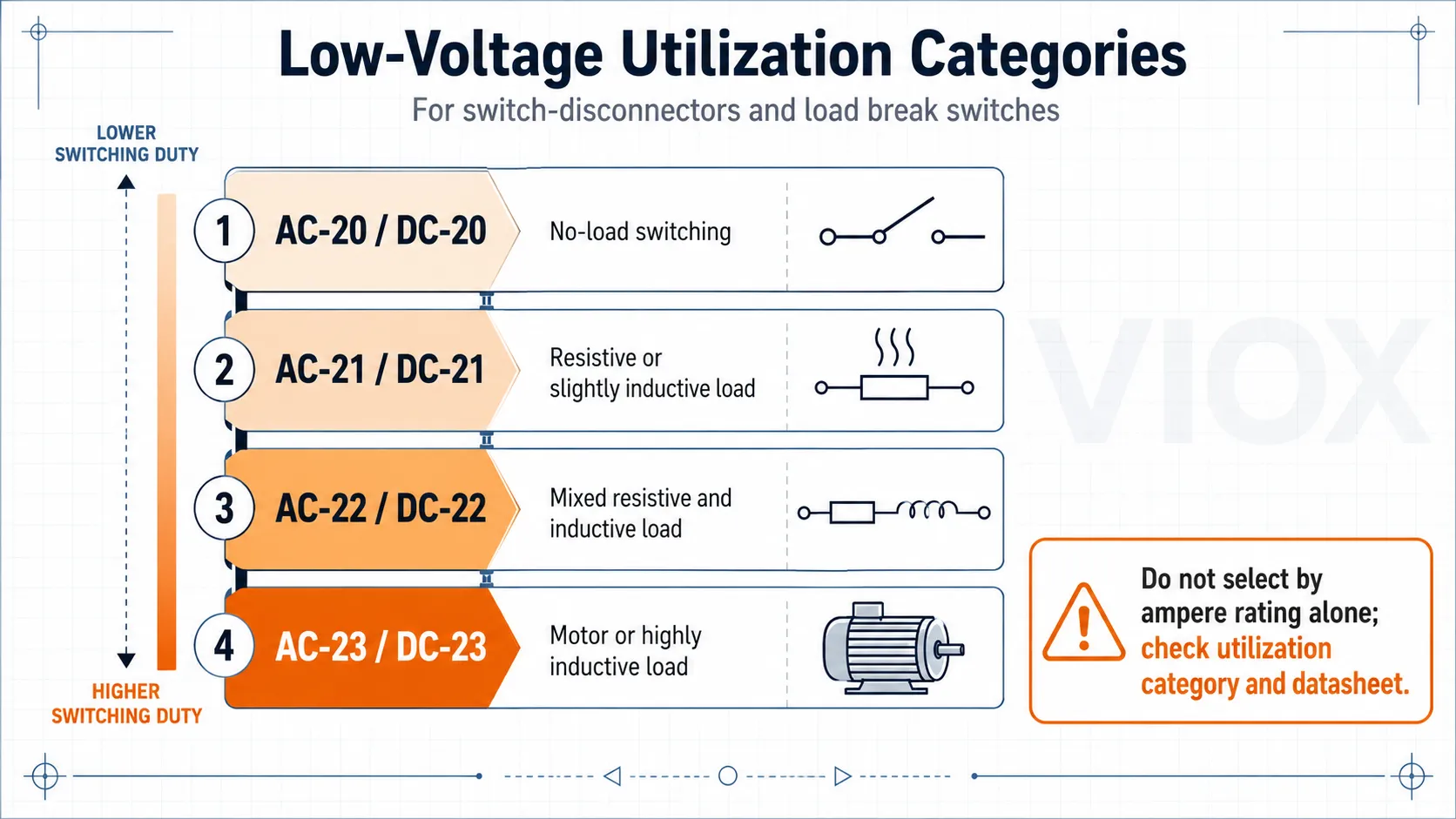
This is one of the most common procurement mistakes. A device may have a high thermal current rating, but that does not automatically mean it can interrupt a high-inrush motor or inductive DC circuit.
Which Device Should You Use?
Use a disconnector or isolator when the circuit is switched elsewhere
Choose this when the device only needs to provide a safe open isolation point after another device has interrupted the current. Typical examples include maintenance isolation points in switchgear or systems where operating sequence is controlled.
Use a switch-disconnector when the panel needs manual switching and isolation
Choose this for many low-voltage main switch and control cabinet applications, provided the utilization category and current rating match the load. This is often the best fit for industrial panels, machinery, and distribution boards where a local handle is required.
Use a load break switch when normal load current must be switched
Choose this when the operating job is to switch normal load current, such as feeders or transformer circuits. Confirm whether the product also provides isolation function if maintenance isolation is required.
Use a circuit breaker when automatic protection is required
Choose a circuit breaker when the device must automatically trip on overload or short-circuit fault current. Do not replace a circuit breaker with a switch-disconnector unless another suitable protective device is provided.
Use a DC-rated device for PV, battery, and DC distribution
DC systems require special attention. The absence of natural current zero crossing makes DC arc interruption more difficult. For PV and battery systems, check DC voltage rating, pole wiring, polarity, utilization category, and whether the device is rated for the specific application. For PV-specific context, see What Is a DC Isolator Switch? and How to Read DC Isolator Switch Ratings.
Common Selection Mistakes
Mistake 1: Assuming every isolator can break load current
This is the most dangerous misunderstanding. Some isolating devices are intended for off-load operation only. If load breaking is required, select a switch-disconnector or load break switch with the correct rating.
Mistake 2: Treating a disconnect switch as a circuit breaker
A disconnect switch may provide a safe disconnection point, but it usually does not provide automatic overload or short-circuit protection. Protection must be provided by a fuse, circuit breaker, or coordinated protective assembly.
Mistake 3: Looking only at current rating
Current rating alone is not enough. The same device may have different ratings under AC-21, AC-22, AC-23, DC-21, DC-22, or DC-23 duties. Always read the utilization category.
Mistake 4: Ignoring short-circuit coordination
Switch-disconnectors and load break switches are often used with upstream fuses or circuit breakers. Check conditional short-circuit ratings and coordination requirements in the datasheet.
Mistake 5: Using AC ratings for DC circuits
An AC load-break rating does not automatically apply to DC. DC switching must be explicitly rated and wired according to the manufacturer’s diagram.
Mistake 6: Assuming visible handles mean visible contacts
A rotary handle or external operator does not necessarily mean visible contact separation. If visible isolation or positive contact indication is required, verify the product construction and standard marking.
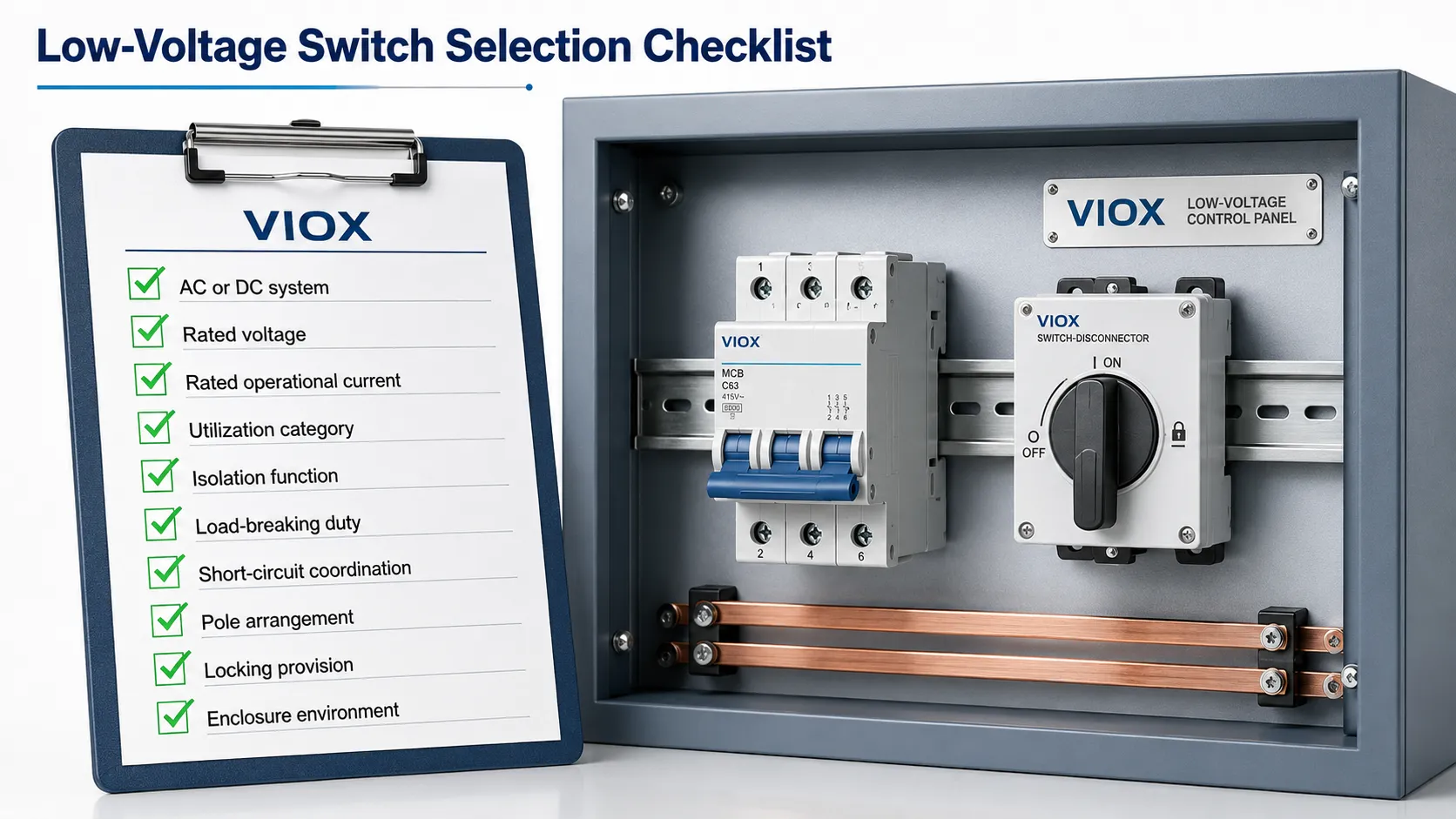
Selection Checklist for Engineers and Buyers
Before specifying any isolator, disconnector, switch-disconnector, load break switch, or disconnect switch, confirm:
| Check | What to verify |
|---|---|
| System type | AC or DC |
| Rated voltage | Must match the system voltage and pole arrangement |
| Rated operational current | Must match load current under the correct duty |
| Utilization category | AC-20/21/22/23 or DC-20/21/22/23 as applicable |
| Isolation function | Device must be suitable for isolation if used for maintenance safety |
| Load breaking | Required if the device will be opened under normal load current |
| Short-circuit coordination | Upstream fuse/breaker and conditional rating must be checked |
| Number of poles | Phase, neutral, and DC pole arrangement must match circuit design |
| Locking provision | Needed for maintenance lockout applications |
| Enclosure rating | Indoor/outdoor, dust, moisture, UV, and installation environment |
| Standard and certification | Must match project, market, and approval requirements |
For VIOX-related product evaluation, see the Isolator Switch, Switch Disconnector, and DC Isolator Switch pages.
FAQ
Can I use an AC-22 switch-disconnector for VFD bypass?
Do not decide from AC-22 alone. A variable frequency drive bypass circuit may involve motor load behavior, inrush, interlocking, and upstream short-circuit coordination. Check the application diagram, utilization category, motor duty, and the manufacturer’s bypass recommendations. Many motor-related switching duties require a more severe rating than a simple mixed-load application.
Is AC-23 always required for motor circuits?
Not always, but motor and highly inductive loads are more demanding than resistive loads. If the device will make or break motor current directly, AC-23 or another manufacturer-specified motor-duty rating may be required. If the motor current is switched by a contactor and the isolating device is opened only off-load, the requirement may be different.
Can a switch-disconnector replace a circuit breaker in a panel?
Only if another correctly rated protective device provides overload and short-circuit protection. A switch-disconnector can switch and isolate, but it does not automatically trip like a circuit breaker.
Why does my drawing show a disconnect switch but the BOM lists a switch-disconnector?
This is common in international projects. “Disconnect switch” may be used as a functional drawing label, while the purchased device is specified as a switch-disconnector to ensure both load switching and isolation. The bill of materials should follow the required ratings, not only the drawing nickname.
Can I use an AC load break switch for DC?
Not unless the device is explicitly rated for DC at the required voltage, current, pole configuration, and application. DC switching is more demanding because the arc does not naturally extinguish at zero crossing.
Does a handle marked OFF prove safe isolation?
No. The handle position is not enough by itself. For maintenance isolation, verify that the device is suitable for isolation, correctly installed, lockable where required, and used with the site’s verification and lockout procedure.
Which device is best for a low-voltage control panel main switch?
In many low-voltage control panels, a switch-disconnector is the practical choice because it can provide manual switching and isolation. Final selection depends on current, voltage, utilization category, enclosure, locking requirements, and local standards.
Summary
The difference is not just vocabulary.
- Disconnector: isolation first, usually off-load.
- Isolator: broad term for isolation devices; capability depends on design.
- Switch-disconnector: switching plus isolation under rated conditions.
- Load break switch: designed to make and break normal load current.
- Disconnect switch: broad term for disconnecting means, especially in North American/general usage.
The safest rule is simple: do not select by name alone. Select by function, rating, utilization category, AC/DC suitability, isolation requirement, and short-circuit coordination.