

On this page
The best modular contactor manufacturer depends on the load, control voltage, contact arrangement, documentation, availability, and supplier model required for the project. A familiar brand name cannot replace exact-model verification, and a low unit price cannot compensate for missing utilization-category ratings or coordination data.
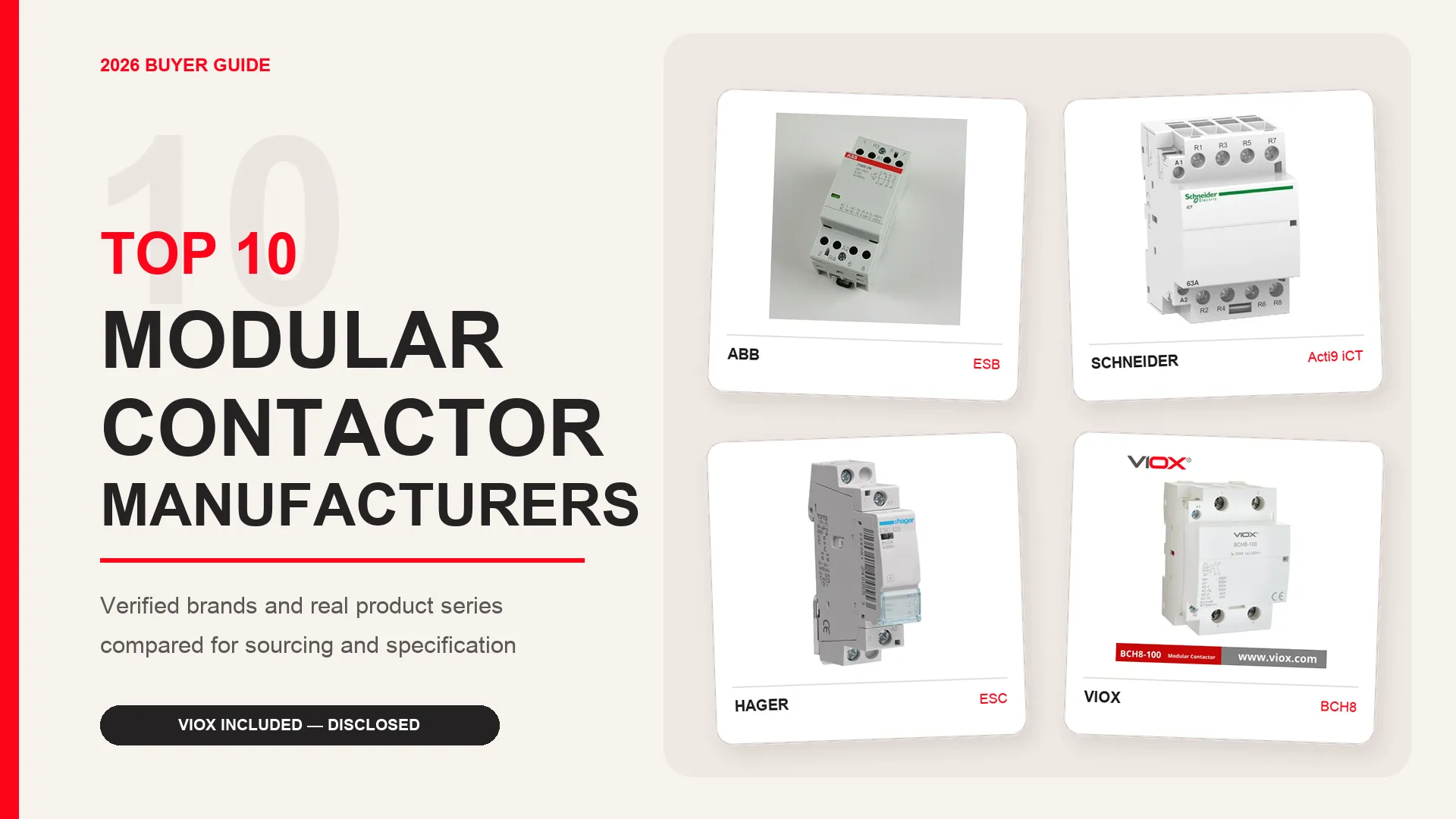
This comparison covers ten manufacturers with current modular or installation contactor product evidence. It is arranged alphabetically, not as a 1-to-10 performance score. Product-line descriptions summarize manufacturer-published information reviewed on the date below; they are not independent performance tests. VIOX publishes this article and is included as one of the manufacturers, so buyers can evaluate that relationship directly.
Review date: September 16, 2026.
Comparison Method
Each manufacturer had to show a named modular or installation contactor family in current official product information, with a traceable model or series and a recognizable real product image. This confirms that the compared product family exists in the current brand portfolio. A product page or image alone does not independently prove ownership of a particular factory, so factory status, legal manufacturer identity, and production-site evidence should still be checked during supplier qualification. We then compared the factors that help a buyer build a shortlist:
- a traceable product series rather than a general company claim;
- fit for DIN-rail distribution or control panels;
- representative range or model information that can be checked;
- technical documentation suitable for model-level review;
- a route to market that fits catalog purchasing, distribution, direct sourcing, or OEM/private-label work.
This method does not rank electrical life, reliability, delivery, price, or certification coverage. Those characteristics can vary by exact model, factory, market, order quantity, and application. Verify them during the request-for-quotation process.
Modular Contactor Manufacturers at a Glance
| Manufacturer | Representative modular/installation series | Useful shortlist signal | Likely buyer fit |
|---|---|---|---|
| ABB | ESB and EN | Broad installation-contactor family with manual and automatic variants in the range | Projects already using ABB modular devices or global catalog channels |
| Eaton | Z-SCH and CMUC | Installation-contactor options within Eaton’s modular protection and control ecosystem | Eaton-standardized building and panel projects |
| ETI | RD | Modular contactors with specific AC/DC coil and manual-control configurations in the published range | Distributors and panel builders using ETI modular equipment |
| Finder | Series 22 | Dedicated modular power-contactor family with multiple contact and control configurations | Building automation, lighting, heating, pumps, and quiet switching projects |
| Hager | ESC and ERC | Installation contactors positioned within Hager’s modular building-control portfolio | Residential and commercial distribution boards using Hager devices |
| Legrand | CX3 | Modular power contactors designed for DIN-rail integration and remote load control | Building projects using Legrand modular distribution systems |
| LOVATO Electric | CN and CNM | Compact modular contactors, including manually controlled variants | Panel builders wanting a focused control-device catalog |
| Schneider Electric | Acti9 iCT | Modular contactors integrated with the Acti9 installation system | Projects standardized around Acti9 protection and control devices |
| Siemens | 5TT5 Insta | Installation contactors within the SENTRON modular-device environment | Siemens-specified building infrastructure and distribution projects |
| VIOX | BCH8 | Direct manufacturer range with 2-pole and 4-pole models and OEM inquiry path | Buyers seeking direct sourcing, customization discussion, or private-label support |
The table identifies families worth investigating. It does not mean that every product in a family suits every load. For example, the current rating used for a resistive load cannot automatically be applied to a motor or a high-inrush lighting circuit. The exact utilization category remains part of selection.
1. ABB — ESB and EN Installation Contactors
ABB’s ESB and EN families are a clear installation-contactor option for buyers who need a recognized modular product line. Current ABB material presents ESB/EN as a 16 A to 100 A range for functions such as lighting, heating, ventilation, motors, and pumps. EN variants add manual override in selected models.
The practical strength is portfolio integration: a buyer can evaluate contactors, accessories, spacing requirements, and related modular equipment within one documented ecosystem. Check the exact model for the required poles, contact state, coil voltage, utilization category, mounting conditions, and compatible auxiliary devices.
Shortlist ABB when: the project already specifies ABB modular equipment, multi-market documentation matters, or the distributor is expected to supply a coordinated catalog package.
2. Eaton — Z-SCH and CMUC Installation Contactors
Eaton’s Z-SCH and CMUC families provide installation-contactor options alongside the company’s modular protection and control equipment. Individual Z-SCH products cover building-control configurations such as multi-pole switching with common AC control voltages.
This is most useful when the panel is already based on Eaton components and the buyer wants one distribution route for protection, switching, and accessories. Do not assume that a catalog-family name establishes the required load duty. Confirm the exact operational current, utilization category, coil, contact arrangement, and regional product status.
Shortlist Eaton when: the design is standardized around Eaton’s modular ecosystem or local Eaton distribution and project support are important procurement inputs.
3. ETI — RD Modular Contactors
ETI’s RD family gives distributors and panel builders another modular option for installation boards. Current product information includes specific RD configurations with AC/DC control, manual ON-OFF-AUTO operation, four-pole arrangements, and AC-1/AC-7a ratings.
Those details demonstrate useful configuration depth, but one product page should not be treated as the specification for the whole family. Match the order code to the required operating current, contact combination, control voltage, width, and operating mode.
Shortlist ETI when: the buyer already sources ETI modular devices or needs a traceable installation-contactor option through an ETI-focused distributor.
4. Finder — Series 22 Modular Contactors
Finder positions Series 22 as a dedicated modular power-contactor family for building and equipment-control tasks. Its current range information covers nominal currents from 25 A to 63 A and multiple contact, coil, and manual-control configurations. Finder also distinguishes features available on selected models, so the model code matters.
Series 22 is relevant when switching noise, control options, or configuration breadth is part of the shortlist. Treat any feature such as manual override or a particular contact behavior as model-specific until it is confirmed in the datasheet.
Shortlist Finder when: the project involves building automation, lighting, heating, pumps, fans, or another installation duty that benefits from a focused relay-and-control manufacturer.
5. Hager — ESC and ERC Installation Contactors
Hager’s ESC and ERC products sit naturally in residential and commercial distribution boards built around Hager modular equipment. Current product entries show standard contactor configurations as well as selected quiet or manually controlled variants.
Hager is therefore a logical ecosystem choice, particularly where the designer, contractor, and distributor already use Hager enclosures and modular devices. Exact specifications must still be checked at product level because current, poles, contact state, control voltage, manual control, and acoustic characteristics differ across the range.
Shortlist Hager when: the project uses a Hager distribution-board system and consistent catalog sourcing is more important than an OEM/private-label route.
6. Legrand — CX3 Modular Power Contactors
Legrand’s CX3 family includes modular power contactors for remote control of loads in DIN-rail panels. Current product information includes compact one-module options and configurations with or without manual control, while wider family material covers higher-current choices.
CX3 is a practical candidate for commercial and residential projects that already use Legrand modular protection and control products. The family name alone is not a specification: confirm AC-7a or other declared duty, poles, normally open or normally closed contacts, coil voltage, module width, and permitted auxiliaries for the exact reference.
Shortlist Legrand when: the installation is being designed around the Legrand modular ecosystem or the contractor expects Legrand catalog availability in the project market.
7. LOVATO Electric — CN and CNM Modular Contactors
LOVATO Electric offers CN modular contactors and CNM manually controlled versions in standardized DIN-rail formats. Current catalog entries include one-, two-, three-, and four-pole arrangements across multiple current and control-voltage options.
The range is useful for panel builders who want modular contactors from a company focused on control and protection devices. Its catalog makes configuration comparison relatively direct, but the buyer still needs to verify the operational rating for the intended load instead of relying on the free-air thermal current alone.
Shortlist LOVATO Electric when: a compact control-device portfolio, manual variants, and conventional distributor purchasing suit the panel builder’s workflow.
8. Schneider Electric — Acti9 iCT Modular Contactors
Schneider Electric’s Acti9 iCT family is designed to sit within the broader Acti9 modular system. Current Schneider Electric information describes DIN-rail contactors up to 100 A for electrical control in residential, commercial, and industrial buildings.
The main shortlist reason is ecosystem continuity. Designers using Acti9 protective and control devices can evaluate contactors and related modular functions in one product environment. As with every family here, confirm category-specific current, operating voltage, coil, poles, contact state, accessories, spacing, and the documents required in the destination market.
Shortlist Schneider Electric when: Acti9 is already the panel standard or the project values broad distributor coverage and a unified modular catalog.
9. Siemens — 5TT5 Insta Contactors
Siemens lists 5TT5 Insta contactors within its modular switching-device portfolio. The family includes installation contactors for DIN-rail panels, with order-code variations for contact arrangement, control voltage, and operating current.
This makes Siemens a relevant option for building infrastructure projects already specified around SENTRON modular devices. Check current product status and the exact order code in the applicable regional catalog; a model visible in one market may not have the same availability or documentation package elsewhere.
Shortlist Siemens when: the project already uses Siemens building-distribution equipment or requires procurement through Siemens project and distribution channels.
10. VIOX — BCH8 Modular Contactors
VIOX manufactures the BCH8 modular contactor family and publishes 2-pole and 4-pole product options in its current range. Buyers can review the VIOX modular contactor range and discuss model documentation, order quantity, packaging, branding, and application requirements directly with VIOX.
VIOX is included because it offers a current modular contactor line and a direct manufacturer/OEM route. This article does not claim that VIOX is universally better than the other manufacturers. The same exact-model checks apply: load category, operational voltage and current, coil voltage, poles, contact state, switching frequency, environment, protection coordination, and required market documents.
Shortlist VIOX when: direct manufacturer communication, an OEM/private-label discussion, or a configurable sourcing program is central to the buying decision.
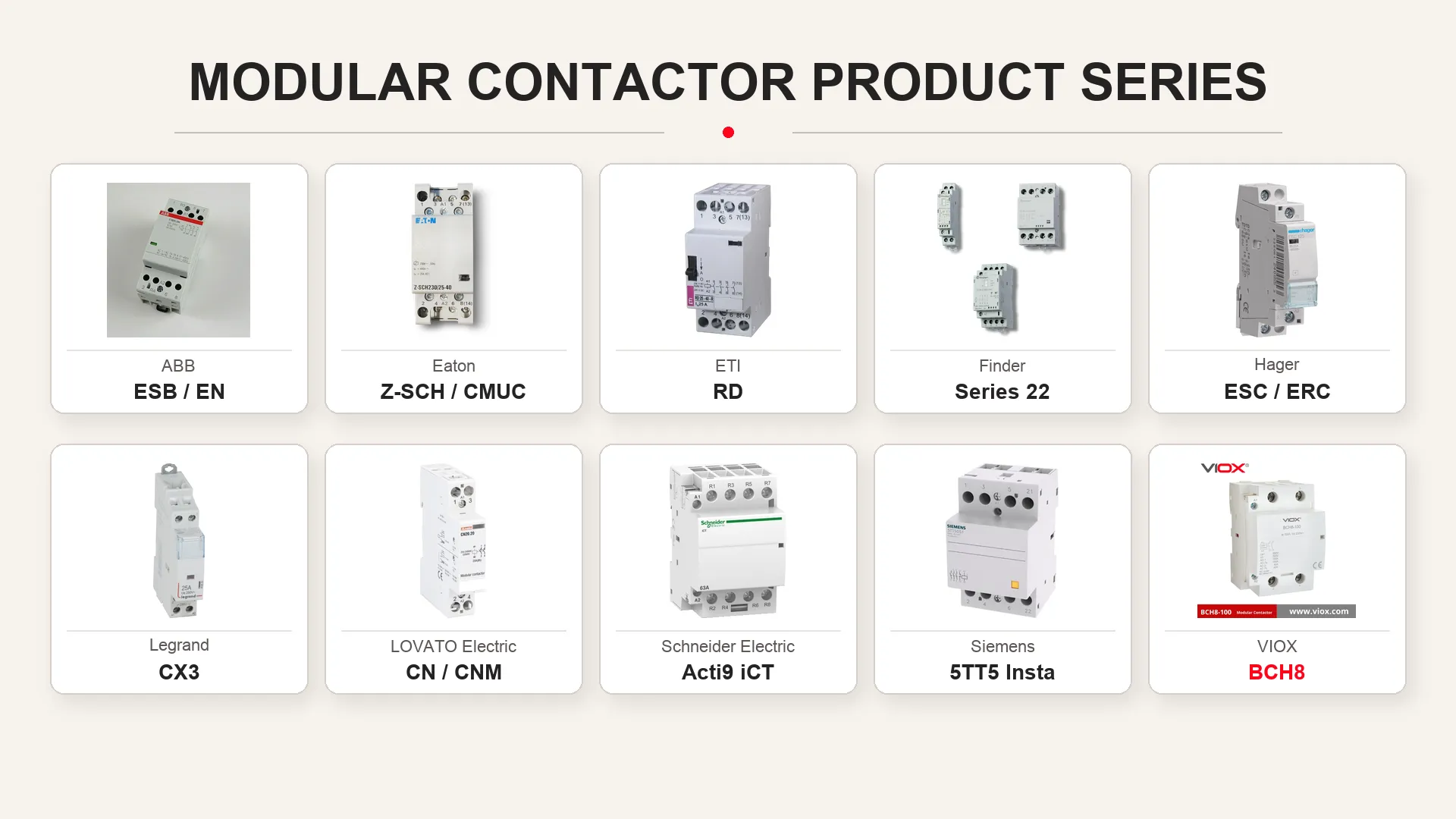
Choose by Project Type, Not by a Universal Winner
| Project situation | Start with | Why |
|---|---|---|
| Existing branded modular panel ecosystem | The contactor family from the installed protection/control ecosystem | Simplifies accessory, documentation, distributor, and panel-design coordination |
| Multi-country catalog project | Manufacturers with strong regional catalogs and document access in every destination | Product availability and approvals can differ by market |
| Building automation or quiet switching | Families with clearly documented installation duty and low-noise options on the exact model | Acoustic and manual-control features are model-specific |
| Direct sourcing or private label | A manufacturer with an explicit OEM inquiry path, such as VIOX | Commercial configuration, packaging, labeling, and quantities can be discussed directly |
| Replacement in an existing board | The exact existing model or a manufacturer-approved replacement | Width, terminals, coil, contacts, heat, and accessories must remain compatible |
| Motor, pump, fan, heater, or LED switching | Any brand only after category-specific load verification | Equal ampere labels do not mean equal switching capability across load types |
If the project has not yet converted the load into a specification, use the VIOX guide on how to choose a modular contactor. It explains the inputs that should be fixed before comparing order codes.
RFQ Checklist for Comparing Suppliers
A useful supplier comparison starts with the same request sent to every candidate. Include:
- Load data: load type, operational voltage, continuous current, inrush or starting current, and switching frequency.
- Duty category: the required utilization category and the rating expected under that category. Use the VIOX guide to contactor utilization categories if the duty still needs clarification.
- Control circuit: coil voltage, AC or DC supply, frequency, acceptable power consumption, and control-device constraints.
- Main contacts: pole count, normally open and normally closed arrangement, manual override requirement, and isolation expectations.
- Panel constraints: DIN-module width, enclosure temperature, ventilation, grouping, terminal capacity, and accessory space.
- Protection and coordination: upstream protective device, prospective short-circuit current, and the required coordination evidence.
- Documents: exact-model datasheet, declaration or certificate, standard and edition, installation instructions, coordination tables, and marking image.
- Commercial requirements: quantity, target delivery date, destination market, packaging, labeling, warranty terms, change control, and sample approval.
- OEM requirements: brand ownership, artwork control, traceability, inspection plan, approved substitutions, and pre-shipment evidence.
Do not accept a family brochure as proof for every order code. Match the model on the quotation, datasheet, declaration, label, and shipment. For the boundary between household/similar-purpose and broader industrial contactor standards, see IEC 61095 vs IEC 60947-4-1.
Final Shortlist Rule
Use the brand comparison to identify two or three credible product families. Then approve only the exact model that satisfies the load duty, control circuit, contact arrangement, panel constraints, coordination requirements, destination-market documentation, and commercial terms.
For catalog-based projects, ecosystem compatibility and local distributor support may decide the shortlist. For direct sourcing, OEM, or private-label programs, factory communication, documentation control, samples, inspection, and change management deserve equal weight with the electrical specification.
To evaluate a VIOX option, review the BCH8 modular contactor range and send the project inputs to [email protected]. VIOX can respond against an exact model request rather than a generic “best contactor” inquiry.