

On this page
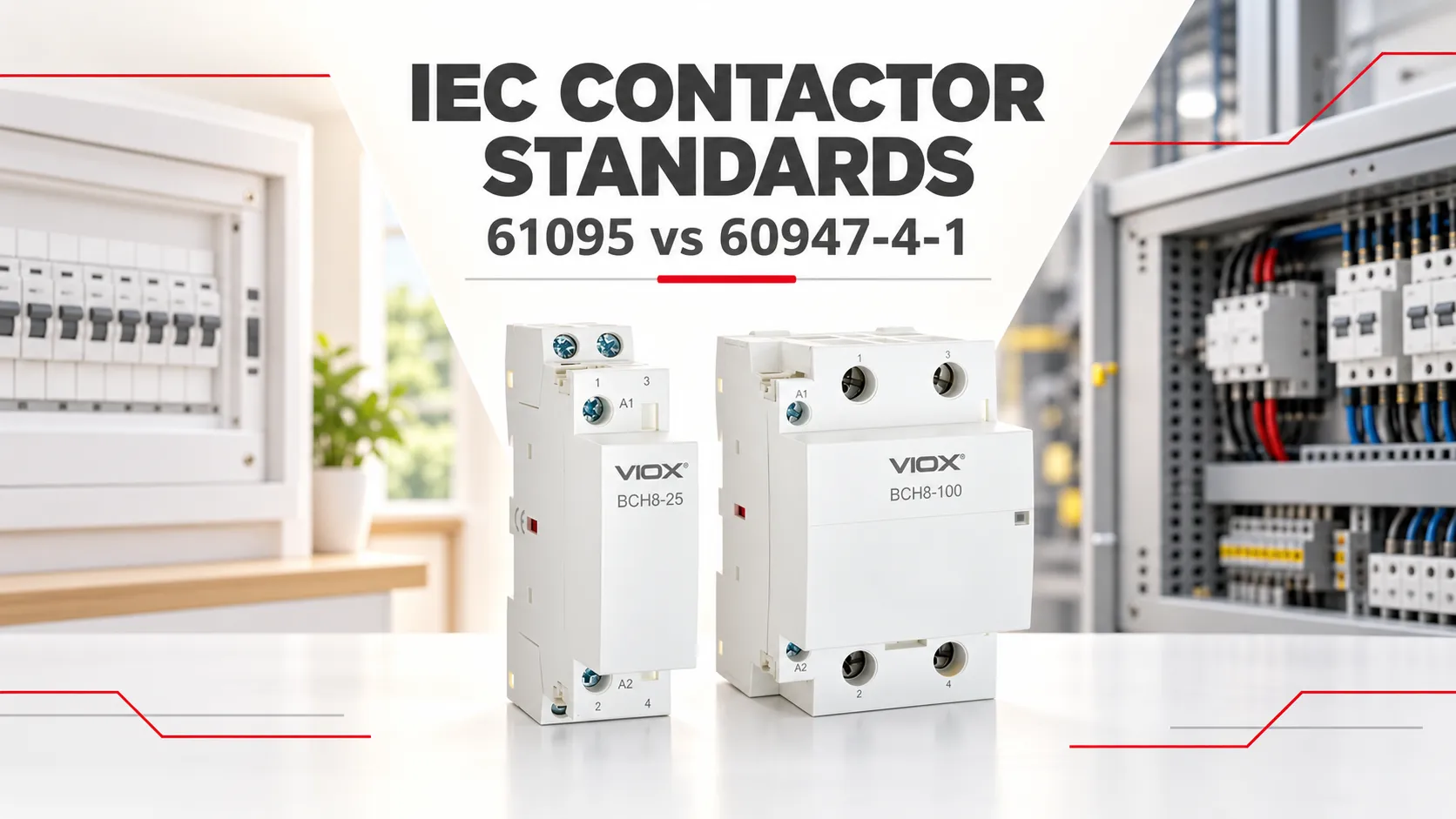
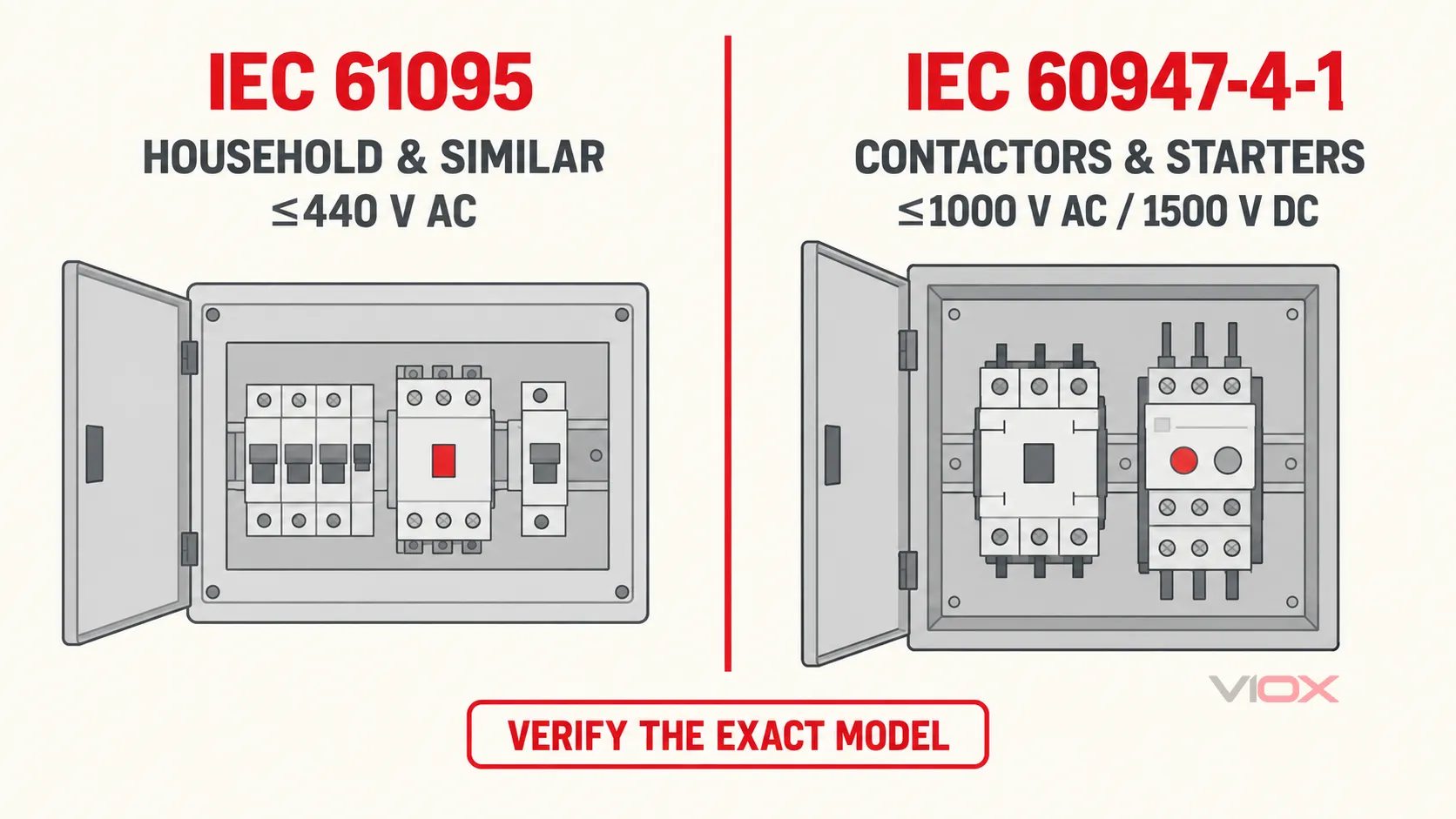
IEC 61095 and IEC 60947-4-1 cover different contactor applications, but the practical choice is not simply “household device versus industrial device.” IEC 61095:2023 applies to electromechanical air-break contactors for household and similar purposes within defined AC voltage, operational-current, and conditional short-circuit-current limits. IEC 60947-4-1:2023 covers a broader group of electromechanical contactors, motor starters, motor protective switching devices, and related equipment for distribution, motor, and other load circuits.
Use the standard declared for the exact product and duty. Then verify the utilization category, operational voltage and current, switching duty, short-circuit coordination, control circuit, and environmental conditions in the manufacturer’s documentation. A DIN-rail housing, an ampere value, or the word “modular” does not prove compliance with either standard.
IEC 61095 vs IEC 60947-4-1 at a Glance
| Decision point | IEC 61095:2023 | IEC 60947-4-1:2023 | Specification impact |
|---|---|---|---|
| Core scope | Electromechanical air-break contactors for household and similar purposes | Electromechanical contactors and starters, including MPSD and IMPSD, plus specified related equipment | Start with the circuit and equipment function, not enclosure appearance |
| Circuit voltage within scope | Up to 440 V AC between phases | Up to 1,000 V AC or 1,500 V DC | A circuit outside the IEC 61095 voltage scope needs another route |
| Rated operational current within the stated scope | Up to 63 A for AC-7a; up to 32 A for AC-7b, AC-7c, and AC-7d | The official scope states circuit-voltage limits rather than one universal current ceiling | Compare the product’s declared operational rating for the required utilization category |
| Short-circuit boundary in scope | Rated conditional short-circuit current up to 6 kA | Coordination and protective functions are addressed across contactors, starters, and protective devices | Verify the tested contactor/SCPD combination; do not treat a current rating as fault protection |
| Typical decision context | Building and household-type load control within the standard’s limits | Distribution circuits, motor circuits, and other load circuits, including industrial motor-control functions | Match the application and declared duty to the relevant product documentation |
| Current edition used here | Third edition, published October 2023 | Fifth edition, published November 2023; corrected version dated March 2026 | Check the edition cited by the certificate or declaration |
The limits above come from the official IEC 61095:2023 and IEC 60947-4-1:2023 publication pages. They describe standard scope. They are not a substitute for the full standard, a product test report, or the applicable installation rules.
What the Two Standards Actually Establish
IEC 61095: household and similar-purpose contactors
IEC 61095:2023 applies to electromechanical air-break contactors whose main contacts connect to circuits not exceeding 440 V AC between phases. Its stated scope reaches 63 A for utilization category AC-7a and 32 A for AC-7b, AC-7c, and AC-7d, with rated conditional short-circuit current not exceeding 6 kA.
These boundaries make IEC 61095 relevant to many building-control duties, but they do not make every compact or DIN-rail contactor an IEC 61095 product. The exact model still needs a declaration or certificate referencing the standard and edition, plus ratings for the intended load.
The standard also notes that these contactors are not normally intended to interrupt short-circuit current. The installation therefore needs suitable short-circuit protection, and the declared conditional rating depends on the specified protective arrangement. “6 kA” in the scope is not the contactor’s independent breaking capacity.
IEC 60947-4-1: contactors and motor starters across wider low-voltage duties
IEC 60947-4-1:2023 applies to electromechanical contactors and starters, including motor protective switching devices, as well as defined coil-circuit contacts, actuators, and dedicated accessories. The covered equipment is intended for distribution circuits, motor circuits, and other load circuits up to 1,000 V AC or 1,500 V DC.
Its scope is wider than motor contactors alone. It addresses characteristics, operation and protection functions, intended environments and applications, construction and performance, testing, and information supplied with the equipment. Some adjacent functions remain under other standards. For example, auxiliary contacts and contactor-relay contacts are covered by IEC 60947-5-1, while certain integrated short-circuit protective devices fall under IEC 60947-2 or IEC 60947-3.
This matters in a panel specification: citing IEC 60947-4-1 for the contactor does not automatically verify the auxiliary contact, upstream protective device, complete starter combination, or assembled panel.
The Standards Are Different Scopes, Not Quality Grades
It is misleading to describe IEC 60947-4-1 as a universally “better” or “stronger” version of IEC 61095. Each standard defines requirements for its own equipment scope and declared duties. A correctly selected IEC 61095 contactor can be appropriate for a qualifying building load. A product evaluated to IEC 60947-4-1 can be appropriate for a motor starter, industrial control function, or another declared load duty.
The reverse shortcut is also unsafe: an IEC 60947-4-1 reference alone does not prove that a product is suitable for every motor, every switching frequency, or every fault level. The utilization category and ratings remain part of the specification.
Physical format does not settle the question. Compact DIN-rail products can carry different declarations, and some products may declare more than one applicable standard or utilization category. Read the marking and exact model documentation instead of classifying the device by shape.
2023 Editions: Changes Worth Checking in Current Specifications
Both standards received new editions in 2023. A specification copied from an older project may therefore miss current categories or product features.
IEC 61095:2023 added requirements for screwless terminals, introduced AC-7d for switching LED lamps and LED control gear, added requirements for electronically controlled electromagnets, and added a reference for embedded-software design.
IEC 60947-4-1:2023 introduced or revised several areas, including instantaneous-only motor protective switching devices, motor-overload protection, use downstream of a basic drive module, environmental aspects, transient-limiting devices, accessible-part temperature limits, EMC environments, embedded software, cybersecurity, electromagnet power-consumption measurement, AC-3e-related material, photovoltaic critical-load-current determination, and adoption of AC-7d from IEC 61095.
The presence of AC-7d in both 2023 editions is a useful warning against selecting by category name alone. The product’s governing standard, category rating, operating conditions, and documentation must be read together.
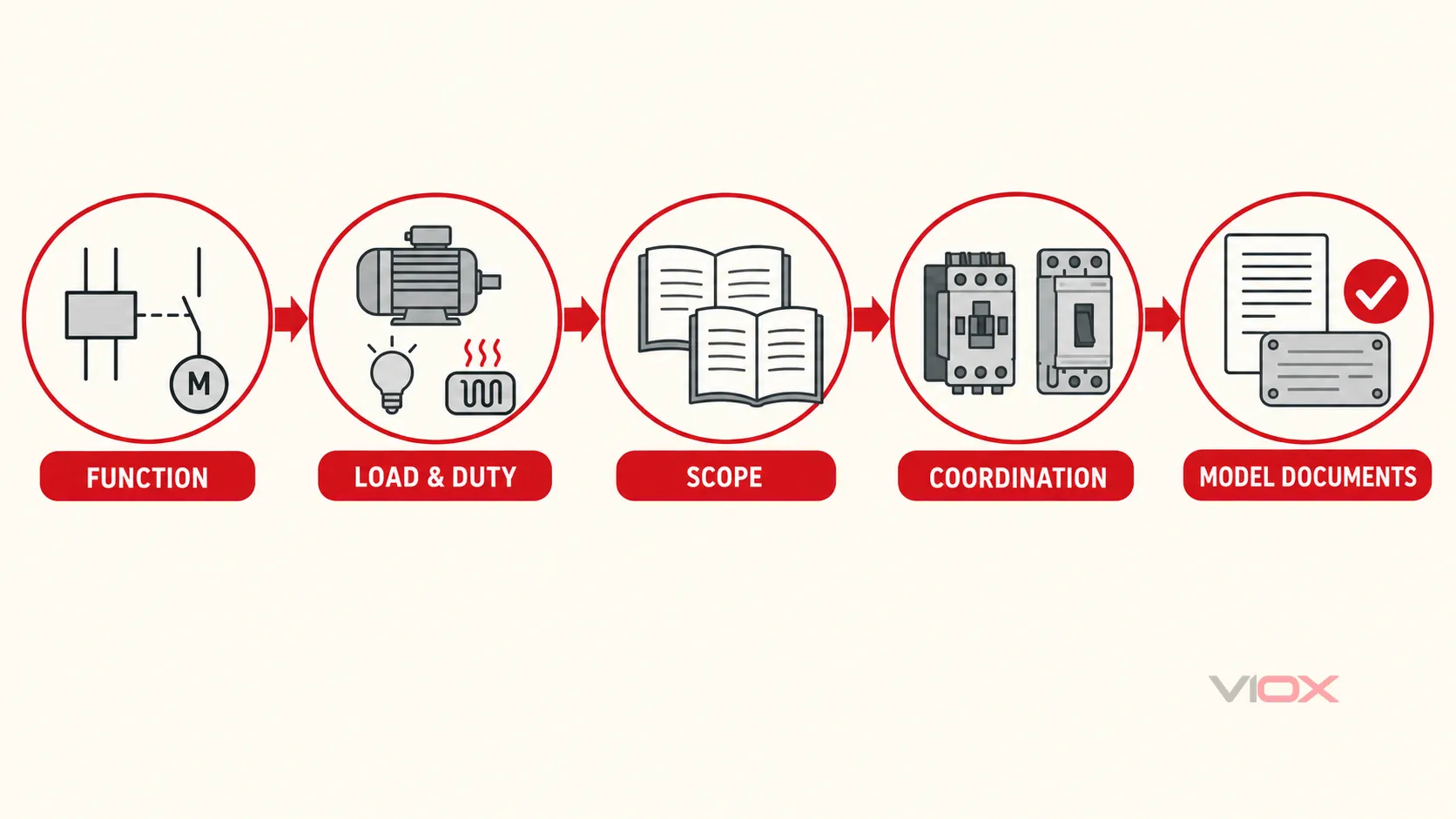
A Five-Step Way to Choose the Standards Path
1. Define the equipment function
State what the device must do: switch a household-type load, control a motor, form part of a starter, switch an auxiliary circuit, or serve another defined function. If the requirement is a motor starter rather than a stand-alone contactor, include the overload-protection and short-circuit-protection functions in the scope of review.
2. Define the load and operating duty
Record the load type, operational voltage, operating current, starting or inrush behavior, switching frequency, and required contact arrangement. The same numerical current can represent very different contact stress for heating, lighting, and motor loads.
Use the product rating for the required utilization category. For a fuller explanation of AC and DC categories, see the VIOX guide to contactor utilization categories.
3. Check whether the circuit fits the standard scope
Compare the circuit with the official scope limits. For IEC 61095, that includes the 440 V AC phase-to-phase ceiling, the category-specific operational-current limits, and the conditional short-circuit-current boundary. For IEC 60947-4-1, confirm that the equipment type and circuit sit within its scope and stated voltage limits.
A circuit being inside a standard’s maximum scope does not make every product under that standard suitable. It only keeps that standards path open; the product ratings complete the decision.
4. Verify protection and coordination
A contactor is a switching device, not a complete short-circuit protection strategy. Obtain the manufacturer’s coordination data for the exact contactor or starter and the specified fuse or circuit breaker. Check the prospective short-circuit current at the installation point and the coordination result required by the design.
Keep three statements separate:
- the contactor’s operational rating for the load;
- the short-circuit protective device’s interrupting capability;
- the tested or declared performance of the combined arrangement.
5. Verify the exact model and edition
Before approval, match the model code across the nameplate, datasheet, declaration, certificate, and coordination table. Confirm the standard number and edition, utilization category, rated operational voltage and current, coil or control voltage, poles and contact state, terminal data, environmental limits, and compatible accessories.
Three Application Examples
Scheduled building lighting
A DIN-rail contactor switches a lighting circuit from a timer. IEC 61095 may be the relevant route when the product and circuit fall within its scope. For LED loads, verify an AC-7d rating for the exact model and check the manufacturer’s declared lamp-load or inrush limitations. A general ampere rating does not answer the LED switching question.
Small fan or pump in a building panel
The panel location does not decide the standard. Define the motor duty and starting behavior, then check whether the selected product carries the applicable household-type category under IEC 61095 or an appropriate motor-duty category under IEC 60947-4-1. Use the manufacturer’s category-specific rating rather than converting from a resistive-load rating.
Industrial motor starter
Where the device forms part of an industrial motor starter, IEC 60947-4-1 is the relevant contactor-and-starter framework. Selection still requires motor data, duty, overload protection, short-circuit coordination, control voltage, environment, and accessory compatibility. The standard reference alone is not a complete motor-starter specification.
For the broader physical and application differences between compact modular devices and conventional contactors, read modular contactor vs traditional AC contactor.
Documentation Checklist for Engineers and Buyers
Request evidence for the exact order code, not only a family brochure.
| Evidence to request | What to verify | Why it matters |
|---|---|---|
| Datasheet | Model, poles, contact state, utilization category, operational voltage/current, coil voltage, frequency, environment | Confirms the device rating for the actual circuit |
| Declaration or certificate | Standard number, edition, model coverage, issuer, validity, and scope | Connects the compliance claim to the ordered product |
| Coordination table | Exact contactor/starter, protective device, fault level, and stated coordination result | Verifies the combined short-circuit arrangement |
| Installation instructions | Terminal capacity, tightening method, mounting, spacing, ventilation, and accessory rules | Supports correct panel integration |
| Marking or nameplate image | Model and ratings consistent with the documents | Catches substitutions and document mismatches |
| Project requirements | Installation code, assembly standard, market approvals, and customer specifications | Product-standard compliance is only one layer of acceptance |
Do not accept “IEC compliant” as a complete answer. The supplier should identify the standard, edition, exact model, rating basis, and supporting document.
Common Specification Errors to Remove
- Selecting by enclosure style: DIN-rail format is a mechanical clue, not proof of IEC 61095 compliance.
- Comparing only nominal current: operational current belongs to a utilization category and operating voltage.
- Treating 6 kA as breaking capacity: IEC 61095 states a conditional short-circuit-current scope limit; the protective combination must be verified.
- Assuming one standard replaces the other: the scopes overlap in some practical product forms but remain distinct standards pathways.
- Ignoring the edition: 2023 changes affect categories and product features that older documents may not address.
- Using a family-level certificate for any model: confirm that the exact order code is covered.
- Confusing product and panel compliance: the contactor standard does not by itself approve the complete assembly or installation.
Final Selection Rule
Choose IEC 61095 when the exact contactor, household-or-similar application, utilization category, circuit ratings, and protective arrangement are documented within that standard’s scope. Choose the IEC 60947-4-1 route when the equipment function and declared product duty fall under its contactor or starter scope. Where a product references both standards, verify the rating claimed under each one and specify the rating that matches the actual load.
VIOX publishes a modular contactor product range and a separate modular contactor selection guide. For model support, provide the load type, operational voltage and current, starting or inrush information, switching frequency, coil voltage, contact arrangement, prospective fault current, target market, and required documentation.
Sources
- International Electrotechnical Commission, IEC 61095:2023 — Electromechanical contactors for household and similar purposes.
- International Electrotechnical Commission, IEC 60947-4-1:2023 — Contactors and motor-starters.