On this page
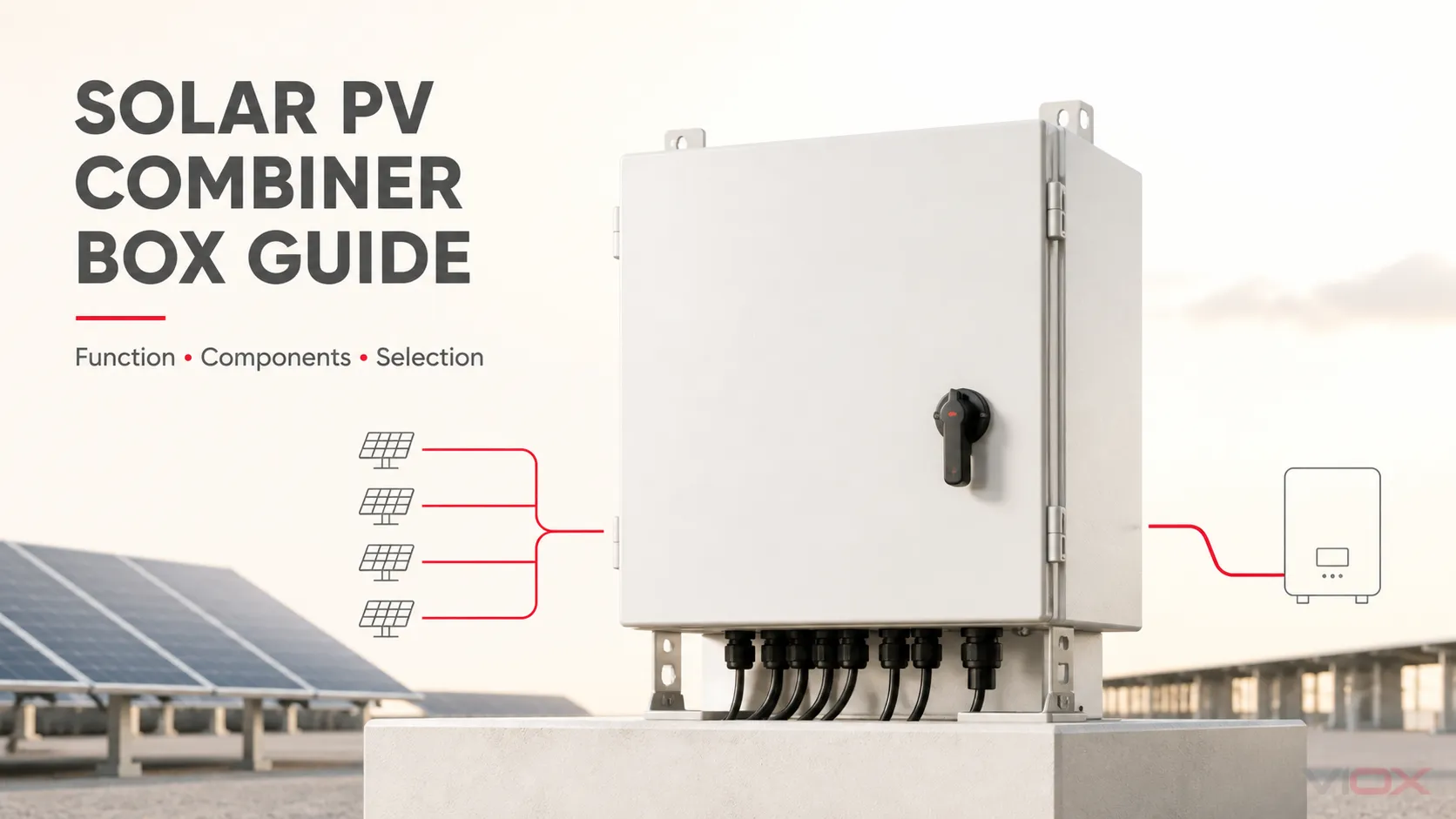
A solar PV combiner box is a direct-current (DC) side enclosure that collects multiple photovoltaic string circuits and routes them into one or more outgoing circuits before an inverter, charge controller, or other approved DC equipment. It is sometimes shortened informally to a PV box, although that broader term can also be used for other photovoltaic enclosures. Depending on the project design, a combiner box may contain string fuses, DC circuit breakers, surge protective devices (SPDs), a DC isolator, busbars, grounding terminals, and string-monitoring equipment.
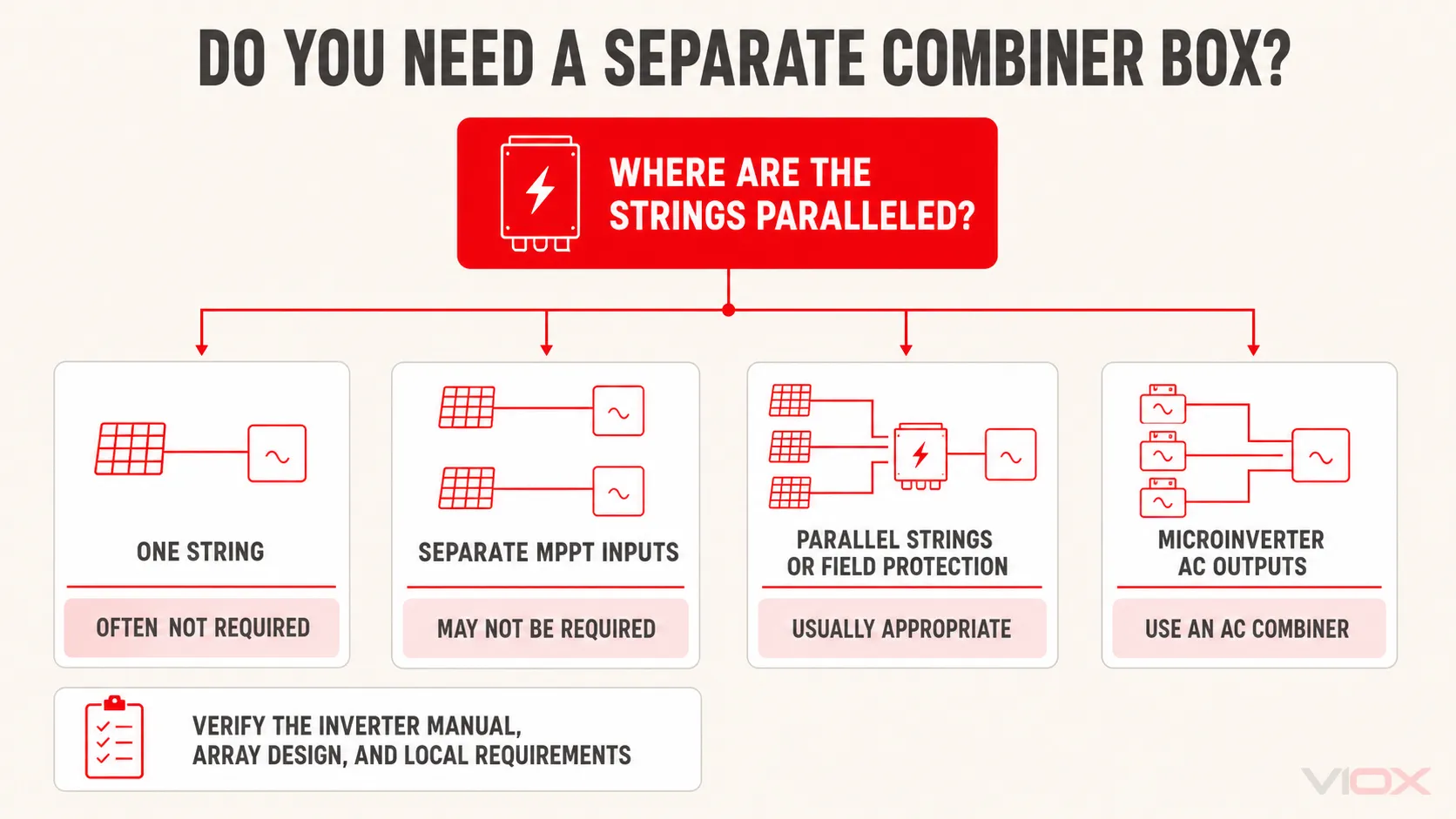
Not every solar installation needs a separate external combiner box. A direct connection may be appropriate when the inverter already provides enough independent inputs and the required protection and isolation functions. A dedicated box becomes more relevant when multiple strings must be paralleled, protected, monitored, or brought to a common field service point.
The correct decision is therefore made from the PV array and inverter architecture—not from enclosure size alone. The key inputs are the number and layout of strings, maximum cold-corrected string voltage, string and output current, protection functions, cable routing, installation environment, and monitoring requirements.
Do You Need a Solar PV Combiner Box?
Use the system design—not the total number of solar modules—as the starting point.
| System condition | Separate combiner box? | What to verify |
|---|---|---|
| One string connected to one suitable inverter or charge-controller input | Often not required | Input voltage/current limits, DC isolation, surge protection, conductor protection, and local requirements |
| Two strings connected to separate inverter inputs or separate maximum power point trackers (MPPTs) | May not be required | Whether the inputs are truly independent, whether parallel connection is permitted, and what protection is already integrated |
| Multiple strings must be paralleled into one downstream input | Usually appropriate | Reverse-current exposure, string protection, busbar/output capacity, and downstream input limits |
| Long string home runs need a common field collection point | Often useful | Cable routing, voltage drop, enclosure location, service access, and output conductor design |
| The project requires string-level fuses, SPDs, local isolation, or monitoring | Usually appropriate | Exact functions, ratings, communication requirements, and duplication with inverter equipment |
| Microinverters or AC module outputs are being combined | A DC PV combiner is normally not the correct device | Evaluate an AC combiner or distribution assembly for the AC architecture |
The deciding question is not “How many panels are installed?” It is “Where are the strings paralleled, protected, isolated, and monitored?” Check the inverter manual, module data, array design, and applicable project requirements before omitting or adding a box.
For a product-focused comparison, see the VIOX solar PV combiner box range. Use the routes below when you need a deeper answer on one part of the design.
PV Combiner Box Selection Path
| If you need to… | Use this resource | Main decision |
|---|---|---|
| Understand the device and its role | This guide | Identify the correct collection and protection boundary |
| Trace string, fuse, SPD, isolator, and inverter connections | Solar combiner box wiring diagram | Confirm the functional DC path |
| Select 600V, 1000V, or 1500V equipment | PV combiner box voltage ratings guide | Match every device to maximum PV voltage |
| Coordinate fuses, breakers, isolators, and SPDs | PV combiner box protection design guide | Define each protection function |
| Plan future string expansion | Solar combiner box sizing guide | Reserve the right inputs and output architecture |
| Inspect an installed assembly | Solar combiner box inspection checklist | Verify labeling, terminals, protection devices, and enclosure condition |
| Compare published product layouts | VIOX PV combiner box products | Match voltage class and input/output configuration |
What Is a Solar PV Combiner Box?
A solar PV combiner box is the organized collection point for parallel PV strings. A string contains multiple solar modules connected in series. Several strings may then be connected in parallel so that their current can be routed to an inverter or charge controller through fewer outgoing circuits.
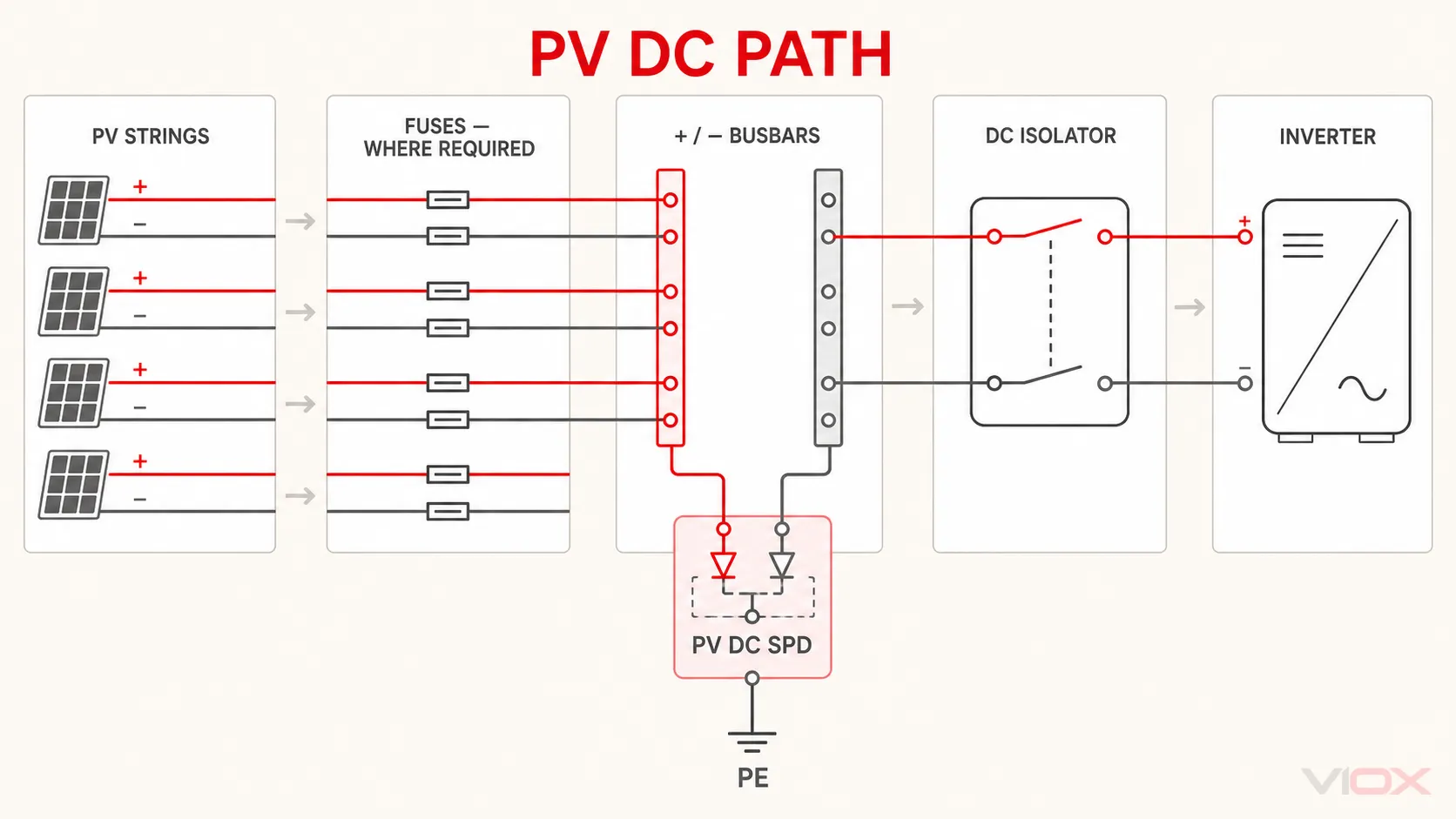
The combiner box sits between the PV array and downstream DC equipment. It is not simply a larger junction box. In a multi-string system, it can establish a practical protection and maintenance boundary by bringing together:
- PV string input terminals
- string-level overcurrent protection where required
- positive and negative busbars or distribution blocks
- a PV-rated DC SPD
- a grounding or protective-earth connection
- an output terminal arrangement
- a DC isolator or switch-disconnector where specified
- optional string monitoring and communication equipment
- an enclosure and cable-entry system suitable for the installation environment
In a small system with only one or two strings, a separate external combiner box may not be necessary if the inverter already provides suitable input channels and protection. As the string count increases, a dedicated box can make collection, protection, testing, isolation, and maintenance more structured.
What Does a PV Combiner Box Do?
The main purpose of a PV combiner box is to organize the transition from multiple PV strings to fewer downstream DC circuits.
| Function | What the box does | What still needs engineering verification |
|---|---|---|
| String collection | Brings parallel string outputs to a defined collection point | Input/output layout, conductor size, terminal rating, and busbar capacity |
| String protection | Uses PV fuses or DC breakers where the array design requires overcurrent protection | Module maximum series fuse rating, reverse-current exposure, conductor ampacity, and applicable code |
| Surge protection | Connects a PV/DC SPD to the DC conductors and protective-earth path | Voltage class, protection level, discharge current, backup protection, earthing, and lead routing |
| Maintenance isolation | Provides a local disconnection point through a DC isolator or suitable switch-disconnector | DC voltage, operating current, pole arrangement, load-break duty, and isolation function |
| Monitoring | Measures string current or device status when the project includes monitoring | Measurement method, accuracy, communications, alarms, power supply, and model-specific availability |
| Field organization | Concentrates labels, terminals, protection devices, and inspection points | Enclosure access, cable entries, heat, sealing, and service space |
These functions are related but not interchangeable. A fuse is not a manual isolator, an isolator is not automatically an overcurrent protective device, and an SPD does not clear sustained short-circuit current. The complete protection boundary must be reviewed as a system.
Main Components Inside a PV Combiner Box
The component mix depends on the inverter architecture, array design, target market, and project specification. A typical assembly may include the following:
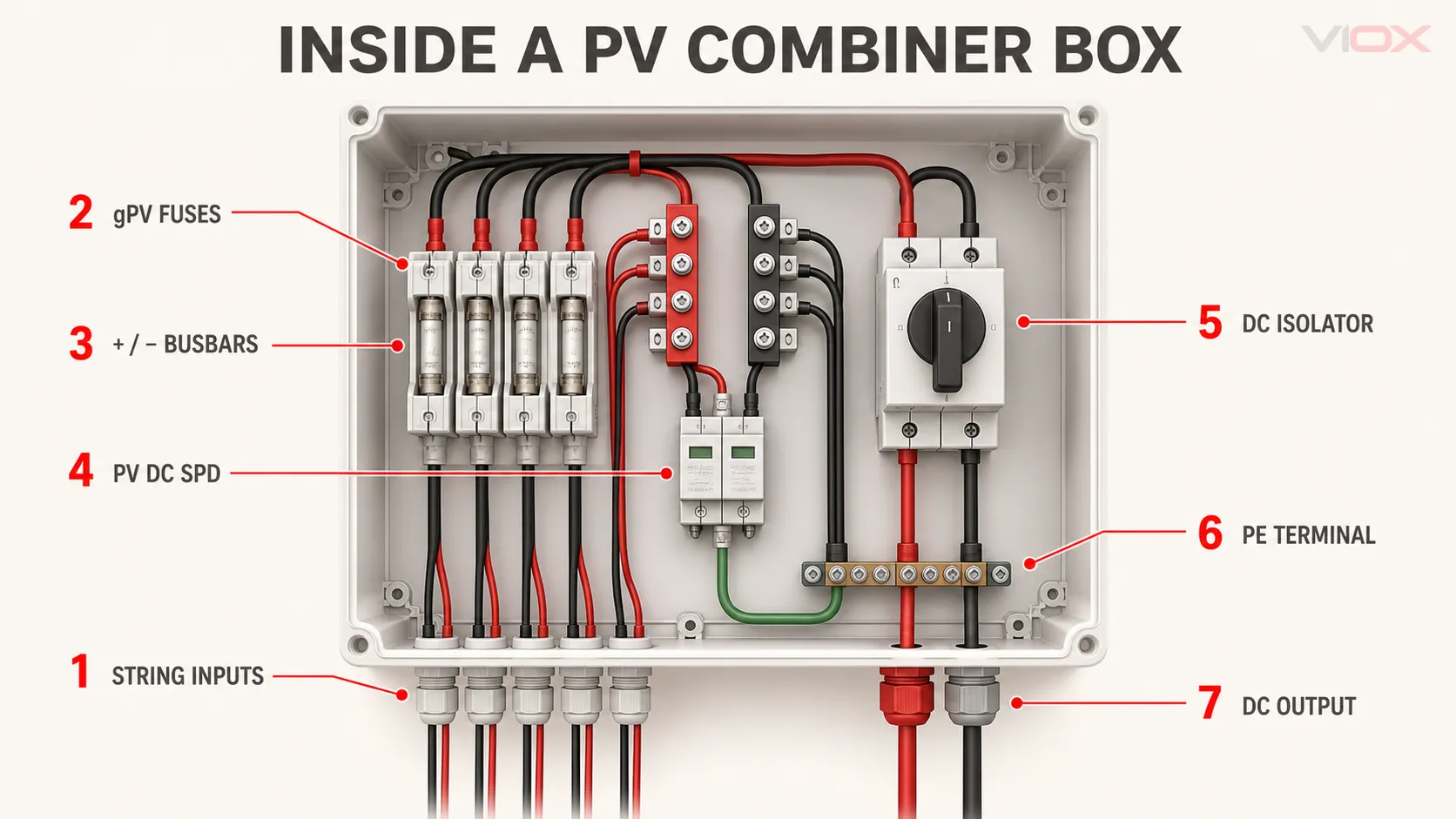
| Component | Primary role | Selection or verification point |
|---|---|---|
| String input terminals or connectors | Receive positive and negative conductors from each PV string | Match conductor size, insulation system, termination method, polarity, and torque instructions |
| PV fuse holders and gPV fuse-links | Limit string-level fault or reverse-current exposure where required | Confirm PV/DC voltage, current, fuse class, module limit, holder rating, and temperature conditions |
| DC circuit breakers | Provide resettable protection or switching where the design calls for it | Verify DC voltage, current, breaking capacity, polarity, pole arrangement, and application suitability |
| Positive and negative busbars | Combine protected string circuits | Check continuous current, temperature rise, spacing, insulation, and connection method |
| PV DC SPD | Limit transient overvoltage on the PV DC side | Match Uc or Ucpv, Up, discharge-current ratings, connection mode, backup protection, and earthing |
| DC isolator or switch-disconnector | Provide intentional manual disconnection | Verify DC switching and isolation ratings, handle arrangement, lockout, and installation duty |
| Protective-earth terminal or grounding bar | Connect the enclosure and SPD earth path to the grounding system | Confirm conductor size, bonding method, corrosion resistance, and project earthing arrangement |
| Output terminals | Send the combined circuit toward the inverter or charge controller | Match output current, cable size, termination method, and downstream equipment |
| String-monitoring module | Detect current imbalance, low-current strings, fuse operation, or device status when specified | Confirm channel count, measurement range, communication protocol, alarms, and model-specific support |
| Enclosure, glands, and plugs | Protect the assembly and seal cable entries | Verify the complete installed environmental protection, UV exposure, corrosion, condensation, and service access |
Do not assume that a product title proves the presence of every component. Before specification, request the wiring diagram, bill of materials, component datasheets, ratings, labels, and test documentation for the exact configuration.
How to Select a Solar PV Combiner Box
1. String count and input/output layout
Combiner boxes are described by their input and output arrangement, such as 2-in/1-out, 4-in/1-out, 6-in/1-out, or 8-in/1-out. Some assemblies keep multiple outputs separate, for example 2-in/2-out or 3-in/3-out, instead of combining all strings into one output.
The correct layout depends on:
- the number of PV strings in the array section
- the inverter’s maximum power point tracking (MPPT) input architecture
- cable routing and distance to the inverter
- whether outputs must remain separated for protection or maintenance
- planned expansion and spare input positions
An unused input must still be sealed and arranged in accordance with the enclosure and installation requirements. Do not specify a larger box solely because the number looks familiar; confirm what the extra terminals and output paths are intended to do.
2. Maximum cold-corrected string voltage
PV open-circuit voltage (Voc) increases as temperature falls. The voltage check must therefore use the maximum expected string open-circuit voltage at the lowest design temperature, not only the nominal system label.
A simplified design relationship is:
Maximum string Voc = module Voc at Standard Test Conditions (STC) × number of modules in series × cold-temperature correction factorThe selected voltage class must be suitable for the corrected value. The check applies to the entire path, including fuse holders, breakers, SPDs, isolators, terminals, busbars, cables, and the inverter input. For a deeper 600V/1000V/1500V comparison, use the PV combiner box voltage ratings guide.
3. String current and combined output current
Each input position must accommodate the relevant string current. The combined output circuit must handle the contribution of all parallel strings that share that output, together with the required design conditions and margins.
Review at least:
- module short-circuit current (Isc)
- operating current and temperature conditions
- string conductor ampacity
- fuse or breaker rating
- busbar and terminal rating
- output isolator or breaker rating
- outgoing cable and inverter input limits
A box can have correctly selected string fuses and still have an undersized output busbar or terminal arrangement. Input protection and output capacity must be reviewed separately.
4. Protection architecture
The combiner box may use fuses, DC breakers, an SPD, a DC isolator, or a combination of these. The correct arrangement depends on reverse-current exposure, grounding arrangement, inverter design, local code, project standard, and the protection already built into upstream or downstream equipment.
For detailed coordination of fuses, breakers, isolators, and SPDs, use the PV combiner box protection design guide. The overview rule is simple: specify each device for the function it must perform and for the actual PV DC duty.
5. Enclosure and installation environment
The enclosure is part of the electrical design. Rooftop, ground-mount, coastal, desert, agricultural, and industrial sites impose different demands on UV exposure, moisture, salt, dust, corrosion, heat, cable entry, condensation, and service access.
Before approving the assembly, verify:
- enclosure material and environmental protection
- cable-gland and unused-opening sealing
- direct-sun and internal heat conditions
- corrosion and salt exposure
- mounting position and working access
- clear labels and safe access to fuses, isolators, SPDs, and terminals
An enclosure rating should be treated as an installed-assembly requirement. The rating can be compromised by the wrong gland, an unsealed opening, poor mounting, or damaged seals.
6. When to Specify a PV Combiner Box With String Monitoring
String monitoring can be useful when the project needs faster fault localization, performance comparison, remote alarms, or a clear record of string-level behavior. It may measure current, voltage, temperature, fuse status, or device status depending on the design.
Specify monitoring only when the project has a defined operational purpose. Confirm:
- the number of monitored strings
- measured quantities and expected ranges
- local display or remote communication
- alarm and data-logging requirements
- auxiliary power requirements
- compatibility with the inverter or plant monitoring system
- whether monitoring is available in the exact combiner box model
String monitoring is not a universal feature across all combiner-box layouts. Treat it as a model-specific option that must be confirmed in the datasheet.
600V, 1000V, or 1500V PV Combiner Box?
Voltage class affects component selection, insulation coordination, switching duty, cable design, and the consequences of a DC arc. It should be selected from the maximum calculated PV voltage and the project equipment architecture.
| Voltage class | Typical project context | Main selection point |
|---|---|---|
| 600V DC | Legacy, smaller, or lower-voltage PV architectures | Confirm the equipment is suitable for the actual array and inverter input voltage |
| 1000V DC | Many commercial, industrial, and mid-size PV systems | Check cold-corrected Voc and verify the rating of every internal component |
| 1500V DC | Utility-scale and large ground-mount systems | Confirm the complete high-voltage DC protection, switching, insulation, and service design |
These are system classes, not automatic product recommendations. A “1000V system” still requires a cold-temperature voltage calculation, and a 1500V project requires more than a 1500V label on the enclosure. The fuses, holders, SPD, isolator, terminals, busbars, wiring, and downstream equipment must all be suitable for the actual design conditions.
PV Combiner Box vs Junction Box vs AC Combiner Box
These terms describe different electrical roles:
| Device | Where it is used | Main role | Protection boundary |
|---|---|---|---|
| PV DC combiner box | Between PV strings and an inverter or charge controller | Collects parallel PV strings and may coordinate DC protection, surge protection, isolation, and monitoring | PV DC voltage, string reverse current, transient overvoltage, polarity, and DC arc behavior |
| Junction box | At a connection or transition point in a circuit | Provides a protected enclosure for splicing, routing, or terminating conductors | Enclosure, conductor, and connection requirements; it is not automatically a string-protection assembly |
| Alternating-current (AC) combiner box | After inverters or microinverters and before AC distribution | Combines AC outputs | AC short-circuit current, phase/neutral arrangement, earthing, and grid-connection requirements |
An AC-rated device cannot be assumed suitable for a PV DC circuit. For the physical and functional boundary between a combiner and a junction box, see Difference Between a Combiner Box and a Junction Box. For the DC/AC distinction, see AC Combiner Box vs DC Combiner Box.
Current VIOX Solar PV Combiner Box Product Range
The current VIOX product page lists published 600V DC and 1000V DC classes and input/output layouts ranging from 1 to 8 string positions. The following table reflects the layouts shown in the current product summary; blank voltage information should be confirmed from the model datasheet before specification.
| VIOX series or model | Published system voltage | Published string layout |
|---|---|---|
| VOPV600-1/1 | 600V DC | 1 in / 1 out |
| VOPV600-2/2 | 600V DC | 2 in / 2 out |
| VOPV1000-1/1 | 1000V DC | 1 in / 1 out |
| VOPV1000-2/2 | 1000V DC | 2 in / 2 out |
| VOPV1000-3/1 | 1000V DC | 3 in / 1 out |
| VOPV1000-3/3 | 1000V DC | 3 in / 3 out |
| VCB F4/1 | Confirm from datasheet | 4 in / 1 out |
| VCB F6/1 | Confirm from datasheet | 6 in / 1 out |
| VCB F8/1 | Confirm from datasheet | 8 in / 1 out |
The product layout is only the starting point. The final selection still needs to match the array’s maximum voltage, current, protection scheme, cable entries, monitoring requirement, installation environment, target market, and documentation requirement. Compare the published models on the VIOX Solar PV Combiner Boxes page and request model support when the project requires a custom arrangement.
Standards and Documentation to Verify
Standards define the design or certification context; they do not replace the project-specific equipment review.
| Design area | Reference or verification path | What to confirm |
|---|---|---|
| PV array design | IEC 62548-1:2023, consolidated with AMD1:2025 | DC array wiring, electrical protection, switching, earthing, and other PV-array design requirements within the project scope |
| PV DC surge protection | IEC 61643-31:2018 | Whether the selected PV SPD and its ratings are appropriate for the DC PV installation |
| North American certification path | UL Solutions Solar Balance of System Certification | The applicable listing, evaluation, or certification evidence for the exact combiner-box configuration |
| Project release package | Manufacturer and project documentation | Wiring diagram, bill of materials, component ratings, labels, installation instructions, test records, and revision control |
Do not state that a particular VIOX combiner box is UL-listed, IEC-certified, or assigned a specific ingress-protection (IP) rating unless the exact model documentation confirms it. Certification is model- and market-specific.
PV Combiner Box Request-for-Quotation (RFQ) and Specification Checklist
Before requesting a quotation or configuration proposal, prepare the following information:
- maximum string open-circuit voltage at the lowest design temperature
- nominal and maximum system voltage class
- string short-circuit current and operating current
- number of input strings
- required input/output layout, such as 4-in/1-out or 3-in/3-out
- inverter or charge-controller model and DC input architecture
- string-fuse or DC-breaker requirement
- output isolator or switch-disconnector requirement
- SPD voltage class, connection mode, backup protection, and monitoring needs
- enclosure material, installation environment, cable-entry arrangement, and mounting method
- target market and required certification or documentation pathway
- quantity, delivery requirements, labeling, and any original-equipment-manufacturer/original-design-manufacturer (OEM/ODM) needs
This information is more useful than asking for a generic “solar combiner box.” It lets the supplier map the array architecture to a complete assembly instead of selecting a box only by string count.
Quick Answers Before You Select
Does every solar PV system need a combiner box?
No. A small system may connect directly to an inverter when the inverter provides enough suitable inputs and protection. A dedicated box becomes more useful as the number of parallel strings, cable runs, protection functions, and maintenance requirements increases.
Can an AC breaker or fuse be used in a PV combiner box?
Not unless the device is explicitly rated for the actual DC voltage, current, and interruption duty. AC and PV DC switching behavior are different.
Does a combiner box always include string monitoring?
No. Monitoring is an optional or model-specific function. Confirm the channel count, measurement variables, communication method, and exact product documentation.
Is a combiner box the same as a junction box?
No. A junction box provides an enclosure for connections or transitions. A PV combiner box is a defined DC collection assembly that may also coordinate string protection, surge protection, isolation, and monitoring.
Request a PV Combiner Box Configuration
If you have the maximum DC voltage, string current, string count, input/output layout, protection requirements, enclosure environment, target market, and quantity, use the VIOX PV combiner box product page to compare the published layouts or request configuration support.
The correct selection is the complete DC protection assembly—not just a box with the right number of cable entries.