

On this page
Quick Answer: AC Combiner Box vs DC Combiner Box
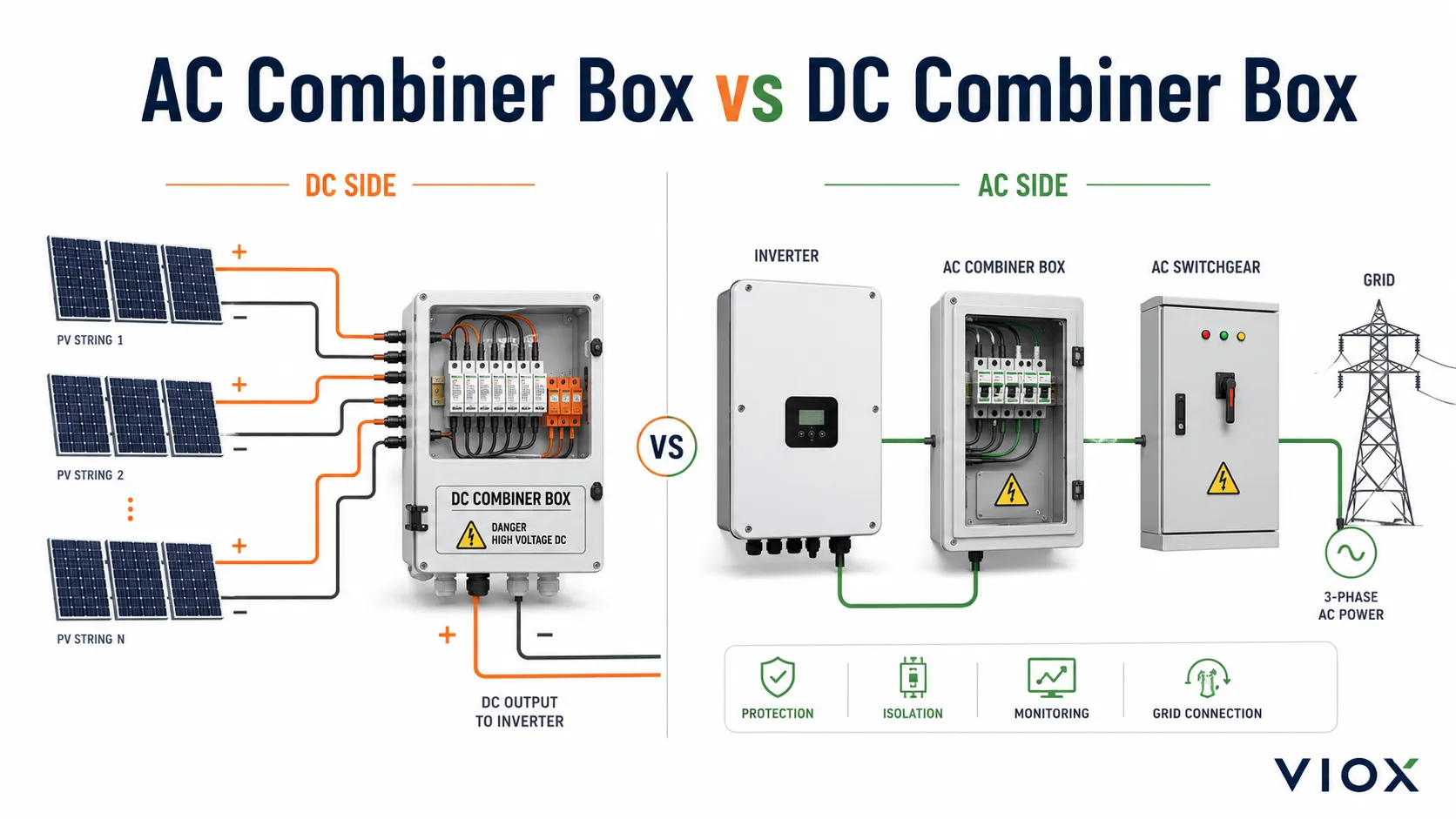
An AC combiner box combines the alternating-current outputs of multiple inverters, microinverters, or inverter branches before feeding an AC distribution panel, switchboard, switchgear, transformer, or grid interconnection point.
A DC combiner box combines the direct-current outputs of PV strings before the inverter. It normally includes string fuses or DC breakers, DC surge protection, positive and negative busbars, DC isolators or disconnects, grounding terminals, and sometimes string monitoring.
The difference is not only where the box sits. It changes the protection design:
A DC combiner box must handle PV DC voltage, polarity, reverse current, and sustained DC arcs. An AC combiner box must handle AC branch protection, inverter output aggregation, short-circuit rating, neutral/ground arrangement, and AC disconnecting or switchgear requirements.
Key Takeaways
- DC combiner boxes are used before the inverter. They combine PV strings on the DC side.
- AC combiner boxes are used after the inverter. They combine AC outputs from string inverters, microinverters, or inverter groups.
- DC protection is not the same as AC protection. DC fuses, DC breakers, DC SPDs, and DC isolators must be selected for PV voltage and polarity.
- AC combiner switchgear is common in larger systems. Multiple inverter outputs may feed AC switchboards, switchgear, or recombiner panels.
- Microinverter systems often use AC combining. Each microinverter converts module DC to grid-compatible AC, so the combining happens on the AC side.
- Do not choose by enclosure size alone. Cable layout, voltage, current, SCCR/short-circuit rating, SPD type, earthing, labeling, and standards all matter.
AC vs DC Combiner Box Comparison Table
| Item | DC Combiner Box | AC Combiner Box |
|---|---|---|
| Location | Between PV strings and inverter DC input | Between inverter outputs and AC distribution/grid connection |
| Current type | Direct current | Alternating current |
| Main purpose | Combine PV string DC circuits | Combine AC inverter output circuits |
| Common input | PV strings | String inverters, microinverters, inverter branch circuits |
| Common output | Inverter DC input | AC panel, AC switchgear, transformer, grid interconnection |
| Protection devices | gPV fuses, DC MCB/MCCB, DC isolator, DC SPD | AC breakers, AC switch, AC SPD, metering, busbar |
| Busbar layout | Positive, negative, PE/ground | Phase busbar, neutral where required, PE/ground |
| Main technical risk | DC arc, polarity error, reverse current, PV overvoltage | AC fault current, inverter backfeed, coordination, switchgear rating |
| Typical applications | String inverter PV arrays, utility PV strings, DC collection | Microinverters, multiple string inverters, commercial rooftops, solar farms |
| Common search term | DC combiner box, solar combiner box | AC combiner box, AC combiner panel, AC combiner switchgear |
Where Each Box Sits in a Solar PV System
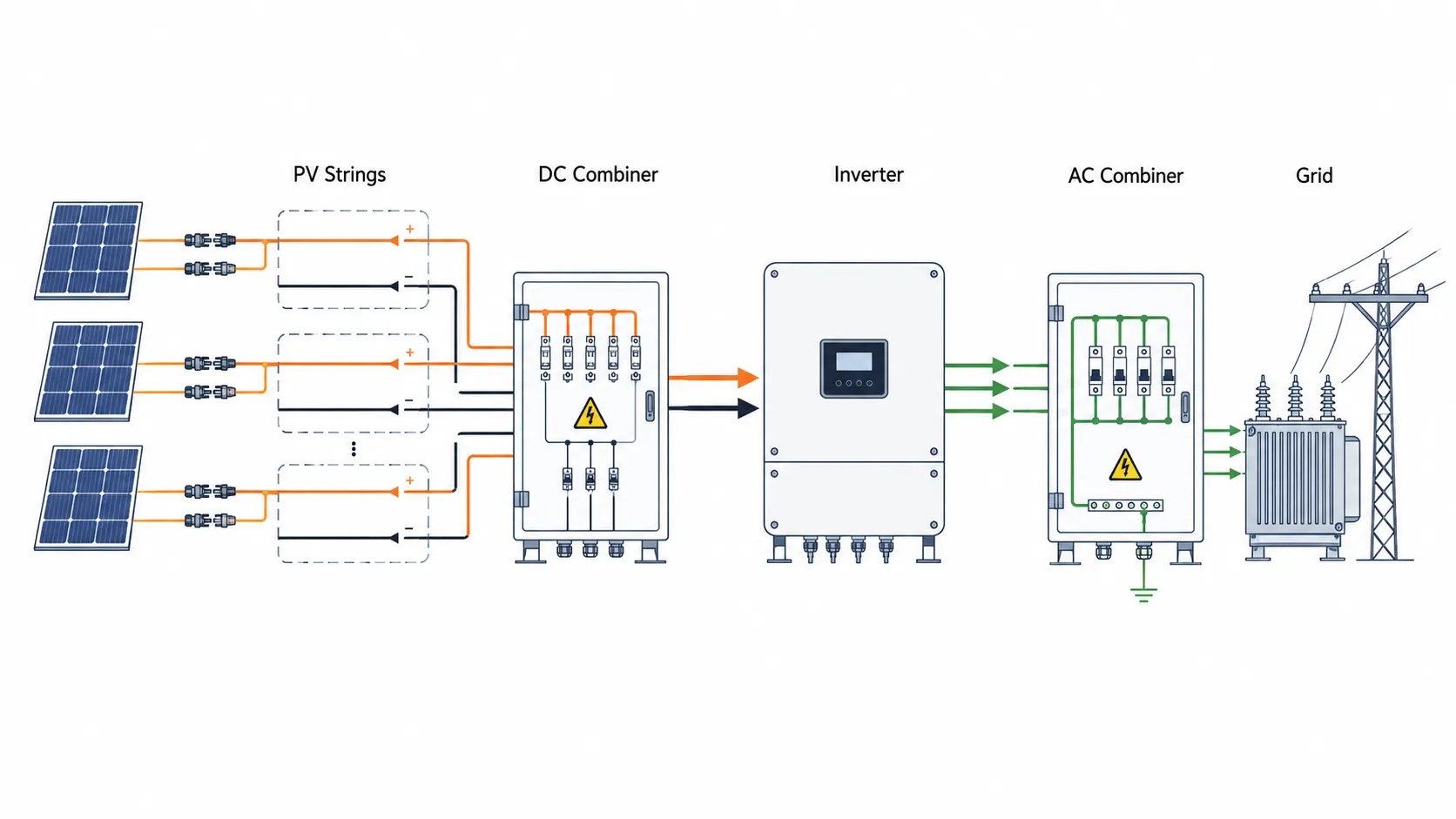
A simplified string inverter system looks like this:
PV modules
   ↓
PV strings
   ↓
DC combiner box
   ↓
String inverter
   ↓
AC combiner box or AC distribution panel
   ↓
Transformer / switchgear / grid
A microinverter system looks different:
PV module
   ↓
Microinverter converts DC to AC at the module
   ↓
AC branch circuit
   ↓
AC combiner box or AC combiner panel
   ↓
Main AC distribution / grid interconnection
That is why a DC combiner box is usually associated with string inverter architecture, while an AC combiner box is common in microinverter systems, multi-inverter commercial systems, and utility-scale inverter output aggregation.
What Is a DC Combiner Box?
A DC combiner box is a PV protection and collection box installed on the DC side of a solar system. It combines multiple PV strings into fewer output circuits before the inverter.
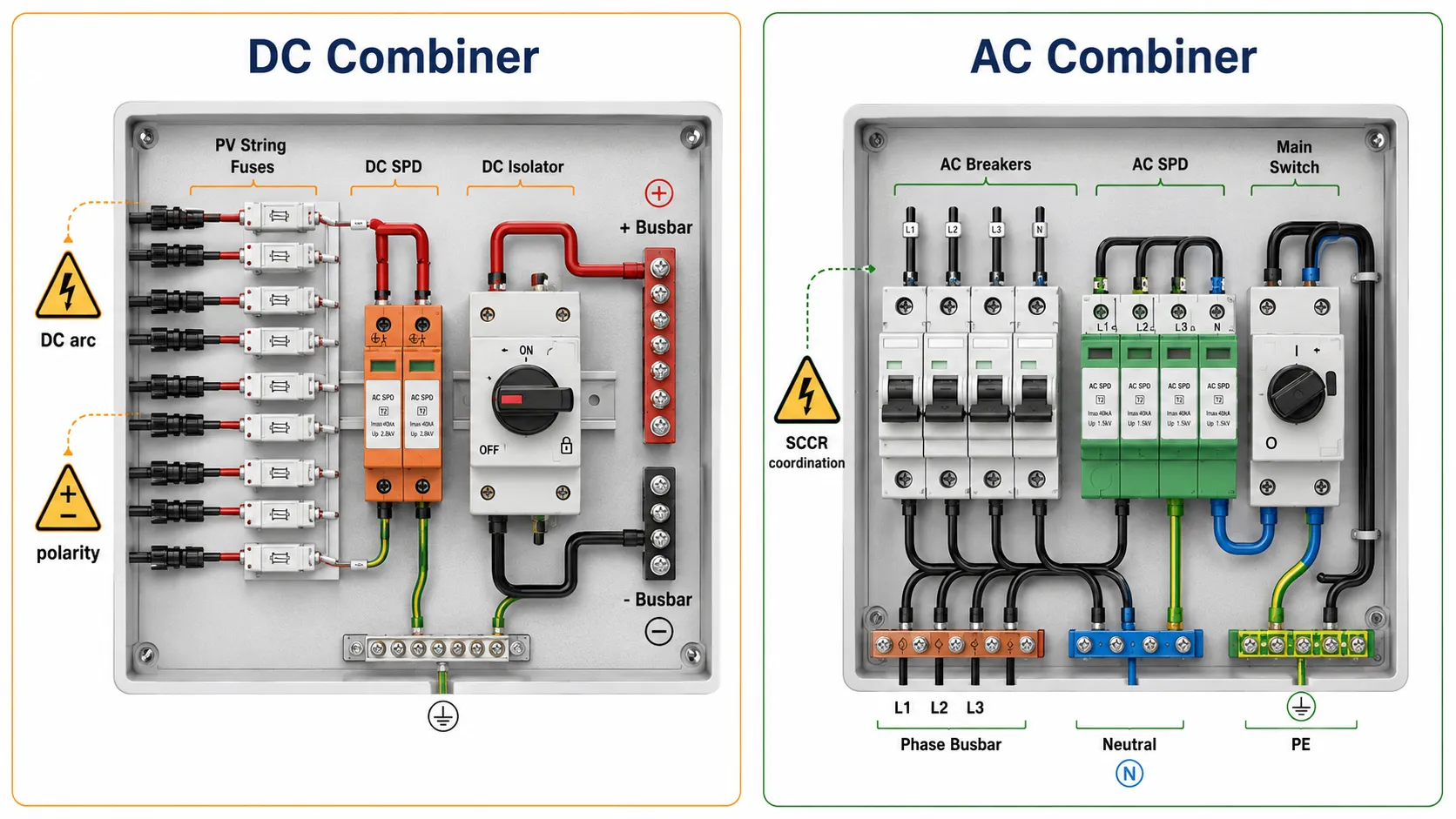
Typical components include:
- PV string fuses or DC breakers
- positive busbar
- negative busbar
- DC surge protective device
- DC isolator or disconnector
- grounding or PE terminal
- string monitoring module where required
- cable glands or PV connectors
- outdoor enclosure
- warning labels and polarity labels
DC combiner boxes are often used when:
- one inverter has multiple PV string inputs
- multiple strings must be protected individually
- string monitoring is needed
- long DC cable runs need organized collection
- DC surge protection is required near the array
- maintenance teams need a clear DC isolation point
For a broader foundation, see VIOX’s PV combiner box guide.
What Is an AC Combiner Box?
An AC combiner box combines AC output circuits from multiple inverters or microinverter branches. It is installed after DC has already been converted into AC.
Typical components include:
- AC breakers or MCCBs
- AC busbar
- main AC disconnect or switch
- AC SPD
- neutral bar where required
- PE/ground bar
- metering or monitoring device
- terminal blocks
- cable glands
- enclosure
- circuit labels
AC combiner boxes are common in:
- microinverter solar systems
- commercial rooftop PV systems with multiple inverters
- utility PV plants with many inverter outputs
- inverter rooms
- AC recombiner panels
- AC combiner switchboards
- AC combiner switchgear
In large PV systems, the term AC combiner switchgear or AC recombiner is often used when the equipment is more than a small box. It may include larger breakers, metering, protective relays, busbars, current transformers, and integration with low-voltage switchgear.
AC Combiner Box vs AC Combiner Switchgear vs AC Recombiner
These terms are related, but they are not always the same size of equipment.
| Term | Practical Meaning | Typical Use |
|---|---|---|
| AC combiner box | Smaller enclosure combining inverter AC outputs | Residential, commercial, microinverter, small multi-inverter systems |
| AC combiner panel | Panel-style AC combining assembly with breakers | Commercial rooftop and distributed inverter systems |
| AC combiner switchboard | Larger AC distribution assembly combining inverter feeders | Commercial and utility-scale PV |
| AC combiner switchgear | More robust switchgear-level AC combining and protection | Large inverter rooms, utility PV plants |
| AC recombiner | Combines outputs from downstream AC combiners or inverter blocks | Larger PV plants and multi-level AC collection systems |
Use the term that matches the equipment level. A small microinverter AC combiner should not be described as switchgear. A utility-scale AC switchgear lineup should not be reduced to a simple combiner box.
DC Combiner Box Components
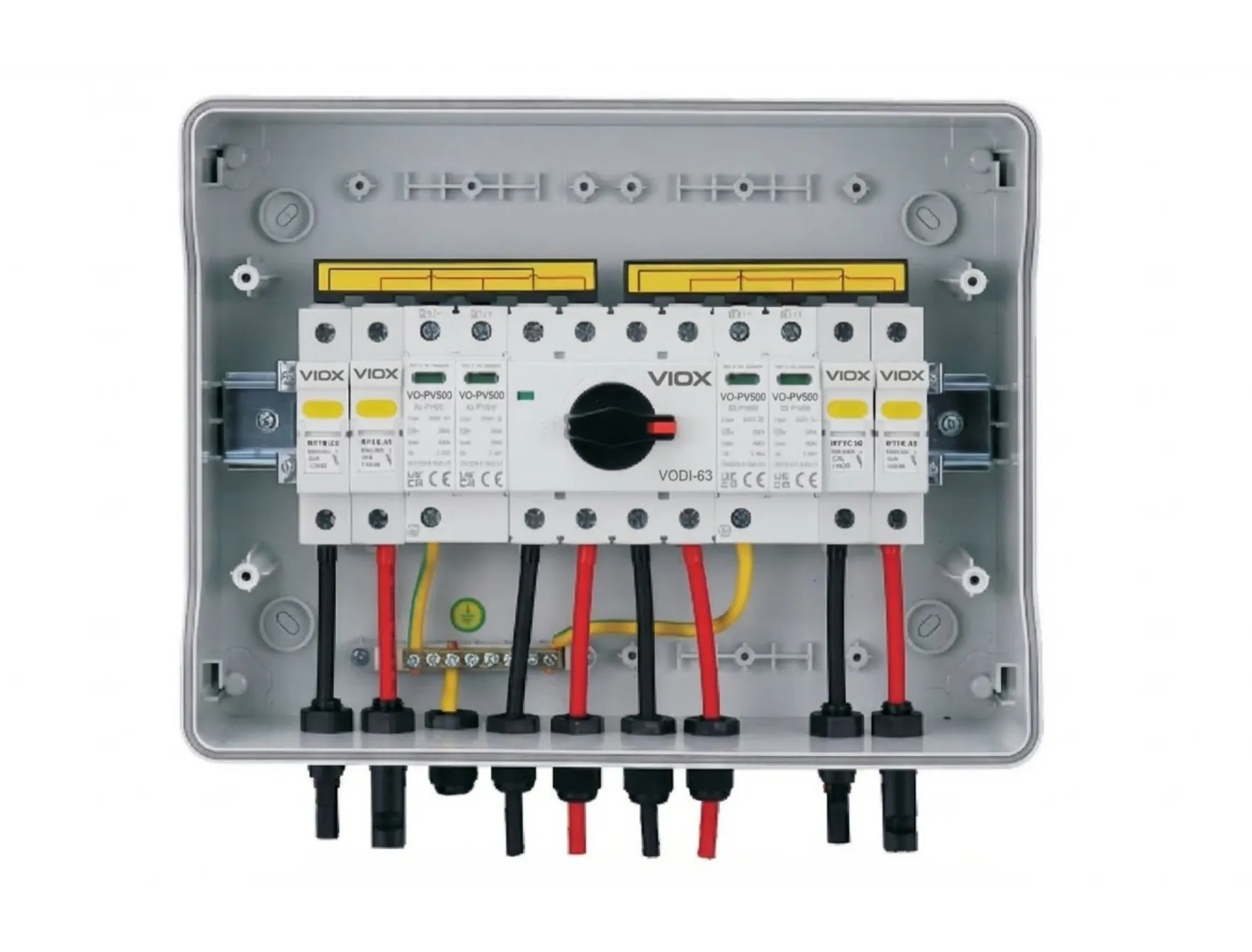
| Component | Function | Selection Note |
|---|---|---|
| gPV fuse or DC breaker | Protects PV string circuits | Must match PV voltage and current |
| Positive busbar | Combines positive string conductors | Check current rating and spacing |
| Negative busbar | Combines negative string conductors | Check polarity and insulation |
| DC SPD | Limits transient overvoltage on PV DC side | Use PV/DC-rated SPD |
| DC isolator | Provides local DC disconnection | Must be DC-rated for the system voltage |
| String monitoring | Measures string current or status | Useful in larger PV plants |
| Enclosure | Protects components outdoors | IP rating, UV resistance, heat, condensation |
| Cable entries | Seal PV cables into enclosure | Match cable diameter and outdoor sealing |
Engineering tip: sizing PV string fuses. In North American NEC-based designs, PV source-circuit current is commonly treated as a continuous current derived from module short-circuit current. A practical starting point is:
Minimum PV fuse current rating >= 1.56 x string Isc
The 1.56 factor comes from applying 125% to PV short-circuit current and another 125% for continuous-duty overcurrent protection sizing. Final selection still depends on the module datasheet, maximum series fuse rating, ambient temperature, grouping, fuse holder rating, local code, and the inverter manufacturer’s design rules.
For IEC projects, do not copy the NEC number blindly. Verify the fuse-link class, voltage rating, string current, reverse-current condition, and gPV fuse coordination according to the project standard and component datasheets.
For DC-side surge protection, see DC surge protection devices for PV, EV, BESS, and industrial systems.
AC Combiner Box Components
| Component | Function | Selection Note |
|---|---|---|
| AC breaker | Protects inverter output branch | Match inverter output current and fault rating |
| Main AC switch | Provides isolation or load disconnection | Verify load-break rating |
| AC busbar | Combines inverter AC outputs | Check current, heat rise, short-circuit rating |
| AC SPD | Limits AC-side transient overvoltage | Match AC system voltage and earthing |
| Neutral bar | Used where neutral is required | Depends on system type |
| PE/ground bar | Protective bonding | Must follow grounding design |
| Metering | Measures output or branch currents | Common in larger AC combiner panels |
| Enclosure | Protects AC components | Indoor/outdoor, IP/NEMA, corrosion |
For general AC/DC distribution differences, see VIOX’s guide to AC distribution box vs DC distribution box.
Why DC Combiner Boxes Need Special Attention
DC combiner boxes are technically demanding because PV DC behaves differently from AC.
Key DC risks include:
- no natural current zero crossing
- sustained DC arcs
- high open-circuit voltage in cold conditions
- reverse current between strings
- polarity mistakes
- insulation faults
- UV and outdoor exposure
- condensation inside enclosures
- cable gland sealing failure
The most serious design mistake is treating a PV DC combiner as a normal distribution box. A standard AC breaker, AC SPD, or generic disconnect may not safely interrupt or withstand the PV DC circuit.
SPD Selection: Type 1+2 vs Type 2 in PV Combiner Boxes
Surge protection is not just a checkbox. In PV combiner design, the SPD type should match the lightning exposure, earthing system, cable routing, and protection zone.
| SPD Choice | Typical Use in Solar PV | Practical Design Note |
|---|---|---|
| Type 2 DC SPD | Most PV arrays without a direct lightning protection system | Common choice for induced surges and switching transients on the DC side |
| Type 1+2 DC SPD | PV arrays on buildings with external lightning protection, exposed rooftops, or high lightning-risk sites | Used where partial lightning current may need to be discharged at the PV boundary |
| Type 2 AC SPD | AC combiner panels and inverter output distribution | Match AC voltage, earthing system, and upstream/downstream SPD coordination |
| Type 1+2 AC SPD | Service entrance, main AC switchgear, or lightning-exposed installations | Often coordinated with downstream Type 2 SPDs |
For rooftop commercial PV with an external lightning protection system, a DC Type 1+2 SPD near the array combiner is often evaluated together with AC-side SPD coordination at the inverter output and main distribution board. For ordinary low-exposure commercial roofs, Type 2 SPDs may be sufficient, but the decision belongs in the project surge protection design, not in a generic bill of materials.
Thermal Management and Condensation Control
Outdoor combiner boxes fail as much from heat and moisture as from incorrect wiring. A DC combiner exposed to sun can run much hotter than the ambient air temperature, especially when fuse holders, busbars, and cable terminals are packed tightly inside a small enclosure.
Check these points before approving the enclosure layout:
- Fuse holder heat rise: gPV fuse holders dissipate heat under load; derating may be required in hot climates or dense layouts.
- Cable bending space: tight cable bends create mechanical stress and make maintenance harder.
- Ventilation or pressure equalization: outdoor enclosures may need breather valves or ventilation glands to reduce condensation and pressure cycling while maintaining the required IP rating.
- UV and corrosion resistance: plastics, seals, cable glands, and labels must survive outdoor exposure.
- Service access: technicians need space to test string voltage, replace fuses, inspect terminals, and verify SPD indicators.
Field review rule: if the electrical schematic looks correct but the enclosure layout forces every cable, fuse holder, and SPD into a cramped hot zone, the design is not finished.
When to Use a DC Combiner Box
Use a DC combiner box when:
- multiple PV strings must be combined before one inverter input
- string-level fusing is required
- DC surge protection is needed near the array
- string monitoring is required
- DC cable runs need organized collection
- local DC isolation improves maintenance
- the inverter has fewer MPPT inputs than the number of strings
A DC combiner is usually unnecessary when a small inverter already has enough protected string inputs, or when the system uses microinverters and the combining happens on the AC side.
When to Use an AC Combiner Box
Use an AC combiner box when:
- multiple inverter AC outputs need to be combined
- a microinverter system has several AC branch circuits
- a commercial rooftop system has distributed inverters
- inverter outputs need local AC disconnecting
- AC surge protection is required before the main distribution panel
- metering or monitoring is needed at inverter output level
- the project needs an AC recombiner stage before switchgear
AC combining becomes more important as inverter count increases. In larger systems, the design may move from a small AC combiner box to AC combiner switchgear or an AC recombiner panel.
AC vs DC Combiner Box Selection Checklist
| Question | DC Combiner Box | AC Combiner Box |
|---|---|---|
| Which side of the inverter? | Before inverter | After inverter |
| What voltage applies? | PV DC maximum voltage | AC nominal voltage |
| What protection devices? | gPV fuse, DC breaker, DC SPD, DC isolator | AC breaker, AC SPD, AC switch |
| What current source? | PV strings | Inverter outputs |
| Does polarity matter? | Yes | Not in the same way |
| Is reverse current possible? | Yes, especially multi-string PV | Possible backfeed from inverter outputs depending on design |
| What enclosure rating? | Usually outdoor, UV, IP, condensation | Indoor or outdoor depending on inverter location |
| What standard framework? | PV DC and low-voltage assembly rules | AC panel, switchboard, or switchgear rules |
| What labels are critical? | DC voltage, polarity, isolation, warning | AC voltage, source, breaker ID, disconnect |
Standards and Design References to Verify
Exact requirements depend on country, installation type, system voltage, and project specification. Common references include:
| Standard or Code Area | Relevance |
|---|---|
| IEC 61439 series | Low-voltage switchgear and controlgear assemblies |
| IEC 62548 | PV array design and installation practices |
| IEC 60947 series | Low-voltage switching and protection devices |
| IEC 60269-6 | gPV fuses for photovoltaic applications |
| IEC 61643-31 | SPDs connected to the DC side of photovoltaic installations |
| IEC 61643-11 | SPDs for AC low-voltage power systems |
| NEC Article 690 | Solar photovoltaic systems in NEC-governed installations |
| UL 508A / UL 1741 context | Industrial control panels and inverter-related equipment in North American projects |
Do not assume that using certified components makes the complete combiner assembly certified. The enclosure, wiring, temperature rise, short-circuit rating, spacing, labeling, and documentation all matter.
Common Mistakes
Mistake 1: Using an AC Combiner Where a DC Combiner Is Needed
An AC combiner cannot replace a PV DC combiner. AC protection devices may not interrupt PV DC safely.
Mistake 2: Calling Every Solar Box a DC Combiner Box
Microinverter systems usually combine outputs on the AC side. In that case, the relevant equipment may be an AC combiner box or AC combiner panel.
Mistake 3: Ignoring Inverter Architecture
String inverter systems, central inverter systems, microinverter systems, and optimizer systems use different combining strategies.
Mistake 4: Selecting by Current Rating Only
Voltage, polarity, breaking capacity, fuse derating, surge protection type, enclosure rating, temperature, and cable entry design are just as important.
Mistake 5: Treating SPD Selection as a Generic Accessory
For PV systems, the SPD decision depends on whether the combiner is on the DC or AC side, whether the building has external lightning protection, and where the equipment sits in the lightning protection zone. A Type 2 SPD is not automatically wrong, and a Type 1+2 SPD is not automatically better; the correct answer depends on the surge protection design.
Mistake 6: Undersizing the Enclosure
Combiner boxes need enough space for cable bending, heat dissipation, service access, terminal spacing, and future inspection.
Mistake 7: Forgetting Outdoor Failure Modes
Many solar combiner failures come from water ingress, condensation, UV aging, poor cable glands, loose terminals, or overheated fuse holders rather than the electrical diagram alone.
Mistake 8: Copying One Combiner Design Across Different Inverter Architectures
A design built for string inverters may be wrong for microinverters, and a compact AC combiner panel may not be suitable for utility-scale AC recombining. In EPC reviews, one of the fastest ways to catch a weak design is to ask: “Is this box combining PV strings before inversion, or inverter outputs after inversion?” If the drawing cannot answer that immediately, the equipment naming and protection design need another pass.
FAQ
What is the fastest way to identify whether a combiner is AC or DC?
Look at its position relative to the inverter. If it combines PV strings before the inverter, it is a DC combiner box. If it combines inverter outputs after conversion, it is an AC combiner box, AC combiner panel, AC combiner switchgear, or AC recombiner.
Do microinverter systems use AC or DC combiner boxes?
Microinverter systems usually use AC combining because each microinverter converts module DC power to AC at or near the panel.
Can an AC breaker be used in a DC combiner box?
Only if the exact breaker is rated and documented for the required DC voltage, current, pole wiring, and application. AC-only breakers should not be used for PV DC interruption.
How do you size a DC combiner box fuse?
Start with the PV module short-circuit current and the project code basis. In NEC-based designs, a common starting point is fuse current rating >= 1.56 x string Isc, while also checking the module maximum series fuse rating, ambient temperature derating, fuse holder rating, and local AHJ requirements.
Should a PV combiner use Type 1+2 or Type 2 SPD?
Use Type 2 SPD for many standard PV combiner applications where the risk is induced surge. Evaluate Type 1+2 SPD where the PV array is connected to a structure with external lightning protection, exposed rooftop lightning risk, or a design requirement to discharge partial lightning current.
What is AC combiner switchgear?
AC combiner switchgear is a larger AC combining and protection assembly used in commercial or utility PV systems where multiple inverter outputs are brought together at switchgear level.
What is an AC recombiner?
An AC recombiner combines outputs from multiple AC combiner panels or inverter blocks into a higher-level AC collection point before the main switchgear or transformer.
Which is better: AC combiner or DC combiner?
Neither is universally better. The correct choice depends on inverter architecture. String inverter systems often need DC combining. Microinverter and multi-inverter systems often need AC combining.
Conclusion
AC and DC combiner boxes solve different problems in solar PV systems.
A DC combiner box collects PV string circuits before the inverter and must be designed for PV DC voltage, polarity, reverse current, DC arc interruption, DC surge protection, and outdoor conditions.
An AC combiner box collects inverter AC outputs after conversion and must be designed for AC branch protection, inverter output aggregation, switchgear coordination, AC surge protection, metering, and grid-side distribution.
For a reliable solar installation, start with the inverter architecture. Once you know where the combining happens, choose the combiner box according to current type, voltage, protection devices, enclosure environment, wiring layout, and applicable standards.