

On this page
Replace an existing Type AC RCD when assessment shows that its waveform capability no longer suits the connected equipment or the proposed work. Investigate an unexplained failed test before giving reassurance, even if later tests pass. These are separate decisions: whether the device operates reliably, and whether it is the right type for the circuit.
If you have been told to upgrade after adding a socket, the useful questions are: what changed, what failed, and which replacement is compatible with the existing board? The Type AC label alone does not answer all three.
This guide uses UK inspection and installation guidance. As of November 2026, the IET identifies BS 7671:2018+A4:2026 as the current edition following the October transition. Other countries have different requirements; UK inspection codes are not global rules. See the IET edition checker.
Three points before authorising work: a later pass does not explain an earlier failure; a passing operational test does not establish suitability for every connected load; and a Type A device that physically fits is not automatically an approved replacement.
Consumer-unit inspection, internal testing and replacement require a competent electrical professional. A householder can provide appliance details and ask for records without removing the cover.
What Should Happen to the Existing Type AC RCD?
An RCD is a residual current device. In a typical split-load board, the relevant device is an RCCB: a residual current circuit breaker without integral overcurrent protection. The RCCB overview explains that device boundary.
| What has been established? | Appropriate next step | What remains to be checked? |
|---|---|---|
| The device operates correctly and serves a verified suitable fixed load | Retention may be justified | Applicable rules, installation condition and future changes |
| Electronic equipment is present or foreseeable, but suitability is undocumented | Arrange a type-suitability assessment | Equipment instructions and possible residual-current waveforms |
| A new socket, circuit or changed load is proposed | Assess the protection serving the new work | Current requirements and the existing circuit’s suitability |
| A test fails once and passes on repetition | Investigate and preserve both results | Test conditions, instrument setup, connected loads and device condition |
| Correct testing confirms failure to operate as required | Treat as a protective-device defect requiring prompt remedial action | Cause, safe interim arrangements and suitable replacement |
| Type A is supported by the load assessment but no compatible replacement is documented | Resolve the assembly design before ordering | Approved device family or another verified protection arrangement |
These are decision routes, not remote inspection codes. Different findings can coexist: a device can be the wrong type and also have an operational defect.
It Failed Once, Then Passed: Does That Prove DC Blinding?
No. Direct current (DC) can impair unsuitable RCDs, but a sequence of inconsistent tests does not identify the cause by itself. The IET’s explanation of RCD types describes how DC can affect sensing; it does not establish that every delayed or failed operation is DC blinding.
For example, an electrician adds a socket, obtains one unsatisfactory result, then obtains satisfactory results after disconnecting appliances. That establishes that the conditions changed. It does not measure a DC component or prove that the device is healthy under every operating condition.
The IET’s 2022 RCD-testing explanation notes that downstream electronic loads and circuit capacitance can affect recorded results. Use that explanation to understand interference, not as a substitute for the current testing procedure and instrument instructions.
Ask the electrician to retain the initial result and document:
- which device and circuit were tested, and where;
- the instrument, selected test mode and relevant settings;
- which loads were connected for each result;
- whether the applicable method and acceptance criteria were satisfied;
- what further investigation resolved the discrepancy, or what remains unresolved.
Do not reduce the record to the best repeat result. Equally, do not declare a mechanical fault, DC blinding or an unsafe installation from the sequence alone. Detailed test methods belong in the RCCB testing and maintenance guide.
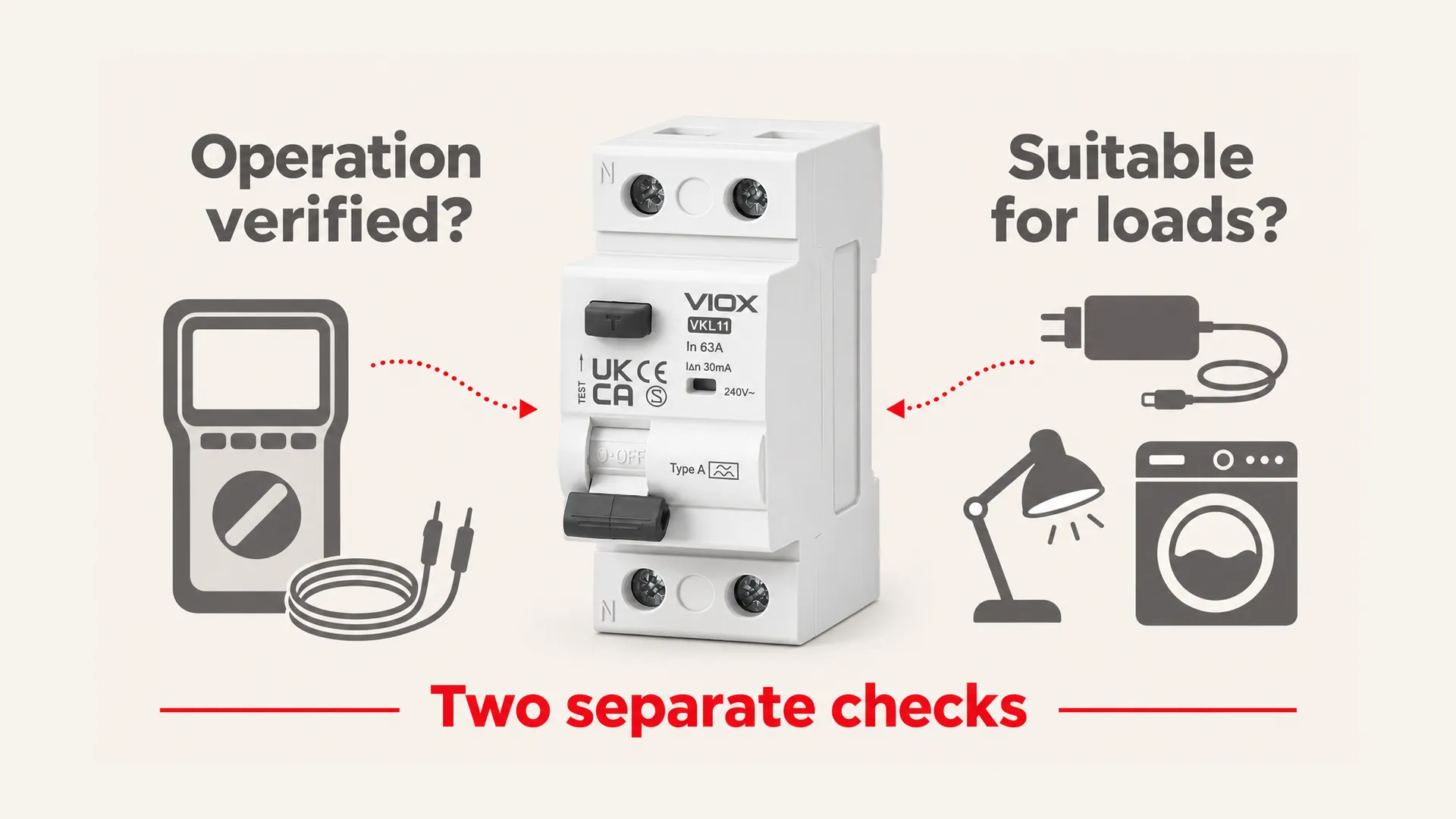
Two separate checks: observed operation and suitability for the connected equipment. The illustration shows assessment relationships, not a test connection or wiring diagram.
Does Adding a Socket Change the Upgrade Decision?
Yes, it changes the assessment. Inspecting an untouched installation, replacing a damaged accessory and extending a circuit are different scopes of work. The electrician should identify the actual scope before recommending retention or replacement.
Existing installation under inspection
When preparing a UK Electrical Installation Condition Report (EICR), Electrical Safety First’s guidance, Q2.53, distinguishes three circumstances: connected or foreseeable equipment requiring a different type can warrant C3, improvement recommended; confirmed incorrect operation can warrant C2, potentially dangerous; and a known load without impairing DC components may need no recommendation code for the Type AC issue.
Those distinctions require site evidence. Neither every Type AC device nor every electronic appliance automatically establishes C2.
New socket or circuit alteration
An additional socket can allow different equipment to be connected. Reassess protection for the proposed use; do not assume that an older device remains appropriate because the original circuit has worked for years. Ask which current requirement and equipment characteristics support the chosen type.
Accessory replacement or maintenance
A repair is not automatically a mandate to replace the entire consumer unit. It also does not justify ignoring a defect discovered during the work. The recommendation should distinguish what the repair requires from any separate improvement identified. For the wider board decision, see whether an old consumer unit needs upgrading.
Is Type A Enough for the Equipment Now Connected?
Type A extends Type AC capability to pulsating DC residual current. It does not provide universal protection for every inverter, charger or variable-speed appliance.
Before authorising a Type A replacement, obtain the protective-device requirement for the actual equipment. If documentation calls for Type F, Type B or an application-specific arrangement, changing to Type A alone does not complete the design. The existing RCCB Type AC/A/F/B guide covers those waveform choices.
A passing instrument test and a suitable waveform type answer different questions. Replacing the device without reviewing the connected equipment can leave the original suitability question unanswered. Conversely, choosing the correct type does not excuse defective wiring or an unresolved failed test.
Can You Replace Just the RCD Instead of the Whole Board?
Possibly, if the proposed device is suitable for both the circuit and the consumer-unit assembly. Obtain the board make and range, existing device reference and proposed replacement reference before buying.
The IET’s 2025 guidance on integrating devices into assemblies explains why matching dimensions or individual product standards does not establish compatibility. Even products from the same manufacturer can belong to different ranges. Seek documented suitability for the exact arrangement.
Use three checks:
- Device requirement: verify type, voltage, frequency, rated current, residual operating current, poles and time characteristic.
- Protection arrangement: verify associated overcurrent protection and upstream/downstream coordination. Do not raise the residual operating current merely to avoid tripping.
- Assembly fit: verify terminal and busbar interfaces, enclosure clearances and the approved device family against the assembly documentation.
If compatibility cannot be established, the designer must evaluate another verified arrangement. That can involve a separate assembly or wider replacement; it does not make a complete board upgrade inevitable. A quotation should identify why a small device change is feasible or why it is not.
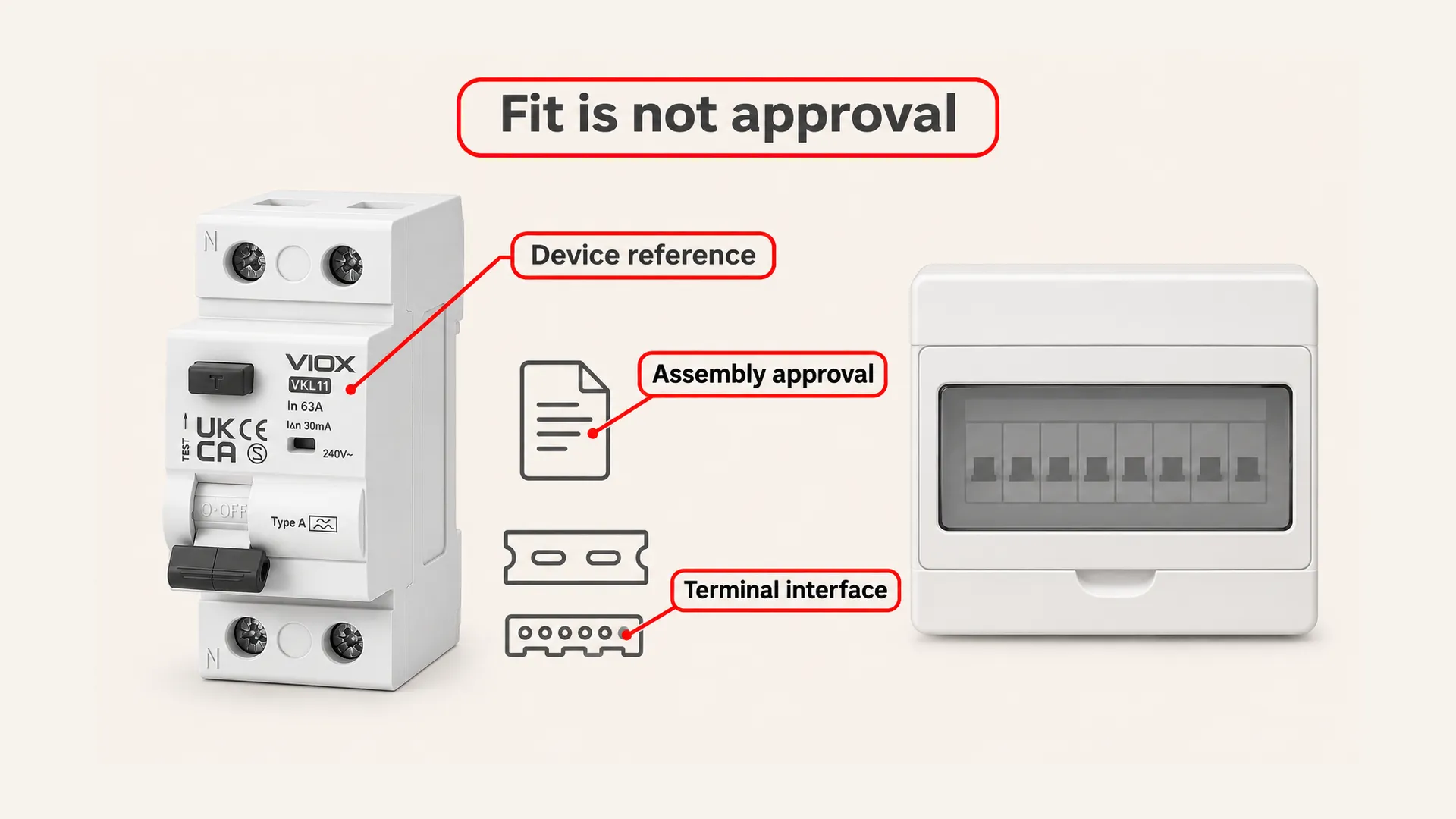
The VIOX product photograph identifies an example device. It does not demonstrate compatibility with the generic board shown, or approval for any existing installation.
How to Answer the Customer’s Question: “Is It Unsafe Now?”
Avoid “it is old, so it is unsafe” and the equally unhelpful “it passed eventually, so everything is fine.” Explain the finding, evidence and next action separately.
For an unresolved test discrepancy, a useful explanation is:
“One result was unsatisfactory and the later conditions were different. We need to establish why before confirming this part of the installation is satisfactory. Separately, I am checking whether the existing RCD type suits the equipment now supplied.”
For a documented improvement rather than a confirmed operational failure:
“The recommendation concerns suitability for the connected equipment. The report will identify the observation and priority, and the replacement proposal will show the compatible device and the verification included.”
These are communication examples, not predetermined inspection verdicts. Where a defect is confirmed, the electrician should explain the affected protection, remedial priority and any necessary interim precautions directly.
What Should the Completed Upgrade Record Include?
Before accepting the job as complete, ask for a short record linking the recommendation to the completed work:
| Record | What it should make clear |
|---|---|
| Reason for action | Operational defect, changed load, new work or another documented finding |
| Device identification | Existing and replacement references, with the required type and ratings |
| Compatibility evidence | Why that device is suitable for the actual consumer-unit arrangement |
| Verification results | Applicable inspection and instrument results, with earlier discrepancies addressed |
| Handover | Updated circuit identification, relevant certification and manufacturer instructions |
For a VIOX candidate, the RCCB product page lists the VKL11 family with Type AC, A and ASi variants. Request the exact variant documents and destination-market evidence. Family availability and the product photograph do not establish retrofit compatibility or certification for the proposed installation.
Written by the VIOX Editorial Team. Sources and editorial content reviewed 3 November 2026. This article supports a replacement discussion; it is not an inspection report for a particular property.