

On this page
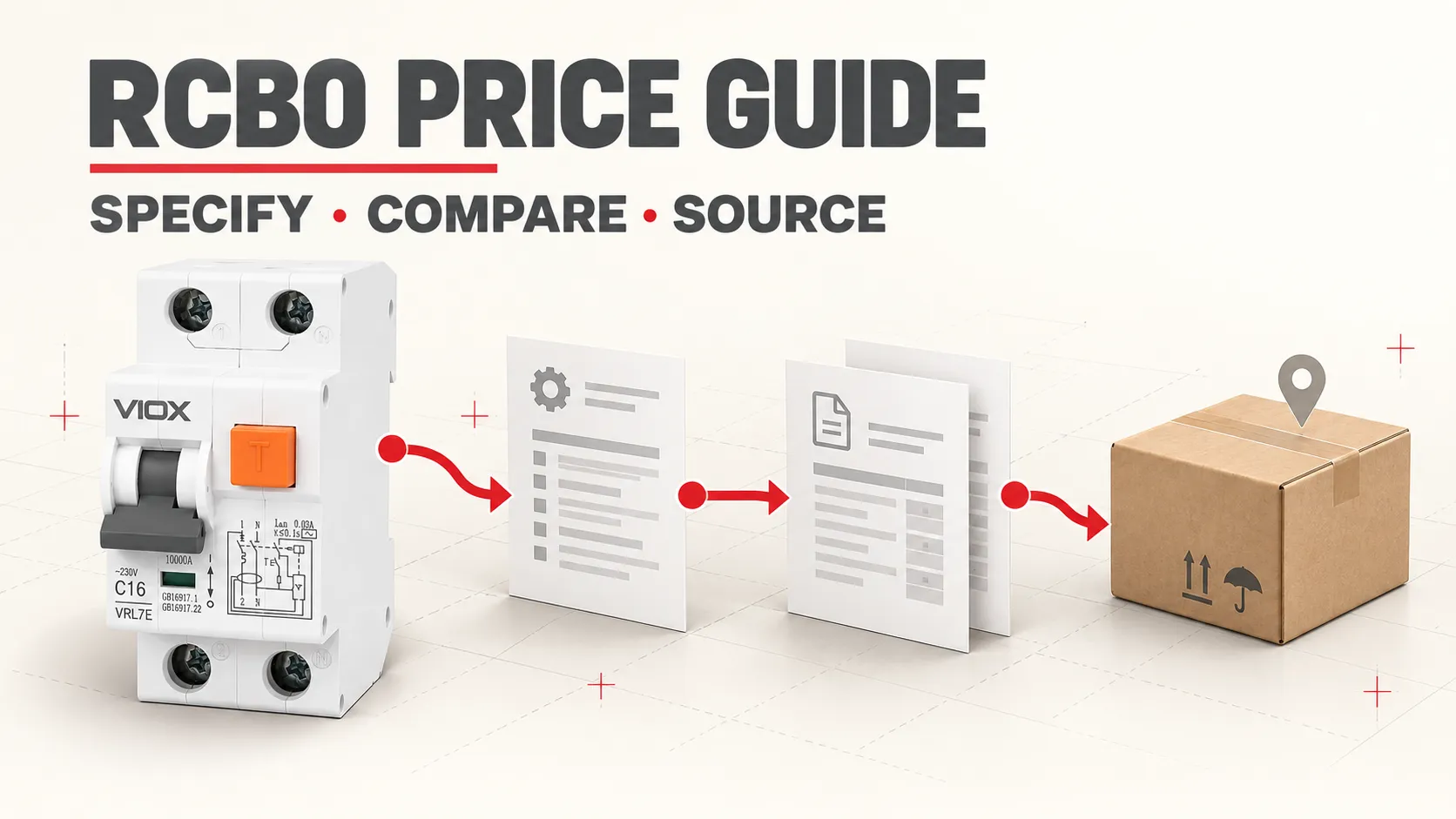
There is no defensible universal RCBO price. Two devices with the same current rating may have different pole arrangements, protected conductors, residual-current response, trip curves, breaking capacities, operating designs, approvals, accessories, and order scope. Their prices are not comparable until those fields—and the delivery boundary—match.
For procurement, use this rule:
Freeze the required RCBO specification first. Then compare quotations for the same model scope, evidence package, quantity, currency, destination, and Incoterm.
If a supplier quotes only “32 A RCBO” or “four-pole RCBO,” the item is not sufficiently defined for a price decision. A lower number may describe a different protective function or simply exclude documents, packaging, freight, tax, or customization included elsewhere.
If the purchasing brief still uses RCBO, RCCB, and MCB interchangeably, resolve what an RCBO protects before comparing offers.
This guide intentionally does not publish an invented INR, USD, or EUR price range. It shows how to establish a comparable price and ends with a copy-ready request for quotation (RFQ).
Five Different Numbers Can All Be Called an RCBO Price
Before comparing numbers, identify what each number represents.
| Price boundary | What it may include | What it may exclude | Appropriate use |
|---|---|---|---|
| Retail shelf price | One stocked device, local channel margin, and applicable local tax treatment | Factory customization, project documents, export freight, or volume terms | Buying a small quantity of an identified local SKU |
| Sample delivered cost | One or several devices, sample handling, express delivery, and possibly payment charges | Production-volume economics and final packaging | Technical evaluation and sample approval |
| Production unit quote | A defined quantity of one or more frozen SKUs under named factory terms | Freight, duties, taxes, or destination services unless stated | Comparing manufacturing offers |
| Landed unit cost | Product plus the buyer’s allocated customization, documentation, freight, insurance, duty, tax, inspection, and related order costs | Installation labor and site work unless deliberately included | Comparing what an acceptable device costs at the receiving point |
| Installed project cost | Devices plus panel work, labor, testing, commissioning, downtime, and other site scope | Anything outside the installation quotation | Budgeting the completed electrical project |
A retail RCBO price in India, a sample sent by courier, and a production-volume export quotation are three different commercial objects. Treating them as one “market price” creates a false comparison even when the currency is converted correctly.
Start with a Comparable RCBO Line Item
An RCBO quotation becomes comparable only when it identifies the complete protective device. At minimum, freeze:
- pole arrangement and which poles are overcurrent-protected and switched;
- rated operational voltage and frequency;
- rated current
In; - overcurrent trip curve;
- rated residual operating current
IΔn; - residual-current Type, such as AC, A, F, or B where applicable;
- short-circuit breaking capacity, referenced standard, and voltage basis;
- voltage-dependent or voltage-independent operation where the project distinguishes them;
- required supply direction or permitted terminal arrangement;
- module width, terminal style, neutral arrangement, and busbar or assembly compatibility;
- exact model number and revision;
- required declaration, certificate, report, datasheet, instructions, and markings; and
- quantity, packaging, destination, currency, delivery term, and quotation validity.
If the circuit requirement is not yet frozen, use the VIOX RCBO selection guide before asking suppliers to compete on price. Procurement must not reduce a required rating or protection function to make one offer appear cheaper.
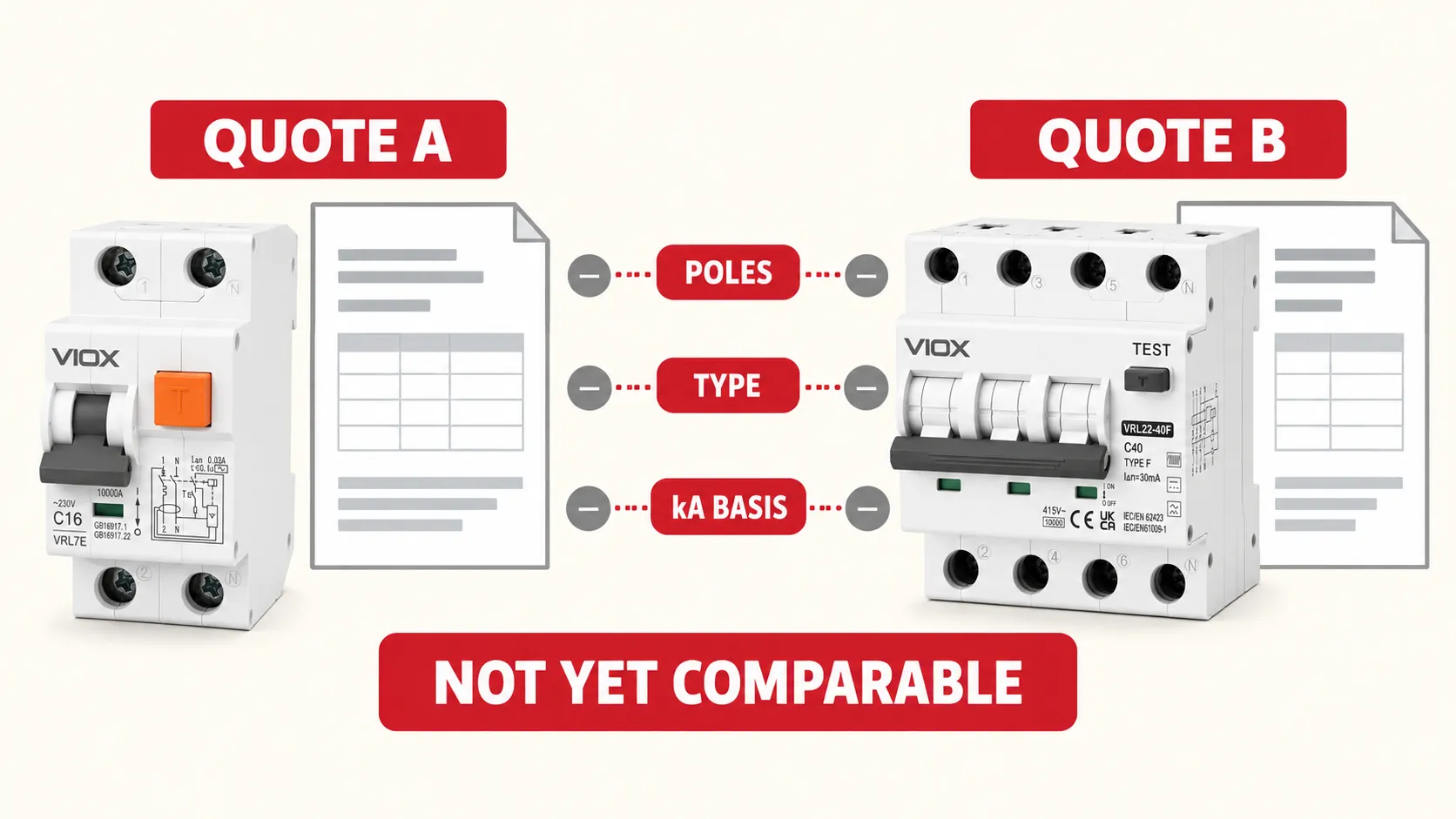
RCBO Price Drivers: What Must Match
The table does not assign universal price multipliers. It explains why each field changes the quote object or prevents direct comparison.
| Quote field | Why it affects the supplied device or evidence | What the buyer should compare |
|---|---|---|
| 1P+N, 2P, 3P+N, or 4P | Pole configuration changes current paths, switching arrangement, terminals, width, materials, assembly, and verification scope | Exact pole notation, protected poles, switched poles, neutral arrangement, module width |
| Type AC, A, F, or B | Residual-current response requirements and the associated detection design and verification are different | Exact Type on the model, datasheet, marking, and evidence—not a family-level promise |
| 6 kA, 10 kA, or 16 kA | Short-circuit duty can change the contact, magnetic, arc-control, housing, terminal, and test requirements | Capacity under the same standard, voltage, pole condition, and declared basis |
| Rated current and curve | In and B/C/D or another declared curve define different overcurrent characteristics |
Same current, curve, reference standard, temperature basis, and project coordination requirement |
IΔn |
10, 30, 100, 300 mA or another offered value serves a specified protection and coordination task | Same sensitivity and residual-current Type; do not substitute one to reduce price |
| Voltage dependence | Devices that depend on line voltage and those declared voltage-independent do not represent the same operating design | Required operating principle and exact declaration for the destination application |
| Directionality | Line/Load restrictions or a documented top/bottom or bidirectional arrangement can affect product suitability | Exact terminal diagram and manufacturer statement for the offered model |
| Terminals and form factor | Flying-neutral leads, neutral terminals, terminal capacity, module width, and busbar compatibility affect integration | Complete physical interface and included accessories, not just front appearance |
| Standard and market evidence | A catalogue statement, supplier declaration, third-party certificate, and market approval do not have the same scope | Required evidence type, issuer, model coverage, edition, validity, and supplied language |
IEC 61009-1:2024 gives general requirements and tests for RCBOs within its published household-and-similar-use AC scope, including limits up to 440 V AC, 125 A, and 25 kA. That scope is useful for defining the product-standard framework; it is not evidence that an unspecified quoted RCBO is certified, approved for a destination market, or suitable for a particular circuit.
Pole Count Is More Than a Width Label
1P+N and 2P should not be treated as interchangeable shorthand. Depending on the exact design and declaration, the notation can distinguish which conductor receives overcurrent protection, which conductors are switched, and how the neutral is arranged. Likewise, 3P+N and 4P require exact protected-pole and neutral-switching information.
More poles or modules can change material and production scope, but there is no valid universal rule that a four-pole RCBO costs four times a 1P+N device. Compare the declared function, dimensions, accessories, and evidence of the exact offered models.
Type A, F, and B Are Not Price Tiers Alone
Residual-current Type is a protection requirement, not a budget upgrade menu. Type AC, A, F, and B respond to different residual-current waveforms and conditions. The available designs, component architecture, evidence, and commercial price can differ between suppliers and markets.
Do not apply a generic multiplier such as “Type B always costs three times Type A.” First determine the required waveform response, then request that exact Type from every bidder. The VIOX comparison of RCBO Type AC, A, F, and B handles the technical decision separately.
Compare 6 kA, 10 kA, and 16 kA on the Same Basis
A larger printed kA number is not enough to approve a product or explain its price. Confirm whether each supplier is quoting the same breaking-capacity definition under the same product standard, rated voltage, frequency, and pole conditions. Also verify whether a claimed performance depends on a documented backup combination.
The correct capacity comes from the prospective fault current and applicable design rules, not from a preference for the cheapest or largest label. Use the 6 kA, 10 kA, and 16 kA RCBO breaking-capacity guide to settle that input before comparing offers.
Certification and Documentation Change the Quote Boundary
A familiar logo on a quotation is not enough. For each offered catalog number, ask what document will actually be supplied and what models it covers.
The evidence schedule may include:
- current datasheet and installation instructions;
- declaration of conformity or supplier declaration, where applicable;
- third-party certificate or listing required by the destination market;
- test report or report reference required by the project;
- model schedule showing covered ratings and variants;
- product and packaging markings;
- certificate holder, legal manufacturer, production site, and brand relationship where relevant; and
- document language, revision, validity, and change-notification requirements.
Do not compare a bare product offer with a project package that includes additional testing, document preparation, inspection, or approval support. Conversely, do not pay for evidence that does not cover the exact model being purchased.
Sample, Trial, and Production Prices Serve Different Decisions
Sample order
A sample quotation may include individual handling, small-quantity packaging, courier transport, and payment charges. Its purpose is to obtain and evaluate a representative unit. It does not prove the production price, production consistency, or final delivery schedule.
Trial order
A trial order tests ordering, packing, documentation, incoming inspection, and limited commercial execution at a larger scale. Record whether its labels, cartons, manuals, certificates, and product revision will match later production.
Production order
A production quotation should state quantity per SKU, total quantity, carton multiples, permitted mix, delivery schedule, price validity, payment terms, and change-control conditions. A large total order divided among many low-volume variants may not have the same economics as one stable SKU.
Never invent a universal RCBO minimum order quantity or volume discount. These are supplier-, model-, configuration-, and period-specific commercial terms.
How OEM, Packaging, and Variant Count Affect RCBO Cost
OEM scope should be broken into explicit deliverables instead of hidden inside one unit number:
| OEM or order variable | Questions to settle before comparison |
|---|---|
| Product marking | Standard product, buyer logo, rating-label layout, language, barcode, date or batch coding |
| Housing appearance | Existing standard colors or a separately approved customization |
| Instructions | Supplier standard document, translated document, buyer-branded manual, included languages and revision control |
| Inner and master packaging | Box artwork, labels, carton quantity, export marks, moisture protection, palletization |
| SKU mix | Number of currents, curves, Types, pole arrangements, sensitivities and breaking capacities in the order |
| Inspection | Supplier inspection, buyer inspection, third-party inspection, sample plan and report format |
| Spares and replacements | Extra units, spare ratio, replacement process and model continuity requirement |
| Change control | Notice required before component, marking, document, factory, or process changes |
The lowest standard-product price may no longer be the lowest complete offer after artwork, documentation, mixed-SKU handling, inspection, and logistics are normalized.
RCBO Price in India vs an Export Factory Quote
A search for RCBO price in India often has immediate retail intent: the buyer wants a locally stocked device, visible tax treatment, local delivery, and a known brand or model. An export or OEM factory quotation answers a different question. It may use EXW, FOB, CIF, or another delivery term and may exclude local duty, tax, distribution margin, or last-mile delivery.
If the task is to buy one replacement RCBO today, compare current authorized local offers for the exact approved SKU. If the task is sourcing for a distributor, panel builder, project, or private-label program, compare frozen factory specifications and landed cost instead. Do not present one as the other.
Calculate Comparable Landed Unit Cost
Use the same quantity and allocation method for every supplier:
Comparable landed unit cost =
  quoted product value / accepted units
+ one-time customization and artwork / accepted units
+ required documentation, testing and inspection / accepted units
+ packaging and planned spares / accepted units
+ freight and insurance / accepted units
+ applicable duty, tax and clearance / accepted units
+ payment, banking and other stated order costs / accepted units
Keep installation labor, panel modifications, commissioning, downtime, and site testing outside this device-level formula unless every compared quotation includes the same project boundary.
ICC’s Incoterms rules clarify the tasks, costs, and risks allocated between seller and buyer for delivery of goods. State the named Incoterm and place in every comparison; “shipping included” is not a sufficiently precise trade boundary.
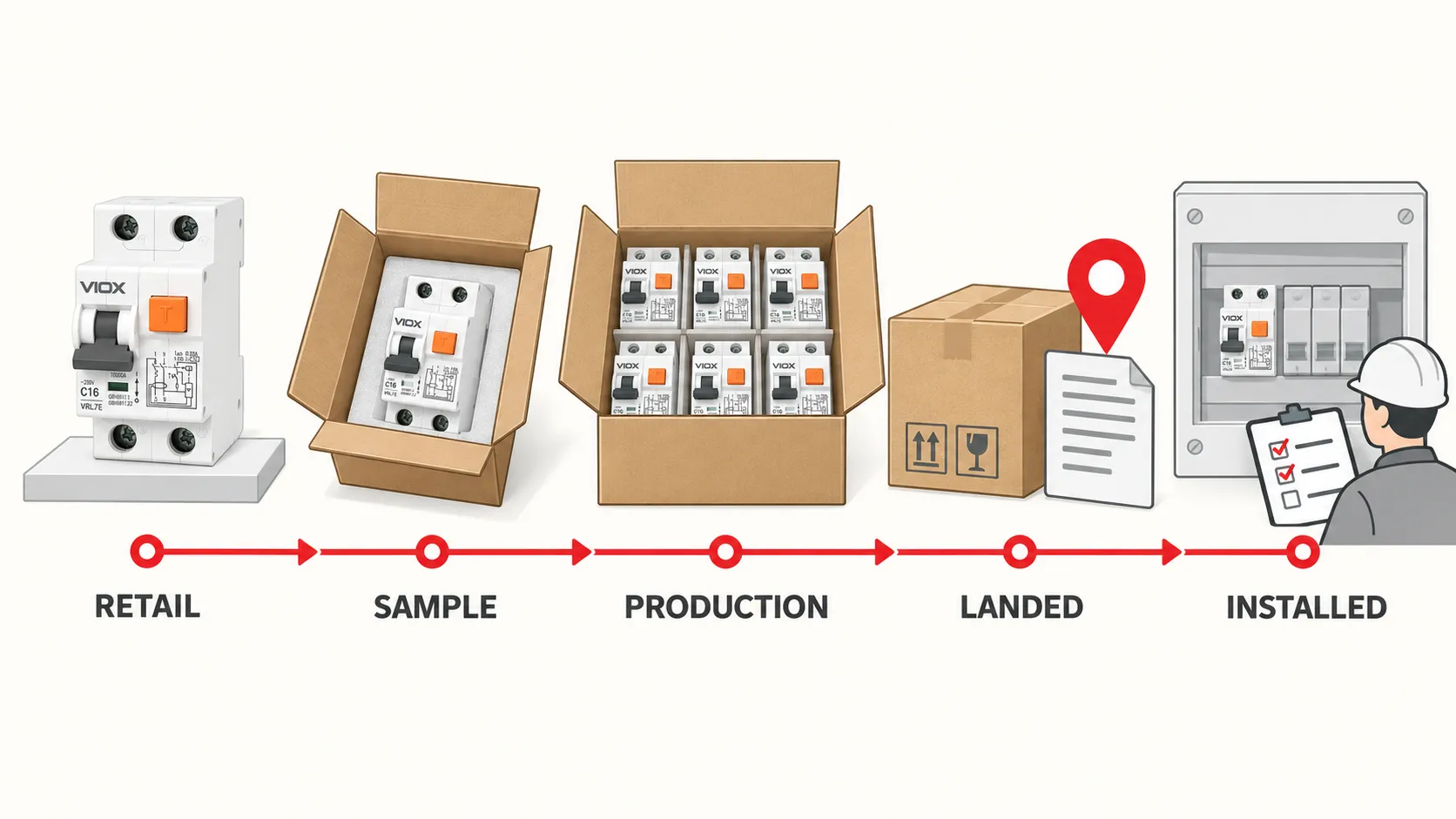
A Five-Step RCBO Quotation Comparison
1. Reject incomplete product descriptions
Return any quotation that lacks the exact model and the fields needed to identify its protection, physical interface, and evidence. Do not fill blanks using another model’s datasheet.
2. Normalize the technical specification
Place every offer against one frozen schedule. Mark each field as match, deviation, or unresolved. A deviation may be acceptable after engineering review, but it must not be hidden by a lower price.
3. Normalize the supplied evidence and order scope
Confirm which declarations, certificates, reports, instructions, labels, accessories, packaging, samples, spares, inspection records, and change controls are included.
4. Normalize commercial terms
Use the same currency date or agreed conversion basis, quantity, SKU mix, destination, Incoterm and named place, payment terms, delivery scope, and quotation validity.
5. Calculate landed cost and record residual risk
Calculate comparable landed unit cost, then list open technical, evidence, quality, delivery, or after-sales assumptions. The selected offer is not automatically the lowest quoted unit price; it is the acceptable offer with the best evaluated commercial result under the same requirement.
Illustrative Quote-Normalization Test
Suppose a buyer needs a defined 1P+N, Type A RCBO with a specified In, curve, IΔn, voltage/frequency, breaking capacity, physical interface, market evidence, packaging, and delivery term.
| Field | Quote A | Quote B | Comparison result |
|---|---|---|---|
| Pole description | 1P+N; protected and switched poles declared | “2 pole”; protected-pole arrangement not stated | Unresolved—not yet comparable |
| Residual-current response | Type A tied to exact model | Type not stated | Unresolved—not yet comparable |
| Breaking capacity | Value, standard and voltage stated | kA value only | Unresolved—not yet comparable |
Curve and IΔn |
Both match the schedule | Curve matches; IΔn differs |
Technical deviation |
| Product evidence | Model appears on supplied schedule | Certificate logo shown; model scope absent | Evidence unresolved |
| Quantity basis | Production quantity per SKU stated | Total quantity stated without SKU mix | Commercial basis differs |
| Packaging | Buyer-approved labels and cartons included | Standard bulk packing | Scope differs |
| Delivery | Named Incoterm and place | “Freight included” | Delivery boundary unresolved |
No price comparison should be made yet. Quote B first needs clarification or revision. This is the core discipline of an RCBO price guide: normalize the object before ranking the number.
Copy-Ready RCBO RFQ Template
Use this block when requesting a quotation:
Buyer / project:
Destination country and final delivery location:
Application and circuit description:
Required product standard and edition:
Required destination-market approval or evidence:

Pole configuration:
Overcurrent-protected poles:
Switched poles and neutral arrangement:
Rated operational voltage:
Frequency:
Rated current In:
Trip curve:
Rated residual operating current IΔn:
Residual-current Type:
Required breaking capacity, standard and voltage basis:
Voltage-dependent or voltage-independent requirement:
Required source direction / terminal arrangement:
Module width and mounting:
Terminal and conductor requirements:
Busbar / distribution-board compatibility:
Required accessories:

Required datasheet and instruction revision:
Required declaration, certificate, listing or test report:
Required model schedule and product markings:
Required document languages:
Inspection and report requirements:
Change-notification requirements:

Sample quantity:
Trial-order quantity:
Production quantity per SKU:
Annual forecast, if available:
Number of SKU variants:
Planned spare quantity:

Standard or OEM branding:
Product-label requirements:
Manual requirements:
Inner-box and master-carton requirements:
Barcode / traceability requirements:

Requested currency:
Required Incoterm and named place:
Payment terms requested:
Requested delivery schedule:
Quotation validity required:
Warranty / replacement terms to be quoted:
Other inclusions or exclusions:
Review the current VIOX RCBO range only after the technical requirement is defined. For an OEM or wholesale quotation, send the completed RFQ to [email protected] or use the VIOX RCBO manufacturer page. The resulting quotation should identify the exact model, document scope, order basis, currency, delivery term, named place, inclusions, exclusions, and validity; this article is not a binding price offer.