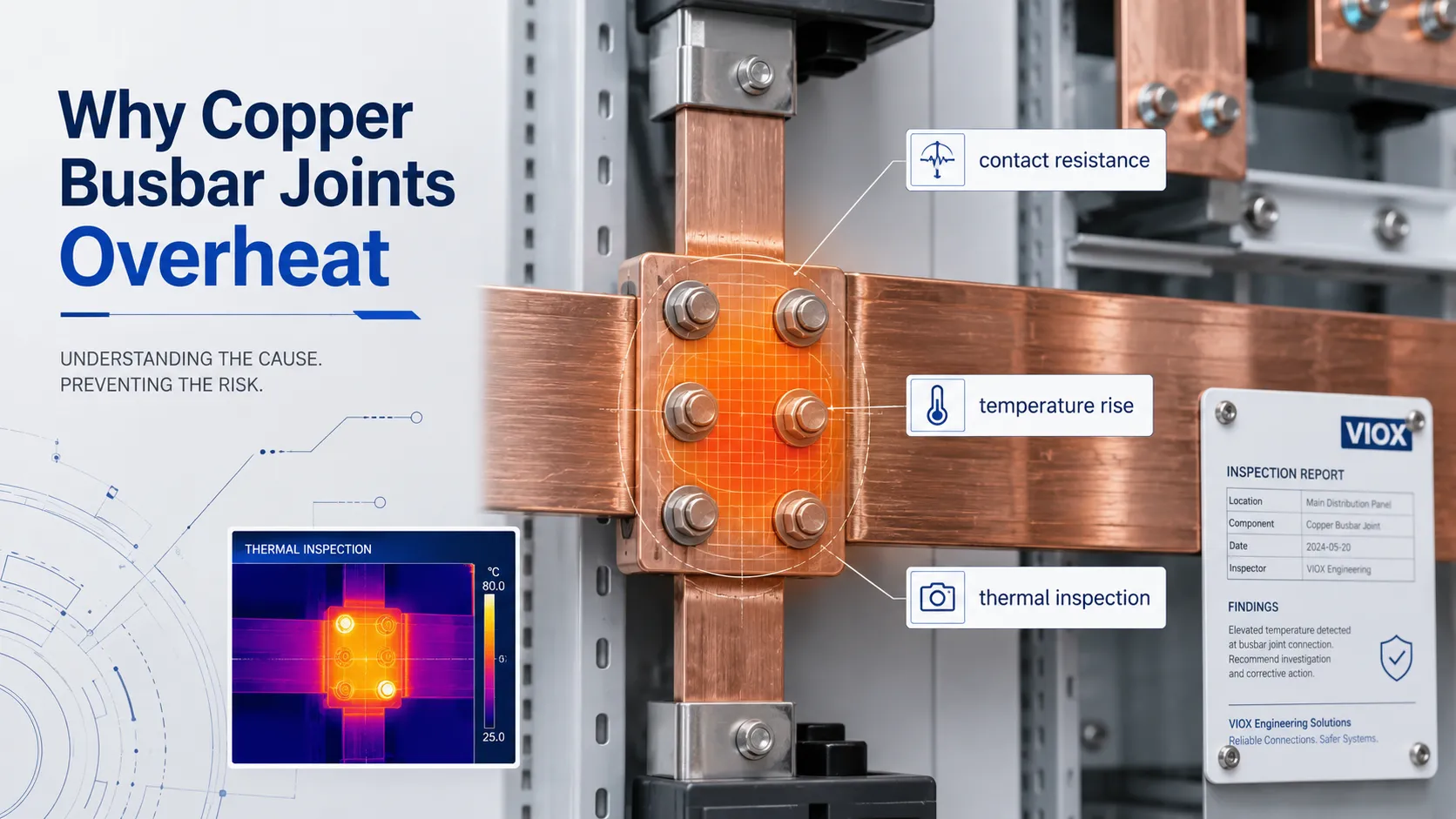
Quick Answer: Why Does a Copper Busbar Joint Get Hotter When the Current Has Not Changed?
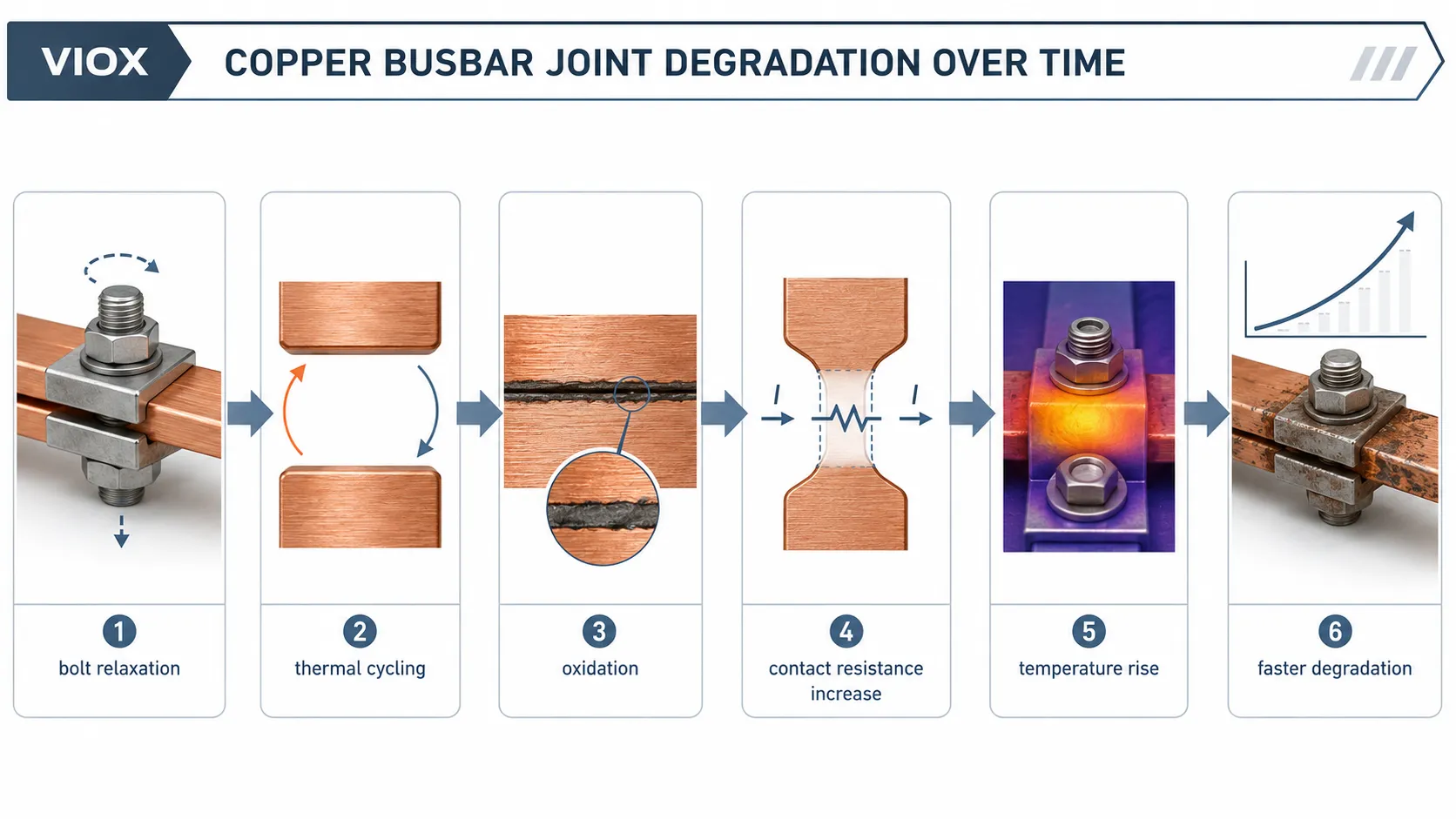
A copper busbar joint can overheat even when the load current is stable because the joint resistance is not stable. The copper itself has a positive temperature coefficient of resistance, and the contact interface can slowly degrade through bolt relaxation, thermal cycling, oxidation, corrosion, plating wear, and reduced contact pressure.
The important distinction is:
Copper’s temperature coefficient of resistance is usually not the root cause of a failing busbar joint. It is the accelerator.
The slow process is contact resistance degradation over months or years. The fast process is the electrical and thermal response once resistance and temperature rise. When the joint gets hotter, the copper resistance increases, which increases I²R heating at the same current. Higher temperature then accelerates creep, oxidation, and contact degradation. That is why a joint can move from slightly warm to seriously hot even though the current never changed.
要点
- Copper resistance rises with temperature. Copper’s temperature coefficient is roughly 0.39% per °C near room temperature.
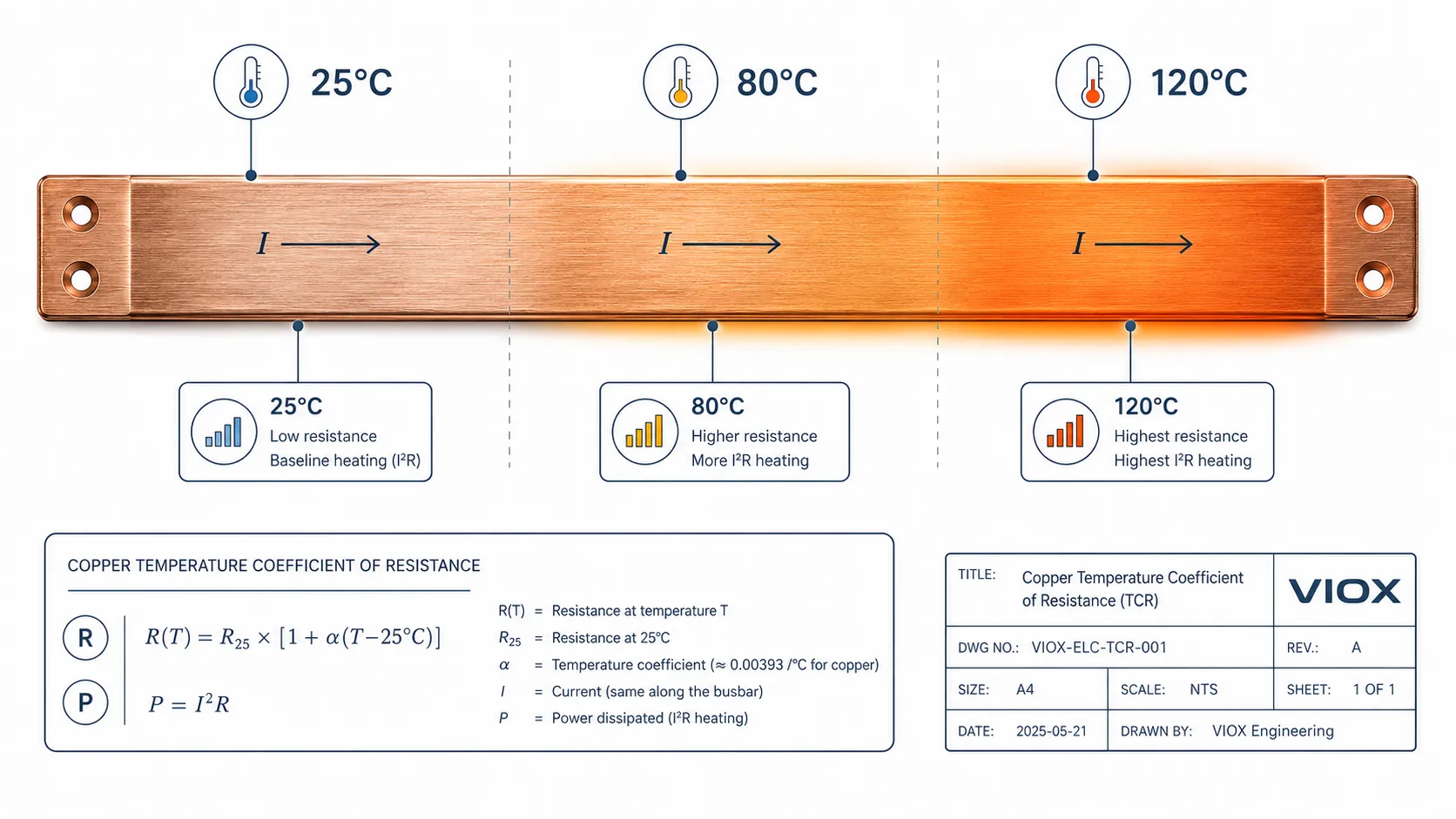
- At the same current, hotter copper produces more I²R heating. Compared with 25°C, copper resistance is about 21% higher at 80°C and about 37% higher at 120°C.
- TCR alone is normally a converging process. Heat loss also increases as temperature rises, so temperature does not run away from copper TCR alone under normal conditions.
- The real long-term fault is contact resistance growth. Loose bolts, creep, thermal cycling, oxidation, corrosion, and surface damage reduce effective contact area.
- Thermal imaging should track trends. A single hot spot matters, but the rate of temperature increase over months or years often gives a better maintenance signal.
Copper TCR: Why Heating Increases at the Same Current
Copper is an excellent conductor, but its resistivity is not constant. As temperature rises, copper resistivity rises. This is described by the temperature coefficient of resistance (TCR).

For copper near room temperature, a commonly used coefficient is approximately:
α ≈ 0.0039 per °C
The simplified resistance relationship is:
R(T) = R25 × [1 + α × (T - 25°C)]
At the same current, heating is:
P = I²R
So when resistance rises, heating rises even if current stays the same.
| Copper Temperature | Approximate Resistance Increase vs 25°C | Effect at Same Current |
|---|---|---|
| 55°C | +12% | I²R heating is about 12% higher |
| 80℃ | +21% | I²R heating is about 21% higher |
| 100°C | +29% | I²R heating is about 29% higher |
| 120°C | +37% | I²R heating is about 37% higher |
This is why a busbar joint that was acceptable at one temperature can become more stressful at a higher temperature. The current is not changing; the resistance is.
For background on electrical conductivity and resistivity, see VIOX’s guide to conductivity vs resistivity vs %IACS.
Why TCR Alone Is Usually Not the Root Cause
The copper TCR effect is real, but by itself it normally reaches a new thermal equilibrium.
If a copper busbar joint rises from 25°C to 55°C, the copper resistance increases and I²R heating increases. That extra heat may push the temperature slightly higher. But as temperature rises, the joint also loses more heat to the surrounding air and surfaces.
Heat dissipation increases through:
- convection
- radiation
- conduction into connected copper, fasteners, supports, and enclosure structures
In a healthy joint with stable contact pressure, the temperature normally settles. The extra TCR-related heating does not grow without limit.
This is why a clean, correctly torqued busbar joint may only move a few degrees above the first thermal balance point. TCR changes the equilibrium; it does not automatically create a failure.
The Slow Problem: Contact Resistance Degradation

The serious failure path starts when the busbar joint contact interface changes over time.
A busbar joint is not a perfect metal-to-metal block. Current flows through many microscopic contact spots. The real contact area is much smaller than the apparent overlap area. Anything that reduces contact pressure or damages those microscopic contact points increases contact resistance.
Common long-term degradation mechanisms include:
| Degradation Mechanism | What Happens at the Joint | 結果 |
|---|---|---|
| Bolt relaxation and creep | Clamping force decreases over time, especially under heat | Contact pressure drops |
| 熱サイクリング | Daily load changes cause expansion and contraction | Micro-movement damages contact surfaces |
| 酸化 | Oxide films form where air reaches the contact interface | Effective contact area decreases |
| Corrosion or sulfide contamination | Industrial atmosphere attacks exposed metal surfaces | Contact resistance rises |
| Plating wear | Tin or silver plating is damaged by micro-motion or poor assembly | Base metal exposure increases |
| Poor initial installation | Wrong torque, dirty surfaces, misalignment, uneven pressure | High starting resistance |
Once contact resistance rises, the joint temperature rises. Once the joint temperature rises, contact degradation can accelerate. That is the real positive feedback loop.
Fast Process vs Slow Process
The most useful way to understand busbar joint overheating is to separate two time scales.
| プロセス | Time Scale | What Drives It | 意味 |
|---|---|---|---|
| Copper TCR response | 数分から数時間 | Temperature rise increases copper resistance | Usually settles to a new thermal balance |
| Contact interface degradation | 数ヶ月~数年 | Clamping loss, oxidation, corrosion, thermal cycling | Can continuously increase joint resistance |
The field pattern often looks like this:
- The busbar joint starts with a slightly elevated contact resistance.
- Load current creates I²R heat at the joint.
- Temperature rises.
- Copper TCR increases resistance and adds more heating.
- Higher temperature accelerates creep and oxidation.
- Contact resistance increases further.
- The next inspection finds a higher hot spot.
In this chain, TCR is not the first fault. It is the multiplier that makes a deteriorating joint heat more sharply as the temperature rises.
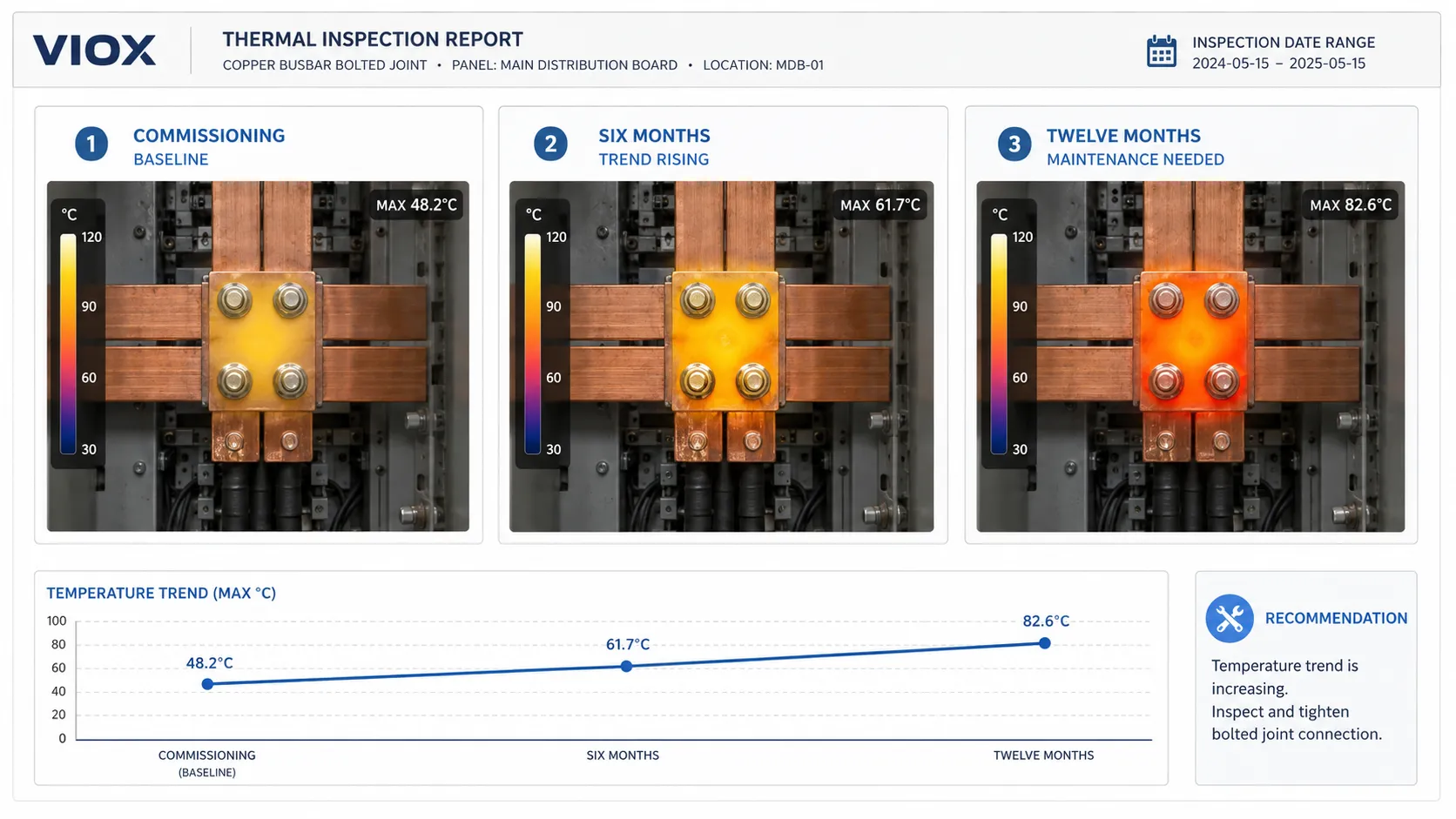
Field Example: 55°C to 85°C to 110°C
A typical maintenance case looks like this:
- Commissioning inspection: joint temperature is about 55°C.
- Six months later: the same joint reaches about 85°C under similar load.
- Another six months later: the joint exceeds 110°C.
- Load current has not changed significantly.
The wrong conclusion is: “The copper heated itself uncontrollably.”
The better diagnosis is: “The joint contact resistance is drifting upward, and the copper TCR is amplifying the thermal effect at each higher temperature.”
If a joint starts with a contact resistance of 20 micro-ohms and later rises to 30 micro-ohms, that is a 50% increase before considering the additional temperature effect. If it later rises again, the temperature jump becomes more visible because the joint is already operating in a hotter region.
How Thermal Imaging Should Be Used

Thermal imaging is useful because it shows abnormal heat distribution under load. But one inspection image is only a snapshot. The trend is usually more valuable than the single number.
When inspecting busbar joints, compare:
- the same joint over time
- similar joints under similar load
- phase-to-phase temperature differences
- upstream and downstream joint temperatures
- ambient temperature and enclosure condition
- load current during inspection
| Thermal Pattern | Likely Interpretation |
|---|---|
| One joint much hotter than similar joints | Local contact issue or installation defect |
| All phases similarly warm | High load, enclosure temperature, or limited ventilation |
| One phase gradually increasing year by year | Contact degradation trend |
| Hot spot at bolt area | Clamping, surface, or joint interface problem |
| Hot spot at cable lug or terminal | Termination issue, not necessarily busbar body issue |
Many maintenance programs classify thermal anomalies by temperature difference, but the exact action threshold should follow the facility maintenance standard, equipment manufacturer guidance, and applicable inspection practice. Do not treat one generic temperature number as universal.
Micro-Ohm Testing: Why Baseline Matters
Thermal imaging tells you where the heat is. Low-resistance testing helps quantify whether the joint resistance has changed.
For busbar joints, the most useful micro-ohm reading is often not the absolute value. It is the comparison with the baseline measurement taken after installation or commissioning.
| Measurement Approach | Practical Value |
|---|---|
| Initial baseline after installation | Establishes the reference condition |
| Same point measured during annual shutdown | Shows resistance drift |
| Compare phases of the same assembly | Identifies abnormal joint behavior |
| Compare similar joints under similar geometry | Helps separate design temperature from defect temperature |
Because micro-ohm measurements are sensitive to probe placement, surface condition, temperature, and test method, small differences may be measurement noise. A clear upward trend is more meaningful than a single isolated reading.
Why Some Busbar Joints Degrade Faster
Three conditions make busbar joint overheating more likely.
1. High Current Density
Higher current density increases base temperature rise. Once the joint operates hotter, creep, oxidation, and thermal cycling effects become more severe.
The heat is proportional to current squared:
P = I²R
A modest current increase can create a large heat increase if the contact resistance is already high.
2. Poor Initial Contact Quality
A joint that starts with poor contact pressure, uneven surfaces, contamination, wrong torque, or damaged plating already has a higher starting resistance. Over time, its degradation path begins from a worse baseline.
Installation quality matters:
- correct torque
- clean contact surface
- correct overlap area
- flat contact faces
- proper washers and fasteners
- correct plating compatibility
- stable mechanical support
For busbar material and plating selection, see VIOX’s バスバー選定ガイド.
3. Poor Heat Dissipation
The same joint resistance can create different temperatures depending on the environment.
Higher risk environments include:
- sealed IP54 or IP65 enclosures
- stacked busbar assemblies
- dusty cabinets
- solar combiner boxes exposed to sun
- high-altitude or poorly ventilated rooms
- cable compartments with limited airflow
- dense terminal and busbar layouts
In PV DC equipment, cable glands, terminals, fuse holders, and busbar joints often work together as a thermal system. For related PV enclosure overheating issues, see solar combiner box overheating causes.
Inspection and Maintenance Checklist
| Maintenance Step | なぜそれが重要なのか |
|---|---|
| Record commissioning thermal image | Creates a baseline |
| Record load current during each inspection | Makes thermal images comparable |
| Compare phase-to-phase temperature | Detects abnormal joint behavior |
| Check annual trend, not only one threshold | Finds accelerating degradation |
| Measure joint resistance during shutdown | Confirms contact resistance drift |
| Inspect bolt torque according to procedure | Finds clamp force loss |
| Inspect surface oxidation or discoloration | Identifies contact damage |
| Check enclosure ventilation and dust | Confirms cooling condition |
| Review load changes | Separates overload from joint degradation |
For large busbar joints, the first maintenance inspection after commissioning is especially useful. Some clamping systems settle after the first thermal cycles. The correct retightening practice depends on the fastener system, manufacturer instructions, and facility maintenance procedure.
Common Mistakes in Busbar Joint Overheating Diagnosis
Mistake 1: Treating Every Hot Joint as a Load Problem
If current is stable and only one joint is hot, the problem is often contact resistance, not load current.
Mistake 2: Looking Only at One Thermal Image
A joint that is 20°C hotter than a similar joint deserves attention. But a joint that rises from 8°C difference to 16°C difference in one year may be more important than a joint that has been stable at a moderate difference for years.
Mistake 3: Ignoring the First Baseline
Without commissioning temperature and micro-ohm baseline data, maintenance teams cannot easily separate design temperature from degradation.
Mistake 4: Retightening Without Inspecting the Contact Surface
If the contact surface is oxidized, pitted, contaminated, or plating-damaged, retightening alone may not restore a reliable joint.
Mistake 5: Forgetting the Enclosure
A busbar joint is part of a thermal system. Enclosure temperature, ventilation, cable routing, dust, and nearby heat sources can all change the result.
Relationship to Terminal Block and MCB Busbar Overheating
The same physical logic appears in smaller electrical connections.
Terminal blocks can overheat when contact pressure drops, wire preparation is poor, or current rating is exceeded. For that topic, see 「制御盤における端子台の過熱」.
MCB comb busbars can overheat because of wrong insertion, poor terminal clamping, undersized busbar, loose screws, or incompatible devices. For that narrower application, see MCB busbar overheating causes and fixes.
Large copper busbar joints are different in scale, but the same core principle remains: contact pressure and contact resistance decide whether the connection stays cool under load.
結論
Copper busbar joint overheating is not only a current problem. It is a contact-resistance problem, a material-temperature problem, and a maintenance-trend problem.
Copper’s temperature coefficient means that a hotter copper path has higher resistance and therefore more I²R heating at the same current. But the long-term fault usually begins at the joint interface: bolt relaxation, creep, thermal cycling, oxidation, corrosion, plating wear, or poor initial assembly.
For maintenance engineers, the best question is not only “How hot is it today?” It is also “How fast is this same joint getting hotter over time?”
Track thermal images, load current, and micro-ohm measurements as a trend. That is how a copper busbar joint moves from a hidden maintenance issue to a predictable and preventable failure.