

On this page
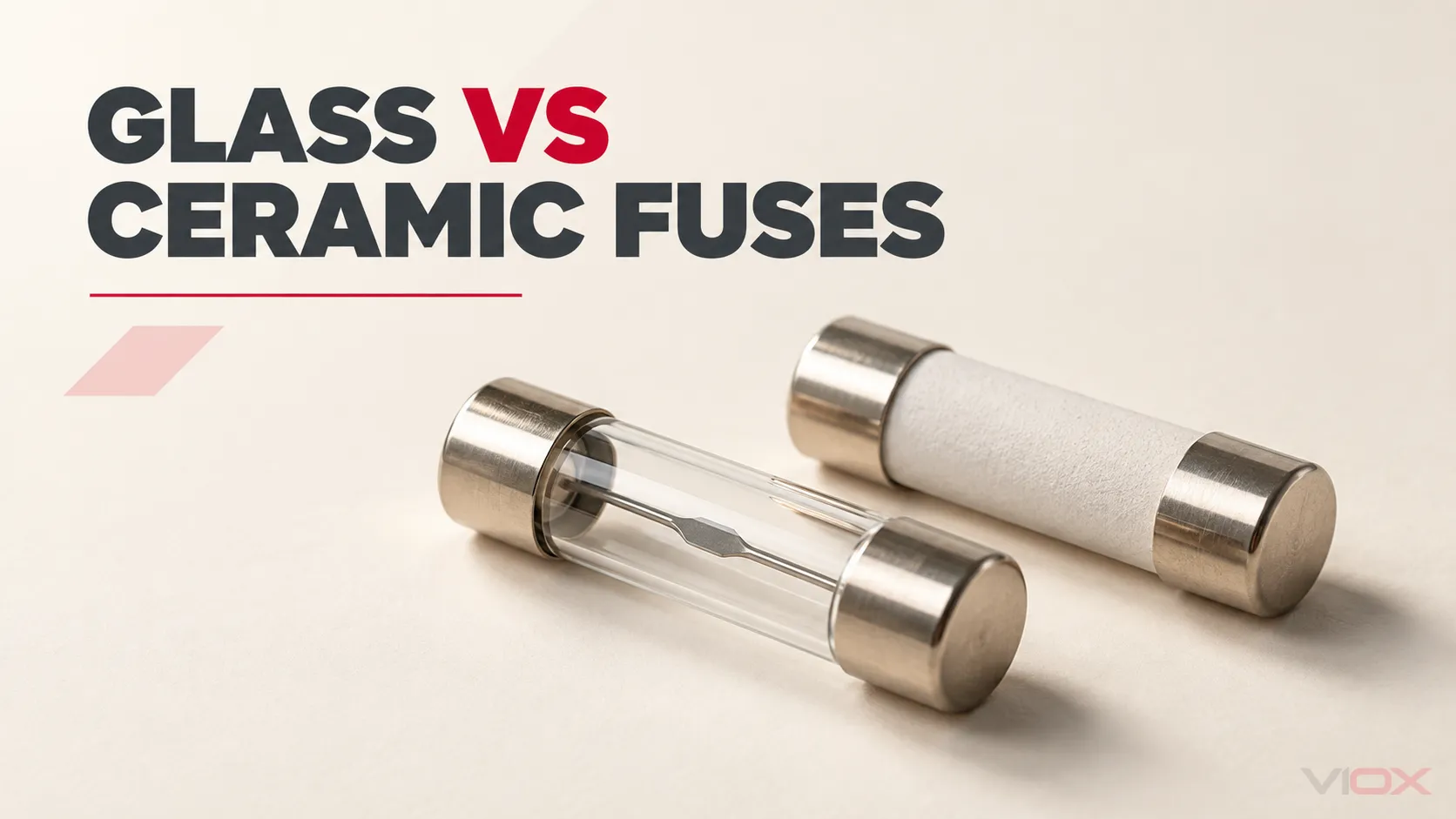
A glass fuse and a ceramic fuse are not automatically interchangeable, even when they have the same ampere rating and fit the same holder. The body material affects visibility and may accompany different fault-containment or arc-quenching construction, but it does not by itself define the fuse’s voltage rating, breaking capacity, operating speed, or application.
Use the original manufacturer part number whenever possible. If an alternative is necessary, replace one fuse with the other only after the fuse system and dimensions, rated current, rated voltage and AC/DC duty, time-current characteristic, breaking capacity, holder compatibility, and required approvals all match the equipment documentation.
Glass Fuse vs Ceramic Fuse at a Glance
| Comparison point | Glass cartridge fuse | Ceramic cartridge fuse | What the replacement decision requires |
|---|---|---|---|
| Body | Transparent or translucent glass tube | Opaque ceramic tube | Body material alone does not establish electrical equivalence |
| Element visibility | The element may be visible | The element is normally hidden | Use visibility only as an inspection aid, not as a rating check |
| Internal construction | May be unfilled or use another supported construction | May be filled or unfilled, depending on the series | Verify the actual datasheet; do not infer filling from the body alone |
| Rated current | Series- and part-specific | Series- and part-specific | Match the required ampere rating and operating conditions |
| Voltage and AC/DC duty | Part-specific | Part-specific | Candidate rating must cover the circuit voltage and current type |
| Operating characteristic | Fast-acting, time-delay, or another defined characteristic may be available | Fast-acting, time-delay, or another defined characteristic may be available | Match the specified characteristic or approved time-current data |
| Breaking capacity | Part-specific | Part-specific; some ceramic designs are made for higher fault duties | Verify the declared interrupting or breaking capacity against the prospective fault current |
| Dimensions and contacts | Common miniature cartridge formats and catalog-specific formats exist | Common miniature cartridge formats and industrial formats exist | Match length, diameter, cap/contact form, and holder system |
| Replacement verdict | Suitable when the complete specification is correct | Suitable when the complete specification is correct | Do not choose by transparency, color, or ampere marking alone |
The practical answer is therefore not “ceramic is always better” or “glass is good only for low voltage.” The correct fuse is the one whose complete verified specification matches the circuit and equipment requirements.
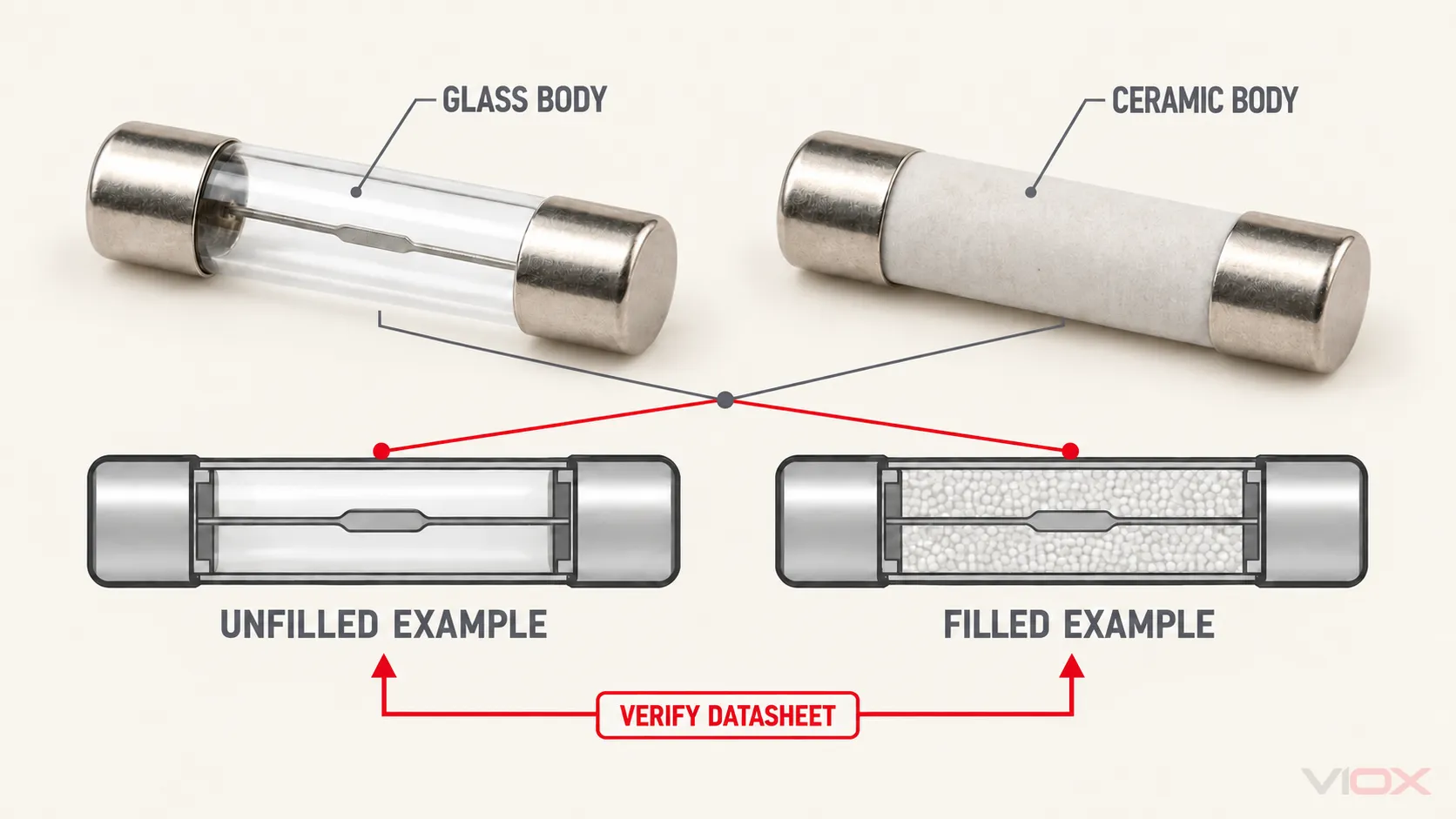
Body Material and Internal Filling Are Different Decisions
The visible tube tells you what the enclosure is made from. It does not reveal every internal feature.
A glass tube lets a technician see part of the fuse element. This is useful when the element has separated clearly, but the view may be obstructed by deposits, end caps, an internal spring, or the location of the break. A fuse that looks intact can still be open, and a visible break says nothing about why it operated.
An opaque ceramic tube conceals the element. Ceramic is commonly selected where the design needs stronger thermal or mechanical containment, and many higher-breaking-capacity cartridge fuses use a ceramic body with an arc-quenching filler. However, it is not safe to convert that common design pattern into a universal rule:
- not every glass fuse is unfilled;
- not every ceramic fuse is filled;
- not every ceramic fuse is a High Rupturing Capacity (HRC) fuse;
- two fuses with the same body material can still have different operating characteristics and breaking capacities.
“Filled” and “unfilled” describe the space around the fuse element, while “glass” and “ceramic” describe the body. A filler can help absorb heat, cool and de-ionize the arc, and support interruption, but the user should rely on the fuse’s declared ratings and test standard—not a visual guess about its contents.
For broader identification by dimensions, markings, contacts, and fuse system, use the Cartridge Fuse Guide.
Breaking Capacity Is Not the Same as Ampere Rating
This is the most important distinction in a glass-versus-ceramic replacement.
The rated current relates to the current the fuse is intended to carry and its defined operating behavior under specified conditions. The breaking capacity, also called interrupting rating in some markets, is the fault current the fuse can safely interrupt under its stated voltage and test conditions.
The basic verification rule is:
Declared fuse breaking capacity ≥ prospective short-circuit current at the installation point
A 5 A fuse is not necessarily able to interrupt every fault above 5 A. During a short circuit, the available current can be many times the load current. If the prospective fault current exceeds the fuse’s declared breaking capacity, the fuse may not safely complete the interruption.
Ceramic construction is often associated with higher fault-duty designs, but the material is not the rating. A ceramic candidate without verified breaking-capacity data is not automatically an upgrade, and a glass fuse should not be rejected solely because it is transparent. Compare the exact markings, datasheet, approval information, and equipment requirements.
The HRC fuse guide explains high-fault-current interruption in more detail. It should not be used to assume that every opaque cartridge is an HRC fuse.
Seven Checks Before Replacing Glass With Ceramic—or Ceramic With Glass
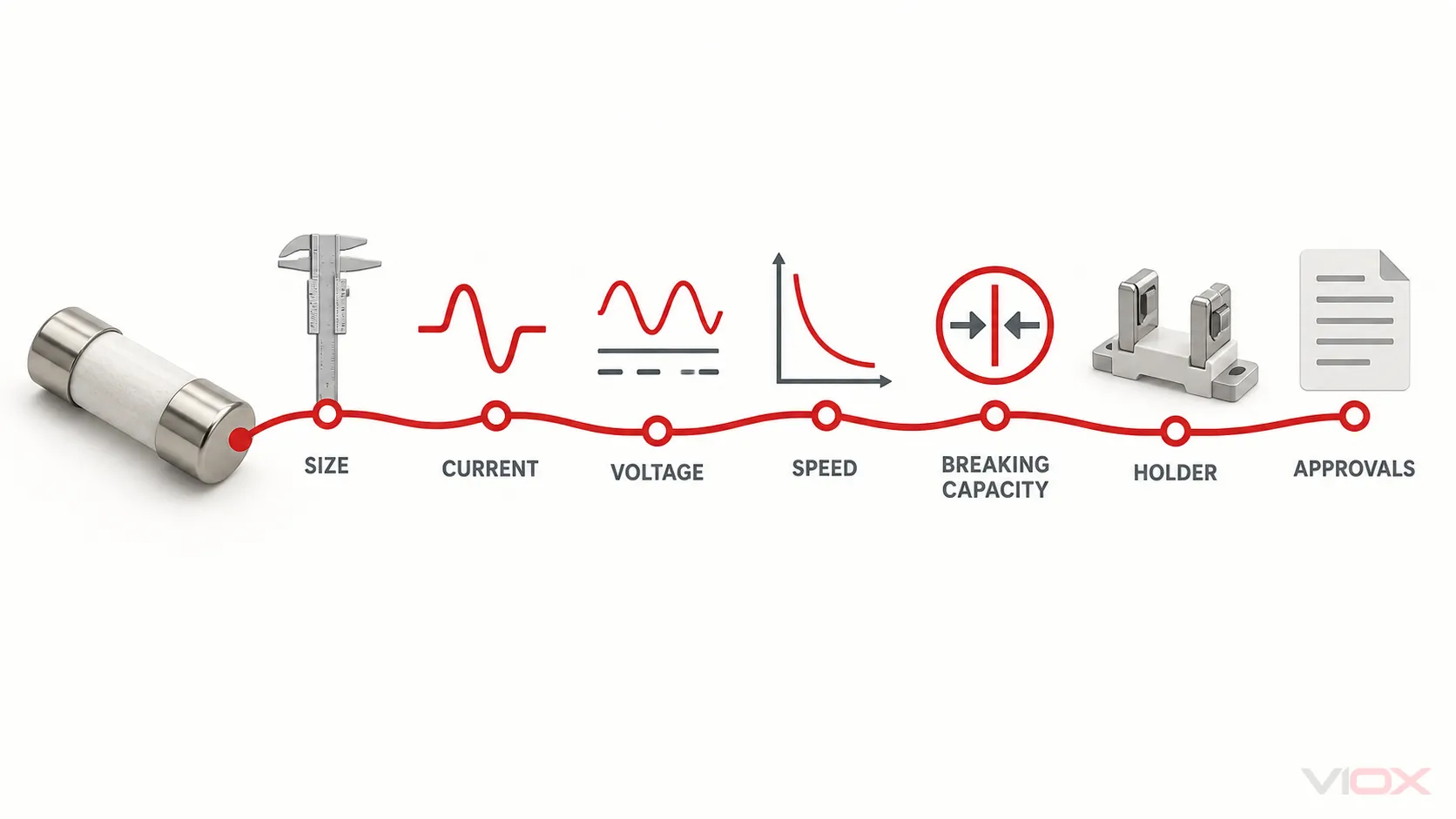
1. Identify the Fuse System and Exact Dimensions
Measure or verify the fuse length and diameter, but do not stop there. Confirm the end-cap or contact arrangement, whether leads are attached, and the holder or clip system. A fuse that can be forced into a holder is not necessarily a compatible fuse.
IEC 60127-2 covers special requirements for miniature cartridge fuse-links in 5 × 20 mm and 6.3 × 32 mm formats. Those dimensions help establish a physical system; they do not make every fuse of the same size electrically interchangeable.
2. Match the Rated Current
Use the equipment manual, original bill of materials, service documentation, or exact original part number. Do not increase the ampere rating to prevent repeated operation. A fuse that keeps opening is a diagnostic signal, not permission to install a larger fuse.
Rated current is also affected by operating conditions and the complete fuse-holder assembly. Enclosure temperature, ventilation, adjacent heat sources, terminal condition, and holder power acceptance can all matter. Use the equipment and fuse manufacturer’s application data rather than applying a universal derating factor.
3. Match the Voltage Rating and AC/DC Duty
The candidate fuse must be suitable for at least the circuit voltage under the applicable rating system. Also verify whether the declared rating applies to alternating current (AC), direct current (DC), or both.
AC and DC interruption are not interchangeable assumptions. A fuse carrying an AC voltage marking is not automatically suitable for the same numerical DC voltage. The AC Fuse vs DC Fuse guide explains why arc interruption and rating evidence must be checked separately.
4. Match the Operating Characteristic
Glass and ceramic cartridge families can both include fast-acting and time-delay designs. The body material does not tell you how quickly the fuse operates.
A time-delay fuse may be specified to ride through a permitted motor, transformer, lamp, power-supply, or capacitor inrush. A fast-acting fuse may be selected where downstream components require quicker protection. Substituting between these characteristics can cause nuisance opening or allow damaging energy to pass before the fuse clears.
Match the stated characteristic, standard sheet or class, and part number. Where coordination is consequential, compare the manufacturer-specific time-current curves and let-through data. The fuse time-current curve guide shows how to distinguish melting time from total clearing time.
5. Verify Breaking Capacity at the Stated Voltage
Find the declared breaking capacity or interrupting rating for the exact fuse and the relevant voltage/current type. Then compare it with the prospective short-circuit current at the installation point.
Do not transplant an interrupting value from another fuse in the same catalog family, from a different voltage, or from an AC table to a DC application. If the available fault current is unknown, the replacement decision requires engineering review or the equipment manufacturer’s specified fuse—not an appearance-based substitute.
6. Confirm Holder and Thermal Compatibility
The candidate must fit the holder without modifying clips, caps, springs, or contacts. Confirm:
- dimensions and contact geometry;
- holder voltage and current ratings;
- permitted fuse power dissipation or power acceptance where specified;
- terminal and contact condition;
- touch protection and service method;
- environmental or enclosure requirements.
Discoloration, weak spring pressure, damaged caps, corrosion, or heat damage can make replacement of the fuse alone insufficient. A new fuse does not repair a degraded holder.
7. Match Approvals, Standard Family, and Equipment Instructions
The replacement should satisfy the same equipment and market requirements as the original. Confirm the applicable fuse standard or catalog system, required approvals, and any equipment-manufacturer restriction on replacement parts.
Under the IEC system, IEC 60127-1:2023 covers general requirements and tests for miniature fuse-links used to protect appliances, electronic equipment, and component parts; it explicitly separates that scope from fuses for low-voltage electrical installations, which are covered by IEC 60269. In North American contexts, UL 248-1 establishes general low-voltage fuse requirements, while UL 248-14 applies to supplemental fuses and does not make them branch-circuit fuses.
The letters printed on a fuse must be interpreted within the correct manufacturer’s catalog and standard system. For example, treat AGC as a fuse-series or catalog designation unless authoritative documentation for the exact product defines it further. Do not decode it into a universal phrase and infer voltage, application, or breaking capacity from that phrase.
Replacement Decision Table
| Situation | Decision | Why |
|---|---|---|
| Same ampere rating and same size, but breaking capacity is unknown | Reject or pause | Two matched fields do not establish safe fault interruption |
| Same dimensions, current, voltage, speed, and breaking capacity, but equipment manual requires an exact approved part | Use the specified or approved part | Equipment approval and safety evaluation may depend on the documented component |
| Ceramic original; glass candidate has lower or undocumented breaking capacity | Reject | Body fit does not compensate for inadequate or unknown fault-duty evidence |
| Glass original; ceramic candidate has a higher voltage or breaking-capacity marking but different time characteristic | Reject | A stronger enclosure does not correct a mismatched operating curve |
| Glass original; ceramic candidate matches every required electrical, mechanical, thermal, and approval field | Potentially acceptable after documentation review | Equivalence is based on the complete specification, not the material change |
| Exact original part number is available | Prefer the exact replacement | It minimizes hidden differences in characteristic, construction, loss, and approval |
| Fuse operates again after replacement | Stop troubleshooting by substitution | The circuit fault, load, inrush, incorrect specification, or holder condition must be investigated |
The word “potentially” is deliberate. Equipment instructions and market approvals can impose a narrower replacement rule than a general electrical comparison.
Can You Tell Whether a Fuse Is Blown by Looking at It?
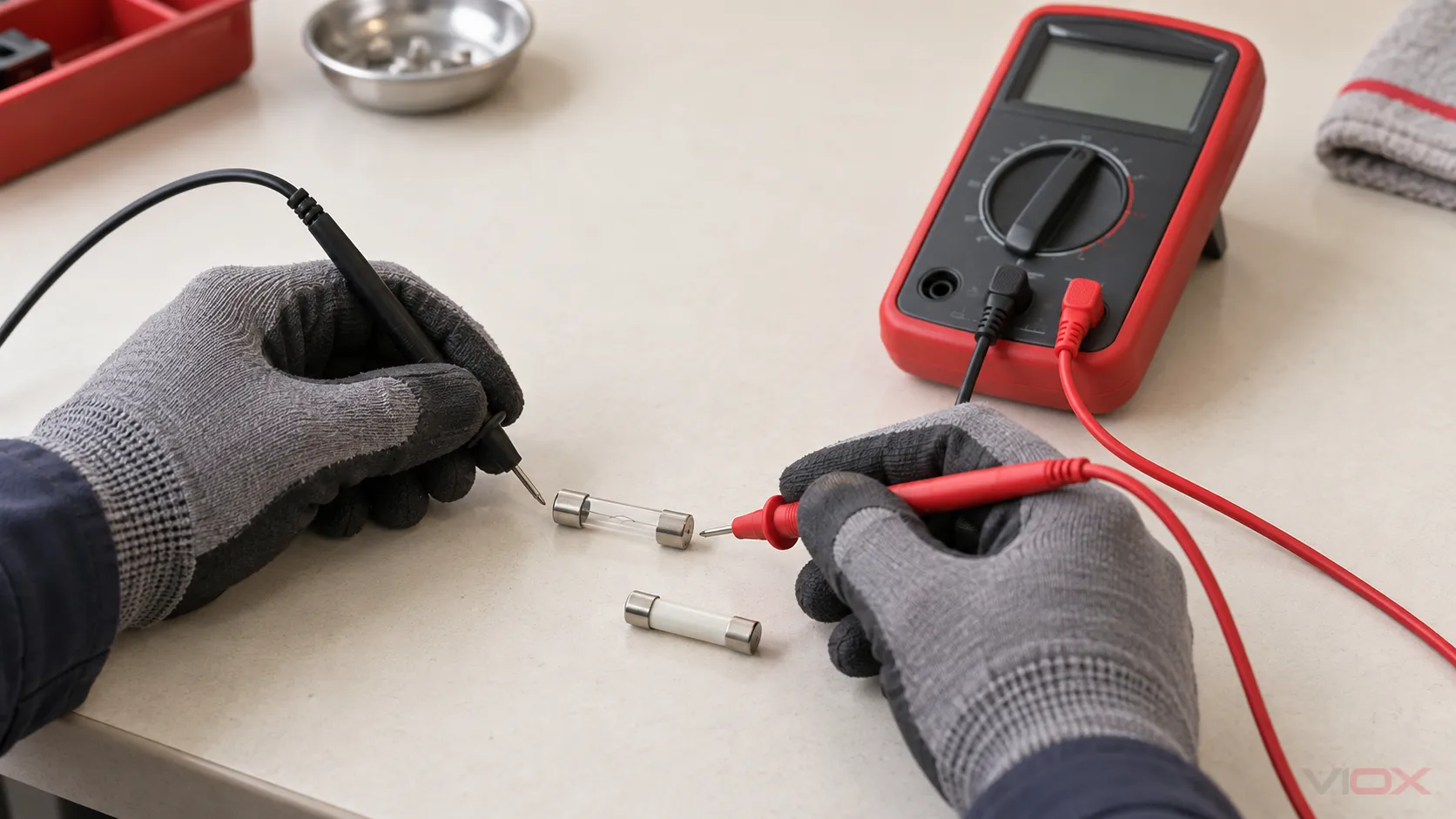
A transparent body can make a separated element easier to see, but visual inspection is not a complete test. Deposits can obscure the element, the break may be hidden near an end cap, and an intact-looking element does not verify the fuse’s condition under load.
Before testing, isolate the equipment according to its approved safe-work procedure, verify the de-energized state with an appropriate instrument, and remove the fuse if the equipment instructions permit. Testing a fuse in circuit can produce a misleading continuity path through other components. On an isolated, removed fuse, a suitable continuity or resistance test can determine whether the current path is open; it cannot explain why the fuse operated or prove that a replacement specification is correct.
For the bounded testing procedure and interpretation limits, see How to Tell If a Fuse Is Blown. If the replacement opens again, use the Fuse Keeps Blowing diagnostic guide rather than fitting a higher-rated fuse.
Which Is Better: Glass or Ceramic?
Neither material is universally better.
Choose a glass-body fuse when the exact approved specification calls for it and visibility provides useful inspection value. Choose a ceramic-body fuse when the specified design and verified ratings meet the circuit duty. In higher-energy applications, a ceramic, filled, high-breaking-capacity design may be the appropriate result—but that conclusion must come from the part’s documented ratings and the circuit fault study, not from its white body.
The most defensible selection rule is:
Match the complete fuse specification first. Treat body material as one construction attribute, not as a substitute for the datasheet.
Frequently Asked Questions
Can a ceramic fuse replace a glass fuse?
Only when the candidate matches the required fuse system and dimensions, rated current, voltage and AC/DC duty, time-current characteristic, breaking capacity, holder compatibility, approvals, and equipment instructions. Ceramic construction alone does not prove equivalence.
Can a glass fuse replace a ceramic fuse if the amps are the same?
Not on ampere rating alone. A same-amp glass fuse may have a different voltage rating, operating characteristic, breaking capacity, power dissipation, or approval. If any required field is lower, different, or undocumented, do not use it as the replacement.
Are ceramic fuses always slow-blow?
No. Ceramic and glass cartridge fuses can be produced with different operating characteristics. Confirm the marking, part number, applicable standard sheet or class, and time-current data.
Are all ceramic fuses filled with sand?
No. Many high-breaking-capacity ceramic designs use an arc-quenching filler, but body material and filling are separate construction attributes. Verify the exact fuse documentation.
Can a glass cartridge fuse be rated for 125 V or 250 V?
Yes, depending on the exact series and approval. Transparency does not confine every glass fuse to automotive voltage. The printed or documented voltage rating still must be checked together with AC/DC duty and breaking capacity.
Is a visible fuse element enough to confirm that a glass fuse is good?
No. Visual inspection may identify an obvious break, but it can miss a hidden or obscured open circuit. Use the equipment’s safe isolation procedure and an appropriate continuity or resistance test on the removed fuse when permitted.
Specify the Replacement, Not Just the Material
For an existing machine or appliance, start with the equipment manual and exact original part number. For a new design or sourcing request, document the fuse system, dimensions, current, voltage, AC/DC duty, operating characteristic, breaking capacity, holder, environmental conditions, and required approvals.
VIOX supplies low-voltage fuse and fuse-holder families for different applications. Review the VIOX fuse range or send the complete circuit and replacement requirements to [email protected] for a specification-based discussion.