

On this page
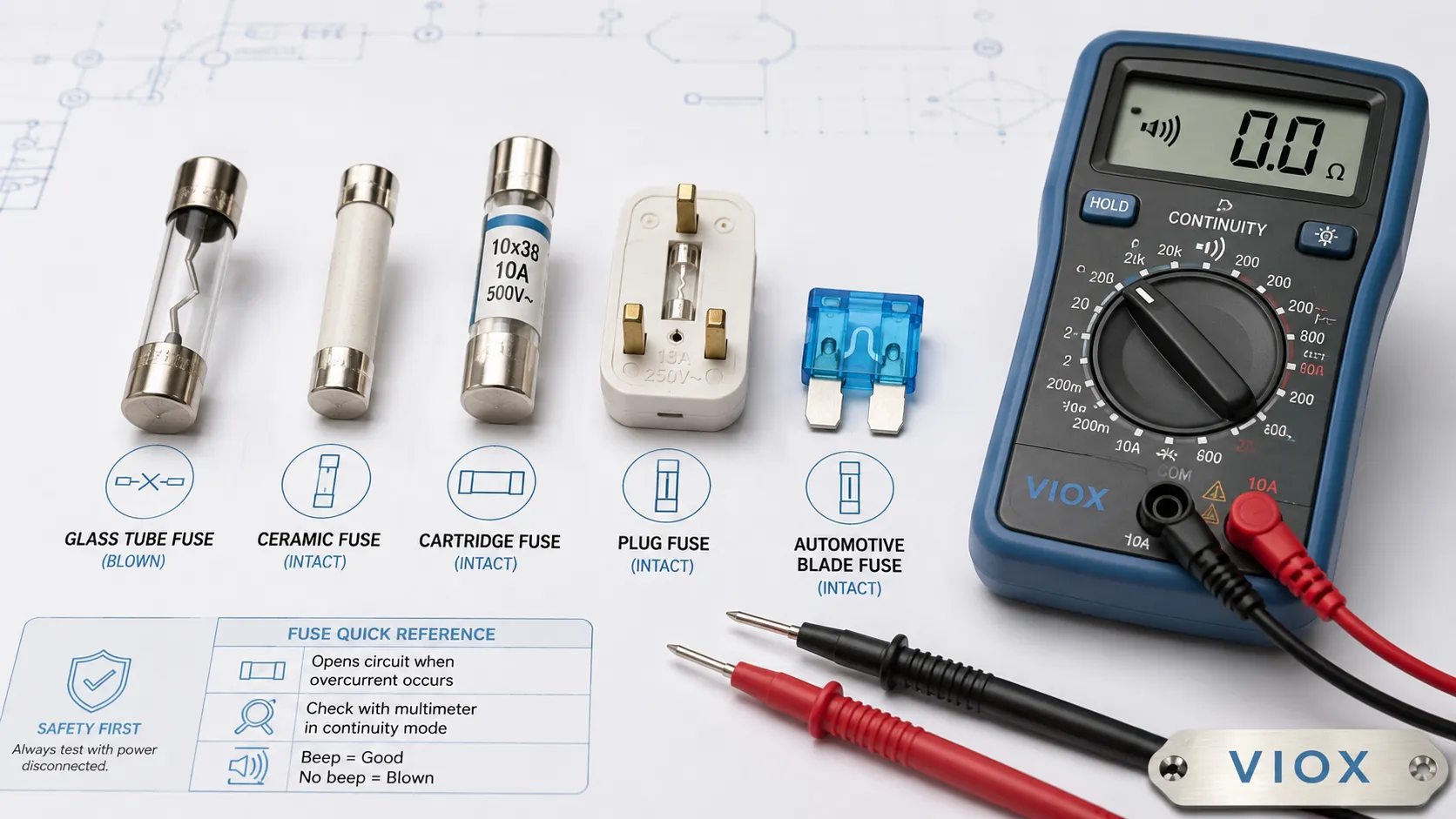
A blown fuse means the fuse element has opened and stopped current flow because the circuit experienced overload, short circuit, or another fault condition. The most reliable way to confirm a blown fuse is to test continuity with a multimeter, but some fuses also show visible signs.
Quick answer: a glass fuse is often visibly blown if the internal wire is broken or the glass is darkened. A ceramic or cartridge fuse may look normal from the outside, so it usually needs a continuity test.
Safety note: Always disconnect power before removing or testing a fuse. If the fuse is in a building distribution board, industrial panel, appliance with capacitors, or high-current circuit, have a qualified person inspect it.
Blown Fuse Quick Check Table
| Fuse Type | What a Blown Fuse May Look Like | Best Test Method | Visual Check Reliable? |
|---|---|---|---|
| Glass tube fuse | Broken wire, darkened glass, metal vapor marks | Continuity test | Often, but not always |
| Ceramic fuse | Usually no visible change | Continuity test | No |
| Cartridge fuse | May look normal outside | Continuity test or fuse tester | No |
| Plug fuse / 13A fuse | Sometimes visible through window if glass type; many look normal | Continuity test or safe replacement with same rating | Limited |
| Automotive blade fuse | Broken metal link visible through plastic body | Visual check and continuity test | Often |
| Industrial HRC fuse | Usually no reliable visible sign | Proper test and qualified inspection | No |
Good Fuse vs Blown Fuse: What Does It Look Like?
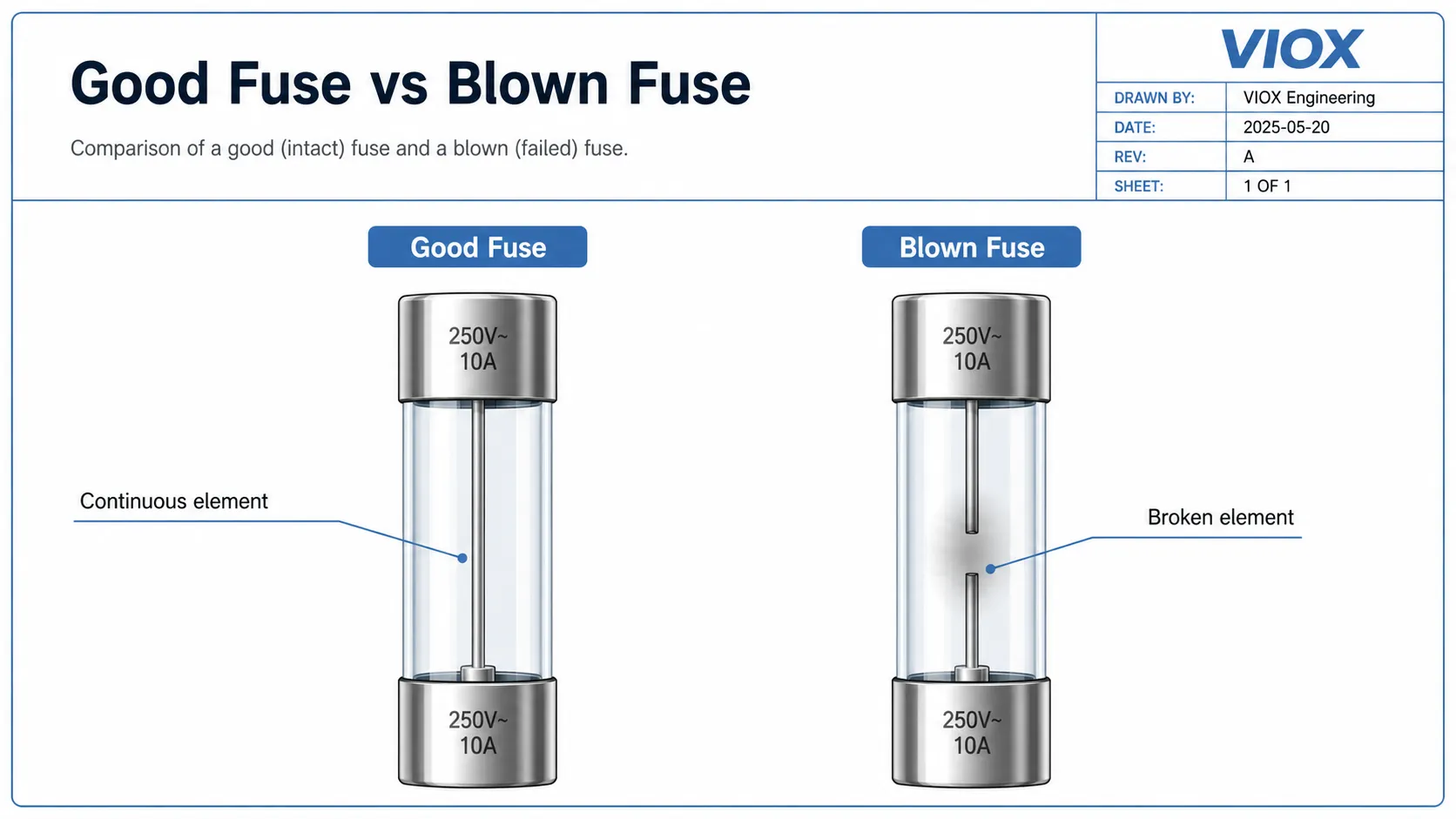
The easiest fuse to inspect visually is a transparent glass or blade fuse.
| Condition | What You May See |
|---|---|
| Good fuse | Continuous internal element, no burn marks, no broken link |
| Blown fuse | Broken internal element, melted link, darkened glass, black marks, or visible gap |
| Uncertain fuse | Looks normal, but circuit still does not work |
Visual inspection is useful, but it is not final proof. Some fuses open internally without obvious marks. Ceramic and cartridge fuses are especially difficult to judge by appearance alone.
How to Test a Fuse With a Multimeter
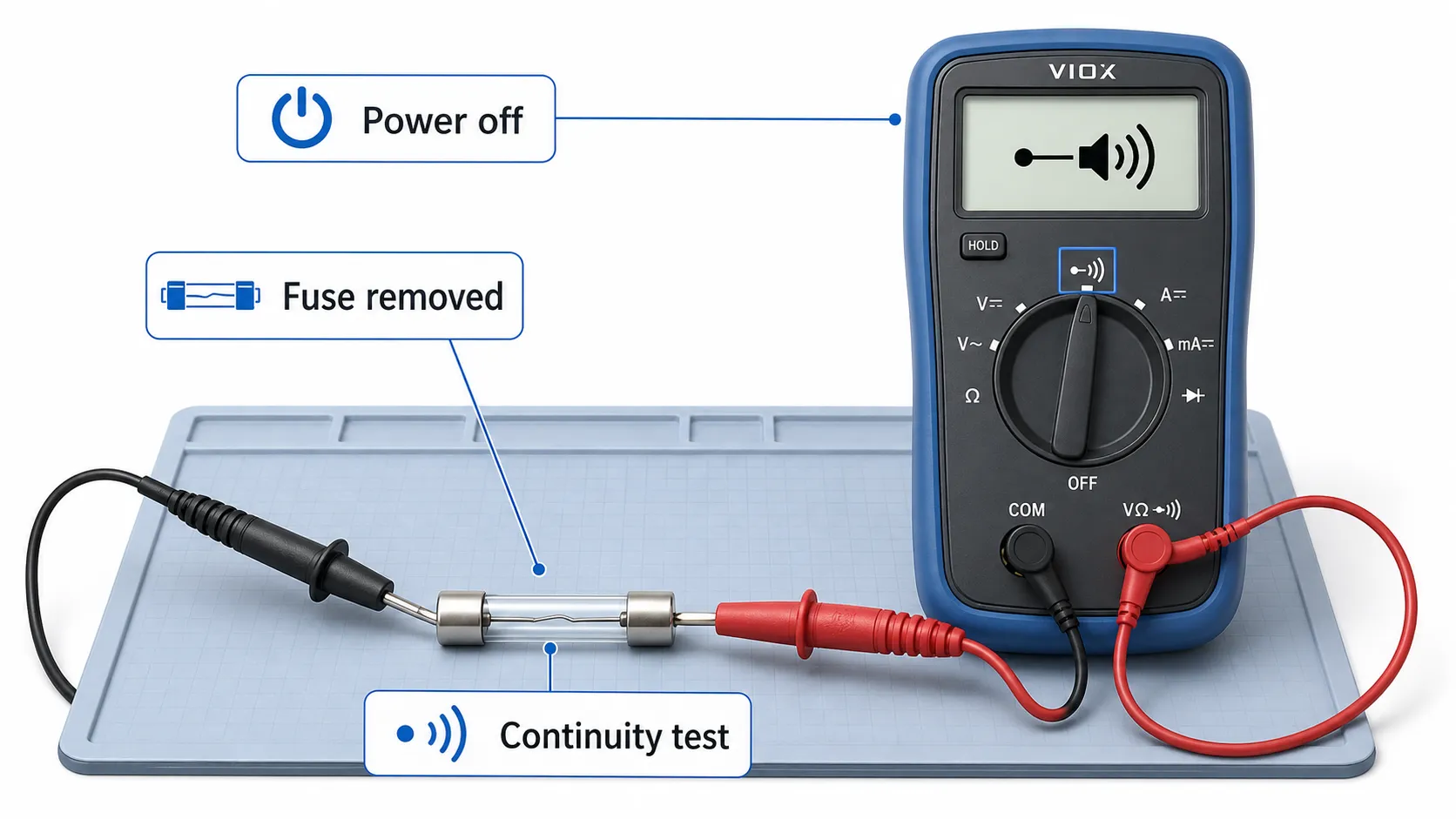
A multimeter continuity test is the best basic method for checking a removed fuse.
- Turn off and isolate power.
- Remove the fuse from the circuit.
- Set the multimeter to continuity or resistance mode.
- Touch one probe to each end of the fuse.
- Read the result.
| Multimeter Result | Meaning |
|---|---|
| Beep or very low resistance | Fuse is likely continuous |
| No beep or open circuit / OL | Fuse is likely blown |
| Unstable reading | Check probe contact, fuse holder, or use a second test method |
Do not test continuity on a live fuse. Continuity mode is for de-energized components only.
How to Tell if a Fuse Is Blown Without a Multimeter
Without a multimeter, you can only make a limited judgment.
| Method | When It Helps | Limitations |
|---|---|---|
| Visual inspection | Glass and blade fuses | Not reliable for ceramic or cartridge fuses |
| Replace with identical known-good fuse | Small appliance or plug fuse, when safe | Does not identify the root cause |
| Check fuse indicator window | Some fuse holders or plugs | Not all fuses have indicators |
| Observe repeated failure | Fuse blows again after replacement | Indicates a fault that needs diagnosis |
If a replacement fuse blows immediately, do not keep replacing it. The circuit may have a short circuit, overloaded load, damaged appliance, wrong fuse rating, or wiring fault.
How to Tell if a Glass Fuse Is Blown
A glass fuse is often the easiest to inspect. Look for:
- a broken or missing fuse wire;
- dark gray or black marks inside the glass;
- melted metal beads;
- a cloudy or smoky appearance;
- a gap in the internal element.
However, a glass fuse can still fail without dramatic visual damage. If the circuit matters, confirm with a continuity test.
How to Tell if a Ceramic Fuse Is Blown
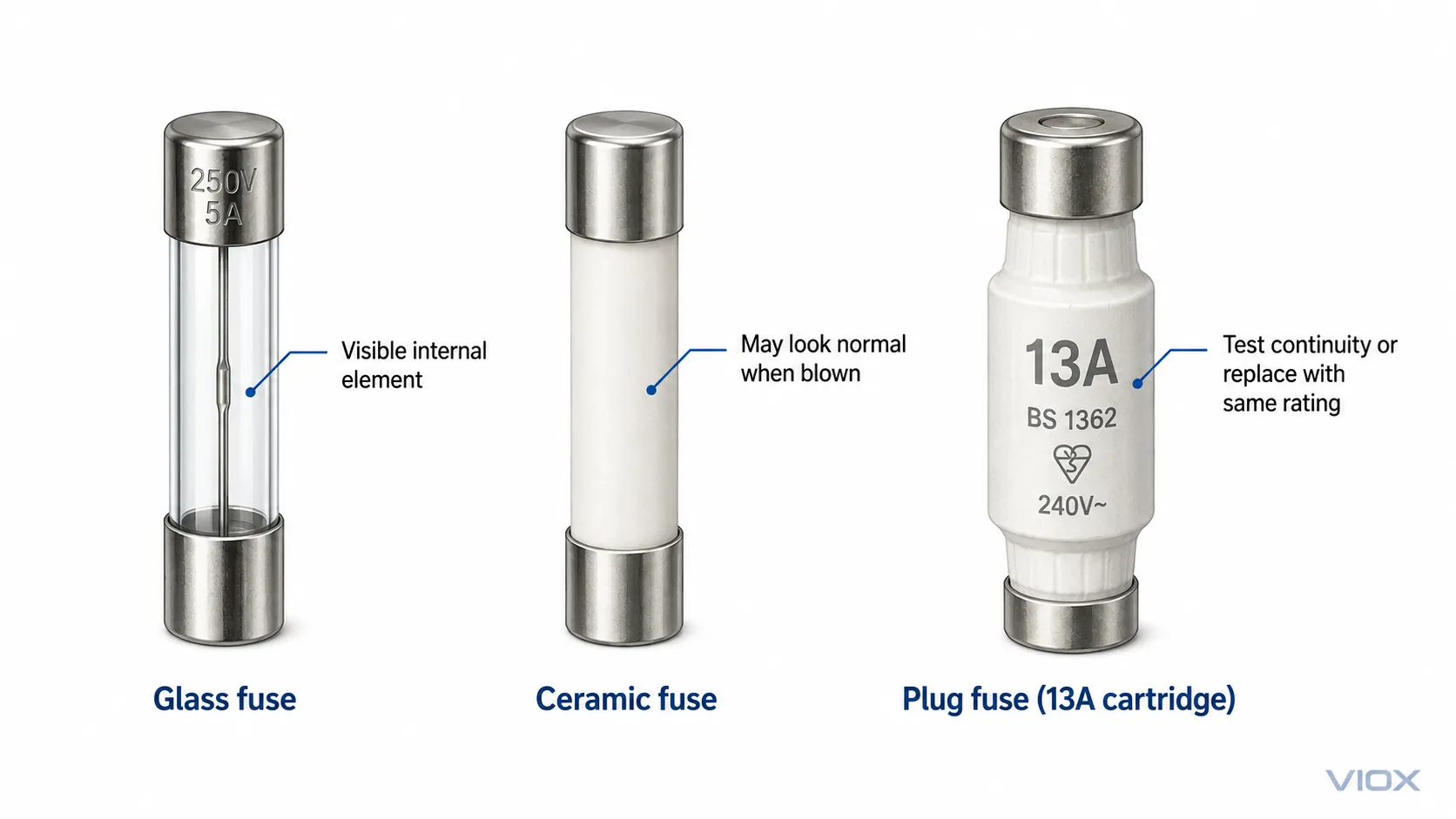
A ceramic fuse usually cannot be judged from the outside. The ceramic body hides the internal element, so a blown ceramic fuse may look completely normal.
The correct check is:
- remove the fuse from the circuit;
- test continuity across both ends;
- replace only with the same type, current rating, voltage rating, and breaking capacity class where applicable.
For appliance or plug fuses, never assume a ceramic fuse is good just because it is not blackened or cracked.
How to Tell if a Plug Fuse or 13A Fuse Is Blown
In UK-style plugs and many appliance plugs, the fuse may be a small cartridge fuse, often rated 3A, 5A, or 13A depending on the appliance and plug standard.
Signs of a blown plug fuse may include:
- the appliance suddenly stops working;
- the plug fuse shows no continuity;
- a visible internal element is broken if the fuse body allows inspection;
- a replacement fuse of the same correct rating restores operation.
For a 13A fuse, visual inspection is often not enough. Test continuity or replace it with a correct same-rated fuse only if the appliance and plug are safe to inspect. If the new fuse blows again, stop using the appliance.
How to Tell if a Cartridge Fuse Is Blown
Cartridge fuses include many cylindrical fuses used in appliances, control circuits, panels, and industrial equipment. Some are glass, some are ceramic, and some are high-rupturing-capacity fuses.
For cartridge fuses:
- do not rely on the outer body;
- test continuity after removal;
- inspect the fuse holder for heat damage or loose contacts;
- confirm the exact replacement rating.
Industrial cartridge fuses may have specific voltage ratings, utilization categories, or breaking capacities. Replacing them with a physically similar fuse can be unsafe.
For industrial fuse selection context, see VIOX’s guide to HRC fuses.
How to Tell if a House Fuse Is Blown
In a house fuse box or older distribution board, a blown fuse may cause:
- loss of power to one circuit;
- lights or outlets not working;
- visible blown fuse wire in rewirable fuse carriers;
- tripped fuse switch or blown cartridge fuse depending on the system.
Do not open a live distribution board or touch fuse carriers unless you are qualified. Older fuse boxes may have exposed live parts, degraded insulation, or wiring issues. If a house fuse blows repeatedly, call a licensed electrician.
Can a Fuse Be Partially Blown?
A fuse is normally either continuous or open. In that sense, a fuse is usually not “partially blown.”
However, a fuse can be damaged, weakened, heat-stressed, or have poor end-cap contact. That can create intermittent faults, heating, voltage drop, or unreliable operation before complete failure.
If a fuse looks heat-damaged, loose, corroded, or discolored, replace it with the correct type and inspect the fuse holder. Do not reuse a questionable fuse in a critical circuit.
Why Did the Fuse Blow?
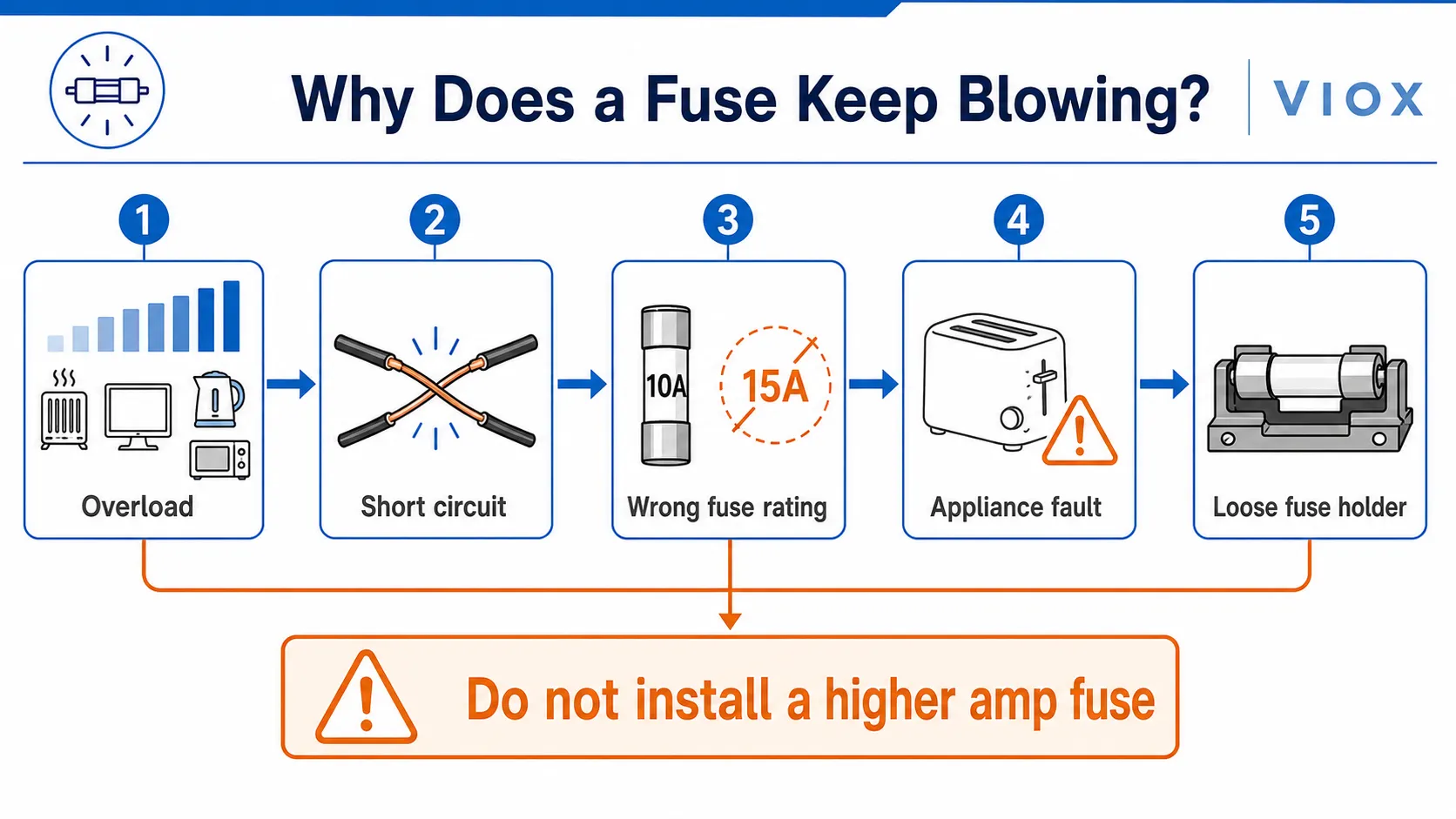
A blown fuse is a symptom, not the root cause.
| Cause | What It Means | What to Do |
|---|---|---|
| Overload | Too much current for too long | Reduce load and check circuit rating |
| Short circuit | Very low resistance fault path | Stop using the circuit until inspected |
| Wrong fuse rating | Fuse too small or wrong type | Replace only with correct specified fuse |
| Appliance fault | Internal fault in equipment | Disconnect appliance and repair/replace |
| Loose fuse holder | Heat and poor contact | Inspect holder and terminals |
| Inrush current | Startup current exceeds fuse characteristics | Use correct fuse type specified by equipment manufacturer |
Never solve repeated fuse blowing by installing a higher-amp fuse. That can defeat the protection and increase fire risk.
How to Choose the Correct Replacement Fuse
Match the original fuse and equipment specification. At minimum, check:
- current rating, such as 3A, 5A, 10A, 13A, 15A, or other value;
- voltage rating;
- AC or DC rating;
- fast-acting or time-delay characteristic;
- glass, ceramic, HRC, blade, plug, or cartridge format;
- breaking capacity or interrupting rating where applicable;
- physical size and terminal style.
For industrial panels, PV systems, motor circuits, or DC circuits, fuse selection is not just amperage. Voltage rating, DC arc behavior, breaking capacity, and coordination matter.
VIOX also explains the difference between fuses and circuit breakers and fuse vs MCB response time.
When to Call an Electrician or Technician
Call a qualified electrician or technician if:
- the same fuse blows repeatedly;
- the fuse holder is hot, melted, loose, or discolored;
- you smell burning;
- the fuse is in a distribution board or industrial panel;
- you do not know the correct replacement type;
- the circuit involves high current, three-phase power, PV DC, batteries, or machinery.
FAQ
What does a blown fuse mean?
A blown fuse means the internal fuse element has opened and stopped current flow because the circuit exceeded the fuse’s operating limit.
What does a blown fuse look like?
A blown glass fuse may have a broken wire, darkened glass, or burn marks. A blown ceramic or cartridge fuse may look normal from the outside.
How do you know if a fuse is blown?
The most reliable basic method is to remove the fuse safely and test continuity with a multimeter. No continuity usually means the fuse is blown.
How do you tell if a ceramic fuse is blown?
You usually cannot tell visually. Test continuity across the fuse after removing it from the circuit.
How do you tell if a fuse is blown in a plug?
Remove the plug fuse safely and test continuity, or replace it with the same correct rating if the appliance and plug are safe to inspect. If the new fuse blows again, stop using the appliance.
Can you test a fuse without a multimeter?
Only partially. You can visually inspect transparent fuses or try a known-good identical fuse in safe low-risk equipment, but a multimeter is more reliable.
Can a fuse look good but be blown?
Yes. Ceramic and cartridge fuses often look normal even when blown. Some glass fuses can also fail without obvious marks.
Is a blown fuse dangerous?
The blown fuse itself has performed its protective function, but the cause may be dangerous. Repeated fuse blowing, heat, burning smell, or melted holders require inspection.
Can I replace a blown fuse with a higher amp fuse?
No. Use the correct fuse rating specified by the equipment or circuit. A higher amp fuse can allow excessive current and increase fire risk.
Why does my fuse keep blowing?
Common causes include overload, short circuit, appliance fault, wrong fuse type, inrush current, loose fuse holder, or wiring problems.
Conclusion
To tell if a fuse is blown, start with the fuse type. Glass and blade fuses may show visible damage, but ceramic and cartridge fuses usually need continuity testing. If a fuse blows repeatedly, the fuse is not the main problem; the circuit or equipment needs diagnosis.
The safest rule is simple: replace a blown fuse only with the correct type and rating, and investigate the cause if it blows again.