


Sur cette page
Un Disjoncteur CC est un dispositif de commutation de protection conçu pour interrompre le courant continu en cas de surcharge ou de court-circuit. Contrairement aux disjoncteurs CA, un disjoncteur CC doit éteindre un arc électrique continu sans pouvoir compter sur un passage naturel par zéro du courant.
En termes simples : un disjoncteur CC protège un circuit CC en ouvrant le circuit lorsque le courant dépasse son niveau autorisé, mais il doit être spécifiquement dimensionné et conçu pour la tension CC, l'extinction d'arc CC, la polarité et le pouvoir de coupure..
Les applications courantes des disjoncteurs CC incluent les systèmes photovoltaïques solaires, les systèmes de stockage d'énergie par batterie, les équipements de recharge de véhicules électriques, l'alimentation CC des télécommunications, les tableaux électriques CC marins, la distribution CC industrielle et les circuits de contrôle.
Lors de la sélection sur le terrain, l'erreur est souvent plus profonde que le simple choix d'un mauvais calibre d'ampérage. Les ingénieurs peuvent sélectionner un appareil qui semble physiquement correct mais qui présente une erreur au niveau de la tension nominale CC, l'exigence de polarité ou le contexte de la norme de coupure. Cette erreur peut ne pas apparaître lors d'un fonctionnement normal ; elle se manifeste lorsque le disjoncteur est sollicité pour interrompre un arc CC.
Principaux enseignements
- Un disjoncteur CC n'est pas simplement un disjoncteur CA avec une étiquette différente. Les arcs CC sont plus difficiles à éteindre.
- La sélection d'un disjoncteur CC doit vérifier la tension nominale, le courant nominal, le pouvoir de coupure, la configuration des pôles, la polarité et le schéma de câblage.
- Un disjoncteur CC polarisé doit être câblé conformément à sa polarité marquée ou au sens source/charge.
- Un disjoncteur CC non polarisé est plus adapté lorsque le courant peut s'inverser, comme dans certains circuits de batteries ou d'onduleurs hybrides.
- Les disjoncteurs modulaires CC sont généralement utilisés pour les circuits de dérivation ; les disjoncteurs boîtiers moulés CC sont utilisés pour les départs à courant plus élevé ou la protection industrielle en courant continu.
- N'utilisez pas un disjoncteur uniquement CA dans un circuit CC, sauf si la fiche technique indique explicitement la valeur nominale CC requise.
Aperçu des disjoncteurs CC
| Objet | Ce que cela signifie |
|---|---|
| Signification complète | Disjoncteur à courant continu |
| Fonction principale | Ouvre un circuit CC en cas de surcharge ou de court-circuit |
| Défi principal | L'arc en courant continu ne passe pas naturellement par zéro comme en courant alternatif |
| Produits typiques | Disjoncteur modulaire CC, disjoncteur boîtier moulé CC, disjoncteur ouvert CC, disjoncteur haute tension CC |
| Caractéristiques nominales clés | Tension CC, courant nominal, pouvoir de coupure CC, polarité, câblage des pôles |
| Applications courantes | Solaire photovoltaïque, batterie, véhicule électrique, télécommunications, marine, courant continu industriel, circuits de commande |
| Avertissement principal | Les caractéristiques nominales des disjoncteurs CA ne peuvent être considérées comme valides pour une utilisation en CC |
Pourquoi les disjoncteurs CC sont différents des disjoncteurs CA
Le courant alternatif traverse naturellement le zéro à chaque demi-cycle. Ce passage par zéro aide un disjoncteur CA à éteindre l'arc après la séparation des contacts.
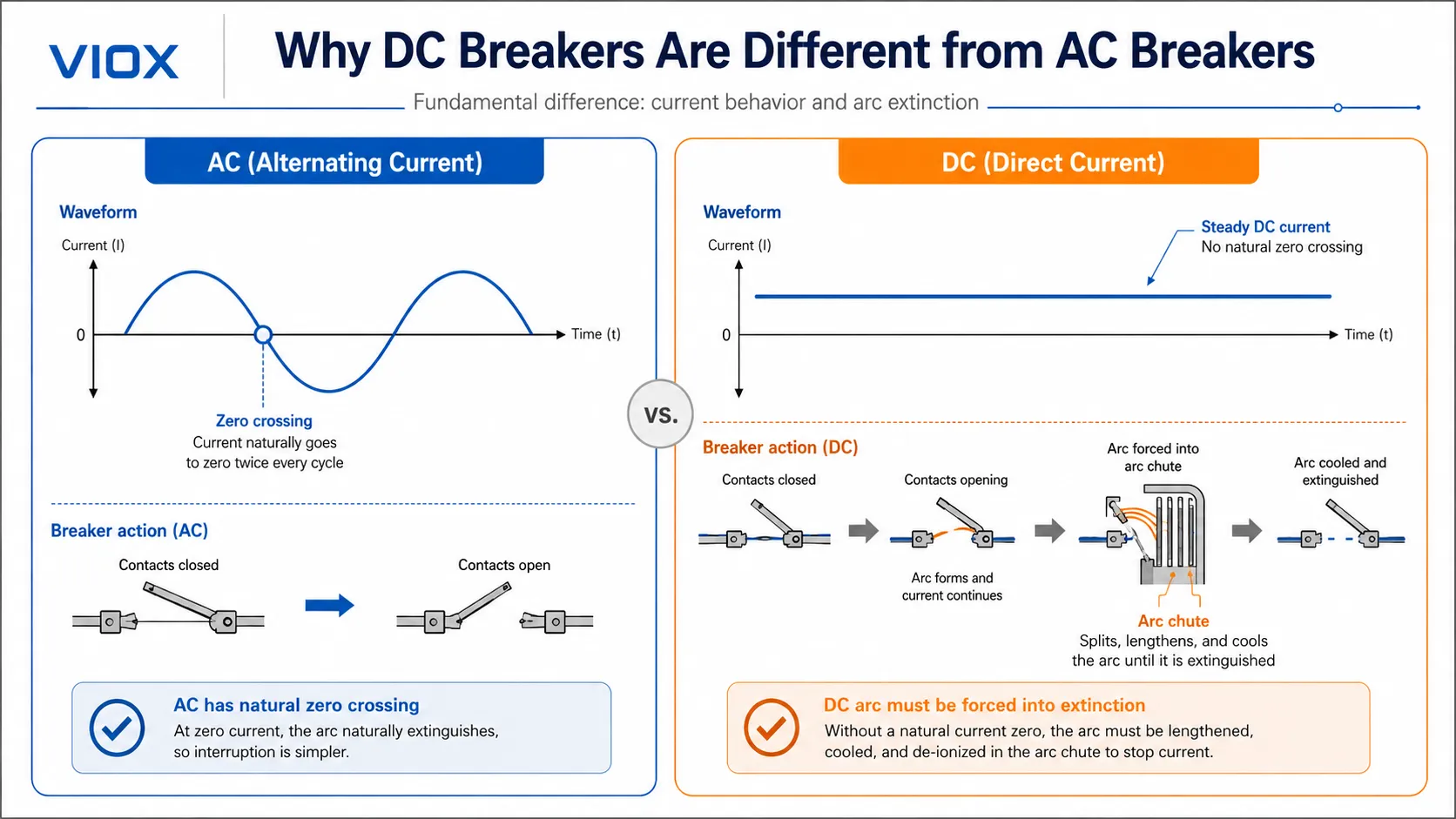
Le courant continu ne présente pas ce passage naturel par zéro. Une fois les contacts ouverts, l'arc peut se maintenir à moins que la conception du disjoncteur ne le force à s'étirer, se refroidir, se diviser et s'éteindre.
| Fonctionnalité | Disjoncteur AC | Disjoncteur DC |
|---|---|---|
| Comportement du courant | Alterne et traverse le zéro | Circule dans une seule direction dans des conditions normales |
| Interruption de l'arc | Assisté par le passage naturel du courant par zéro | Nécessite une conception de contrôle d'arc plus robuste |
| Conception de la chambre de coupure | Conçu pour l'extinction d'arc en courant alternatif (AC) | Conçu pour l'extinction d'arc soutenu en courant continu (DC) |
| Problématique de polarité | Généralement moins critique | Peut être critique dans les conceptions polarisées |
| Application examples | Circuits de bâtiment en courant alternatif, distribution AC | Chaînes photovoltaïques, circuits de batterie, tableaux DC, équipements pour véhicules électriques |
C'est pourquoi un disjoncteur doit avoir une tension nominale CC explicite pour la tension et le courant de défaut prévus. Un appareil marqué uniquement pour le courant alternatif ne doit pas être utilisé comme disjoncteur CC.
Fonctionnement d'un disjoncteur CC
Lorsqu'un disjoncteur CC s'ouvre en charge ou en cas de défaut, ses contacts se séparent et un arc électrique se forme. Le disjoncteur doit déplacer cet arc vers une structure de contrôle d'arc et l'éteindre en toute sécurité.
Les caractéristiques typiques de contrôle d'arc d'un disjoncteur CC peuvent inclure :
- une séparation des contacts avec une distance d'isolement suffisante ;
- des cornes d'arc qui guident l'arc loin des contacts ;
- des chambres de coupure qui divisent et refroidissent l'arc ;
- des aimants permanents ou des bobines de soufflage magnétique qui dirigent l'arc dans la chambre de coupure ;
- pôles multiples câblés en série pour des tensions nominales CC plus élevées.
La conception interne exacte dépend du type de disjoncteur et de la classe de tension. Les petits disjoncteurs modulaires (MCB) CC, les disjoncteurs à boîtier moulé (MCCB) CC et les disjoncteurs CC haute tension n'utilisent pas la même construction.
Bobine de soufflage magnétique et extinction d'arc CC
Certains disjoncteurs CC utilisent un un soufflage magnétique principe. Lorsque le courant traverse le disjoncteur, la force magnétique aide à pousser l'arc hors de la zone de contact et vers la chambre de coupure.
Dans un disjoncteur CC polarisé, ce mouvement de l'arc peut dépendre du sens du courant. Si le disjoncteur est câblé à l'envers, il peut toujours laisser passer le courant en fonctionnement normal, mais l'arc peut être dirigé dans la mauvaise direction lors de l'ouverture du disjoncteur. C'est pourquoi le marquage de polarité est important dans de nombreuses conceptions de disjoncteurs CC.
Pour plus de détails sur la polarité, consultez le Guide de polarité des disjoncteurs CC de VIOX.
Schéma de câblage du disjoncteur CC : source, charge et polarité
Un disjoncteur CC de base est installé en série avec le circuit qu'il protège. Le câblage exact dépend du système, du type de disjoncteur, du nombre de pôles et du schéma du fabricant.
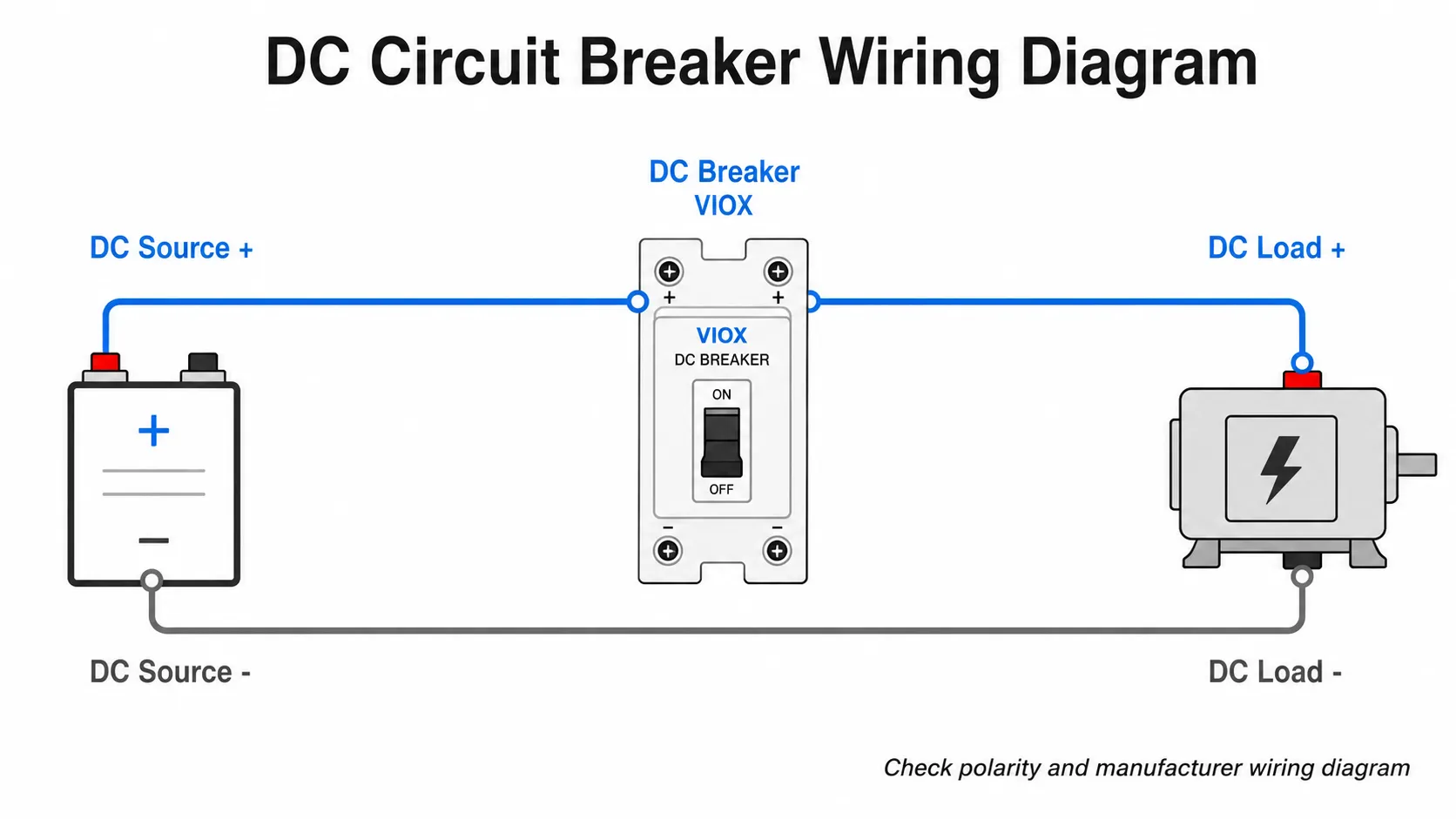
Source CC (+) -> Disjoncteur CC -> Charge CC (+)
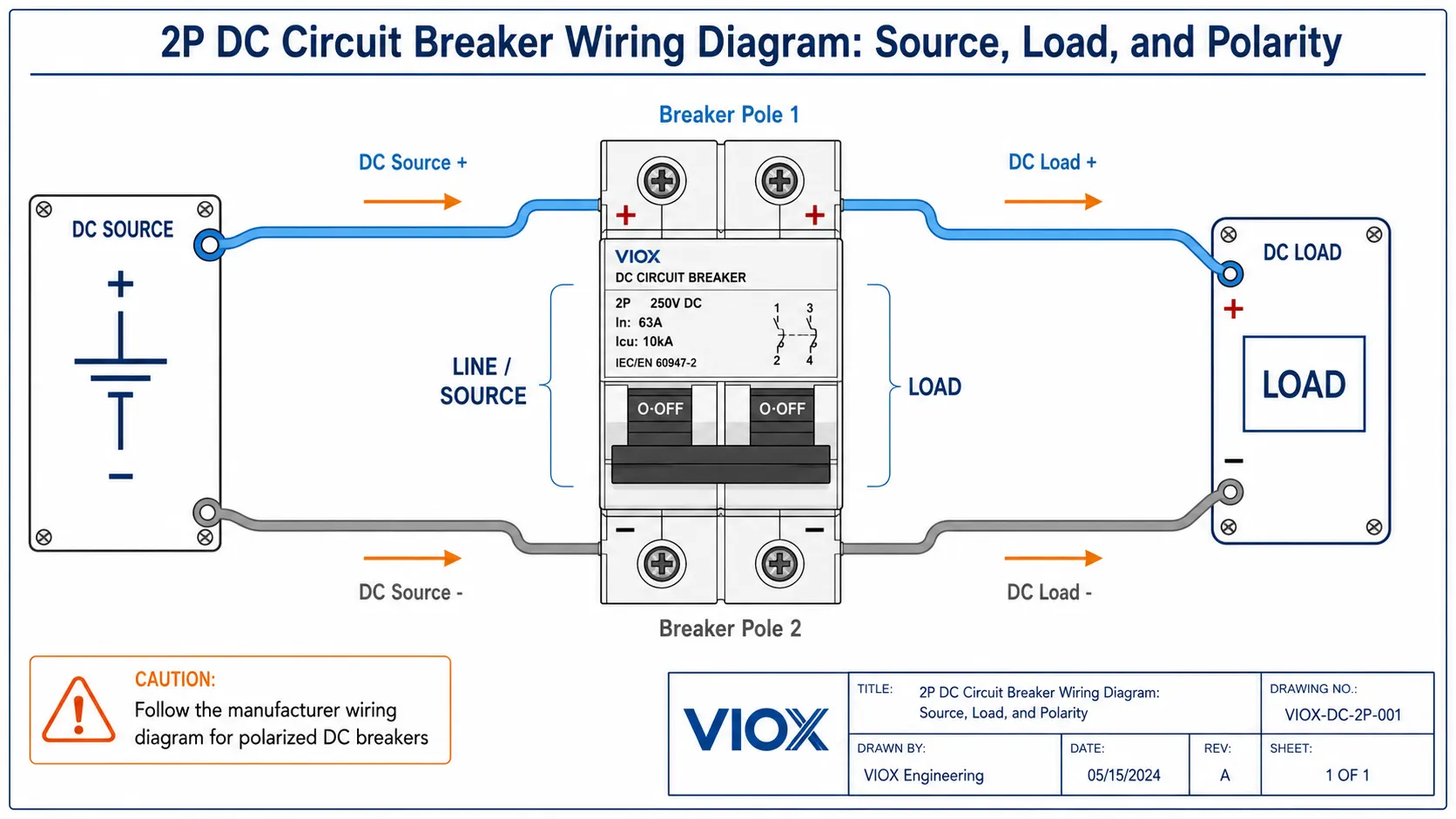
Dans de nombreux circuits CC basse tension, le disjoncteur est installé sur le conducteur positif. Dans d'autres systèmes, les conducteurs positif et négatif peuvent être commutés ou protégés. Dans les applications de disjoncteurs modulaires (MCB) CC à plus haute tension, plusieurs pôles peuvent être câblés en série pour augmenter la capacité de coupure d'arc.
Vérifiez toujours :
+et-les marquages des bornes ;- sens ligne/charge ou source/charge ;
- câblage série des pôles requis ;
- si le disjoncteur est polarisé ou non polarisé ;
- si l'appareil est dimensionné pour la tension CC réelle.
Polarité du disjoncteur CC : Polarisé vs Non polarisé
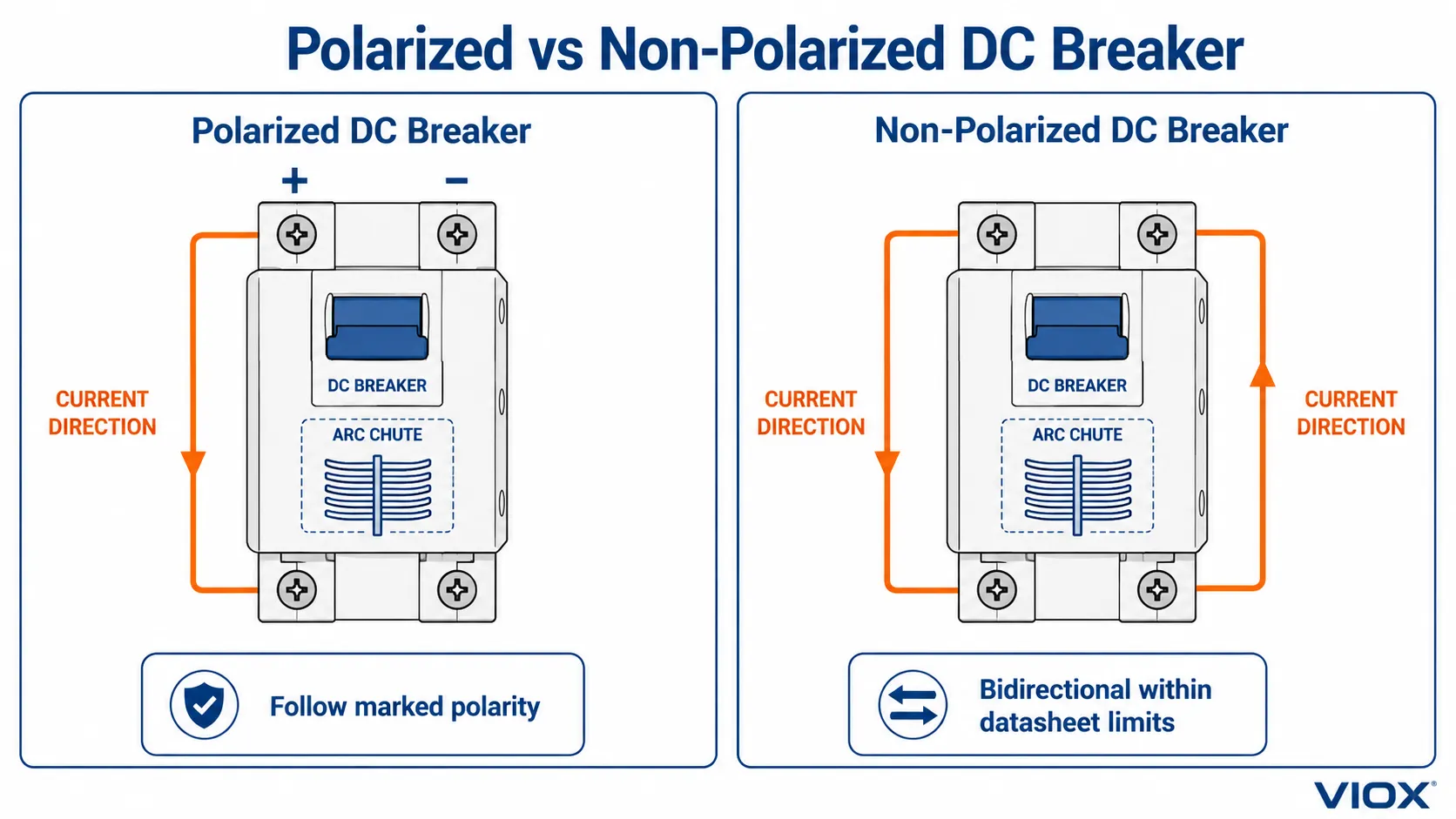
La polarité est l'une des différences les plus importantes entre les disjoncteurs CC et de nombreux disjoncteurs CA.
| Objet | Disjoncteur CC polarisé | Disjoncteur CC non polarisé |
|---|---|---|
| Sens du courant | Doit respecter le sens indiqué | Peut interrompre le courant dans les deux sens dans les limites de la fiche technique |
| Marquages des bornes | Utilise souvent +, -, ligne/charge, ou des flèches | Peut être marqué comme sans polarité ou bidirectionnel |
| Risque principal | Un câblage inversé peut réduire les performances d'interruption d'arc | Doit toujours correspondre à la tension, au courant et au pouvoir de coupure |
| Meilleure solution | Circuits CC unidirectionnels | Batterie, stockage ou circuits CC bidirectionnels lorsque cela est approuvé |
Ne présumez pas que chaque disjoncteur CC est non polarisé. Ne présumez pas non plus que “ ligne ” signifie toujours positif ou que “ charge ” signifie toujours négatif. Le schéma de câblage et la fiche technique font foi.
MCB CC vs MCCB CC
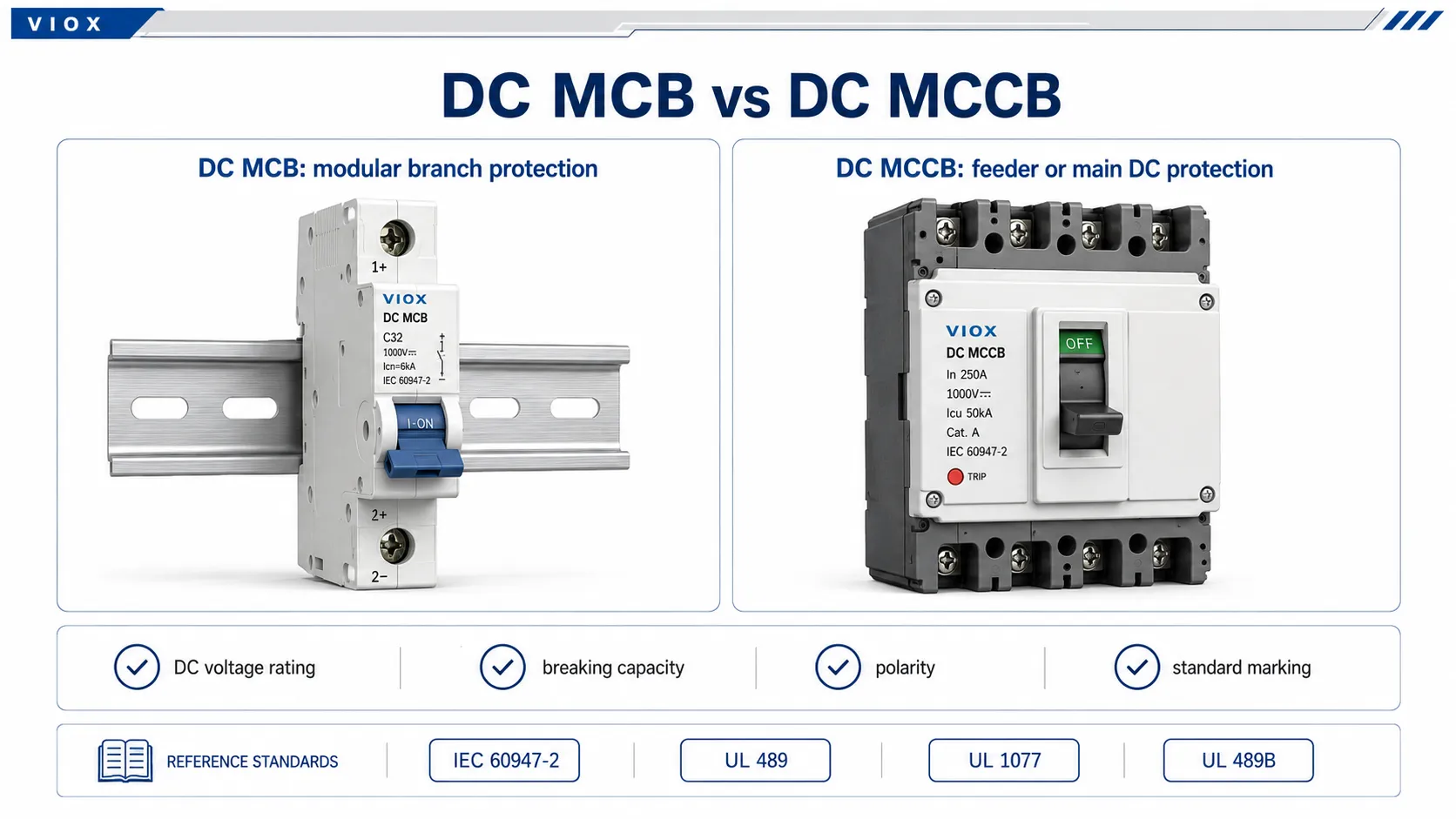
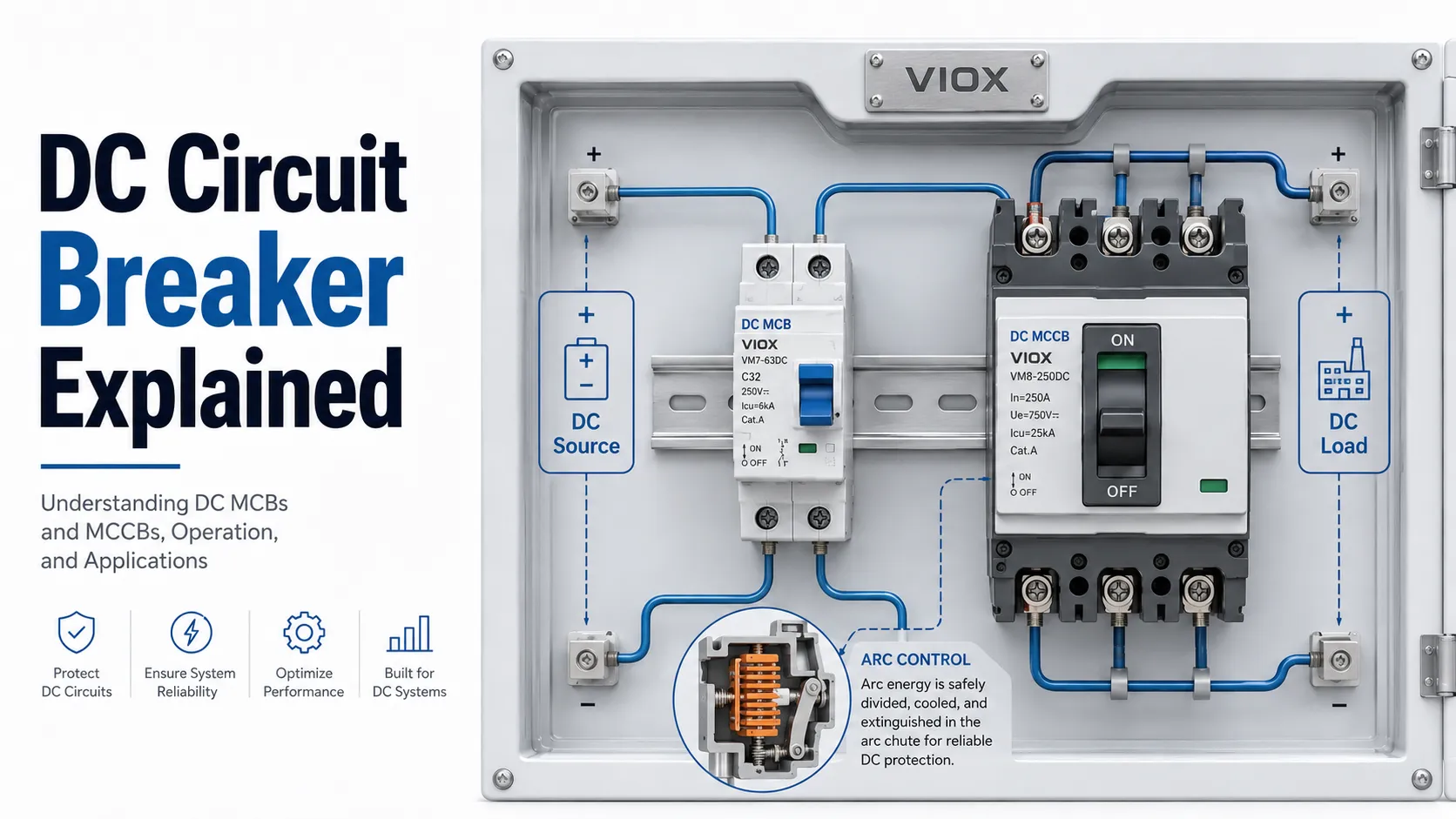
Les termes DC MCB et Disjoncteur boîtier moulé CC (MCCB) font référence à différentes familles de disjoncteurs.
| Fonctionnalité | DC MCB | Disjoncteur boîtier moulé CC (MCCB) |
|---|---|---|
| Nom complet | Disjoncteur miniature CC | Disjoncteur à boîtier moulé CC |
| Rôle typique | Protection modulaire de dérivation ou de chaîne | Protection d'alimentation à courant élevé ou protection CC principale |
| Montage | Tableaux modulaires sur rail DIN | Tableaux de distribution ou coffrets de plus grande taille |
| Gamme de courant | Faible à moyen, selon la gamme de produits | Moyen à élevé, selon le calibre |
| Paramètres | Caractéristiques de déclenchement généralement fixes | Possibilité de réglages ajustables sur les calibres supérieurs |
| Applications courantes | Chaînes photovoltaïques, circuits de commande CC, départs télécom | Alimentations de batteries, circuits industriels CC, distribution CC principale |
Si le circuit nécessite un courant élevé, une performance de court-circuit supérieure ou une protection réglable, envisagez un disjoncteur boîtier moulé (MCCB) CC ou une conception coordonnée fusible/disjoncteur plutôt que de supposer qu'un disjoncteur modulaire (MCB) CC suffit.
Caractéristiques principales d'un disjoncteur CC
| Evaluation | Ce qu'il faut vérifier | Pourquoi c'est important |
|---|---|---|
| Tension nominale en courant continu (CC) | Tension CC maximale que le disjoncteur peut interrompre | La tension nominale CC n'est pas identique à la tension nominale CA |
| Courant nominal | Courant de fonctionnement continu | Doit correspondre à la protection de la charge et du conducteur |
| Pouvoir de coupure | Courant de défaut maximal que le disjoncteur peut interrompre à la tension CC nominale | Doit dépasser le courant de défaut disponible |
| Nombre de pôles | 1P, 2P, 3P, 4P | Affecte la commutation du conducteur et l'interruption de l'arc en série |
| Polarité | Polarisé, non polarisé, direction source/charge | Une mauvaise polarité peut affecter l'extinction de l'arc en courant continu (DC) |
| Courbe ou caractéristique de déclenchement | Comportement en cas de surcharge et déclenchement instantané | Doit être adapté au type de charge et au courant d'appel |
| Normes et marquage | Cadre normatif IEC, UL ou exigences du projet | Confirme le contexte de la valeur nominale |
Ne choisissez pas un disjoncteur DC uniquement en fonction de son ampérage. Un disjoncteur de 32 A peut être approprié dans un système DC et dangereux dans un autre si la tension, le pouvoir de coupure ou la polarité ne correspondent pas.
Normes importantes : IEC 60947-2, UL 489, UL 1077 et UL 489B
Les normes sont essentielles car un même boîtier en plastique peut dissimuler des capacités testées très différentes. Un disjoncteur marqué pour des circuits de dérivation AC, une protection auxiliaire DC, une utilisation photovoltaïque DC ou une distribution industrielle DC ne doit pas être considéré comme interchangeable.
| Norme / Contexte de marquage | Pertinence commune | Que vérifier |
|---|---|---|
| CEI 60947-2 | Disjoncteurs basse tension, incluant de nombreuses applications industrielles de type MCB/MCCB | Tension nominale CC, contexte d'utilisation, pouvoir de coupure, polarité, câblage des pôles |
| IEC 60898-1 | Disjoncteurs miniatures CA pour usages domestiques et analogues | Ne pas présumer de l'adéquation pour le courant continu (CC) à moins que l'appareil ne dispose d'une tension nominale CC valide |
| UL 489 | Disjoncteurs à boîtier moulé et disjoncteurs de dérivation sur les marchés nord-américains | Vérifier si le disjoncteur est homologué pour la tension CC et l'application requises |
| UL 1077 | Disjoncteurs auxiliaires pour une utilisation à l'intérieur des équipements | Différents des disjoncteurs de branchement ; les limites d'application sont importantes |
| UL 489B | Disjoncteurs CC photovoltaïques dans les contextes UL | Pertinent pour les circuits CC photovoltaïques le cas échéant |
L'interprétation la plus sûre est simple : utilisez la norme et les caractéristiques nominales indiquées sur la fiche technique, et non uniquement la forme du produit ou le titre du catalogue. Si un disjoncteur est utilisé dans un coffret de regroupement solaire, une armoire à batteries, une borne de recharge pour VE ou un tableau CC industriel, le cahier des charges du projet peut également exiger une conformité à une norme spécifique.
Exemple de terrain : Pourquoi une étiquette “ DC Rated ” ne suffit pas
Lors de l'examen des tableaux de commande, un signal d'alerte courant est un disjoncteur modulaire décrit uniquement comme “ compatible CC ” sans indication claire de la tension, du pouvoir de coupure, de la polarité et du schéma de câblage. Ces informations sont insuffisantes pour une approbation technique.
Par exemple, un disjoncteur peut être acceptable pour un circuit de commande CC basse tension mais inadapté à une chaîne photovoltaïque haute tension. Un autre disjoncteur peut ne couper correctement que s'il est câblé selon un sens source/charge défini. Dans les deux cas, l'appareil peut sembler correct sur le rail DIN tout en étant inadapté aux conditions de défaut réelles.
Avant d'approuver un disjoncteur CC, vérifiez ces quatre éléments conjointement : Tension nominale CC, courant de défaut disponible, polarité/schéma de câblage et marquage de la norme applicable..
Comment dimensionner un disjoncteur CC en toute sécurité
Le dimensionnement d'un disjoncteur CC dépend de l'application. Évitez d'appliquer un multiplicateur universel à chaque circuit CC.
Le processus de sélection sécurisé est le suivant :
- Confirmez la tension maximale du système CC, et non seulement la tension nominale.
- Calculer le courant de fonctionnement et les exigences de charge continue.
- Vérifier l'ampacité des conducteurs et les conditions de température.
- Vérifier le courant de défaut disponible et le pouvoir de coupure requis.
- Confirmer le câblage des pôles et la polarité.
- Adapter le disjoncteur à l'application : PV, batterie, VE, télécom, marine ou courant continu industriel.
- Respecter les codes locaux, les instructions de l'équipement et les exigences de la fiche technique du produit.
Pour les étapes de sélection détaillées, voir Comment choisir un disjoncteur CC.
Applications des disjoncteurs CC
| Application | Pourquoi le choix du disjoncteur CC est important |
|---|---|
| Solaire PV | Tension de chaîne élevée, tension en circuit ouvert (Voc) par temps froid, conditions de courant inverse, architecture de boîtier de jonction |
| Systèmes de batteries | Énergie de défaut élevée, courant bidirectionnel, coordination du BMS |
| équipement de recharge de VE | Architecture de bus CC et coordination de la protection au niveau de l'équipement |
| Alimentation CC pour télécommunications | Tension plus faible mais courant de défaut potentiellement élevé provenant des batteries |
| Courant continu pour applications marines et véhicules | Vibrations, tableaux compacts, circuits de batterie, service basse tension à courant élevé |
| Distribution CC industrielle | Redresseurs, variateurs, commandes, charges CC et coordination des courants de défaut |
Pour les différences d'application entre le photovoltaïque, les batteries et les véhicules électriques, voir Disjoncteurs CC pour systèmes solaires, batteries et véhicules électriques.
Erreurs courantes avec les disjoncteurs CC
Erreur 1 : Utiliser un disjoncteur CA dans un circuit CC
Une valeur nominale CA seule ne prouve pas la capacité de coupure en courant continu. Utilisez un appareil avec une tension CC et un pouvoir de coupure clairement spécifiés.
Erreur 2 : Ignorer la polarité
Un disjoncteur CC polarisé peut être dangereux s'il est câblé à l'envers. Vérifiez les bornes +/-, source/charge, les flèches et la fiche technique.
Erreur 3 : Choisir uniquement en fonction de l'intensité
La tension nominale et le pouvoir de coupure sont tout aussi importants que l'intensité nominale dans les circuits CC.
Erreur 4 : Mauvais câblage des disjoncteurs CC multipolaires
Certains disjoncteurs CC haute tension nécessitent que les pôles soient câblés en série selon un schéma spécifique. Ne devinez pas le câblage uniquement à partir du nombre de pôles.
Erreur 5 : Traiter les circuits de batterie et les circuits photovoltaïques de la même manière
Les chaînes photovoltaïques, les parcs de batteries et les chargeurs CC présentent des comportements de défaut et des problèmes de direction de courant différents.
FAQ
Qu'est-ce qu'un disjoncteur CC ?
Un disjoncteur CC est un dispositif de protection qui ouvre un circuit à courant continu en cas de surcharge ou de court-circuit. Il doit être dimensionné pour la tension CC et l'interruption CC.
À quoi sert un disjoncteur CC ?
Les disjoncteurs CC sont utilisés dans le solaire photovoltaïque, le stockage par batterie, les équipements de recharge de véhicules électriques, l'alimentation CC des télécommunications, les tableaux marins, la distribution CC industrielle et les circuits de commande.
Puis-je utiliser un disjoncteur CA pour du CC ?
Uniquement si la fiche technique du disjoncteur indique explicitement les caractéristiques nominales CC requises pour la tension, le courant et le pouvoir de coupure. Ne présumez jamais qu'un disjoncteur CA est adapté au CC.
Pourquoi le courant continu est-il plus difficile à couper que le courant alternatif ?
Le courant continu ne passe pas naturellement par zéro comme le courant alternatif. Le disjoncteur doit forcer l'extinction de l'arc en utilisant un espacement approprié des contacts, une conception de chambre de coupure, un soufflage magnétique ou d'autres méthodes de contrôle d'arc.
Qu'est-ce qu'un disjoncteur miniature (MCB) CC ?
Un MCB CC est un disjoncteur miniature modulaire conçu pour les circuits à courant continu. Il est couramment utilisé dans les chaînes photovoltaïques, les circuits de commande CC, les branches de télécommunications et les tableaux de distribution CC compacts.
Qu'est-ce qu'un disjoncteur boîtier moulé (MCCB) CC ?
Un MCCB CC est un disjoncteur à boîtier moulé conçu pour les circuits à courant continu. Il est généralement utilisé pour les départs à courant élevé, les circuits de batterie, les systèmes industriels CC et la protection principale en courant continu.
La polarité d'un disjoncteur CC est-elle importante ?
Oui, si le disjoncteur est polarisé. Un disjoncteur CC polarisé doit être câblé en respectant la polarité et le sens du courant indiqués. Les disjoncteurs non polarisés sont plus flexibles, mais doivent tout de même respecter les limites spécifiées dans la fiche technique.
Qu'est-ce qu'un schéma de câblage pour disjoncteur CC ?
Un schéma de câblage indique comment la source CC, la charge, la polarité et les pôles du disjoncteur doivent être connectés. Pour les disjoncteurs modulaires (MCB) CC, le schéma peut également indiquer la connexion en série requise de plusieurs pôles pour des tensions CC plus élevées.
Quel calibre dois-je vérifier en priorité sur un disjoncteur CC ?
Commencez par la tension nominale CC maximale, puis vérifiez le courant nominal, le pouvoir de coupure, la polarité, le câblage des pôles et le type d'application.
Ressources VIOX connexes
- Page produit disjoncteur CC (MCB)
- Comment choisir un disjoncteur CC
- Guide de polarité des disjoncteurs CC de VIOX
- Défis de conception des disjoncteurs miniatures (MCB) 1000V CC
- Sectionneur DC vs Disjoncteur DC
Conclusion
Un disjoncteur CC protège les circuits à courant continu contre les surcharges et les courts-circuits, mais la protection CC diffère de la protection CA. Les arcs électriques en courant continu sont plus difficiles à interrompre, la polarité peut être importante et la tension nominale est critique.
Pour une sélection fiable, vérifiez la tension CC, le courant, le pouvoir de coupure, le câblage des pôles, la polarité, la courbe de déclenchement et le type d'application. Si vous sélectionnez des produits pour un projet, commencez par le schéma de câblage du système et la fiche technique du disjoncteur, et non uniquement par l'intensité nominale.