On this page
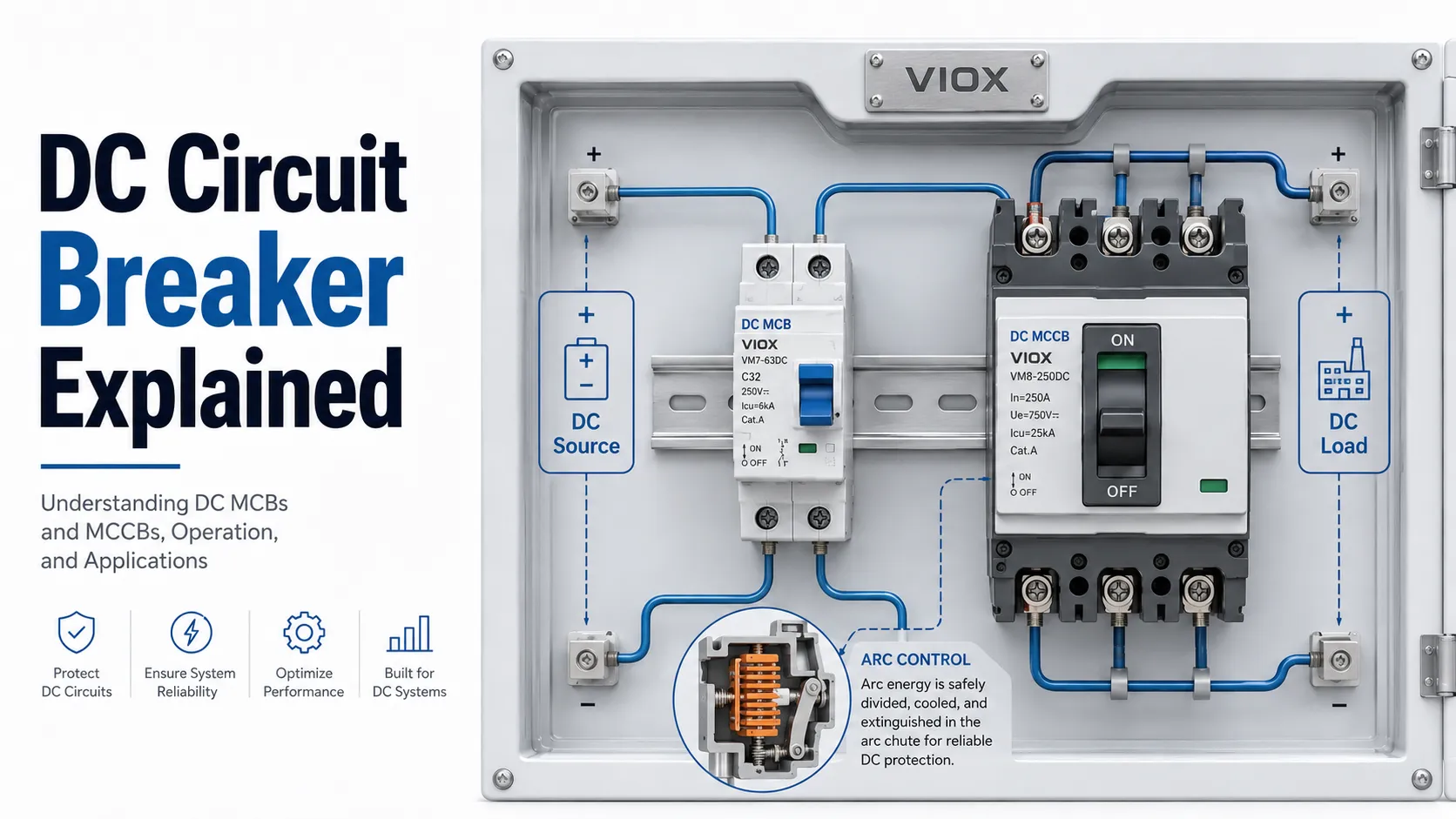
A DC circuit breaker is a protective switching device designed to interrupt direct current under overload or short-circuit conditions. Unlike AC breakers, a DC breaker must extinguish a DC arc without relying on a natural current zero crossing.
In simple terms: a DC circuit breaker protects a DC circuit by opening the circuit when current exceeds its allowed level, but it must be specifically rated and designed for DC voltage, DC arc interruption, polarity, and breaking capacity.
Common DC breaker applications include solar PV systems, battery energy storage systems, EV charging equipment, telecom DC power, marine DC panels, industrial DC distribution, and control circuits.
In field selection, the mistake is often deeper than choosing the wrong amp rating. Engineers may select a device that looks physically correct but has the wrong DC voltage rating, polarity requirement, or interrupting standard context. That mistake may not appear during normal operation; it appears when the breaker is asked to interrupt a DC arc.
Key Takeaways
- A DC breaker is not just an AC breaker with a different label. DC arcs are harder to extinguish.
- DC breaker selection must check voltage rating, current rating, breaking capacity, pole configuration, polarity, and wiring diagram.
- A polarized DC breaker must be wired according to its marked polarity or source/load direction.
- A non-polarized DC breaker is more suitable where current may reverse, such as some battery or hybrid inverter circuits.
- DC MCBs are typically used for modular branch circuits; DC MCCBs are used for higher-current feeders or industrial DC protection.
- Do not use an AC-only breaker in a DC circuit unless the datasheet explicitly provides the required DC rating.
DC Circuit Breaker at a Glance
| Item | What It Means |
|---|---|
| Full meaning | Direct current circuit breaker |
| Main function | Opens a DC circuit during overload or short-circuit conditions |
| Main challenge | DC arc does not naturally pass through zero like AC |
| Typical products | DC MCB, DC MCCB, DC air circuit breaker, high-voltage DC breaker |
| Key ratings | DC voltage, rated current, DC breaking capacity, polarity, pole wiring |
| Common applications | Solar PV, battery, EV, telecom, marine, industrial DC, control circuits |
| Main caution | AC breaker ratings cannot be assumed valid for DC use |
Why DC Circuit Breakers Are Different from AC Breakers
AC current naturally crosses zero every half cycle. That zero crossing helps an AC breaker extinguish the arc after contacts separate.
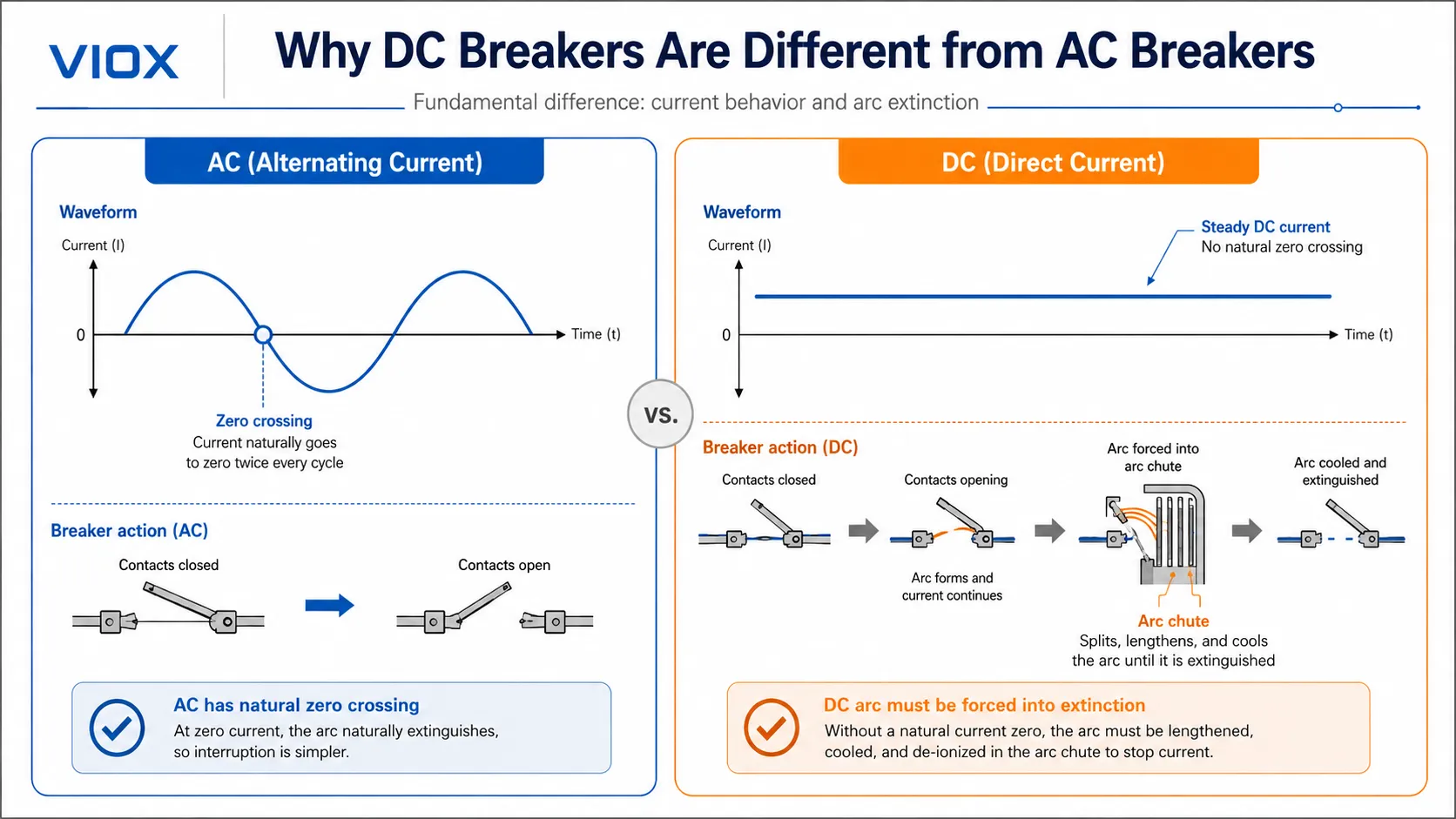
DC current does not have that natural zero crossing. Once the contacts open, the arc can continue unless the breaker design forces it to stretch, cool, split, and extinguish.
| Feature | AC Circuit Breaker | DC Circuit Breaker |
|---|---|---|
| Current behavior | Alternates and crosses zero | Flows in one direction under normal conditions |
| Arc interruption | Assisted by natural current zero | Requires stronger arc-control design |
| Arc chute design | Designed for AC arc extinction | Designed for sustained DC arc extinction |
| Polarity concern | Usually less critical | Can be critical in polarized designs |
| Application examples | Building AC circuits, AC distribution | PV strings, battery circuits, DC panels, EV equipment |
This is why a breaker must have an explicit DC rating for the intended voltage and fault current. A device marked only for AC should not be used as a DC circuit breaker.
How a DC Circuit Breaker Works
When a DC breaker opens under load or fault conditions, its contacts separate and an electric arc forms. The breaker must move that arc into an arc-control structure and extinguish it safely.
Typical DC breaker arc-control features may include:
- contact separation with sufficient insulation distance;
- arc runners that guide the arc away from the contacts;
- arc chutes that split and cool the arc;
- permanent magnets or magnetic blowout coils that drive the arc into the arc chute;
- multiple poles wired in series for higher DC voltage ratings.
The exact internal design depends on the breaker type and voltage class. Small DC MCBs, DC MCCBs, and high-voltage DC breakers do not use the same construction.
Magnetic Blowout Coil and DC Arc Extinction
Some DC breakers use a magnetic blowout principle. When current flows through the breaker, magnetic force helps push the arc away from the contact area and into the arc chute.
In a polarized DC breaker, this arc movement may depend on current direction. If the breaker is wired backward, it may still carry current during normal operation, but the arc may be driven in the wrong direction when the breaker opens. That is why polarity marking matters in many DC breaker designs.
For deeper polarity details, see VIOX’s DC Circuit Breaker Polarity Guide.
DC Circuit Breaker Wiring Diagram: Source, Load, and Polarity
A basic DC breaker is installed in series with the circuit it protects. The exact wiring depends on the system, breaker type, pole count, and manufacturer diagram.
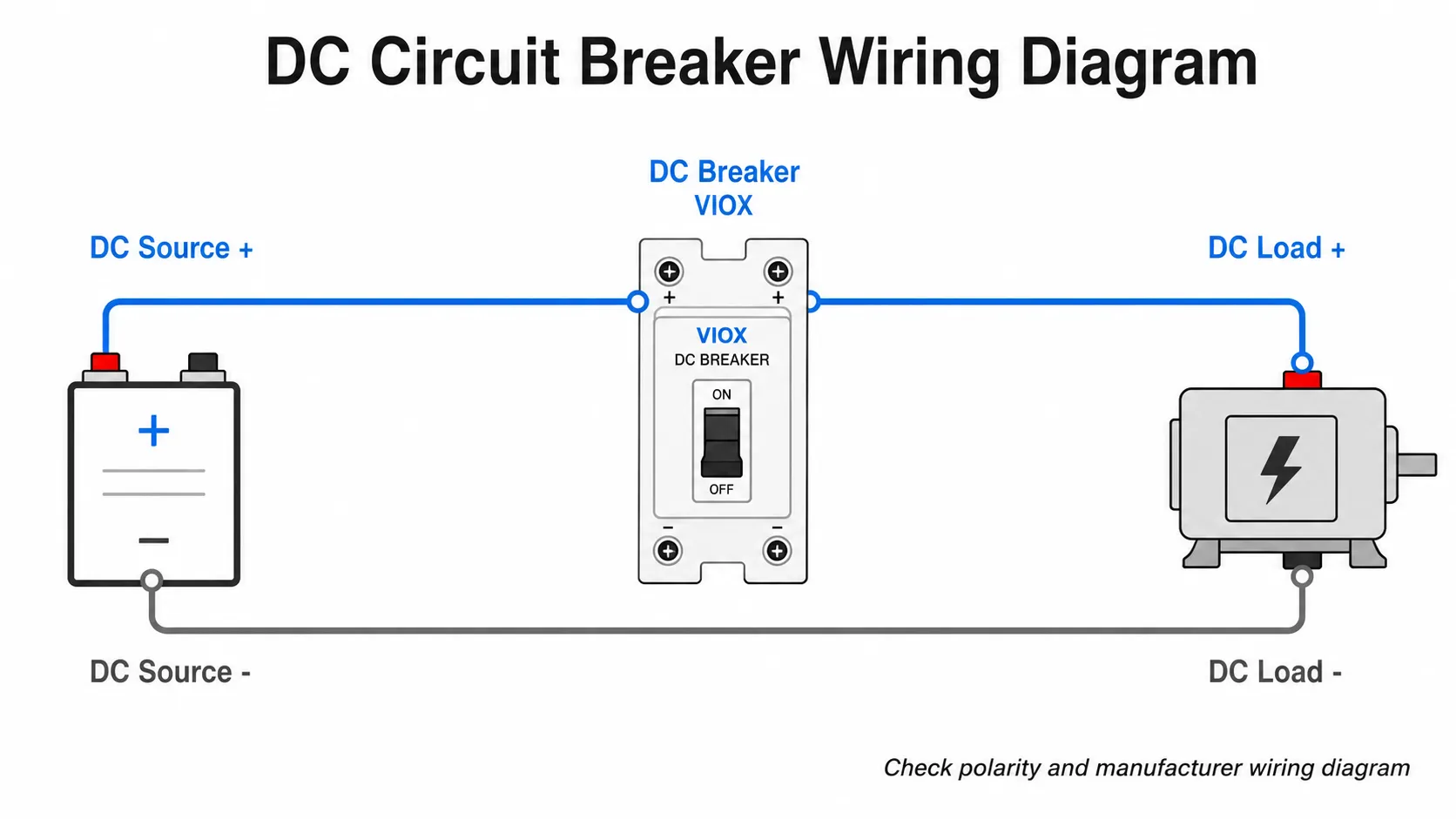
DC source (+)  ->  DC breaker  ->  DC load (+)
DC source (-)  ---------------->  DC load (-)
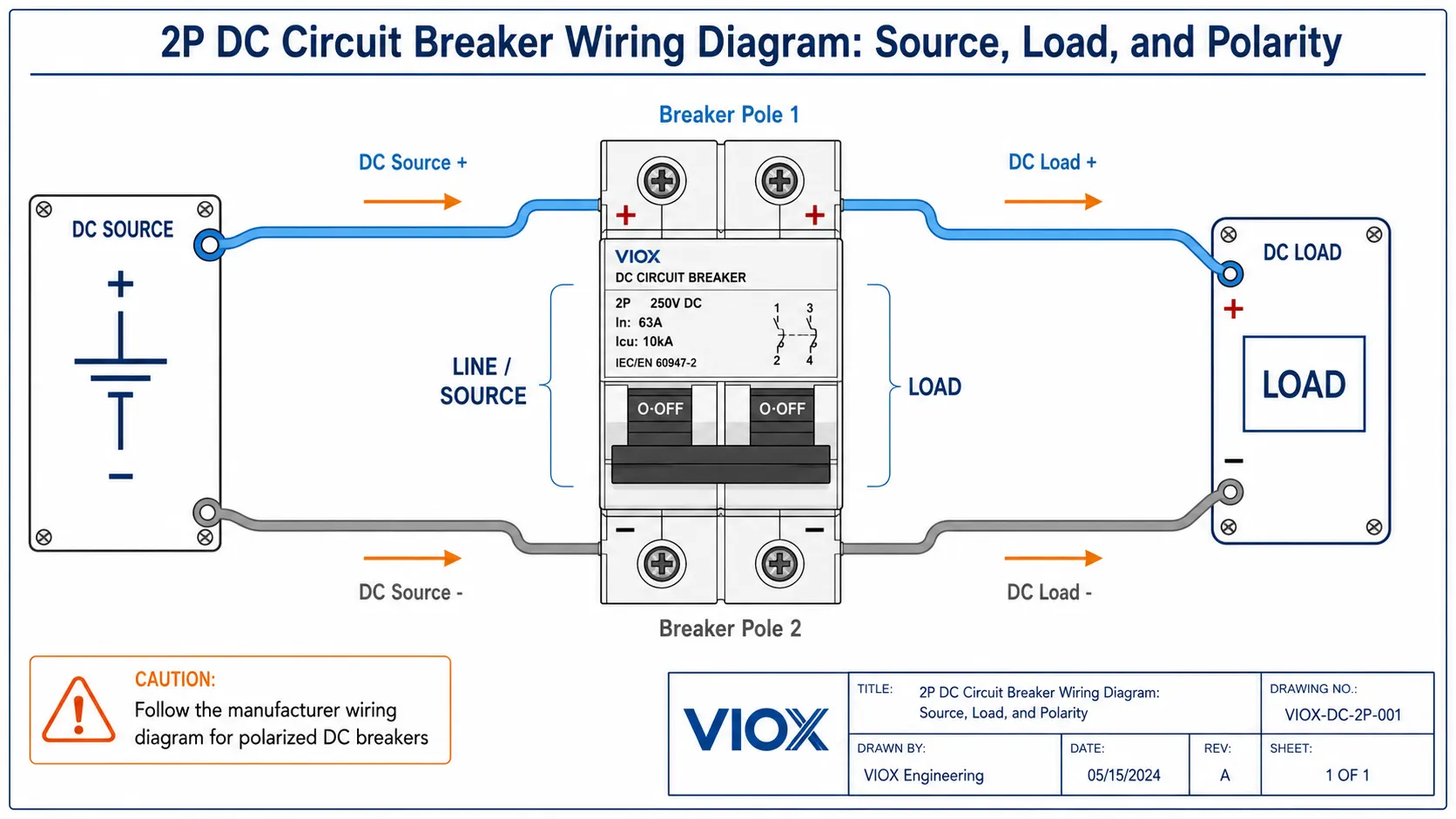
In many low-voltage DC circuits, the breaker is installed in the positive conductor. In other systems, both positive and negative conductors may be switched or protected. In higher-voltage DC MCB applications, multiple poles may be wired in series to increase arc interruption capability.
Always check:
+and-terminal markings;- line/load or source/load direction;
- required pole series wiring;
- whether the breaker is polarized or non-polarized;
- whether the device is rated for the actual DC voltage.
DC Breaker Polarity: Polarized vs Non-Polarized
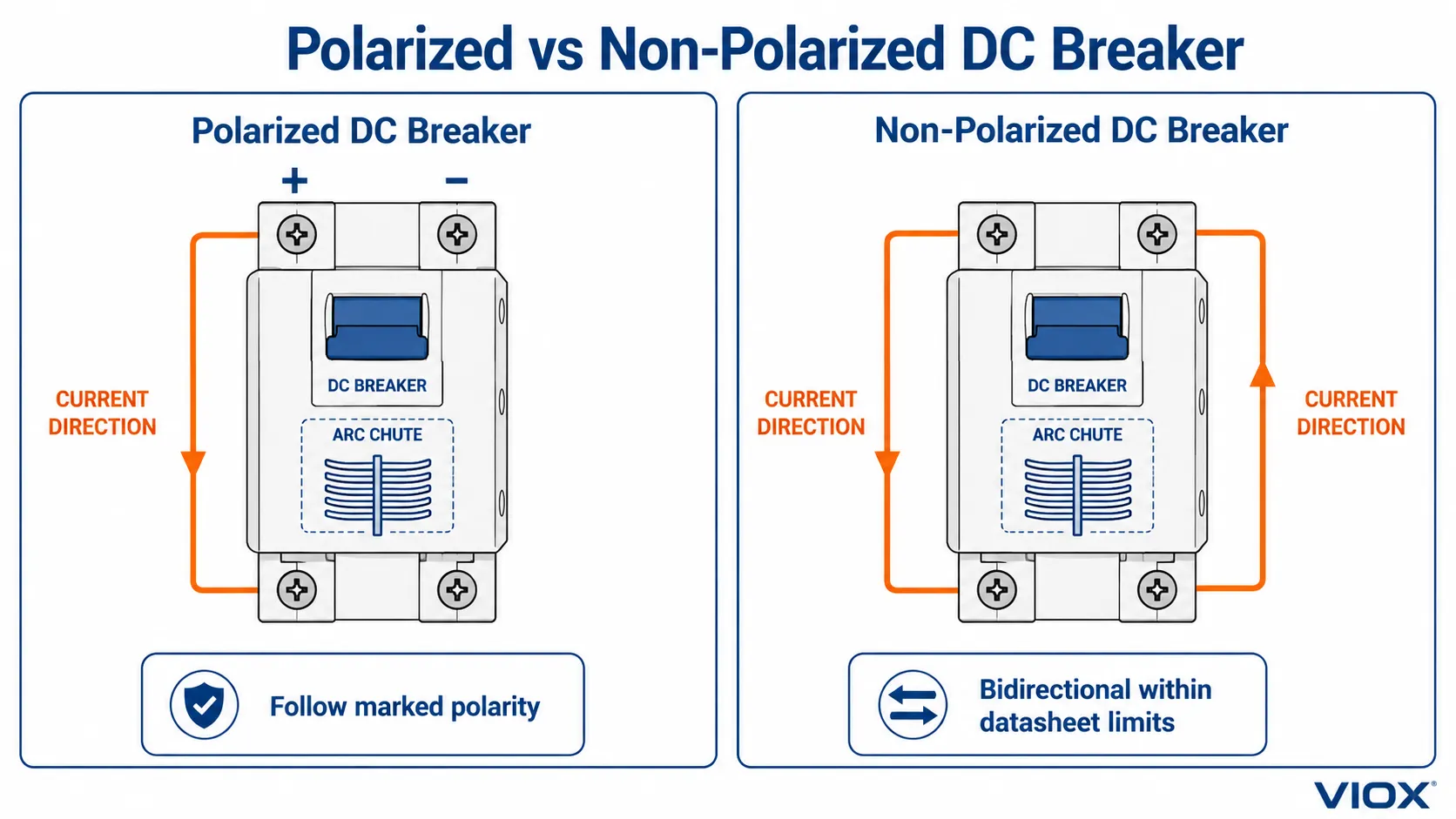
Polarity is one of the most important differences between DC breakers and many AC breakers.
| Item | Polarized DC Breaker | Non-Polarized DC Breaker |
|---|---|---|
| Current direction | Must follow marked direction | Can interrupt current in either direction within datasheet limits |
| Terminal markings | Often uses +, -, line/load, or arrows | May be marked polarity-free or bidirectional |
| Main risk | Reverse wiring can reduce arc interruption performance | Still must match voltage, current, and breaking capacity |
| Best fit | Unidirectional DC circuits | Battery, storage, or bidirectional DC circuits where approved |
Do not assume every DC breaker is non-polarized. Also do not assume “line” always means positive or “load” always means negative. The wiring diagram and datasheet decide.
DC MCB vs DC MCCB
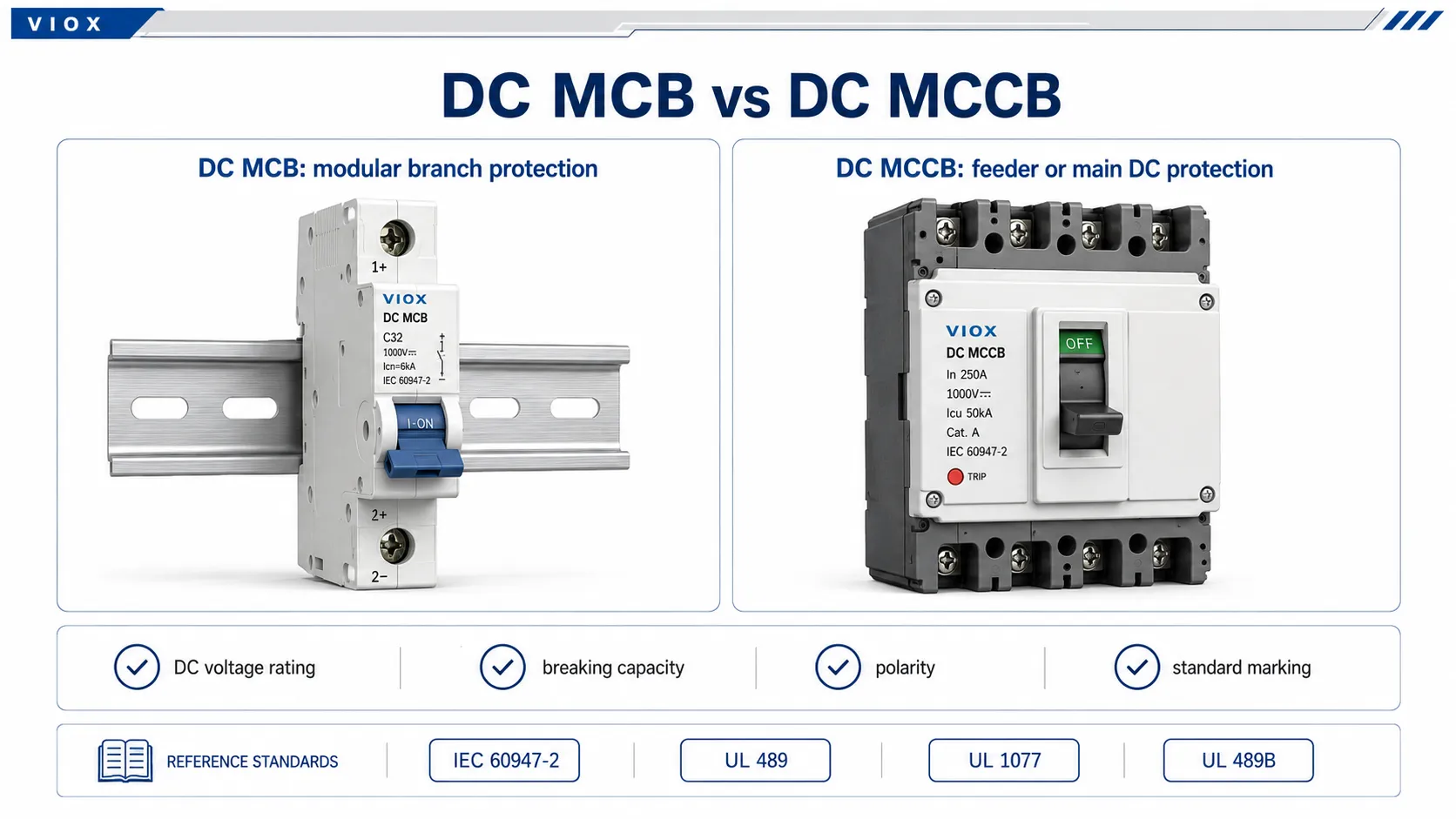
The terms DC MCB and DC MCCB refer to different breaker families.
| Feature | DC MCB | DC MCCB |
|---|---|---|
| Full name | DC miniature circuit breaker | DC molded case circuit breaker |
| Typical role | Modular branch or string protection | Higher-current feeder or main DC protection |
| Mounting | DIN rail modular panels | Larger distribution panels or enclosures |
| Current range | Lower to medium, depending on product family | Medium to high, depending on frame |
| Settings | Usually fixed trip characteristics | May offer adjustable settings in larger frames |
| Common applications | PV strings, DC control circuits, telecom branches | Battery feeders, industrial DC circuits, main DC distribution |
If the circuit requires high current, higher short-circuit performance, or adjustable protection, review a DC MCCB or a coordinated fuse/breaker design rather than assuming a modular DC MCB is enough.
Key Ratings on a DC Circuit Breaker
| Rating | What to Check | Why It Matters |
|---|---|---|
| Rated DC voltage | Maximum DC voltage the breaker can interrupt | DC voltage rating is not the same as AC rating |
| Rated current | Continuous operating current | Must match load and conductor protection |
| Breaking capacity | Maximum fault current the breaker can interrupt at rated DC voltage | Must exceed available fault current |
| Pole count | 1P, 2P, 3P, 4P | Affects conductor switching and series arc interruption |
| Polarity | Polarized, non-polarized, source/load direction | Wrong polarity can affect DC arc extinction |
| Trip curve or characteristic | Overload and instantaneous trip behavior | Must fit load type and inrush current |
| Standard and marking | IEC, UL, or project-required framework | Confirms the rating context |
Do not choose a DC breaker by amperes alone. A 32 A breaker can be correct in one DC system and unsafe in another if the voltage, breaking capacity, or polarity does not match.
Important Standards: IEC 60947-2, UL 489, UL 1077, and UL 489B
Standards matter because the same plastic housing size can hide very different tested capabilities. A breaker marked for AC branch circuits, DC supplementary protection, PV DC use, or industrial DC distribution should not be treated as interchangeable.
| Standard / Marking Context | Common Relevance | What to Verify |
|---|---|---|
| IEC 60947-2 | Low-voltage circuit breakers, including many industrial MCB/MCCB applications | DC voltage rating, utilization context, breaking capacity, polarity, pole wiring |
| IEC 60898-1 | Household and similar AC miniature circuit breakers | Do not assume suitability for DC unless the device has a valid DC rating |
| UL 489 | Molded-case and branch-circuit circuit breakers in North American markets | Whether the breaker is Listed for the required DC voltage and application |
| UL 1077 | Supplementary protectors for use inside equipment | Not the same as a branch-circuit breaker; application limits matter |
| UL 489B | Photovoltaic DC circuit breakers in UL contexts | Relevant for PV DC circuits where applicable |
The safest reading is simple: use the standard and rating printed on the datasheet, not only the product shape or catalog title. If a breaker is used in a solar combiner box, battery cabinet, EV charger, or industrial DC panel, the project specification may also require a specific standard route.
Field Example: Why a “DC Rated” Label Is Not Enough
In control panel reviews, a common red flag is a modular breaker described only as “DC rated” without a clear voltage, breaking capacity, polarity, and wiring diagram. That is not enough information for engineering approval.
For example, a breaker may be acceptable for a low-voltage DC control circuit but not suitable for a high-voltage PV string. Another breaker may interrupt correctly only when wired with a defined source/load direction. In both cases, the device can look correct on the DIN rail while being wrong for the actual fault condition.
Before approving a DC breaker, check four items together: DC voltage rating, available fault current, polarity/wiring diagram, and applicable standard marking.
How to Size a DC Circuit Breaker Safely
DC breaker sizing depends on the application. Avoid applying one universal multiplier to every DC circuit.
The safe selection process is:
- Confirm maximum DC system voltage, not just nominal voltage.
- Calculate operating current and continuous-load requirements.
- Check conductor ampacity and temperature conditions.
- Verify available fault current and required breaking capacity.
- Confirm pole wiring and polarity.
- Match the breaker to the application: PV, battery, EV, telecom, marine, or industrial DC.
- Follow local code, equipment instructions, and product datasheet requirements.
For detailed selection steps, see How to Choose a DC Circuit Breaker.
DC Circuit Breaker Applications
| Application | Why DC Breaker Selection Matters |
|---|---|
| Solar PV | High string voltage, cold-weather Voc, reverse-current conditions, combiner architecture |
| Battery systems | High fault energy, bidirectional current, BMS coordination |
| EV charging equipment | DC bus architecture and equipment-level protection coordination |
| Telecom DC power | Lower voltage but potentially high battery-backed fault current |
| Marine and vehicle DC | Vibration, compact panels, battery circuits, low-voltage high-current duty |
| Industrial DC distribution | Rectifiers, drives, controls, DC loads, and fault-current coordination |
For PV, battery, and EV application differences, see DC Circuit Breakers for Solar, Battery, and EV Systems.
Common DC Breaker Mistakes
Mistake 1: Using an AC breaker in a DC circuit
An AC-only rating does not prove DC interrupting capability. Use a device with a clear DC voltage and breaking capacity rating.
Mistake 2: Ignoring polarity
A polarized DC breaker can be dangerous if wired backward. Check +/-, source/load, arrows, and the datasheet.
Mistake 3: Choosing by current only
Voltage rating and breaking capacity are just as important as amp rating in DC circuits.
Mistake 4: Miswiring multi-pole DC MCBs
Some high-voltage DC MCBs require poles to be wired in series in a specific pattern. Do not guess the wiring from pole count alone.
Mistake 5: Treating battery and PV circuits the same
PV strings, battery banks, and DC chargers have different fault behavior and current-direction issues.
FAQ
What is a DC circuit breaker?
A DC circuit breaker is a protective device that opens a direct-current circuit during overload or short-circuit conditions. It must be rated for DC voltage and DC interruption.
What is a DC breaker used for?
DC breakers are used in solar PV, battery storage, EV charging equipment, telecom DC power, marine panels, industrial DC distribution, and control circuits.
Can I use an AC breaker for DC?
Only if the breaker datasheet explicitly provides the required DC rating for voltage, current, and breaking capacity. Do not assume an AC breaker is suitable for DC.
Why is DC harder to interrupt than AC?
DC current does not naturally pass through zero like AC current. The breaker must force the arc to extinguish using suitable contact spacing, arc chute design, magnetic blowout, or other arc-control methods.
What is a DC MCB?
A DC MCB is a modular miniature circuit breaker rated for DC circuits. It is commonly used in PV strings, DC control circuits, telecom branches, and compact DC distribution panels.
What is a DC MCCB?
A DC MCCB is a molded case circuit breaker rated for DC circuits. It is typically used for higher-current feeders, battery circuits, industrial DC systems, and main DC protection.
Does DC breaker polarity matter?
Yes, if the breaker is polarized. A polarized DC breaker must be wired according to its marked polarity and current direction. Non-polarized breakers are more flexible but still must follow datasheet limits.
What is a DC circuit breaker wiring diagram?
A wiring diagram shows how the DC source, load, polarity, and breaker poles must be connected. For DC MCBs, the diagram may also show required series connection of multiple poles for higher DC voltage.
What rating should I check first on a DC breaker?
Start with the maximum DC voltage rating, then check current rating, breaking capacity, polarity, pole wiring, and application duty.
Related VIOX Resources
- DC MCB Product Page
- How to Choose a DC Circuit Breaker
- DC Circuit Breaker Polarity Guide
- 1000V DC MCB Design Challenges
- DC Isolator vs DC Circuit Breaker
Conclusion
A DC circuit breaker protects direct-current circuits from overload and short-circuit conditions, but DC protection is different from AC protection. DC arcs are harder to interrupt, polarity can matter, and voltage rating is critical.
For reliable selection, check DC voltage, current, breaking capacity, pole wiring, polarity, trip characteristic, and application duty. If you are selecting products for a project, start with the system wiring diagram and the breaker datasheet, not the amp rating alone.