

On this page
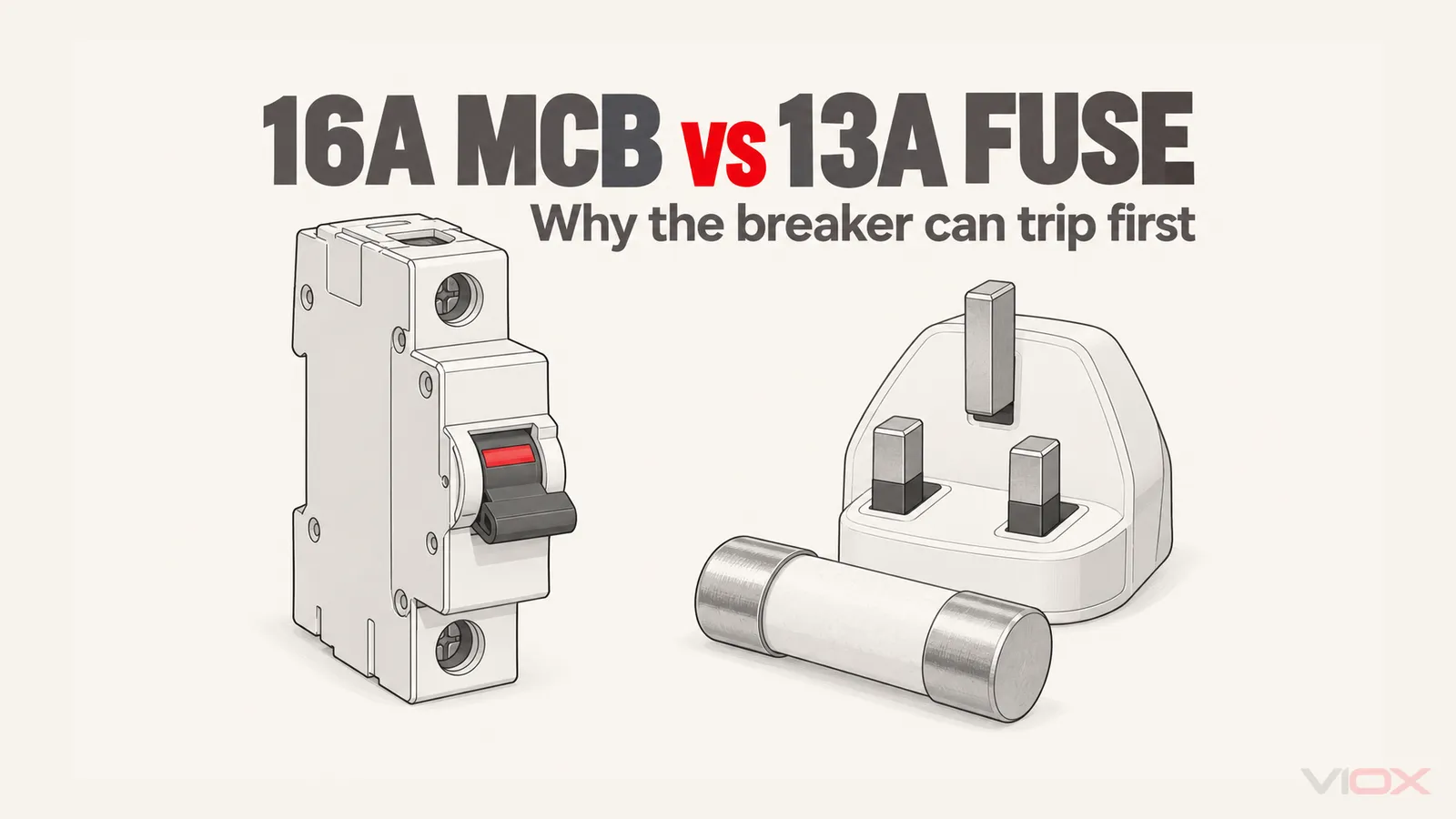
A 16A miniature circuit breaker (MCB) can trip before a 13A plug fuse because the two devices respond differently to current magnitude and duration. A brief starting current may operate the MCB without melting the fuse. A fault in the fixed wiring before the plug fuse may also operate the MCB without passing through that fuse. The smaller ampere number does not guarantee which device opens first.
An intact plug fuse therefore does not prove that the appliance is healthy or that the trip is harmless. Before changing protection, identify which device operated, when it operated and what current path was involved.
Before trying another start: stop using the equipment if there is burning smell, scorching, crackling, damaged cable or repeated immediate tripping. Do not keep resetting the breaker or fit a larger fuse. Electrical Safety First advises acting on these warning signs and obtaining qualified help.
Why 13A Does Not Mean the Fuse Must Open First
The plug fuse and the circuit breaker normally sit in series with the appliance supply. On a dedicated radial supplying only that appliance, both carry its operating current. The MCB protects the fixed circuit; the correctly specified plug fuse protects the appliance’s flexible lead. However, they do not have identical operating characteristics.
| Device | What the marking tells you | What it does not tell you |
|---|---|---|
| B16 MCB | A 16A rated current and a Type B instantaneous characteristic | That it trips immediately at 16.1A, or that it always operates after a 13A fuse |
| 13A BS 1362 plug fuse | A rated current within a specified fuse system | That it melts instantly above 13A, or that it will clear every event before the branch MCB |
The MCB Has Thermal and Magnetic Responses
A thermal-magnetic MCB responds to sustained overload through its thermal mechanism and to sufficiently high current through its magnetic mechanism. The current level and its duration both matter.
For BS EN 60898-style Type B characteristics, the familiar instantaneous test band is 3–5 times rated current. For B16, the arithmetic is:
3 x 16A = 48A
5 x 16A = 80A
This 48–80A band is not a measured pickup value for the installed breaker. It does not mean every short pulse in that range must cause a trip. The exact device curve, tolerances, pulse duration and measurement basis still matter. The IET’s explanation of magnetic characteristics gives the established Type B range; it is not a substitute for the installed product’s data.
A momentary waveform peak should not simply be compared with an RMS-based time-current plot. The VIOX guide to reading circuit-breaker trip curves explains that distinction in more detail.
The Plug Fuse Also Has a Time-Current Characteristic
A fuse element heats as current passes through it. Whether it melts depends on the event’s magnitude and duration, its initial condition and its specified characteristic. A 13A fuse is not an instantaneous 13A switch, and it should not automatically be described as a generic slow-blow fuse.
BSI’s public BS 1362 scope identifies time/current zones among the characteristics standardized for these plug fuse links. To determine an actual opening time, use the exact fuse’s data rather than inventing a delay from its ampere rating.
If the MCB interrupts the supply before the fuse element melts, current through the appliance branch stops. The fuse may remain intact. That outcome is possible without either protective device being defective.
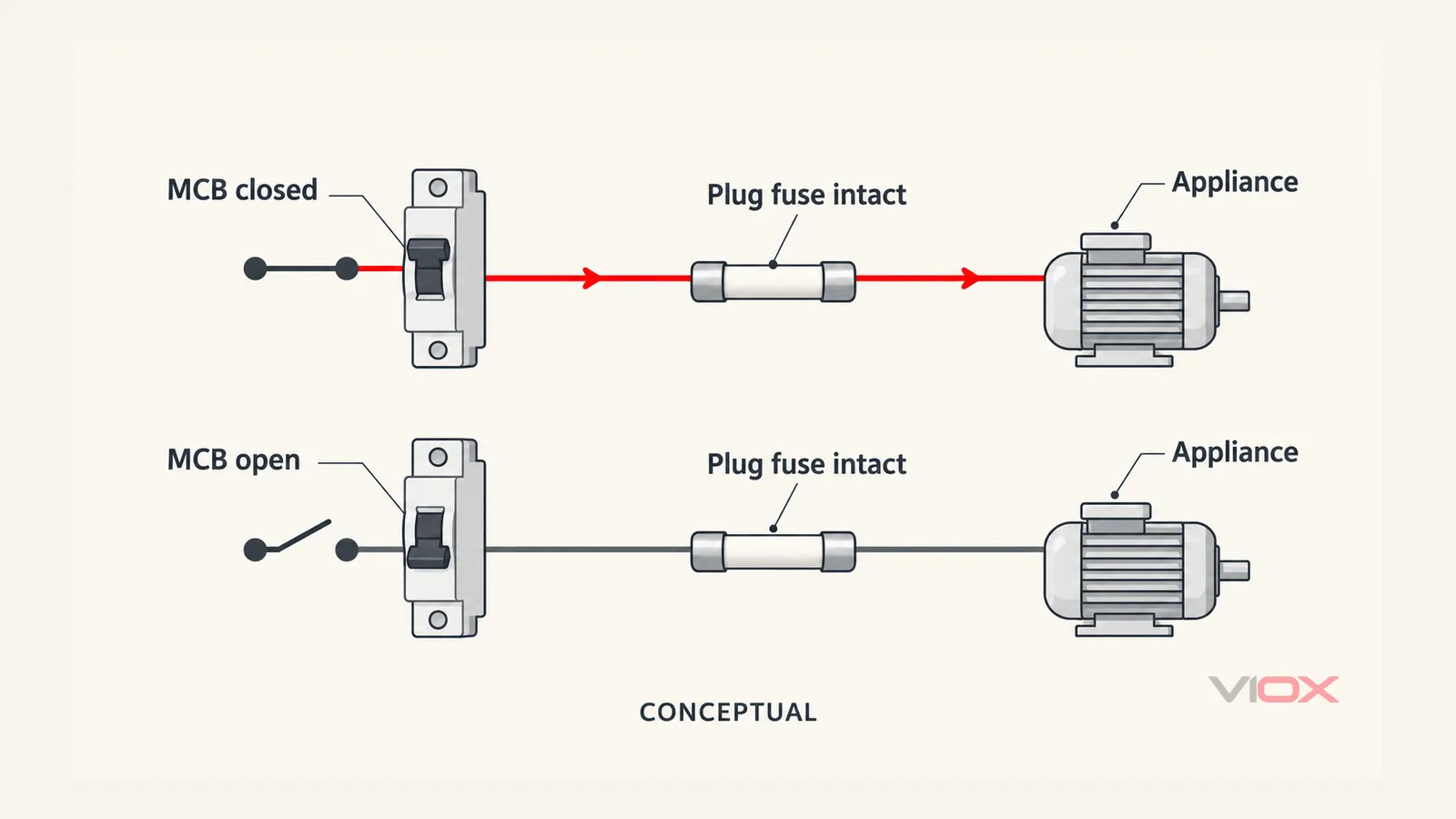
Conceptual interruption sequence for a single-source appliance branch. Contact glyphs beside the MCB depict its switching state, not an additional switch. This is not a measured trip time or a verified selectivity result. Return conductors and installation details are omitted.
The BEAMA switch and fusegear guide explains why an upstream circuit breaker and downstream fuse must be assessed using their operating characteristics and tolerances. Comparing 13 with 16 alone does not establish selectivity. See fuse vs MCB response time for the distinction between melting time, clearing time and current-limiting performance.
Why a 2kW Appliance Can Still Trip a 16A Circuit
Consider an illustrative appliance with 2,000W of electrical input power, supplied at 230V with unity power factor:
Running current = input power / (voltage x power factor)
                = 2,000W / (230V x 1)
                = approximately 8.7A
That is a steady-state estimate under stated assumptions. It does not describe startup current, acceleration time or a stalled condition. If power factor differs, or the quoted wattage is mechanical output rather than electrical input, the estimate changes. Use the appliance’s rated-current information and manufacturer data where available.
A motor or electronic input circuit can draw a starting transient greater than its running current. But a generic multiplier does not prove the cause of a particular trip. Diagnosis requires the actual event and the protective device’s response. The broader inrush-current guide covers measurement windows and load mechanisms.
Occasional startup trips can reflect changing starting conditions, previous thermal loading, supply conditions or an intermittent defect. A motor that struggles to accelerate may draw elevated current for longer. Do not infer the motor type, starting-current multiple or effect of restricted airflow simply from the word vacuum, extractor or compressor.
Follow the Symptom Before Choosing a Different Breaker
First confirm whether the operated device is an MCB, a residual current device (RCD), or a residual current circuit breaker with overcurrent protection (RCBO). An RCBO can operate for more than one protective function. Use its manufacturer’s indication and instructions; the handle position alone may not explain why it operated. See MCB, RCCB and RCBO tripping differences.
Record events already observed. Do not repeatedly reproduce a trip, restrict an appliance inlet, open the consumer unit or probe live terminals to fill in the table.
| Observed pattern | What it may indicate | Useful observation | Qualified next action |
|---|---|---|---|
| MCB trips at the start command; plug fuse remains intact | Starting transient, an unsuitable characteristic, or an immediate equipment/circuit fault | Device marking, appliance identity, starting condition and any abnormal sound | Capture startup current and duration safely; compare with device data and examine the equipment |
| MCB trips after running for a while | Sustained overload, prolonged acceleration, thermal loading or a defect | Time to trip, other connected loads and recent operating history | Measure operating current and inspect the circuit/equipment condition |
| Trips follow use of a remote switch or extension | Accessory suitability, contact condition or supply-path differences may matter | Accessory model, stated load suitability, extension length and visible damage | Assess motor-switching duty, connections and supply conditions; do not assume the accessory’s headline ampere rating is sufficient |
| Circuit trips even with the appliance unplugged | Another load or a fixed-wiring/accessory fault is possible | Which loads were disconnected and whether recent wiring work occurred | Investigate the fixed installation before returning it to service |
| An RCD or RCBO residual-current indication operates | A different protective function may be involved | Exact device and trip indication | Follow the residual-current diagnostic route rather than treating it as a B16 inrush problem |
An unchanged 13A fuse narrows neither the diagnosis to inrush nor the repair to a new MCB. If the event falls outside this specific pattern, the general MCB-tripping diagnostic guide provides the wider starting point.
Fault Location Can Explain the Intact Plug Fuse
The plug fuse is downstream of the fixed wiring and socket contacts. A fault in the radial circuit or socket, before that fuse, need not send its fault current through the fuse element. The MCB can operate while the plug fuse remains unaffected.
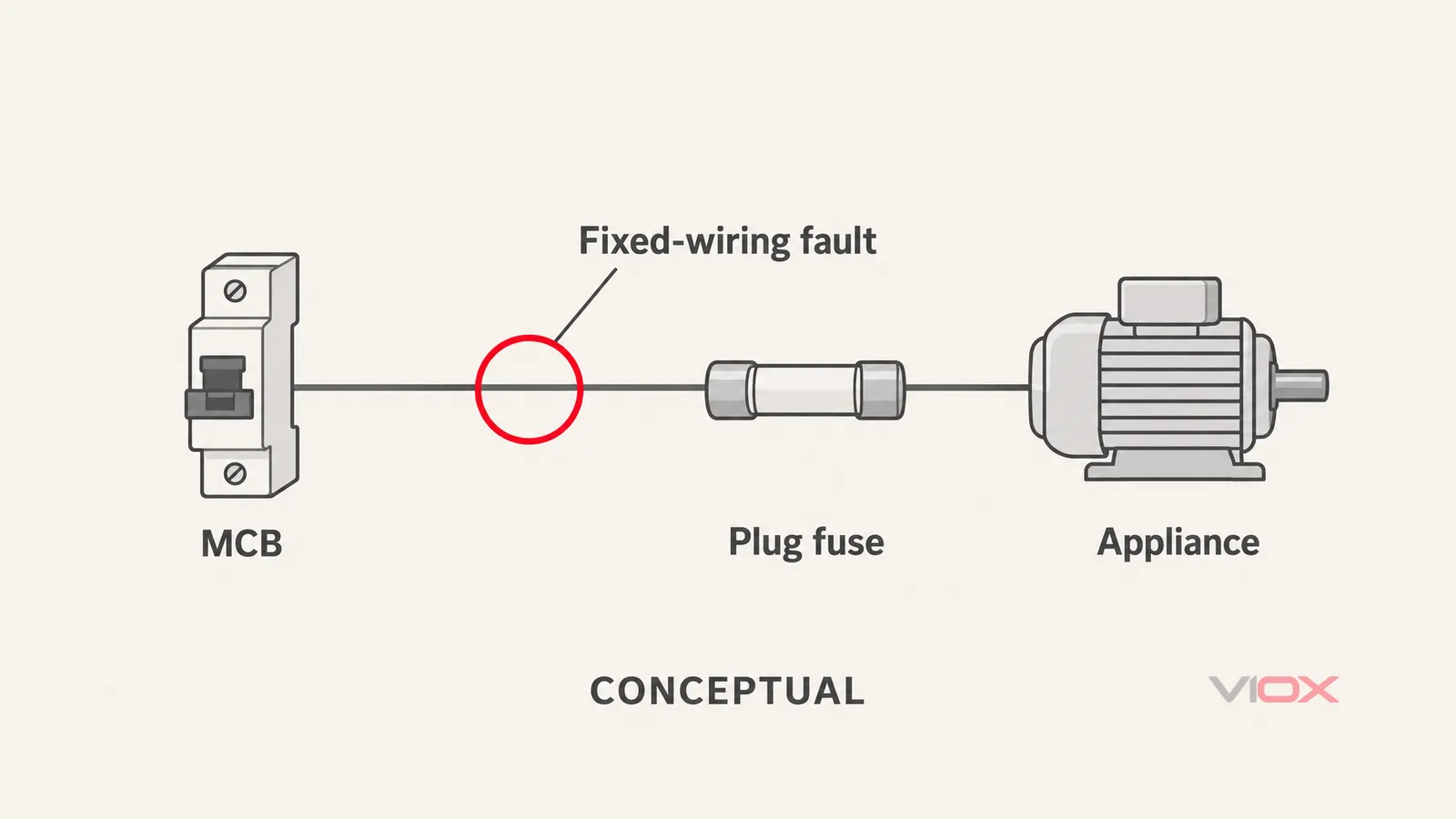
The red location marker identifies an example fault before the plug fuse. Lines show device order, not terminal wiring, a complete fault-return path or proof of isolation.
For a fault inside the appliance, the plug fuse may be in the fault-current path, but the operating sequence still depends on both devices’ characteristics and the available current. The fuse surviving is therefore an observation to explain, not a certificate that everything downstream is safe.
Does Working on a 32A Circuit Prove the Appliance Is Fine?
No. A different circuit changes the upstream protection and may also change voltage drop, connection condition or supply impedance. Successful operation on that circuit does not identify which factor mattered.
Treat an earlier successful start elsewhere as information for the electrician, not a recommendation to move a suspect appliance and keep testing. Retain the correct plug fuse and follow the equipment’s supply requirements. A larger branch-circuit rating does not increase the permitted rating of the plug, flexible cord, remote switch or appliance.
Check These Conditions Before Changing B16 to C16 or D16
A higher magnetic pickup characteristic may tolerate a starting event that operates a Type B device. It also changes the current needed for rapid fault operation. Keeping the same 16A rating does not make the change automatically acceptable.
The IET’s fault-loop and protective-device guidance connects startup suitability with available fault current, device-specific data and automatic-disconnection requirements. A qualified electrician should establish:
- whether starting current is normal for the appliance, or a defect is extending it;
- the actual MCB characteristic and startup-event measurement basis;
- conductor current-carrying capacity, installation conditions and overload protection;
- the applicable fault-protection arrangement, including loop impedance and required disconnection performance;
- prospective fault current and the device’s breaking capability;
- consumer-unit compatibility and the appliance manufacturer’s instructions;
- coordination with the plug fuse and any other protection where required.
An RCD being present does not, by itself, validate a curve change or replace the overload and short-circuit assessment. Equally, a 13A plug fuse remaining intact is not evidence that a larger fuse should be fitted.
What to Give the Electrician
Prepare a short record: the accessible device marking and trip indication, appliance make/model and nameplate current, when the trip occurs, other loads operating, any remote switch or extension used, and any recent equipment or wiring change. Include unusual smells, sounds, slow acceleration or visible damage. Photograph only safely accessible labels; do not remove the consumer-unit cover.
The useful result is a diagnosis supported by the load’s current-versus-time behavior and the circuit’s protective conditions. The eventual action may be equipment repair, accessory replacement, circuit repair or a verified protection change. The order of operation alone cannot choose between them.