

On this page
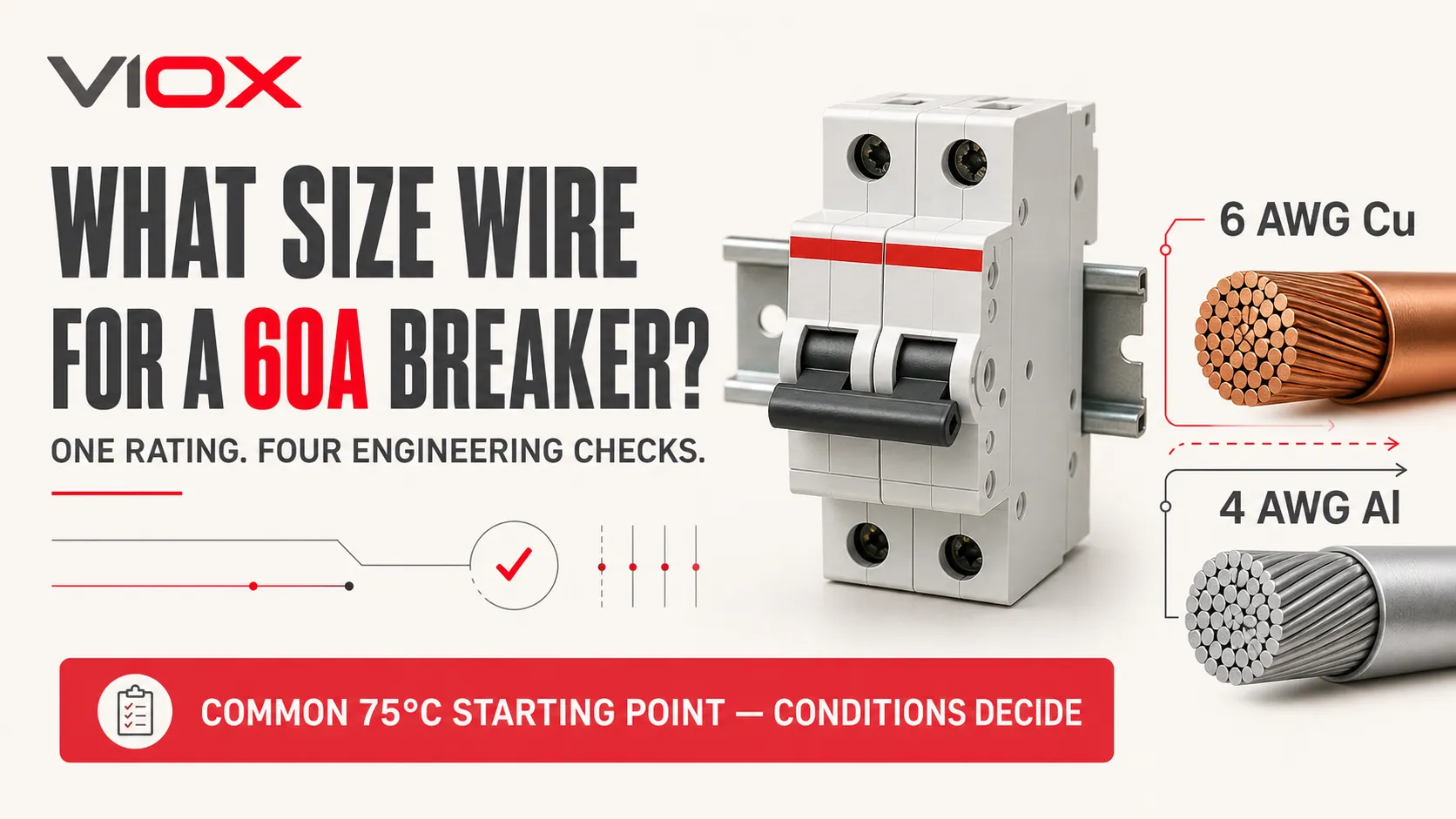
For many 60 amp circuits, use 6 AWG copper or 4 AWG aluminum/copper-clad aluminum when the 75°C ampacity column is permitted. If the installation must use the 60°C column, the starting sizes become 4 AWG copper or 3 AWG aluminum/copper-clad aluminum.
The breaker rating alone does not settle the question. Before choosing the conductor, the design must pass four gates:
- required load ampacity;
- wiring method;
- terminal temperature and material ratings; and
- installation adjustments and voltage drop.
If any gate disqualifies 6 AWG copper, use the size established by the most restrictive condition.
60 Amp Wire Size at a Glance
| Installation basis | Copper starting size | Aluminum/Cu-clad aluminum starting size | What must be true |
|---|---|---|---|
| 75°C ampacity permitted | 6 AWG | 4 AWG | Wiring method and every relevant termination permit 75°C ampacity |
| 60°C ampacity controls | 4 AWG | 3 AWG | Conductor must have at least 60A table ampacity |
| 6 AWG copper NM-B | 55A conductor ampacity | Not applicable to this row | A 60A breaker is conditional; calculated load cannot exceed 55A |
| Conditions require derating or voltage-drop upsizing | Calculate larger size if necessary | Calculate larger size if necessary | Final adjusted ampacity must satisfy the load and equipment requirements |
Key takeaways
6 AWG copperis not a universal 60A answer.- It has 65A ampacity at 75°C but only 55A at 60°C under the table's base conditions.
- Type NM-B uses the 60°C ampacity limitation even though its internal insulation is rated 90°C.
- A 60A breaker can sometimes protect a 55A conductor, but the breaker does not increase that conductor's ampacity.
- A conventional 60A circuit generally supports no more than 48A of continuous load.
The VIOX Four-Gate 60A Conductor Framework
The four gates prevent a common error: selecting wire from the breaker handle marking before establishing what the circuit actually requires.
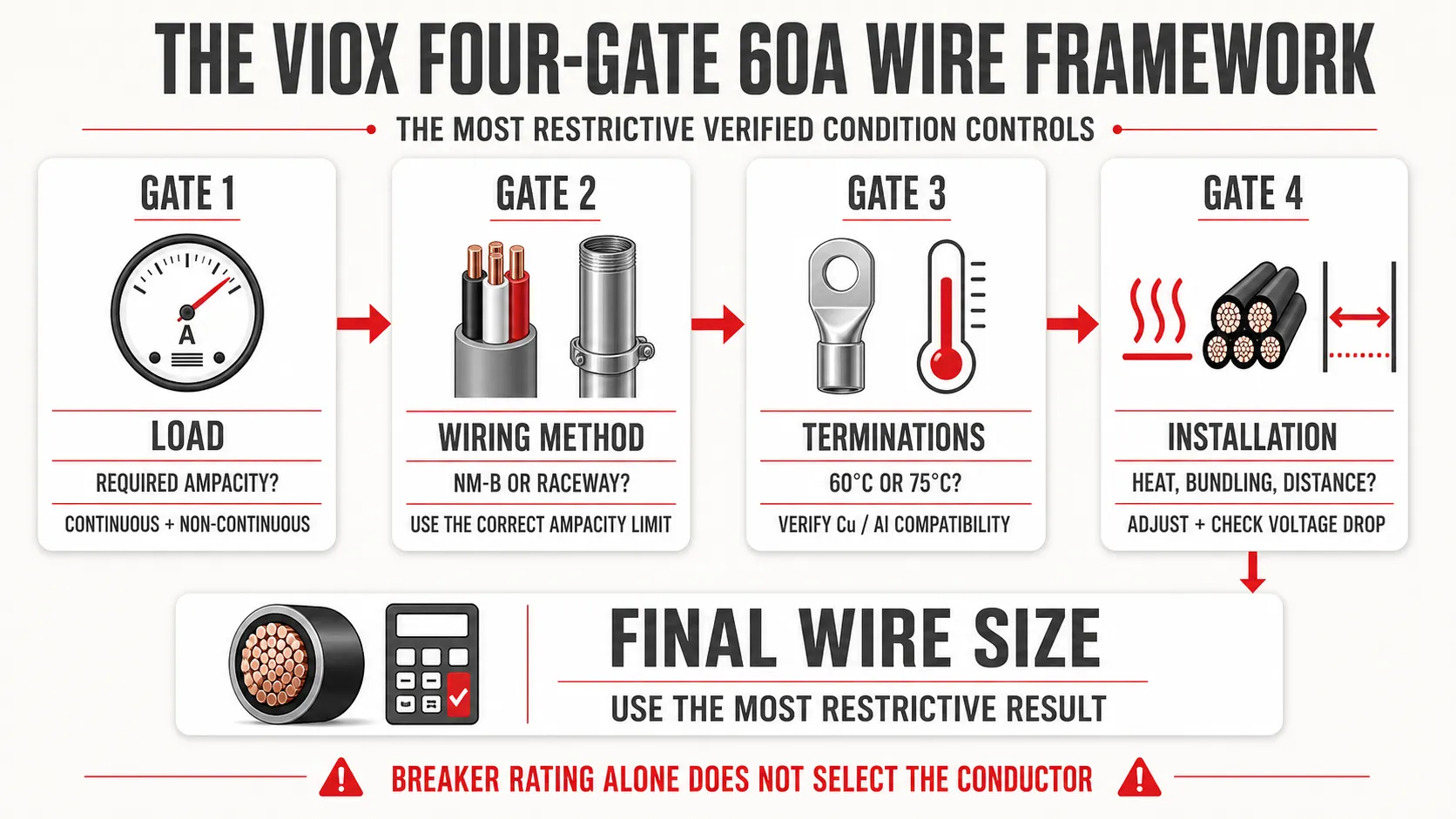
| Gate | Question | Pass condition for 6 AWG copper | If it fails |
|---|---|---|---|
| 1. Load | What ampacity does the calculated load require? | Required conductor ampacity is no more than the permitted ampacity of 6 AWG | Increase conductor size or redesign the circuit |
| 2. Wiring method | Is this NM-B, individual raceway conductors, or another cable system? | The wiring method permits use of the needed ampacity column | Use the ampacity limitation of the actual wiring method |
| 3. Terminations | What temperature and conductor material are marked at both ends? | Every controlling termination permits 75°C copper conductors of this size | Use the lower temperature column or approved conductor material |
| 4. Installation | Do ambient temperature, conductor count, or voltage drop change the result? | Adjusted ampacity remains sufficient and voltage drop is acceptable | Upsize or change the installation method |
The final conductor is not an average of these results. The most restrictive applicable condition controls.
For a broader breaker-to-conductor reference, see the VIOX wire gauge and circuit breaker sizing chart.
Gate 1: Calculate the Required Conductor Ampacity
First determine the load rather than assuming the circuit carries 60A continuously.
For many branch circuits and feeders, conductor ampacity must cover:
Required ampacity = (1.25 × continuous load) + (1.00 × non-continuous load)For a fully continuous load on a conventional 60A circuit:
60 A ÷ 1.25 = 48 AThat is why a 48A continuous load is commonly paired with a 60A circuit. It does not mean every 60A breaker carries a 48A load, nor does it mean every load must be reduced to 80%. The calculation depends on whether the load is continuous and whether equipment-specific rules apply.
Worked Example: Mixed Continuous and Non-Continuous Load
Assume a feeder supplies 32A of continuous load and 12A of non-continuous load:
(32 A × 1.25) + 12 A = 52 AThe conductor therefore needs at least 52A allowable ampacity before considering the wiring method, terminations, adjustment factors, and voltage drop. A 55A conductor could satisfy this load calculation, while a design requiring a full 60A conductor could not use that same 55A value.
If the load has not been established, start with the VIOX guide on how to size a circuit breaker from load and wire size.
Gate 2: Identify the Wiring Method
Two conductors can both be 6 AWG copper and still have different usable ampacity because they belong to different wiring systems.
Individual Conductors in Raceway
Six AWG copper has 65A ampacity in the 75°C column under the ordinary conditions represented by NEC Table 310.16. Appropriately marked individual conductors in a suitable raceway are therefore a common solution when 75°C terminations are available.
The marking still matters. Outdoor and underground raceways are wet locations internally, so the conductor insulation must be listed for the location. THWN-2 or XHHW-2 are common wet-location markings where otherwise suitable.
Type NM-B Cable
Southwire's Type NM-B specification states that NM-B ampacity is limited to the 60°C conductor value. At that temperature:
- 6 AWG copper = 55A
- 4 AWG copper = 70A
Therefore, 6 AWG NM-B is not a 60A conductor. Whether it can be protected by a 60A breaker is a separate question addressed below.
Gate 3: Check the Controlling Temperature Rating
The relevant conductor values are:
| Conductor | 60°C | 75°C | 90°C |
|---|---|---|---|
| 6 AWG copper | 55A | 65A | 75A |
| 4 AWG copper | 70A | 85A | 95A |
| 4 AWG aluminum/Cu-clad aluminum | 55A | 65A | 75A |
| 3 AWG aluminum/Cu-clad aluminum | 65A | 75A | 85A |
These figures are table values under stated base conditions, not automatic permissions for every installation.
Why 90°C Insulation Does Not Mean 90°C Terminations
A THHN/THWN-2 conductor may carry a 90°C insulation marking, but a breaker or equipment lug can be limited to 75°C or 60°C. The conductor's high-temperature rating does not upgrade the terminal.
Where permitted, the 90°C value may be used as the starting point for adjustment or correction calculations. The final allowable ampacity must still remain within the controlling termination and equipment limits.
Aluminum Requires Explicit Terminal Compatibility
Four AWG aluminum/Cu-clad aluminum is a common 75°C starting size for 60A, but only when each connected terminal is approved for that conductor material and size. Do not assume that a lug accepting 4 AWG copper also accepts 4 AWG aluminum.
Follow the equipment instructions for conductor preparation and tightening. A general article cannot supply a universal torque value because torque is terminal-specific.
Can a 60A Breaker Protect 6 AWG NM-B?
Potentially, but only when the next-standard-size rule applies and the calculated load does not exceed the conductor's 55A ampacity.
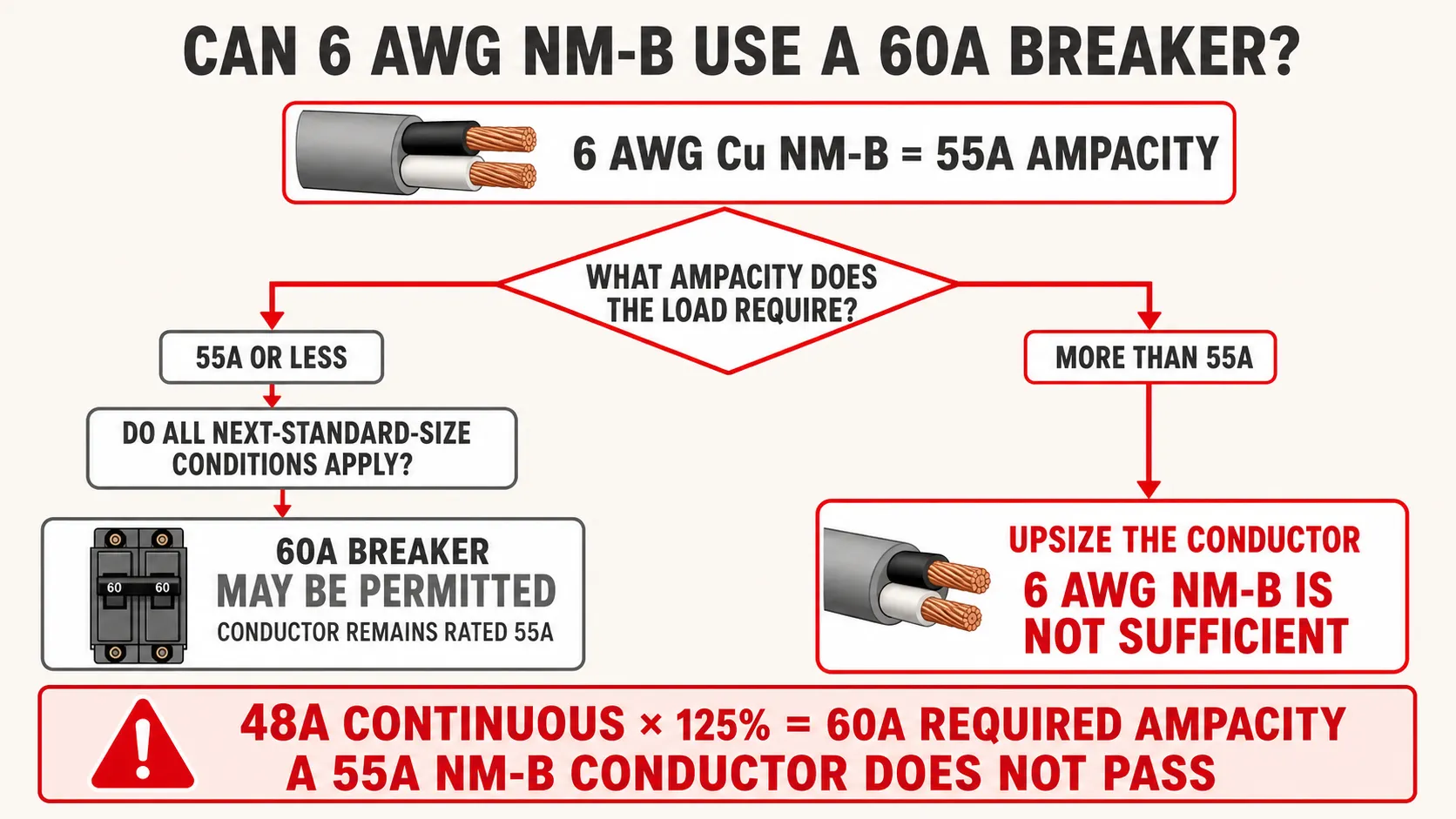
The design must verify that:
- 55A falls between standard overcurrent-device ratings;
- 60A is the next standard rating;
- the overcurrent device does not exceed 800A;
- the circuit and connected equipment do not fall under a rule requiring different protection; and
- the conductor's calculated load remains at or below 55A after applying the relevant load rules.
This is the critical distinction:
The rule may permit a 60A protective device; it does not convert a 55A conductor into a 60A conductor.
Example A: 52A Required Ampacity
The mixed-load calculation above produced a 52A conductor requirement. A 6 AWG NM-B conductor rated 55A could satisfy the ampacity requirement, and a 60A breaker may be considered if every condition of the next-standard-size rule and the connected-equipment rules is met.
Example B: 48A Continuous EVSE
A 48A continuous load requires:
48 A × 1.25 = 60 AA 55A NM-B conductor does not satisfy a 60A conductor requirement. The next-standard-size rule does not erase that shortfall.
As a product-specific check, Tesla's Universal Wall Connector instructions distinguish between terminal ratings: they specify at least 6 AWG, 90°C THWN-2 copper with a 75°C-rated breaker, and at least 4 AWG copper with a 60°C-rated breaker. The equipment accepts copper conductors only. This example illustrates the method; it is not a universal specification for every electric vehicle supply equipment (EVSE) product.
Gate 4: Verify the Installation Conditions
Even after a conductor passes the first three gates, the installation can require a larger size.
Ambient Temperature
High ambient temperature can reduce allowable ampacity. This matters in rooftop raceways, hot mechanical spaces, and locations near heat-producing equipment.
Number of Current-Carrying Conductors
More than three current-carrying conductors in a raceway or cable can trigger an adjustment factor. A neutral may or may not count depending on how it carries current, including harmonic current from nonlinear loads.
Voltage Drop
Length does not reduce base ampacity, but it increases voltage drop. Calculate voltage drop from actual load current, one-way length, conductor material, system voltage, and the project limit.
Do not use a fixed statement such as “upgrade after 50 feet.” At the same current and conductor length, a given voltage loss represents twice the percentage on a 120V circuit that it represents on a 240V circuit.
Equipment-Specific Rules
Stop using the general table when the equipment establishes a different selection method. HVAC nameplates can provide Minimum Circuit Ampacity (MCA) and Maximum Overcurrent Protection (MOCP). Motor circuits separately coordinate conductor ampacity, overload protection, and short-circuit/ground-fault protection.
These are not exceptions to hide in a generic 60A chart; they are separate design intents requiring their own equipment-based calculation.
60A Conductor Selection Worksheet
Complete this worksheet before ordering conductor:
| Input | Project value | Verification source |
|---|---|---|
| Continuous load | ____ A | Load calculation / equipment data |
| Non-continuous load | ____ A | Load calculation |
| Required ampacity | ____ A | 125% continuous + 100% non-continuous or applicable equipment rule |
| Conductor material | Copper / Aluminum / Cu-clad aluminum | Equipment terminal markings |
| Wiring method | __________ | Plans and installation conditions |
| Controlling terminal rating | 60°C / 75°C / other | Breaker, disconnect, splice, and equipment markings |
| Base table ampacity | ____ A | Adopted code table |
| Adjustment/correction result | ____ A | Ambient and conductor-count calculation |
| Voltage-drop result | ____ % | Project calculation |
| Equipment-specific requirement | __________ | Nameplate and installation manual |
| Final conductor size | __________ | Most restrictive verified result |
If any input is unknown, the conductor selection is not complete.
Final Answer
For a conventional 60A circuit that permits 75°C ampacity, use 6 AWG copper or 4 AWG aluminum/Cu-clad aluminum as the normal starting point. When the 60°C column controls, use 4 AWG copper or 3 AWG aluminum/Cu-clad aluminum as the starting point.
Then pass the selection through the four gates: load, wiring method, terminations, and installation conditions. This is especially important for 6 AWG NM-B: it is a 55A conductor under the 60°C column. A 60A breaker may be permitted in a qualifying application, but the connected load must still fit within the conductor's actual ampacity.
Frequently Asked Questions
Is 6 AWG copper enough for a 60 amp breaker?
It is commonly sufficient when the 75°C column is permitted, the controlling terminations are rated 75°C, the wiring method is suitable, and the adjusted ampacity remains adequate. It is not a universal answer for all 6 AWG cable types.
Is 4 AWG copper required for every 60 amp circuit?
No. Four AWG copper is the relevant starting size when 60°C ampacity controls or when load, adjustment, voltage-drop, or equipment requirements exceed what 6 AWG can provide. Six AWG copper is a common choice under qualifying 75°C conditions.
Can 6/3 NM-B be connected to a 60 amp breaker?
Only conditionally. Six AWG copper NM-B is limited to 55A ampacity. A 60A breaker may be permitted under the next-standard-size rule when every condition is met and the calculated load does not exceed 55A. It cannot supply a load requiring 60A conductor ampacity.
What size aluminum wire is used with a 60 amp breaker?
Four AWG aluminum/Cu-clad aluminum is a common 75°C starting size. If the 60°C column controls, 3 AWG is the relevant starting size. Every termination must be marked for the selected material and conductor size.
Can 8 AWG copper be used on a 60 amp breaker?
Not as a general-purpose 60A conductor under the standard ampacity table. Equipment-specific HVAC or motor rules must be evaluated separately and should not be generalized to ordinary branch circuits or feeders.
What equipment grounding conductor is commonly used with a 60A breaker?
Where a wire-type equipment grounding conductor is sized from a 60A overcurrent device, common minimums are 10 AWG copper or 8 AWG aluminum/Cu-clad aluminum. Verify the applicable grounding method, conductor upsizing rules, equipment instructions, and local amendments.
Does a long 60 amp run automatically require 4 AWG copper?
No fixed distance creates that requirement. Calculate voltage drop using actual load current, voltage, one-way length, and conductor material. Upsize when the calculation or connected equipment requires it.
Technical References
- NFPA 70, National Electrical Code: Articles 110, 210, 215, 240, 250, 310, and the equipment-specific article applicable to the connected load. Use the edition adopted by the local jurisdiction.
- Southwire Type NM-B Cable Specification
- Cerrowire Ampacity Charts
- Tesla Universal Wall Connector: Breaker and Conductor Requirements