

Sur cette page
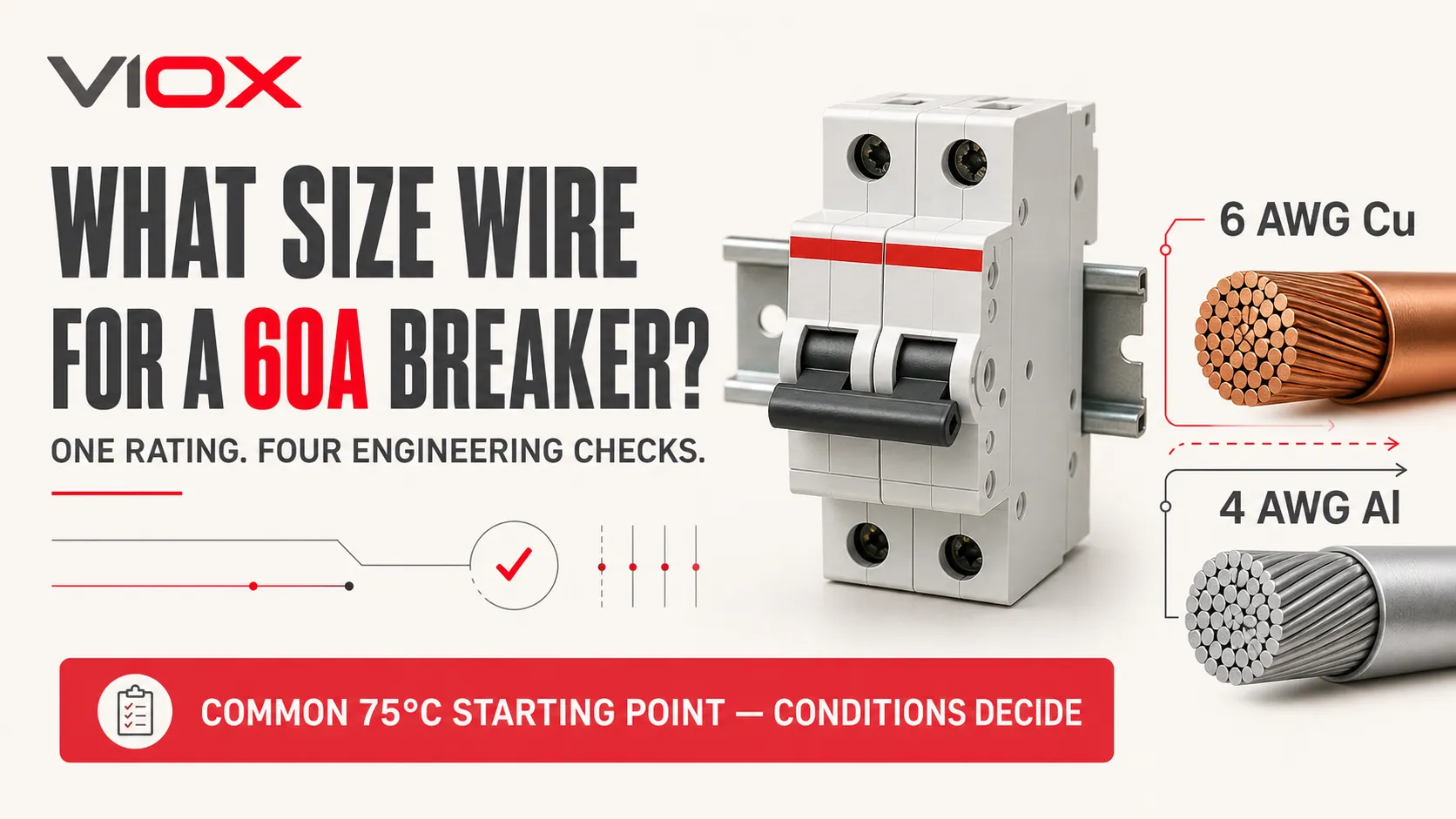
Pour de nombreux circuits de 60 A, utilisez Cuivre de calibre 6 AWG ou 4 AWG aluminium/aluminium plaqué cuivre lorsque la colonne d'ampacité à 75°C est autorisée. Si l'installation doit utiliser la colonne à 60°C, les sections minimales deviennent 4 AWG cuivre ou 3 AWG aluminium/aluminium plaqué cuivre.
Le calibre du disjoncteur seul ne suffit pas à trancher la question. Avant de choisir le conducteur, la conception doit franchir quatre étapes :
- l'ampacité de charge requise ;
- méthode de câblage ;
- températures nominales des bornes et matériaux ; et
- ajustements d'installation et chute de tension.
Si une condition disqualifie le cuivre 6 AWG, utilisez la section établie par la contrainte la plus restrictive.
Aperçu de la section de câble pour 60 Ampères
| Base d'installation | Section initiale pour le cuivre | Section initiale pour l'aluminium/aluminium plaqué cuivre | Ce qui doit être vrai |
|---|---|---|---|
| Intensité admissible à 75°C autorisée | 6 AWG | 4 AWG | La méthode de câblage et chaque raccordement pertinent permettent une intensité admissible à 75°C |
| L'intensité admissible à 60°C prévaut | 4 AWG | 3 AWG | Le conducteur doit avoir une intensité admissible d'au moins 60 A selon le tableau |
| Câble NM-B en cuivre de calibre 6 AWG | Intensité admissible du conducteur de 55 A | Non applicable à cette ligne | Un disjoncteur de 60 A est conditionnel ; la charge calculée ne peut excéder 55 A |
| Les conditions imposent un déclassement ou une augmentation de la section pour compenser la chute de tension | Calculer une section supérieure si nécessaire | Calculer une section supérieure si nécessaire | L'ampacité ajustée finale doit satisfaire aux exigences de la charge et de l'équipement |
Principaux points à retenir
Cuivre de calibre 6 AWGn'est pas une réponse universelle pour 60 A.- Il présente une ampacité de 65 A à 75 °C, mais seulement 55 A à 60 °C selon les conditions de base du tableau.
- Le câble de type NM-B utilise la limite d'ampacité à 60 °C bien que son isolation interne soit classée pour 90 °C.
- Un disjoncteur de 60 A peut parfois protéger un conducteur de 55 A, mais le disjoncteur n'augmente pas l'ampacité de ce conducteur.
- Un circuit conventionnel de 60 A supporte généralement une charge continue ne dépassant pas 48 A.
Le cadre de conducteur VIOX à quatre portes de 60 A
Les quatre portes permettent d'éviter une erreur courante : choisir le calibre du fil en se basant sur le marquage de la poignée du disjoncteur avant d'avoir déterminé les besoins réels du circuit.
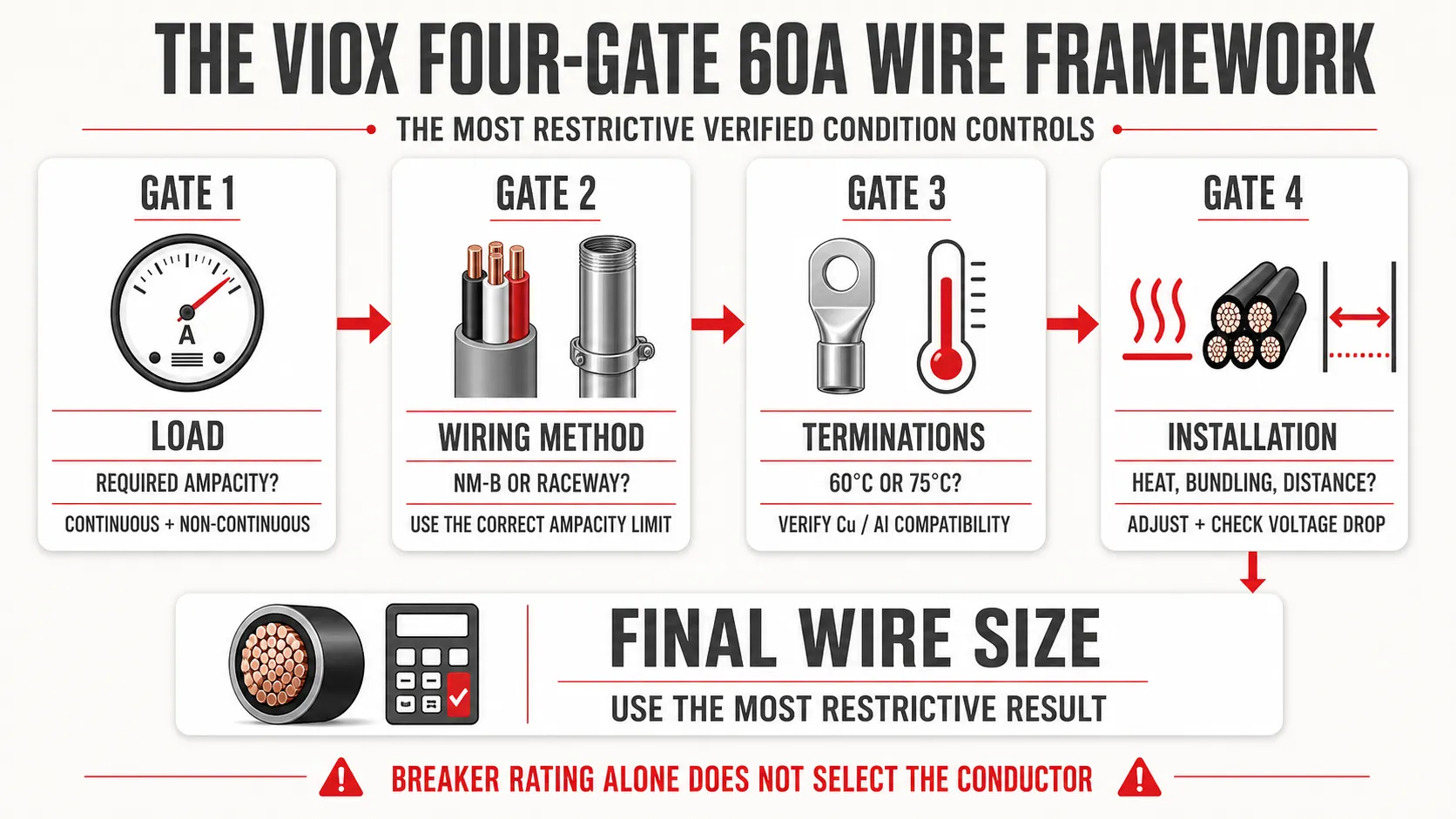
| Porte | Question | Condition de réussite pour du cuivre 6 AWG | En cas d'échec |
|---|---|---|---|
| 1. Charge | Quelle est l'ampacité requise par la charge calculée ? | L'ampacité requise du conducteur n'excède pas l'ampacité admissible du 6 AWG | Augmenter la section du conducteur ou revoir la conception du circuit |
| 2. Méthode de câblage | S'agit-il de câble NM-B, de conducteurs individuels sous conduit ou d'un autre système de câblage ? | La méthode de câblage permet l'utilisation de la colonne d'ampacité nécessaire | Utiliser la limitation d'ampacité propre à la méthode de câblage réelle |
| 3. Raccordements | Quelles sont la température et le matériau du conducteur indiqués aux deux extrémités ? | Chaque borne de contrôle autorise des conducteurs en cuivre de cette section à 75°C | Utilisez la colonne de température inférieure ou le matériau de conducteur approuvé |
| 4. Installation | La température ambiante, le nombre de conducteurs ou la chute de tension modifient-ils le résultat ? | L'intensité admissible ajustée reste suffisante et la chute de tension est acceptable | Augmentez la section ou modifiez la méthode d'installation |
Le conducteur final n'est pas une moyenne de ces résultats. La condition applicable la plus restrictive prévaut.
Pour une référence plus large sur la relation disjoncteur-conducteur, voir le VIOX tableau de dimensionnement des câbles et des disjoncteurs.
Étape 1 : Calculer l'ampacité requise du conducteur
Déterminez d'abord la charge plutôt que de supposer que le circuit transporte 60 A en continu.
Pour de nombreux circuits dérivés et alimentations, l'ampacité du conducteur doit couvrir :
Ampacité requise = (1,25 × charge continue) + (1,00 × charge non continue)Pour une charge entièrement continue sur un circuit conventionnel de 60 A :
60 A ÷ 1,25 = 48 AC'est pourquoi une charge continue de 48 A est généralement associée à un circuit de 60 A. Cela ne pas signifie pas que chaque disjoncteur de 60 A supporte une charge de 48 A, ni que chaque charge doit être réduite à 80 %. Le calcul dépend du caractère continu de la charge et de l'application de règles spécifiques à l'équipement.
Exemple pratique : Charge mixte continue et non continue
Supposons qu'une alimentation fournisse 32 A de charge continue et 12 A de charge non continue :
(32 A × 1,25) + 12 A = 52 ALe conducteur doit donc avoir une capacité admissible d'au moins 52 A avant de prendre en compte la méthode de câblage, les terminaisons, les facteurs de correction et la chute de tension. Un conducteur de 55 A pourrait satisfaire ce calcul de charge, alors qu'une conception nécessitant un conducteur de 60 A complet ne pourrait pas utiliser cette même valeur de 55 A.
Si la charge n'a pas été établie, commencez par le guide VIOX sur la manière de dimensionner un disjoncteur en fonction de la charge et de la section du conducteur.
Étape 2 : Identifier la méthode de câblage
Deux conducteurs peuvent être tous deux en cuivre de calibre 6 AWG et avoir pourtant une intensité admissible différente car ils appartiennent à des systèmes de câblage distincts.
Conducteurs individuels sous conduit
Le cuivre de calibre 6 AWG possède une intensité admissible de 65 A dans la colonne 75 °C selon les conditions ordinaires représentées par le tableau 310.16 du NEC. Les conducteurs individuels correctement marqués dans un conduit approprié constituent donc une solution courante lorsque des terminaisons à 75 °C sont disponibles.
Le marquage reste important. Les conduits extérieurs et souterrains sont des emplacements humides à l'intérieur ; l'isolant du conducteur doit donc être homologué pour cet emplacement. THWN-2 ou XHHW-2 sont des marquages courants pour les emplacements humides lorsqu'ils sont appropriés.
Câble de type NM-B
La spécification du câble de type NM-B de Southwire stipule que l'intensité admissible du NM-B est limitée à la valeur du conducteur à 60 °C. À cette température :
- Cuivre 6 AWG = 55 A
- Cuivre 4 AWG = 70 A
Par conséquent, le câble NM-B 6 AWG n'est pas un conducteur de 60 A. La question de savoir s'il peut être protégé par un disjoncteur de 60 A est une question distincte traitée ci-dessous.
Étape 3 : Vérifier la température nominale de service
Les valeurs pertinentes pour les conducteurs sont :
| Chef d'orchestre | 60°C | 75°C | 90°C |
|---|---|---|---|
| Cuivre de calibre 6 AWG | 55A | 65A | 75A |
| 4 AWG cuivre | 70A | 85A | 95A |
| Aluminium 4 AWG / Aluminium recouvert de cuivre | 55A | 65A | 75A |
| Aluminium 3 AWG / Aluminium recouvert de cuivre | 65A | 75A | 85A |
Ces chiffres sont des valeurs tabulées dans des conditions de base définies, et ne constituent pas des autorisations automatiques pour chaque installation.
Pourquoi une isolation à 90°C ne signifie pas des bornes à 90°C
Un conducteur THHN/THWN-2 peut porter un marquage d'isolation à 90°C, mais un disjoncteur ou une cosse d'équipement peut être limité à 75°C ou 60°C. La température nominale élevée du conducteur ne rehausse pas la limite de la borne.
Lorsque cela est autorisé, la valeur de 90°C peut être utilisée comme point de départ pour les calculs d'ajustement ou de correction. L'ampacité admissible finale doit toujours rester dans les limites de la borne et de l'équipement.
L'aluminium nécessite une compatibilité explicite des bornes
Le calibre 4 AWG en aluminium/aluminium plaqué cuivre est une taille de départ courante à 75°C pour 60A, mais uniquement lorsque chaque borne connectée est approuvée pour ce matériau et cette taille de conducteur. Ne présumez pas qu'une cosse acceptant du cuivre 4 AWG accepte également de l'aluminium 4 AWG.
Suivez les instructions de l'équipement pour la préparation et le serrage des conducteurs. Un article général ne peut pas fournir une valeur de couple universelle, car le couple est spécifique à chaque borne.
Un disjoncteur de 60A peut-il protéger du câble NM-B de 6 AWG ?
Potentiellement, mais uniquement lorsque la règle de la taille standard supérieure s'applique et que la charge calculée ne dépasse pas l'ampacité de 55A du conducteur.
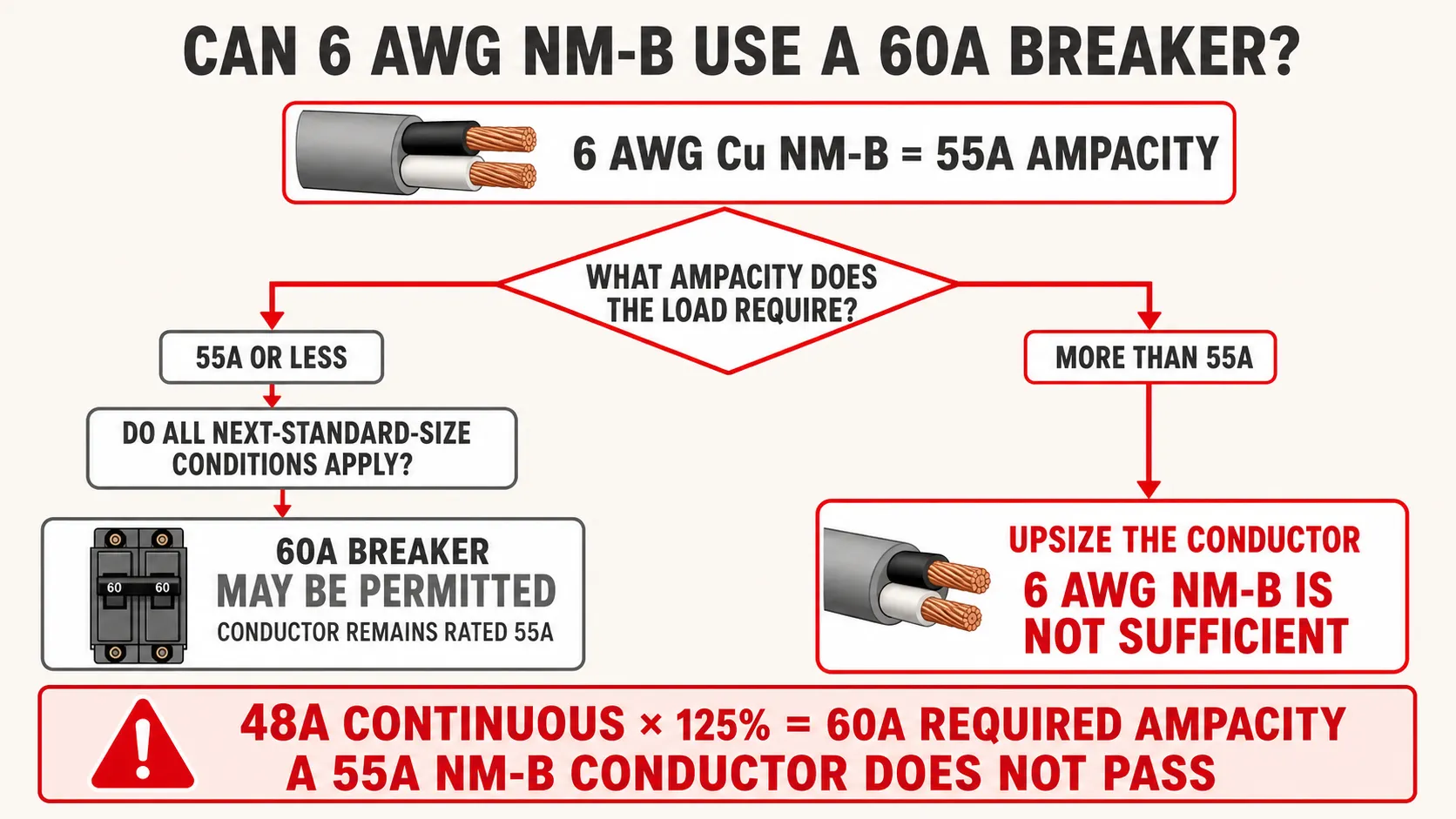
La conception doit vérifier que :
- 55 A se situe entre les calibres standard des dispositifs de protection contre les surintensités ;
- 60 A est le calibre standard immédiatement supérieur ;
- le dispositif de protection contre les surintensités ne dépasse pas 800 A ;
- le circuit et l'équipement raccordé ne sont pas soumis à une règle exigeant une protection différente ; et
- la charge calculée du conducteur reste égale ou inférieure à 55 A après application des règles de charge pertinentes.
Voici la distinction essentielle :
La règle peut autoriser un dispositif de protection de 60 A ; elle ne transforme pas un conducteur de 55 A en un conducteur de 60 A.
Exemple A : Intensité admissible requise de 52 A
Le calcul de charge mixte ci-dessus a abouti à une exigence de conducteur de 52 A. Un conducteur NM-B de calibre 6 AWG évalué à 55 A pourrait satisfaire à l'exigence d'intensité admissible, et un disjoncteur de 60 A peut être envisagé si toutes les conditions de la règle du calibre normalisé supérieur et des règles relatives aux équipements connectés sont remplies.
Exemple B : EVSE à charge continue de 48 A
Une charge continue de 48 A nécessite :
48 A × 1,25 = 60 AUn conducteur NM-B de 55 A ne satisfait pas à une exigence de conducteur de 60 A. La règle du calibre normalisé supérieur ne compense pas ce déficit.
À titre de vérification spécifique au produit, les instructions du connecteur mural universel de Tesla distinguent les valeurs nominales des bornes : elles spécifient au minimum du cuivre THWN-2 de 6 AWG à 90 °C avec un disjoncteur classé à 75 °C, et au minimum du cuivre de 4 AWG avec un disjoncteur classé à 60 °C. L'équipement accepte uniquement des conducteurs en cuivre. Cet exemple illustre la méthode ; il ne s'agit pas d'une spécification universelle pour tous les produits d'équipement d'alimentation pour véhicules électriques (EVSE).
Étape 4 : Vérifier les conditions d'installation
Même après qu'un conducteur a passé les trois premières étapes, l'installation peut nécessiter une section plus importante.
Température ambiante
Une température ambiante élevée peut réduire l'ampacité admissible. Cela est important dans les chemins de câbles en toiture, les locaux techniques chauds et les emplacements proches d'équipements dégageant de la chaleur.
Nombre de conducteurs transportant du courant
Plus de trois conducteurs actifs dans un chemin de câbles ou un câble peuvent déclencher un facteur de correction. Un neutre peut être compté ou non selon la manière dont il transporte le courant, y compris le courant harmonique provenant de charges non linéaires.
Chute de tension
La longueur ne réduit pas l'ampacité de base, mais elle augmente la chute de tension. Calculez la chute de tension à partir du courant de charge réel, de la longueur unidirectionnelle, du matériau du conducteur, de la tension du système et de la limite du projet.
N'utilisez pas d'affirmation fixe telle que “ augmenter la section après 50 pieds ”. À courant et longueur de conducteur identiques, une perte de tension donnée représente deux fois le pourcentage sur un circuit 120V par rapport à un circuit 240V.
Règles spécifiques aux équipements
Cessez d'utiliser le tableau général lorsque l'équipement établit une méthode de sélection différente. Les plaques signalétiques des systèmes CVC peuvent fournir l'ampacité minimale du circuit (MCA) et la protection maximale contre les surintensités (MOCP). Les circuits de moteurs coordonnent séparément l'ampacité du conducteur, la protection contre les surcharges et la protection contre les courts-circuits/défauts à la terre.
Il ne s'agit pas d'exceptions à masquer dans un tableau générique de 60 A ; ce sont des intentions de conception distinctes nécessitant leur propre calcul basé sur l'équipement.
Fiche de sélection des conducteurs 60 A
Remplissez cette fiche avant de commander les conducteurs :
| Entrée | Valeur du projet | Source de vérification |
|---|---|---|
| La charge continue | ____ A | Calcul de charge / données de l'équipement |
| Charge non continue | ____ A | Calcul de la charge |
| Intensité admissible requise | ____ A | 125 % continu + 100 % non continu ou règle applicable à l'équipement |
| Matériau conducteur | Cuivre / Aluminium / Aluminium recouvert de cuivre | Marquages des bornes de l'équipement |
| Méthode de câblage | __________ | Plans et conditions d'installation |
| Calibre de la borne de contrôle | 60 °C / 75 °C / autre | Marquages des disjoncteurs, sectionneurs, épissures et équipements |
| Ampacité de base du tableau | ____ A | Tableau du code adopté |
| Résultat d'ajustement/correction | ____ A | Calcul de la température ambiante et du nombre de conducteurs |
| Résultat de la chute de tension | ____ % | Calcul du projet |
| Exigence spécifique à l'équipement | __________ | Plaque signalétique et manuel d'installation |
| Section finale du conducteur | __________ | Résultat vérifié le plus restrictif |
Si une donnée d'entrée est inconnue, la sélection du conducteur n'est pas complète.
Réponse finale
Pour un circuit conventionnel de 60 A autorisant une capacité de courant à 75 °C, utilisez Cuivre de calibre 6 AWG ou Aluminium 4 AWG / Aluminium recouvert de cuivre comme point de départ normal. Lorsque la colonne 60 °C prévaut, utilisez 4 AWG cuivre ou Aluminium 3 AWG / Aluminium recouvert de cuivre comme point de départ.
Soumettez ensuite la sélection aux quatre filtres : charge, méthode de câblage, terminaisons et conditions d'installation. Ceci est particulièrement important pour le câble NM-B de 6 AWG : il s'agit d'un conducteur de 55 A selon la colonne 60 °C. Un disjoncteur de 60 A peut être autorisé dans une application admissible, mais la charge connectée doit toujours respecter la capacité de courant réelle du conducteur.
Foire Aux Questions
Un conducteur en cuivre de 6 AWG est-il suffisant pour un disjoncteur de 60 ampères ?
C'est généralement suffisant lorsque la colonne 75°C est autorisée, que les bornes de raccordement sont certifiées pour 75°C, que la méthode de câblage est appropriée et que l'ampacité ajustée reste adéquate. Ce n'est pas une réponse universelle pour tous les types de câbles 6 AWG.
Un conducteur en cuivre de 4 AWG est-il requis pour chaque circuit de 60 ampères ?
Non. Le cuivre 4 AWG est la taille de départ pertinente lorsque l'ampacité à 60°C s'applique ou lorsque la charge, les facteurs de correction, la chute de tension ou les exigences de l'équipement dépassent ce que le 6 AWG peut fournir. Le cuivre 6 AWG est un choix courant dans les conditions admissibles à 75°C.
Un câble NM-B 6/3 peut-il être raccordé à un disjoncteur de 60 ampères ?
Uniquement sous conditions. Le cuivre NM-B 6 AWG est limité à une ampacité de 55A. Un disjoncteur de 60A peut être autorisé selon la règle de la taille standard supérieure lorsque toutes les conditions sont remplies et que la charge calculée ne dépasse pas 55A. Il ne peut pas alimenter une charge nécessitant une ampacité de conducteur de 60A.
Quelle taille de fil en aluminium est utilisée avec un disjoncteur de 60 ampères ?
L'aluminium ou l'aluminium plaqué cuivre 4 AWG est une taille de départ courante à 75°C. Si la colonne 60°C s'applique, le 3 AWG est la taille de départ pertinente. Chaque borne de raccordement doit être marquée pour le matériau et la taille de conducteur sélectionnés.
Le cuivre 8 AWG peut-il être utilisé sur un disjoncteur de 60 ampères ?
Pas en tant que conducteur à usage général de 60 A selon le tableau standard de capacité de courant. Les règles spécifiques aux équipements CVC ou aux moteurs doivent être évaluées séparément et ne doivent pas être généralisées aux circuits de dérivation ou aux alimentateurs ordinaires.
Quel conducteur de mise à la terre de l'équipement est couramment utilisé avec un disjoncteur de 60 A ?
Lorsqu'un conducteur de mise à la terre de type fil est dimensionné à partir d'un dispositif de protection contre les surintensités de 60 A, les minimums courants sont du 10 AWG en cuivre ou du 8 AWG en aluminium/aluminium plaqué cuivre. Vérifiez la méthode de mise à la terre applicable, les règles de surdimensionnement des conducteurs, les instructions de l'équipement et les amendements locaux.
Une longue ligne de 60 ampères nécessite-t-elle automatiquement du cuivre 4 AWG ?
Aucune distance fixe ne crée cette exigence. Calculez la chute de tension en utilisant le courant de charge réel, la tension, la longueur à sens unique et le matériau du conducteur. Augmentez la section lorsque le calcul ou l'équipement connecté l'exige.
Références techniques
- NFPA 70, National Electrical Code : Articles 110, 210, 215, 240, 250, 310, et l'article spécifique à l'équipement applicable à la charge connectée. Utilisez l'édition adoptée par la juridiction locale.
- Spécification du câble Southwire de type NM-B
- Tableaux d'ampacité Cerrowire
- Connecteur mural universel Tesla : exigences relatives aux disjoncteurs et aux conducteurs