On this page
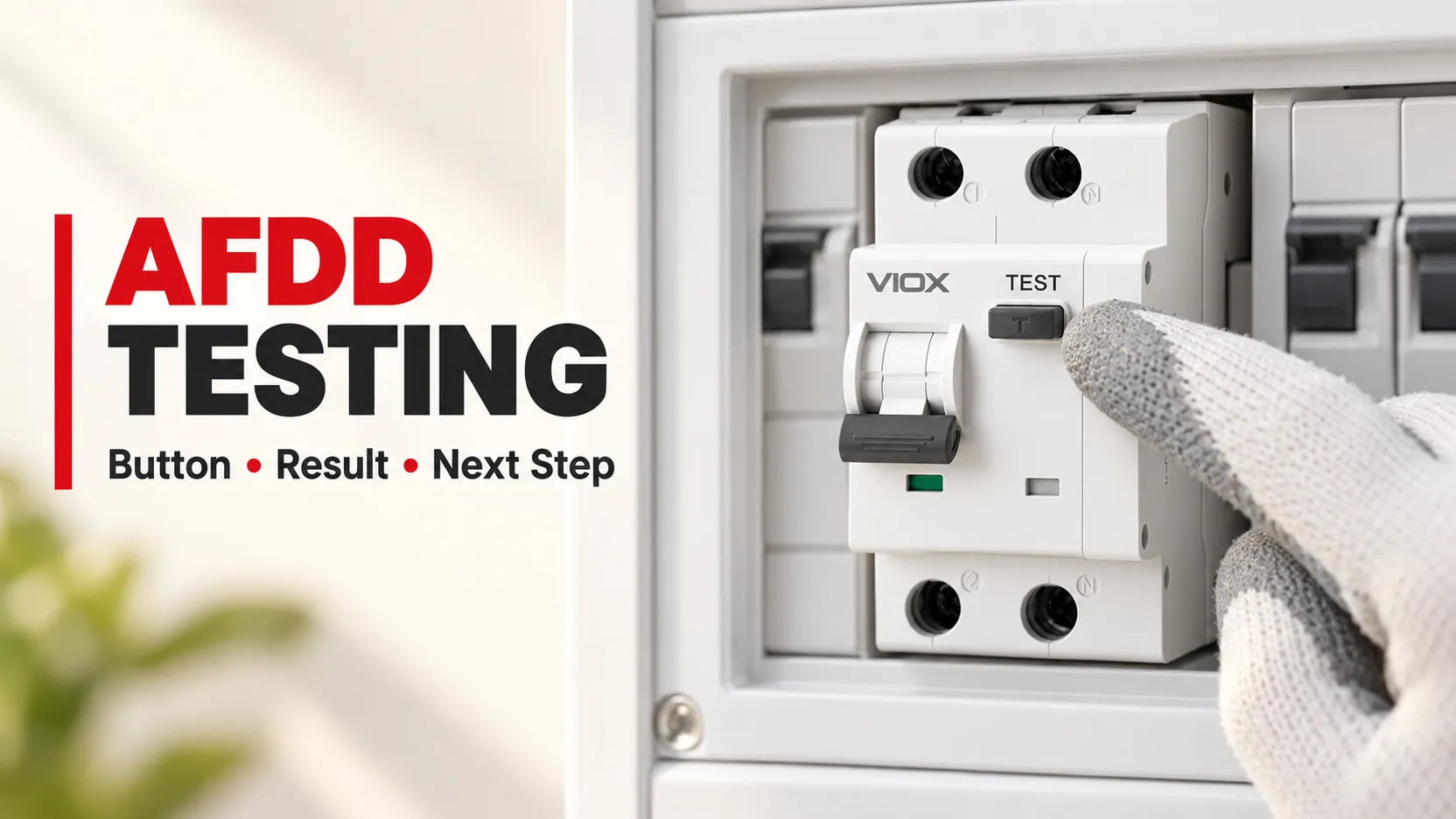
To test an Arc Fault Detection Device (AFDD), first identify the exact device and read its current instructions. Warn users that the protected circuit may lose power, put the device and circuit in the condition specified by the manufacturer, operate the test control exactly as directed, verify the declared response, and reset the device only as instructed.
If the AFDD does not respond as documented, will not reset, trips again, or shows unusual heat, odor, sound, or physical damage, stop and arrange investigation by a competent electrical professional. Do not create sparks or improvise an arc to test the device.
Key Takeaways
- The model instructions—not a generic color code or universal countdown—define the correct test conditions and expected result.
- A manual test commonly checks an internal test path and the device’s ability to open the circuit, but it does not reproduce every IEC 62606 product test or prove that the wiring is fault-free.
- Test frequency depends on the manufacturer and applicable installation rules. As a UK example, the current IET model-form guidance gives a six-monthly interval for an AFDD with a manual test facility and directs users to the manufacturer when manual and automatic test functions are both present.
- A failed test, failed reset, repeat trip, or abnormal physical condition needs investigation. It does not by itself identify the cause.
- An integrated AFDD + RCBO contains distinct protection functions. Do not assume one button or one result verifies every function unless the exact instructions say so.
For a wider explanation of arc-fault protection, start with what an AFDD is and how it works.
Before You Press the Test Button
Testing may disconnect everything on the protected circuit. A short preparation check avoids data loss, unexpected equipment shutdown, or interruption of a critical load.
| Check | What to establish | Stop or escalate when |
|---|---|---|
| Exact device | Manufacturer, model, protection functions, and current instruction sheet | The device cannot be identified or its test control is unclear |
| Affected circuit | Which lights, sockets, controls, alarms, refrigeration, IT equipment, or other loads will lose power | Loss of supply could create a safety or process risk |
| Test conditions | Whether the instructions require the device energized, switched on, unloaded, or in another stated condition | The required condition cannot be established safely |
| Visible condition | Exterior is intact, dry, normally mounted, and free of obvious discoloration or damage | There is heat, burning odor, noise, moisture, cracking, melting, or exposed live parts |
| Restoration plan | How the device is reset and how normal supply will be confirmed | Restoration requires opening the enclosure or accessing conductors |
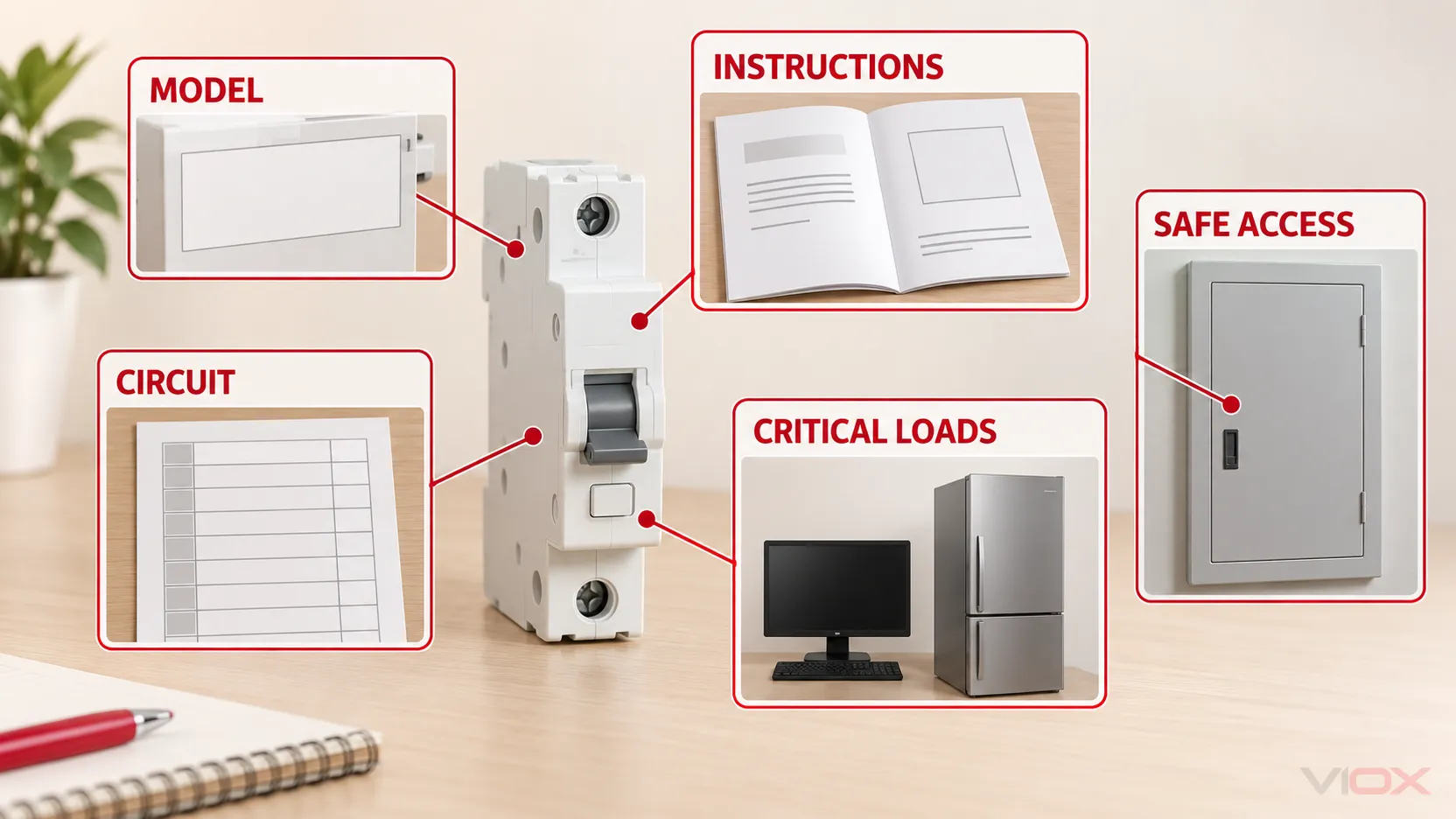
Save computer work and notify affected people before the test. Do not remove the distribution-board cover, touch terminals, tighten connections, or carry out energized measurements as part of a routine button check.
Not every AFDD has the same controls. Some products integrate overcurrent and residual-current protection, while others use a different construction arrangement. IEC 62606 recognizes multiple ways to provide the arc-fault detection function, so appearance alone cannot establish what a particular control tests. The IEC 62606 AFDD standard guide explains these construction boundaries.
AFDD Test-Button Procedure
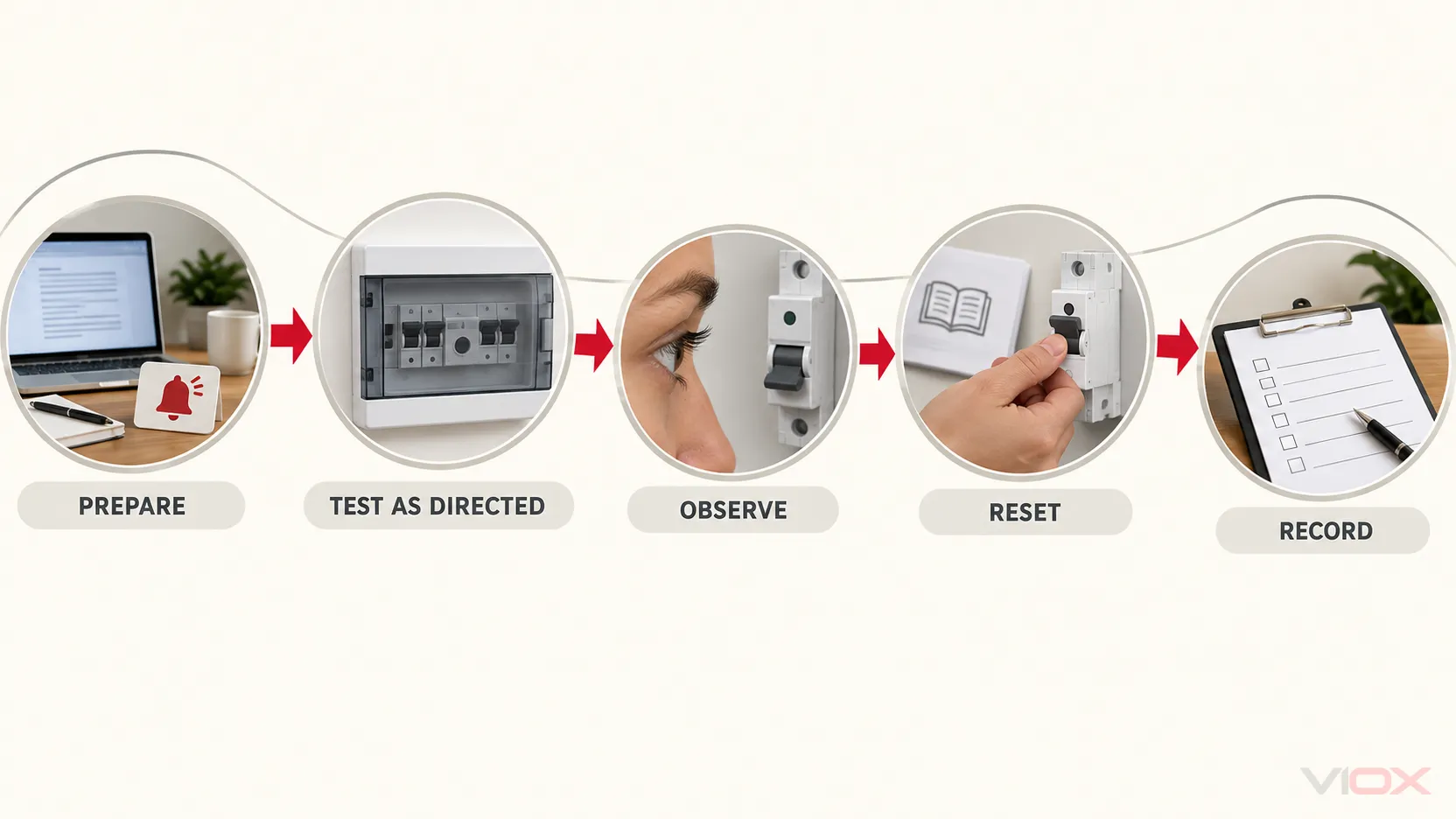
Use this sequence as a control framework. Where the exact instruction sheet differs, the model instructions take priority.
1. Record the Starting Condition
Note the circuit identification, device position, visible indicator state, and any previous trip information. If the device provides a trip-memory indication, preserve it before operating controls because resetting may clear useful diagnostic evidence.
2. Prepare for the Expected Power Interruption
Shut down affected equipment in its normal manner. Confirm that no critical service depends on the circuit during the test. Make sure adequate lighting and safe access remain available if a lighting circuit will be disconnected.
3. Put the Device in the Required Test Condition
Follow the exact instruction sheet. It may specify whether supply voltage is required and which handle position or load condition applies. Do not copy a press duration, indicator sequence, or operating condition from a different AFDD.
4. Operate the Test Control as Directed
Press or hold the control only for the method and duration stated by the manufacturer. Do not repeatedly operate a control that produces no documented response, and never test by deliberately making an electrical arc.
5. Compare the Response with the Instructions
Check whether the switching mechanism, handle position, indicator, or other declared result matches the device documentation. Avoid generic statements such as “green means normal” or “red means arc fault”: indicator behavior is model-specific.
6. Reset and Restore the Circuit
Reset the device only by its documented method. Restore affected equipment deliberately, then confirm that the expected circuit supply has returned. If the AFDD will not reset or trips again, do not keep forcing it on.
7. Record the Outcome
Record the date, device and circuit, test method, observed result, restoration status, and any abnormal condition. A simple record makes repeated symptoms and later professional investigation easier to interpret.
AFDD Test Results: What to Do Next
The useful output of a button test is not merely “pass” or “fail.” It is a documented observation connected to a safe next action.
| Observed result | What it may establish | What it does not establish | Next action |
|---|---|---|---|
| Device responds and resets as documented | The declared manual test path and opening/restoration sequence responded under the test conditions | That every arc will be detected, the wiring is sound, every integrated protection function passed, or the installation complies | Record the result and follow the specified future test interval |
| No documented response | Test conditions may be wrong, supply may be absent, the wrong control may have been used, or the device/test path may need attention | The device is definitely defective | Stop repeated attempts, check the exact instructions, and seek competent advice if the cause is not obvious without opening the enclosure |
| Device operates but will not reset | A fault, connected load, supply condition, wiring issue, device state, or internal problem may remain | That an arc fault is the confirmed cause | Leave the circuit in a safe state and arrange investigation |
| Device resets and trips again | A connected load, circuit condition, loose or damaged connection, supply/neutral issue, application mismatch, or device problem may be involved | That the trip is “nuisance,” or that the AFDD is faulty | Preserve the trip indication and event details; do not repeatedly reset; arrange systematic diagnosis |
| Indicator differs from the manual | The device has presented an undocumented or misunderstood state | A universal meaning based on color alone | Photograph or record the pattern and consult the exact instruction sheet or technical support |
| Heat, odor, sound, discoloration, moisture, cracking, or melting | A potentially unsafe physical condition exists | A cause that can be corrected by routine button testing | Avoid further operation and arrange prompt competent assessment |
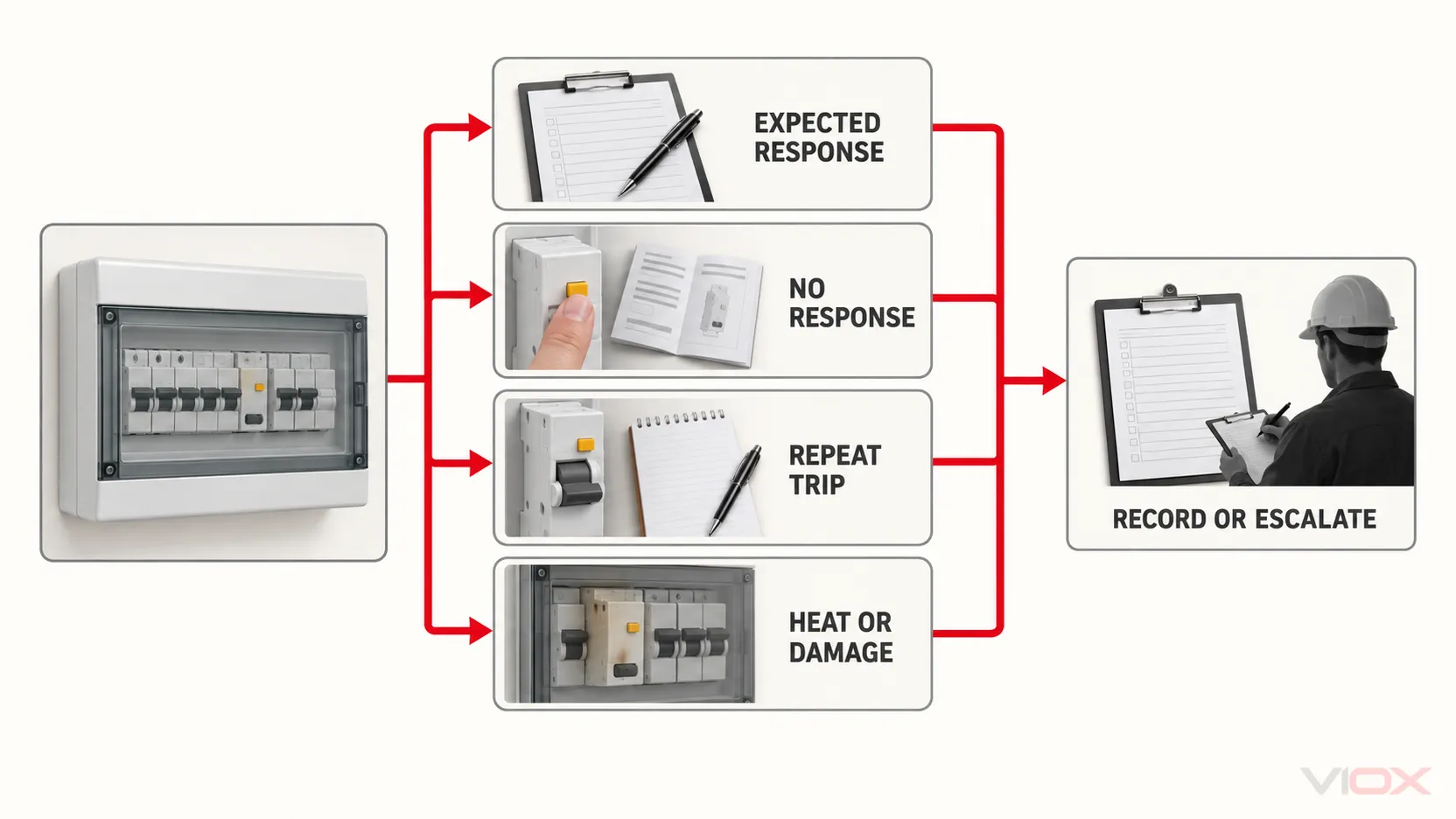
A conservative response to a device that does not switch off as documented is to stop repeated attempts, confirm the exact instructions, and seek competent advice. A failed button check alone is not enough to identify the cause or justify an immediate replacement.
What the Test Button Proves—and What It Does Not
A manual AFDD test button creates an internal test condition defined by the product design. When the device produces its declared response, the check provides useful evidence that the relevant internal path and opening action responded at that moment.
It is not a field reproduction of the full IEC 62606 type-test program. The IEC standard addresses AFDD construction and performance for household and similar AC applications, including different construction routes. Product conformity is established through the applicable model documentation and evidence—not through one site button press. See the official IEC 62606 consolidated publication scope.
A successful manual check does not prove:
- that the final circuit contains no damaged cable or loose connection;
- that every possible series or parallel arc will be detected under every load condition;
- that residual-current or overcurrent functions in an integrated device were separately verified;
- that the device is compatible with the distribution board or correctly installed;
- that its certification, rating, or maintenance status is current; or
- that a previous trip was caused by an arc rather than another integrated protection function.
Do not use an improvised spark gap, loose conductor, or homemade arc generator. Such a test creates an uncontrolled hazard and cannot demonstrate standardized product performance.
How Often Should an AFDD Be Tested?
Use the interval and method stated in the current manufacturer instructions and the installation rules that apply to the project location.
For one clearly labeled regional example, the recipient guidance in the IET’s BS 7671:2018+A4:2026 model forms says that an AFDD with a manual test facility should be tested six-monthly by pressing the test button. Where an AFDD has both a test button and an automatic test function, the guidance says to follow the manufacturer’s instructions for test-button operation. This UK example should not be converted into a universal global interval. Review the IET A4 model forms.
Automatic self-test behavior also varies by design. It may monitor electronics or other internal functions without interrupting the circuit, but its presence does not tell you whether a separate manual check is required. Confirm the function, indication, and required user action in the exact model documentation.
Testing an Integrated AFDD + RCBO
An integrated AFDD + Residual Current Circuit Breaker with Overcurrent Protection (RCBO) combines arc detection, residual-current protection, overload protection, and short-circuit protection in one declared product. These functions address different fault conditions.
The front panel may provide one control, multiple controls, or model-specific indication. Do not infer which functions are checked from the number or color of the buttons. Use the manufacturer’s instructions to identify:
- what each test control exercises;
- the required supply and handle condition;
- the expected switching and indicator response;
- the reset procedure; and
- whether separate professional verification applies to the residual-current function.
The field test requirements for an RCD function are not interchangeable with an AFDD manual button test. For example, the IET explains that current BS 7671 verification of a general non-delay RCD uses an AC test at its rated residual operating current and no longer requires the former five-times test. That work requires suitable equipment and competence; it is not part of a routine end-user AFDD button check. Read the IET explanation of RCD testing.
For help matching all four protection functions to a circuit, use the AFDD + RCBO selection guide.
If the AFDD Trips Again or Will Not Reset
Do not assume that every repeat trip is a hazardous arc, and do not dismiss it as nuisance operation. A combined device may have operated for an arc-detection, residual-current, overload, or short-circuit condition. Other possibilities include a connected appliance, damaged wiring, a poor connection, an incorrect circuit or supply arrangement, an application outside the model’s declared use, or a device problem.
Before anyone resets or changes the installation, record:
- the time and operating conditions;
- which loads were running or had just switched;
- the handle, flag, display, or indicator state;
- whether the event followed installation work, damage, moisture, or a supply disturbance; and
- whether other circuits or protective devices operated.
An ordinary user may switch off or unplug accessible loads only when doing so is safe and permitted. Removing a board cover, disconnecting outgoing conductors, tightening terminals, measuring live circuits, or substituting devices belongs to a competent electrical professional following safe isolation and the relevant instructions.
A professional diagnosis should use the recorded evidence, the model’s diagnostic guide, and appropriate circuit tests. The aim is to separate load, wiring, supply, connection, application, and device causes—not to replace the AFDD simply because the first reset failed.
AFDD Test Record Template
| Record field | Entry |
|---|---|
| Date and time | |
| Distribution board and circuit | |
| AFDD manufacturer and model | |
| Instruction document/revision used | |
| Starting handle and indicator state | |
| Test control and method | |
| Observed response | |
| Reset and supply-restoration result | |
| Loads or conditions associated with a repeat trip | |
| Follow-up action and responsible person |
Sources
- IEC 62606:2013+AMD1:2017+AMD2:2022 — General requirements for arc fault detection and protection devices
- IET — BS 7671:2018+A4:2026 model forms for certification and reporting
- IET — Current BS 7671 edition and transition status
- IET — Changes to RCD testing in BS 7671:2018+A2:2022
VIOX publishes VAF1-40 and VAF3-40M combined-protection models on its AFDD product page. Request the current model instructions, datasheets, and available conformity documents before defining a test method for a specific order. For documentation support, contact [email protected].