On this page
How Many Watts on a 20 Amp Circuit?
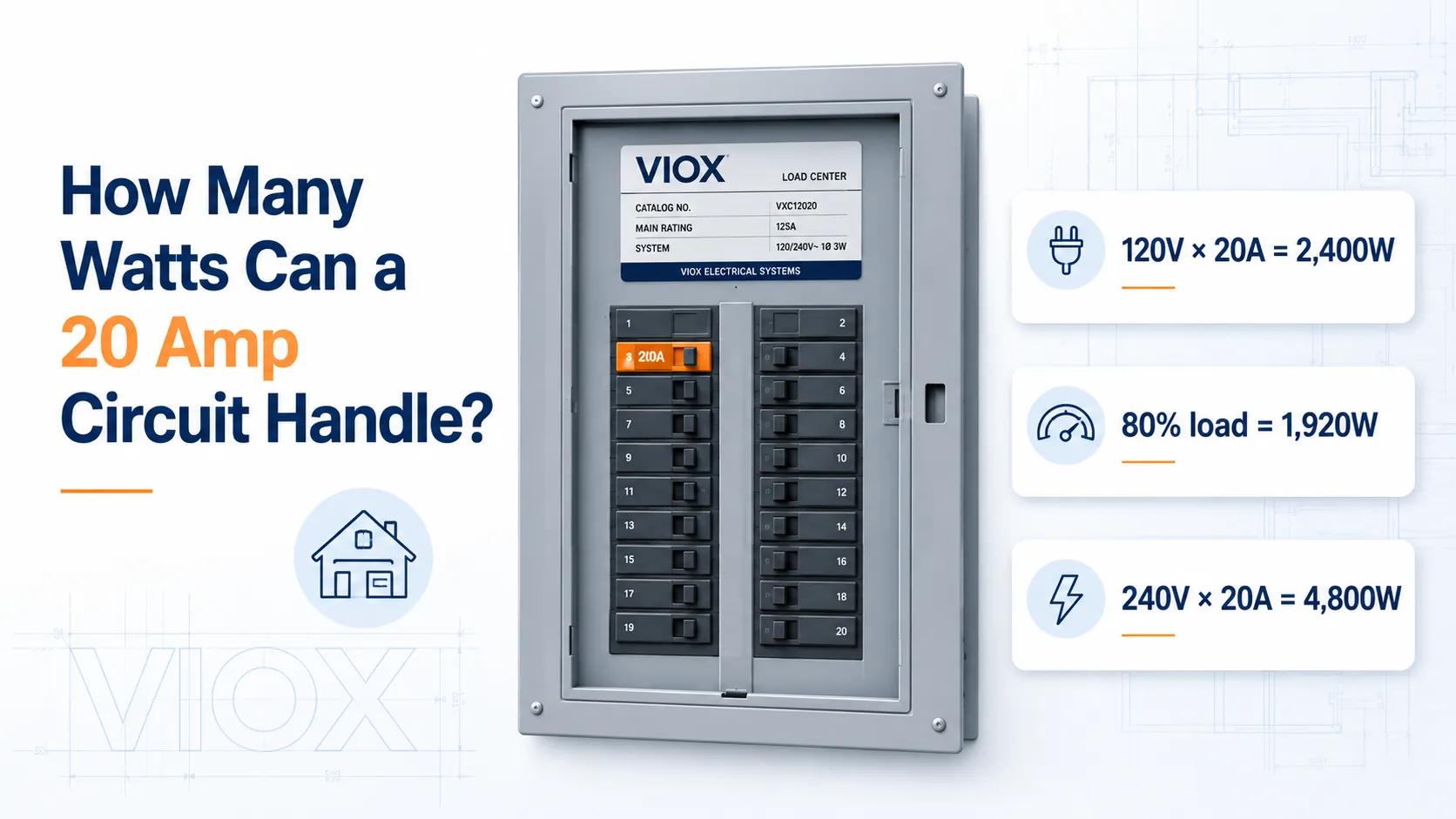
A 20 amp circuit can handle 2,400 watts at 120 volts or 4,800 watts at 240 volts. For continuous loads, use the 80% rule: 1,920 watts at 120V or 3,840 watts at 240V. Always match the breaker to the wire size, outlet rating, load type, and local electrical code.
The basic formula is:
Watts = Volts × Amps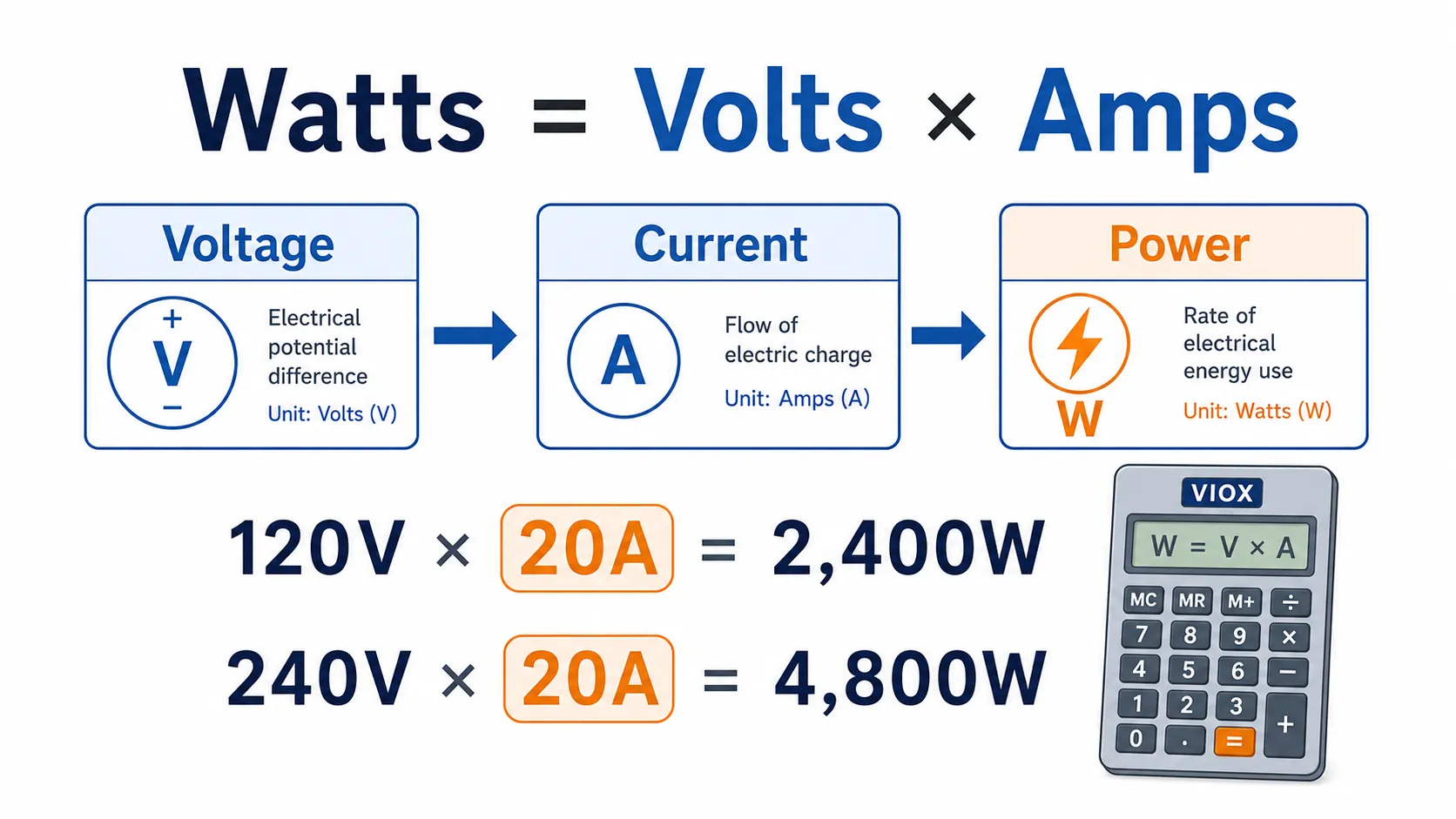
So for a 20 amp circuit:
- 120V × 20A = 2,400W
- 240V × 20A = 4,800W
But those are maximum calculated values. In real installations, a circuit breaker protects the wiring, not just the appliance. Continuous loads, conductor size, receptacle rating, voltage, and local code all affect what is safe.
20 Amp Circuit Watts Quick Table
| Circuit voltage | Maximum calculated load | 80% continuous load target | Common use |
|---|---|---|---|
| 120V, 20A | 2,400W | 1,920W | General receptacles, kitchen small-appliance circuits, laundry receptacles |
| 208V, 20A single-phase | 4,160W | 3,328W | Some commercial equipment circuits |
| 240V, 20A | 4,800W | 3,840W | Dedicated equipment circuits, some heaters or tools |
| 240V, 20A, 3-phase | about 8,314W | about 6,651W | Commercial and light industrial loads |
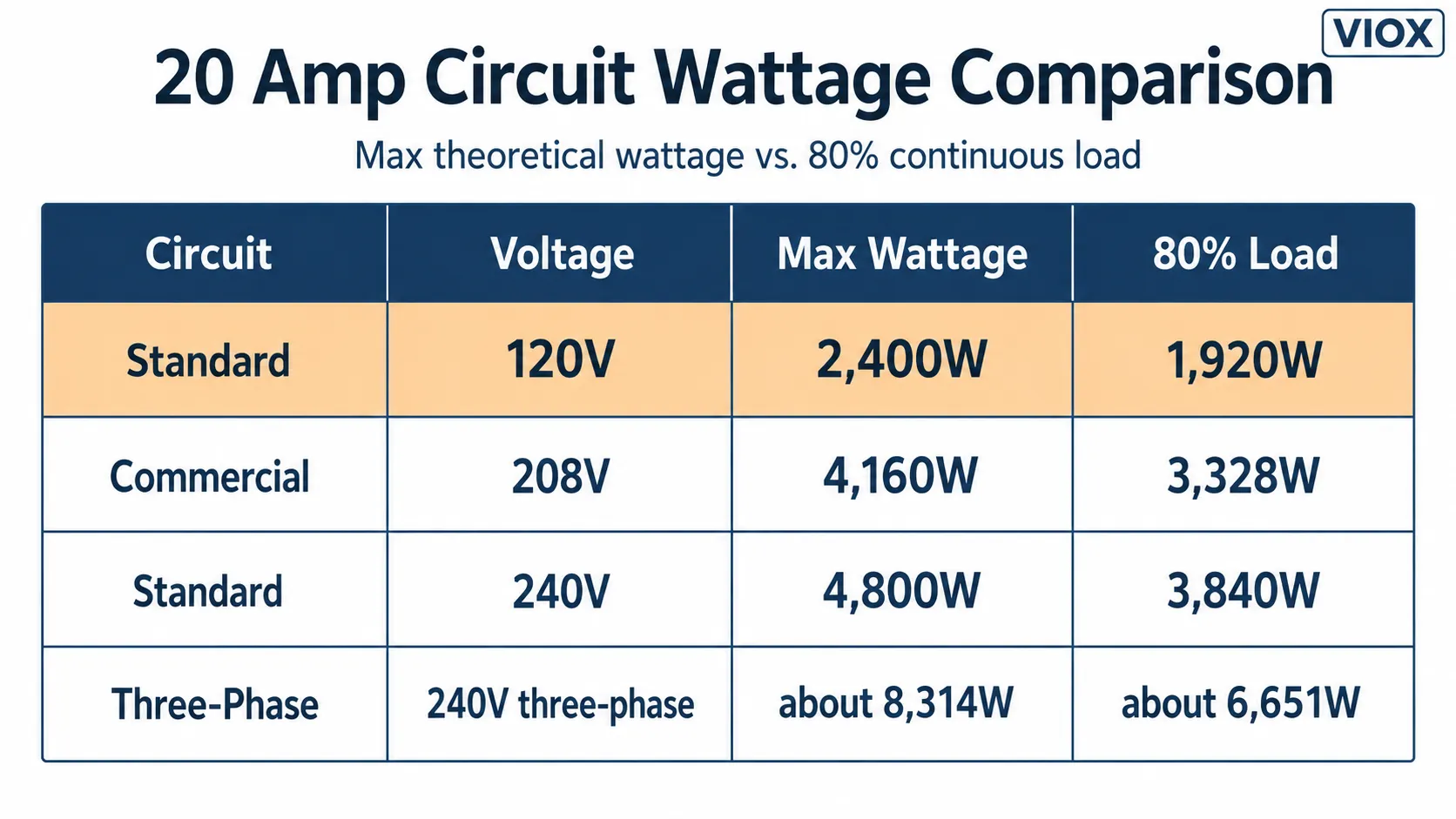
For most U.S. homeowners asking about a 20 amp circuit, the answer is usually the 120V line: 2,400 watts maximum, or 1,920 watts for continuous load planning.
120V vs 240V: Why the Wattage Changes
A 20 amp breaker does not have one fixed wattage. Wattage depends on voltage.
| Formula | Result |
|---|---|
| 120V × 20A | 2,400W |
| 240V × 20A | 4,800W |
| 208V × 20A | 4,160W |
This is why “how many watts can a 20 amp breaker handle?” is incomplete unless you also know the voltage.
A single-pole 20A breaker in a typical North American residential panel usually supplies a 120V circuit. A double-pole 20A breaker usually supplies a 240V circuit. The breaker amp rating may look the same, but the available wattage is different because the voltage is different.
What Is the 80% Rule for a 20 Amp Circuit?
For continuous loads, do not plan to use the full 20 amps. A common rule is to size continuous loads at no more than 80% of the circuit rating.
For a 20 amp circuit:
20A × 80% = 16AAt 120V:
120V × 16A = 1,920WAt 240V:
240V × 16A = 3,840W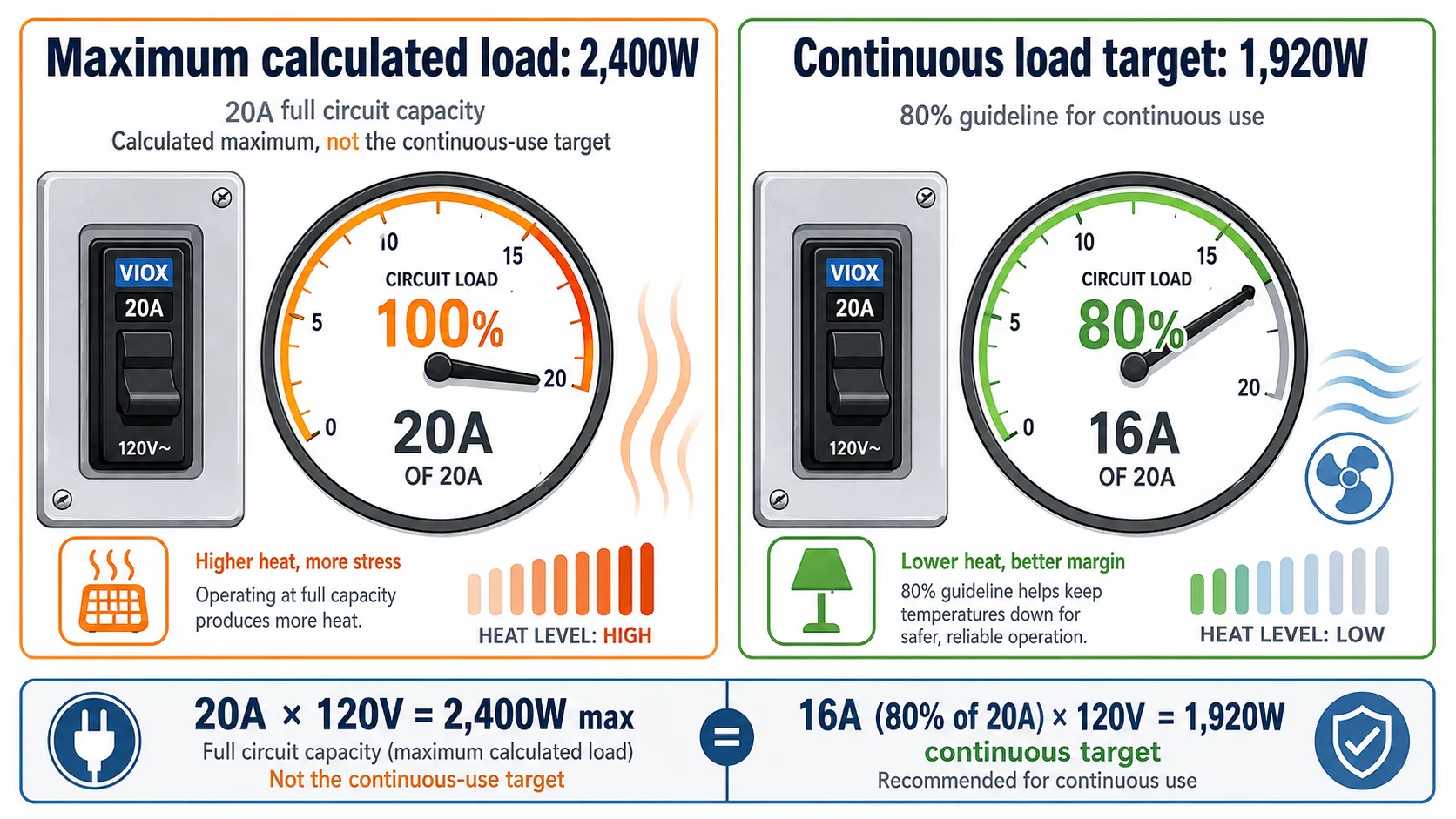
This matters for loads that run for a long time, such as fixed lighting, heaters, some commercial equipment, and continuous-duty appliances. A short-use kitchen appliance is not the same as a heater running for hours.
Maximum Load vs Safe Continuous Load
| Question | 120V 20A circuit | 240V 20A circuit |
|---|---|---|
| Absolute calculated maximum | 2,400W | 4,800W |
| Better planning target for continuous load | 1,920W | 3,840W |
| Current at the 80% target | 16A | 16A |
| Should you load it to the maximum all day? | No | No |
A breaker may not trip immediately at exactly 20 amps. Thermal-magnetic breakers have time-current behavior. That does not mean the circuit should be used continuously at its full rating. Heat builds in conductors, terminals, receptacles, plugs, and breaker contacts.
Can a 20 Amp Breaker Run a 3000W Load?
It depends on the voltage.
| Load | Current at 120V | Current at 240V | Suitable for a 20A circuit? |
|---|---|---|---|
| 3,000W | 25A | 12.5A | Not on 120V 20A; possibly on 240V 20A if the circuit and equipment are correctly rated |
| 2,000W | 16.7A | 8.3A | Usually too high for continuous 120V planning, but under 20A for short-duty use |
| 1,500W | 12.5A | 6.25A | Common on 120V 20A circuits |
| 7,200W | 60A | 30A | Not suitable for a 20A circuit |
A 3,000 watt appliance on 120V draws about 25 amps, so it is too large for a 20 amp 120V circuit. On 240V, the same 3,000 watt load draws only 12.5 amps, so it may fit a 20 amp 240V circuit if the equipment, breaker, wire, receptacle, and installation rules all match.
How Many Volts Can a 20 Amp Breaker Handle?
A 20 amp breaker is rated by both current and voltage. The “20A” marking tells you the current rating, not the voltage rating.
To know the voltage, check the breaker label and panel application. Common examples include:
- single-pole residential breakers used on 120V circuits
- double-pole residential breakers used on 240V circuits
- industrial or commercial breakers marked for specific AC voltage ratings
- DC breakers marked separately for direct-current voltage
Do not assume a breaker can be used at any voltage just because it is rated 20A. Voltage rating affects arc interruption and safety. This is especially important when comparing AC breakers and DC breakers.
For general breaker sizing and load planning, see VIOX’s homeowner guide to circuit breaker sizing and load calculation.
20 Amp Breaker, Wire Size, and Outlet Safety
A breaker protects the circuit wiring. You should never increase a breaker size just to stop nuisance tripping.
In common North American residential wiring:
- 15A circuits are commonly associated with 14 AWG copper conductors.
- 20A circuits are commonly associated with 12 AWG copper conductors.
- A 20A breaker should not be placed on wiring that is only suitable for 15A protection.
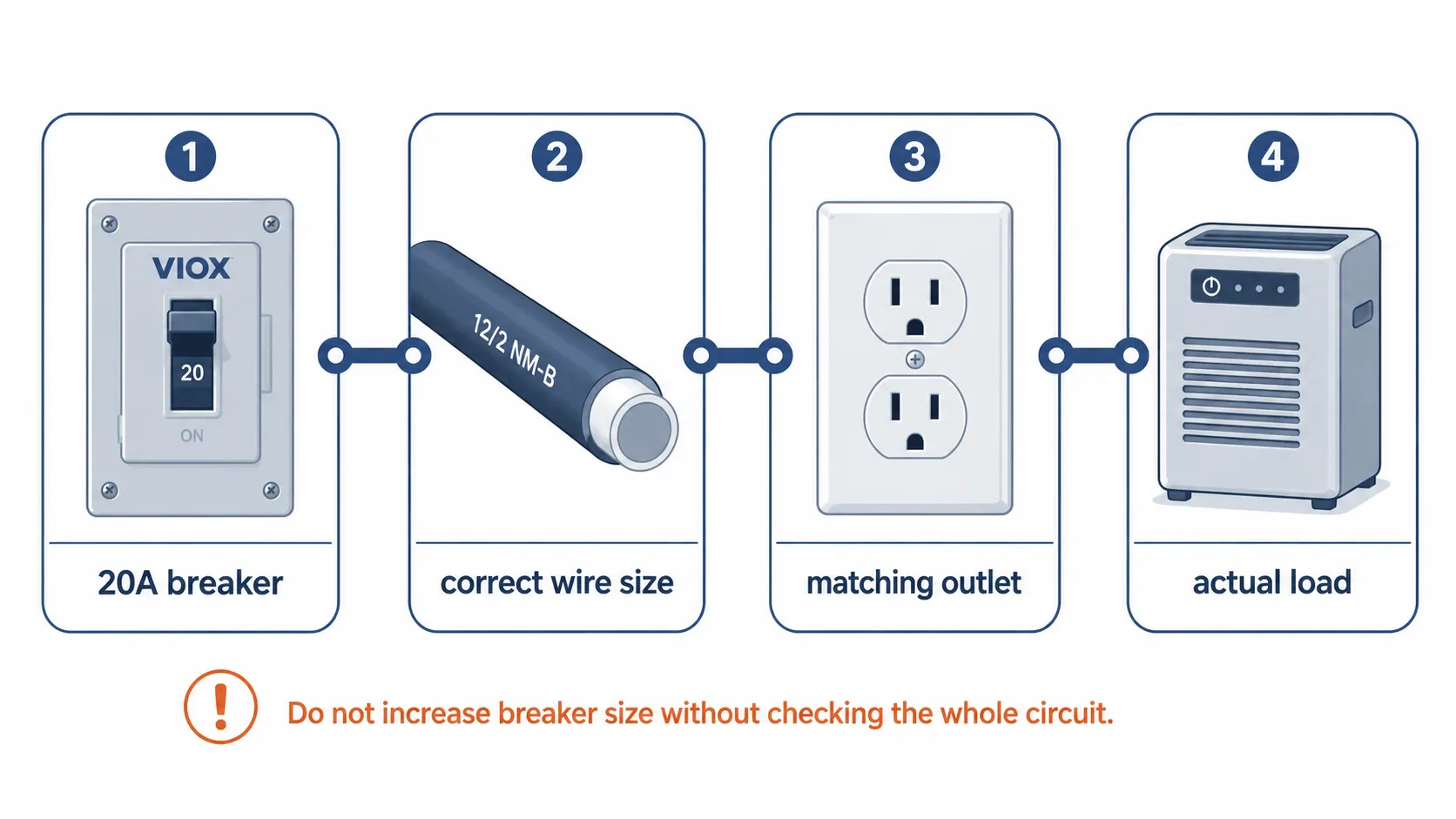
The breaker, conductor, receptacle, and load must be treated as one system. If one part is undersized, the circuit can overheat even if the appliance seems to run normally.
For a deeper wire and breaker pairing reference, see VIOX’s wire gauge vs circuit breaker sizing chart. If you are deciding between 15A and 20A protection, see how to know if you need a 15 or 20 amp breaker.
Common Appliance Examples on a 20 Amp 120V Circuit
| Appliance or load | Typical wattage range | Notes for a 20A 120V circuit |
|---|---|---|
| Phone charger / small electronics | under 100W | Usually low load |
| Laptop | 45W–150W | Usually low load |
| Desktop computer and monitor | 200W–600W | Multiple devices can add up |
| Microwave | 900W–1,500W output, often higher input | May need a dedicated circuit depending on installation |
| Toaster | 800W–1,500W | High load for short periods |
| Space heater | about 1,500W | Large share of a 20A circuit |
| Hair dryer | 1,200W–1,875W | High load; often used near GFCI-protected areas |
| Portable air conditioner | varies widely | Check nameplate current, not only marketing wattage |
The safest method is to read the nameplate on each appliance. Add the watts of devices that may run at the same time, then compare the total with the circuit capacity.
How to Calculate Load on a 20 Amp Circuit
Use this simple process:
- Find the voltage of the circuit: usually 120V or 240V.
- Find the appliance wattage or current from the nameplate.
- Convert current to watts if needed:
Watts = Volts × Amps. - Add the loads that can operate at the same time.
- Compare the total with the circuit limit.
- For continuous loads, compare with the 80% planning value.
Example:
| Device | Watts |
|---|---|
| Space heater | 1,500W |
| Desktop computer setup | 400W |
| Lighting | 150W |
| Total | 2,050W |
On a 120V 20A circuit, 2,050W is below the calculated maximum of 2,400W, but above the 1,920W continuous-load planning value. If the space heater runs for long periods, this is not a good load plan.
Why a 20 Amp Breaker Trips Before You Expect
A 20 amp breaker can trip even when your quick math looks acceptable. Common reasons include:
- several high-wattage appliances running at the same time
- motor, compressor, pump, or transformer inrush current
- loose receptacle or terminal connections
- damaged plugs or cords
- old or weak breaker mechanism
- shared loads on the same branch circuit
- heat buildup inside the panel or outlet box
- a ground fault or arc fault on protected circuits
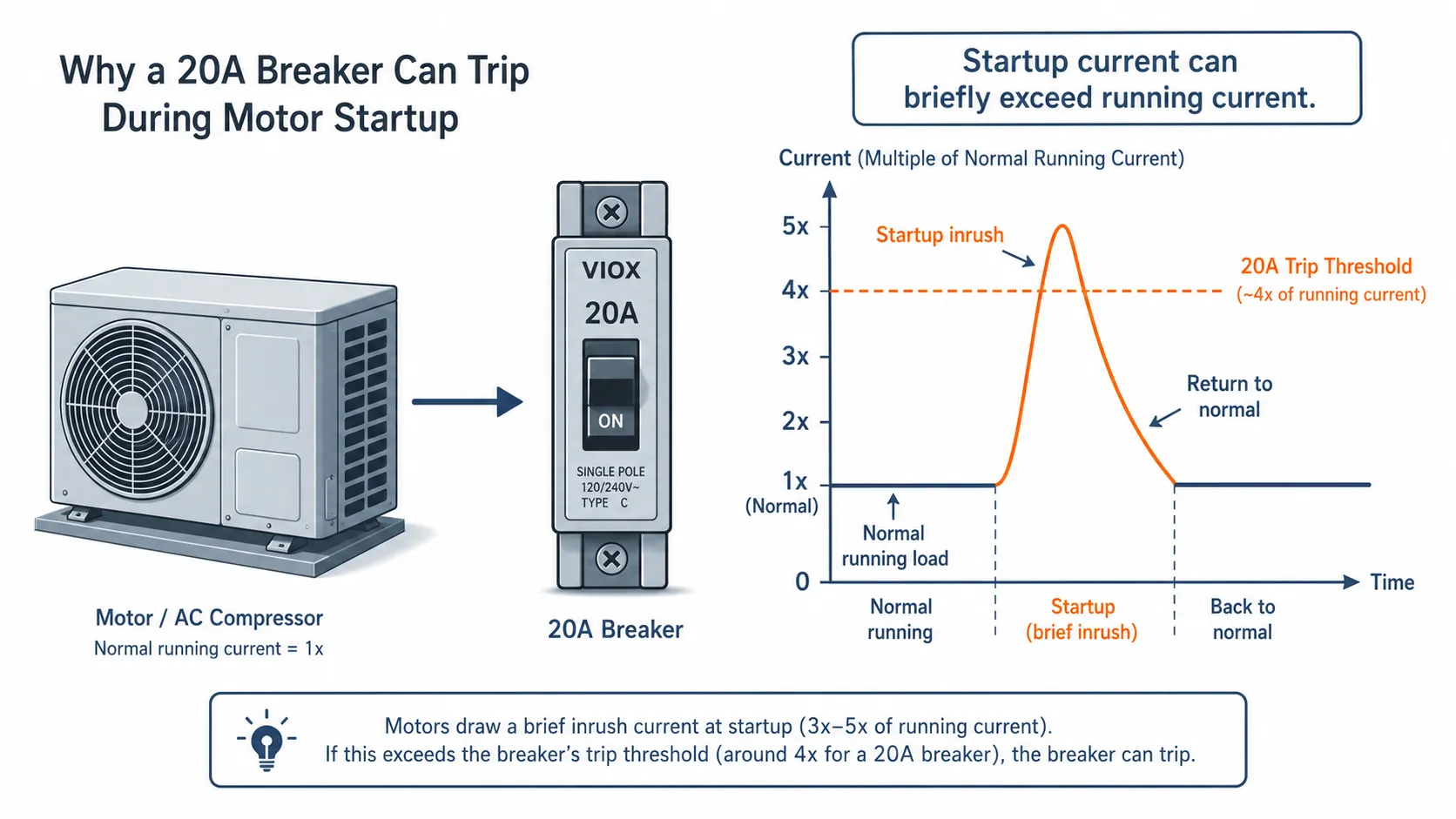
The most overlooked cause is startup current. Motor loads such as air-conditioner compressors, pumps, refrigerators, and shop tools can draw several times their normal running current for a short time during startup. As a practical field estimate, many small motor loads may momentarily draw about 3 to 5 times their running current, and some equipment can be higher depending on design.
That means a device that appears to be a 1,500W running load may briefly demand 4,500W or more during startup. A thermal-magnetic breaker may tolerate short overloads for a limited time, but a large inrush spike, weak connection, hot enclosure, or already-loaded circuit can still cause an immediate trip.
This is why nameplate running watts alone do not always explain breaker behavior. For motors and compressors, check the equipment nameplate current, locked-rotor amperes (LRA) if provided, starting method, and manufacturer circuit requirements.
If a breaker trips repeatedly, do not keep resetting it without finding the cause. A breaker that trips is usually telling you something about the circuit load or a fault condition.
For common breaker sizes and how they are used, see VIOX’s standard breaker sizes.
20 Amp Circuit Quick Conversion Table
| Watts | Amps at 120V | Amps at 240V |
|---|---|---|
| 500W | 4.2A | 2.1A |
| 1,000W | 8.3A | 4.2A |
| 1,500W | 12.5A | 6.25A |
| 1,920W | 16A | 8A |
| 2,400W | 20A | 10A |
| 3,000W | 25A | 12.5A |
| 3,840W | 32A | 16A |
| 4,800W | 40A | 20A |
| 7,200W | 60A | 30A |
This table also explains why international searches such as “3000 watt berapa ampere” or “combien de watt sur une prise 20A” cannot be answered safely without voltage. The same wattage draws very different current at 120V and 240V.
Can I Use a Larger Breaker for More Watts?
No, not unless the entire circuit is designed for the larger breaker.
A larger breaker allows more current before it trips. If the existing wire, receptacle, or equipment is not rated for that current, the wiring can overheat before the breaker opens. Upgrading from 20A to 30A is not a simple breaker swap; it may require different conductor size, receptacle type, equipment rating, and code review.
The practical rule is:
Breaker size follows the wire and load design. It does not create extra safe capacity by itself.Final Answer
A 20 amp circuit can supply 2,400 watts at 120V or 4,800 watts at 240V. For continuous loads, use the 80% planning value: 1,920 watts at 120V or 3,840 watts at 240V.
If the load is 3,000 watts, it is too large for a 120V 20A circuit because it draws about 25A. The same 3,000 watt load may fit a 240V 20A circuit because it draws about 12.5A, but only if the breaker, wire, receptacle, and equipment are properly rated.
FAQ
How many watts can a 20 amp circuit handle at 120V?
A 20 amp 120V circuit can handle 2,400 watts by calculation. For continuous loads, use 1,920 watts as the 80% planning value.
How many watts can a 20 amp breaker handle at 240V?
A 20 amp 240V circuit can handle 4,800 watts by calculation. For continuous loads, use 3,840 watts.
What is the 80% rule for a 20 amp breaker?
For a 20A circuit, the common continuous-load planning value is 16A. At 120V, that equals 1,920W; at 240V, it equals 3,840W. Short-duration loads and continuous loads should not be treated the same.
Can I run 2,000 watts on a 20 amp circuit?
At 120V, 2,000W draws about 16.7A. That is below 20A, but it is above the normal continuous-load planning target for a 20A circuit. Whether it works safely depends on duty cycle, other loads on the circuit, receptacle rating, wire size, and local code.
Can a 20 amp circuit run a 3,000 watt heater?
Not at 120V. A 3,000W heater at 120V draws about 25A, which is too much for a 20A circuit. At 240V, 3,000W draws about 12.5A, so a properly designed 240V 20A circuit may be suitable.
Why does my 20 amp breaker trip if the load is under 2,400 watts?
The load may have startup inrush, another appliance may be sharing the circuit, or there may be heat, loose wiring, a weak breaker, or a fault condition. Motors and compressors are especially important because their starting current can be much higher than their normal running current.
How many outlets can be on a 20 amp circuit?
This depends on the circuit purpose, local code, and expected load. The safer question is not only how many outlets are installed, but how many watts of equipment may run at the same time.
Is a 20 amp breaker always 120V?
No. A 20A breaker can be used in different voltage applications depending on the breaker type, pole configuration, panel, and system. Always check the breaker and panel ratings.
Can I replace a 15 amp breaker with a 20 amp breaker?
Only if the wiring and circuit are rated for 20A and the installation complies with local code. Do not install a 20A breaker on wiring that is only suitable for 15A protection.