

On this page
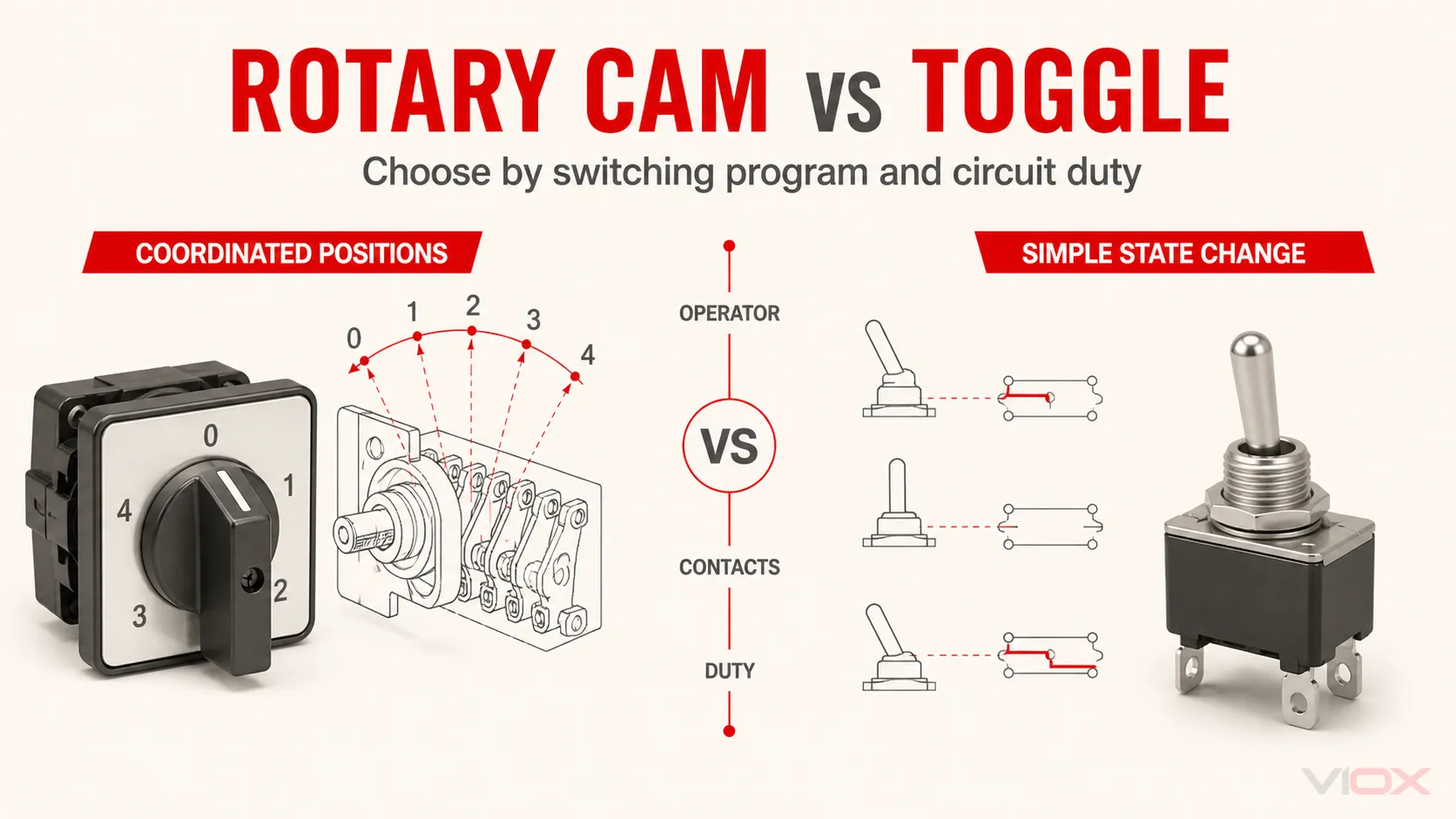
A rotary cam switch is normally the better choice when one handle must produce a defined multi-position or multi-contact switching program. A toggle switch is usually the simpler choice when a lever-operated two- or three-state function is sufficient. However, operator shape does not determine electrical duty: either device must have ratings and a declared switching function suitable for the actual circuit.
This distinction matters because “rotary,” “toggle,” “selector,” and “cam” do not describe the same property. Rotary and toggle describe how the operator moves. Selector describes what the operator lets a user choose. Cam describes one internal method of actuating contacts. The companion guide to selector-switch types and contact logic separates these layers in detail. The datasheet—not the handle—determines whether a device is intended for a control signal, an inductive control circuit, a motor circuit, isolation, or another load-switching duty.
Rotary Cam Switch vs Toggle Switch: Quick Decision Matrix
| Decision factor | Rotary cam switch | Toggle switch | What to verify |
|---|---|---|---|
| Operator movement | Handle rotates through defined positions | Lever flips between defined positions | Position count, angle, detents and marking |
| Contact architecture | Cam profile can coordinate several contact sets in each position | Commonly a simpler pole-and-throw arrangement, although industrial variants differ | Contact diagram or switching program |
| Best functional fit | Multi-position selection, coordinated circuit changes and mechanically defined sequences | Simple ON/OFF, changeover or momentary control | Required circuit states, not appearance |
| Return action | Maintained positions, spring return or mixed action may be available | Maintained or momentary action may be available | Which positions latch and which return |
| Electrical duty | May be a control switch or a load-switching device, depending on the declared product standard and ratings | May be a signal, control or load switch, depending on the declared ratings | Rated operational voltage/current, utilization category and load type |
| Circuit count | Well suited to several contacts changing according to one shaft position | Often selected for one or a few straightforward contact changes | Number of independent contact paths |
| Operator interface | Clear position pointer and labeled operating modes | Fast lever movement and an obvious physical state | Human-factors and guarding requirements |
| Replacement test | Match the full switching program and duty | Match poles, throws, action and duty | Never replace from panel appearance alone |
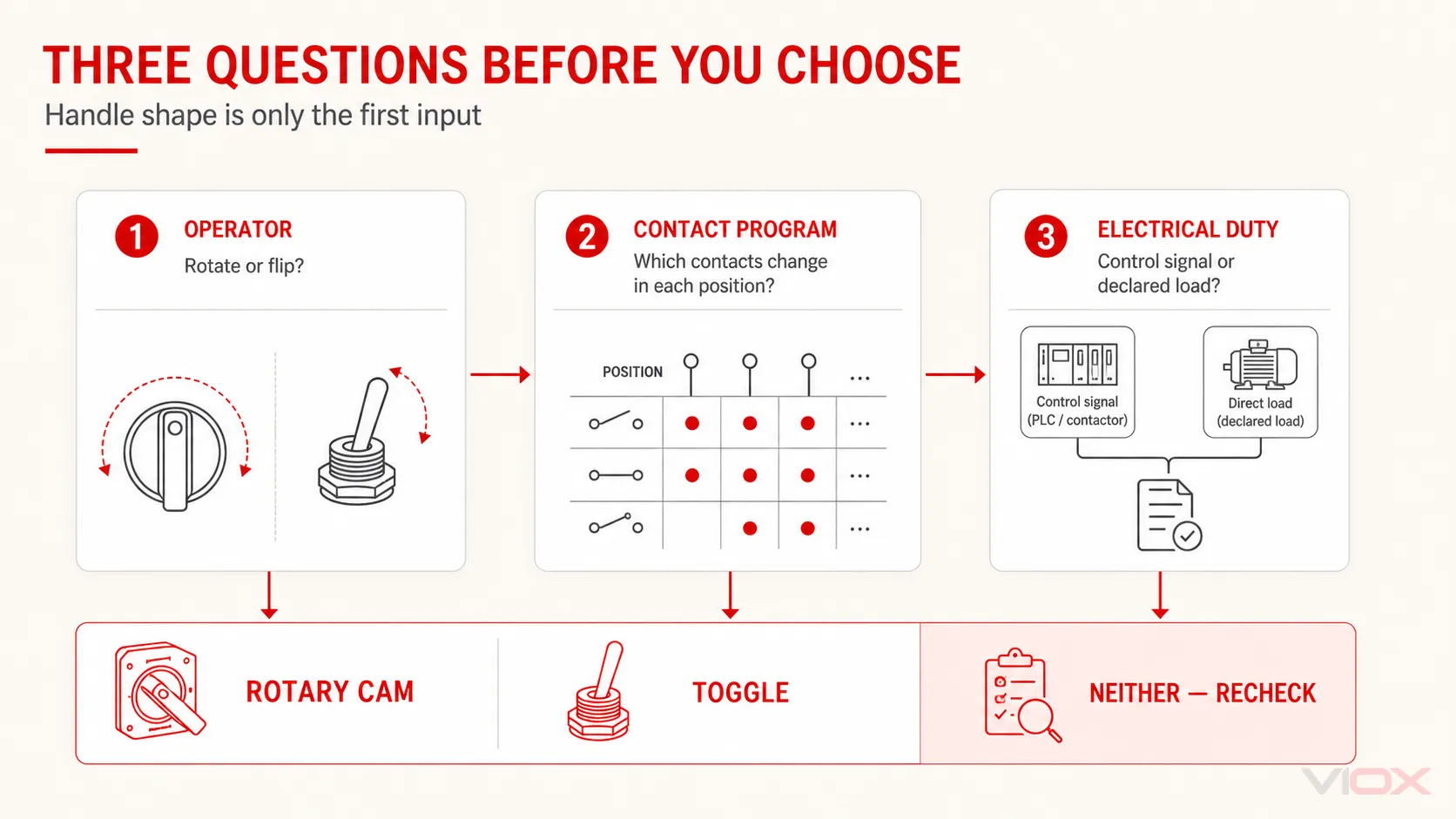
The practical rule is simple: use a rotary cam switch because you need its switching program, not merely because you prefer a round handle. Use a toggle switch because its simpler state change completes the task, not because every toggle is interchangeable.
Three Questions That Prevent the Wrong Selection
1. How should the operator move?
A rotary operator turns through labeled positions such as 0–1–2, OFF–ON, or HAND–OFF–AUTO. A toggle operator moves a lever between positions. This choice affects panel layout, position indication, accidental-operation risk and how the operator interacts with the machine.
The movement does not reveal the internal circuit. Two visually similar rotary operators may actuate completely different contact arrangements. Likewise, two toggle switches with the same lever can differ in pole count, momentary action and electrical rating.
2. What contact state is required in every position?
A rotary cam switch uses one or more cam profiles to actuate contact sets as the shaft turns. The switching program can make several circuits change together in a predetermined pattern. That is useful for functions such as instrument selection, source selection or motor-direction command logic when the exact product is rated for the duty.
A toggle switch is often described by its poles and throws—for example, single-pole single-throw or double-pole double-throw—but the marking alone still does not define every characteristic. Check the terminal diagram, normal state, maintained or momentary action, and whether any center position is electrically open.
For terminology around normally open and normally closed contacts, use the VIOX guide to NO and NC contact states.
3. What circuit must the contacts actually switch?
This is the most important boundary. A selector operator in a control panel may switch only a control signal that commands a contactor or programmable controller input. A different cam switch may be designed to make and break a declared load directly. These are not equivalent duties.
IEC 60947-5-1:2024 covers electromechanical control-circuit devices and switching elements used for functions such as controlling, signalling and interlocking. IEC 60947-3:2020 covers switches, disconnectors, switch-disconnectors and fuse-combination units used in distribution and motor circuits within its scope. A handle style does not place every product into one of these categories; use the manufacturer’s declaration for the exact device.
When a Rotary Cam Switch Is the Better Fit
Choose a rotary cam switch when the required output is best described by a position-to-contact table rather than a single ON/OFF state.
Examples include:
- selecting one of several measurement points with one instrument;
- issuing a mechanically defined forward–off–reverse command sequence;
- selecting operating modes while several auxiliary contacts change together;
- choosing between circuit paths where the exact break-before-make or other switching sequence is documented;
- replacing an existing cam switch whose terminal program must be reproduced exactly.
The decisive engineering object is the switching program. Record every handle position across the top of a table and every contact pair down the side. Mark which pairs are closed in each position. If the candidate switch cannot reproduce that table, matching its shaft size or number of positions is irrelevant.
For a deeper explanation of cam profiles and device categories, see the VIOX cam switch technical guide. If the terminology itself is unclear, the separate cam switch vs rotary switch comparison explains why most industrial cam switches are rotary but not every rotary switch is a cam switch.
When a Toggle Switch Is the Better Fit
A toggle switch is appropriate when a lever provides the required interface and the circuit needs only a straightforward state change. Common functions include a maintained enable/disable command, a momentary jog command, or selection between two control states.
Its simplicity can improve usability, but it does not remove the need for verification. Confirm:
- the number of poles and throws;
- whether each position is maintained or momentary;
- the normal state and center-position behavior;
- the exact terminal diagram;
- the rated control or load duty at the circuit voltage;
- enclosure, sealing and environmental requirements;
- the need for a guard, key or another means of access control.
Do not treat an ordinary guarded toggle switch as an emergency-stop device. Emergency-stop functions require purpose-designed equipment and a safety architecture that meets the applicable machinery and market requirements.
Maintained and Momentary Are Independent of Handle Shape
Both rotary and toggle operators can be maintained or momentary.
- Maintained: the operator remains in the selected position after release.
- Momentary or spring return: the operator returns to a defined position after release.
- Mixed action: some positions remain selected while another position returns to center or to one side.
For example, a three-position selector may remain in HAND and AUTO, or it may spring back from one or both side positions. An official Schneider Electric product example, the ZB4BD5 selector-switch head, is described as a three-position spring-return operator. That example demonstrates a configuration option; it does not establish a universal arrangement for all selector switches.
Write the required action explicitly in an RFQ. “Three-position rotary switch” is incomplete; “three-position, spring return from left and right to center” communicates a functional requirement.
Control Signal or Direct Load? Draw the Boundary First
Before comparing current ratings, identify what sits downstream of the switch.
| Circuit architecture | What the manual switch does | Primary verification |
|---|---|---|
| Operator → PLC input | Changes a low-energy input state | Input compatibility, contact type, wetting current and control-circuit rating |
| Operator → contactor coil | Commands an electromagnetic coil | Coil voltage/current, control utilization category and suppression effects |
| Operator → relay logic | Selects a logic path | Contact arrangement, normal state and control-circuit rating |
| Cam switch → declared load | Makes or breaks the load directly | Load type, utilization category, operational ratings and switching program |
| Device used for isolation | Establishes an isolation function | Explicit disconnector or switch-disconnector suitability and installation requirements |
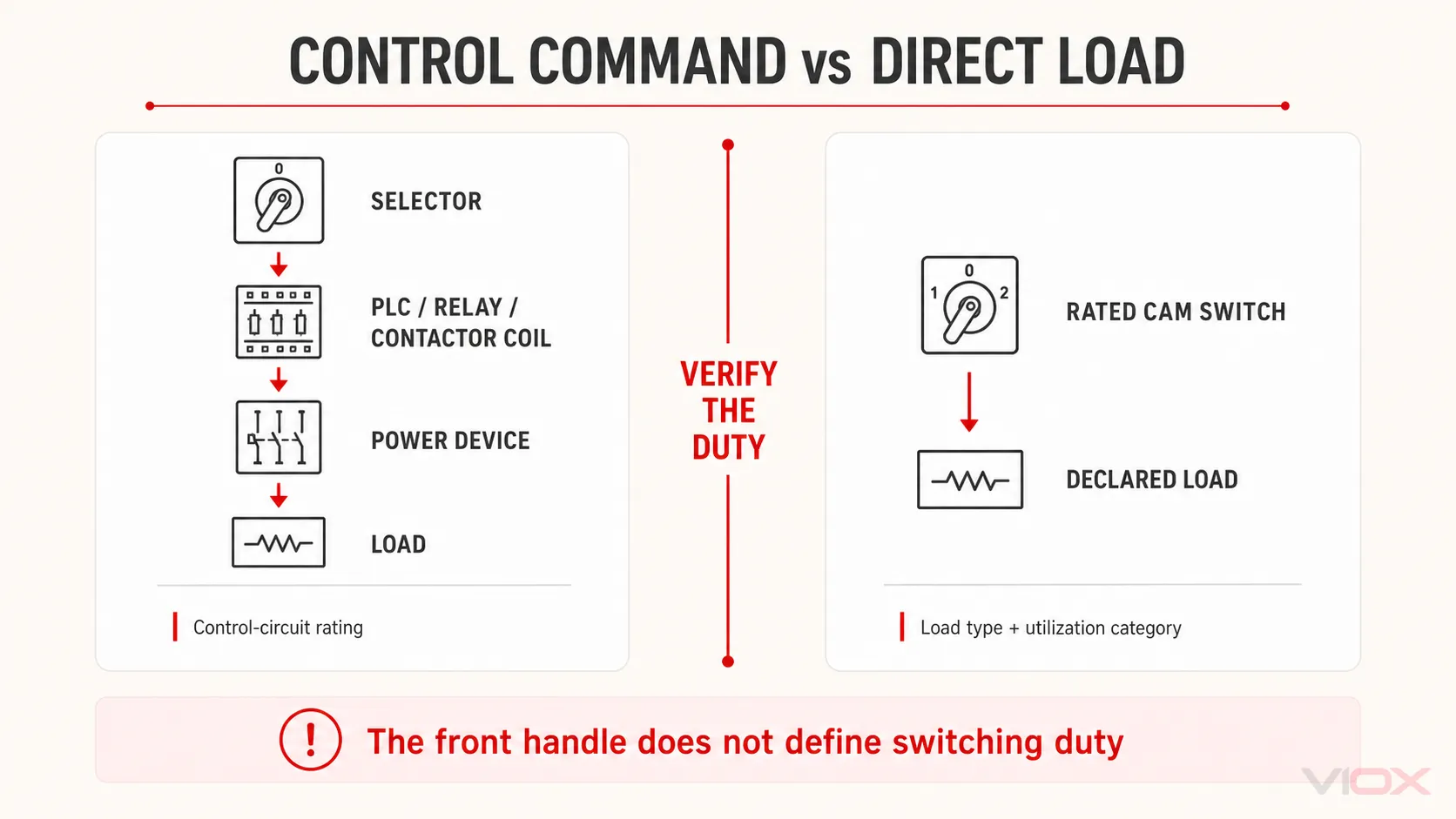
A selector switch in a control circuit and a switch-disconnector can both have rotary handles while performing fundamentally different jobs. Never infer isolation suitability, motor-duty suitability or breaking capacity from the front operator.
Application-Based Selection Examples
HAND–OFF–AUTO control input
The primary task is selecting three labelled control states. A rotary selector operator with the required maintained positions and contact blocks is often a natural interface. A rotary cam power switch is unnecessary unless the switching program or circuit duty specifically requires it.
Simple equipment enable
If the task is one maintained enable/disable command in a suitable control circuit, a toggle switch may provide the clearest interface. A rotary operator may still be chosen for labeling, access control or panel consistency, but it is not electrically superior by shape alone.
Forward–off–reverse function
First determine whether the manual device is commanding contactor logic or directly switching a motor circuit. The two architectures require different ratings and safety considerations. A cam switch can provide a defined multi-contact sequence, but only a product documented for the intended circuit and duty should be used.
Source or meter selection
Multiple coordinated contacts and clear position indexing favor a rotary cam arrangement. The required sequence—such as whether one path must open before another closes—must come from the system design and the exact switch program.
Specification Checklist
| Field | Required decision |
|---|---|
| Function | What must each operator position command? |
| Positions | How many positions, and what labels or rotation angles are required? |
| Action | Maintained, spring return, or mixed? |
| Contact program | Which terminals are closed in each position? |
| Circuit type | PLC input, relay/contactor control, measurement circuit or direct load? |
| Electrical duty | AC or DC, voltage, current, load type and applicable utilization category? |
| Mounting | Panel cutout, panel thickness, terminal access and available depth? |
| Environment | Required enclosure or front-of-panel protection for the actual installation? |
| Human interface | Knob or lever, pointer, legend, key operation, guard or padlocking requirement? |
| Evidence | Datasheet, contact diagram, applicable conformity documents and model-specific instructions? |
If the application requires coordinated multi-position switching, review the VIOX cam switch and rotary switch range after defining the switching program and duty. For a simple control operator, evaluate the appropriate control and signalling device family against the same circuit requirements.
Frequently Asked Questions
Is a rotary switch always a cam switch?
No. Rotary describes operator movement. A rotary switch may use a cam mechanism, wafer contacts or another construction. Verify the internal contact arrangement and declared duty.
Is a toggle switch always limited to ON/OFF?
No. Toggle switches are available with different poles, throws, center positions and momentary actions. The exact configuration must come from the terminal and action diagrams.
Can a rotary cam switch replace a toggle switch?
Only when it reproduces the required operator behavior, contact states, circuit duty, ratings, mounting and safety function. A mechanical fit or similar front marking is not enough.
Which switch is better for a motor?
That depends on the circuit architecture. A manual switch that only commands a contactor coil has a different duty from a switch that directly makes and breaks a motor circuit. Select against the exact diagram, load and manufacturer ratings.