

On this page
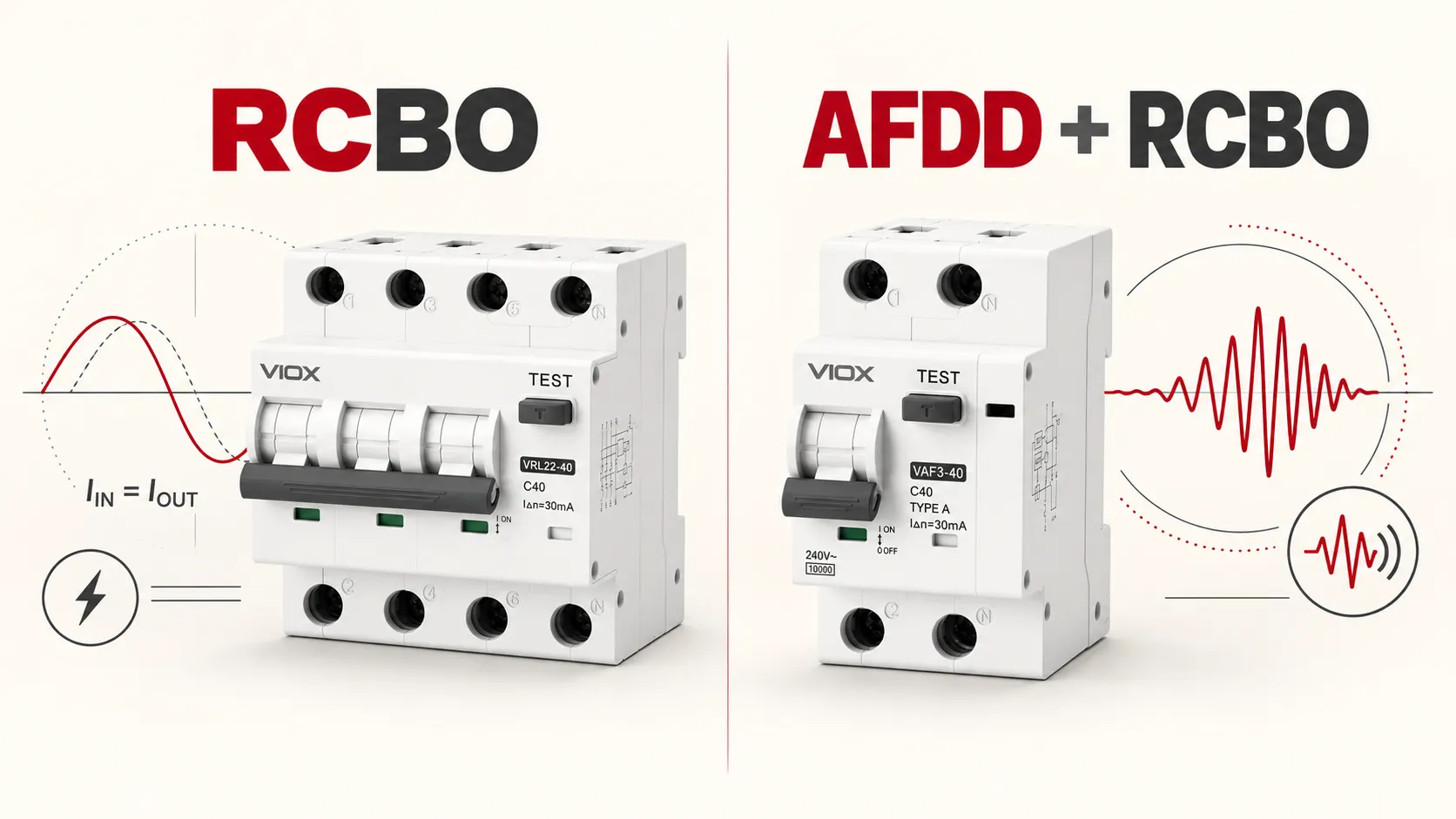
An RCBO combines residual-current and overcurrent protection. An AFDD detects electrical signatures associated with hazardous arc faults. They answer different fault questions, so neither label is a substitute for the other.
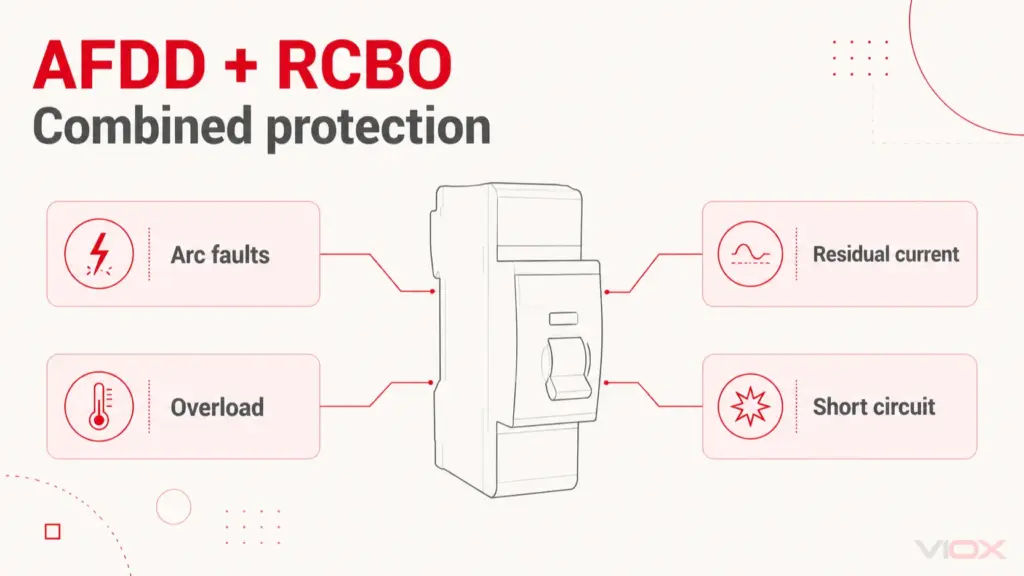
If a circuit design requires residual-current, overload, short-circuit and arc-fault protection, select a device or assembly explicitly declared to provide all four functions. In many final-circuit applications, that means an integrated AFDD + RCBO. The words on the front are only the starting point: ratings, residual-current type, breaking capacity, pole arrangement and distribution-board compatibility must still match the circuit.
RCBO vs AFDD at a Glance
| Comparison point | RCBO | AFDD | Integrated AFDD + RCBO |
|---|---|---|---|
| Main detection task | Residual-current imbalance and overcurrent | Hazardous arc-fault signatures | Both sets of functions |
| Overload protection | Yes | Not guaranteed by the AFDD label alone | Yes when explicitly declared |
| Short-circuit protection | Yes | Not guaranteed by the AFDD label alone | Yes when explicitly declared |
| Residual-current protection | Yes | Not guaranteed by the AFDD label alone | Yes when explicitly declared |
| Arc-fault detection | No dedicated AFDD function | Yes | Yes |
| Can replace the other? | No | No | Only if the exact product is declared for all required functions |
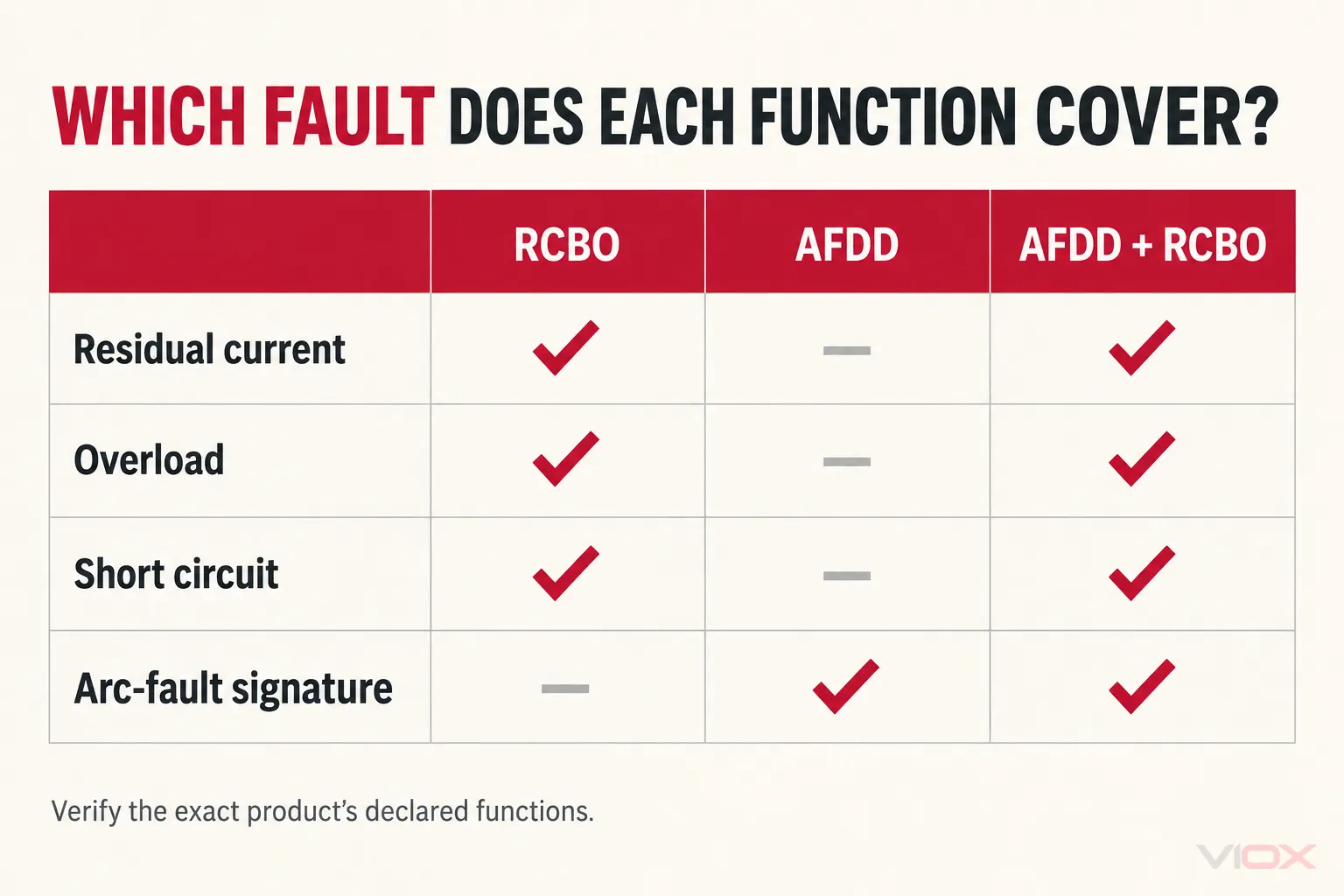
The important distinction is between a protection function and a physical product format. IEC 62606 recognizes AFDDs as a device with opening means, a device integrating another protective device, or a separate unit assembled with a declared protective device. Therefore, “AFDD” does not automatically tell you whether the product also contains RCBO functions. IEC 62606 official scope
For a broader introduction to arc protection, start with what an AFDD is and how it works. This page stays focused on the comparison and the choice between protection architectures.
What an RCBO Detects
RCBO means residual current operated circuit-breaker with integral overcurrent protection. Its residual-current function monitors whether current returning through the intended circuit conductors differs from the outgoing current. Its overcurrent function responds to overload and short-circuit conditions according to the device’s declared characteristics.
That gives an RCBO three distinct jobs:
- residual-current protection;
- overload protection; and
- short-circuit protection.
IEC 61009-1 covers RCBOs for household and similar uses within the scope and ratings stated by the standard. The standard title itself is useful because it prevents a common naming mistake: an RCBO contains overcurrent protection; an RCCB does not. IEC 61009-1:2024
An RCBO does not have a dedicated arc-signature detection function. It may still disconnect some faults that also happen to involve high current or leakage to earth, but that does not make it an AFDD.
For a definition-led treatment, see the separate RCBO guide.
What an AFDD Detects
An AFDD evaluates electrical characteristics associated with hazardous arcing and opens the circuit when its detection criteria are met. This addresses fault conditions that conventional residual-current or overcurrent protection may not identify soon enough—or may not identify at all.
The AFDD function is aimed at arc-fault risk. It should not be described as a universal detector for every loose connection, every hot terminal or every possible electrical fire. Correct conductor sizing, sound connections, inspection, verification and suitable conventional protection remain necessary.
The product format matters. A device sold as an AFDD may have only the arc-detection and opening functions, may integrate a circuit breaker or RCBO, or may form a manufacturer-declared combination with another protective device. Check the exact datasheet instead of inferring the included functions from the category name.
The Protection Gap: Why an RCBO May Not Detect a Series Arc
A deteriorated or loose series connection can arc while the connected load limits the current. The same current can still leave and return through the monitored conductors, so there may be neither enough overcurrent nor enough residual-current imbalance to operate an RCBO.
That is the central protection gap in the RCBO-versus-AFDD comparison. The devices are not competing versions of the same sensor:
- the overcurrent function asks whether current magnitude and duration cross its operating characteristic;
- the residual-current function asks whether outgoing and returning current are imbalanced; and
- the AFDD function looks for qualifying arc-fault characteristics.
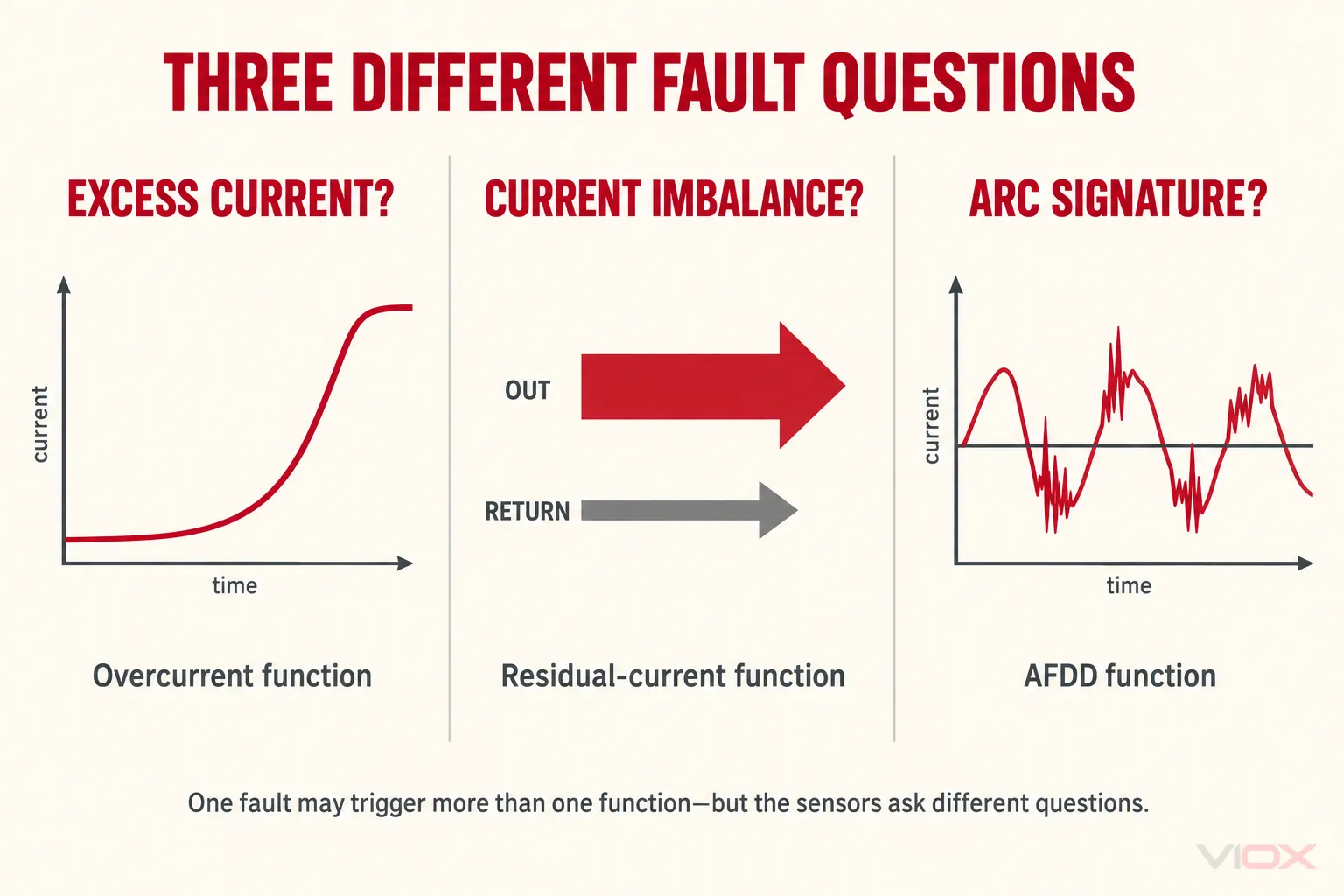
A parallel arc between conductors may also create overcurrent or residual current, depending on the fault path and impedance. One or more conventional functions may then operate. However, that possible overlap does not justify assuming that every arc will trip an RCBO or that every RCBO trip identifies an arc.
The reverse limitation matters too: arc detection does not automatically provide residual-current or overcurrent protection. An AFDD cannot replace those functions unless the exact product is declared as an integrated protective device that includes them.
Do You Need Both an RCBO and an AFDD?
You need both functions when the circuit design or applicable installation rules require residual-current and overcurrent protection as well as arc-fault detection. That does not always mean installing two independent modules.
There are three practical outcomes:
- RCBO only. Appropriate where the design requires residual-current and overcurrent protection but does not require an AFDD function. This conclusion must come from the applicable rules and risk assessment, not from price or available board space alone.
- AFDD function with declared conventional protection. Some AFDD construction routes use a separate or associated protective device. Only use the manufacturer-declared combination and follow its assembly instructions.
- Integrated AFDD + RCBO. One declared product provides arc detection, residual-current protection, overload protection and short-circuit protection. This is often the clearest procurement route when all four functions are required, but it remains necessary to verify every rating and interface.
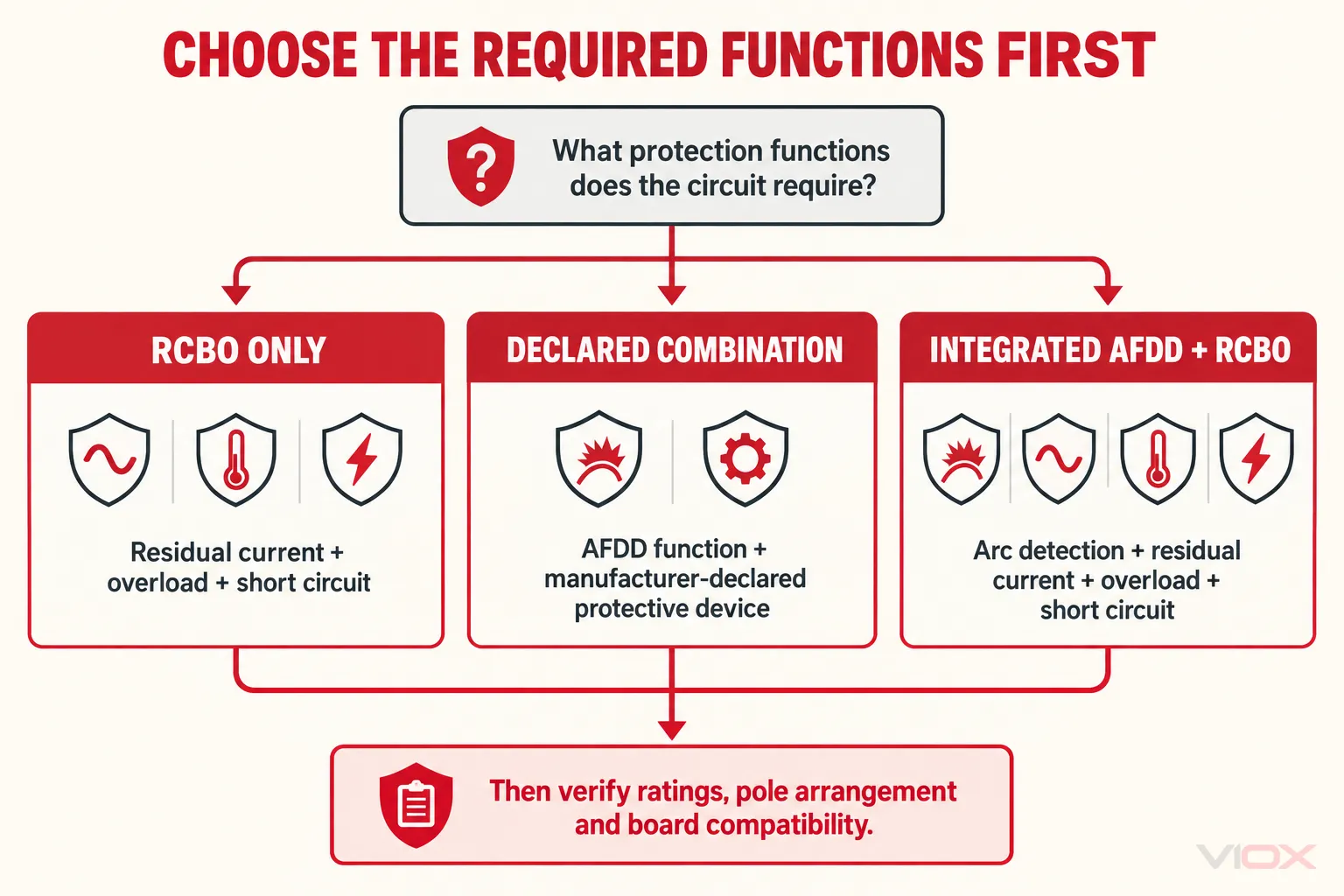
Do not place an arbitrary AFDD and RCBO together merely because both fit a DIN rail. Mechanical fit does not establish electrical coordination, terminal compatibility, thermal suitability or compliance of the assembly.
If you have already decided that a combined unit is required, continue to the dedicated AFDD + RCBO selection guide. It converts the circuit requirements into a complete device specification.
Selection Checks After You Choose the Protection Architecture
The comparison answers which functions are needed. It does not complete device selection. Check the following against the actual circuit and board:
| Design input | Device information to verify | Why it matters |
|---|---|---|
| Supply system | Rated voltage, frequency and supported configuration | The device must be declared for the supply |
| Load and conductor | Rated current and applicable derating | The conductor must remain correctly protected |
| Starting current and fault conditions | Overcurrent characteristic | Normal inrush and required disconnection must both be considered |
| Connected equipment | Residual-current type | Electronic loads can affect the required waveform capability |
| Protection design | Rated residual operating current | Sensitivity and coordination are separate from ampere rating |
| Prospective fault current | Breaking capacity and documented backup protection | The device must safely interrupt the assessed fault level |
| Circuit arrangement | Number of poles and neutral switching/protection | Width alone does not reveal the internal pole arrangement |
| Distribution board | Approved device series, busbar, terminals, dimensions and thermal limits | DIN-rail mounting alone does not prove assembly compatibility |
| Project evidence | Datasheet, instructions, declarations and required certificates | Claims must cover the exact model and rating ordered |
Several markings are easy to confuse. In a label such as “C20, Type A, 30 mA,” C describes an overcurrent characteristic, 20 A is the rated current, Type A describes residual-current waveform capability and 30 mA is the rated residual operating current. None of those values, by itself, states the short-circuit breaking capacity or confirms AFDD functionality.
Likewise, a test button has a defined manufacturer procedure. It is not a substitute for installation verification or a universal test of every protective function. For operation and records, use the dedicated guide on how to test an AFDD.
Standards and Regional Requirements
Product standards describe device scope and test requirements; installation rules decide where and how protection is applied. IEC 61009-1 is relevant to RCBOs, while IEC 62606 addresses AFDDs. A standard number printed on a device or web page is not, by itself, evidence that every variant is independently certified or suitable for every jurisdiction.
National requirements can change and differ by building type, circuit and project date. For example, the IET currently lists BS 7671:2018+A4:2026 and notes a transition in which Amendment 3:2024 remains valid until 15 October 2026. Use the edition applicable to the project rather than relying on a static online summary. IET BS 7671 edition checker
For the boundary between product standards, installation rules and documentary evidence, see the IEC 62606 AFDD guide.
Applying the Comparison to VIOX Products
The VIOX RCBO range is the correct starting point when the required architecture is residual-current plus overcurrent protection without a dedicated AFDD function.
The VIOX AFDD range includes integrated products whose published markings identify both IEC/EN 62606 and IEC/EN 61009-1 functions. In that case, “AFDD” is the product category, while the exact model can also include RCBO protection. Verify the chosen model’s current rating, curve, residual type and sensitivity, breaking capacity, pole arrangement and board compatibility before ordering.
Send VIOX the supply details, design current, required overcurrent characteristic, residual-current requirement, prospective short-circuit current, board make and series, destination market, quantity and required documents. That information allows the offered device to be checked against the complete protection requirement rather than only the words “RCBO” or “AFDD.”
Frequently Asked Questions
Is an AFDD better than an RCBO?
Not as a general comparison. An AFDD and an RCBO target different fault conditions. The correct architecture is the one that supplies every protection function required by the circuit and applicable rules.
Can an AFDD replace an RCBO?
Only when the exact AFDD product is explicitly declared to include the necessary RCBO functions and meets all circuit requirements. The AFDD category name alone is insufficient.
Does an RCBO protect against arc faults?
An RCBO may operate if an arc also creates sufficient overcurrent or residual-current imbalance, but it does not provide dedicated AFDD detection. A current-limited series arc can remain outside those operating conditions.