このページについて
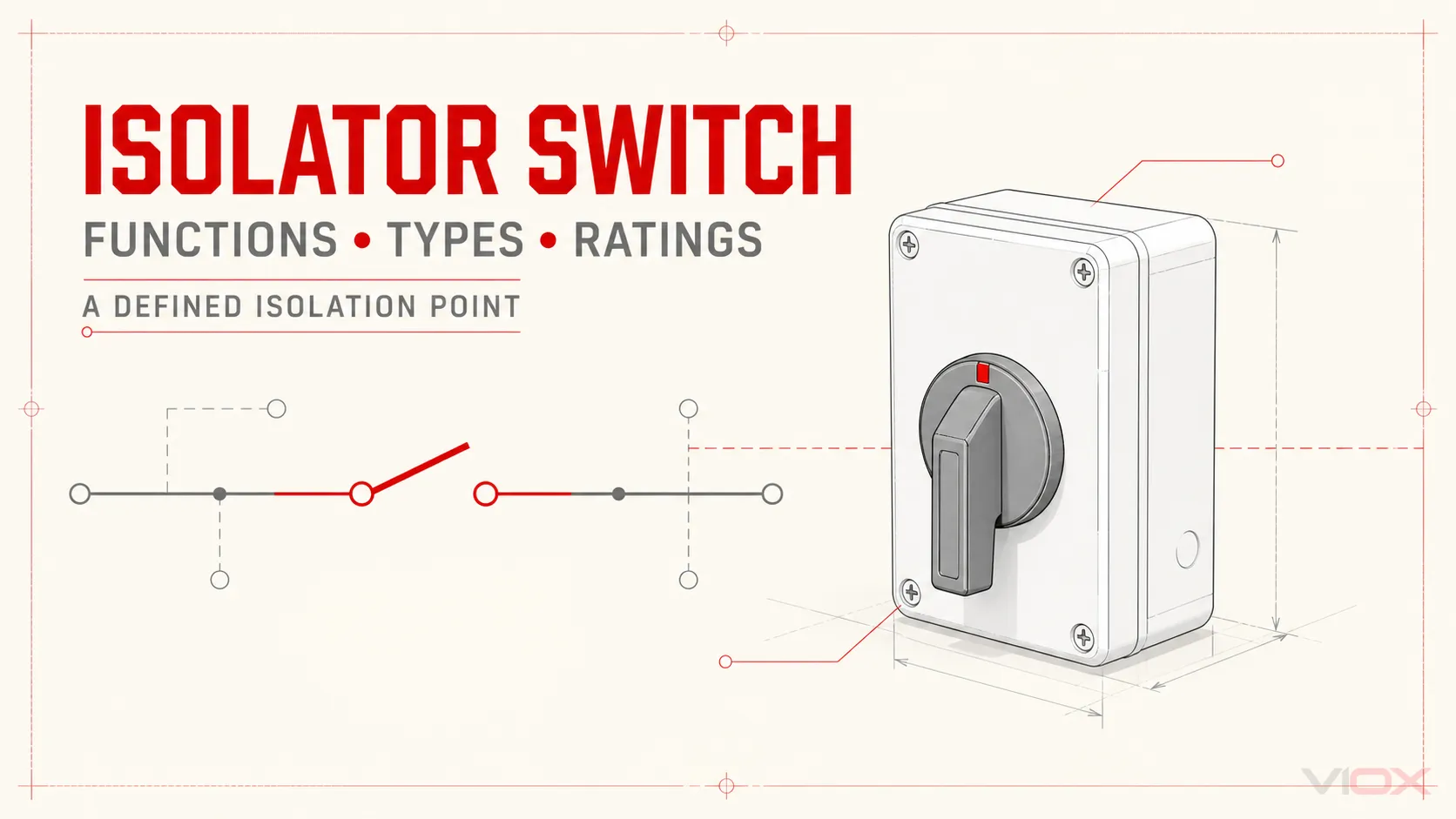
アン アイソレータスイッチ is a mechanical switching device used to separate a circuit or item of equipment from its electrical supply. Its primary job is to provide a defined isolation point for inspection, servicing, replacement, or lockout—not to detect overloads or short circuits.
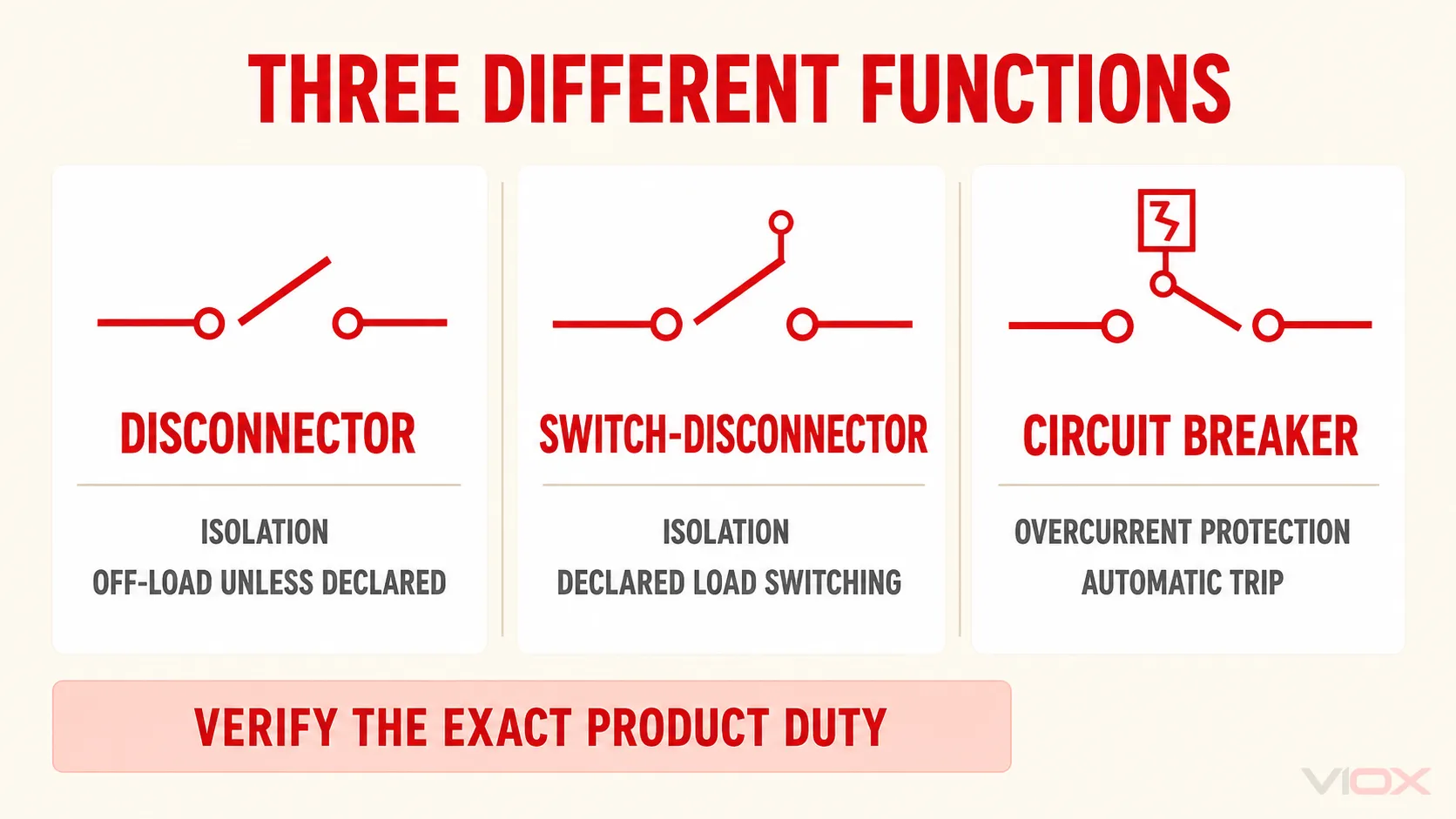
The name alone does not establish what the device may interrupt. In IEC terminology, a 断路器 provides isolation in the open position. A 断路器 provides isolation and can also make and break current within its declared switching duty. Many products marketed as “isolator switches” are switch-disconnectors, while others are intended for off-load isolation. The exact datasheet and device marking decide which function is available.
Opening an isolator is also not, by itself, proof that a work area is de-energized. Safe electrical isolation depends on the complete system, every possible source, an appropriate operating procedure, locking where required, and verification by qualified personnel under the applicable rules.
Find the Right Isolator Switch Guide
This page provides the topic map. Use the route that matches the question you actually need to answer.
| Your question | What this page establishes | Continue with |
|---|---|---|
| What does an isolator switch do? | It creates a deliberate electrical separation point; it does not automatically provide fault protection | Continue below |
| Is an isolator the same as a disconnector or load-break switch? | The words overlap in commerce, but the declared switching and isolation functions differ | Isolator vs disconnector vs switch-disconnector |
| Do I need a breaker or an isolator? | Protection and isolation are different system functions and often coexist | Circuit breaker vs isolator switch |
| Is the application AC or DC? | The supply type changes the switching duty and arc-control requirements | DC isolator vs AC isolator switch |
| Is this a three-phase circuit? | Pole arrangement and neutral treatment must match the system | 3-phase isolator switch guide |
| What do the DC ratings mean? | Voltage, current, poles, utilization category, and coordination must be read together | DC isolator switch ratings |
| Does the device need an outdoor enclosure? | Enclosure suitability is separate from the switching function | Indoor vs outdoor isolator switches |
What an Isolator Switch Does—and Does Not Do
An isolator switch establishes a controlled open state between a supply and the part of the installation that needs to be separated. Depending on the product, its operating mechanism may provide positive contact indication, a directly visible gap, or another standard-defined means of confirming the open position. A padlockable handle can help prevent unintended re-closing when the installation procedure requires it.
The device may disconnect one conductor or several conductors together. Which conductors must be switched is a system and regulatory question; it cannot be decided from a generic label such as 2P, 3P, 3P+N, or 4P without checking the circuit and the product diagram.
| Function or claim | Basic disconnector / isolator | 開閉器(スイッチ・ディスコネクタ) | 漏電ブレーカー |
|---|---|---|---|
| Provides an isolation function when correctly selected and installed | あり | あり | Only when the exact breaker is declared suitable for isolation |
| Makes and breaks normal load current | Not unless declared for that duty | はい、その定格使用カテゴリーの範囲内であれば可能です | Yes, within its declared ratings and application limits |
| Detects overload or short-circuit current | No | No | あり |
| Opens automatically during an overcurrent fault | No | No | Yes, according to its trip characteristics |
| Requires short-circuit coordination with another protective device | Normally | Normally | Must have adequate breaking capacity and coordination for the installation |
The comparison is functional, not a substitution rule. A switch-disconnector still does not become a circuit breaker, and a breaker should not be treated as a maintenance isolator unless its documentation, marking, and installation permit that use.
How an Isolator Switch Works
Moving the handle or actuator changes the position of the main contacts through a mechanical linkage. In the open state, the device provides the separation required by its declared isolation function. In a multipole device, the mechanism operates the relevant poles together so the intended conductors change state as one device.
What happens during the opening movement depends on the product class:
- A 断路器 is selected primarily for isolation. It may be intended to operate only when current is absent or negligible.
- A 断路器 includes a switching function and is evaluated for making and breaking current under stated conditions.
- A ヒューズ内蔵型スイッチ断路器 combines switching and isolation with fuse links that provide the declared overcurrent-protection function.
This distinction is why external appearance is unreliable. Two enclosed rotary devices can use similar handles while having different voltage ratings, utilization categories, short-circuit coordination requirements, and permitted switching duties.
Main Types of Isolator Switches
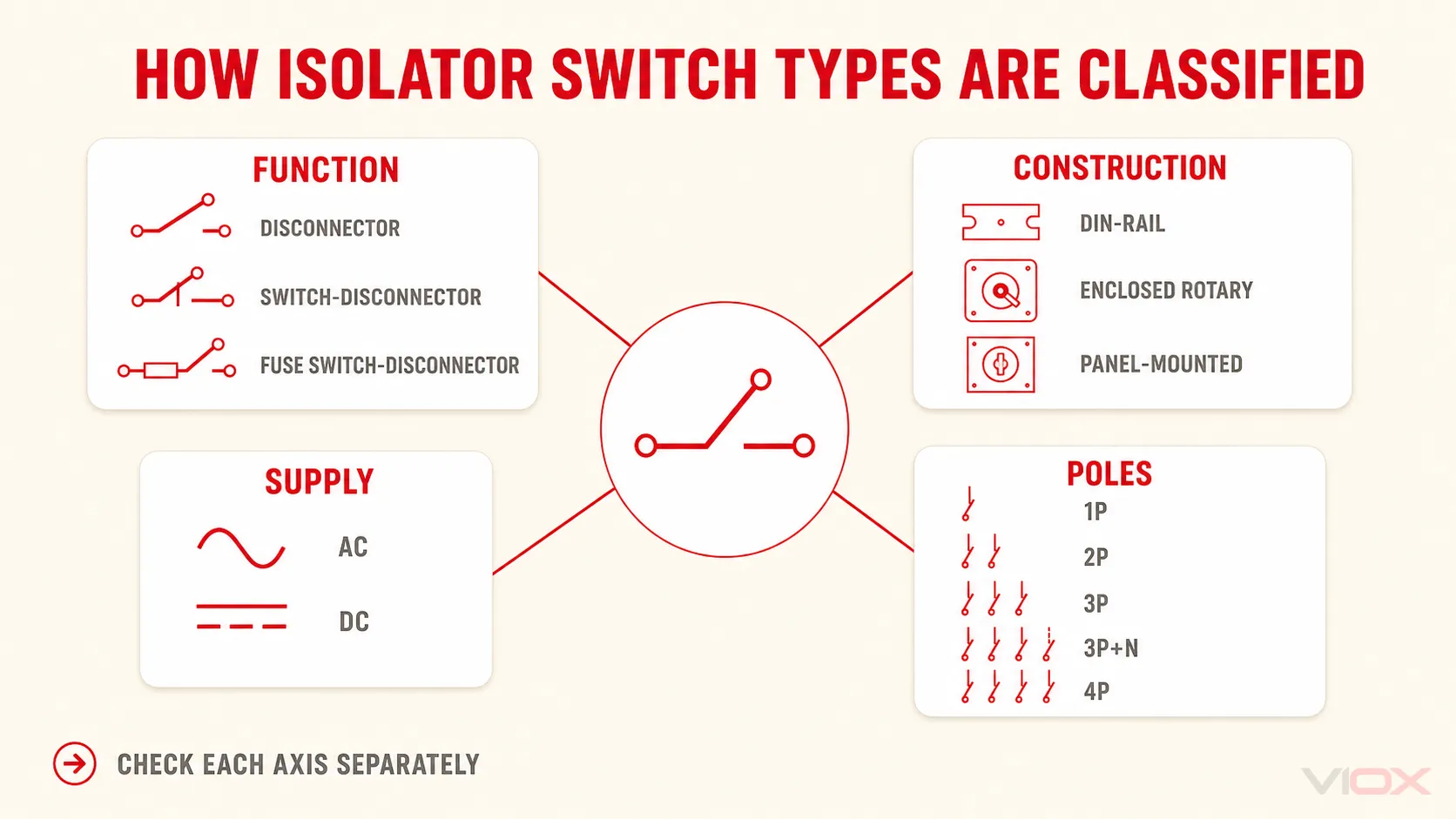
“Type” can refer to function, physical construction, supply, pole arrangement, or application. These classifications should not be mixed.
| 分類 | Common forms | 分類が示す内容 | 依然として検証が必要な事項 |
|---|---|---|---|
| Functional duty | Disconnector, switch-disconnector, fuse switch-disconnector | Whether the device isolates, switches load, or integrates fuse protection | Exact rated duty, coordination, and market approval |
| 建設 | Modular DIN-rail, enclosed rotary, panel-mounted, molded-case | How the device mounts and is operated | Electrical function, enclosure rating, terminals, and accessories |
| 供給システム | AC isolator, DC isolator | Which current type the design addresses | Operational voltage, pole arrangement, utilization category, and polarity rules |
| 開閉される導体 | 1P, 2P, 3P, 3P+N, 4P | Number or arrangement of poles offered | Which poles switch, neutral behavior, and circuit suitability |
| Protection arrangement | Non-fused or fused | Whether fuse protection is integrated | Fuse class, rating, replacement rules, and upstream/downstream coordination |
| 環境 | Open device or enclosed indoor/outdoor assembly | Whether an enclosure is included | Verified IP or enclosure type rating and installation conditions |
Modular Isolator Switches
Modular devices mount on a DIN rail in distribution boards and control panels. Some are disconnectors; others are switch-disconnectors. Module width and current rating do not prove busbar compatibility or switching duty, so the exact product family must be checked.
Enclosed Rotary Isolators
An enclosed rotary isolator combines the switching device, external handle, and enclosure. It is commonly used as a local disconnection point near machinery, HVAC equipment, pumps, and outdoor equipment. The enclosure’s environmental rating and the internal device’s electrical duty are separate specifications.
DCアイソレーター
DC isolators are designed for declared DC circuits such as photovoltaic arrays, batteries, telecom power, or other DC distribution. DC voltage, current, pole configuration, polarity, and switching duty must all match the application. An AC rating must not be transferred to a DC circuit by assumption. The dedicated guide explains 直流アイソレータスイッチとは.
Three-Phase Isolators
Three-phase isolators operate multiple poles together for three-phase circuits. Whether the neutral is switched depends on the system, product arrangement, and applicable rules. The separate 3-phase isolator guide owns that deeper system question.
Isolator Switch Ratings: What to Read on the Datasheet
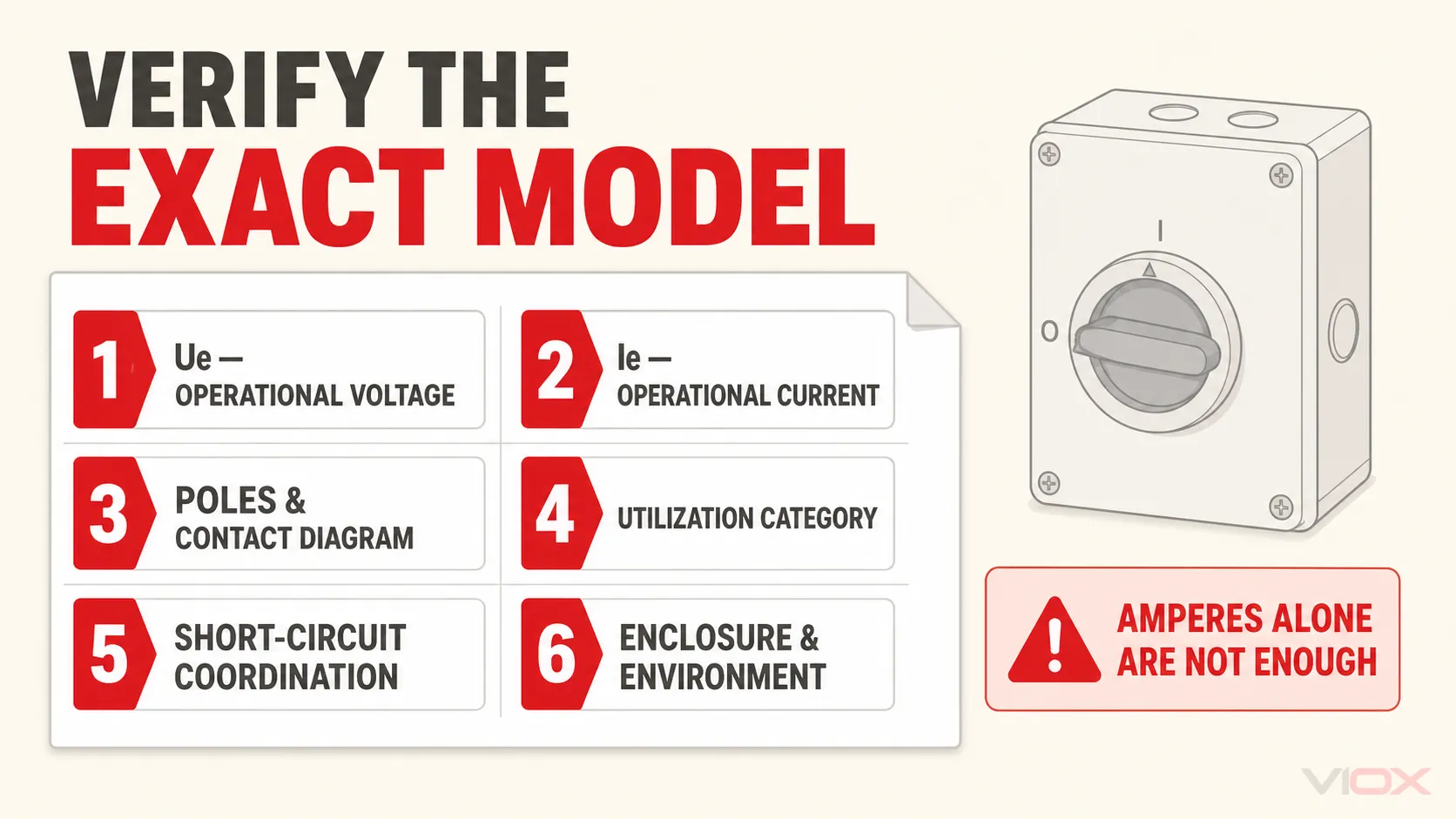
The headline ampere value is not enough to specify an isolator switch. Use the datasheet to establish the complete declared duty.
| データシートの項目 | 制御対象 | よくある間違い |
|---|---|---|
| Rated operational voltage, Ue | The system voltage and duty for which performance is declared | Applying an AC voltage rating to DC |
| Rated operational current, Ie | Current capability under stated operating conditions and utilization category | Treating one current value as valid for every load type |
| Number of poles and contact diagram | Which conductors pass through operated contacts | Assuming 3P+N and 4P constructions are identical across manufacturers |
| 利用カテゴリー | The load and switching duty for which the device is evaluated | Assuming every “isolator” can switch motors or inductive loads |
| Isolation suitability and marking | Whether the product provides the declared disconnector function | Relying on the handle position or product nickname alone |
| Short-time withstand or conditional short-circuit data | How the device coordinates with the prospective fault current and upstream short-circuit protective device | Confusing withstand or making capability with fault-current interruption |
| Frequency and supply type | The electrical system for which ratings apply | Ignoring frequency, AC/DC, or polarity limits |
| Enclosure or IP rating | Environmental protection of the assembled product | Assuming the internal switch and complete enclosure have the same rating |
| Ambient and installation conditions | Conditions under which the published ratings remain valid | Ignoring derating, enclosure temperature, altitude, or terminal limits |
IEC 60947-3:2020+AMD1:2025, available from IEC as a consolidated version, covers low-voltage switches, disconnectors, switch-disconnectors, and fuse-combination units within the standard’s stated scope. It also addresses short-circuit coordination and declared utilization duties. Compliance with a product standard does not automatically satisfy every installation rule or national approval requirement.
North American terminology follows different product categories. For example, UL Solutions distinguishes branch-circuit disconnects and standards such as UL 98 from some industrial-control disconnecting devices. A product selected for an IEC project should therefore not be assumed interchangeable with a North American disconnect solely because the current and voltage labels look similar.
Common Isolator Switch Applications
The application determines which branch of the topic matters next.
| の応用 | Isolation objective | Typical device path to evaluate |
|---|---|---|
| Distribution board or sub-panel | Separate a board or section for service | Main switch-disconnector or another approved isolating device |
| Motor, pump, conveyor, or machine | Provide a local, lockable disconnection point | Enclosed switch-disconnector matched to the motor or load duty |
| HVAC and building-services equipment | Allow service near the equipment | Local enclosed isolator or switch-disconnector with suitable environmental rating |
| Solar PV array or inverter input | Isolate a declared DC section | Purpose-rated DC disconnector or DC switch-disconnector |
| バッテリーまたはDCキャビネット | Separate a DC source or subsystem | DC-rated isolation device coordinated with the protection architecture |
| 産業用制御盤 | Provide a main or local isolation function | Panel-mounted switch-disconnector, fused switch-disconnector, or approved disconnect arrangement |
An isolator switch should not automatically be labeled an emergency-stop device. Emergency switching, emergency stopping, protective disconnection, and maintenance isolation are separate functions that may require different devices, control logic, locations, and standards.
Isolator Switch vs Circuit Breaker, Contactor, and Selector Switch
An isolator switch is sometimes confused with other devices that also change circuit state.
- A 漏電ブレーカー detects and interrupts specified overcurrent conditions; an isolator does not. See the full circuit breaker vs isolator switch comparison.
- A 接触器 is an electrically operated switching device used for frequent control of loads. It should not be assumed to provide the same maintenance-isolation function as a declared disconnector.
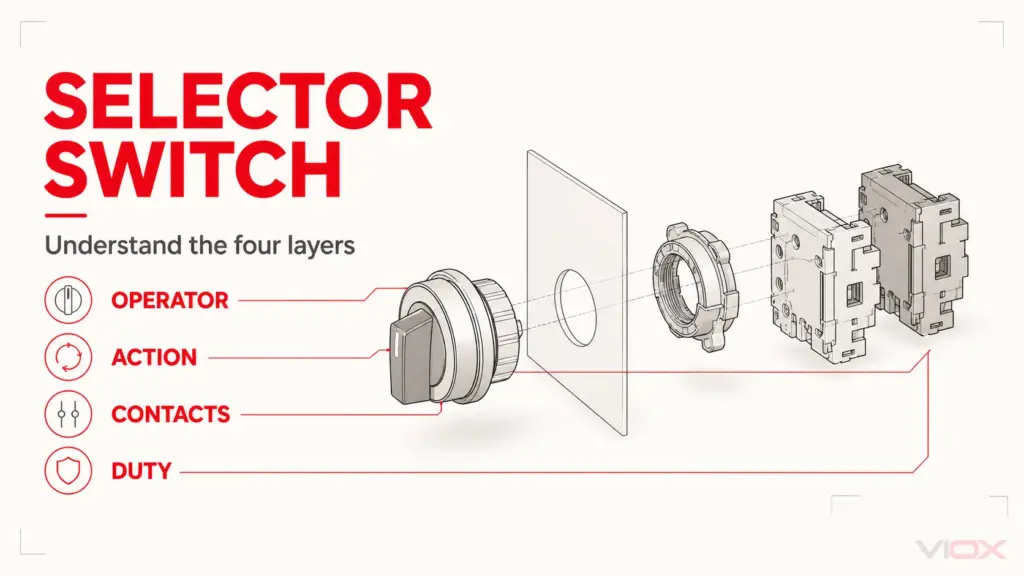
- A セレクタスイッチ is normally a control-circuit command device. It can request ON, OFF, AUTO, or another operating mode, but it does not usually isolate the power circuit.
- A 転送開閉器 changes a load between sources. Source transfer and maintenance isolation are related system decisions but not the same function.
From Definition to Product Evaluation
Before comparing products, define whether the installation needs isolation only, rated load switching plus isolation, or integrated fuse protection. Then confirm the supply type, operational voltage, load current and duty, poles, short-circuit coordination, enclosure, operating handle, locking provisions, and destination-market requirements.
VIOX organizes available models in the isolator switch product category. Treat that page as a product-evaluation step rather than a substitute for the circuit specification. For a model-level enquiry, send the system voltage, AC or DC duty, load type, rated current, pole arrangement, enclosure requirement, destination market, and required quantity to [email protected].