

On this page
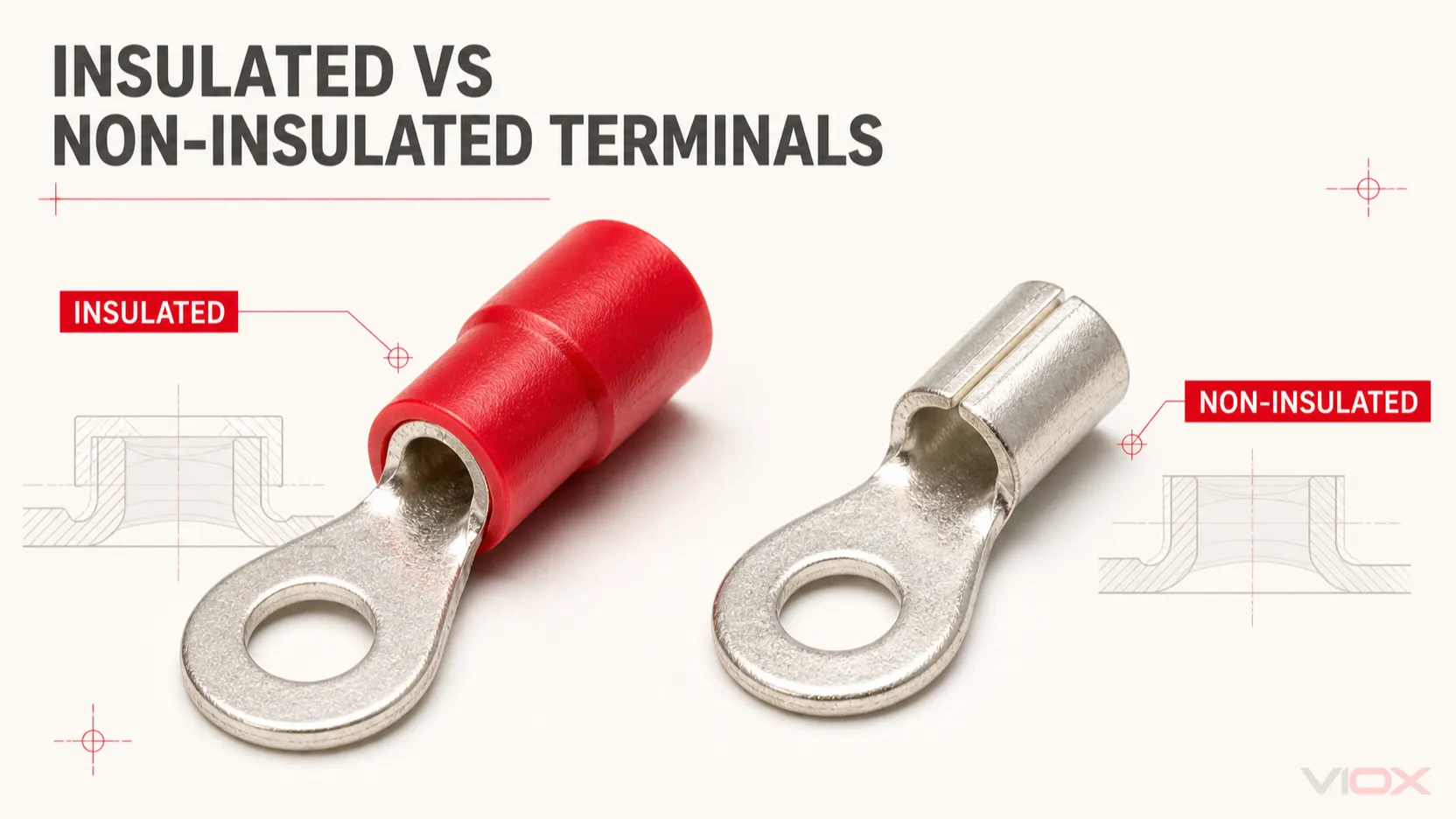
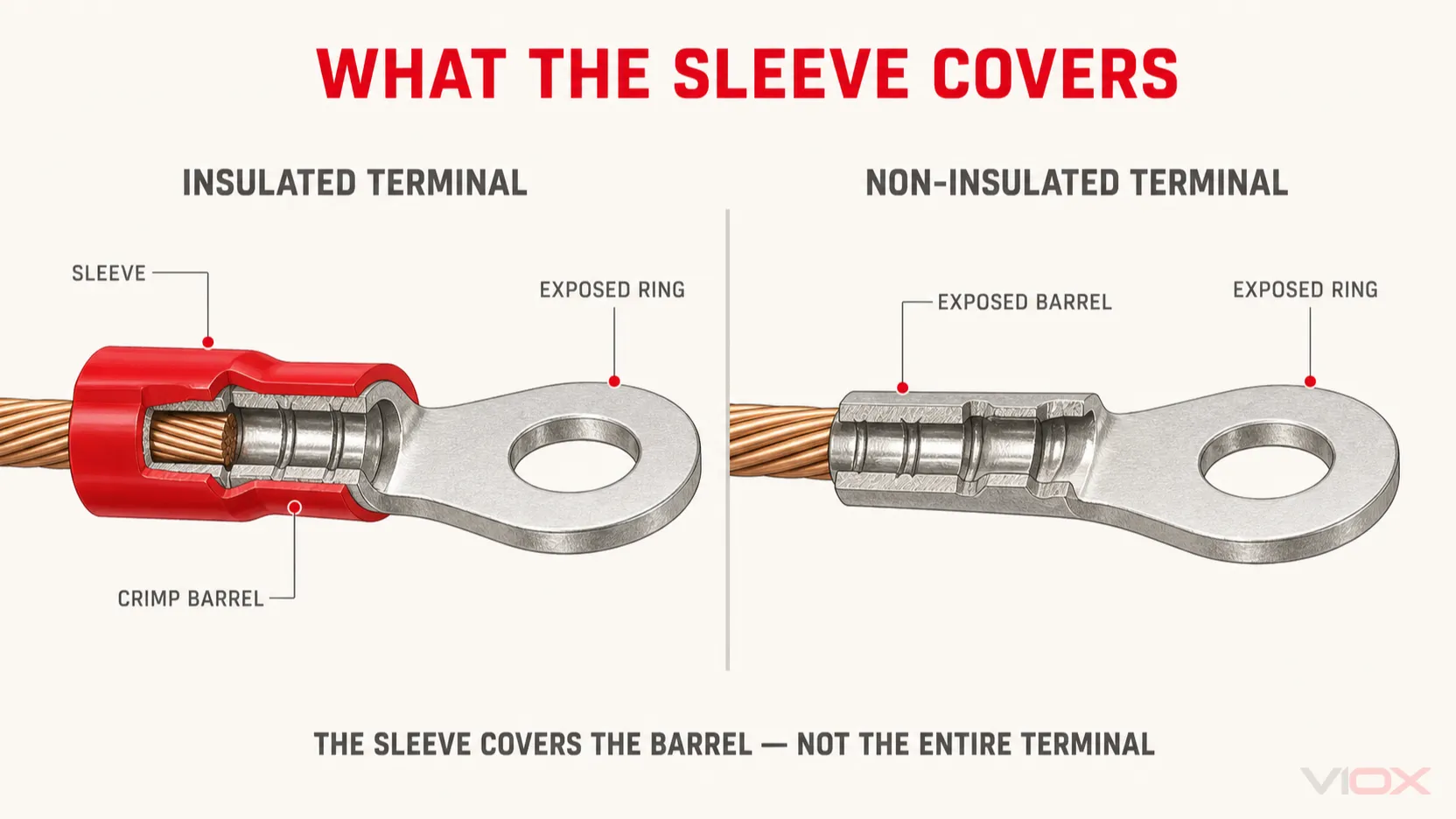
Insulated terminals include a dielectric sleeve around the crimp barrel; non-insulated terminals leave the metal barrel exposed. Choose an insulated terminal when reducing accidental contact around the crimp barrel, separating nearby conductive parts, or supporting the wire entry is important. Choose a non-insulated terminal when space is limited, the crimp must remain fully visible, or the completed connection will receive suitable insulation or remain inside a protected assembly.
Neither type is automatically safer, stronger, or higher-current. Connection reliability depends on the complete combination of terminal, conductor, crimp geometry, tooling, and installation environment. The terminal manufacturer’s application data should control the final selection.
Insulated vs Non-Insulated Terminals: Quick Comparison
| Selection factor | Insulated terminal | Non-insulated terminal |
|---|---|---|
| Crimp-barrel covering | Vinyl, nylon, heat-shrink, or another specified dielectric sleeve | Exposed metal barrel |
| Barrel-area contact reduction | The sleeve reduces accidental contact around the crimp barrel; the ring, fork, tab, or pin may remain exposed | Must come from enclosure design, spacing, a boot, heat-shrink, or another method |
| Installed profile | Usually larger | Usually more compact |
| Crimp inspection | Sleeve may limit the visible area | Barrel deformation is easier to inspect |
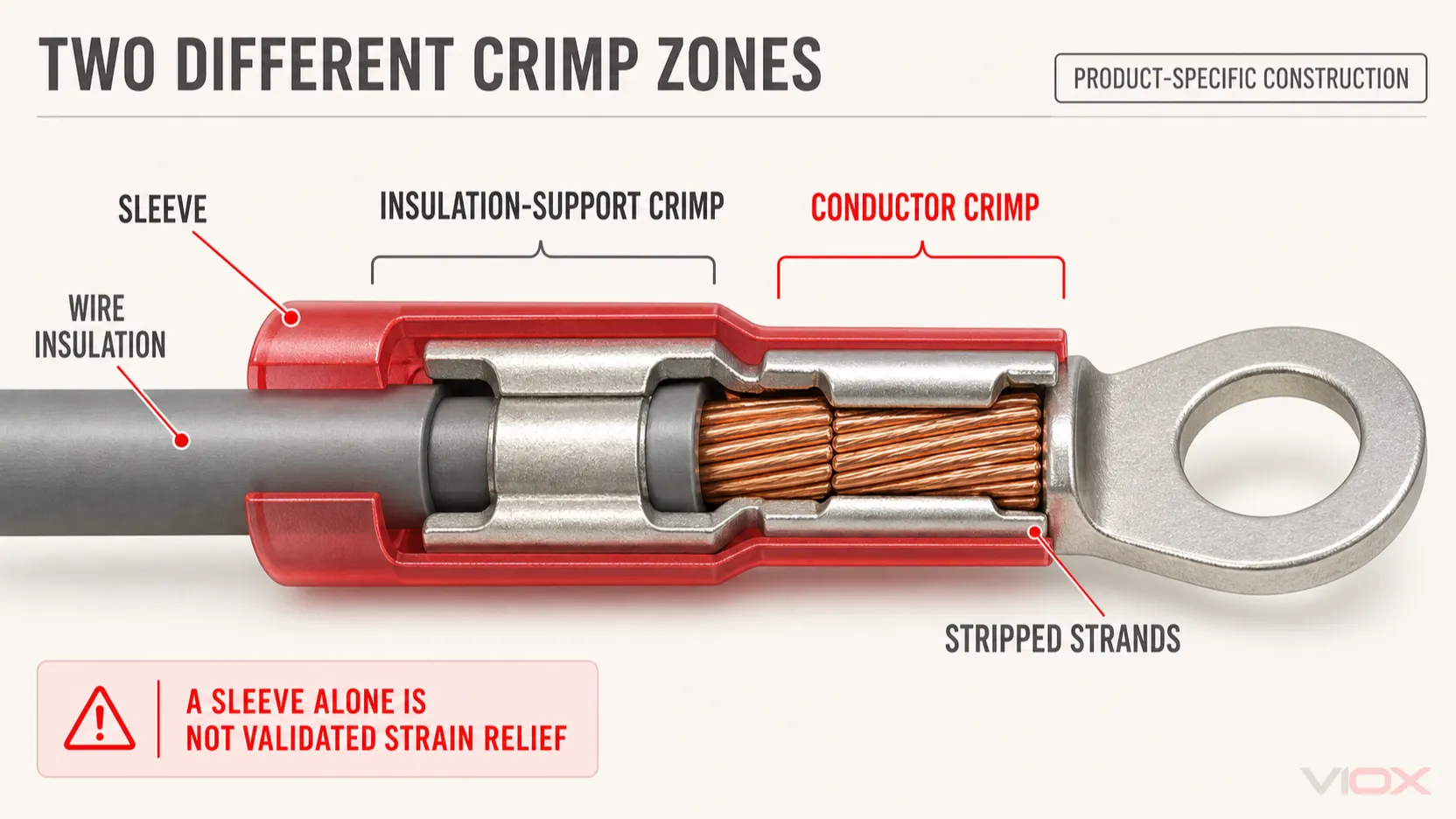
| Wire-entry support | May be provided by a defined insulation-support barrel or double-crimp construction; the sleeve alone is not validated strain relief | Depends on terminal geometry and any secondary support |
| Moisture sealing | Only when the specific product is designed and rated as a sealed connection | None by itself; separate sealing is required when needed |
| Tooling | Use the tool and die specified for that terminal family | Use the tool and die specified for that terminal family |
| Typical fit | General equipment wiring, service work, exposed barrel locations, and applications needing integrated insulation | Enclosed equipment, compact assemblies, harness production, bonding connections, or connections insulated after crimping |
The word non-insulated describes the terminal construction, not the safety of the finished assembly. A non-insulated terminal can be appropriate when another part of the design provides the required protection. An insulated terminal can still be unsuitable if its voltage rating, temperature rating, wire range, material, or crimp tooling does not match the application.
What Is an Insulated Terminal?
An insulated crimp terminal has a factory-applied sleeve around all or part of the wire barrel. Common terminal styles include ring terminals, fork or spade terminals, pin terminals, quick-disconnects, and butt splices.
Depending on the product design, the sleeve may:
- reduce accidental contact with the crimp barrel;
- help separate adjacent conductive parts;
- support the wire insulation near the barrel entry;
- identify a conductor-size range within that manufacturer’s product family; or
- provide environmental sealing when it is a purpose-designed, correctly installed heat-shrink terminal.
The sleeve does not make every insulated terminal waterproof, vibration-proof, or suitable for the same temperature. Those properties are product-specific and must be checked in the datasheet or approval documentation.
A sleeve does not automatically provide a validated strain-relief crimp. Some terminals use a separate insulation-support barrel or a defined double-crimp construction, which must be applied with the specified tooling.
What Does Non-Insulated Mean?
A non-insulated terminal has no factory-applied dielectric sleeve over the crimp barrel. It may be made from copper, tinned copper, brass, or another specified conductive material, depending on the terminal type and application.
Because the barrel remains visible, non-insulated terminals offer three practical advantages:
- Smaller installed size: useful in compact connectors, harness branches, and tightly arranged equipment.
- Direct visual inspection: the crimp shape, conductor position, and barrel condition are easier to examine.
- Flexible finishing: the assembler can add a specified boot, sleeve, heat-shrink tube, connector housing, or other insulation after crimping.
They also require more design discipline. The finished connection must still satisfy the equipment’s requirements for insulation, spacing, strain relief, environment, and access to live parts.
Which Type Should You Use?
Use the following six-factor decision matrix rather than choosing by price or appearance alone.
| Question | Favor an insulated terminal when… | Favor a non-insulated terminal when… |
|---|---|---|
| Will the barrel remain accessible or close to other conductive parts? | The sleeve reduces accidental contact around the crimp barrel | The enclosure, connector housing, or secondary insulation already provides protection |
| Is installation space restricted? | There is enough clearance for the sleeve and bend radius | A smaller terminal profile is required |
| Does the environment require sealing? | A validated sealed terminal system is available for the environment | A separate, validated sealing method is part of the assembly |
| Must inspectors see the completed barrel deformation? | The product provides an inspection window or transparent sleeve | Full visual access to the crimp is important |
| Is production tooling already qualified? | The approved tool, die, locator, and terminal combination covers the insulated product | The qualified process is built around the non-insulated terminal family |
| Will insulation be applied after crimping? | No additional operation is preferred | Heat-shrink, a boot, housing, or potting is already part of the controlled process |
Choose insulated terminals when barrel covering simplifies the assembly
Insulated terminals are often the practical choice for field wiring, maintenance work, control circuits, and assemblies where a bare barrel could approach an adjacent terminal or grounded surface. They can also simplify inventory and installation when the manufacturer uses sleeve colors to identify conductor ranges.
For moisture or contaminant exposure, do not assume that a vinyl or nylon sleeve creates a seal. Select a terminal specifically designed for environmental sealing and verify its installation method, compatible conductor insulation, heating procedure, and declared rating.
Choose non-insulated terminals when the assembly provides the protection
Non-insulated terminals are often suitable inside connector housings, protected equipment compartments, or controlled harness assemblies. They are also useful when the finished crimp needs to be inspected before a separate sleeve or housing is installed.
For example, the VIOX C45 insert-in copper lug is a specific non-insulated pin-terminal product intended for compatible clamp-style connection applications. It should not be treated as a universal substitute for other non-insulated ring, fork, splice, or contact families.
The enclosure’s IP rating alone does not prove that every exposed terminal arrangement is acceptable. The equipment design must still address spacing, insulation coordination, wire support, access, and the requirements of the applicable product or installation standard.
Insulation Sleeve Types
Insulated terminals are not a single performance class. The sleeve material changes installation behavior and application fit.
| Sleeve construction | Practical characteristics | Verify before selection |
|---|---|---|
| Vinyl or PVC | Economical, common in general equipment wiring | Product temperature rating, flame properties, chemical exposure, and wire range |
| Nylon | Often tougher and more flexible than basic vinyl; some designs permit better visual inspection | Moisture absorption, temperature rating, chemical compatibility, and terminal-specific tooling |
| Heat-shrink | Can provide strain relief and environmental sealing when designed for that purpose | Whether the product is adhesive-lined, the specified recovery process, conductor compatibility, and the declared sealing rating |
| High-temperature polymer | Used where ordinary sleeve materials are unsuitable | Exact material, temperature rating, approval status, tooling, and application limits |
For a deeper discussion of material selection and installation failures, see VIOX’s guide to heat-shrink tube failure prevention.
Are Red, Blue, and Yellow Terminal Colors Universal?
No. Red, blue, and yellow are widely used by many insulated-terminal product families to distinguish conductor ranges, but they should not be described as a universal IEC or UL color code.
For example, some established product families use red for 22–16 AWG, blue for 16–14 AWG, and yellow for 12–10 AWG terminals. Other terminal series use different colors, ranges, insulation thicknesses, or metric mappings. Always verify the terminal part number, conductor cross-section, stranding, and insulation diameter against the manufacturer’s data.
Wire size is only one input. Two conductors with the same nominal AWG or square-millimeter size can have different strand constructions and insulation diameters. That difference can affect wire insertion, insulation support, and finished crimp geometry. For conductor-selection context, see the VIOX wire gauge sizing guide.
Insulated vs Non-Insulated Crimping Tools
Do not select a crimper only because its handle or die is labeled “insulated” or “non-insulated.” The correct tool must match the exact terminal family, conductor range, and crimp geometry.
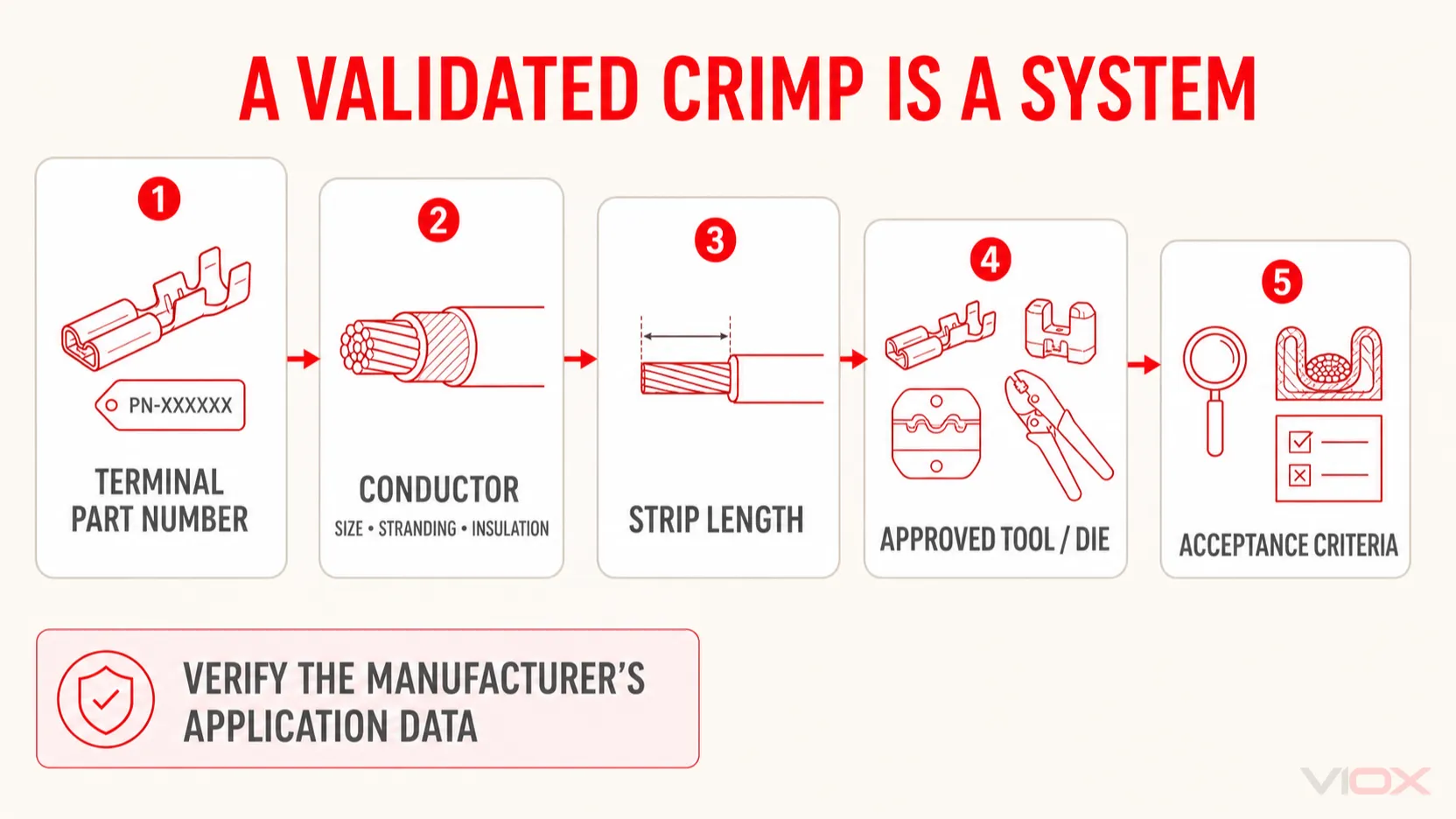
A controlled crimping process should define:
- terminal manufacturer and part number;
- conductor material, size, stranding, and insulation diameter;
- strip length;
- approved hand tool or applicator;
- die, locator, and orientation;
- finished crimp dimensions or other acceptance criteria; and
- inspection and pull-test requirements where applicable.
TE Connectivity’s tooling guidance emphasizes matching the terminal to tooling engineered for its crimp height, width, and geometry. Molex similarly identifies the terminal, wire, and tooling as the three interacting elements that determine crimp quality. A generic die may visibly compress a barrel without producing the connection specified by the terminal manufacturer.
Using an unsuitable die can damage an insulation sleeve, deform the barrel incorrectly, cut conductor strands, leave the conductor loose, or fail to support the wire insulation. If the specified tooling is unavailable, do not treat a visual tug test as proof of an acceptable production crimp.
For a separate comparison of termination processes, read crimping vs soldering.
Standards and Approval Boundaries
Standards apply according to product type, connection design, conductor range, equipment category, and market. A standard reference in an article does not establish that a particular VIOX or third-party terminal is certified.
| Reference | Relevant scope | Practical implication |
|---|---|---|
| IEC 60352-2:2024 | Solderless crimped connections using appropriately designed uninsulated or pre-insulated crimp barrels with stranded conductors from 0.05 to 10 mm² or solid conductors from 0.25 to 3.6 mm diameter; coaxial-cable crimping is excluded | Relevant to crimp connection requirements, tests, and practical guidance for electrical and electronic equipment; verify that the product and application are within scope |
| UL 486A-486B | Wire connectors evaluated for the North American market | Use the certification record and installation information for the specific connector |
| UL 486D | Sealed wire connector systems | Relevant when a declared sealed connection is required |
| UL 486E | Equipment wiring terminals | Applies to covered equipment-wiring-terminal categories |
| UL 486F | Bare and covered ferrules | Relevant to ferrules rather than every ring, fork, pin, or splice terminal |
IEC 60998-1 concerns connecting devices for household and similar low-voltage circuits. It should not be presented as a universal industrial crimp-terminal standard. For an industrial panel or OEM assembly, identify the equipment standard, component category, destination market, and product certification evidence before claiming compliance.
Common Selection and Crimping Mistakes
- Choosing by sleeve color alone. Color is not a substitute for checking the part number and conductor range.
- Assuming every insulated terminal is sealed. A basic sleeve and a validated sealed connector system are different constructions.
- Using a generic crimper without terminal-specific validation. Similar-looking terminals can require different crimp geometry.
- Ignoring conductor stranding and insulation diameter. Nominal wire size alone may not define fit.
- Leaving a non-insulated barrel unprotected without a design review. The finished assembly must provide the required insulation and spacing.
- Assuming insulated and non-insulated versions have identical ratings. Compare the actual product specifications and approvals.
- Adding solder to compensate for a poor crimp. Follow the terminal manufacturer’s termination method rather than improvising a mixed process.
- Treating a pull by hand as full process qualification. Production acceptance may require dimensional checks, documented tooling, pull testing, or other controls.
Terminal Selection Checklist
Before ordering or approving a terminal, record:
- terminal style: ring, fork, pin, disconnect, splice, ferrule, or another type;
- conductor material, nominal size, stranding, and insulation diameter;
- stud, tab, mating, or connector-interface dimensions;
- operating voltage, current, and temperature requirements;
- enclosure, contact-access, and spacing conditions;
- moisture, chemicals, vibration, and mechanical strain;
- need for integrated or secondary insulation;
- required approvals and destination market;
- manufacturer-specified tool, die, and crimp acceptance criteria; and
- packaging and production-volume requirements.
This information is more reliable than asking for an “insulated terminal for 16 AWG wire” without defining the application.
Frequently Asked Questions
Are insulated terminals better than non-insulated terminals?
Not universally. Insulated terminals provide a built-in sleeve and may simplify protection around the barrel. Non-insulated terminals are more compact and easier to inspect, and they can be appropriate when the assembly provides suitable insulation and mechanical support.
Are non-insulated terminals safe?
They can be safe in a correctly designed assembly. The finished connection must provide the required protection against contact, short circuits, movement, and environmental exposure. A bare terminal should not be assumed acceptable solely because it is inside an enclosure.
Can I use a non-insulated crimper on insulated terminals?
Only when the terminal manufacturer explicitly approves that tool and die for the exact part number. A die intended for another terminal construction can damage the sleeve or produce the wrong barrel geometry.
Can I use an insulated-terminal crimper on non-insulated terminals?
Apply the same rule: use the specified tool-terminal combination. A tool can appear to close the barrel while failing to achieve the required crimp shape or compression.
Do insulated and non-insulated terminals have the same current rating?
Do not assume so. Current suitability depends on the terminal material and geometry, conductor, connection interface, temperature conditions, and product evaluation. Compare the ratings of the exact parts being considered.
Should I put heat-shrink over a non-insulated terminal?
Heat-shrink can provide secondary insulation or strain relief when it is compatible with the assembly, but it does not correct an improperly selected or poorly crimped terminal. Where sealing is required, use a validated sealing construction and follow its installation instructions.
Are ferrules the same as insulated crimp terminals?
Ferrules are one category of crimped wire-end termination. Bare and covered ferrules have their own product and application considerations and should not be treated as interchangeable with ring terminals, fork terminals, disconnects, or butt splices.
Final Selection Rule
Choose an insulated terminal when integrated barrel protection and wire-entry support make the finished assembly safer or simpler. Choose a non-insulated terminal when compact size, crimp visibility, or a controlled secondary-insulation process is more important.
Then verify the exact terminal against the conductor, mating interface, environment, approval requirements, and specified tooling. The words “insulated” and “non-insulated” describe only one part of the connection design.
VIOX supplies terminal products for OEM, panel-building, distribution, and wiring applications. Review the VIOX insulated terminal range, see the specific C45 non-insulated insert-in lug, or submit your conductor, terminal style, mating interface, environment, tooling, and destination-market requirements for product matching.