

On this page
Quick Answer: Circuit Breaker vs Isolator Switch
A circuit breaker protects a circuit by automatically tripping during overloads or short circuits. An isolator switch provides a deliberate disconnection point so equipment can be safely inspected or maintained. The breaker is mainly for fault protection. The isolator is mainly for safe isolation. In many electrical systems, both are needed because they solve different problems.
The important nuance is this: not every isolator is a load-breaking device. A pure disconnector or isolator is normally used off-load, while a switch-disconnector or load-break isolator can make and break current within its rated conditions. Likewise, some circuit breakers may be suitable for isolation when their standard, marking, and installation method allow it, but this should never be assumed from the handle alone.
Circuit Breaker vs Isolator Switch: Core Comparison
| Feature | Circuit Breaker | Isolator Switch |
|---|---|---|
| Main function | Automatic protection | Manual isolation |
| Primary job | Interrupt overload or short-circuit current | Disconnect equipment for maintenance or service |
| Trips automatically? | Yes | No |
| Overcurrent protection? | Yes, if correctly selected | No |
| Short-circuit interruption? | Yes, within rated breaking capacity | No, unless part of a protected switch-fuse or special assembly |
| Load switching | Yes, if rated for the application | Only if it is a switch-disconnector or load-break isolator |
| Maintenance isolation | Possible only if listed/marked and installed for isolation duty | Primary purpose |
| Visible or positive isolation | Usually internal contacts; depends on device marking | Often provides clear open indication or visible isolation depending on design |
| Lockout capability | Sometimes available | Commonly required or provided |
| Typical standards | IEC 60898-1, IEC 60947-2, UL 489 | IEC 60947-3, UL 98, UL 98B depending on market |
| Typical products | MCB, MCCB, ACB, DC circuit breaker | Isolator switch, switch-disconnector, DC isolator, fuse switch-disconnector |
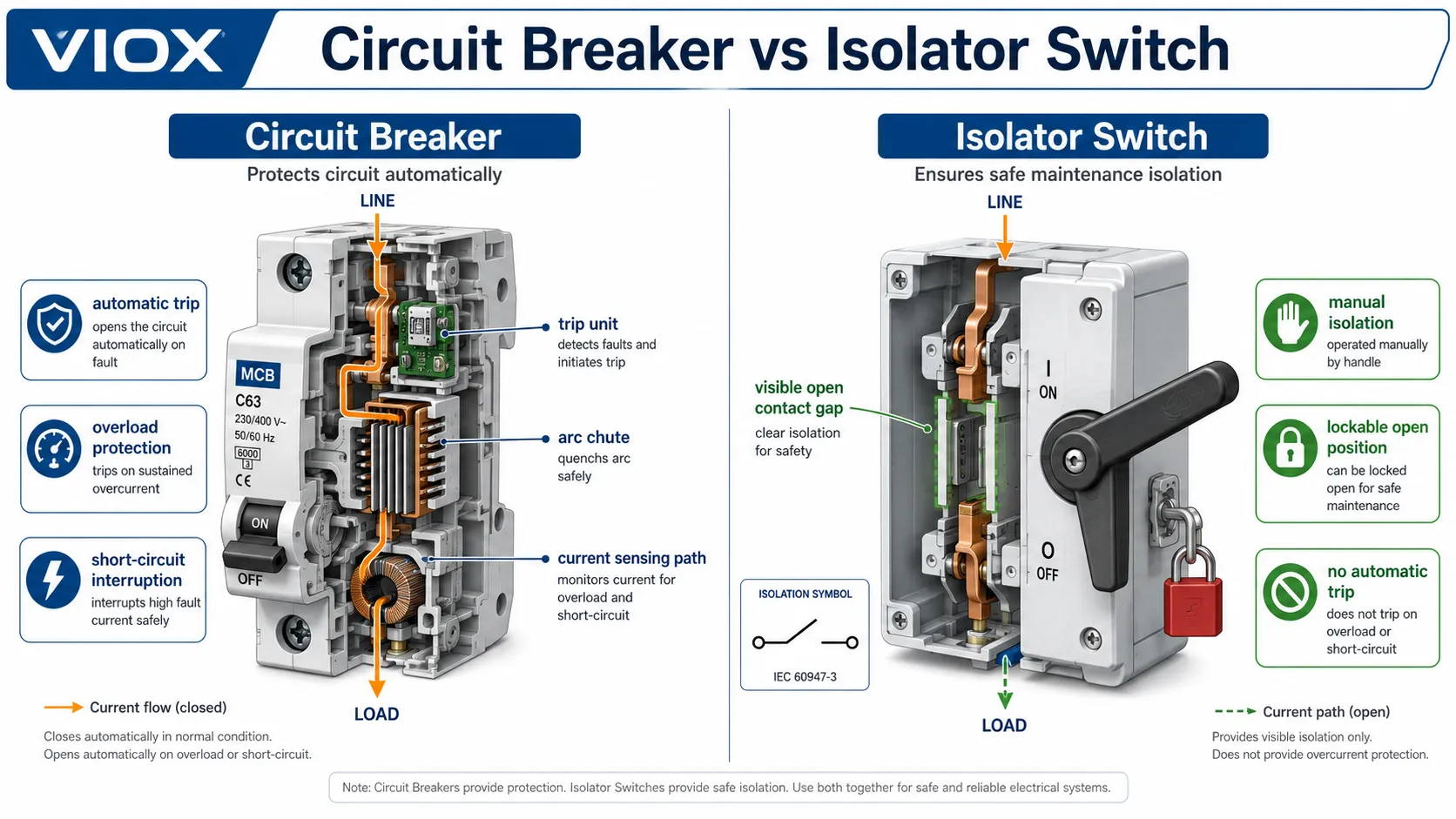
What Is a Circuit Breaker?
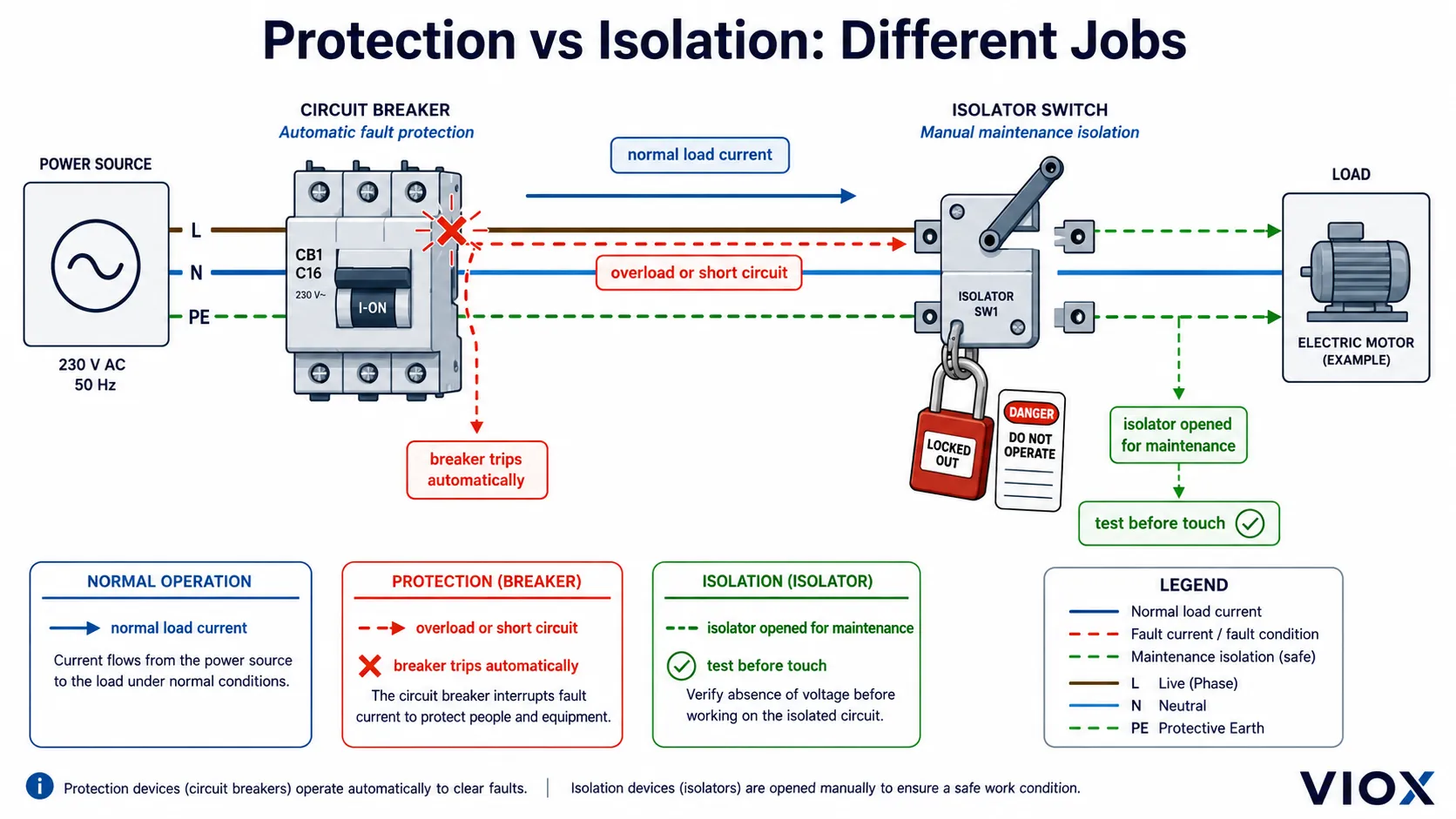
A circuit breaker is an automatic protective device that opens a circuit when current exceeds a safe value. It is designed to protect cables, equipment, and electrical systems from damage caused by overload or short-circuit current.
Common low-voltage circuit breaker types include:
- MCB (Miniature Circuit Breaker) for branch circuits and distribution boards
- MCCB (Molded Case Circuit Breaker) for feeders, larger loads, and industrial panels
- ACB (Air Circuit Breaker) for low-voltage main distribution and high-current switchboards
- DC circuit breaker for solar PV, battery, EV, telecom, and DC distribution systems
For product-level references, see the VIOX MCB and MCCB pages.
What a Circuit Breaker Does
A circuit breaker can:
- carry normal current continuously within its rating
- detect overloads through thermal, electronic, or magnetic trip mechanisms
- detect short circuits through instantaneous or short-time protection
- open automatically without human operation
- extinguish the arc created when contacts separate
- be reset after tripping, if inspection confirms it is safe to re-energize
The critical rating is breaking capacity. A breaker must be able to interrupt the prospective short-circuit current at the installation point. For MCB applications, the guide on 6kA vs 10kA MCB breaking capacity explains this selection boundary in more detail.
What a Circuit Breaker Does Not Always Do
A breaker does not automatically provide the same maintenance confidence as a dedicated isolator. Many breakers have internal contacts that are not visible from outside the enclosure. The handle position may show OFF or TRIPPED, but the contact separation is still inside the device.
That does not mean a breaker can never be used for isolation. Some breakers are rated and marked for isolation function under the relevant standard. The correct question is not "does it look open?" but:
Is this exact breaker listed, marked, and installed as suitable for isolation in this application?
If the answer is unclear, use a dedicated isolator or switch-disconnector for maintenance isolation.
What Is an Isolator Switch?
An isolator switch, also called a disconnector or disconnect switch, is a manually operated switching device used to separate a circuit or item of equipment from its power source. Its main purpose is not fault protection. Its purpose is to create a safe, deliberate isolation point for inspection, service, replacement, or lockout/tagout.
Typical applications include:
- isolating a distribution board
- disconnecting a motor or machine before maintenance
- isolating an inverter, combiner box, or DC circuit
- providing a local equipment disconnect
- separating a feeder or outgoing circuit during service work
For product context, see the VIOX Isolator Switch and Switch Disconnector pages.
What an Isolator Switch Does
An isolator switch can:
- create a defined open position
- provide a local manual disconnection point
- support lockout/tagout procedures
- separate equipment from supply for maintenance
- help technicians verify the intended isolation state
Many isolators include a padlockable handle and position indication. Some designs provide visible contact separation; others provide positive contact indication rather than directly visible contacts. The exact isolation confidence depends on device construction, standard, marking, and installation.
What an Isolator Switch Does Not Do
A basic isolator switch does not:
- detect overload current
- detect short-circuit current
- trip automatically
- replace a circuit breaker or fuse
- necessarily break load current unless specifically rated as a switch-disconnector or load-break device
This is the most common misunderstanding. A high current rating printed on an isolator does not automatically mean it can interrupt fault current. Current-carrying capacity and fault-interrupting capability are different things.
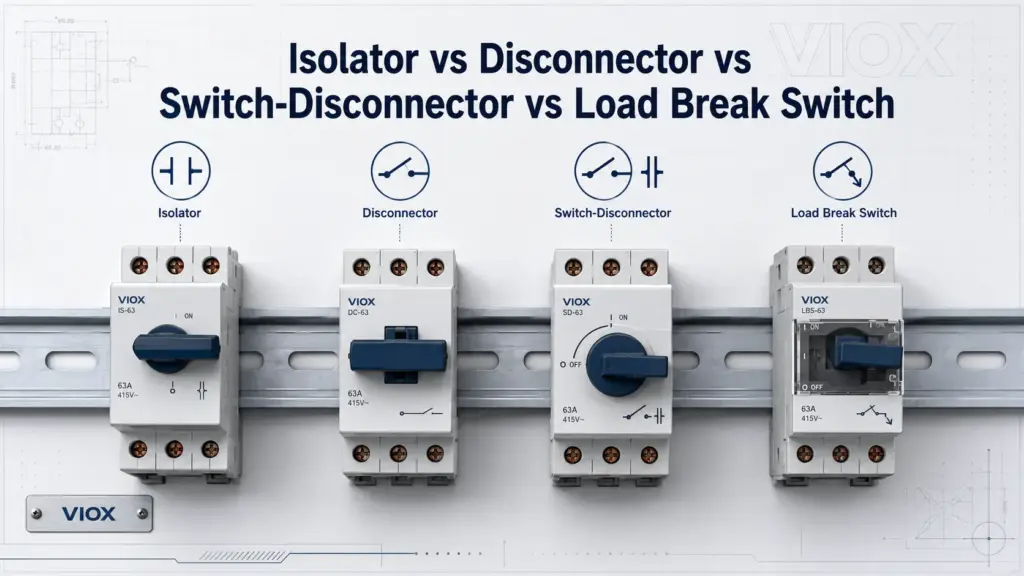
Isolator vs Switch-Disconnector vs Load Break Switch
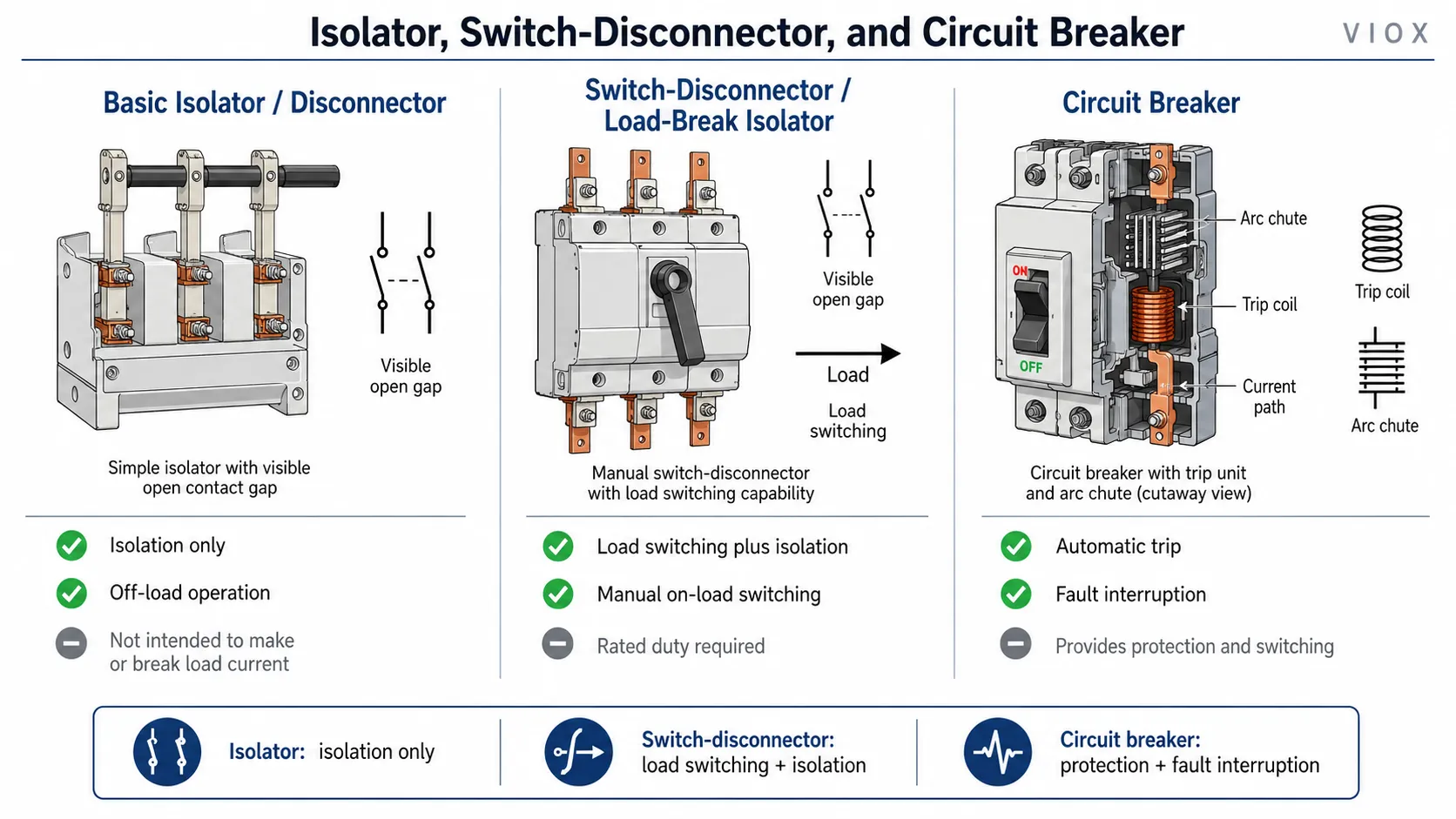
This distinction is the missing piece in many "circuit breaker vs isolator" explanations.
Under IEC 60947-3, the product family includes switches, disconnectors, switch-disconnectors, and fuse-combination units used in distribution and motor circuits up to defined low-voltage limits. These terms are related, but their duties are not identical.
| Device Term | Main Role | Can Break Load Current? | Provides Isolation? | Typical Use |
|---|---|---|---|---|
| Disconnector / isolator | Isolation | Generally off-load only unless otherwise rated | Yes | Maintenance isolation after current is interrupted |
| Switch-disconnector | Switching + isolation | Yes, within rated duty | Yes | Main switch, local disconnect, panel isolation |
| Load break switch | Load switching | Yes, within rated duty | Depends on design and standard | Manual load switching |
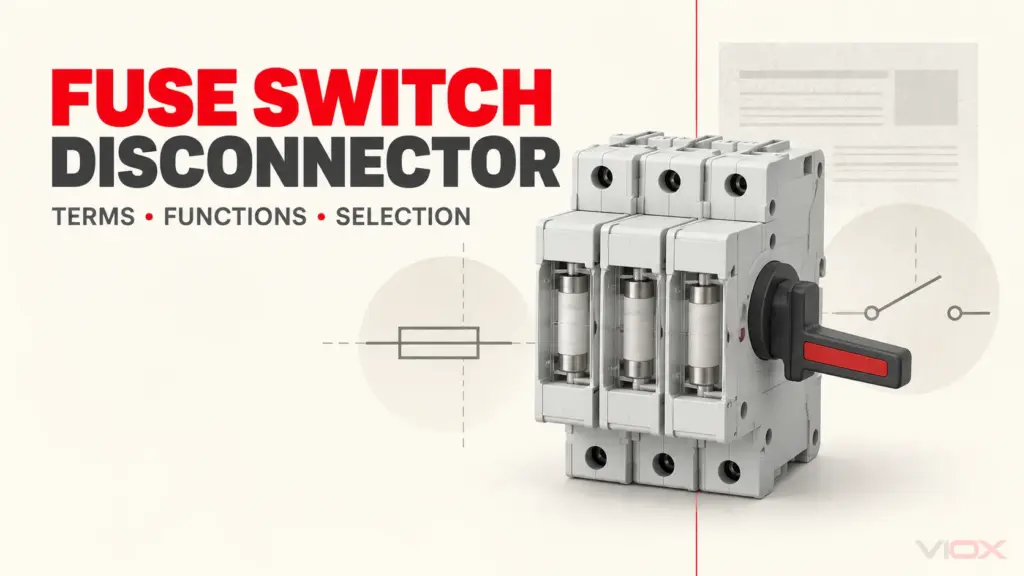
| Fuse switch-disconnector | Isolation + fuse protection | Yes, within rated duty | Yes | Feeder protection and isolation with fuses |
| Circuit breaker | Automatic protection | Yes, within breaking capacity and utilization limits | Only if marked/listed for isolation | Overload and short-circuit protection |
The practical rule:
Do not treat every isolator as a load-break switch. Do not treat every breaker as a maintenance isolator. Read the device marking and datasheet.
Can an Isolator Switch Trip Like a Circuit Breaker?
No. A normal isolator switch does not trip automatically.
It has no thermal-magnetic trip unit, no electronic trip unit, and no automatic overcurrent detection. If a short circuit occurs downstream, the isolator will not sense the fault and open by itself. The circuit must be protected by a properly rated breaker or fuse.
This is why an isolator alone is not a protection device. It is a switching and isolation device. For safe design, it usually works together with protective devices such as:
- MCB
- MCCB
- fuse
- fuse switch-disconnector
- motor protection circuit breaker
- DC breaker or DC fuse
Can a Circuit Breaker Be Used as an Isolator?
Sometimes, but only when the device is designed, marked, and installed for isolation duty.
Some molded case circuit breakers and miniature circuit breakers may be suitable for isolation under applicable IEC or regional standards. In those cases, the manufacturer documentation should clearly state the isolation function, and the installation should provide the required indication and lockout method.
However, a breaker should not be assumed to be an isolator just because it has an OFF position. For maintenance safety, many systems still use a dedicated isolator or switch-disconnector because it gives technicians a clearer and more deliberate disconnection point.
Use a dedicated isolator or switch-disconnector when:
- the maintenance team needs a lockable local disconnect
- the breaker contacts are not visible or not positively indicated
- the breaker is remote from the equipment
- the breaker may need to be maintained itself
- the system requires isolation on both source and load sides
- local code, machine safety rules, or project specifications require it
When Do You Need Both?
Many circuits need both a circuit breaker and an isolator switch because they perform different jobs.
The breaker protects the circuit during operation. The isolator provides a safer disconnection point before maintenance.
| Application | Circuit Breaker Role | Isolator Switch Role | Typical Arrangement |
|---|---|---|---|
| Distribution board feeder | Protects cable and downstream board | Allows board isolation for service | Breaker upstream + main switch-disconnector at board |
| Motor control panel | Protects feeder or motor circuit | Provides local lockable isolation | Breaker or MPCB + local isolator / switch-disconnector |
| HVAC equipment | Protects supply circuit | Allows service disconnect near equipment | MCB/MCCB + local isolator |
| Solar PV combiner box | Protects strings or output circuit if breakers are used | Provides DC-side manual isolation | DC breaker/fuse + DC isolator |
| Battery or DC cabinet | Interrupts overcurrent if DC-rated | Provides manual isolation point | DC breaker/fuse + DC isolator |
| Main incomer panel | Provides short-circuit and overload protection if breaker type | Provides main manual isolation if switch-disconnector type | MCCB/ACB or switch-disconnector depending design |
For solar combiner boxes, the boundary is especially important because DC arcs behave differently from AC arcs. The related guide DC Isolator vs DC Circuit Breaker explains why isolation and overcurrent interruption are separate jobs in PV systems.
Low-Voltage Examples: MCB, MCCB, Switch-Disconnector, and DC Isolator
MCB vs Isolator Switch
An MCB protects final circuits against overload and short circuit. An isolator switch provides manual disconnection. In a small distribution board, the MCBs protect individual outgoing circuits, while the main switch or switch-disconnector may isolate the whole board.
MCCB vs Isolator Switch
An MCCB protects higher-current circuits and feeders. A molded case isolator or switch-disconnector may look similar, but it does not have the same trip mechanism. For a closer product-level comparison, see Molded Case Isolator Switch vs Molded Case Circuit Breaker.
Switch-Disconnector vs Isolator
A switch-disconnector combines switching duty with isolation duty. It can make and break load current within its rating and also provide isolation. A basic off-load isolator is mainly for isolation after current has already been interrupted.
DC Isolator vs DC Circuit Breaker
A DC isolator provides manual isolation on a DC circuit. A DC circuit breaker provides automatic overcurrent protection. DC applications require special attention to voltage, polarity, pole configuration, and arc extinction because DC has no natural current zero-crossing.
For product selection, see the VIOX DC Isolator Switch page.
Correct Operating Sequence
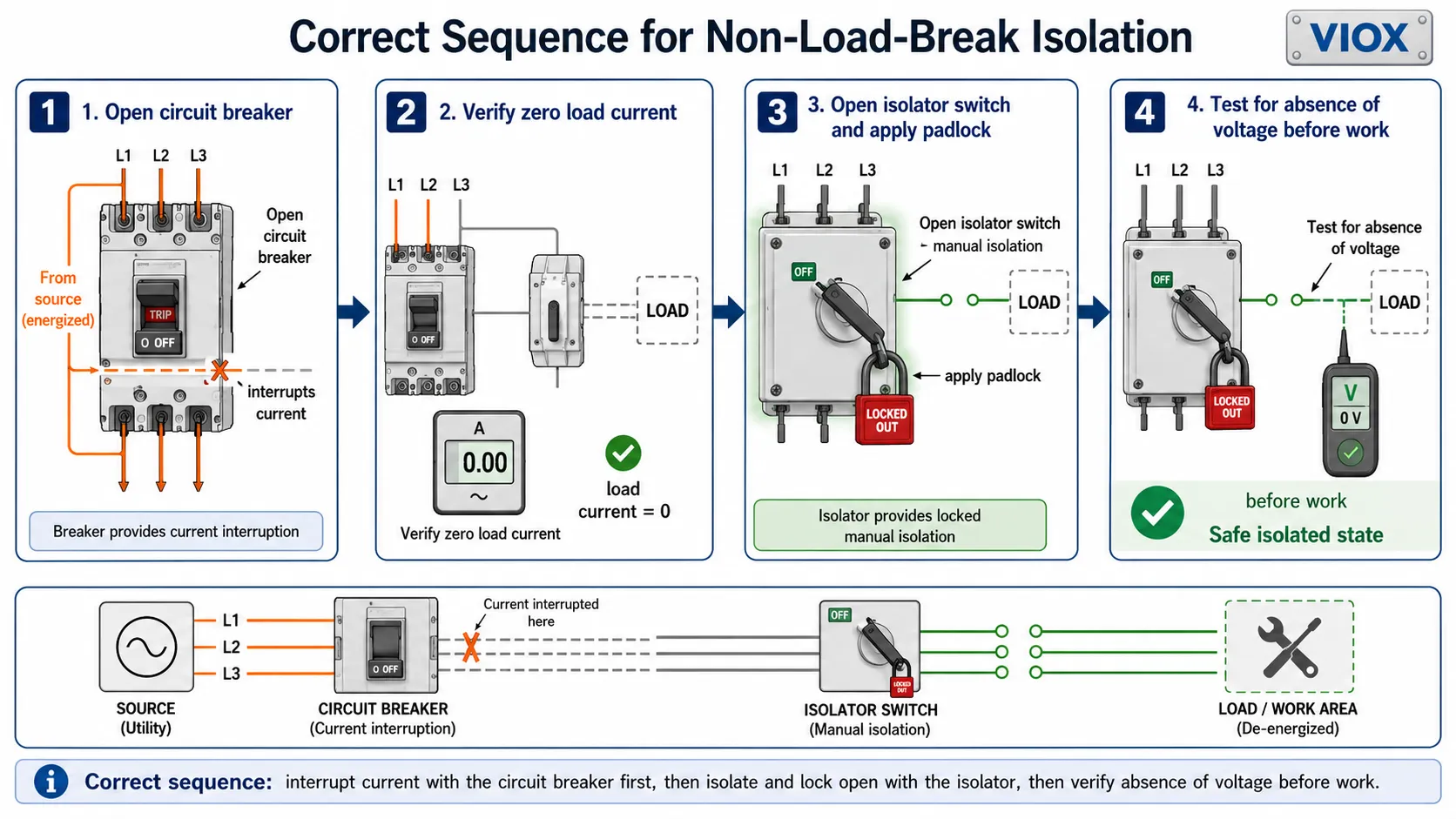
For a non-load-break isolator, the general operating logic is:
- Open the circuit breaker or upstream protective device first.
- Verify that load current has stopped.
- Open the isolator.
- Lock the isolator in the open position where required.
- Test for absence of voltage at the work location.
For re-energizing:
- Confirm the work area is clear.
- Close the isolator.
- Close the circuit breaker or upstream protective device.
- Confirm normal operation.
If the device is a rated switch-disconnector, it may be designed to break load current within its rating. Even then, the operating procedure should follow the manufacturer’s instructions, site safety rules, and local electrical code.
Common Selection Mistakes
Mistake 1: Using an Isolator as a Circuit Breaker
An isolator does not detect faults. If you install an isolator where overcurrent protection is required, the circuit may remain energized during overload or short-circuit conditions until another protective device clears the fault.
Mistake 2: Opening a Non-Load-Break Isolator Under Load
A basic disconnector or isolator may not be designed to interrupt load current. Opening it under load can create dangerous arcing and equipment damage. If load switching is required, specify a switch-disconnector or load-break isolator with the correct utilization category and rating.
Mistake 3: Assuming a Breaker Always Provides Safe Isolation
Some breakers can provide isolation when marked and installed correctly. Others should not be relied on as the sole maintenance isolation point. Check the standard, product marking, lockout capability, and installation requirement.
Mistake 4: Ignoring DC Ratings
AC and DC switching are not interchangeable. DC circuits are harder to interrupt because there is no natural current zero-crossing. A device used in PV, battery, EV, or DC distribution systems must be explicitly rated for the actual DC voltage, current, pole arrangement, and duty.
Mistake 5: Confusing Current Rating with Breaking Capacity
An isolator may be able to carry a certain continuous current, but that does not mean it can interrupt short-circuit current. A breaker has a rated breaking capacity. An isolator typically depends on an upstream breaker or fuse for fault clearing.
Mistake 6: Leaving No Local Isolation Point
If the breaker is far from the equipment, maintenance becomes harder and less safe. Local isolators or switch-disconnectors are often used near motors, HVAC equipment, machines, inverter cabinets, and distribution boards to provide a clear service point.
How to Choose Between a Circuit Breaker and an Isolator Switch
Use this decision sequence:
Step 1: Decide Whether You Need Protection
If the circuit needs overload or short-circuit protection, use a circuit breaker or fuse. An isolator alone is not enough.
Step 2: Decide Whether You Need Manual Isolation
If technicians need to safely service equipment, use an isolator switch, switch-disconnector, local disconnect, or breaker marked for isolation duty as allowed by the applicable standard.
Step 3: Decide Whether Load Switching Is Required
If the device must be opened or closed while carrying load current, specify a switch-disconnector or other load-break device, not a basic off-load isolator.
Step 4: Check AC or DC Application
For AC systems, confirm voltage, current, utilization category, and short-circuit coordination. For DC systems, confirm DC voltage, polarity, pole configuration, arc-extinction design, and whether the device is rated for the actual DC duty.
Step 5: Check Lockout and Indication
For maintenance, the device should support the required lockout/tagout method and provide reliable open/closed indication. Some applications may require visible contact separation, while others accept positive contact indication according to the applicable design and standard.
FAQ
What is the main difference between a circuit breaker and an isolator switch?
A circuit breaker provides automatic protection against overloads and short circuits. An isolator switch provides manual disconnection for maintenance or service. The breaker protects the circuit during operation. The isolator helps make equipment safe to work on.
Can I use an isolator switch instead of a circuit breaker?
No, not where overcurrent protection is required. An isolator switch does not trip automatically and does not replace a breaker or fuse. It should be used together with an appropriate protective device.
Can a circuit breaker be used as an isolator?
Sometimes, but only if the specific breaker is marked, rated, and installed for isolation duty. Do not assume every breaker provides maintenance isolation just because it has an OFF handle position.
Can an isolator switch be operated under load?
A basic isolator or disconnector is usually intended for off-load operation. A switch-disconnector or load-break isolator can break load current within its rating. The datasheet and device marking must be checked.
What is a switch-disconnector?
A switch-disconnector combines load switching and isolation functions. It can make and break current within its rated duty and also provide isolation. It is commonly used as a main switch, equipment disconnect, or panel isolating device.
Does an isolator switch protect against short circuits?
No. An isolator switch does not detect or interrupt short circuits by itself. Short-circuit protection must come from a circuit breaker, fuse, or another rated protective device.
Which comes first: circuit breaker or isolator?
It depends on the circuit design. In many systems, a breaker protects the circuit and a switch-disconnector or isolator provides local isolation. For maintenance, a non-load-break isolator should only be opened after current has been interrupted by a breaker or other suitable device.
What standard applies to isolator switches?
For many low-voltage IEC applications, IEC 60947-3 covers switches, disconnectors, switch-disconnectors, and fuse-combination units. In North America, UL 98 and UL 98B may be relevant depending on the product and application.
What standard applies to circuit breakers?
Common standards include IEC 60898-1 for household and similar miniature circuit breakers, IEC 60947-2 for low-voltage circuit breakers in industrial switchgear and controlgear, and UL 489 for molded case and miniature circuit breakers in North American applications.
Final Answer
A circuit breaker and an isolator switch are not interchangeable.
Use a circuit breaker when the circuit needs automatic protection against overloads or short circuits. Use an isolator switch when equipment needs a manual, lockable, and clearly defined disconnection point for service or maintenance.
If the device must both switch load current and provide isolation, specify a switch-disconnector or load-break isolator with the correct rating. If the circuit is DC, confirm the device is explicitly DC-rated for the actual voltage, current, pole arrangement, and switching duty.
The safest design is not "breaker or isolator." In many panels, machines, PV systems, battery systems, and distribution boards, the correct answer is breaker for protection, isolator for isolation, and switch-disconnector where load-breaking isolation is required.
Related VIOX Pages
- Isolator Switch
- Switch Disconnector
- DC Isolator Switch
- MCB
- MCCB
- DC Isolator vs DC Circuit Breaker
- Molded Case Isolator Switch vs Molded Case Circuit Breaker
Sources and Standards Referenced
- IEC 60947-3:2020 – Low-voltage switchgear and controlgear: switches, disconnectors, switch-disconnectors and fuse-combination units
- IEC 60947-2: low-voltage circuit-breakers
- IEC 60898-1: circuit breakers for overcurrent protection for household and similar installations
- UL 489: molded-case circuit breakers, molded-case switches, and circuit-breaker enclosures
- UL 98 / UL 98B: enclosed and dead-front switches, including photovoltaic switch applications where applicable