On this page
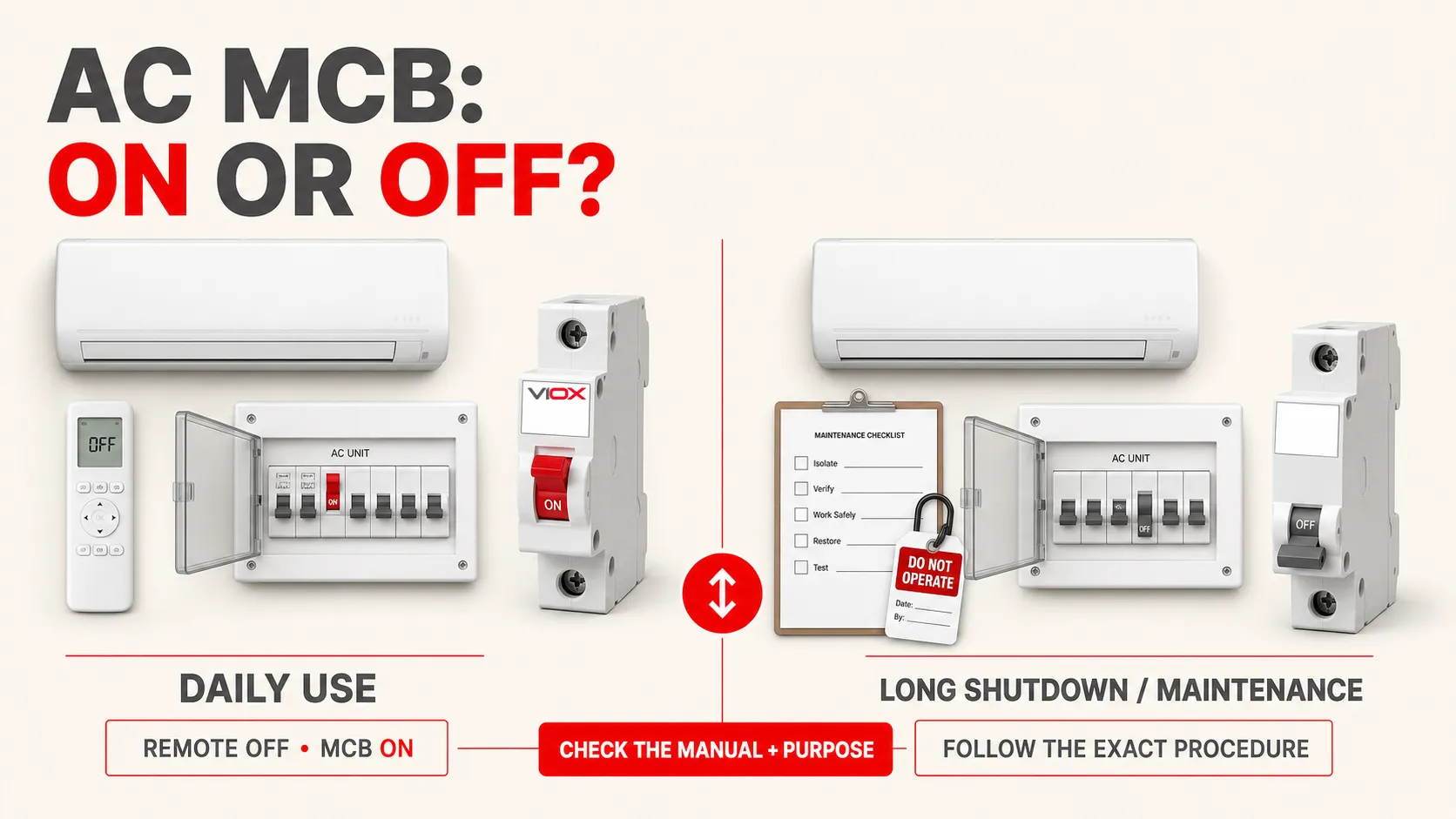
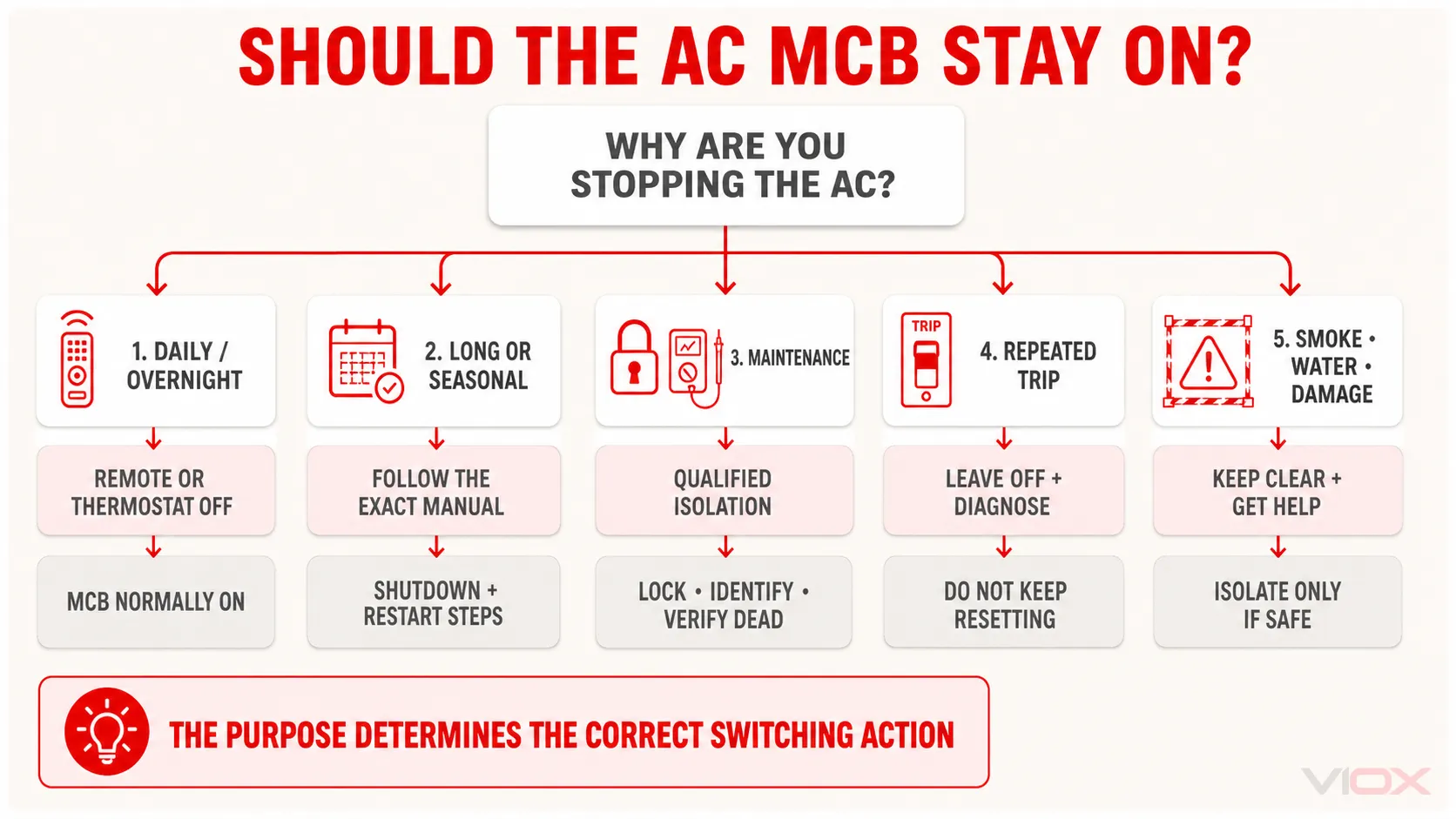
For ordinary daily use, turn the air conditioner off with its remote, thermostat, or normal operating control and normally leave its dedicated MCB on. The MCB protects the circuit against overcurrent; it is not usually the primary control for starting and stopping the air conditioner.
Switching off the identified breaker or local isolator can be appropriate for a manufacturer-defined long shutdown, electrical work performed under a verified isolation procedure, or an abnormal condition when it is safe to isolate the supply. The exact answer depends on the air-conditioner manual, the installed disconnecting arrangement, and local electrical rules—not on a universal number of days.
AC MCB On or Off? A Quick Decision Table
| Situation | Normal action | Why or important condition |
|---|---|---|
| Stopping the AC for the day or overnight | Use the remote, thermostat, or normal OFF control; normally leave the MCB on | This lets the appliance complete its normal control sequence and preserves any standby functions specified by the manufacturer |
| Leaving for a weekend or another short absence | Normally use the normal OFF control | Do not assume a short absence requires breaker isolation; check the exact manual if the site has special shutdown requirements |
| Seasonal or extended non-use | Follow the exact manufacturer shutdown instructions; they may direct you to switch off the dedicated breaker or isolator after stopping the unit normally | Some products permit or recommend supply disconnection during long non-use, while others require a defined power-on preparation before restarting |
| Maintenance, wiring work, or opening electrical covers | Use a qualified-person isolation procedure: identify every supply, disconnect, secure against reconnection where required, and verify absence of voltage | Moving one MCB handle to OFF is not, by itself, proof that every relevant conductor and control supply is dead |
| Breaker trips repeatedly | Leave the system off and arrange diagnosis; do not repeatedly reset it | Repeated tripping can indicate an appliance, circuit, connection, or protection problem |
| Burning smell, smoke, sparking, water ingress, or visible damage | Stop using the system; if this can be done without approaching a hazard, isolate the relevant supply and obtain professional help | Do not touch wet or damaged equipment or operate a panel in a dangerous condition |
The important distinction is between stopping the appliance and isolating its electrical supply. They are different operations with different purposes.
What Do You Mean by the “AC Main Switch”?
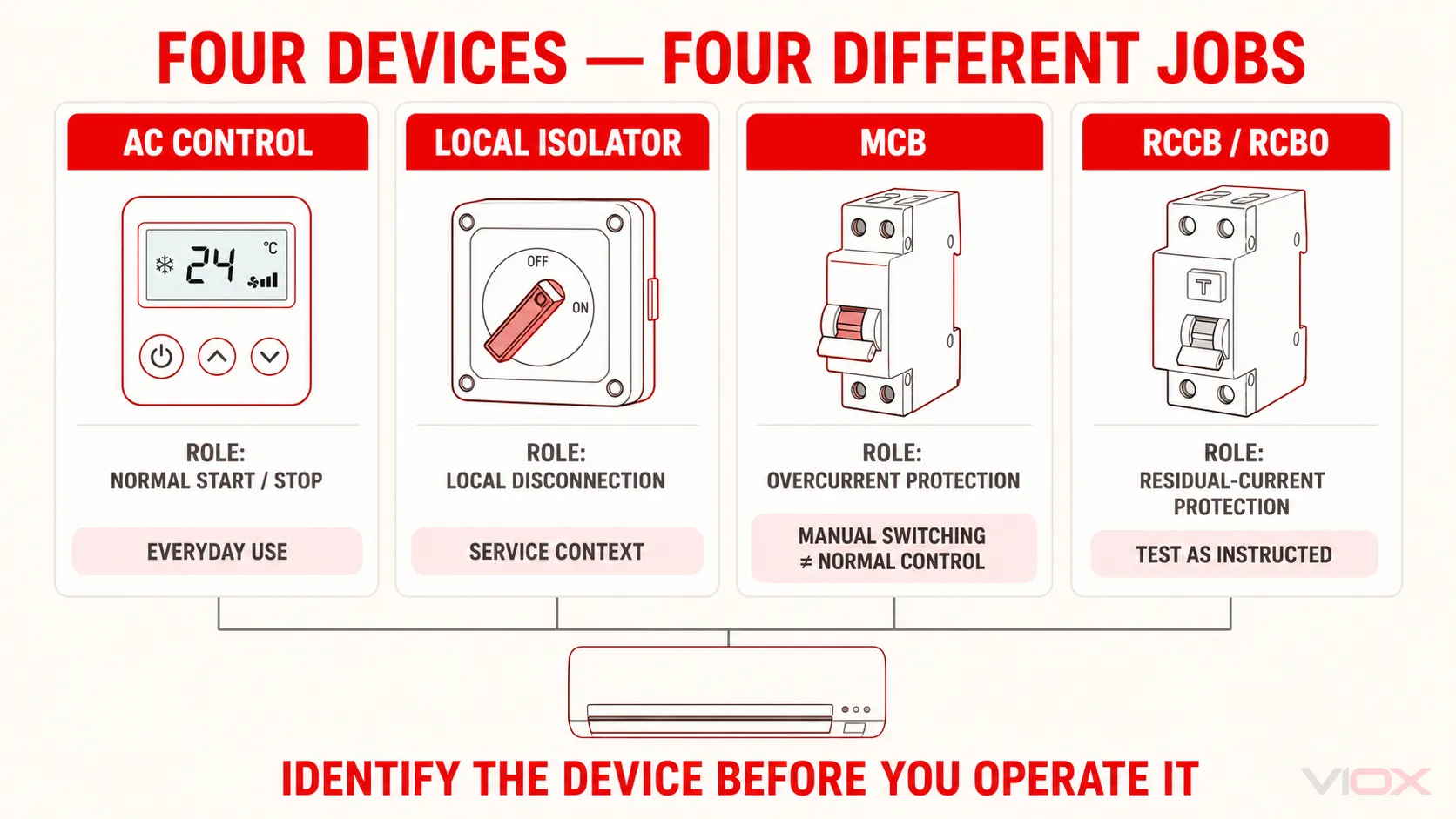
People use “main switch” for several different devices. Before acting, identify which device you actually have.
| Device | Primary role | Is it the normal everyday AC control? |
|---|---|---|
| Remote, thermostat, or wired controller | Sends the appliance its normal run, stop, temperature, mode, and scheduling commands | Yes |
| Local AC isolator or disconnect | Provides a local means of disconnecting the equipment when the exact device and installation are suitable | Usually no; it is primarily associated with isolation and service access |
| Dedicated MCB in a distribution board | Protects the circuit against overload and short-circuit current and can also be operated manually | Usually no; manual switching capability does not make it the preferred appliance controller |
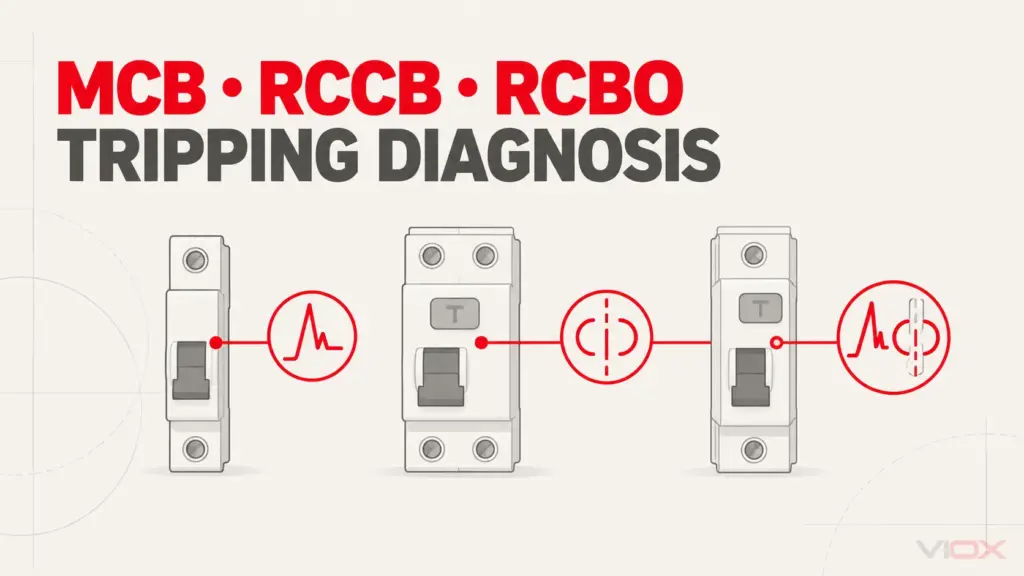
| RCCB or RCBO | Provides residual-current protection; an RCBO also provides overcurrent protection | No; follow the manufacturer’s instructions for any TEST function rather than using it as an appliance control |
An ordinary miniature circuit breaker does not become an RCD merely because it supplies an air conditioner, and an ordinary MCB normally has no residual-current TEST button. If you only need to identify breaker handle positions, see Which Is ON and OFF on an MCB?.
Why Leave the AC Breaker On During Normal Use?
The air conditioner’s normal control is designed to start and stop the unit through its control system. Depending on the model, a powered but inactive system may retain a clock, remote receiver, Wi-Fi connection, diagnostics, protective logic, or a heater used under particular operating conditions.
That does not mean every air conditioner requires continuous power in every climate. It means the model documentation should decide. Some manufacturer manuals instruct users to turn off the circuit breaker during a long period of non-use. Other manuals warn that certain systems need power for a period before operation so a protective or preheating function can prepare the equipment. A fixed restart delay copied from another model is therefore unsafe guidance.
Using the normal OFF command first also avoids abruptly removing power while the appliance is executing a manufacturer-controlled sequence. The breaker may be suitable for manual operation, but its ability to open the circuit does not establish that it is the intended daily user control for the connected AC system.
Does an AC Use Electricity When It Is Off but the MCB Is On?
It may. “Off” at the remote or thermostat often means that active heating or cooling has stopped, not necessarily that the product is electrically disconnected. Control electronics, network functions, sensors, displays, or protective heaters can continue to use power.
There is no defensible universal standby wattage or annual cost for all air conditioners. The value depends on the exact model, configuration, operating mode, ambient conditions, and measurement method. Use one of these sources:
- the standby or off-mode data in the exact product documentation;
- a manufacturer energy label or declared performance document applicable to the model and market; or
- a suitable measurement performed by a competent person without exposing live parts.
Disconnecting the supply can eliminate equipment-side standby consumption, but it can also disable scheduled control, remote access, freeze protection, monitoring, or model-specific compressor protection. For a short absence, standby savings alone are not enough reason to ignore the manual. For seasonal shutdown, follow the documented shutdown and restart sequence.
How to Handle a Long or Seasonal AC Shutdown
Where the manufacturer permits or recommends supply disconnection during a long period of non-use, the general sequence is:
- Stop the air conditioner with its normal controller.
- Allow any documented post-run or drying process to finish.
- Complete the cleaning, drainage, or storage steps stated in the exact manual.
- Switch off the identified dedicated disconnecting device only if the manual and installed arrangement support that action.
- Before the next use, inspect for damage or obstruction and follow any required power-on preparation or restart delay in the manual.
Do not convert “long period” into one universal threshold such as 30 or 60 days. Manufacturers use different language because designs and operating conditions differ.
The question of whether the AC should have a dedicated circuit is a separate design task. For breaker sizing, conductor considerations, and inrush boundaries, use Why an Air Conditioner Needs a Dedicated Circuit.
Is Switching the MCB Off Safe Isolation for Maintenance?
Not automatically. IEC 60364-5-53 addresses isolation, switching, control, and the selection and erection of the relevant devices. Whether a particular breaker provides the required isolation depends on the device’s declared function, the circuit arrangement, the conductors it disconnects, other possible supplies, and the applicable installation rules.
For electrical work, a qualified person should identify every relevant source, operate the correct disconnecting devices, prevent unintended reconnection where required, and verify absence of voltage using an appropriate procedure and instrument. A handle that appears to be OFF is not a substitute for proving the circuit dead.
Do not rely on switching off one MCB as universal lightning or surge protection. An MCB is principally an overcurrent-protection device. Surge protection, bonding, the number of conductors disconnected, and safe storm procedures are separate questions. Never approach or operate wet, arcing, smoking, or visibly damaged electrical equipment.
What If the AC Breaker Keeps Tripping?
An MCB that trips repeatedly is not asking to become the normal ON/OFF switch. It is indicating that the protected circuit has reached an operating condition that requires investigation, or that another fault or device issue exists in the installation.
Do not increase the breaker rating, change the trip curve, or keep resetting it to make the symptom disappear. Leave the system off and have the circuit and appliance assessed. The dedicated guide Why Your MCB Keeps Tripping owns the diagnostic path.
Frequently Asked Questions
Is it necessary to switch off the AC from the main switch every time?
Usually not. For normal daily shutdown, use the remote, thermostat, or wired controller. Use a dedicated breaker or isolator for long shutdown, maintenance, or an abnormal condition only when the exact manual, installed design, and safety conditions support it.
Should the AC MCB be on or off when the AC is not running?
It is normally left on between ordinary uses. If the unit will be unused for a long or seasonal period, follow its manufacturer shutdown instructions rather than applying a fixed time rule.
If the AC main switch is on, does it use electricity?
It may consume standby power even when it is not actively cooling or heating. The amount and purpose are model-specific. Check the declared product data or measure it appropriately; do not assume a universal wattage.
Can I use the circuit breaker to turn the AC on and off every day?
The breaker can be manually operated if it is designed and installed for that function, but the air conditioner’s normal controller is generally the correct everyday control. Repeated power interruption may also bypass a model-specific shutdown or restart sequence.
Should I turn off the AC breaker during a storm?
There is no universal rule that makes one MCB handle complete lightning protection. Follow the equipment manual, local emergency guidance, and the installation’s engineered surge-protection and isolation arrangements. Do not operate electrical equipment while exposed to an active hazard.
Bottom Line
For routine use, turn off the air conditioner with its normal control and leave the dedicated MCB on. Switch off an identified breaker or isolator when the exact manufacturer procedure calls for it during long non-use, when a qualified person establishes safe isolation for work, or when an abnormal condition makes continued operation unsafe and the supply can be isolated without approaching danger.
When specifying protection for an AC circuit, match the breaker to the documented load, conductor, fault level, installation conditions, and applicable standard. The VIOX MCB range can be evaluated against those project-specific requirements; the product label or a generic AC size alone is not enough.
Sources
- IEC 60364-5-53:2019+AMD1:2020+AMD2:2024 CSV — Low-voltage electrical installations: devices for protection, isolation, switching, control and monitoring
- Daikin operation manual — normal operation and long-period shutdown guidance
- Daikin operation manual — long stop and model-specific power-on preparation
- Daikin operation manual — long idle procedure example
- UL Solutions — Circuit Breaker and Supplementary Protector Services