

On this page
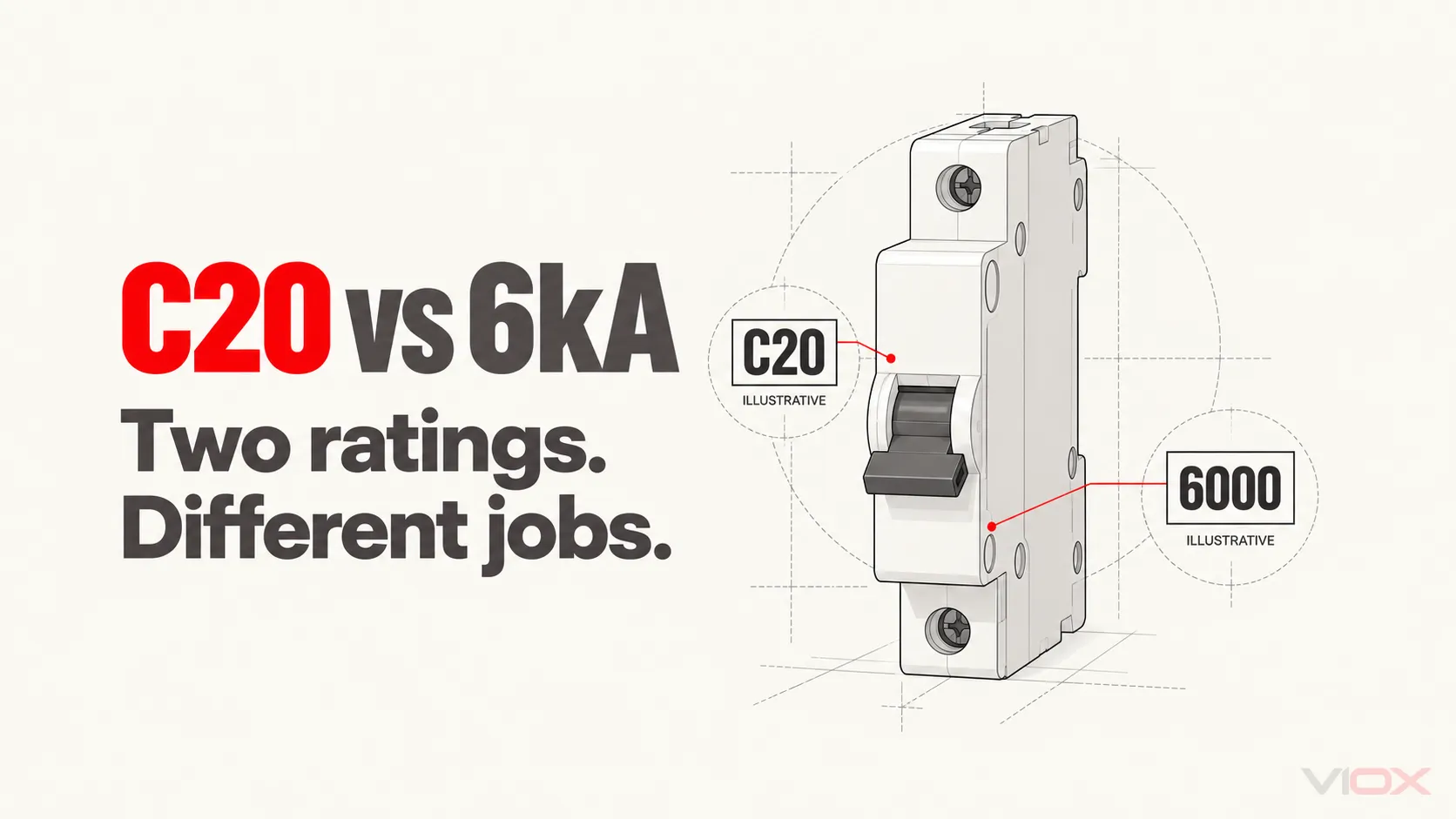
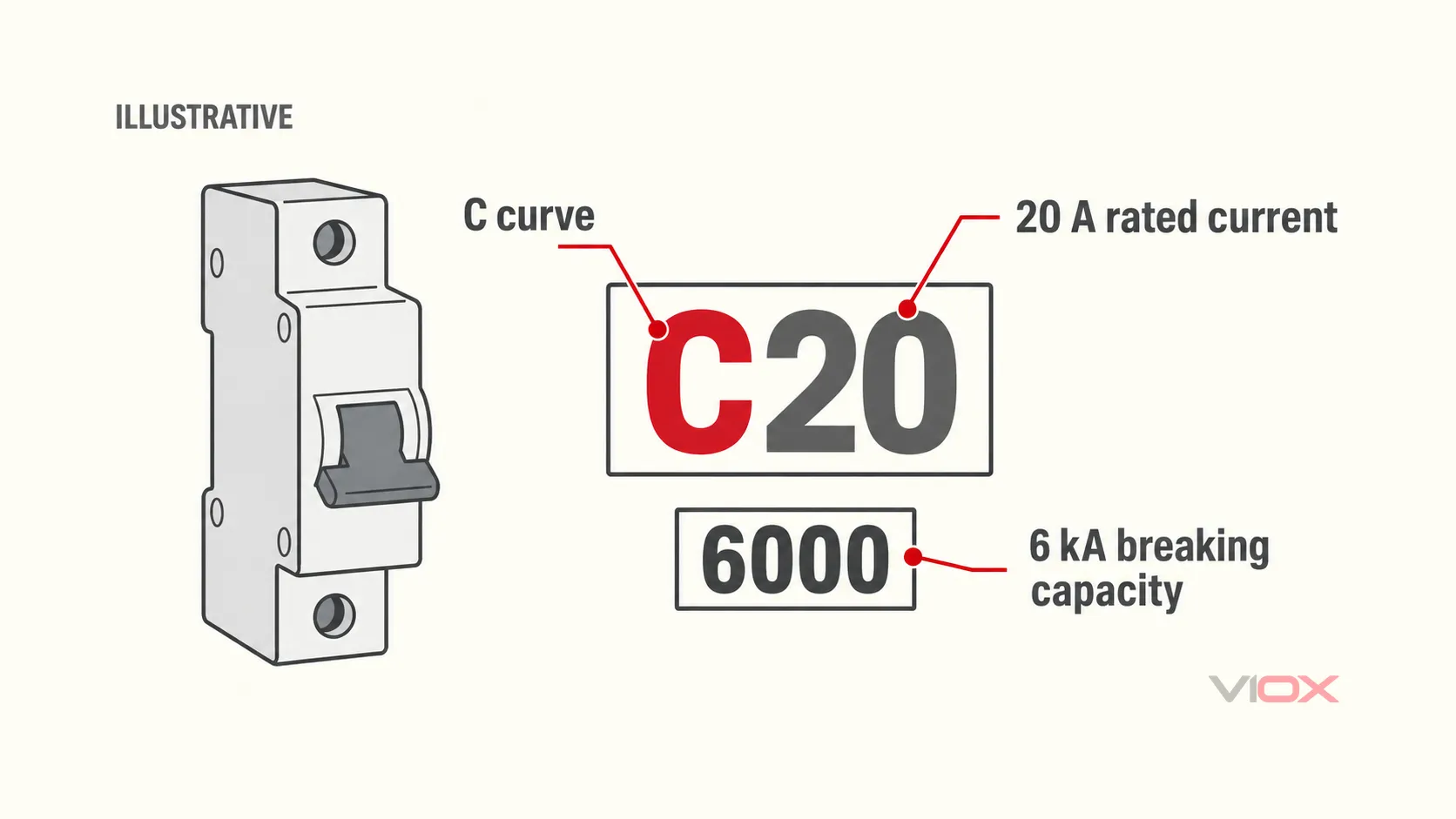
On an IEC-style miniature circuit breaker (MCB), C20 means a C-type tripping characteristic and a rated current of 20 amperes. A separate 6000 or 6kA marking means a short-circuit breaking capacity of 6,000 amperes, at the stated voltage and under the applicable product-standard conditions. These markings describe different properties; they are not alternatives.
| Marking | What it means | What it does not mean |
|---|---|---|
| C | C-type time-current characteristic | A voltage rating or a breaking-capacity value |
| 20 in C20 | Rated current, In = 20 A | An exact instantaneous trip point at 20 A |
| 6000 or 6kA | Rated short-circuit breaking capacity of 6,000 A under stated conditions | A 6,000 A normal load rating or a requirement to reach 6,000 A before tripping |
Reading the label is not enough to approve a replacement. The circuit, conductors, available fault current and distribution-board compatibility still need to be checked. Do not remove a live panel cover to find hidden markings.
What Does C20 Mean on a Circuit Breaker?
Read C20 as two pieces of information, not one oversized current number.
C Is the Tripping Characteristic
The letter identifies how the breaker responds to overcurrent. For the conventional IEC-style C characteristic, the instantaneous magnetic operating band is described as 5 to 10 times rated current, as illustrated in university circuit-breaker teaching material. For a 20 A device, that corresponds to 100 to 200 A.
That is a characteristic band, not a promise that every C20 breaker trips at one exact current within it. Use the manufacturer’s time-current curve and the applicable test conditions to assess a particular device. The MCB nameplate guide explains where the curve designation sits among the other markings.
20 Is Rated Current, Not a Stopwatch Setting
The number means In = 20 A under the declared reference conditions. It does not mean that the breaker measures 20.1 A and opens immediately.
A conventional thermal-magnetic MCB has a time-dependent thermal response to sustained overload and a faster magnetic response to sufficiently high current. Ambient temperature, previous loading and the actual current magnitude affect thermal operation. Therefore, a statement such as “a C20 always trips after a few minutes at 22 A” is not a reliable interpretation of its label.
Nor does the 100-200 A magnetic band authorize a continuous load of that size. It concerns a short-duration operating characteristic; the rated current remains 20 A.
What Does 6000 or 6kA Mean?
The prefix k means one thousand:
6 kA = 6,000 AWhen 6000 appears as the declared short-circuit-capacity marking on an IEC 60898-1 MCB, it refers to the rated short-circuit capacity, commonly designated Icn. Confirm this interpretation against the complete nameplate and datasheet; a number without its context is not enough.
IEC 60898-1 is an AC circuit-breaker product standard for household and similar installations. A breaking-capacity declaration belongs to a specified product standard and voltage. It must not be transferred automatically to a different AC voltage, a DC circuit or another standard’s test regime.
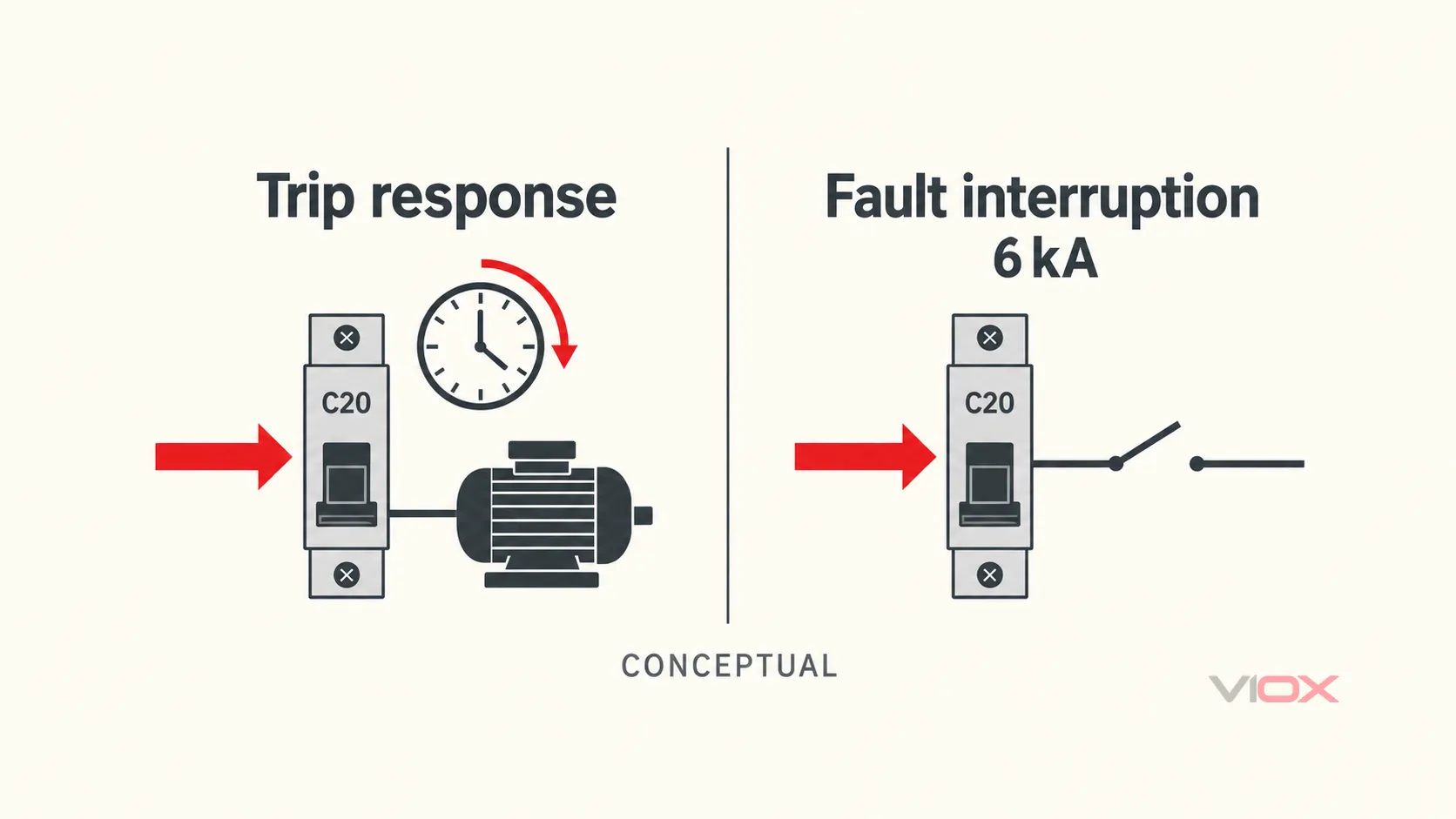
A 6kA rating answers: What fault current is this breaker rated to interrupt under the declared conditions? It does not answer: At what current does the trip mechanism start operating?
For example, a C20/6kA breaker can operate on an overcurrent far below 6,000 A. The time-current characteristic determines its response; the capacity rating establishes a separate fault-interruption limit. A large capacity number is not a guarantee against every arc-flash hazard, installation error or fault location.
For the wider terminology, including distinctions between rating systems, see circuit-breaker kA ratings explained.
Does 6kA Change the Permitted Load or Wire Size?
No. Raising breaking capacity does not increase the permissible normal load of a 20 A breaker. A C20/10kA device is still rated 20 A, not 10,000 A for continuous operation.
Load and conductor protection depend on the circuit’s design current, conductor ampacity under the actual installation conditions, the protective characteristic and applicable wiring rules. A cable cannot be selected from the kA marking alone. Fault thermal withstand and required disconnection performance also need appropriate verification.
Conversely, an apparently suitable 20 A rating does not prove adequate fault interruption. Both checks must be satisfied: suitable overcurrent protection for the circuit, and sufficient fault-interruption capability at the installation point.
Can a C20/3kA Breaker Replace a C20/6kA Breaker?
Not on the basis of C20 alone. The new device has the same nominal characteristic and current marking, but a lower declared breaking capacity if the voltage and standard are comparable.
Do not assume that 3kA is automatically sufficient because the installation is residential. Equally, the lower number alone does not establish that a particular circuit is unsafe: the available fault current, required rating and documented protective coordination must be assessed.
| Replacement check | Why the C20 marking cannot settle it |
|---|---|
| Rated voltage and AC/DC suitability | C20 contains neither a voltage nor an AC/DC declaration |
| Breaking capacity at that voltage | Identical current ratings can accompany different fault-interruption ratings |
| Available fault current | It is a property of the supply and circuit, not a number established by C20 |
| Time-current curve | The actual declared curve and conditions are needed for protection checks |
| Board, busbar and terminal compatibility | Similar dimensions or a matching DIN-rail fit do not prove approval for the assembly |
| Pole configuration and required protection functions | C20 does not identify every switched/protected conductor or additional protection function |
An upstream protective device is not a blanket justification for using a lower-capacity breaker. Any backup or series-rated arrangement must be supported by the applicable manufacturer’s documented combination and conditions.
As a US workplace example of the underlying requirement, OSHA 1910.303(b)(4) requires an interrupting rating sufficient for the nominal circuit voltage and available current at the equipment’s line terminals. Other markets require their own applicable installation rules. For the detailed rating decision, use the 6kA vs 10kA MCB selection guide.
The Same Distinction in a US Example: 15A and 10kA
A breaker marked 15 A with a 10 kA interrupting rating has two separate ratings: 15 A rated current and 10,000 A fault-interruption capability at the declared voltage and conditions. They cannot substitute for one another.
The UL circuit-breaker marking guide treats ampere and interrupting ratings separately. This illustrates the same distinction, but it does not make a UL interrupting rating interchangeable with IEC Icn or Icu, or give a US device a C-type curve.
If you can see only 10kA, do not conclude that the device must be an isolator or molded-case switch. Check the accessible handle/front markings, exact model documentation and equipment records. Have a qualified person identify the device if its current rating or protection function remains unclear; do not guess from a partial photograph.
Read Both Ratings Before Making a Decision
C20 tells you the characteristic and rated current. 6kA tells you the declared fault-interruption capacity. Neither marking replaces the other, and neither proves complete installation suitability. Keep the load-protection check, fault-capacity check and equipment-compatibility check separate.
Sources
- IEC 60898-1: AC circuit breakers for household and similar installations – product-standard scope; verify the edition declared for the exact device.
- Arab Academy for Science, Technology and Maritime Transport: Circuit-breaker teaching material – conventional C characteristic on slide 27; not an exact-model test report.
- UL Solutions: Molded Case Circuit Breaker Marking and Application Guide – US marking and application context.
- OSHA 1910.303: General electrical requirements – US workplace installation and interrupting-rating requirements.