

On this page
Quick Answer: AC Distribution Box vs DC Distribution Box
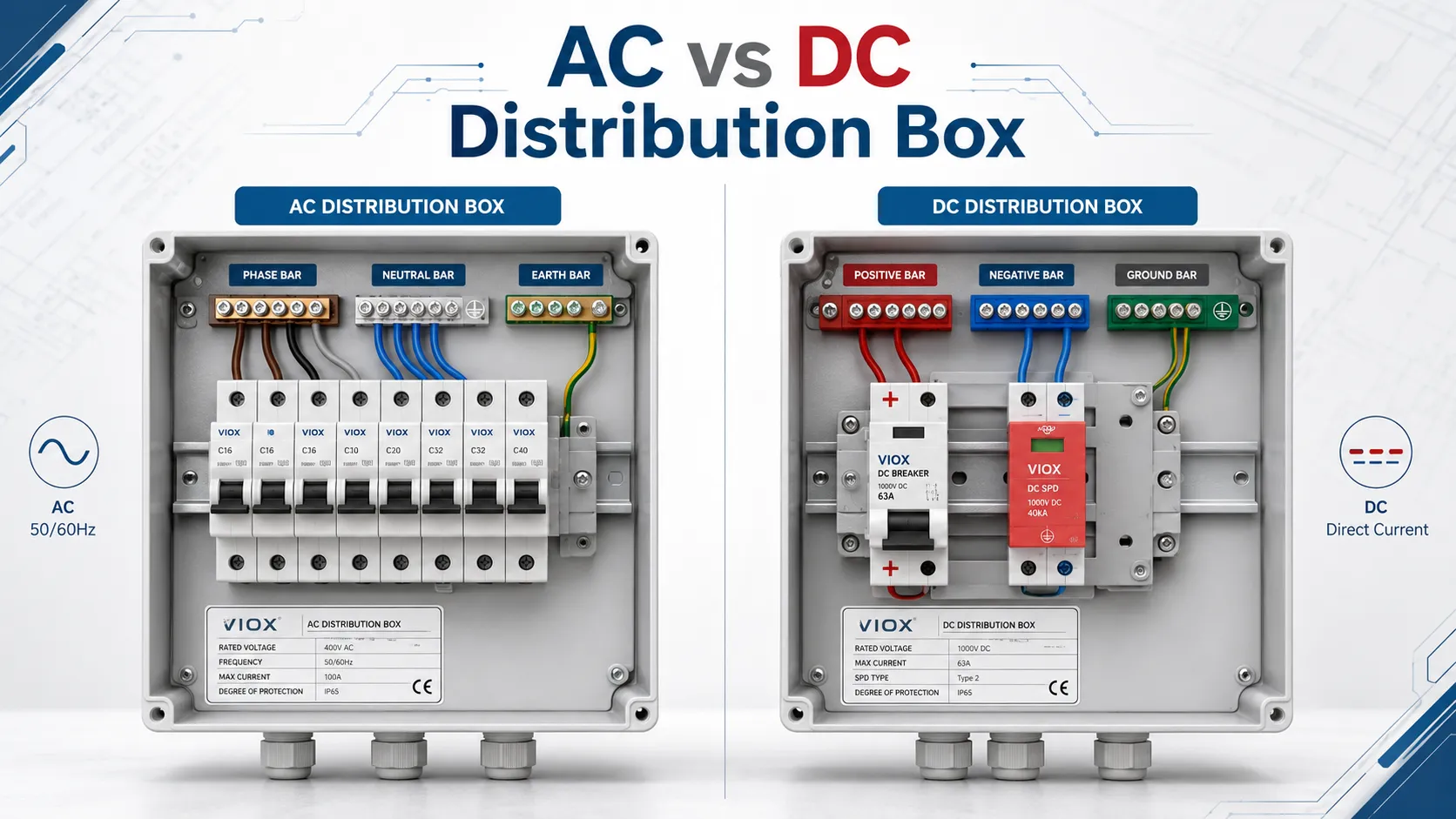
An AC distribution box distributes alternating current to branch circuits in buildings, equipment, and low-voltage installations. It usually contains AC-rated MCBs, MCCBs, RCCBs, RCBOs, neutral bars, earth bars, busbars, and AC surge protective devices.
A DC distribution box distributes direct current in systems such as solar PV, battery energy storage, telecom power, EV-related DC equipment, marine DC systems, and industrial DC control cabinets. It must use DC-rated breakers, DC fuses, DC isolators, DC surge protective devices, polarity-aware wiring, and components capable of interrupting DC arcs.
The main safety difference is simple:
AC current naturally crosses zero many times per second, which helps extinguish arcs. DC current does not have a natural zero crossing, so DC distribution boxes need protection devices specifically rated for DC voltage, polarity, and arc interruption.
Key Takeaways
- AC and DC distribution boxes are not interchangeable. The enclosure may look similar, but the protection devices, wiring rules, busbar layout, and arc behavior are different.
- DC arc interruption is harder. A DC breaker or fuse must be rated for the actual DC voltage and fault conditions.
- Polarity matters in DC systems. Positive and negative conductors must be clearly identified, and polarized devices must be wired according to manufacturer instructions.
- AC boxes often include neutral and residual-current protection. DC boxes usually focus on positive/negative distribution, DC isolation, fuses, DC breakers, and DC surge protection.
- Application decides the design. A building AC distribution board, a 48V telecom DC board, and a 1000V PV DC combiner/distribution box are very different products.
- Standards depend on market and assembly type. IEC 61439, IEC 60364, UL 508A, and PV or DC-specific product standards may all become relevant depending on where and how the box is used.
AC vs DC Distribution Box Comparison Table
| Item | AC Distribution Box | DC Distribution Box |
|---|---|---|
| Current type | Alternating current | Direct current |
| Common names | AC distribution board, AC panel, DB box, consumer unit, panelboard | DC distribution box, DC distribution board, DC power distribution panel |
| Typical voltage | 120/240V, 230/400V, 277/480V depending on market | 12V, 24V, 48V, 110V, 220V DC, 600V/1000V/1500V PV DC depending on system |
| Common use | Buildings, lighting, sockets, HVAC, machinery supply | Solar PV, batteries, telecom, DC control, EV systems, marine, off-grid |
| Breakers | AC MCB, MCCB, RCBO, RCCB with MCB | DC MCB, DC MCCB, DC fuse, DC disconnector |
| Arc behavior | AC zero crossing helps arc extinction | DC arc is harder to extinguish |
| Polarity | Phase, neutral, protective earth | Positive, negative, protective earth where used |
| Surge protection | AC SPD | DC SPD or PV SPD |
| Busbar system | Phase busbar, neutral bar, earth bar | Positive busbar, negative busbar, PE/ground bar |
| Main mistake | Wrong breaker size, poor neutral/earth layout, overload | Using AC devices on DC circuits, wrong polarity, underrated DC voltage |
What Is an AC Distribution Box?
An AC distribution box is an electrical assembly that receives AC power and distributes it to outgoing circuits. In different markets it may be called a distribution board, consumer unit, panelboard, breaker box, load center, or DB box.
Common AC distribution box components include:
- main switch or main breaker
- MCBs or MCCBs for overcurrent protection
- RCCBs or RCBOs for residual-current protection
- neutral bar
- earth or protective conductor bar
- phase busbar
- Type 1 or Type 2 AC SPD where required
- terminal blocks
- enclosure and cover
- circuit labels
AC distribution boxes are common in:
- residential buildings
- commercial offices
- factories
- lighting distribution
- HVAC feeders
- small machinery supplies
- sub-distribution boards
- control panel incoming supply circuits
For broader terminology around distribution boxes, boards, and enclosures, see VIOX’s guide to electrical enclosure vs distribution box vs distribution board.
What Is a DC Distribution Box?
A DC distribution box distributes direct current from one or more DC sources to DC loads or downstream circuits. It may be used at low DC voltages such as 12V, 24V, or 48V, or at high PV DC voltages such as 600V, 1000V, or 1500V depending on the system.
Common DC distribution box components include:
- DC main switch or DC disconnector
- DC-rated MCB, MCCB, or fuse
- positive busbar
- negative busbar
- protective earth or grounding bar where required
- DC SPD or PV SPD
- string fuse or branch fuse in PV systems
- polarity labels
- DC warning labels
- cable glands or connectors
- enclosure with suitable IP rating
DC distribution boxes are common in:
- solar PV systems
- PV combiner boxes
- battery energy storage systems
- telecom 48V DC systems
- DC control power systems
- marine DC distribution
- off-grid power systems
- EV charger internal or auxiliary DC circuits
- LED lighting systems
For DC breaker fundamentals, see VIOX’s guide on what is a DC circuit breaker.
Why DC Distribution Boxes Need Different Protection
The biggest technical difference between AC and DC distribution is arc interruption.
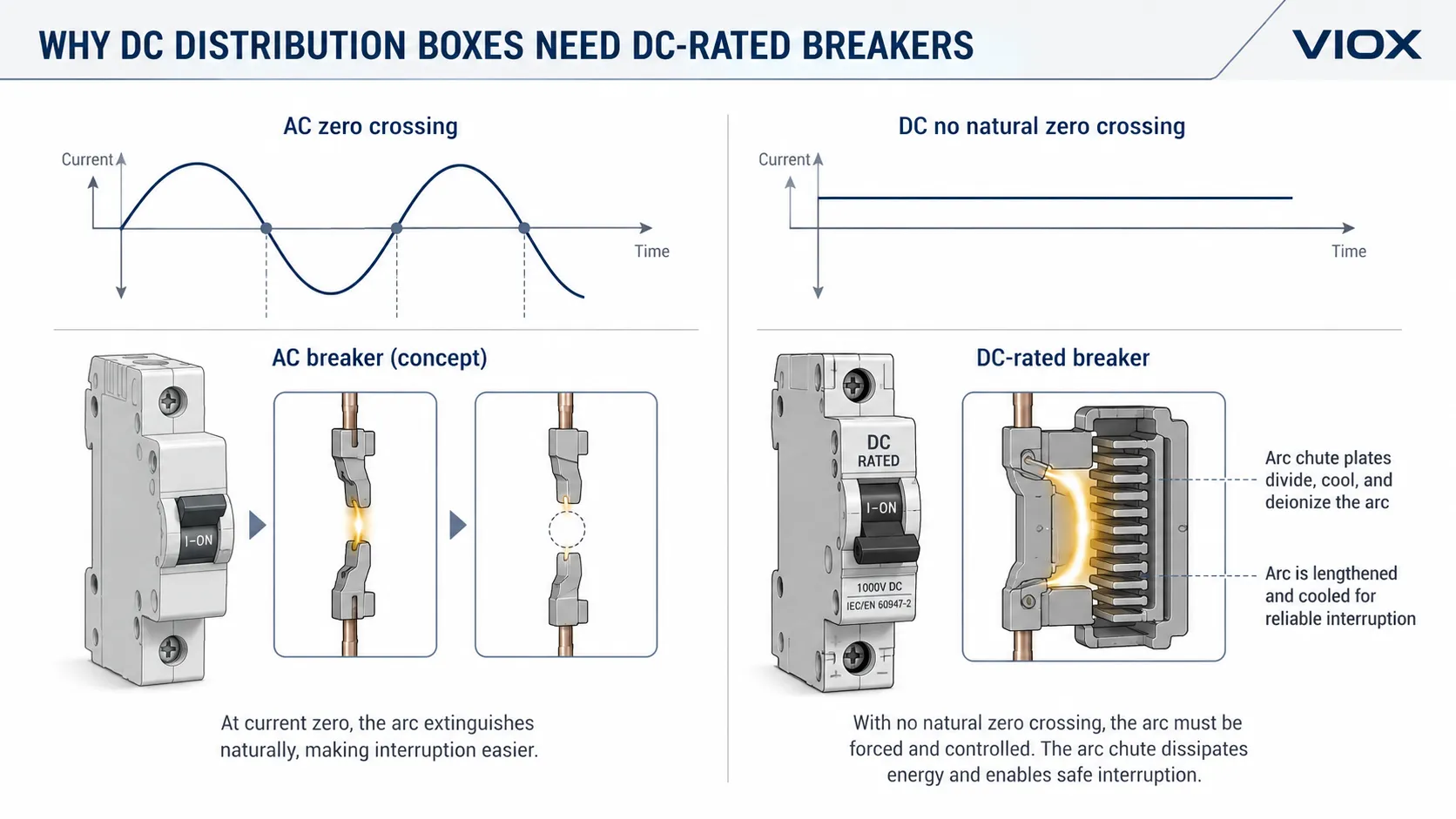
In an AC circuit, the current crosses zero naturally every half-cycle. This helps extinguish the arc when a breaker opens. In a DC circuit, the current does not naturally cross zero. Once a DC arc forms, it can persist longer and is harder to extinguish.
That means DC distribution boxes require protection devices that are rated for:
- DC voltage
- DC fault current
- correct number of poles
- polarity or non-polarized operation
- arc chute design suitable for DC
- series pole wiring where required
- application type, such as PV, battery, or telecom
Using an AC breaker in a DC distribution box because it physically fits is a serious mistake. The device may fail to interrupt a DC fault safely.
Standards and Compliance: AC and DC Boxes Are Reviewed Differently
For B2B procurement, a distribution box is not selected only by its wiring diagram. The applicable standard framework depends on the market, installation type, and whether the product is a complete assembly, industrial control panel, building distribution board, PV combiner box, or equipment subassembly.
Common standard references include:
| Standard or Code | Relevance to Distribution Boxes |
|---|---|
| IEC 61439 series | Low-voltage switchgear and controlgear assemblies; important for distribution boards and power assemblies |
| IEC 60364 series | Low-voltage electrical installations; relevant to building installation design and protection coordination |
| UL 508A | Industrial control panels in North American practice |
| UL 67 / panelboard context | Relevant to certain North American panelboard applications |
| IEC 60947 series | Low-voltage switching and protection devices used inside assemblies |
| IEC 61643 series | Surge protective devices for AC and DC systems, depending on application |
| IEC 60269 series | Fuse selection, including PV fuse context where applicable |
The key point is that the enclosure and internal components must be evaluated as a system. A box built with certified components does not automatically become a certified assembly. Busbar spacing, wiring layout, temperature rise, short-circuit withstand, protective-device coordination, creepage and clearance, and markings may all need review.
For export-oriented equipment, ask the supplier which standard basis applies to the finished assembly, not only whether individual breakers or terminals have certificates.
Components Inside AC and DC Distribution Boxes
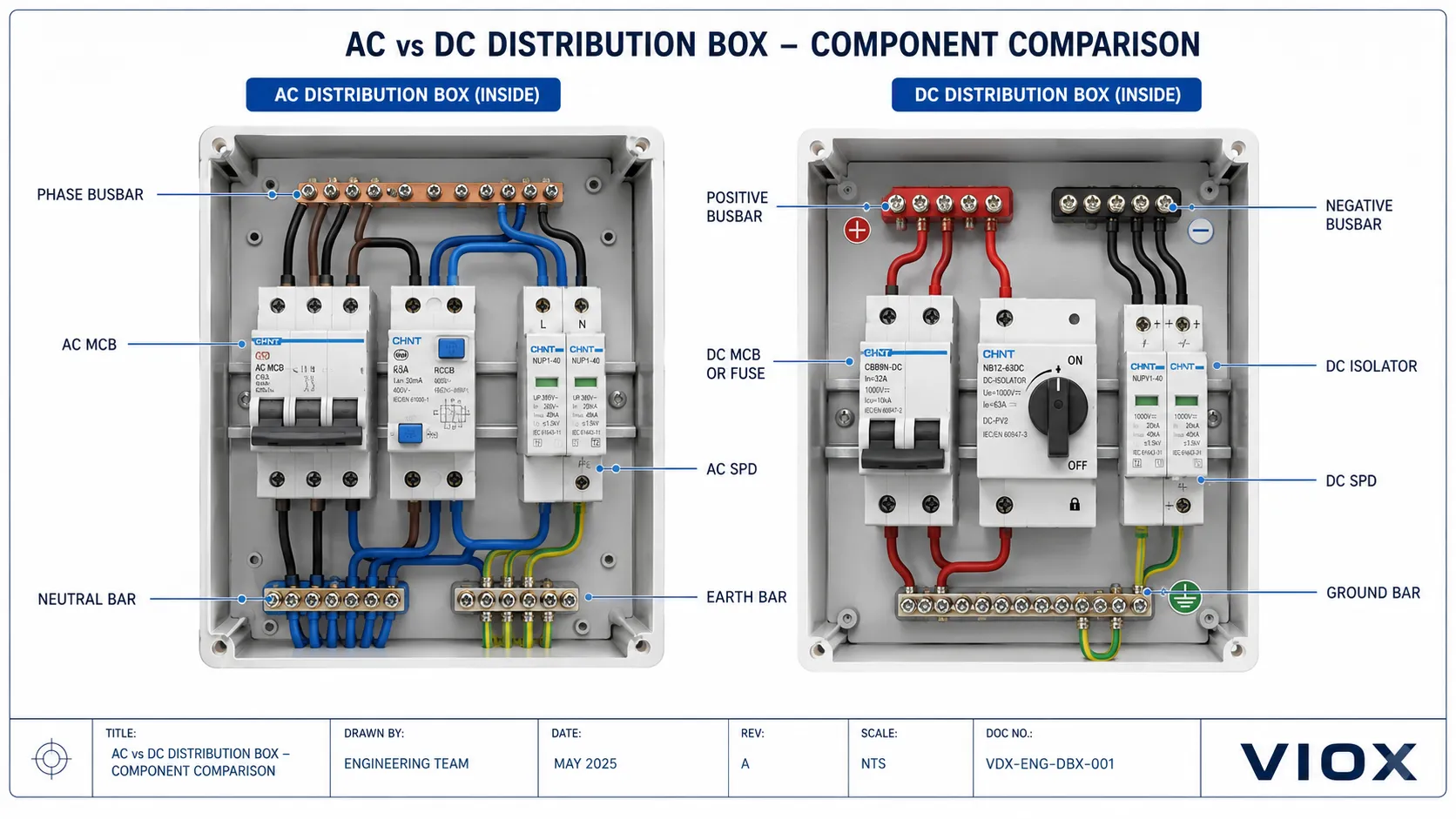
| Component | AC Distribution Box | DC Distribution Box |
|---|---|---|
| Main incoming device | AC main switch, isolator, or breaker | DC disconnector, DC breaker, or DC switch |
| Branch protection | AC MCB, MCCB, RCBO | DC MCB, DC fuse, DC MCCB |
| Earth leakage protection | RCCB or RCBO where required | Depends on DC system design and leakage detection method |
| Surge protection | AC Type 1 / Type 2 SPD | DC SPD, PV SPD, or system-specific SPD |
| Neutral bar | Common in single-phase or three-phase four-wire AC systems | Usually not used in simple two-wire DC systems |
| Busbars | L1/L2/L3, neutral, PE | Positive, negative, PE/ground |
| Labels | Circuit numbers, phase, neutral, earth | Polarity, voltage, source, isolation warning |
| Enclosure | Indoor/outdoor depending on application | Often outdoor or harsh-environment in PV and battery systems |
For surge protection comparison, see VIOX’s guide to SPD Type 1 vs Type 2 vs Type 3. For DC-side surge protection, review DC surge protection devices for PV, EV, BESS, and industrial systems.
AC Distribution Board Wiring Basics
An AC distribution board normally separates the incoming supply into outgoing branch circuits.
A simplified single-phase AC layout is:
Utility / inverter AC output
        ↓
Main switch or main breaker
        ↓
Phase busbar → MCB / RCBO → outgoing load
Neutral bar → outgoing neutral
Earth bar   → protective conductor
In three-phase systems, the phase busbar may distribute L1, L2, and L3 to outgoing breakers. Neutral and protective earth must be arranged according to the earthing system and local code.
Do not treat the neutral bar and earth bar as interchangeable. Their relationship depends on the grounding system and installation rules.
DC Distribution Box Wiring Basics
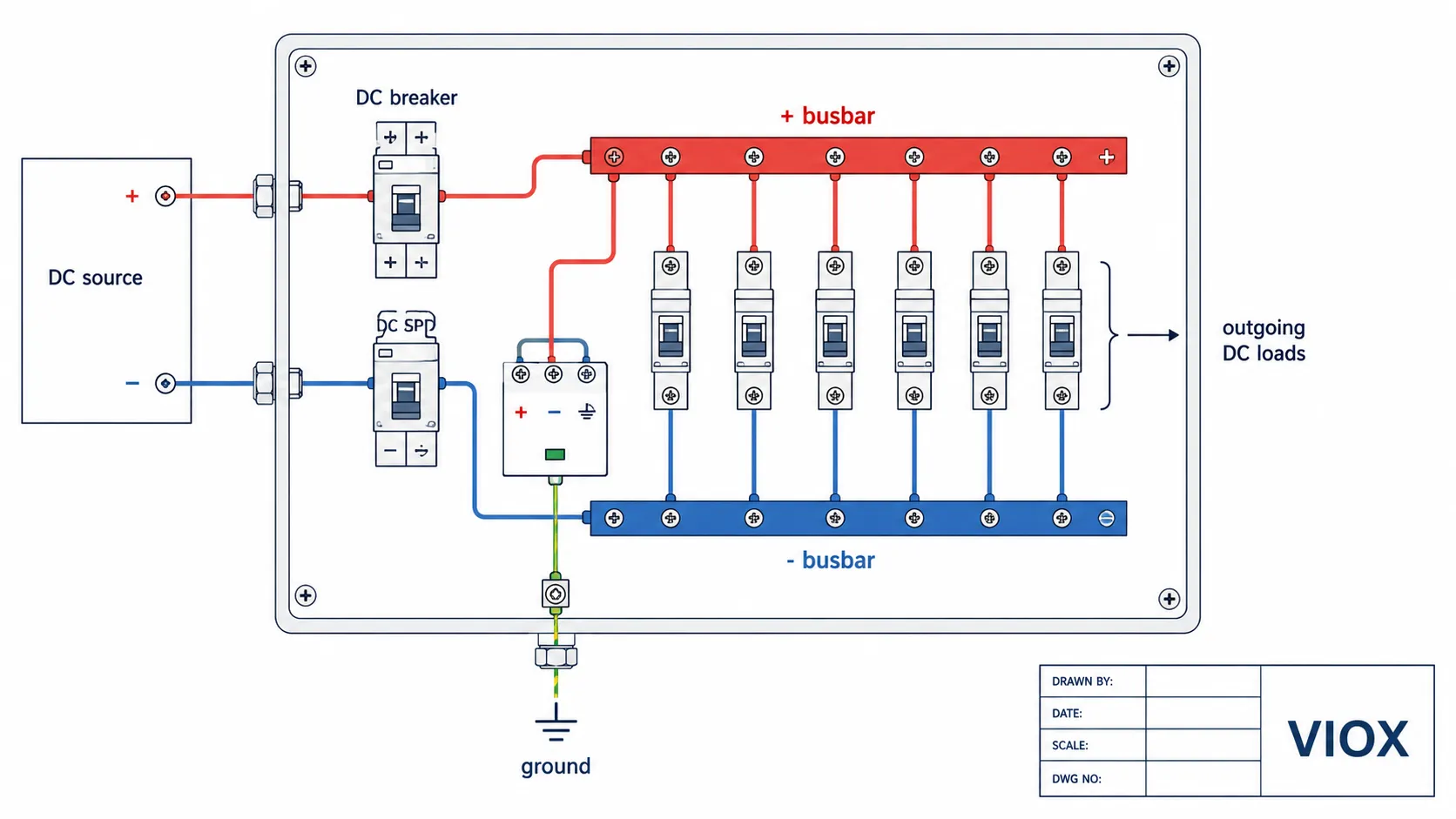
A simplified DC distribution box layout is:
DC source positive (+)
        ↓
DC isolator / DC breaker / fuse
        ↓
Positive busbar
        ↓
Outgoing DC circuits

DC source negative (-)
        ↓
Negative busbar
        ↓
Outgoing DC returns
For PV or battery systems, additional devices may be included:
- string fuses
- DC SPD
- DC isolator
- battery fuse
- DC MCCB
- monitoring device
- grounding or bonding terminal
- polarity warning labels
The exact wiring depends on voltage, grounding method, source type, current direction, and whether the system can experience reverse current.
Can You Use an AC Breaker in a DC Distribution Box?
In most cases, no. Do not use an AC breaker in a DC distribution box unless the manufacturer explicitly rates that exact device for the required DC voltage, current, wiring method, and application.
The risks include:
- failure to extinguish a DC arc
- contact welding
- internal damage
- fire hazard
- wrong polarity wiring
- insufficient breaking capacity
- invalid equipment certification
Some breakers are marked for both AC and DC use, but the DC rating may be lower than the AC rating and may require specific pole wiring. Always read the datasheet and wiring diagram.
Polarized vs Non-Polarized DC Breakers
Some DC breakers are polarized. That means the positive and negative terminals must be connected in the specified direction. A polarized DC breaker may use magnetic blowout or internal arc-control geometry that depends on current direction.
This matters in systems such as:
- PV arrays with possible reverse current
- battery systems with charge and discharge direction
- DC distribution with multiple sources
- bidirectional DC converters
If current can flow in both directions, a non-polarized DC breaker or a device specifically rated for the application may be required. Do not assume a low-cost DC breaker is suitable for battery or PV reverse-current conditions.
Typical Applications
| Application | AC Distribution Box | DC Distribution Box |
|---|---|---|
| Residential building | Lighting, sockets, appliances | Small DC backup or solar auxiliary circuits |
| Commercial building | AC sub-distribution boards | DC control or backup power systems |
| Solar PV | AC inverter output distribution | PV string combiner and DC isolator circuits |
| Battery energy storage | AC grid connection side | Battery string and DC bus protection |
| Telecom | AC input panel | 48V DC distribution board |
| EV charging | AC supply to charger | Internal DC circuits or high-power DC charging architecture |
| Marine/off-grid | AC inverter loads | Battery and DC load distribution |
| Industrial cabinet | AC supply and branch circuits | DC control power, drives, sensors, backup DC |
For PV-specific DC distribution, a PV combiner box may be more appropriate than a generic DC box. See VIOX’s PV combiner box guide.
Selection Checklist
| Selection Question | AC Distribution Box | DC Distribution Box |
|---|---|---|
| What is the system voltage? | AC RMS voltage and phase arrangement | DC maximum operating voltage |
| What protection is needed? | Overload, short circuit, leakage, surge | DC short circuit, reverse current, surge, isolation |
| What breaker type is required? | AC MCB, MCCB, RCCB, RCBO | DC MCB, DC MCCB, fuse, DC disconnector |
| What is the fault level? | Prospective short-circuit current | DC available fault current |
| What SPD is needed? | AC SPD by system and installation point | DC SPD or PV SPD by voltage and source |
| What busbar layout is required? | Phase, neutral, PE | Positive, negative, PE/ground |
| What enclosure rating is needed? | Indoor/outdoor, IP/NEMA, material | Often outdoor, UV, heat, condensation, IP rating |
| What standard framework applies? | IEC 61439, IEC 60364, local wiring rules, or UL panel context | IEC 61439, UL 508A, PV/DC standards, or equipment-specific rules |
| What labels are required? | Circuit, phase, neutral, warning | Polarity, DC voltage, source isolation |
Common Mistakes
Mistake 1: Using AC Breakers on DC Circuits
Physical fit does not prove DC suitability. DC interruption must be clearly rated.
Mistake 2: Ignoring Polarity
Reversing a polarized DC breaker can prevent the internal arc-control system from working correctly.
Mistake 3: Treating a DC Box Like a Normal AC Distribution Board
DC systems may require different SPD selection, fuse coordination, disconnecting means, and warning labels.
Mistake 4: Forgetting Reverse Current
PV strings, batteries, and multi-source DC systems can create current paths that do not exist in simple AC branch circuits.
Mistake 5: Selecting Only by Amp Rating
Amp rating is not enough. Check voltage, breaking capacity, pole count, polarity, wire size, temperature, enclosure rating, and certification.
Mistake 6: Using the Wrong Enclosure
Outdoor DC systems, especially PV and battery systems, need proper IP rating, UV resistance, cable entry sealing, heat dissipation, and condensation control.
Mistake 7: Assuming Certified Components Make a Certified Box
A distribution box may contain certified breakers, SPDs, terminals, and busbars, but the complete assembly still needs correct design verification, spacing, temperature rise control, wiring, marking, and documentation according to the project standard.
FAQ
What is a DC distribution box?
A DC distribution box distributes direct current from a DC source to multiple DC circuits. It is used in solar PV, batteries, telecom power, DC control systems, marine DC systems, and off-grid power equipment.
What is an AC distribution box?
An AC distribution box distributes alternating current to branch circuits. It usually contains breakers, busbars, neutral and earth bars, and sometimes RCCBs, RCBOs, and SPDs.
What is the difference between an AC distribution board and a DC distribution board?
An AC distribution board uses AC-rated protection devices and phase/neutral/earth wiring. A DC distribution board uses DC-rated protection devices, positive/negative busbars, polarity labels, and devices capable of interrupting DC arcs.
Can AC and DC circuits be in the same distribution box?
Only if the enclosure and internal layout are designed, rated, labeled, and separated correctly for both systems. AC and DC wiring should not be mixed casually inside a generic box.
Can I use an AC MCB for DC?
Only if the exact MCB is marked and documented for the required DC voltage, current, pole wiring, and application. Many AC-only MCBs are not safe for DC interruption.
Why is DC switching harder than AC switching?
AC current naturally crosses zero, which helps extinguish the arc. DC current does not have a natural zero crossing, so the arc can persist unless the device is designed to interrupt DC safely.
What protection is used in a DC distribution box?
Common protection includes DC breakers, DC fuses, DC disconnectors, DC SPDs, polarity labels, and sometimes monitoring or leakage detection depending on the system.
Is a PV combiner box the same as a DC distribution box?
A PV combiner box is a specialized DC distribution and protection box for solar strings. It may include string fuses, DC SPD, DC isolator, busbars, terminals, and monitoring.
Conclusion
AC and DC distribution boxes may look similar from the outside, but they are not the same engineering problem.
An AC distribution box is built around AC branch protection, neutral and earth systems, AC breakers, residual-current protection, and AC surge protection. A DC distribution box is built around DC voltage, polarity, sustained arc interruption, positive and negative busbars, DC protection devices, and application-specific risks such as PV reverse current or battery fault current.
The safest selection rule is simple: choose the distribution box according to the current type, voltage, fault current, protection device rating, wiring method, and application. Never assume an AC component is safe in a DC box just because it fits.