On this page
What Are AC and DC Current?
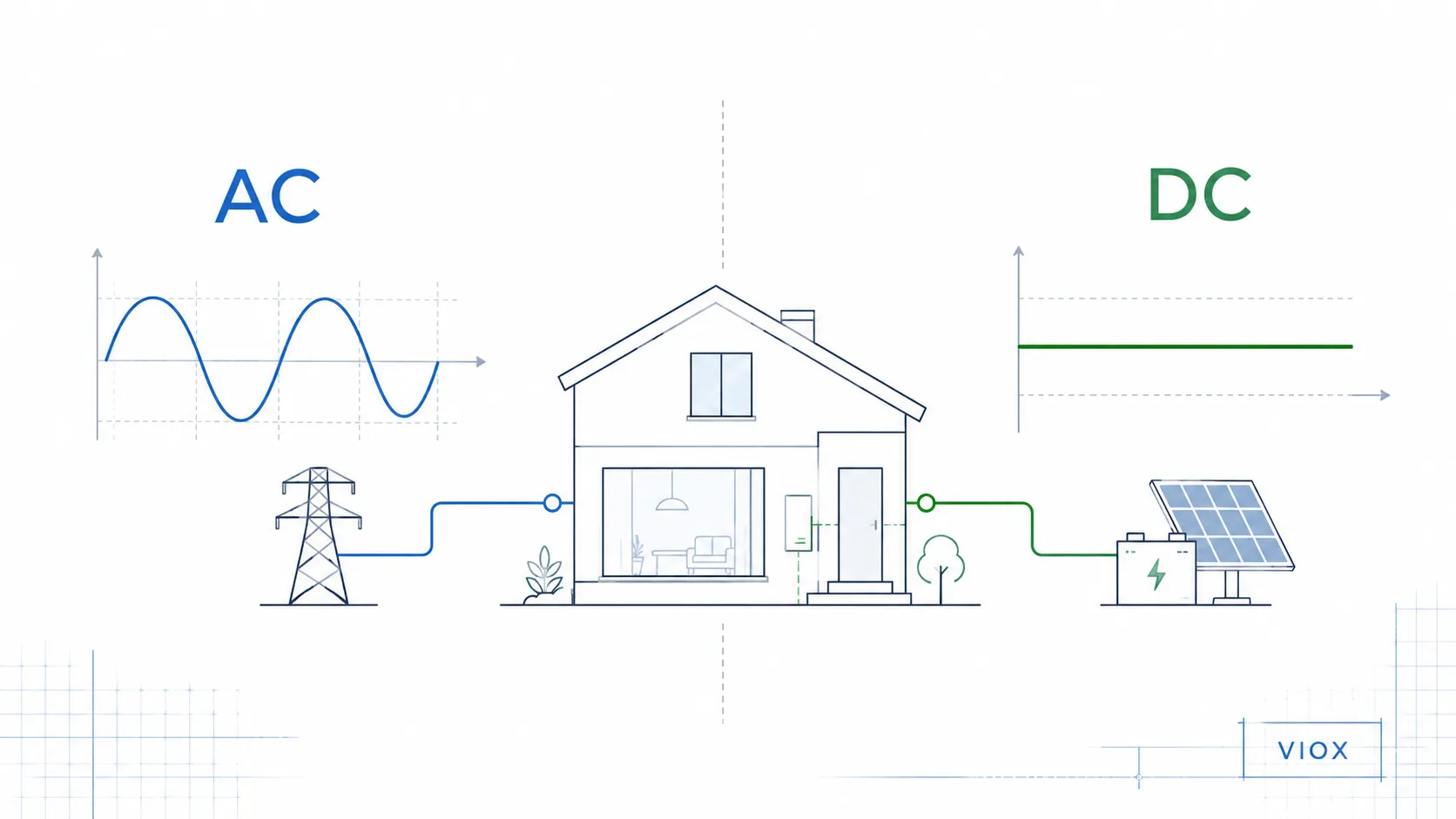
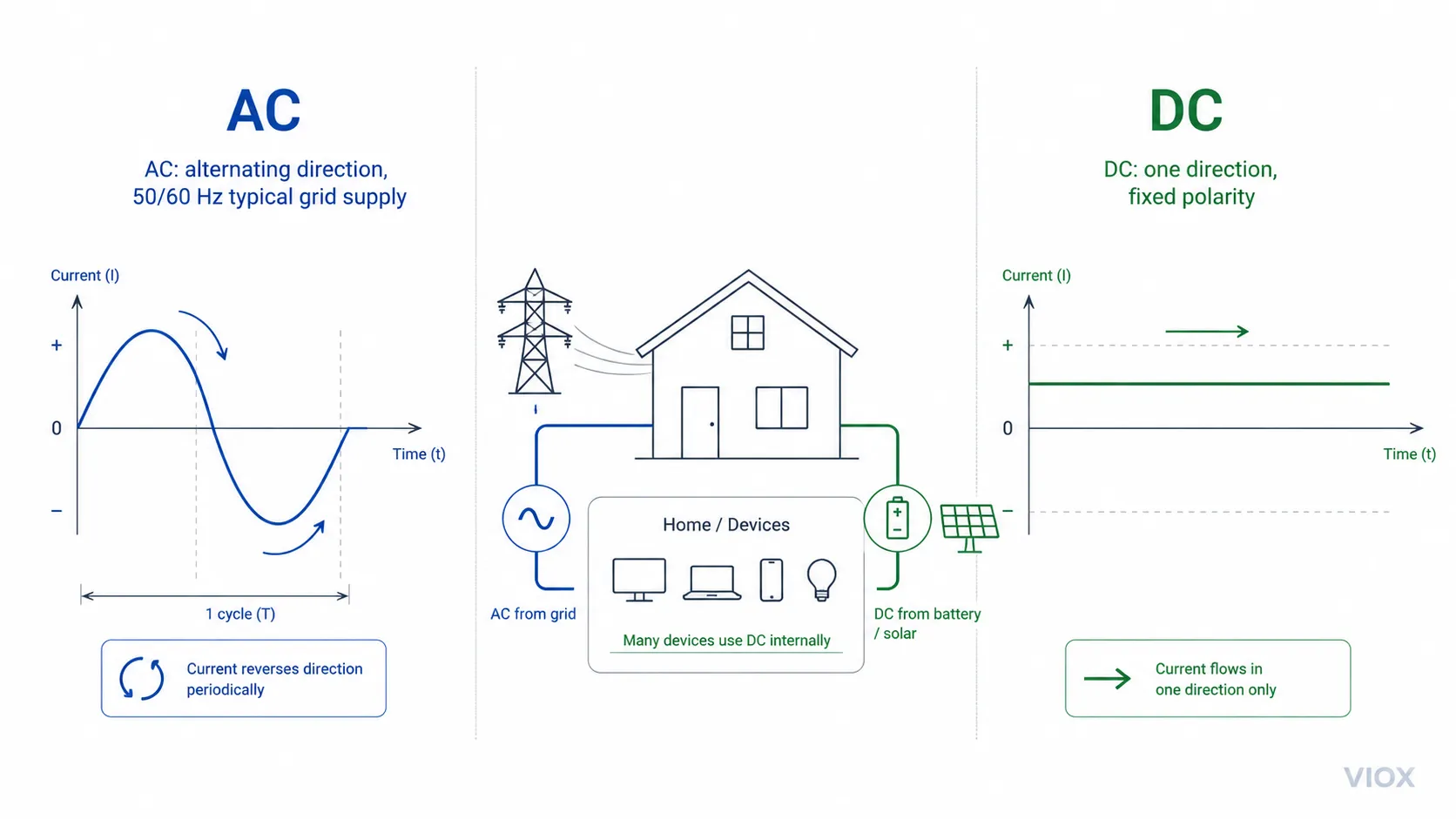
AC and DC are two different ways electric current flows. AC, or alternating current, changes direction periodically and is the standard supply for most homes and buildings. DC, or direct current, flows in one direction and is used in batteries, solar panels, electronics, LED drivers, EV systems, and many low-voltage control circuits.
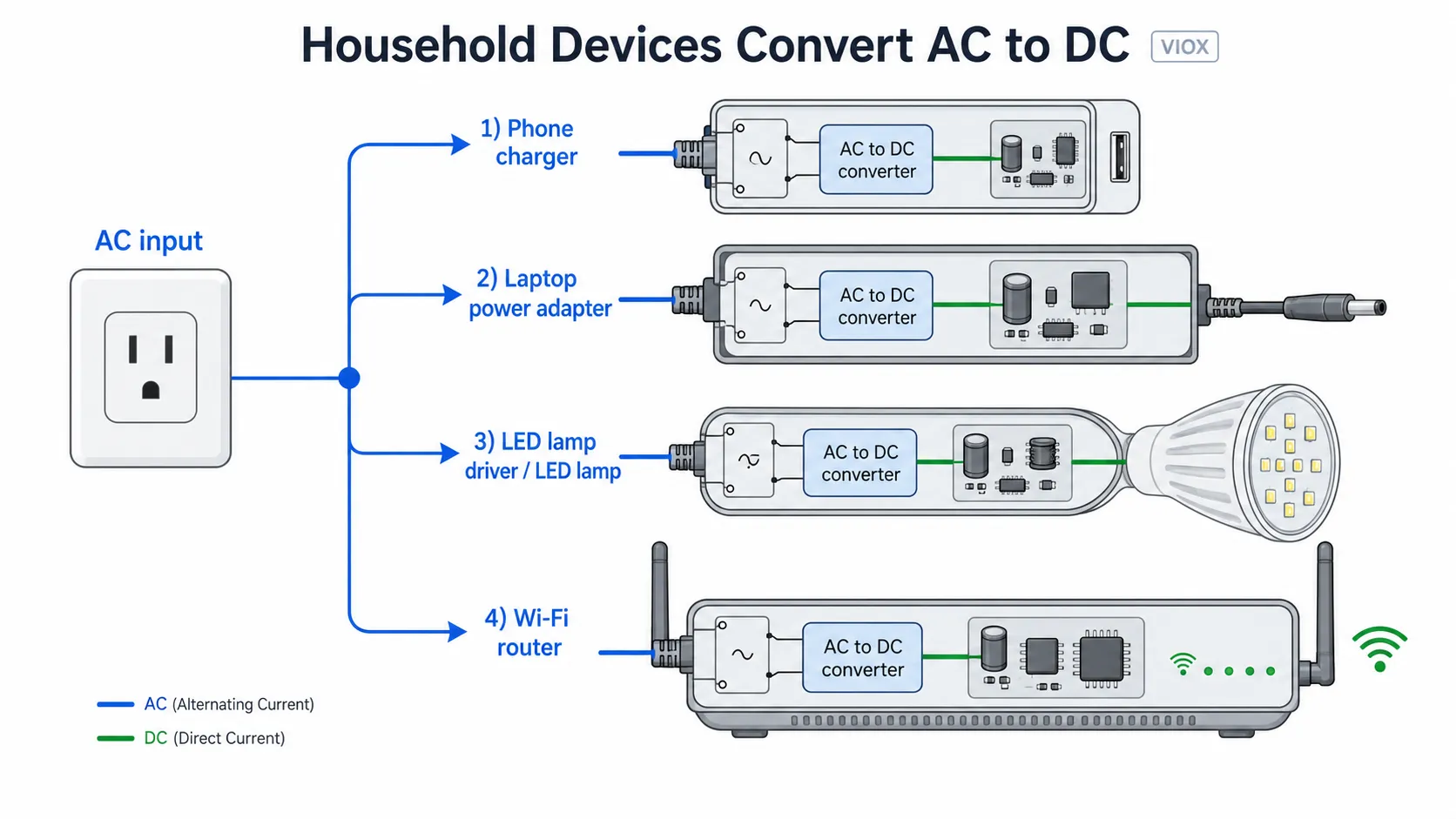
In a typical home, the power coming from the utility grid is AC power. However, many devices inside the home do not actually use AC all the way through. A phone charger, laptop adapter, television, LED light driver, router, inverter appliance, or EV charger may receive AC at the plug and then convert it internally into DC for electronic circuits, batteries, or semiconductor components.
That is why the real answer is not simply “homes use AC.” A more accurate answer is:
Homes normally receive AC from the grid, but many modern appliances and electronic devices convert AC into DC internally.
AC vs DC Current at a Glance
| Question | AC Current | DC Current |
|---|---|---|
| Full name | Alternating Current | Direct Current |
| Current direction | Reverses direction periodically | Flows in one direction |
| Frequency | Usually 50 Hz or 60 Hz in power systems | 0 Hz in steady DC |
| Common source | Utility grid, generators, alternators | Batteries, solar panels, DC power supplies |
| Typical home role | Main supply power from the grid | Internal device power after conversion |
| Easy voltage transformation | Yes, using transformers | Requires electronic converters |
| Common uses | Homes, buildings, motors, distribution grids | Electronics, batteries, EVs, solar PV, control circuits |
| Protection concern | Overload, short circuit, leakage, surge | DC arc interruption, polarity, voltage conversion, battery fault current |
What Is AC Current?
AC current means alternating current. In an AC circuit, current changes direction repeatedly. In most public power systems, this happens at either 50 Hz or 60 Hz, depending on the country or region.
The key feature of AC is that its voltage can be stepped up or stepped down efficiently with a transformer. This made AC extremely practical for public power grids because power can be transmitted at high voltage and lower current, then reduced to a safer usable voltage near homes and buildings.
AC is commonly used for:
- residential power supply
- commercial buildings
- industrial distribution
- lighting circuits
- motors and pumps
- HVAC equipment
- general-purpose wall outlets
- building distribution boards
For circuit protection on AC systems, devices such as miniature circuit breakers, RCCBs, RCBOs, and surge protective devices may be used depending on the circuit design and protection requirement.
What Is DC Current?
DC current means direct current. In a DC circuit, current flows in one direction. The voltage polarity is fixed: one side is positive and the other side is negative.
DC is common wherever stored energy, electronics, or semiconductor conversion is involved. Examples include:
- batteries
- solar photovoltaic panels
- phone chargers
- laptop adapters
- LED drivers
- electronic control boards
- EV battery systems
- telecom power systems
- industrial DC control circuits
- battery energy storage systems
DC is not “less important” than AC. In fact, modern homes and industrial systems use more DC internally than many people realize. The difference is that the public grid usually supplies AC, and many devices convert it into DC at the point of use.
In solar and battery systems, DC protection requires devices designed for DC behavior. For example, a DC circuit breaker or DC isolator switch must be selected according to DC voltage, current, pole configuration, polarity, and interruption requirements.
Why Do Homes Use AC Instead of DC?
Homes use AC mainly because the power grid was built around AC generation, transformation, transmission, distribution, and protection.
The main reasons are:
| Reason | Why It Matters |
|---|---|
| Easy voltage transformation | AC voltage can be stepped up or down efficiently with transformers |
| Efficient distribution | High-voltage AC transmission reduces current and cable losses |
| Grid compatibility | Utility networks, transformers, switchgear, and appliances were standardized around AC |
| Practical circuit protection | AC current naturally crosses zero, which helps circuit breakers interrupt arcs |
| Appliance ecosystem | Most household wiring and plug-in appliances are designed around AC supply |
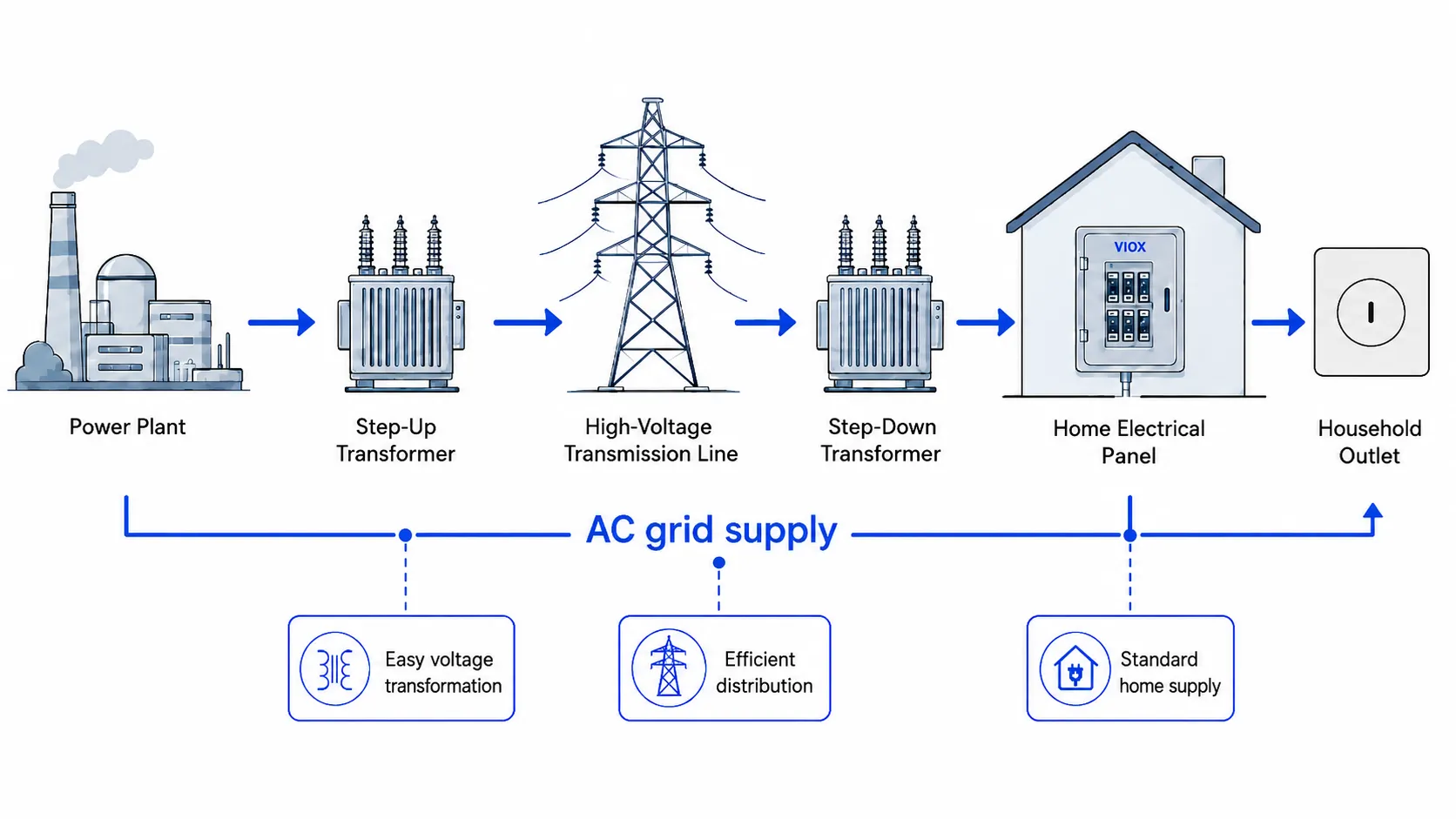
The transformer advantage is the biggest historical reason. To send power over long distances, utilities raise voltage to reduce current. Lower current means lower resistive losses in conductors. Near the point of use, transformers step the voltage down to residential or commercial levels.
DC can also be transmitted efficiently in certain high-voltage direct current systems, especially for very long-distance or undersea links. But that does not mean ordinary homes are ready to use DC as their main supply. A home electrical system still needs standard wiring, protection devices, outlets, appliances, inspections, and service equipment that match the supply system.
Which Current Is Used in Homes?
Most homes use AC current from the utility grid.
The exact voltage depends on the country. For example, some regions use 120 V AC systems, while many others use 230 V AC systems. Larger appliances may use higher line-to-line voltage depending on the local supply arrangement.
But inside the home, the picture is mixed:
| Home device or system | Supply at the plug or panel | Internal operating power |
|---|---|---|
| Incandescent heater or simple resistive load | AC | AC |
| Refrigerator or air conditioner | AC | AC motor or inverter-controlled power electronics |
| LED lamp | AC input | DC inside the LED driver |
| Phone charger | AC input | DC output |
| Laptop adapter | AC input | DC output |
| Wi-Fi router | AC adapter input | DC electronics |
| Solar PV module | DC generation | Converted to AC by inverter for grid/home use |
| EV battery | Receives AC or DC depending on charger | Stores DC |
So if someone asks, “Do we use AC or DC in our homes?” the best answer is:
The home supply is normally AC, but many modern devices convert that AC into DC internally.
Are Household Appliances AC or DC?
Many household appliances are designed to connect to AC power, but that does not always mean every internal part runs on AC.
Simple heating appliances, traditional motors, fans, and many pumps may use AC directly. But electronic appliances often convert AC to DC internally. This includes televisions, chargers, LED lighting, computers, smart appliances, and many control boards.
Modern inverter appliances add another layer. A variable-speed air conditioner, washing machine, or refrigerator may receive AC from the wall, rectify it to DC internally, and then convert it back into controlled AC for a motor. This improves speed control and efficiency, but it also means the appliance contains both AC and DC stages.
That is one reason residual-current protection, surge protection, and circuit protection are more complex today than in older purely resistive or simple motor circuits.
Why Is DC Not Used as the Main Home Supply?
DC is widely used inside devices, but it is not the standard main supply for most homes because the existing electrical infrastructure is built around AC.
The main barriers are:
- standard utility distribution is AC
- residential transformers and service panels are designed for AC
- most wall outlets and appliance plugs are standardized for AC
- AC circuit protection is mature and widely available
- DC switching and arc interruption require special device design
- many appliance categories are already designed for AC input
DC has one difficult behavior that matters a lot for protection: DC arcs do not naturally pass through a zero-current point. AC current crosses zero every half cycle, which helps extinguish arcs when switches or breakers open. DC current can sustain an arc more easily, so DC breakers, DC isolators, and DC contactors need specific arc-extinction designs.
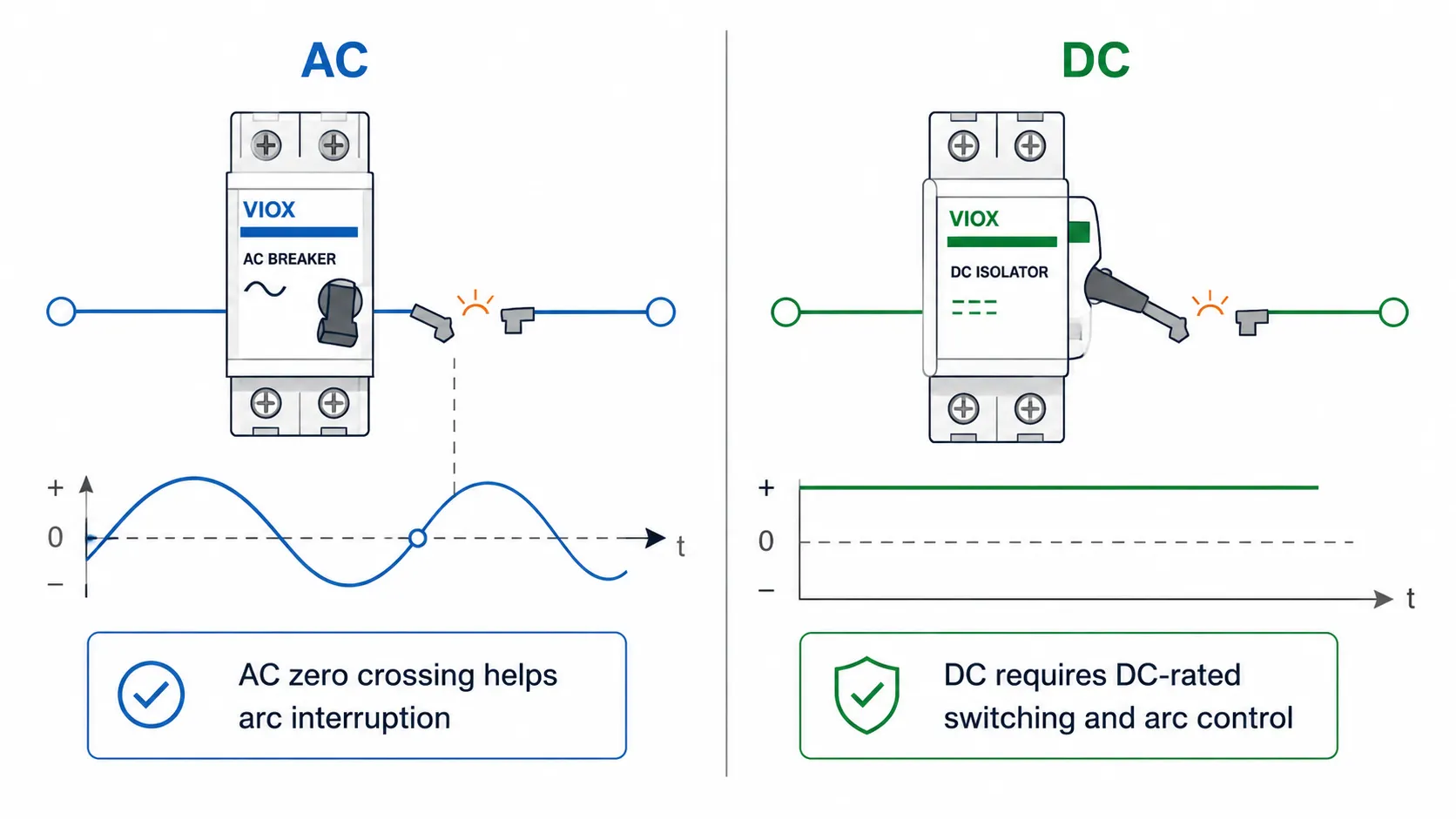
This is why an AC-rated switch or breaker should not be assumed suitable for a DC circuit. For more detail on this issue, see VIOX’s guide on why DC contactors need special arc extinction.
Where Is DC Used Today?
DC is essential in many modern electrical systems.
Common DC applications include:
- battery storage systems
- solar PV strings
- EV batteries and DC fast charging
- LED lighting drivers
- electronics and control boards
- telecom power supplies
- data centers
- automation control circuits
- low-voltage sensors and relays
- DC motor drives
Solar power is a good example. PV modules generate DC. A solar inverter converts this DC into AC so it can supply building loads or connect to the grid. On the DC side, components such as DC surge protection devices, DC isolators, string fuses, and combiner boxes may be needed depending on system design.
Can a Home Use DC Power Directly?
Yes, but only in specific parts of the system.
A home can use DC directly in systems such as:
- solar PV generation
- battery storage
- low-voltage lighting
- USB power distribution
- EV charging equipment
- off-grid DC loads
- telecom or security backup systems
However, replacing the whole home AC supply with DC is not simple. The wiring, protection devices, outlets, appliance compatibility, inspection rules, and safety standards would all need to match the DC system design.
In practice, most homes use a hybrid model:
- AC from the grid for general distribution
- DC inside electronics and batteries
- inverters and converters to move between AC and DC
This hybrid structure is likely to remain common because it combines the strengths of both systems.
Is AC or DC More Dangerous?
Neither AC nor DC is automatically “safe” or “dangerous” by name alone. The danger depends on voltage, current, contact path through the body, exposure time, frequency, environmental conditions, and the available fault energy.
AC can be especially hazardous at power frequencies because it can affect muscle control and heart rhythm. DC can also be extremely dangerous, especially at high voltage or in battery systems with high available fault current. DC arcs can be harder to interrupt, which creates additional fire and equipment risks in PV, battery, and EV systems.
The practical safety rule is simple:
Never judge risk by AC or DC alone. Always consider voltage, current, energy source, protection device, and installation conditions.
AC vs DC in Solar, Batteries, and EVs
Modern energy systems often use both AC and DC.
| System | AC Role | DC Role |
|---|---|---|
| Solar PV | AC output after inverter | DC generated by PV modules |
| Battery storage | AC connection through inverter/PCS | DC stored in battery cells |
| EV charging | AC charging uses onboard charger | DC fast charging feeds battery more directly |
| Home electronics | AC input at plug | DC used by internal circuits |
| Industrial automation | AC supply for panels and motors | DC control power, sensors, PLCs, relays |
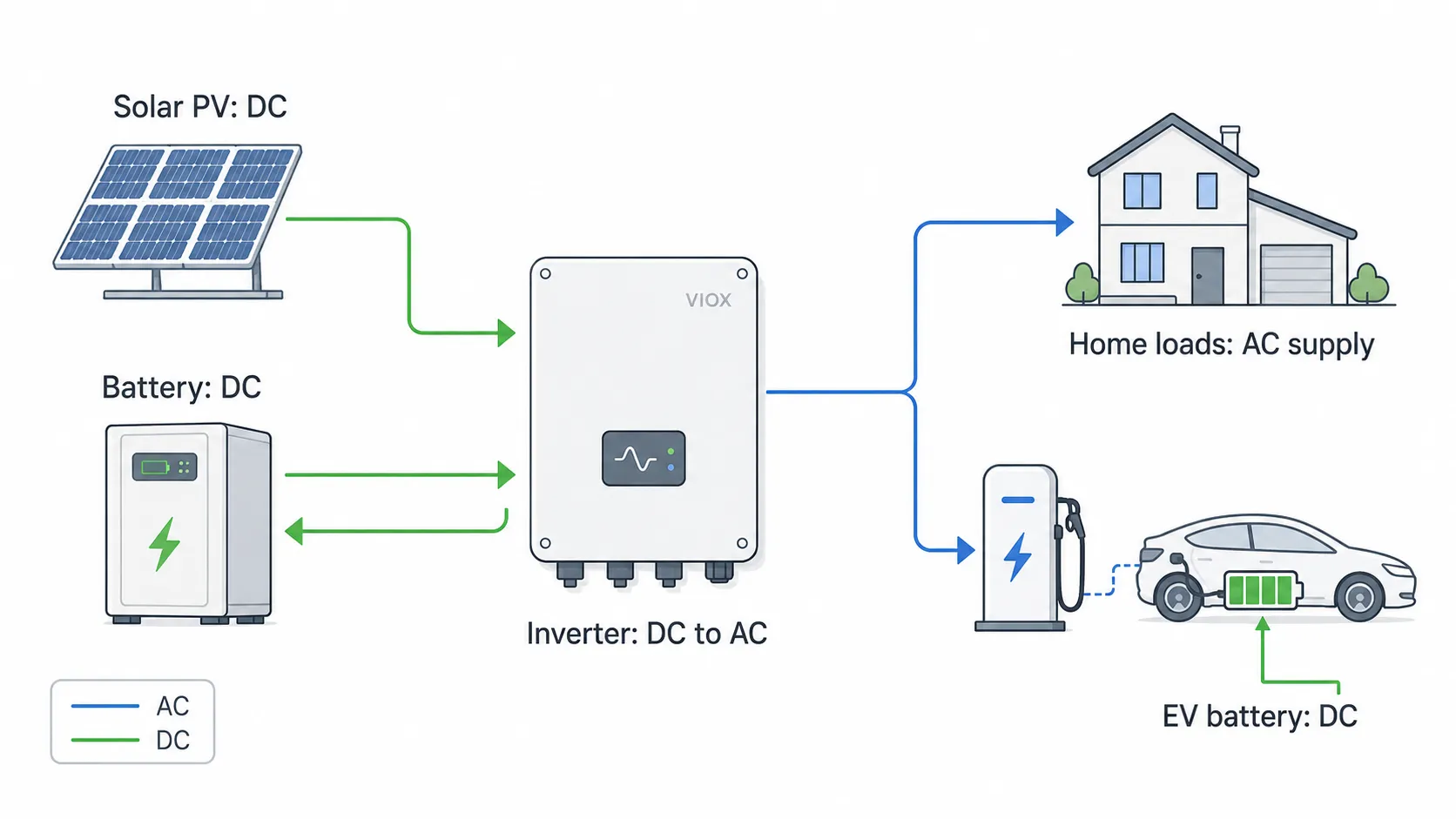
This is why AC vs DC is not a question of one technology replacing the other. The real engineering question is where each form of power is most suitable and how it should be protected.
Common AC and DC Misunderstandings
“Homes use only AC.”
Not exactly. Homes normally receive AC from the grid, but many devices use DC internally after conversion.
“DC is not used in homes.”
DC is used in chargers, electronics, LED drivers, solar panels, batteries, routers, security equipment, and EV systems.
“AC is stronger than DC.”
This is not a technically useful comparison. Power and hazard depend on voltage, current, resistance, source energy, and circuit conditions.
“An AC breaker can be used on DC if the voltage is similar.”
Not necessarily. DC interruption is different. A breaker or switch must be specifically rated for the DC voltage, current, polarity, and application.
“Solar panels produce AC.”
Solar PV modules produce DC. The inverter converts DC into AC for grid or household use.
Quick Summary
| Question | Answer |
|---|---|
| What is AC current? | Current that periodically changes direction |
| What is DC current? | Current that flows in one direction |
| Which current is used in homes? | Homes normally receive AC from the grid |
| Why is AC used in homes? | It is easy to transform, distribute, protect, and standardize |
| Why is DC still important? | Batteries, solar panels, electronics, EVs, and control circuits use DC |
| Are appliances AC or DC? | Many plug into AC but convert power to DC internally |
FAQ
Is 120 V or 230 V home power AC or DC?
Residential utility supply is normally AC, whether the nominal voltage is around 120 V, 230 V, or another regional standard. The exact voltage and wiring arrangement depend on the country and local electrical system.
Do LED lights use AC or DC?
Most LED lamps connect to an AC supply, but the LED chips themselves operate on DC. An internal or external LED driver converts AC input into controlled DC output for the LEDs.
Can solar panels power a house directly?
Solar PV panels produce DC. In most grid-connected homes, an inverter is required to convert PV DC into AC that can supply household loads or synchronize with the grid. Off-grid DC loads are possible, but they need a system designed for DC voltage, protection, and wiring.
Can an AC appliance run on DC power?
Not unless the appliance is specifically designed to accept DC input. Some devices use external adapters and actually run on DC internally, but connecting a standard AC-only appliance directly to DC can damage the device or create a safety risk.
Why does DC need special switches and breakers?
DC current does not naturally cross zero like AC current. When a switch or breaker opens under load, a DC arc can be harder to extinguish. That is why DC circuits require devices with suitable DC voltage, current, polarity, and breaking ratings.
Is DC becoming more common in homes?
Yes. Batteries, solar PV, EV charging, USB power, LED drivers, electronics, and smart controls all increase the amount of DC conversion inside homes. But the main utility supply remains AC in most residential installations.
Conclusion
Homes use AC because the electrical grid, transformers, distribution equipment, protection devices, and household wiring standards were built around AC power. AC is practical for delivering electricity from the grid to buildings.
But DC is now everywhere inside modern homes and industrial systems. Batteries, solar panels, EVs, LED drivers, chargers, electronics, and control circuits all depend on DC. The modern electrical world is not AC or DC only. It is a coordinated system where AC handles distribution and DC powers many of the devices and technologies we use every day.