

On this page
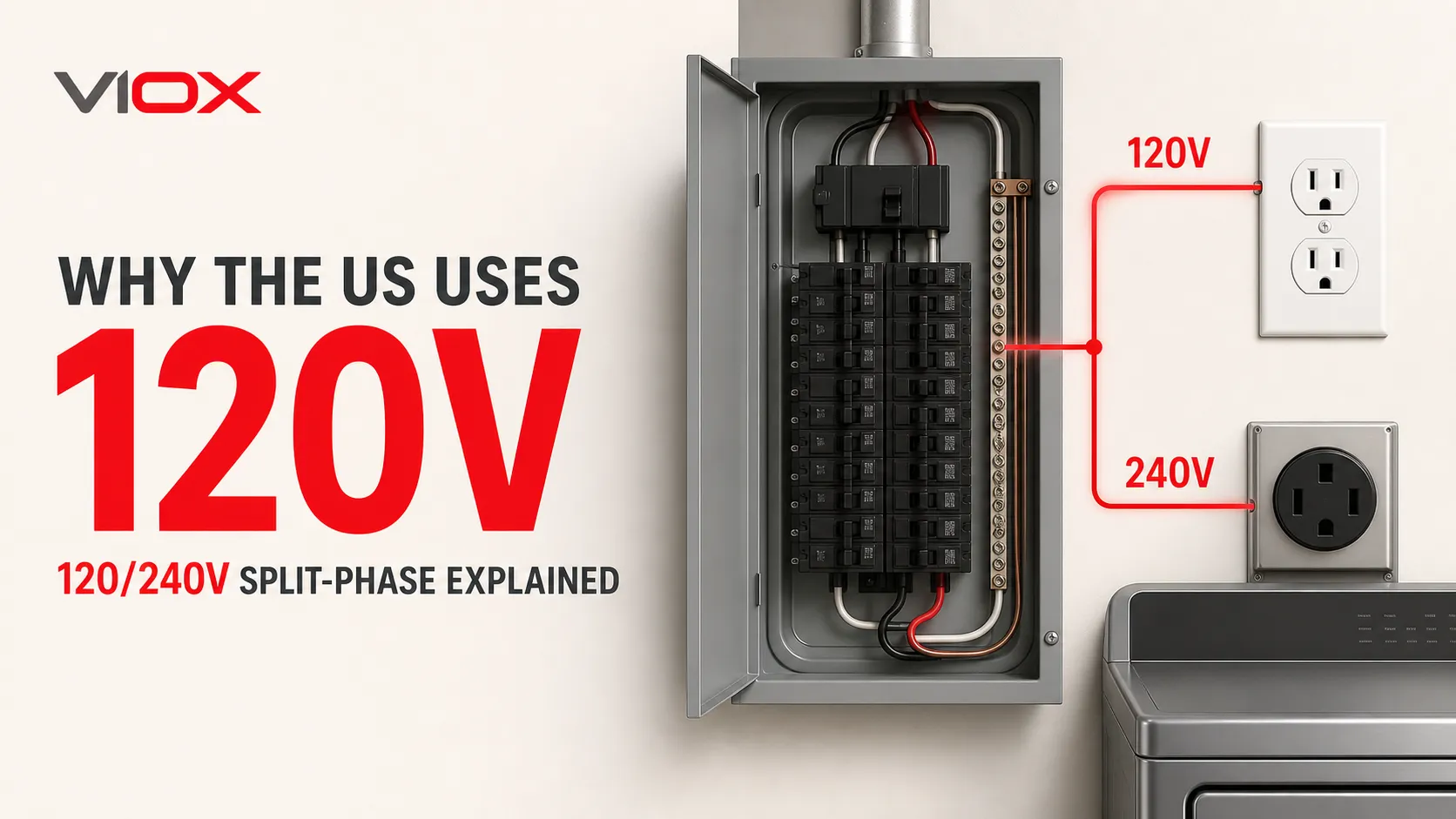
The short answer is that the United States does not use only 120 volts. Most US homes receive 120/240V split-phase power at 60 Hz. Standard receptacles supply 120V, while electric ranges, clothes dryers, water heaters, air-conditioning equipment, EV chargers, and other high-power loads may use 240V.
America retained 120V for ordinary outlets because its early electric-lighting systems, appliances, wiring practices, and safety rules developed around the 100–120V range. Once that installed base became enormous, changing every compatible device and branch circuit would have brought high cost with limited practical benefit. The split-phase system already gives US homes access to 240V where the higher voltage is useful.
US Voltage at a Glance
| Question | Short answer |
|---|---|
| What is the standard US outlet voltage? | Nominally 120V AC at 60 Hz |
| Do US homes have 220V or 240V? | Yes. Most homes have 240V available between the two hot conductors |
| Is the US supply 110V or 120V? | 120V is the modern nominal value; 110V and 115V are older or informal terms |
| Why are large appliances connected to 240V? | For the same power, 240V requires half the current of 120V |
| Is a plug adapter also a voltage converter? | No. An adapter changes the plug interface, not the voltage or frequency |
| Is 240V always better than 120V? | No. Each voltage has practical advantages, and system design matters more than the number alone |
The US Department of Energy describes US household power as 110–120V at 60 Hz, compared with 220–240V at 50 Hz in many other countries. For residential service, however, the more complete description is 120/240V split phase.
How 120/240V Split-Phase Power Works
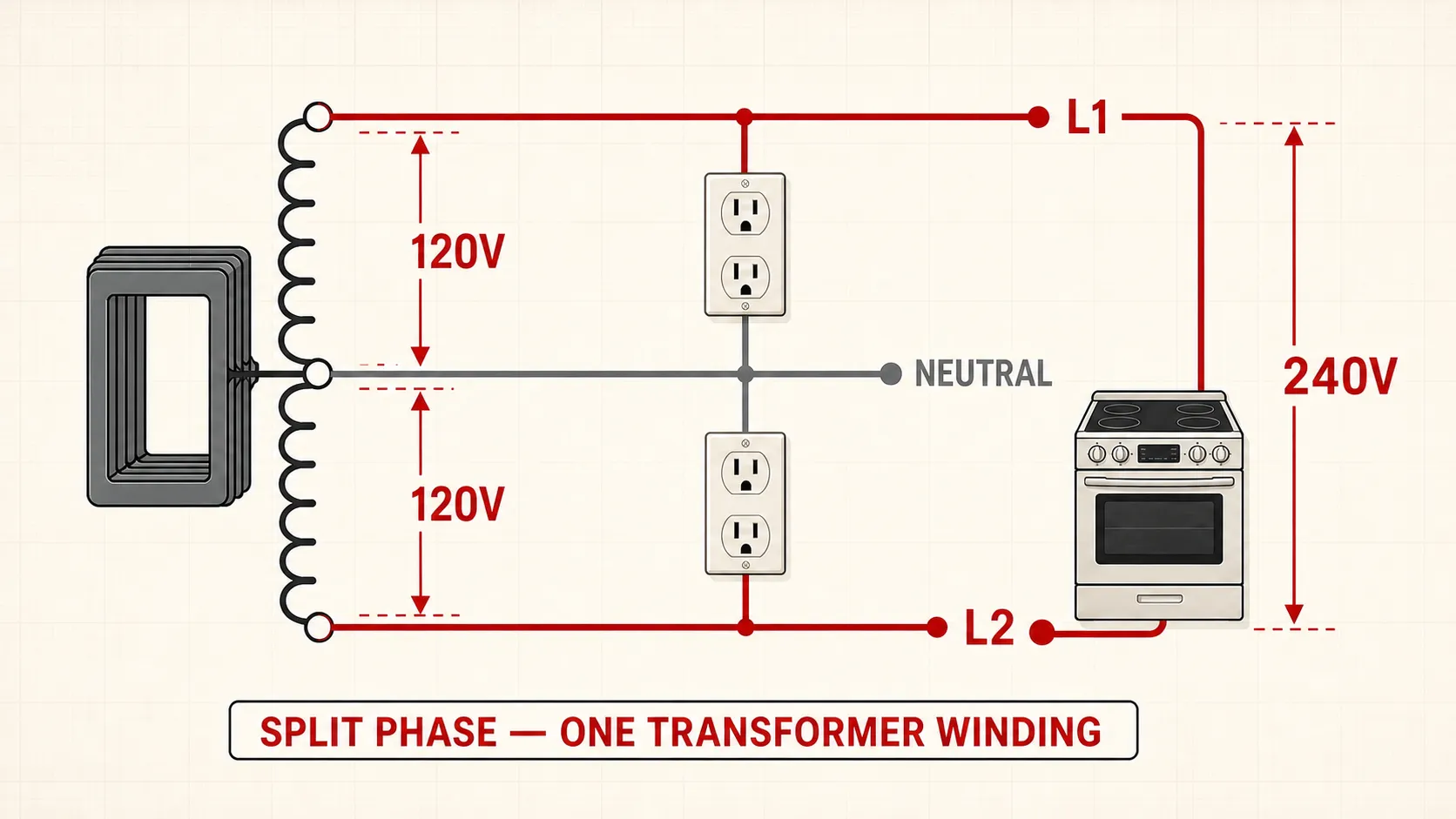
A typical North American home is supplied from a center-tapped transformer secondary. The three service conductors are:
- Hot leg L1
- Hot leg L2
- Center-tapped neutral
The voltage from either hot leg to neutral is 120V. The voltage from L1 to L2 is 240V.
| Connection | Nominal voltage | Common uses |
|---|---|---|
| L1 to neutral | 120V | Lighting and standard receptacle circuits |
| L2 to neutral | 120V | Lighting and standard receptacle circuits |
| L1 to L2 | 240V | Ranges, dryers, water heaters, HVAC equipment, workshop loads, and EV charging |
This is called split phase, not two-phase power. The two 120V legs come from opposite ends of one transformer winding. When one leg is positive relative to neutral, the other is negative, producing 240V between them.
US government housing guidance describes most homes as receiving nominal 120/240V single-phase, three-wire service. Commercial buildings may instead use systems such as 120/208V three-phase, so equipment labeled for 240V should not automatically be assumed to perform identically on 208V.
Why Did the United States Standardize Around 120V?
There was no single worldwide committee that selected one household voltage. Electrical networks developed locally, and early decisions became embedded in generating equipment, lamps, wiring, and appliances.
Early lighting systems established the voltage range
Thomas Edison’s early direct-current lighting systems operated at about 100–110V. The voltage suited the incandescent lamps and distribution technology available at the time. By the late 1880s, 110V lighting systems and compatible equipment were already in commercial use.
Alternating current later won the wider distribution battle because transformers made it practical to transmit power at high voltage and step it down near users. However, AC suppliers still needed to serve an existing market of lamps and equipment designed around the established utilization voltage. The supply method changed, but the familiar low-voltage range remained.
The nominal voltage gradually became 120V
People still say “110V” or “115V,” but the modern nominal US supply is 120V. These numbers are not three entirely different systems. They reflect historical naming, earlier nominal values, equipment ratings, and normal supply variation.
The same naming issue occurs with “220V,” “230V,” and “240V.” In a modern US residence, 240V is the appropriate nominal line-to-line value. In many countries using IEC-based public supply systems, 230V is the nominal line-to-neutral value. Always use the equipment nameplate and the applicable local supply specification rather than relying on informal voltage names.
Infrastructure made a nationwide conversion unattractive
Once millions of buildings, receptacles, lamps, appliances, and protective devices were designed around 120V branch circuits, changing the standard would have required a coordinated replacement program across the entire country.
More importantly, the US did not need to choose between 120V and 240V. Split-phase service preserved 120V for general-purpose circuits while making 240V available for higher-power equipment. That reduced the potential benefit of a nationwide conversion to 230V outlets.
120V vs 220–240V: What Changes Electrically?
For a load drawing real power under the simplified relationship:
P = V × Iwhere:
- P is power in watts
- V is voltage in volts
- I is current in amperes
A 1,500W load would draw approximately:
- 12.5A at 120V
- 6.25A at 240V
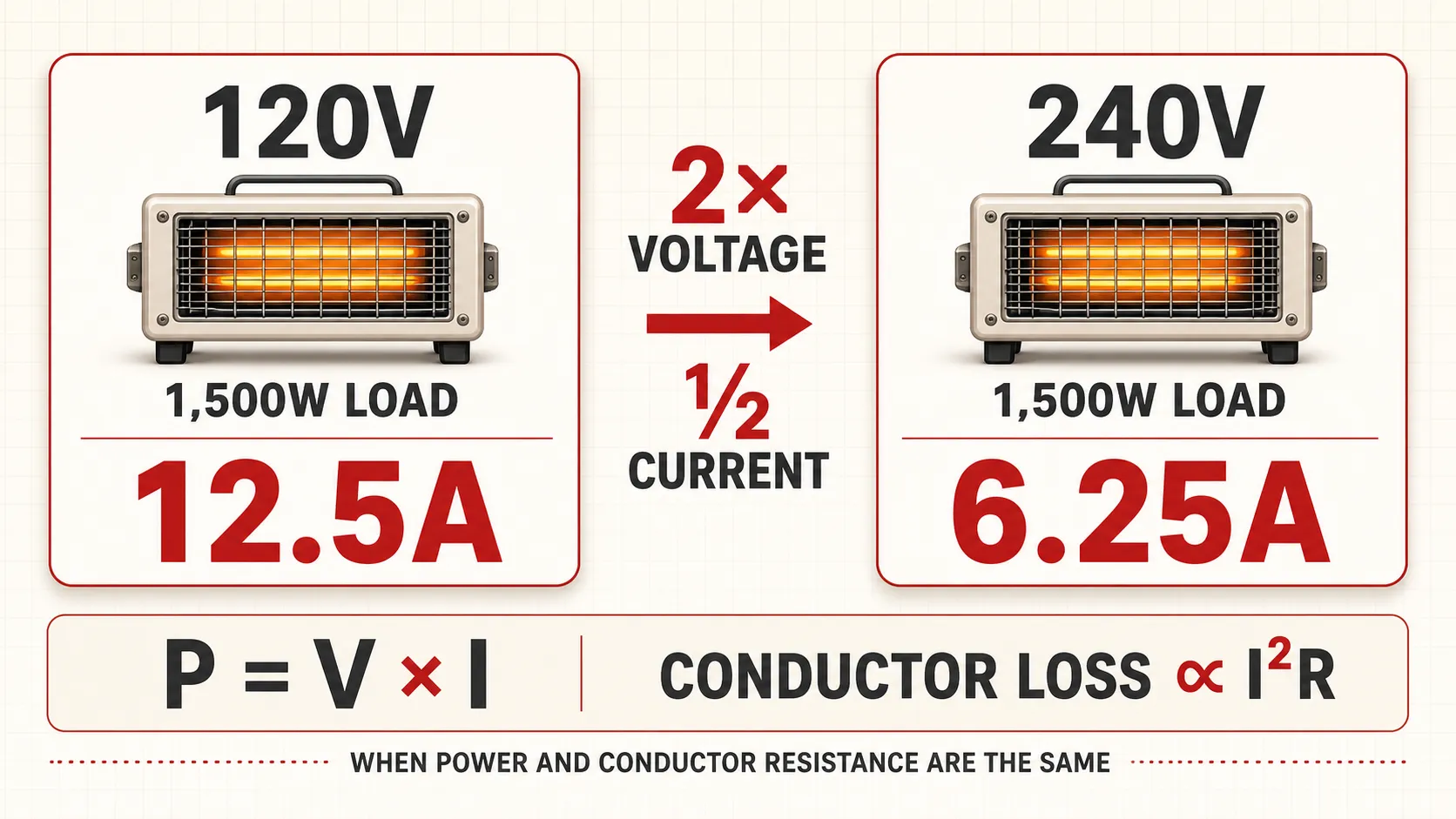
Doubling the voltage halves the current for the same power. This matters because resistive conductor loss follows:
P loss = I²RIf conductor resistance were unchanged, halving the current would reduce that conductor loss to one quarter. Actual installations also change conductor size, breaker rating, circuit length, connection methods, and permitted load, so this equation should not be turned into a claim that a 240V country automatically uses 75% less household electricity.
Practical comparison
| Factor | 120V circuit | 220–240V circuit |
|---|---|---|
| Current for the same power | Higher | Lower |
| Conductor loss with the same resistance and power | Higher because current is higher | Lower because current is lower |
| Power available at the same current rating | Lower | Higher |
| Typical US use | Lighting, receptacles, small appliances | High-power appliances and dedicated equipment |
| Shock exposure | Lower voltage, but still hazardous | Higher voltage can drive more current through the body |
| Appliance compatibility | Requires equipment rated for the available supply | Requires equipment rated for the available supply |
For a deeper engineering treatment, see VIOX’s guide to voltage, current, and line-loss calculations or use the voltage drop calculator for a defined circuit.
Is 240V More Efficient Than 120V?
Higher voltage can deliver the same power at lower current, which can reduce voltage drop and conductor losses. That is why power grids transmit electricity at voltages far above either household utilization voltage, then step it down closer to the load.
But appliance energy consumption depends on the appliance design and its power rating, not voltage alone. A 1,500W heater designed for 120V and a 1,500W heater designed for 230V both consume about 1,500W while operating. Their required current differs, but the useful heat output is broadly tied to power.
Some 230V appliances appear faster because the local socket circuit permits a higher-power appliance. For example, a higher-wattage kettle can heat water faster than a lower-wattage kettle. The faster result comes from the higher permitted power, not from voltage acting as a universal speed multiplier.
Is 120V Safer Than 220–240V?
Lower voltage can reduce the current driven through a given resistance, but neither 120V nor 240V should be treated as safe to touch. Shock severity depends on multiple factors:
- Current path through the body
- Contact duration
- Skin condition and moisture
- Source impedance
- Grounding and bonding
- Fault-clearing time
- Residual-current or ground-fault protection
Voltage is only one part of the safety system. Proper grounding, overcurrent protection, enclosure design, insulation, and Ground-Fault Circuit Interrupter (GFCI) or Residual Current Device (RCD) protection are essential. VIOX’s RCD vs GFCI comparison explains how these protection approaches differ between IEC and North American contexts.
Never alter a branch circuit, receptacle, transformer connection, or equipment voltage configuration unless you are qualified and the work complies with the applicable local code.
Why Doesn’t the US Change All Outlets to 220–240V?
A nationwide change would require much more than replacing receptacles. It could affect:
- Appliances and plug-connected equipment
- Branch-circuit wiring and overcurrent protection
- Receptacle and plug configurations
- Product certification and installation rules
- Maintenance procedures and spare parts
- Building codes and inspection practices
The benefit would also be limited because the existing system already supplies 240V to loads that need it. Standard 120V circuits remain suitable for most lighting, electronics, and portable appliances, while dedicated 240V circuits serve higher-power equipment.
In other words, the US has not ignored 240V. It distributes both utilization voltages within the same residential service.
Can You Use a 220–240V Appliance in the United States?
Check the appliance nameplate before connecting it.
If the label says “100–240V, 50/60Hz”
The power supply is designed for both common voltage and frequency ranges. You may need only a correctly rated plug adapter, but confirm grounding and connector compatibility.
If the label says “220–240V only”
A standard US 120V outlet is not suitable. Depending on the appliance, you may need an appropriate 240V circuit or a correctly sized step-up transformer. Motors, compressors, heating equipment, and high-power appliances require particular care.
If the label says “120V, 60Hz only”
Do not connect it directly to a 230V supply. A simple travel plug adapter does not reduce voltage. A step-down transformer may address voltage, but it does not necessarily change 50Hz to 60Hz. Frequency-sensitive motors, clocks, transformers, and timing devices may still operate incorrectly.
Before using industrial equipment internationally, compare voltage, frequency, phase configuration, current, plug type, grounding arrangement, and protective-device requirements. VIOX’s industrial plug and socket selection guide covers the main compatibility checks.
120V, 208V, 230V, and 240V Are Not Interchangeable Labels
| Marking | Common context | Important distinction |
|---|---|---|
| 110V | Historical or informal North American term | Modern nominal outlet voltage is generally 120V |
| 115V | Common equipment nameplate rating | Equipment rating is not necessarily the utility’s nominal supply |
| 120V | Standard US line-to-neutral residential voltage | Normally 60 Hz |
| 208V | Line-to-line voltage in a 120/208V three-phase WYE system | Not the same as 240V; check equipment tolerance |
| 220V | Older or informal term; still nominal in some markets | Do not assume it means US residential 240V |
| 230V | Common nominal public supply in many countries | Often 50 Hz, but country-level specifications vary |
| 240V | US residential line-to-line split-phase voltage | Used for many high-power residential loads |
The safest rule is simple: match the equipment nameplate to the actual measured or specified supply. Do not select components based only on the familiar label used in conversation.
Which System Is Better: 120V or 220–240V?
There is no universally superior voltage independent of the installation.
The 220–240V approach delivers a given power at lower current, which is useful for conductor sizing, voltage drop, and higher-power socket loads. The US 120/240V split-phase approach provides 120V for general-purpose circuits and 240V for large loads without requiring every appliance to use the higher voltage.
For engineers and equipment buyers, the practical question is not “Which national system wins?” It is:
- What supply voltage, frequency, and phase configuration are available?
- What does the equipment nameplate require?
- What circuit protection and grounding arrangement apply?
- Does the installation comply with the local electrical code?
Frequently Asked Questions
What voltage does the US use?
Standard US receptacles provide nominal 120V AC at 60 Hz. Most homes receive 120/240V split-phase service, so 240V is also available for dedicated high-power loads.
Is the USA 110V or 120V?
120V is the modern nominal value. “110V” remains common in everyday speech because earlier systems used lower nominal voltages. Equipment may also be marked 115V even when intended for a nominal 120V supply.
Does the US use 220V?
US homes commonly provide nominal 240V between the two hot legs. People sometimes call this 220V, but 240V is the more accurate modern residential term. Some commercial buildings provide 208V instead.
Why does Europe use 230V while the US uses 120V outlets?
The systems developed separately before international harmonization. Early equipment, infrastructure, and national standards created different installed bases. Many European systems standardized around the 220–240V range, while North America retained 120V general-purpose circuits and paired them with 240V split-phase service.
Does 240V use less electricity than 120V?
Not automatically. A load’s energy consumption depends primarily on its power and operating time. A higher voltage reduces current for the same power and can reduce wiring losses, but it does not make every appliance consume less energy.
Will a 240V appliance run more slowly on 120V?
It may fail to start, heat weakly, operate incorrectly, or suffer damage, depending on its design. Do not test incompatible equipment by simply plugging it in. Use a correctly rated supply or conversion solution approved for that equipment.
Can a plug adapter convert 220V to 120V?
No. A plug adapter only changes the physical connection. Voltage conversion requires a suitable transformer or electronic converter, and frequency compatibility must be evaluated separately.
Why does the US use 60Hz instead of 50Hz?
Frequency, like voltage, became embedded through early regional standardization. Changing it would affect generators, motors, transformers, clocks, and other frequency-dependent equipment. Modern power electronics can accommodate both frequencies in many products, but not all loads are frequency-independent.
Conclusion
The United States kept 120V general-purpose circuits mainly because early lighting systems and the enormous installed base developed around that voltage range. However, describing the country as a “120V-only” system is misleading. A typical US home receives 120/240V split-phase power, using 120V for ordinary outlets and 240V for higher-power loads.
The meaningful engineering difference is current: for the same power, 240V requires half the current of 120V. That can reduce voltage drop and conductor loss, but it does not make 240V equipment universally more efficient or make 120V safe. Correct equipment matching, grounding, circuit protection, and local-code compliance remain essential at either voltage.