

On this page
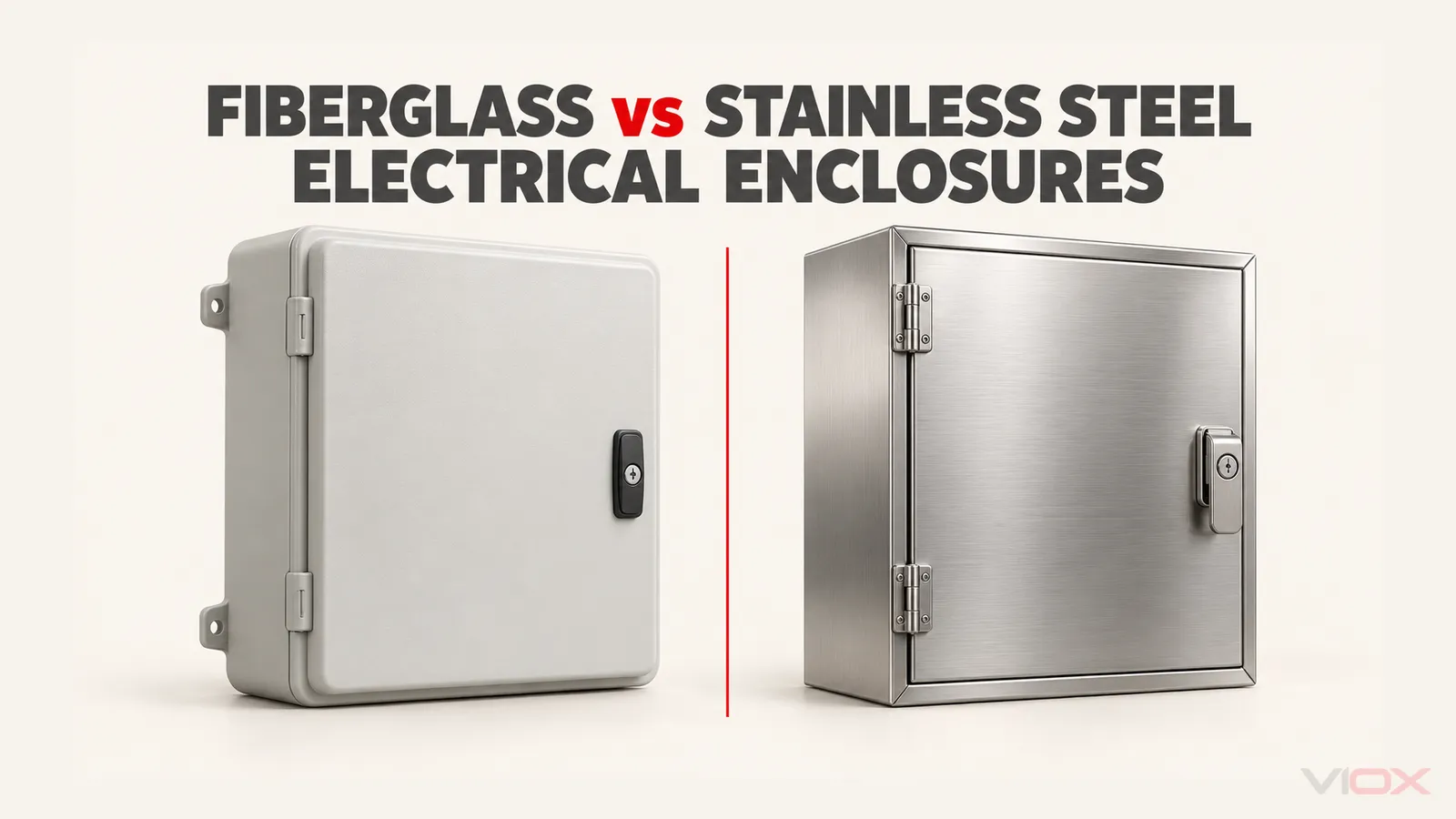
Choose fiberglass when chemical compatibility, a nonmetallic housing and lower handling weight are priorities. Choose stainless steel when mechanical protection, cleanable construction or an engineered conductive shield are priorities. Confirm the actual resin or steel grade against the exposure before accepting either option.
For an electrical enclosure, the shell is only part of the decision. Door seals, hinges, cable entries, mounting loads and internal heat can rule out an otherwise suitable material. A material description alone cannot establish the finished box’s environmental or electrical performance.
Fiberglass vs Stainless Steel: The Selection Table
Compare boxes with equivalent usable space, mounting capacity and required protection. Comparing a small molded junction box with a large reinforced cabinet tells you little about the material itself.
| Selection factor | Fiberglass enclosure | Stainless steel enclosure | Check before choosing |
|---|---|---|---|
| Corrosive exposure | Nonmetallic shell avoids metallic rust; chemical suitability depends on the resin system | Resistance depends on alloy, finish, fabrication and exposure | Exact chemicals, concentration, temperature and contact duration |
| Outdoor use | Requires suitable weathering and ultraviolet qualification | Metal shell tolerates sunlight, but seals and other nonmetallic parts still need review | Complete enclosure’s outdoor-use evidence |
| Impact and security | Performance depends on molding, reinforcement and hardware | Often a practical starting point where rigidity and forced-entry resistance matter | Enclosure impact evidence, locks and mounting details |
| Handling weight | Often lighter for comparable applications | Often heavier, particularly with reinforced construction | Actual assembled mass and wall or pole support |
| Electrical protection | Insulating shell; internal metalwork still needs assessment | Conductive shell requires an appropriate protective bonding arrangement | Finished panel’s electrical protection design |
| Electromagnetic shielding | Ordinary fiberglass is not an engineered conductive shield | Conductive shell can support shielding when seams and entries are designed accordingly | Required frequency range and verified shielding performance |
| Thermal management | Do not assume the housing will remove equipment losses adequately | Metal walls can help conduct heat, but do not establish an acceptable internal temperature | Heat-load assessment for the actual installation |
| Cleaning and washdown | Check resin surface, seal and cleaning-agent compatibility | Cleanable stainless designs are useful where hygiene matters | Door geometry, drainage, cleaning method and gasket resistance |
| Cost | Evaluate complete supplied configuration | Evaluate complete supplied configuration | Installed cost, modifications and maintenance access |
Here, fiberglass means a glass-fiber-reinforced polymer enclosure, also described as glass-reinforced plastic, or GRP. Specify the resin system rather than ordering simply by the word “fiberglass.” For an initial comparison with other materials, use the electrical enclosure material selection guide.
Start With the Chemicals, Not the Material Name
Fiberglass: Verify the Resin Against the Exposure
A fiberglass shell can be a useful candidate where metal corrosion is the main concern. That does not make every fiberglass formulation suitable for acids, alkalis, solvents or disinfectants. The resin, surface condition and exposure all matter.
Give the supplier the chemical name, concentration, maximum temperature, contact duration and whether exposure is airborne, occasional splash or repeated washing. Ask which tested material formulation supports the recommendation. A resistance chart for a different resin or a room-temperature splash test may not represent prolonged hot exposure.
ASTM D543’s chemical-resistance guidance explains why reagent, concentration, temperature, stress and contact conditions must match the intended use. It is a basis for evaluating evidence, not a universal certification requirement for every electrical box.
Stainless Steel: Separate 304 From 316
304 and 316 are different starting points for corrosion assessment. Molybdenum-bearing 316 generally offers better resistance to chloride pitting than 304. Surface finish, weld treatment, crevices and deposited contamination still affect the result. The British Stainless Steel Association’s corrosion guidance explains these mechanisms.
For a coastal cabinet, distinguish salt-laden air from seawater splash or immersion. Even 316 can suffer localized attack; its marine use does not make it universally corrosion proof. See the association’s limits for 316 in seawater applications.
A food-processing room adds a different question: what cleaner contacts the enclosure, and how is it rinsed? A stainless box that suits the room’s atmosphere may still need a different specification for its cleaning regime. Assess the hinges, fasteners and gland materials alongside the shell.
Check Outdoor Aging, Impact and Mounted Loads
For fiberglass, request evidence of outdoor suitability for the supplied formulation and construction. Color retention alone does not establish retained mechanical or electrical properties. UL’s polymeric-material guidance separates thermal, mechanical and environmental evaluations, including ultraviolet and water exposure. A material evaluation also needs to be used within its conditions of acceptance in the finished product.
For stainless steel, include the gasket, viewing window and other polymer parts in the outdoor review. A durable metal shell does not protect an unsuitable window or seal from aging.
Mechanical selection needs more than a material strength number. Compare the complete enclosure’s impact performance, door hardware, backplate rating and mounting arrangement. A heavy transformer, large contactor assembly or door-mounted operator can impose loads quite different from a light terminal strip. Check those loads with the supplier rather than assuming the shell carries them safely.
Fiberglass can reduce handling weight, but use the assembled mass for lifting and support design. A reinforced backplate and installed equipment can remove much of the apparent weight advantage.
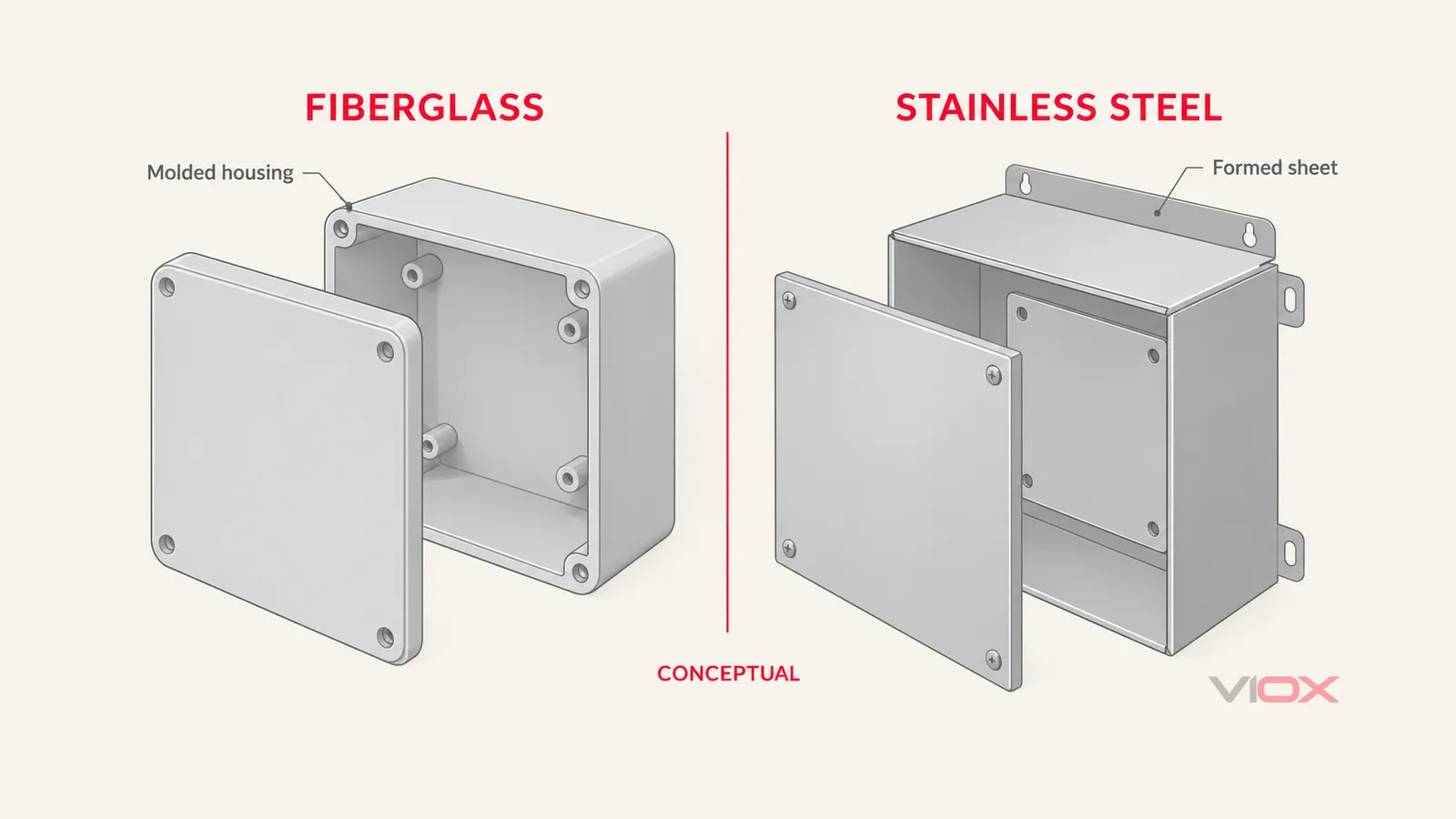
Conceptual construction examples, not model drawings. The resin system, sheet construction and hardware need product-specific confirmation.
Resolve Bonding, Shielding and Heat Before Ordering
An Insulating Shell Does Not Remove Every Bonding Requirement
A fiberglass housing does not provide a conductive fault-return path. A metal backplate, exposed conductive equipment or metal cable hardware inside it may still require protective bonding under the applicable design and installation rules.
A stainless enclosure needs an appropriate bonding arrangement for conductive parts that could become energized. In US workplaces, OSHA 1910.304 addresses grounding of metal enclosures and equipment. Apply the rules for the destination market and the enclosure manufacturer’s instructions; do not infer that a hinge alone provides the required protective continuity.
Shielding Requires a Complete Design
For electromagnetic compatibility (EMC), first establish whether an enclosure shield is required. Do not select ordinary fiberglass on the assumption that electrical insulation also blocks electromagnetic interference. A nonmetallic enclosure may need an engineered conductive formulation, coating, liner or separate shielded compartment when shielding is required.
Stainless steel provides a conductive starting point, but openings, door seams, bonding and cable-shield terminations affect performance. FHNW’s research on conductive plastic housings demonstrates why material conductivity, geometry and frequency must be considered together. Request evidence for the intended shielding requirement rather than accepting a material-only promise.
Specify Heat Loss and Ambient Conditions
Include equipment power losses, ambient temperature, direct sun, mounting position and allowable internal temperature in the enclosure specification. Metal conducts heat through its walls differently from fiberglass, but wall conduction is only one part of heat transfer. Surface area, finish, surrounding airflow and cooling arrangements also matter.
A sealed stainless cabinet can still overheat. A fiberglass cabinet can be suitable with an adequate thermal design. Use a thermal assessment or verified enclosure data for the actual arrangement instead of assigning either material a universal operating-temperature range.
Any fan, filter, vent or cooling unit must also suit the required environmental protection. Adding ventilation can change the conditions under which the original enclosure rating was established.
Verify the Complete Enclosure’s Rating
Neither “fiberglass” nor “stainless steel” establishes an ingress protection (IP) or enclosure Type rating. Specify the required rating and obtain evidence for the exact construction and configuration supplied.
IEC 62208:2023 addresses empty enclosures before components are installed. A completed switchgear or controlgear assembly has additional requirements under its applicable product standard, such as the relevant IEC 61439 parts. Empty-enclosure evidence does not establish finished-panel conformity.
In North American projects, distinguish a claimed National Electrical Manufacturers Association (NEMA) Type rating from a specific third-party certification. Type 4X adds corrosion protection to its environmental protection scope; it does not promise resistance to every process chemical or cleaning cycle. UL 50E addresses environmental enclosure requirements and also identifies limits concerning conditions inside the enclosure and entry through unsealed openings.
An IEC 60529 IP classification does not by itself establish chemical compatibility, EMC performance or a matching North American Type rating. The NEMA vs IP comparison explains that distinction in more detail.
Inspect the interfaces that can change the result:
- Door and gasket: Confirm seal material compatibility, compression and suitability for repeated opening. UL’s gasket guidance distinguishes continuous compression from periodic recompression applications.
- Cable entries and accessories: Verify glands, windows, drains and ventilation devices for the intended mounting and protection requirements.
- Holes and modifications: Establish permitted cutouts and how the modified construction retains the required performance.
- Mounting and hardware: Check external brackets, fasteners and backplate supports against the exposure and load.
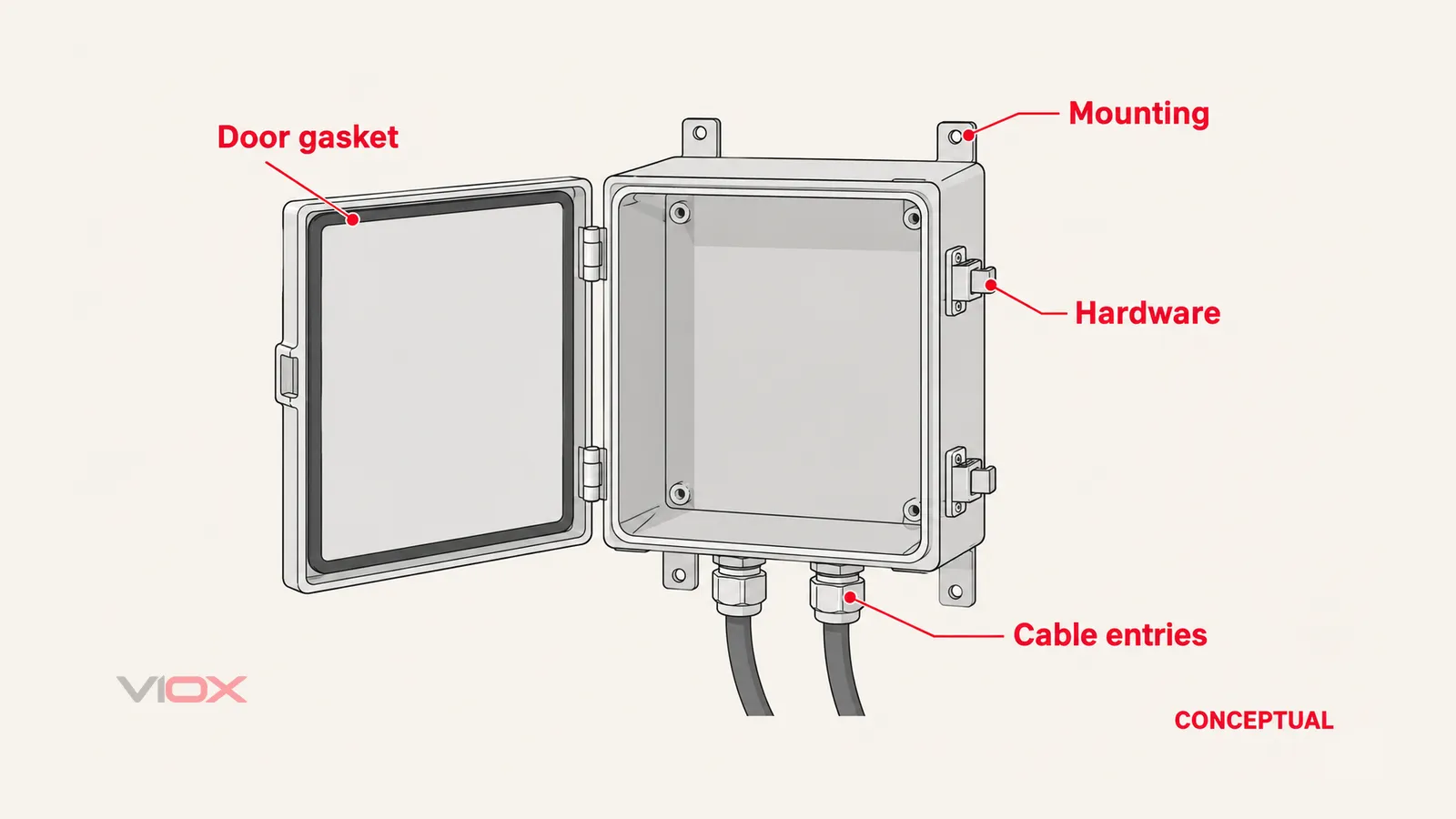
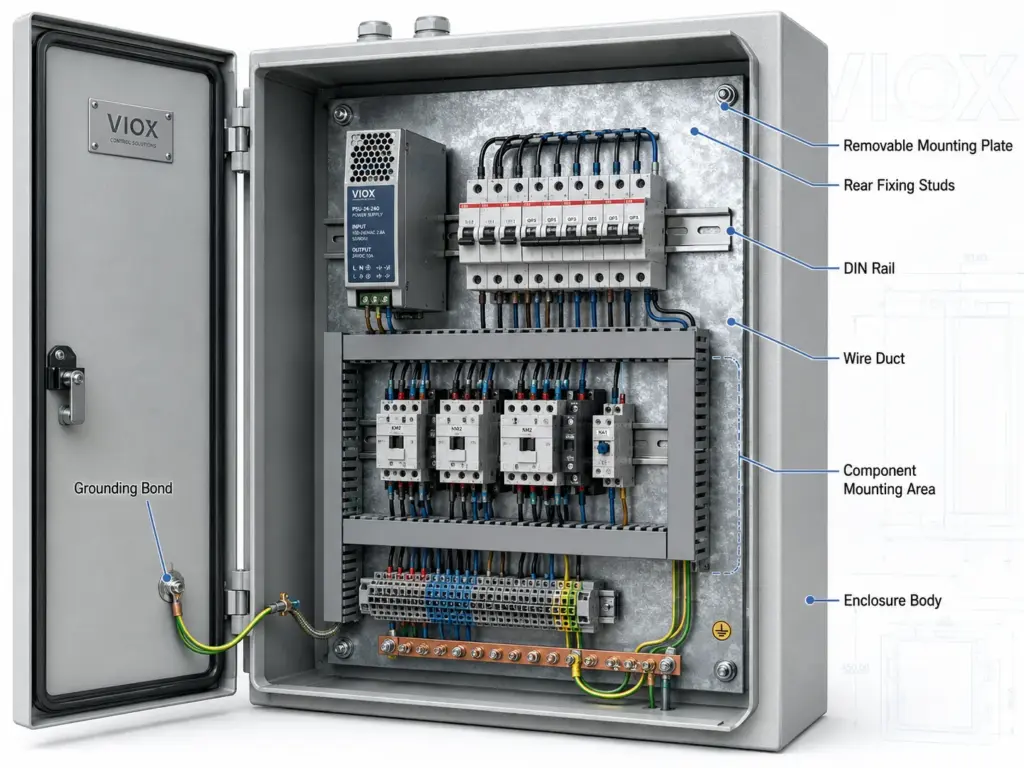
Review the shell and each interface together. The illustration identifies inspection locations and does not assign a rating to the example enclosure.
Apply the Comparison to Mixed Conditions
These are illustrative selection situations, not VIOX field-test results.
A light control box near a chemical dosing skid: Fiberglass is a reasonable candidate if the exact resin, seals and accessories are compatible with the chemicals. Stainless remains an option where alloy evidence supports it. Neither should be accepted from a generic “chemical resistant” description.
A production-area cabinet cleaned every shift: Start with the required cleaning procedure and cleanability of the entire construction. A purpose-designed stainless enclosure may be a practical choice. Confirm cleaner compatibility, door details and washdown evidence; a flat metal surface alone does not establish hygienic suitability.
An outdoor cabinet with heavy equipment and an EMC requirement: Stainless may simplify the mechanical and shielding approach. Compare that with a qualified fiberglass enclosure incorporating suitable supports and a separate shielding solution. Evaluate both complete configurations, including thermal control, rather than comparing bare-box prices.
Send Both Suppliers the Same Specification
A useful quotation request identifies the conditions each material must satisfy:
| Specify | Information to provide or request |
|---|---|
| Exposure | Location, chemicals, concentration, temperature, contact duration and cleaning method |
| Material | Exact fiberglass resin system or stainless grade, finish and hardware materials |
| Mechanical arrangement | Usable internal space, equipment mass, backplate load, door loads and mounting format |
| Electrical integration | Applicable protection method, bonding provisions and any EMC requirement |
| Thermal conditions | Equipment losses, ambient range, sunlight and proposed cooling |
| Environmental evidence | Required IP or Type rating, relevant certification records and accessory conditions |
| Modifications | Cable-entry schedule, windows, cutouts and permitted field changes |
Compare the delivered enclosure, accessories, installation effort and maintenance access. Avoid universal price multipliers or service-life promises: those need comparable quotations and application-specific evidence.
For available VIOX configurations, review the distribution box and electrical enclosure range and submit the same application details with your enquiry. Confirm the exact material, configuration and supporting documents for the proposed model before specification.