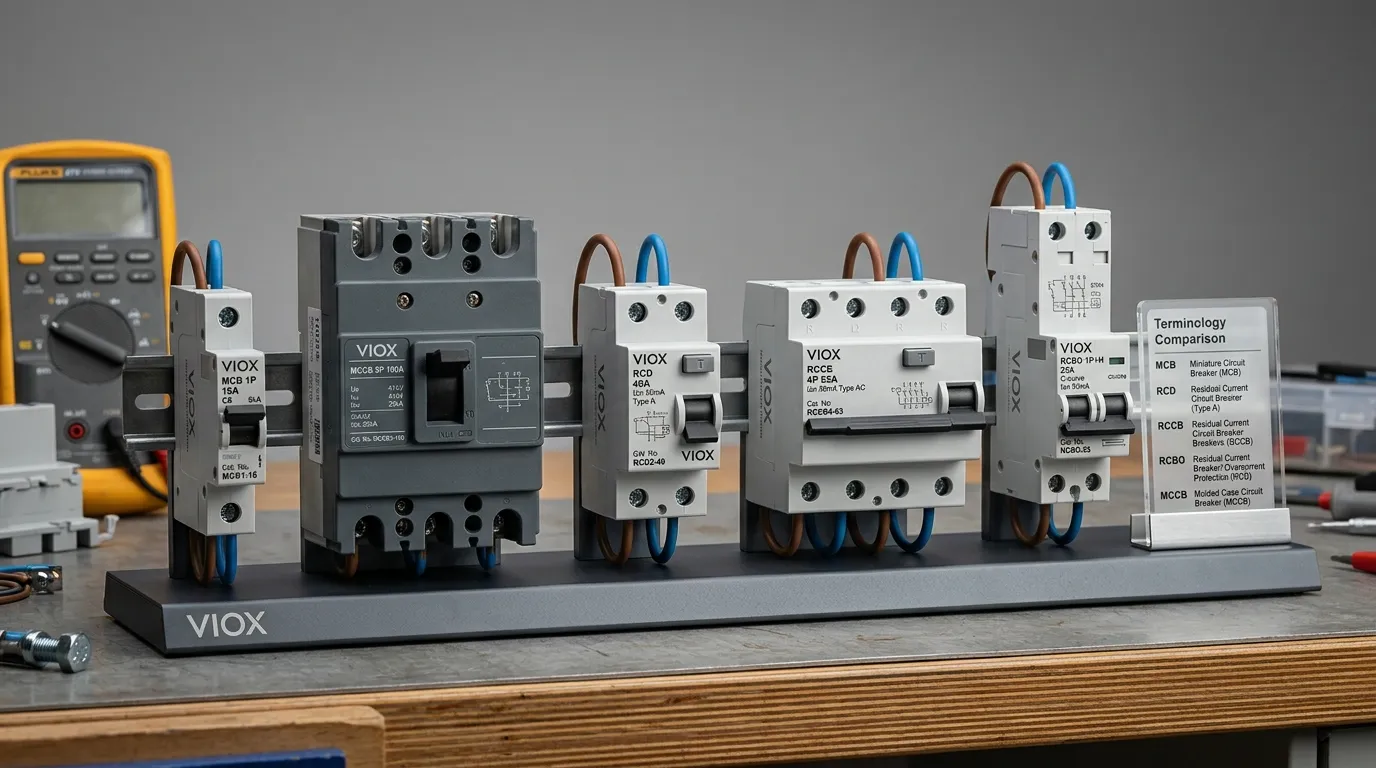
If you are trying to understand the difference between MCB, MCCB, RCB, RCD, RCCB, and RCBO, the short answer is this:
MCBandMCCBmainly protect against overload and short circuitRCD,RCCB, andRCBare mainly used for residual-current or earth-leakage protectionRCBOcombines residual-current protection with overcurrent protection in one device
That is the core distinction. The confusion usually starts because some of these terms are device names, while others are broader category terms that get used differently across markets.
This guide is designed to make that difference clear, fast, and practical.
Quick Comparison Table
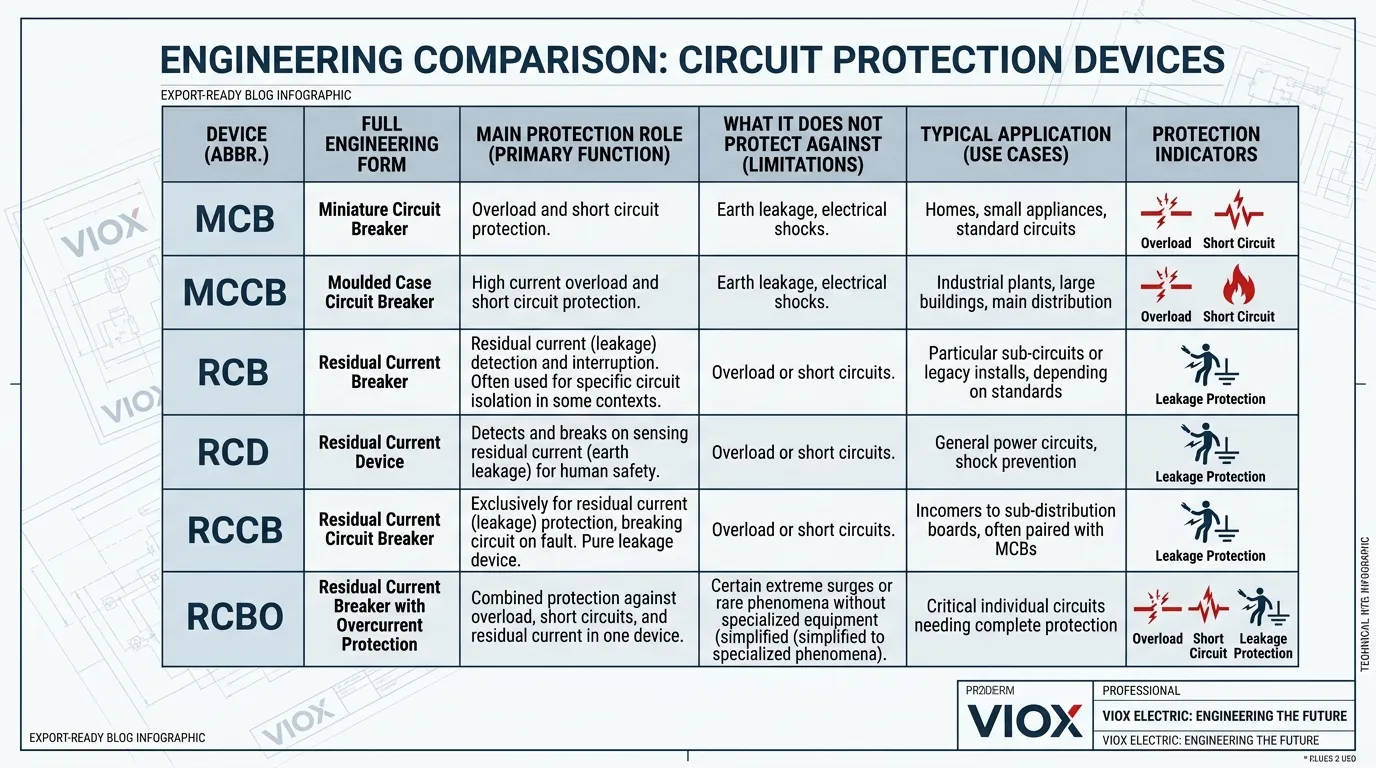
| Term | Full form | Main protection role | What it does not do by itself | Typical use |
|---|---|---|---|---|
| MCB | Miniature Circuit Breaker | Overload and short-circuit protection | Does not provide residual-current protection | Final circuits, branch protection, residential and light commercial panels |
| MCCB | Molded Case Circuit Breaker | Higher-capacity overload and short-circuit protection | Does not provide residual-current protection by itself | Commercial and industrial distribution, larger feeders |
| RCB | Residual Current Breaker | Usually refers to residual-current protection device terminology | Meaning can vary by market and product context | Used loosely in some catalogs or conversations |
| RCD | Residual Current Device | Broad category for residual-current detection devices | Not always a single exact device type | General residual-current protection language |
| RCCB | Residual Current Circuit Breaker | Residual-current or earth-leakage protection | Does not provide overload or short-circuit protection | Shock protection where separate overcurrent protection is present |
| RCBO | Residual Current Breaker with Overcurrent Protection | Combined residual-current, overload, and short-circuit protection | Does not remove the need for correct sizing and coordination | Circuits needing combined protection in one device |
For readers who want a device-by-device definition first, VIOX already has supporting pages for MCB full form, MCCB full form, and RCCB full form.
What Each Term Means
Before comparing these devices, it helps to separate overcurrent protection terms from residual-current protection terms.
MCB
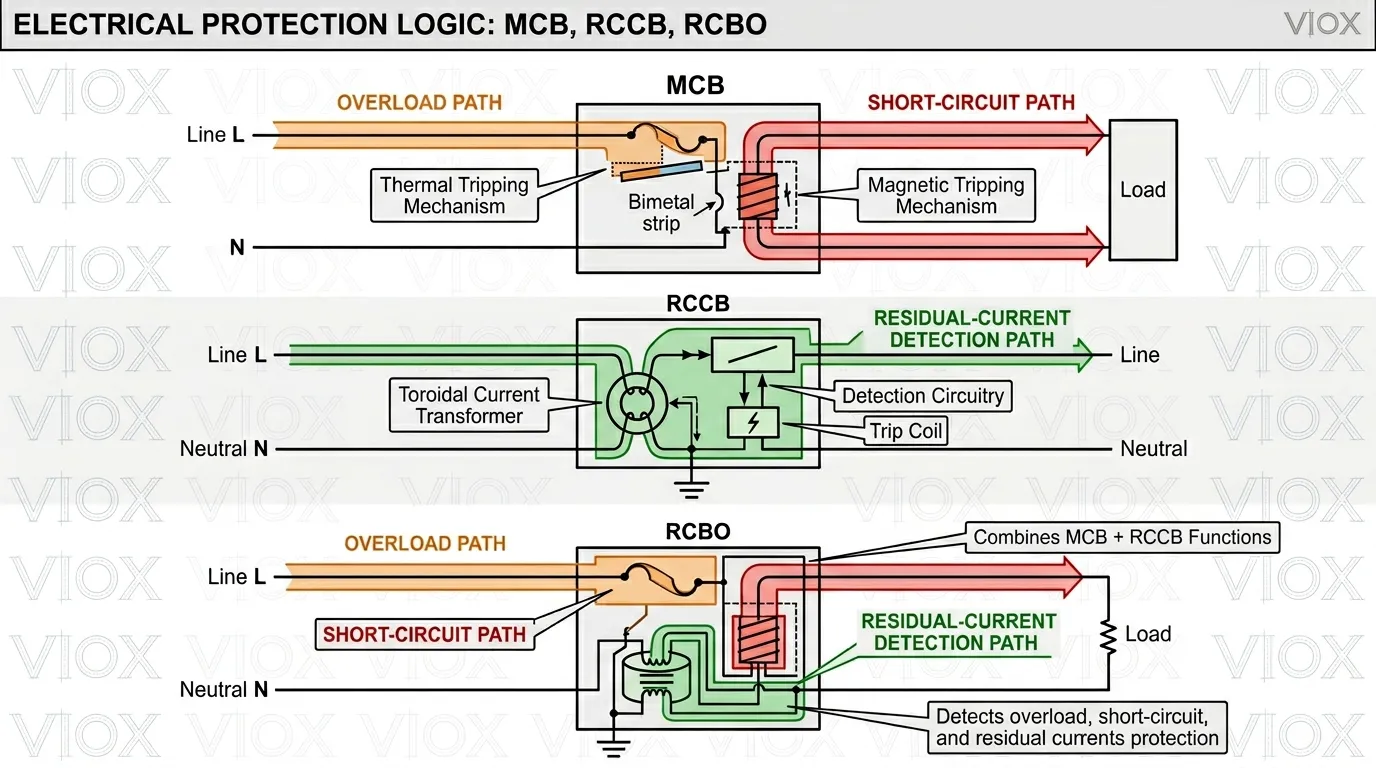
MCB stands for Miniature Circuit Breaker.
It is mainly used to protect circuits against:
- overload
- short circuit
MCBs are common in residential distribution boards, final circuits, and lighter commercial applications. They are compact, widely available, and commonly selected by current rating, trip curve, breaking capacity, and pole configuration.
If you want the deeper definition page, see MCB Full Form in Electrical.
MCCB
MCCB stands for Molded Case Circuit Breaker.
An MCCB performs the same core protection role as an MCB, but it is generally used where higher current levels, larger fault levels, or more adjustable protection settings are required.
Typical reasons to use an MCCB instead of an MCB include:
- larger feeder circuits
- industrial panels
- motor or distribution applications with higher fault energy
- need for adjustable trip settings in some designs
For a dedicated definition article, see MCCB Full Form Molded Case Circuit Breaker.
RCB
RCB usually refers to Residual Current Breaker, but this term is less precise than RCCB or RCBO.
In practice, RCB is often used loosely in conversations, older documents, or mixed catalogs. That is why it can create confusion. Some people use it as a generic label for residual-current protection devices, while others use more specific names such as RCCB or RCBO.
So if the question is technical, it is better not to stop at RCB. Confirm whether the device in question is:
- an
RCCB - an
RCBO - or a broader
RCDcategory reference
RCD
RCD stands for Residual Current Device.
This is usually the broader category term. It describes devices that monitor imbalance between live and neutral currents and trip when residual current exceeds the device threshold.
That means RCCB and RCBO can both sit within the wider residual-current protection discussion, but they are not identical devices.
RCCB
RCCB stands for Residual Current Circuit Breaker.
Its job is to detect residual current or earth-leakage conditions and disconnect the circuit. However, an RCCB does not provide overload and short-circuit protection by itself.
That is one of the most important differences on this page.
RCBO
RCBO stands for Residual Current Breaker with Overcurrent Protection.
An RCBO combines:
- residual-current protection
- overload protection
- short-circuit protection
in one device body.
That makes it especially useful where designers want circuit-level combined protection without pairing a separate RCCB and MCB for the same final circuit.
For more RCBO-focused reading, VIOX also has How to Select the Right RCBO and RCBO vs RCCB MCB Comparison Space Cost Selectivity.
MCB vs MCCB
The difference between MCB and MCCB is not that one protects and the other does not. Both are used for overcurrent protection. The real difference is application range and capability.
MCB is usually better suited for:
- final circuits
- branch protection
- lighter current applications
- residential and light commercial boards
MCCB is usually better suited for:
- feeders
- larger distribution boards
- higher current applications
- installations that may require wider setting flexibility
MCB vs MCCB Table
| Factor | MCB | MCCB |
|---|---|---|
| Typical role | Final circuit protection | Feeder and larger circuit protection |
| Current range tendency | Lower | Higher |
| Setting adjustability | Usually limited | Often broader |
| Common environment | Residential and light commercial | Commercial and industrial |
| Physical size | More compact | Larger and heavier-duty |
For a deeper article focused only on this pair, see MCCB vs MCB.
RCB vs RCD vs RCCB
This group creates the most confusion because the names sound similar, but they are not always used at the same level of specificity.
The simplest way to understand them
RCDis usually the broad category termRCCBis a specific device typeRCBis often a loose or less precise label
That means when someone asks about RCD vs RCCB, the answer is often not a direct “better or worse” comparison. It is more a question of category vs specific device name.
Practical interpretation
If a specification, panel schedule, or product catalog says RCD, you should check:
- whether it means a general residual-current protection function
- whether the intended device is actually an
RCCB - whether the project really needs an
RCBOinstead
This is where poor terminology causes procurement mistakes.

Why RCBO Is Different
An RCBO matters because it bridges the two protection families discussed above.
An MCB protects against overcurrent.
An RCCB protects against residual current.
An RCBO combines both.
RCBO vs RCCB
If you compare RCBO and RCCB, the key difference is simple:
RCCBneeds separate overcurrent protection elsewhere in the system designRCBOalready includes overcurrent protection
That can affect:
- panel space
- circuit selectivity strategy
- cost structure
- fault isolation at the circuit level
For the deeper version of this comparison, use RCBO vs RCCB MCB Comparison Space Cost Selectivity.
RCBO vs MCB
If you compare RCBO and MCB, the difference is also straightforward:
MCB= overload and short circuit onlyRCBO= overload, short circuit, and residual current
That does not automatically mean RCBO is always the right answer. It means the protection function is broader, and the application should decide the choice.
How To Choose the Right Device
If the reader is no longer just comparing names, the next question is usually selection.
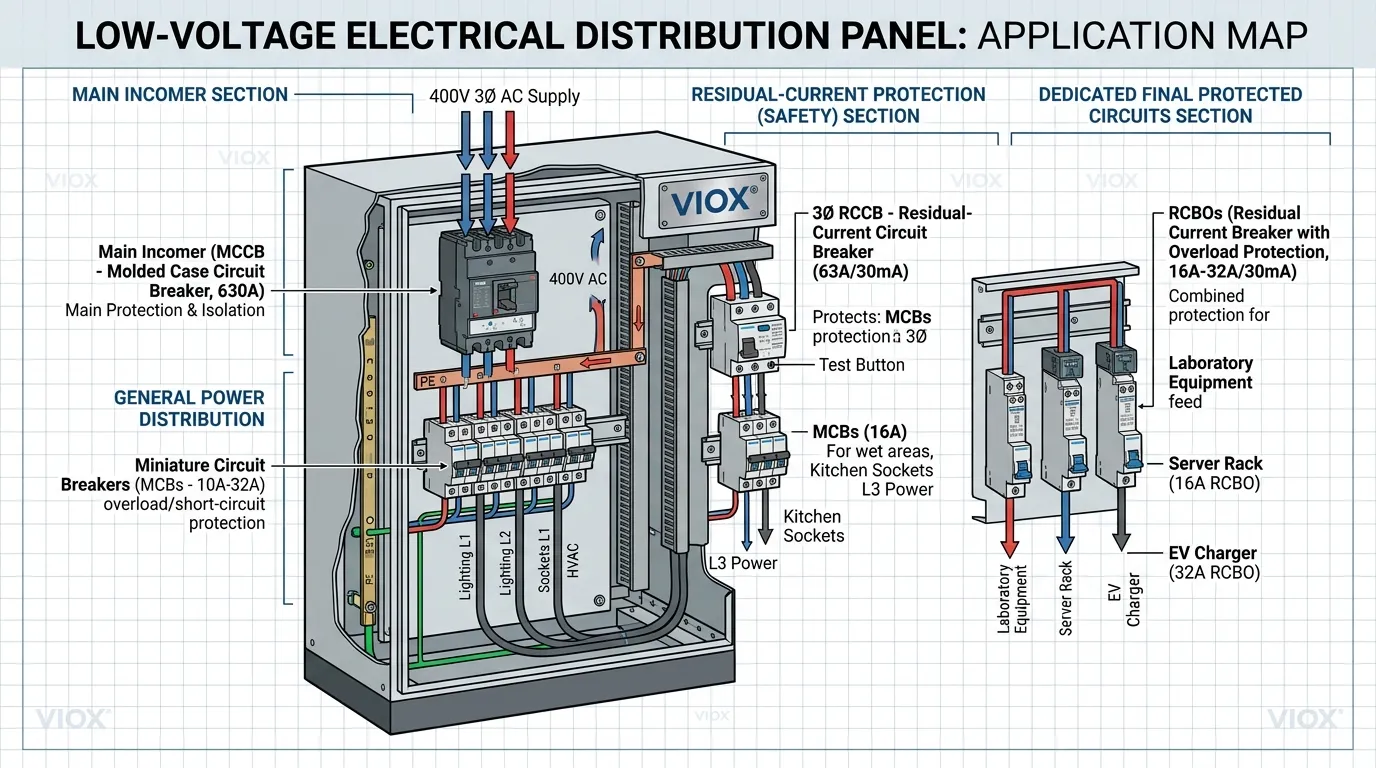
Selection Table
| Situation | Usually start by considering | Why |
|---|---|---|
| Standard final circuit overcurrent protection | MCB | Compact and suitable for many branch circuits |
| Higher-current feeder or industrial distribution | MCCB | Better suited to higher-capacity applications |
| Leakage protection with separate overcurrent device | RCCB | Residual-current protection role |
| Combined leakage and overcurrent protection on one circuit | RCBO | Brings multiple protection functions into one device |
| Residual-current terminology in a broad sense | RCD | Category term, not always the final device choice |
Questions to ask before choosing
- Is the main need overcurrent protection, residual-current protection, or both?
- Is this a final circuit or a larger feeder circuit?
- What is the expected fault level?
- Is panel space limited?
- Does the design require circuit-level isolation instead of grouping many circuits under one residual-current device?
- What do local rules, project specifications, and manufacturer instructions require?
Common Mistakes to Avoid
These are the mistakes that cause the most confusion in real projects:
1. Treating RCD, RCCB, and RCB as fully interchangeable
They are closely related terms, but not always exact substitutes. Category language and device naming should be checked carefully.
2. Assuming RCCB provides overcurrent protection
It does not. An RCCB focuses on residual-current protection and must be used within the correct protection architecture.
3. Choosing MCB when combined protection is needed
If the circuit needs both residual-current and overcurrent protection in one device, an MCB alone is not enough.
4. Using RCBO as a blanket default without checking application fit
An RCBO is powerful, but selection still depends on circuit design, rating, residual-current sensitivity, breaking capacity, and coordination.
5. Ignoring the difference between MCB and MCCB current/application range
These devices overlap in concept, but not always in the same application window.
Related
- MCB Full Form in Electrical
- MCCB Full Form Molded Case Circuit Breaker
- RCCB Full Form Understanding Residual Current Circuit Breakers
- MCCB vs MCB
- RCBO vs RCCB MCB Comparison Space Cost Selectivity
- RCBO vs AFDD Difference Guide
- How to Select the Right RCBO
- How to Select an MCCB for a Panel
FAQ
What is the main difference between MCB and MCCB?
Both protect against overload and short circuit, but MCCBs are generally used for larger and higher-capacity applications, while MCBs are commonly used for final circuits and lighter distribution.
What is the difference between RCD and RCCB?
RCD is usually the broader category term, while RCCB refers to a more specific residual-current circuit breaker device.
Is RCB the same as RCCB?
Not always. RCB is often used as a loose or simplified term, while RCCB is a more precise device name.
What is the difference between RCCB and RCBO?
An RCCB provides residual-current protection only, while an RCBO combines residual-current protection with overload and short-circuit protection.
Is RCBO better than MCB?
Not in every application. An RCBO provides broader protection than an MCB, but the correct choice depends on the protection objective, circuit design, and installation requirements.